
AI Instinct: The Human Framework for Working with AI
Four instincts that make AI partnership as natural as breathing. From effort to instinct.
Table of contents
- Why AI Matters. For You. Right Now.
- What Is AI Instinct?
- The Four Instincts
- How the Four Instincts Work Together
- The Journey: From Awareness to Instinct
- Why This Matters Now
- What AI Instinct Is Not
- Getting Started: One Instinct at a Time
- The Invitation
Why AI Matters. For You. Right Now.
The world is changing. Not in the slow, generational way that lets you figure things out over time. It is changing right now, in real time, in ways that touch every profession, every household, and every person who wants to stay relevant, competitive, and empowered.
Over 1.2 billion people already use generative AI. That number was nearly zero three years ago. AI skills now command a 56% wage premium in the job market. 70% of job skills are projected to change by 2030. This is not a trend reserved for Silicon Valley engineers or Fortune 500 executives. This is reshaping how nurses document patient care, how contractors estimate jobs, how teachers plan lessons, how parents research schools, and how job seekers stand out in a crowded market.
And here is the part that matters most: this is not coming. It is already here. 40% of workers already use AI at work. Many of them are doing it quietly, without telling their managers, because they discovered that AI saves them hours every week and they are not waiting for permission. The question is no longer whether AI will affect your life. It already has. The question is whether you will be the one shaping how it shows up, or whether you will be shaped by it.
This Is About Empowerment, Not Replacement
Let us be direct. AI is not here to replace you. The research is overwhelming on this point. Organizations that invest in human-AI collaboration see 38% higher revenue growth and 10% workforce expansion. The World Economic Forum projects a net gain of 78 million jobs by 2030. The people who thrive will not be the ones who ignore AI, and they will not be the ones who surrender their judgment to it. They will be the people who learn to partner with it.
Think about it the way you think about any other capability that changed the world. When calculators arrived, mathematicians did not become obsolete. They became more powerful. When GPS became ubiquitous, navigators did not disappear. They focused on the decisions that technology could not make for them. AI is the same, but bigger. It is a capability amplifier for every person in every role.
The Cost of Choosing Not to Learn
Here is where we need to be honest. Choosing not to engage with AI is a choice. And unlike most technology waves, this one moves fast enough that waiting has real consequences. Not understanding AI does not protect you from it. It just means someone else (your competitor, your colleague, your kid’s classmate) is building the advantage you are leaving on the table.
This is not about fear. This is about a growth mindset. The same mindset that tells you to learn a new skill, to stay curious, to invest in yourself. You owe it to yourself, your family, your career, and your future to understand what AI can do, what it cannot do, and how to make smart decisions about when and where to use it.
Research consistently shows that growth mindset is the single strongest predictor of AI adoption success. Not technical ability. Not age. Not job title. The people who approach AI with curiosity, who give themselves permission to experiment, who are willing to feel uncomfortable for a little while, are the ones who unlock the most value. Every single time.
You Probably Already Started
Here is the good news. If you have ever asked a chatbot a question, let AI suggest a reply in your email, used a smart assistant to set a reminder, or let your phone auto-complete a sentence, you have already started. You did not think of it as “using AI.” You just did it. That is the seed of what this framework is about. The goal is not to turn you into a technologist. The goal is to help you recognize the AI partnership behaviors you are already developing and give you a path to sharpen them intentionally. So they become second nature. So they become instinct.
What Is AI Instinct?
Think about the first time you drove a car. You gripped the wheel with both hands. You checked every mirror deliberately. You consciously thought about the gas pedal, the brake, the turn signal. Every single action required your full attention.
Now think about how you drive today. You merge onto the highway while adjusting the radio, processing a conversation, and planning your evening. You do not think about driving. You just drive. The skills have not changed, but they have moved from deliberate effort to automatic behavior. From something you do to something you are.
That shift, from conscious effort to unconscious competence, is what happens with AI. And it is already happening to millions of people right now, whether they realize it or not.
The parent who opens ChatGPT before opening the fridge to figure out what to make for dinner. The small business owner who drafts every client email with AI and then edits it in her own voice. The college student who starts every research paper by exploring ideas with an AI partner. The mechanic who photographs an engine code and asks AI to help diagnose it. None of these people think of themselves as “AI users.” They are just people who found a better way to get things done, and now they cannot imagine going back.
AI Instinct is the name for what they have developed. It is the point where working with AI stops being a separate activity and starts being woven into how you think, create, and solve problems. It is not a technology skill. It is a behavioral shift. A set of instincts that, once developed, change the way you approach everything.
Why “Instinct” and Not “Skill”?
Language matters. When we call something a “skill,” it sounds like a class you take, a line on your resume, a box you check. Skills are conscious. You schedule time to learn them, practice them deliberately, and perform them with effort.
Instincts are different. An instinct is something you do without deciding to do it. A parent instinctively reaches for a child near a hot stove. A seasoned driver instinctively checks their blind spot. A good listener instinctively reads the room before speaking.
The goal of AI adoption is not to add a skill to your list. It is to develop instincts that change your default behavior, so that partnering with AI becomes something you do automatically, in the same way you automatically reach for your phone to look something up instead of walking to a library.
Here is the core idea: There are four distinct instincts that make up AI Instinct. Most people start developing one or two naturally. The framework helps you recognize all four and build them intentionally.
What About Authenticity?
Some people worry that leaning into AI means losing something real. Losing your own voice. Becoming dependent on a machine for thinking you used to do yourself. Letting the quality of human thought decay because a shortcut was available. That concern is valid, and dismissing it would be dishonest.
But here is what the evidence actually shows: people with the strongest AI instincts are also the best at knowing when AI is wrong, when to push back, and when something needs a purely human touch. They are not less discerning. They are more discerning. Because partnering with AI forces you to articulate what “good” looks like. It forces you to evaluate outputs critically. It forces you to decide, over and over, what your own judgment adds that AI cannot replicate. That is not a loss of critical thinking. That is a workout for critical thinking.
The real threat to authenticity is not AI partnership. It is blind, uncritical acceptance of whatever AI produces. People who copy and paste without reading. People who let AI make decisions they do not understand. People who stop thinking because a machine can think for them. AI Instinct is the opposite of that. Good instinct means knowing when NOT to use AI. It means recognizing the moments that demand your full, unassisted human judgment. A difficult conversation with a colleague. A creative vision only you can see. A gut feeling that the data does not support but your experience says is right. AI Instinct sharpens those moments. It does not replace them.
The people who will struggle are not the ones who partner with AI. They are the ones who either reject it entirely or accept it blindly. AI Instinct is the middle path: engaged, intentional, and always human-led.
The Four Instincts
1. AI Spine: Organize your world so AI can help
Before you can have a great conversation with anyone, whether a coworker, a doctor, or a financial advisor, you need to be organized enough to explain what you need. The same is true with AI. The people who get the most from AI are not necessarily the ones who write the best prompts. They are the ones whose information, documents, notes, and thinking are structured in ways that make AI partnership effortless. AI Spine is the instinct to create things (notes, files, plans, data, even the way you organize your thoughts) in a way that works for both you and AI. It is the backbone that makes everything else possible.
What this looks like in real life:
-
A project manager runs her weekly team meeting with contractors and stakeholders. The meeting is recorded, so AI captures the transcript automatically. She focuses on the human dynamics, the unspoken tensions, the hallway conversation. After the meeting, she drops her rough shorthand notes into AI alongside the transcript and asks it to merge everything, identify dependencies, flag risks, and draft updates for each stakeholder group. Neither the transcript nor her sketches alone could produce that result.
-
A landscaper structures his job estimates with clear sections for scope, materials, timeline, and exclusions. Not because he read a guide on “AI-optimized documents” but because the last time he dropped an estimate into AI to check pricing against material costs, the cleaner format made the analysis significantly more useful. Now that is just how he writes estimates.
-
An electrician keeps a running digital log of every job, panel type, and code issue he encounters. When he hits an unfamiliar configuration on a job site, he shares the log context with AI and gets relevant code requirements in seconds instead of flipping through manuals.
The question that builds this instinct: “If I handed this to my AI partner right now, could it understand what I need, or would I have to explain a bunch of context first?”
The more often your answer is “it could just work with this,” the stronger your AI Spine.
2. AI Voice: Talk to AI like a trusted collaborator
Everyone remembers their first interaction with AI. Most people type something vague, like “help me with my resume” or “write me an email,” and get back something generic. Some people stop there, concluding AI is not that useful. But others start learning something crucial: how you talk to AI matters enormously. AI Voice is the instinct for communicating with AI effectively. It is not about memorizing formulas or learning technical tricks. It is about developing a natural sense of what AI needs from you to do its best work. The same way you develop a sense for how to explain things to different people in your life. You talk to your kid differently than your boss. You explain things to a new hire differently than a veteran colleague. AI Voice is learning how to talk to AI in the way that brings out the best in it.
What this looks like in real life:
-
A freelance designer does not type “make me a logo.” She says: “I am designing a logo for a children’s bookstore in Portland. The vibe is warm, whimsical, hand-drawn. Think Roald Dahl meets a cozy reading nook. The owner wants it to feel inviting to kids ages 4 to 10 and their parents. Avoid anything corporate or cold.” That is not a technical skill. That is someone who has developed the instinct to give AI what it needs.
-
A nonprofit director says: “I am applying for a $50,000 community health grant. Our program serves 400 uninsured adults in rural Appalachia through mobile health clinics. The funder cares about health equity, measurable outcomes, and sustainability. Here is last year’s application and their feedback. Help me strengthen the impact section.” Not “help me write a grant.”
-
An auto shop owner describes the symptoms: “2019 Honda Civic, intermittent stalling at idle, no check engine light, recently replaced battery,” and gets a prioritized diagnostic checklist in seconds. Then she applies her twenty years of experience to zero in on the real issue. Context in, value out.
The question that builds this instinct: “Am I giving my AI partner what it needs to do its best work, or am I making it guess?”
The more specific, contextual, and clear your communication becomes, without having to think hard about it, the stronger your AI Voice.
3. AI Gravity: Start with AI, not as an afterthought
This is the instinct that marks the biggest behavioral shift. It is also the one most people can feel happening to them. There is a moment, and almost everyone who uses AI regularly can pinpoint it, where your default changes. Before that moment, you do your work and occasionally think, “Maybe I should try AI for this.” After that moment, you start with AI and occasionally think, “I should probably do this part myself.” That flip is AI Gravity. It is the pull that reorients your default behavior so that AI partnership is where you begin, not where you end up when you are stuck.
What this looks like in real life:
-
A real estate agent does not write a property description and then ask AI to polish it. She starts by telling AI about the property, the neighborhood, the target buyer, and the market conditions, then shapes the output with her local expertise and personal voice. The starting point shifted.
-
A college student does not stare at a blank page trying to find a thesis. He starts a conversation with AI about the topic, explores different angles, pushes back on AI’s suggestions, and walks away with three strong directions to choose from. Then he writes the paper himself, with a clear vision. The starting point shifted.
-
A parent does not spend thirty minutes scrolling the internet for weekend activities. She tells AI about the kids’ ages, interests, the weather forecast, and their budget, and gets five tailored options in thirty seconds. Then she picks the one that sounds right and adjusts. The starting point shifted.
The question that builds this instinct: “Did I start with AI, or did I only think of it after I was already stuck?”
The more often AI is your starting point rather than your safety net, the stronger your AI Gravity.
4. AI Rhythm: Make AI partnership continuous, automatic, woven into everything
The first three instincts are about specific capabilities: how you organize, how you communicate, and where you begin. AI Rhythm is what happens when those capabilities fuse into something bigger: a sustained, ongoing partnership that runs through your entire day without stopping and starting. Think about how a musician relates to rhythm. Early on, they count beats consciously. They think about timing. They make deliberate decisions about when to play each note. But eventually, rhythm becomes something they feel. They do not count anymore. The music flows through them. AI Rhythm is that same evolution applied to how you work and live. It is the instinct where AI partnership stops being a series of individual interactions and becomes a continuous presence woven into your day.
What this looks like in real life:
-
A marketing consultant does not “use AI for content creation.” AI is part of every phase: researching the client’s industry, analyzing competitors, brainstorming angles, drafting copy, pressure-testing messaging, summarizing results. All in a continuous flow. AI is not a stop on the route. It is the road itself.
-
A college student does not use AI to “write papers.” She explores topics with AI to find what genuinely interests her, uses AI to challenge her own arguments before the professor does, asks AI to explain confusing concepts in different ways until one clicks, and reviews her draft with AI as a thought partner. It is not a single interaction. It is an ongoing conversation across her entire learning process.
-
A church pastor uses AI to research sermon topics, explore theological perspectives he has not considered, draft bulletin announcements, respond thoughtfully to congregants’ questions during the week, and plan community outreach events. Not as separate AI sessions, but as one continuous thread of partnership running through his entire ministry.
The question that builds this instinct: “Is AI woven into my rhythm, or am I breaking stride to use it?”
The more naturally AI flows through your day without interrupting it, the stronger your AI Rhythm.
How the Four Instincts Work Together
The four instincts are not a checklist you complete in order. They are interconnected capabilities that reinforce each other:
AI Spine creates the organized foundation that makes every AI interaction more effective. When your information is structured well, your conversations with AI produce better results with less effort.
AI Voice ensures your communication with AI consistently produces high-quality results. The better your voice, the more value you get from every interaction, which makes you want to interact more.
AI Gravity reorients your behavior so that AI partnership is your starting point. This means you are engaging with AI more often, which naturally strengthens your Voice and motivates you to keep your Spine sharp.
AI Rhythm is what emerges when the other three instincts mature and merge into a continuous, automatic way of working and living. It sustains and deepens everything, and when you are in rhythm, you naturally keep your Spine organized, your Voice clear, and your Gravity strong.
Together, they form a complete system: structure your world for partnership, communicate effectively when you engage, start with AI as your default, and let these capabilities fuse into a rhythm that runs through everything you do.
The Four Instincts at a Glance
| Instinct | What It Is | The Trigger Question |
|---|---|---|
| AI Spine | Organize your world so AI can help | Could my AI partner work with this, or would I need to explain everything first? |
| AI Voice | Talk to AI in ways that get great results | Am I giving AI what it needs, or making it guess? |
| AI Gravity | Start with AI, not as a last resort | Did I start with AI, or only think of it after I was stuck? |
| AI Rhythm | Continuous, automatic AI partnership woven into everything | Is AI part of my rhythm, or am I breaking stride to use it? |
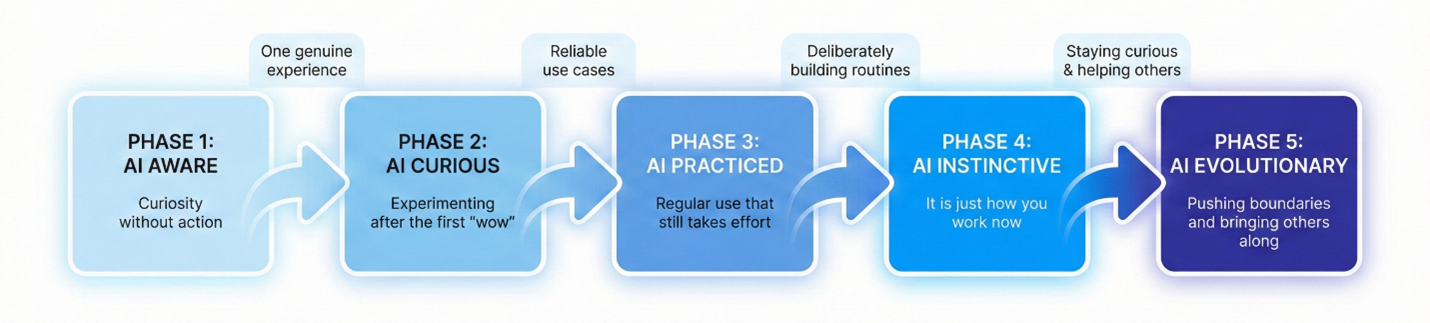
The Journey: From Awareness to Instinct
Developing AI Instinct follows a path that is remarkably similar across all kinds of people, whether you are a CEO, a student, a stay-at-home parent, or a plumber. Understanding where you are helps you see what comes next.
Phase 1: AI Aware (curiosity without action)
You know AI exists and is changing things, but you have not really engaged with it personally. You have seen the headlines. Maybe you have watched a colleague or family member use it. You might have tried it once and thought, “That is interesting,” then went back to your normal way of doing things. Most people in this phase are not resistant to AI. They just do not see why it matters to them, right now, in their life. Research shows that 63% of non-adopters simply “don’t see a need.” They are not anti-technology. They are waiting for a reason that feels personal.
What moves you forward: One genuine experience where AI saves you real time or effort on something you actually care about. Not a demo someone shows you. Not a news article. A moment where you try it, and it works. That is the spark.
Phase 2: AI Curious (experimenting after the first “wow”)
Something clicked. Maybe AI helped you draft a difficult email in thirty seconds. Maybe it explained your kid’s math homework in a way that finally made sense. Maybe it turned a rambling idea into a clear plan. Now you are trying it for other things. Some work great, some fall flat. You are developing a sense of what AI is good at and where it struggles.
What moves you forward: Finding two or three reliable use cases that deliver consistent value in your specific life or work. Not trying to use AI for everything. Just finding the handful of things where the difference is obvious and repeatable. Your personal “I’m never going back” moments.
Phase 3: AI Practiced (regular use that still takes effort)
You have built real habits. You know which tasks to bring to AI. You have gotten noticeably better at communicating what you need. People around you have probably started asking, “How did you do that so fast?” But it still feels like a tool you pick up and put down, not an extension of how you think. You sometimes forget to use AI for things it would clearly help with. This is where most regular AI users are today, and it is where many people get stuck. The gap between “practiced” and “instinctive” is the hardest to cross, because it requires a change in your default behavior, not just improvement in a skill.
What moves you forward: Deliberately building routines that include AI until you stop having to think about it. Start every project with an AI conversation. Review every important document with AI before sending it. Use AI for weekly planning every Sunday. The repetition is what makes it automatic, just like driving.
Phase 4: AI Instinctive (it is just how you work now)
This is the destination the framework is named for. Your four instincts are developed and working together. Your world is organized for AI partnership (Spine). You communicate with AI naturally and effectively (Voice). AI is your default starting point (Gravity). And it all flows through your day as a continuous, automatic rhythm (Rhythm). You have stopped thinking of yourself as “someone who uses AI.” It is just how you work and live now. You would notice the absence of AI the same way you would notice the absence of your phone, not because you are dependent, but because it has become part of how you operate.
What moves you forward: Staying curious as AI evolves. New capabilities emerge constantly, and instinctive users stay open to them rather than locking into habits. They also naturally start helping others. Teaching deepens your own instincts more than anything else.
Phase 5: AI Evolutionary (pushing boundaries and bringing others along)
Some people go beyond personal instinct to become catalysts for the people around them. They experiment at the edges of what AI can do. They discover new ways to use it, develop better approaches, and, most importantly, share what they learn. These are the parents who teach their kids to use AI thoughtfully. The managers who create safe spaces for their teams to experiment. The teachers reimagining how students learn. The small business owners showing their peers what is possible. They are not just adapted to AI. They are helping everyone around them adapt too.
What moves you forward: Generosity with what you know and honesty about what has not worked. The people in this phase accelerate everyone else’s journey, not by being experts, but by being open.
Why This Matters Now
There is a pattern that repeats with every major technological shift: a small group figures it out early, the majority waits, and by the time the majority moves, the early group has built advantages that are hard to close. This happened with the internet, smartphones, social media, and online shopping. Every time, the people who said “I’ll get to it eventually” found that “eventually” arrived faster than expected. AI is following this pattern, but faster than anything before it.
More than a billion people are using AI tools every month. Workers with AI skills earn a 56% wage premium over peers in the same roles without AI skills. Industries most exposed to AI have seen 4x productivity growth since 2022. Research consistently shows 10 to 55% productivity gains from AI-assisted work, with the biggest gains going to people newest to their roles. AI is not just making experts faster. It is an equalizer that helps everyone perform at a higher level.
But here is the most important number: only about 1% of organizations have reached what researchers call mature AI integration. The overwhelming majority, of people and organizations alike, are still in the early phases. The window to build these instincts ahead of the curve is wide open. It will not be open forever.
The encouraging reality: you do not need a class, a certification, or a technical background. People develop these instincts naturally through use. Every time you organize your notes a little more clearly, talk to AI a little more specifically, start a project with AI instead of staring at a blank page, or feel the rhythm of partnership flowing through your day, you are building AI Instinct.
This framework just gives you a name for what is already happening, and a map for where to go next.
What AI Instinct Is Not
It is not about replacing your judgment. People with the strongest AI instincts are also the best at knowing when AI is wrong, when to push back, and when something needs a purely human touch. Good instinct includes knowing when not to use AI.
It is not about being technical. You do not need to understand how AI works any more than you need to understand engines to be a great driver. AI Instinct is about behavior, not technology.
It is not about any one tool. ChatGPT, Claude, Gemini, Copilot: the tools will keep evolving. The instincts transfer across all of them. You are building a capability that outlasts any product.
It is not about doing everything faster. Speed is a side effect, not the goal. The real goal is spending your time and energy on what matters most: the thinking, the creativity, the relationships, the care, the decisions that only you can make. And letting AI handle the parts that drain you without using your gifts.
Getting Started: One Instinct at a Time
You do not need to work on all four instincts at once. Start where you will feel the difference fastest.
If you are brand new to AI, start with Voice. Pick one thing you do regularly (writing emails, researching a question, planning your week, helping with homework) and try doing it with AI. Just notice what happens when you give AI more context and specifics. Your voice develops naturally through practice.
If you use AI sometimes but inconsistently, focus on Gravity. For one week, try starting every task with AI instead of going to it only when stuck. Not everything will benefit, but you will discover things that completely transform when AI is your starting point. That discovery is what makes the shift stick.
If you use AI regularly but feel you are leaving value on the table, work on Spine. Look at how you keep your notes, files, and information. Are they organized for easy AI partnership? Or do you spend time reformatting and explaining every time? Small changes in organization create dramatic improvements in every interaction.
If you are already a confident AI user, pay attention to Rhythm. Is AI flowing through your day as a continuous, almost invisible partnership? Or is it still a series of separate sessions? The shift from individual interactions to an integrated rhythm is what separates practiced users from truly instinctive ones.
The Invitation
AI Instinct is not a certification. It is not a course you complete or a badge you earn. It is a way of working (and living) that develops through practice, curiosity, and a willingness to let your habits evolve.
You do not have to be technical. You do not have to be young. You do not have to work in tech. You do not have to be “good with computers.” You just have to be willing to try, to notice what works, and to keep going.
These instincts are already forming everywhere. In kitchens and classrooms. Repair shops and corner offices. Hospitals and home offices. Churches and city halls. Nonprofits stretching every dollar and startups chasing every opportunity. A parent figuring out the week. A mechanic diagnosing an engine. A student finding their direction. A retiree discovering new passions.
People are finding their AI Voice. Organizing their world for partnership with AI Spine. Reaching for AI first with AI Gravity. Finding their AI Rhythm.
All we are doing here is naming what is already happening. And once you can name it, you can build on it. Intentionally, confidently, and at your own pace.
AI Instinct. From effort to instinct.
Download: AI Instinct (PDF). The complete framework in a shareable format.
AI Instinct is a behavioral framework for everyone, regardless of role, industry, age, or technical background. These instincts belong to anyone willing to develop them.