Abstract
Agentic modeling aims to transform large language models (LLMs) into autonomous agents that
can solve complex tasks through planning, reasoning, tool use, and multi-turn interaction with
external environments. We present Orchard, an open-source framework for
scalable agentic modeling. At its core is Orchard Env, a thin,
Kubernetes-native environment service that provides reusable primitives for sandbox lifecycle
management, designed to operate across task domains, agent harnesses, and different training
stages. On top of Orchard Env, we build three agentic modeling recipes.
Orchard-SWE targets software-engineering agents: we introduce
credit-assignment SFT to learn from productive segments of unresolved trajectories, and for RL
go beyond sparse outcome rewards with a progression of signals — Balanced Adaptive Rollout
(BAR) for sample-efficient sparse-reward optimization, plus two denser rewards, on-policy
distillation (OPD) and rubric-based process reward (RPR). We further introduce historical
experience distillation, which compresses rollouts from past experiments into a small value
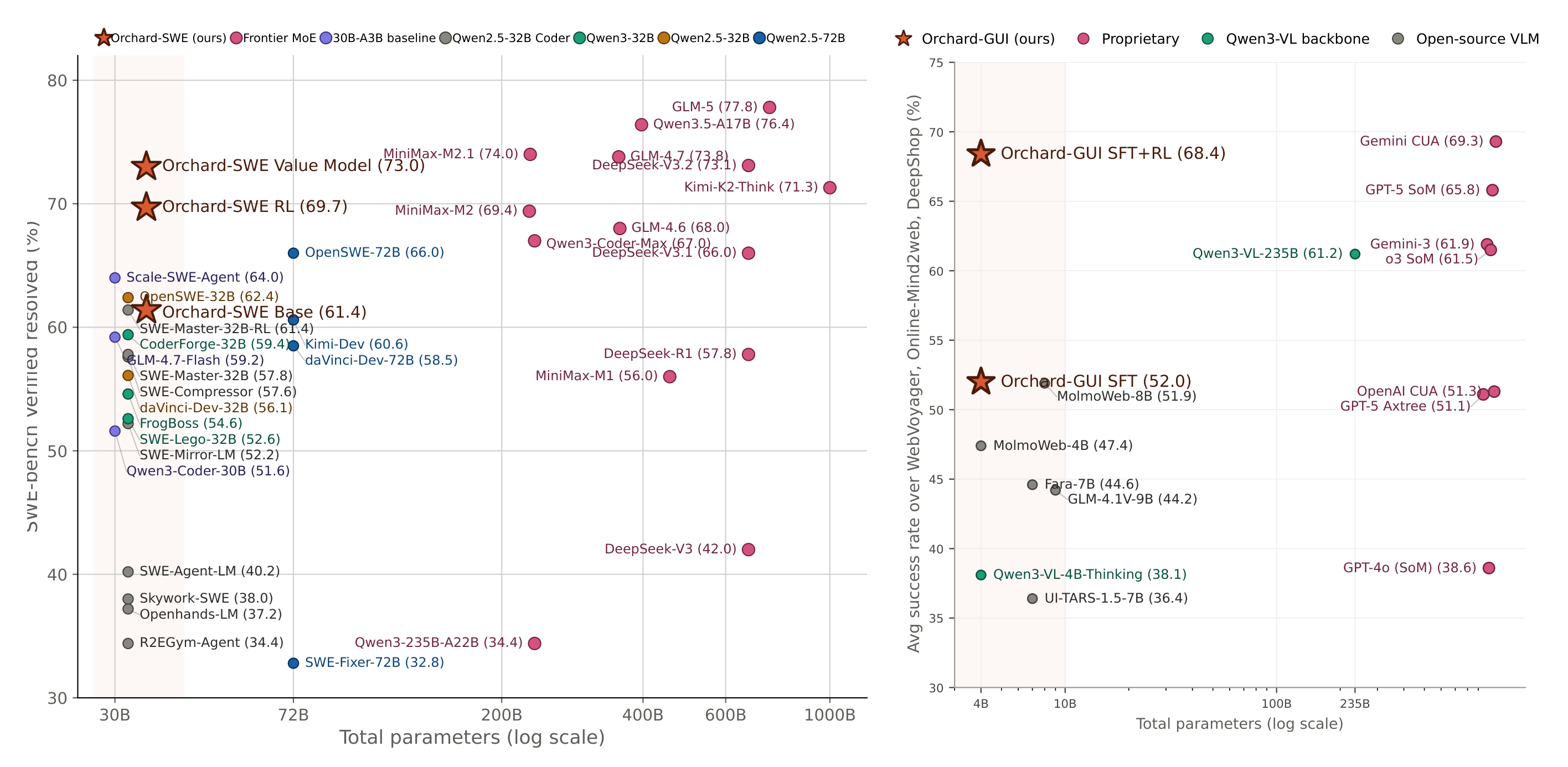
model that reranks candidates at inference time. On the Qwen3.5-35B-A3B backbone it reaches
69.7% with RPR-based RL and 73.0% with best-of-N value-model reranking, setting a new state of
the art among open-source methods while approaching frontier systems more than 10× larger.
Orchard-GUI trains a 4B vision-language computer-use agent using only 0.4K
distilled trajectories and 2.2K open-ended tasks, achieving 74.1%, 67.0%, and 64.0% success
rates on WebVoyager, Online-Mind2Web, and DeepShop, respectively (68.4% average) — the
strongest open-source model while remaining competitive with proprietary systems from OpenAI
and Google Gemini. Orchard-Claw targets personal assistant agents for
productivity workflows such as email, calendar, and daily tool use: trained with only 0.2K
synthetic tasks, it achieves 59.6% pass@3 on Claw-Eval and 73.9% when paired with a stronger
ZeroClaw harness. Collectively, these results show that a thin, open, harness-agnostic
environment layer enables the reuse of agentic data, training recipes, and evaluation
protocols across domains and harnesses.