How Test Generation Works
TL;DR: Accordant explores the state graph defined by your spec and inputs, then extracts paths through that graph as test cases. The algorithm is pluggable — you can use state coverage, transition coverage, random walks, or supply your own.
The Core Idea
You provide a spec (operations and their behavior), a set of operation inputs, and an initial state. Accordant builds a state graph by starting from the initial state and applying each input to see what states result. From each resulting state, it applies all inputs again, continuing until it has explored the reachable state space.
Each path through this state graph becomes a test case — a sequence of operation calls to execute against your real system.
Test generation is essentially walking this state graph. This isn't random — it's systematic exploration with multiple algorithm choices available to you. And importantly, all of this exploration happens entirely on the spec. No real system is running during this phase; the spec's Apply methods compute what should happen, allowing the framework to reason about thousands of sequences without executing anything.
The State Graph
Think of your system as a state machine. Nodes represent states — what the system "remembers" between operations. Edges represent transitions — operations that move from one state to another.
Starting from an initial state, Accordant applies each input and computes the resulting state(s) using your spec's Apply methods. It then recurses: from each new state, it applies all inputs again, building out the graph.
State fingerprinting ensures efficiency: if two different paths lead to the same state, they share the same node. No duplicate exploration.
Here's an actual state graph generated from the BankAccount sample:
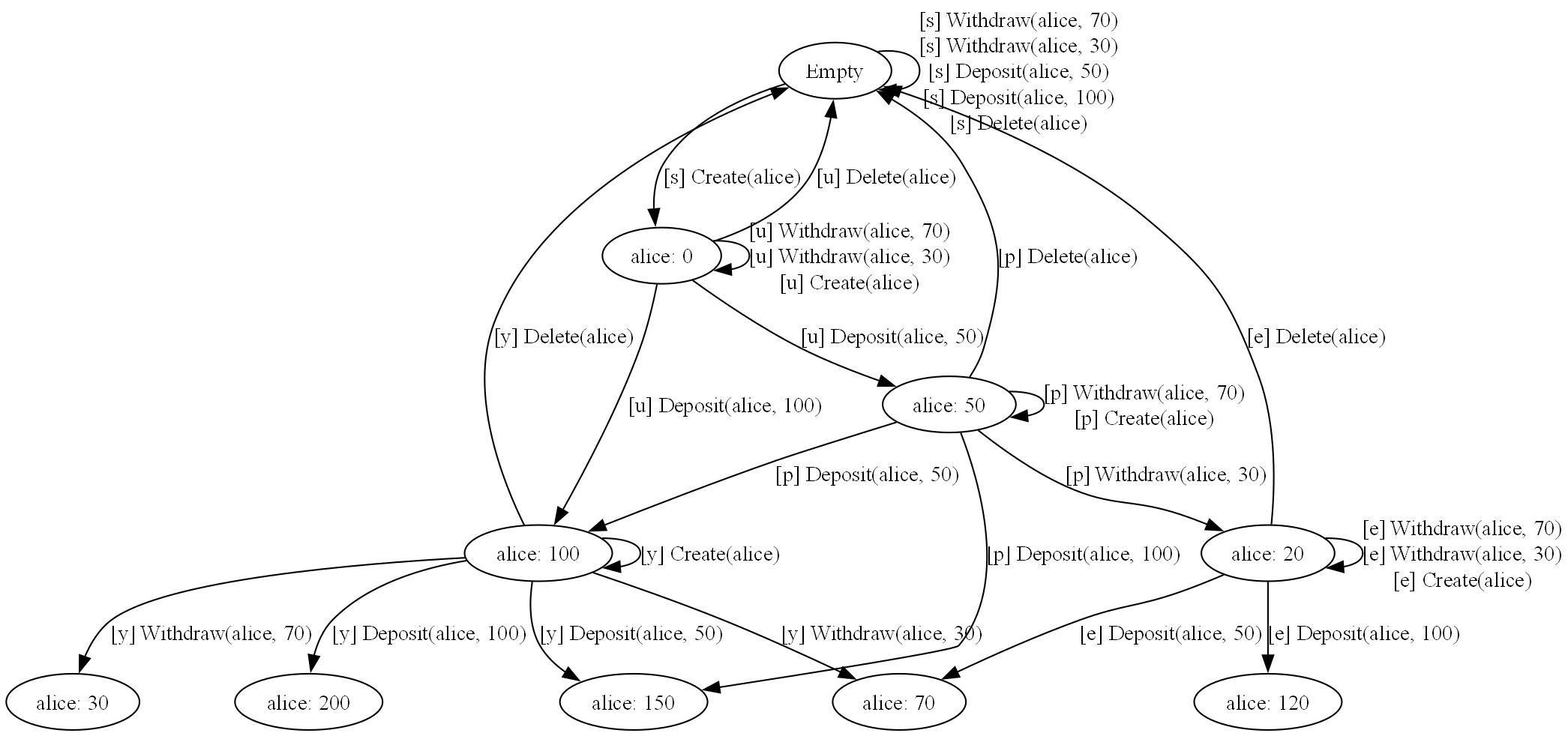
Each node is a state (the set of accounts and balances), and each edge is an operation that transitions to a new state. Self-loop edges represent operations that don't change the state (e.g., withdrawing from a nonexistent account). Paths through this graph become test cases.
From Graph to Test Cases
Once the graph is built, the framework walks it to extract test cases. Each path through the graph becomes a sequence of operation calls — a test case.
Different walk policies are available:
- State coverage visits each unique state at least once
- Transition coverage covers all edges in the graph (though this can produce huge numbers of cases!)
- Random walks sample paths probabilistically
Both success and failure paths are included. If an operation fails in a certain state (say, withdrawing more than the balance), that's a valid test case too — the spec defines what should happen in that scenario.
Pluggable Algorithms
How paths are extracted from the graph is controlled by a pluggable algorithm. You set this via TestGenerationOptions.SequentialTestCaseAlgorithm.
StateCoverage is the default. It covers each unique state in the graph.
var options = new TestGenerationOptions
{
    SequentialTestCaseAlgorithm = SequentialTestCaseAlgorithms.StateCoverage
};
CreateTransitionCoverage maximizes edge coverage. It generates test cases that exercise every possible transition (edge) in the graph. This can produce a large number of test cases — use with caution.
var options = new TestGenerationOptions
{
    SequentialTestCaseAlgorithm = SequentialTestCaseAlgorithms.CreateTransitionCoverage(maxSequenceLength: 4)
};
CreateRandomWalk performs probabilistic sampling. It's useful for large state spaces where exhaustive coverage is impractical. You can provide a seed for reproducibility.
var options = new TestGenerationOptions
{
    SequentialTestCaseAlgorithm = SequentialTestCaseAlgorithms.CreateRandomWalk(
        numberOfWalks: 200,
        maxWalkLength: 8,
        seed: 42)
};
You can also implement your own algorithm by matching the SequentialTestCaseAlgorithm delegate signature. The rootNode gives you access to the full state graph — walk it however you like.
Controlling the Explosion
A state graph can grow exponentially. Every operation applied at every state multiplies the possibilities. Without constraints, you might generate thousands or millions of test cases.
Several options help control this:
MaxDepth limits how deep the exploration goes. The default is 5 — a safeguard against unbounded exploration. When exploring a node, if the current depth exceeds MaxDepth, exploration stops at that node (no further transitions are followed from it). If your state space is unbounded (like a counter that can increment forever), unlimited depth would never terminate.
var options = new TestGenerationOptions
{
    MaxDepth = 5  // Don't explore beyond depth 5
};
StateConstraint prunes states during exploration. When a state is reached, if StateConstraint returns false for that state, the framework does not explore further from that state — no transitions are followed from it. This lets you focus exploration on interesting regions of the state space:
var options = new TestGenerationOptions
{
    StateConstraint = state =>
    {
        var s = (BankState)state;
        return s.Accounts.Count <= 2 && s.Accounts.Values.All(b => b <= 500);
    }
};
ShouldApply controls which operations apply in which states — skip operations that don't make sense in certain states.
MaxOperationApplicationCount limits how many times the same input can be reused in a single path.
Be mindful of test count. More isn't always better. If you're generating more test cases than you need, use these parameters to control the exploration.
Concurrent Test Cases
In addition to sequential test cases, Accordant can also generate concurrent test cases — scenarios where multiple operations execute simultaneously.
A concurrent test case consists of a sequential prefix that sets up a particular state, followed by N operations that execute concurrently from that state:
Sequential prefix: Create alice → Deposit 100
Concurrent operations: [Withdraw 30, Withdraw 50]  ← both execute at once!
This is how Accordant finds race conditions and concurrency bugs. The MaxConcurrencyLevel option controls how many operations can execute concurrently:
var options = new TestGenerationOptions
{
    MaxConcurrencyLevel = 3
};
For how we validate that concurrent results are correct, see Conformance Testing.
Step Functions and Async Behavior
Some operations trigger background work — a job queue processor, a polling loop, an async completion. These are modeled using step functions.
When an operation returns a step function, the framework explores the resulting non-deterministic transitions. For example, CreateJob might trigger background processing that can either succeed or fail. During modeling, the framework doesn't know which outcome will actually occur at runtime, so it explores both possibilities — generating test cases for each path.
Terminating step functions (those that eventually complete) are unwound by default — the framework keeps applying them until they reach their terminal state. This ensures test cases represent complete scenarios (job created → job completed) rather than partial states. You can control this with ShouldUnwindStepFunction.
For details on modeling async behavior, see Step Functions and Async Operations.
Beyond Auto-Generation
The algorithms described here are one approach to generating test cases, but they're not the only option.
You can write test cases by hand and still use the model for conformance checking. More on that in the Conformance Testing section.
You can also implement entirely different algorithms. Test case generation is a rich research area in itself. You might explore coverage-guided approaches, AI-inspired algorithms, heuristic-based exploration, or something else entirely.
The key insight is this: once you have a spec acting as an oracle, test generation becomes an algorithmic problem. Whatever approach you use to come up with interesting sequences of operations — whether it's the built-in algorithms, hand-crafted scenarios, or some novel technique — you have an oracle that can validate whether the system's response is correct. The algorithms can be creative and innovative in generating sequences; the spec checks conformance. This separation is what makes the approach powerful.
What Happens During Execution
Test generation builds the test cases by reasoning about the spec. Test execution runs those cases against your real system.
These are separate phases. During execution, for each test case:
- Start from the initial state
- For each operation in the sequence: execute against the real system, validate the response against the spec, update the tracked state
- Record success or failure
- Reset to the initial state before the next test case
This separation — generate from spec, execute against reality — is what makes the approach powerful. You can generate thousands of scenarios quickly, then run them against the actual implementation.
For details on how validation and execution work, see Conformance Testing.
Summary
| Concept | Description |
|---|---|
| State graph | All reachable states and transitions from the initial state |
| Test case | A path through the state graph |
| StateCoverage | Default algorithm — visits each state once |
| CreateTransitionCoverage | Maximizes edge coverage — can generate many cases |
| CreateRandomWalk | Samples paths probabilistically — good for large spaces |
| Concurrent tests | Multiple operations firing simultaneously |
| StateConstraint | Prunes uninteresting states |
| MaxDepth | Limits sequence length (default: 5) |
Next Steps
- Step Functions and Async Operations — modeling background work
- Conformance Testing — how test execution validates against the spec