Deployment Overview
Git Flow
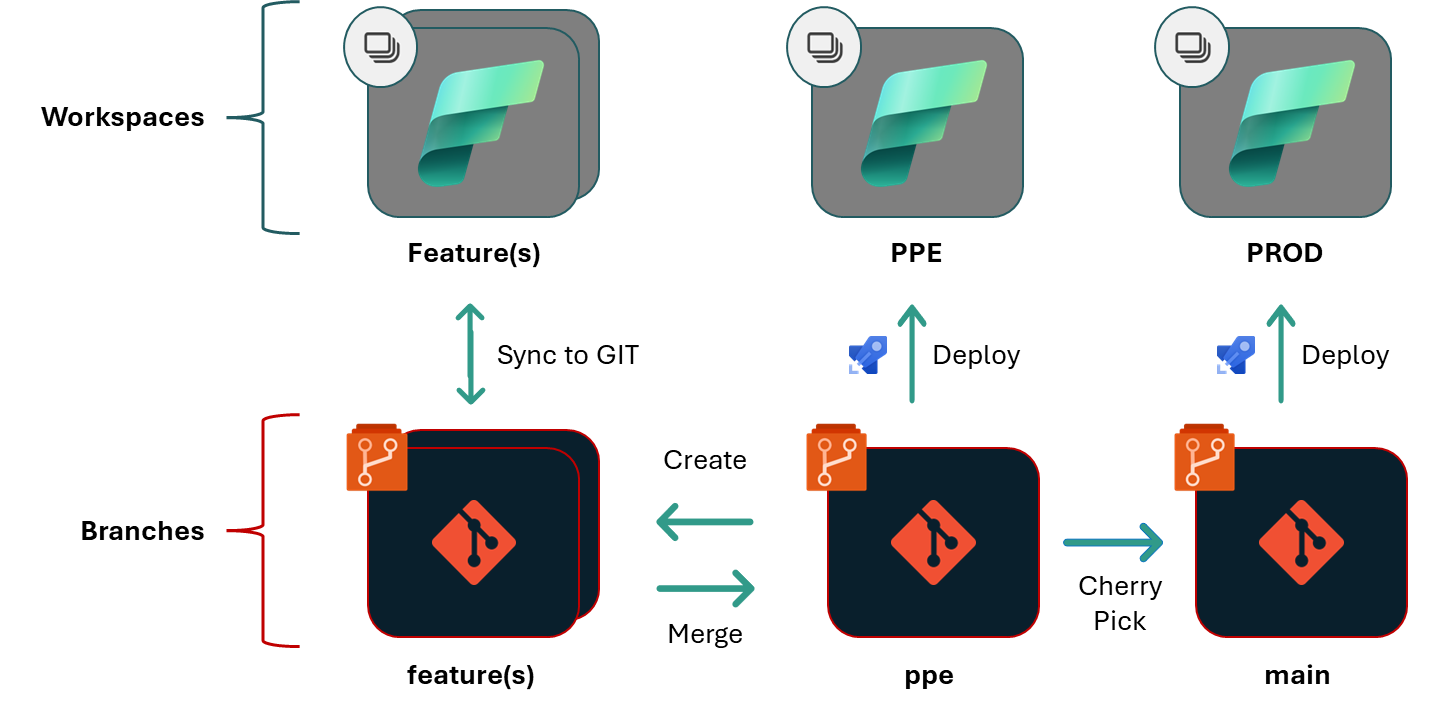
The flow pictured below is the hero scenario for this library and is the recommendation if you're just starting out.
Deployedbranches are not connected to workspaces via Git SyncFeaturebranches are connected to workspaces via Git SyncDeployedworkspaces are only updated through script-based deployments, such as through the fabric-cicd libraryFeaturebranches are created from the default branch, merged back into the defaultDeployedbranch, and cherry-picked into the upperDeployedbranches
Deployment Philosophy
fabric-cicd applies a full deployment on every run — it does not inspect commit history or compute diffs. This ensures the target workspace always reflects the repository and converges to the desired state regardless of what happened in previous runs, preventing environment drift.
Once items are committed to source control via Fabric Source Control, fabric-cicd reads the item definition files from the repository directory and passes the content as a payload to the Fabric REST APIs, which create or update the corresponding items in the target workspace. Every item defined in item_type_in_scope is created or updated on each run. Use unpublish_all_orphan_items() to remove workspace items that are no longer in the repository.
Note: While full deployment is the default and recommended approach, selective deployment and git-based change detection are available as experimental features. Selective deployment is not recommended due to the risk of broken deployments caused by unresolved item dependencies.