Controller Configuration
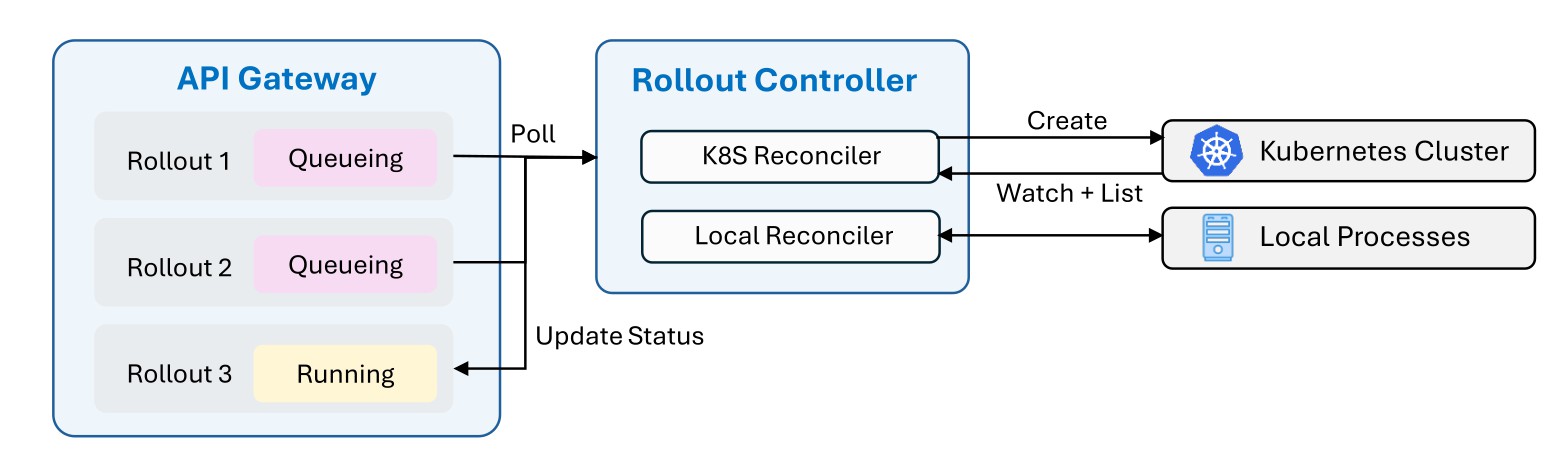
Start the Controller with agl-controller. It translates declarative rollouts into real agent executions, uses Hydra configuration, and loads its complete default configuration from agentlightning/config/controller.yaml:
runner_type: k8s

agl_server:
  url: http://localhost:8080
  agent_url: null
  key: ""

k8s_runner:
  namespace: default
  ttl_after_finished: 1200
  max_jobs_per_minute: 100
  poll_interval: 5

local_runner:
  maximum_size: 50
  poll_interval: 10
Override configuration
Override any setting with a Hydra command-line argument when starting the Controller. For example:
agl-controller \
  runner_type=local \
  agl_server.url=http://localhost:8080 \
  agl_server.key="$AGL_KEY" \
  local_runner.maximum_size=32
Runner type
The Controller supports one runner type at a time. Set runner_type to either k8s or local:
| Key | Default | Description |
|---|---|---|
runner_type |
k8s |
The single execution backend used by this Controller: k8s or local. |
One Controller instance cannot run both modes simultaneously.
In k8s mode, every rollout runs as a Kubernetes Job. The Controller uses the default Kubernetes configuration at ~/.kube/config on its machine to access the cluster. In local mode, every rollout runs as a local subprocess on the Controller machine, with multiple rollouts managed through a local process pool.
Connect to the API Gateway
The Controller configuration contains two API Gateway URLs for two different network paths:
| Key | Default | Description |
|---|---|---|
agl_server.url |
http://localhost:8080 |
API Gateway URL used by the Controller itself. |
agl_server.agent_url |
null |
API Gateway URL used by the Agent. When null, it falls back to agl_server.url. |
agl_server.key |
"" |
Bearer key used by the Controller and agents. |
agl_server.url must be reachable from the Controller process. agl_server.agent_url must be reachable from the Agent process or pod because it is used to build the Gateway proxy and event URLs injected into that Agent.
In most cases, agl_server.agent_url does not need to be set separately. Leave it as null, and Agents automatically use agl_server.url to access the API Gateway.
Set agl_server.agent_url only when Agents cannot reach the API Gateway through agl_server.url, usually because the Controller and Agents are in different networks. For example, when using the Minikube Docker driver, the Controller runs locally while Agents run inside Minikube, so they do not share the same network. The Controller may use http://localhost:8080, while Agents inside Minikube need http://host.minikube.internal:8080 to access the same API Gateway.
K8s runner limits
The K8s runner provides settings that limit Job creation and clean up completed Jobs:
| Key | Default | Description |
|---|---|---|
k8s_runner.max_jobs_per_minute |
100 |
Maximum number of Kubernetes Jobs the Controller can create per minute. |
k8s_runner.ttl_after_finished |
1200 |
Number of seconds a completed Job is retained before Kubernetes removes it automatically. |
max_jobs_per_minute prevents the Controller from creating too many Jobs in a short period. ttl_after_finished prevents completed Jobs from accumulating and overloading the Kubernetes API server.
Local runner limits
The local runner limits concurrent processes and periodically synchronizes their state:
| Key | Default | Description |
|---|---|---|
local_runner.maximum_size |
50 |
Maximum number of Agent subprocesses managed concurrently on the Controller machine. |
local_runner.poll_interval |
10 |
Number of seconds between automatic synchronization checks for local process and rollout state. |
When the process pool reaches maximum_size, queued rollouts wait until capacity becomes available.
How agents are launched
In k8s mode, the Controller reads the Jinja Job template stored in each rollout. The template originates from agentlightning.k8s.job_template_path in the Trainer configuration. The Controller renders the template with the rollout's input, applies the Controller settings such as namespace, timeout, and cleanup TTL, and submits the resulting Kubernetes Job. It also injects rollout-specific AGL_OPENAI_BASE_URL, AGL_EVENT_URL, and AGL_KEY values into every container. See Trainer Configuration for the template configuration and Jinja examples, and agentlightning/controller/k8s_reconciler.py for the implementation.
In local mode, the Controller reads agent_class and env_map from the rollout. It imports the Agent class, starts it in a local subprocess, and uses env_map to replace environment-variable values with fields from the rollout's input. The same rollout-specific Gateway URL, event URL, and key are injected automatically.