ai-agents-for-beginners
(Click di image wey dey above to watch video of dis lesson)
AI Agentic Design Principles
Introduction
Many ways dey to think about building AI Agentic Systems. Because say ambiguity na feature and no be bug for Generative AI design, e dey sometimes hard for engineers to sabi where to start. We don create set of human-centric UX Design Principles to help developers build customer-centric agentic systems to solve their business needs. Dis design principles no be dey prescribe architecture but na starting point for teams wey dey define and build agent experiences.
Generally, agents suppose:
- Make human capacities bigger and better (brainstorming, problem-solving, automation, etc.)
- Fill knowledge gaps (make me sabi well well for knowledge domains, translation, etc.)
- Support and promote collaboration in di way we as individuals like to work wit others
- Make us better versions of ourselves (e.g., life coach/task master, helping us learn emotional regulation and mindfulness skills, build resilience, etc.)
Wetin Dis Lesson Go Cover
- Wetin be Agentic Design Principles
- Some guidelines to follow to fit implement these design principles
- Some examples of how to use the design principles
Learning Goals
After you finish dis lesson, you go fit:
- Explain wetin be Agentic Design Principles
- Explain guidelines to use Agentic Design Principles
- Understand how to build agent using Agentic Design Principles
The Agentic Design Principles
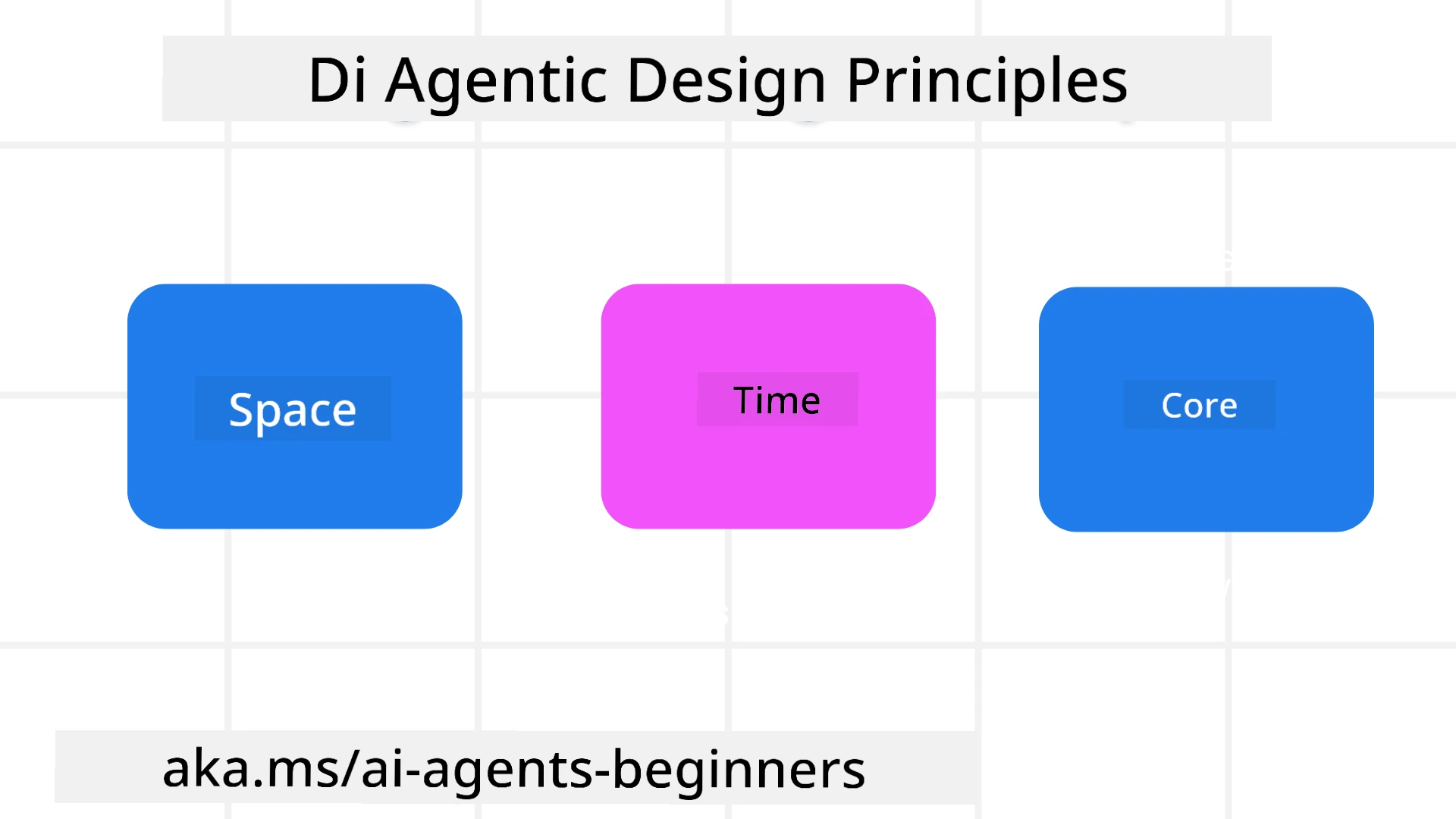
Agent (Space)
Na environment wey agent dey work. These principles dey guide how we design agents to dey engage for physical and digital worlds.
- Connecting, no be collapsing – help connect people to other people, events, and actionable knowledge to enable collaboration and connection.
- Agents dey help connect events, knowledge, and people.
- Agents dey bring people close together. Dem no be to replace or belittle people.
- Easily accessible but sometimes invisible – agent dey mostly operate for background and e go only show small when e necessary and appropriate.
- Agent easy to find and use for authorized users for any device or platform.
- Agent dey support multimodal inputs and outputs (sound, voice, text, etc.).
- Agent fit waka well between foreground and background; between proactive and reactive, depending on how e sense di user needs.
- Agent fit dey invisible form, but the background process path and collaboration with other Agents dey transparent to and fit be controlled by di user.
Agent (Time)
Dis na how the agent dey operate over time. These principles show how we design agents wey dem dey interact across past, present, and future.
- Past: Reflecting on history wey get both state and context.
- Agent go provide better results based on analysis of deep historical data pass only the event, people, or states.
- Agent dey create connections from past events and dey actively reflect on memory to fit engage with current situations.
- Now: Small reminder pass only notification.
- Agent get full approach for interacting with people. When event happen, the Agent no go just give static notification or formal talk. Agent fit simplify flow or dynamically generate cues to direct di user attention at di right time.
- Agent dey deliver information base on contextual environment, social and cultural changes and e go fit user intent.
- Agent interaction fit dey gradual, grow in complexity to empower users for long time.
- Future: Fit adapt and evolve.
- Agent dey adapt to various devices, platforms, and modalities.
- Agent dey adapt to user behavior, accessibility needs, and fit freely customizable.
- Agent dey shaped by and dey evolve through constant user interaction.
Agent (Core)
These na key elements for di core of agent design.
- Embrace uncertainty but make trust dey strong.
- Some level of Agent uncertainty dey expected. Uncertainty na key part of agent design.
- Trust and transparency na foundation layer for Agent design.
- Humans dey control when Agent dey on/off and Agent status dey clear for all time.
Guidelines to Implement These Principles
When you dey use these design principles, follow dis guidelines:
- Transparency: Tell di user say AI dey involved, how e dey work (including past actions), and how to give feedback and change di system.
- Control: Enable user to customize, specify preferences and personalize, and dey control the system and its attributes (including ability to forget).
- Consistency: Try make consistent, multi-modal experience across devices and endpoints. Use familiar UI/UX elements where possible (like microphone icon for voice interaction) and reduce customer cognitive load as much as possible (for example, make responses short, use visual aids, and ‘Learn More’ content).
How To Design Travel Agent using These Principles and Guidelines
Imagine say you dey design Travel Agent, na so you fit take think about using Design Principles and Guidelines:
- Transparency – Make user sabi say Travel Agent na AI-enabled Agent. Give some basic instructions how to start (like “Hello” message, sample prompts). Clearly put am for product page. Show list of prompts user don ask before. Make e clear how to give feedback (thumbs up or down, Send Feedback button, etc.). Say clearly if Agent get usage or topic restrictions.
- Control – Make e clear how user fit change Agent after e don create with things like System Prompt. Enable user to choose how verbose Agent go be, e writing style, and any things wey Agent no suppose talk about. Allow user to see and delete files or data, prompts, and past talks wey join Agent.
- Consistency – Make sure say icons for Share Prompt, add file or photo and tag person or thing dey standard and people fit recognize am. Use paperclip icon for file upload/share with Agent, and image icon for graphics upload.
Sample Codes
- Python: Agent Framework
- .NET: Agent Framework
You Get More Questions About AI Agentic Design Patterns?
Join Microsoft Foundry Discord to meet other learners, attend office hours and make you get your AI Agent questions answer.
Additional Resources
- Practices for Governing Agentic AI Systems | OpenAI
- The HAX Toolkit Project - Microsoft Research
- Responsible AI Toolbox
Previous Lesson
Next Lesson
Disclaimer: Dis document don translate wit AI translation service Co-op Translator. Even tho we dey try make am correct, abeg make you know say automated translation fit get errors or mistakes. Di original document for dia own language na im be di correct source. For important info, make person wey sabi human translation do am. We no go responsible for any misunderstanding or wrong understanding wey fit happen because of dis translation.