Configuring resources
To use the Azure AI Proxy, you need to configure the resources. This guide will walk you through the process of configuring the resources.
Managing resources
The following assumes you have an AI Proxy deployment for your organization and have access to the AI Proxy Admin portal to configure the resources. If you do not have an AI Proxy deployment, please refer to the deployment guide.
This is typically a one-off process. Once you have configured the resources, you can use the same resources for multiple events.
- Create the required Azure AI resources (OpenAI models, AI Search services, Foundry Agents, etc.) in your Azure subscription.
- Sign into the AI Proxy Admin portal (see Authenticating with the AI Proxy Admin).
-
Select the
Resourcestab, then add a collection of resources that you will use for your events.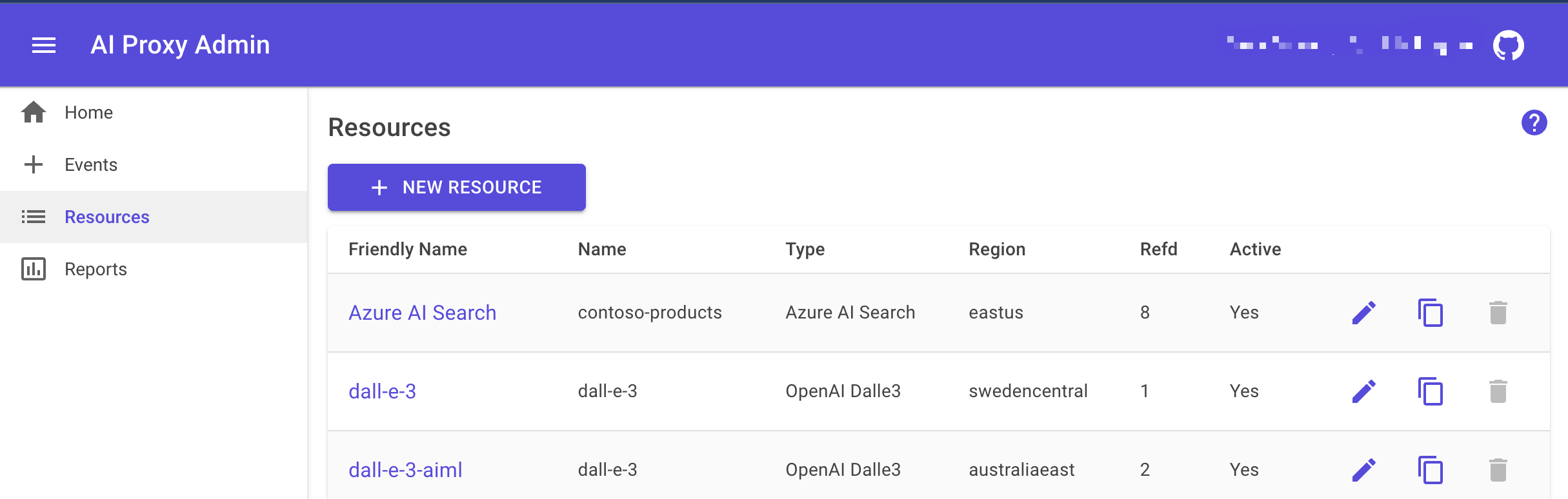
Adding resources
To add a resource, click on the + New Resource button.
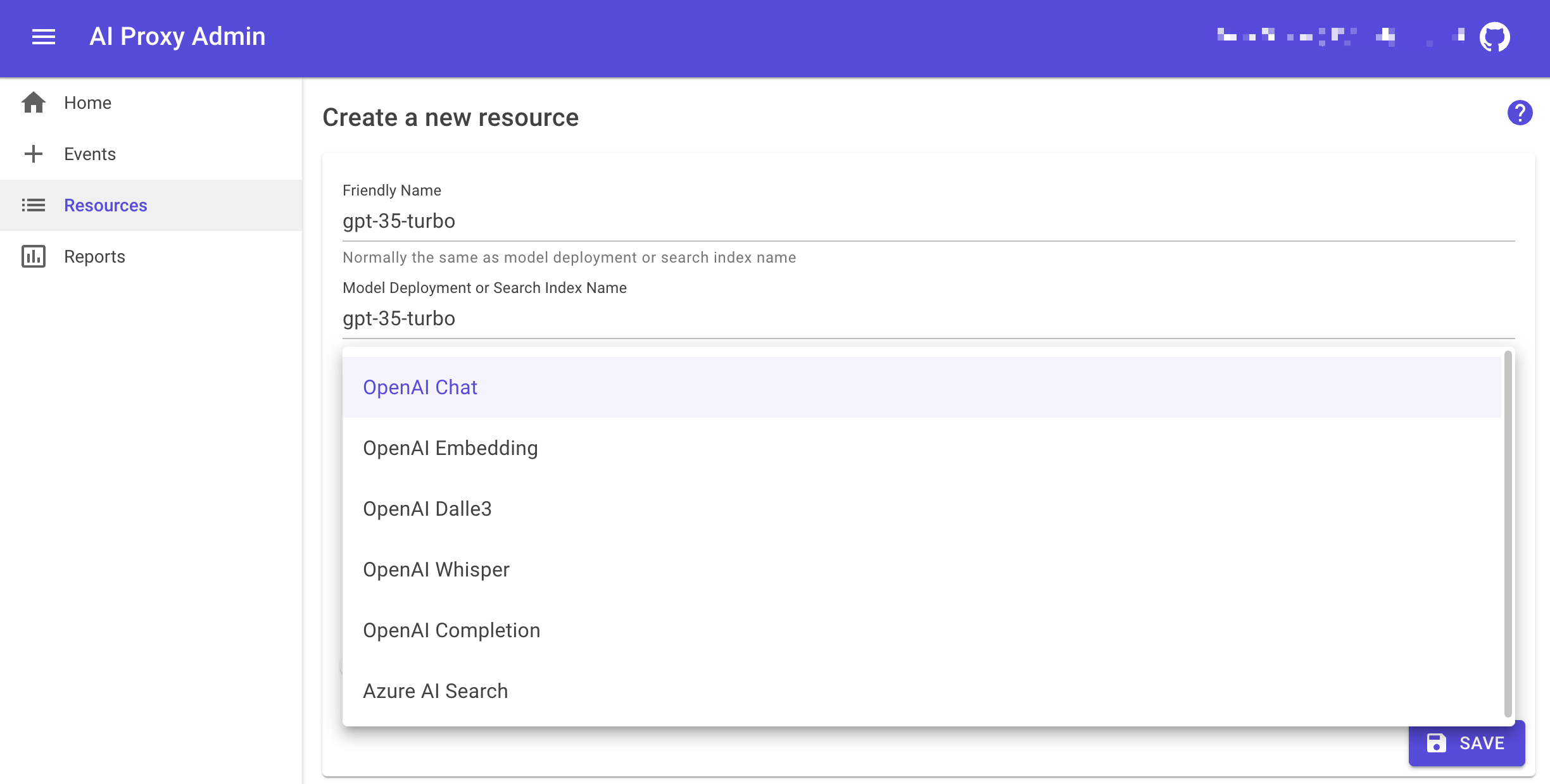
Resource types
The proxy supports the following resource types:
| Resource Type | Description |
|---|---|
| Foundry Model | Azure OpenAI / Foundry model deployments for chat completions and embeddings |
| Foundry Agent | Azure AI Foundry Agent Service for agent, assistant, thread, file, conversation, and response operations |
| MCP Server | Model Context Protocol server endpoints |
| Foundry Toolkit | Models surfaced to attendees via the Foundry Toolkit extension |
| Azure AI Search | Pass-through access to Azure AI Search indexes |
Adding Azure Foundry models with Managed Identity
The proxy supports model deployments secured with either API Keys or Azure Managed Identity authentication. This is the recommended approach for Azure Foundry model deployments and is REQUIRED if using the Azure AI Foundry Agent Service via the proxy.
For step-by-step instructions on setting up Managed Identity, see the Managed Identity guide.
Duplicate resources
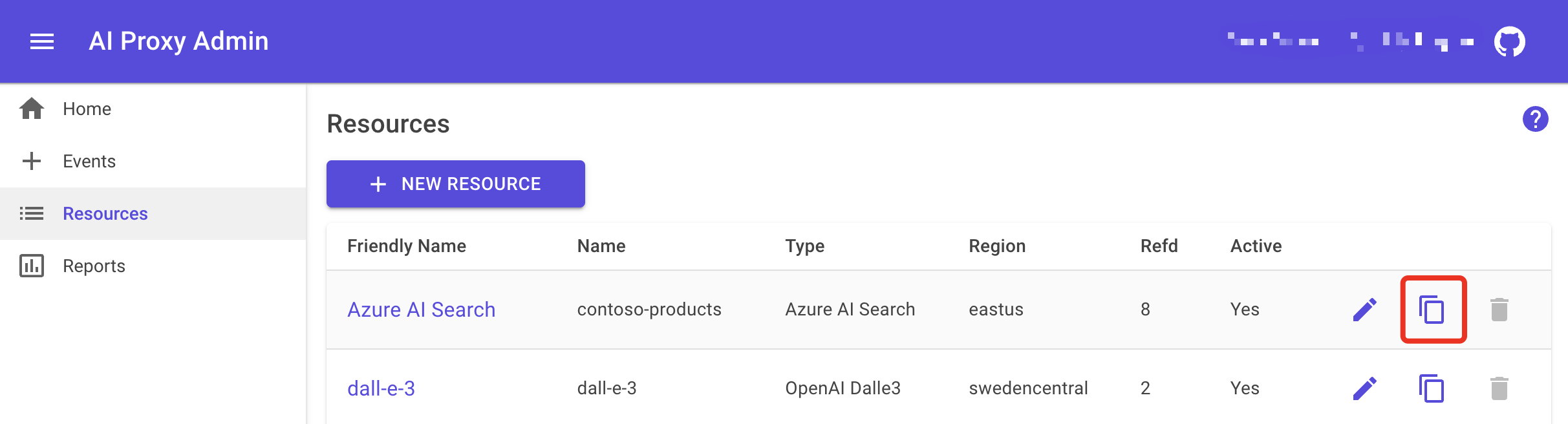
Duplicating a resource is useful when you want to create a new resource with similar settings as an existing resource.
To duplicate a resource, click on the Duplicate icon next to the resource you want to duplicate.
Deleting resources
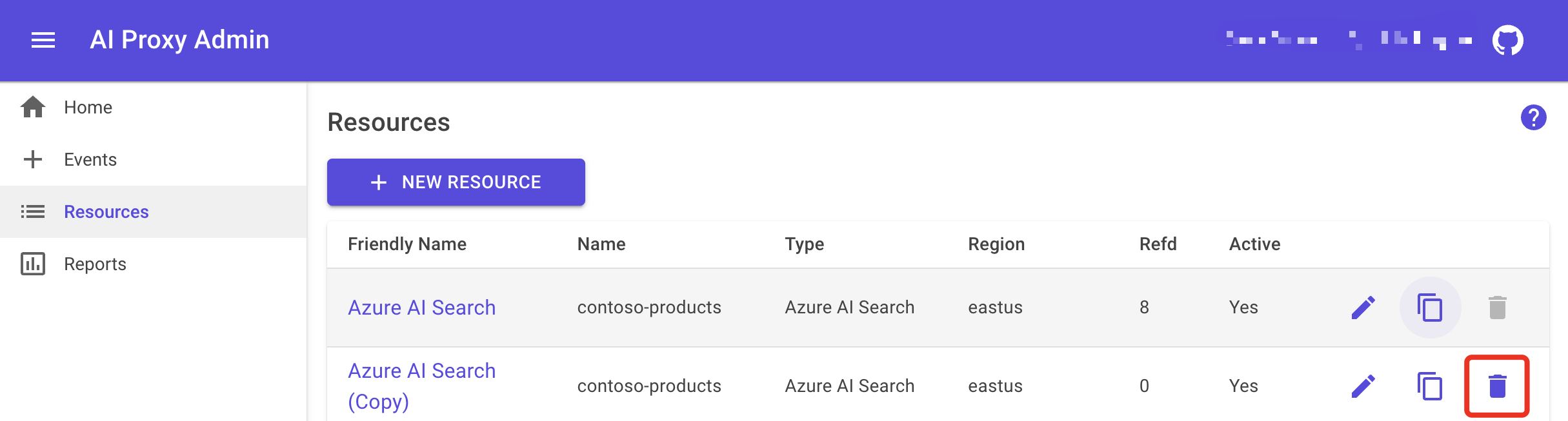
To delete a resource, click on the Delete icon next to the resource you want to delete. Note, you cannot delete a resource that is in use by an event.
Adding Foundry Toolkit models
The proxy supports resources of type Foundry Toolkit, which are surfaced to attendees using the Foundry Toolkit extension. When you create or edit a resource, select Foundry Toolkit from the Type dropdown.
Foundry Toolkit resources are listed as available model endpoints in the attendee registration page so that users can configure the Foundry Toolkit extension to connect through the proxy.
When configuring Foundry Toolkit models, you need to configure your endpoint and api key as follows:
- Azure OpenAI endpoint: https://<endpoint>.services.ai/azure.com/openai/v1?api-version=<api-version>
- API Key: copy the API Key on your Microsoft Foundry project page
Enabling Foundry Toolkit GPT-5.x compatibility
Some newer models (e.g. GPT-5.x) only accept the max_completion_tokens parameter and reject the older max_tokens parameter. The Foundry Toolkit extension may still send max_tokens in requests, which causes these models to return errors.
To work around this, enable the Foundry Toolkit GPT-5.x compatibility toggle when editing a Foundry Toolkit resource. When enabled, the proxy automatically rewrites max_tokens to max_completion_tokens in outgoing requests for that resource.
Note
The Foundry Toolkit GPT-5.x compatibility toggle only appears when the resource type is set to Foundry Toolkit.
Adding MCP Server resources
The proxy supports resources of type MCP Server, which let attendees access downstream MCP servers through the proxy URL pattern /api/v1/mcp/{deploymentName}/....
To add an MCP Server resource, click + New Resource, then select MCP Server from the Type dropdown and use the following values:
| Field | Value | Example |
|---|---|---|
| Friendly Name | A human-readable label | Demo MCP Server |
| Deployment Name | Arbitrary client-facing path segment; use a name that reflects the MCP server's purpose | weather-tools |
| Type | Select MCP Server |
|
| Endpoint URL | Full upstream backend MCP endpoint (usually includes /mcp) |
https://my-mcp-server.contoso.net/mcp |
| Key | Backend API key for the MCP server (optional) | MCP_API_KEY value |
| Region | Any label | eastus |
| Active | Enabled |
Tip
The Deployment Name does not need to match the backend host, app, or container name. It is an alias used in the proxy route (/api/v1/mcp/{deploymentName}/...). Choose a stable, descriptive value that maps to the MCP server's name or function, such as weather-tools, docs-assistant, or sql-tools.
After creating the resource:
- Add it to one or more events so attendees can access it.
- Share the event registration page link with attendees.
The registration page publishes each configured MCP server URL for the event so attendees can copy and use it directly.
Note
The attendee API key is used to authenticate to the proxy. If a backend MCP Key is configured on the resource, the proxy uses that key for downstream requests.
For full deployment and client examples, see MCP Server Deployment.