Workflows
Workflows
Build an autonomous agent using Workflows — the next generation of autonomous agents in Copilot Studio — with an event-driven trigger and a non-deterministic inline agent that books calendar time and updates a to-do.
Content last updated:
Workflows
Build an autonomous agent in Microsoft Copilot Studio using Workflows — an agent that runs on a trigger instead of waiting for a chat, and hands real work to a non-deterministic inline agent.
Lab Details
| Level | Persona | Duration | Purpose |
|---|---|---|---|
| 300 | Maker | 45 minutes (core; bonus extra) | After completing this lab, participants will be able to create a Workflow in Copilot Studio, fire it from an event-driven trigger, and embed a non-deterministic inline agent that reasons over the trigger’s data and acts through tools (Outlook calendar, Microsoft To Do, and web search) — going beyond the classic, deterministic autonomous-agent model. |
Table of Contents
- Why This Matters
- Introduction
- Core Concepts Overview
- Documentation and Additional Training Links
- Prerequisites
- Summary of Targets
- Use Cases Covered
- Instructions by Use Case
- Use Case #1: Automate Task Time-Blocking with a Workflow and an Inline Agent
- Use Case #2: Setting Up the Order Management Workflow
- Use Case #3: Use M365 Copilot and Add a Human-in-the-Loop in Order Management
- Use Case #4: Build an Inline Agent for Inventory Management
- Use Case #5 (Bonus): Call a Price Quote Specialist Agent from a Workflow
- Summary of Learnings
- Conclusions & Recommendations
Why This Matters
Makers and Developers — want your agents to do work on their own, in the background, the moment something happens — instead of only answering when a user types a message?
Think of Workflows as the autonomous side of Copilot Studio:
- Classic agents are conversational — they wait for a user turn, then respond.
- Workflows are event-driven — they start from a trigger (a schedule, or a change in an external system) and run to completion with no one watching.
- The new agent node lets a Workflow hand a step to a reasoning agent rather than a fixed, deterministic action — so the automation can decide how to accomplish a goal, not just replay hard-coded steps.
Common challenges solved by this lab:
- “I want automation that kicks off when a record changes, not when someone opens a chat.”
- “My flows are rigid — I need a step that can reason about messy, real-world inputs and choose what to do.”
- “I want an agent that can read my calendar, book time, and update a task — on its own.”
The 45-minute core covers Use Cases #1–#4: an inline agent that blocks focus time and enriches a task, a multi-branch order-management workflow with human-in-the-loop approval, and an MCP-powered inventory agent that checks stock and creates Dataverse tasks. Use Case #5 is an optional bonus that calls a published price-quote specialist agent.
[!IMPORTANT] Complete the prerequisites, solution imports, and first-use sign-in/consent before starting the core lab. The duration is a workshop target, not a measured completion guarantee; trigger pickup, connection setup, and human approval can add waiting time. Finish the core verification steps before attempting the bonus.
Introduction
Workflows are the next generation of autonomous agents in Microsoft Copilot Studio. Where a classic agent waits to be asked, a Workflow listens for a trigger and then executes — making it ideal for “when X happens, do Y” automation across Microsoft 365 and hundreds of connectors. What makes the new experience powerful is the agent node: a Workflow can now delegate a step to an inline, non-deterministic agent that reasons over the trigger’s data and calls tools to get work done, rather than following a fixed script.
Real-world example: You keep a running list of things you need to do, but you never actually block time to do them. In this lab you’ll build a Workflow that watches a Microsoft To Do list. The moment you add a task, the Workflow’s inline agent reads the task, checks your Outlook calendar for an appropriate slot within your working hours, books a focus block, and then updates the to-do with a due date, a reminder, helpful notes, and a category — all autonomously. You add one task; the agent does the planning.
This example is covered in Use Case 1 of this lab. It establishes the foundation — trigger plus inline agent plus tools — that the later use cases build on.
Core Concepts Overview
| Concept | Why it matters |
|---|---|
| Workflow | The autonomous unit in Copilot Studio. It runs on a trigger instead of a chat turn, so work happens in the background without a user present. |
| Trigger | What starts a Workflow. Triggers can be manual, scheduled (recurrence), or connector-based (an event in an external service, like a new Microsoft To Do task). |
| Inline agent (agent node) | A non-deterministic agent embedded directly in a Workflow step. Instead of a fixed action, it reasons over the input and decides how to achieve the goal. |
Dynamic content / / token |
A reference to data produced earlier in the Workflow (e.g., the trigger’s to-do Title), inserted into the agent’s instructions so it acts on the actual item at run time. |
| Tools | The capabilities you grant the agent so it can take action — here the Find meeting times and Create event actions (Office 365 Outlook), the Update to-do action, and Web search. |
Documentation and Additional Training Links
- Workflows in Microsoft Copilot Studio
- Add an agent to a workflow
- Triggers overview
- Add tools to an agent
- Model Context Protocol (MCP) in Copilot Studio
- Microsoft To Do · Outlook Calendar
Prerequisites
- Access to Microsoft Copilot Studio with appropriate licensing, in an environment where Workflows are enabled.
- A work or school Microsoft 365 account with Outlook (calendar) and Microsoft To Do provisioned — the inline agent reads and writes this account’s calendar and tasks.
- A Power Platform environment where you can edit Dataverse table data and toggle environment settings (System Administrator or System Customizer).
- Sample data pre-loaded into the Dataverse tables used by the order-management use cases (“Tasks” table).
- Permission to create connections for the services used across the lab: Microsoft To-Do (Business), Office 365 Outlook, Work IQ Mail, Microsoft Dataverse / Dataverse MCP, Human Review, and Microsoft 365 Copilot.
- The Dataverse connection reference in the pre-loaded LAB: Account Lookup Agent solution repointed to a connection you own — see Dataverse connection reference — do this first. Every Dataverse tool in this lab fails silently without it.
- Basic familiarity with the Copilot Studio interface.
- The Warehouse MCP custom MCP server imported into your environment — see Custom MCP servers below. Use Case #4 cannot be completed without it.
- The LAB: Order Management Workflows solution imported by you — your environment does not ship with it, and you must own the workflow to publish it. See The Order Management solution below. Use Cases #2–#5 fail without this.
[!IMPORTANT] Use the same work account for Copilot Studio and every connected service in this lab (Microsoft To Do, Outlook, Dataverse, M365 Copilot, and approvals). The triggers, inline agents, and tools all act on one identity — if they don’t match, a workflow can’t see your data or write back to your calendar, tasks, or Dataverse records.
Dataverse connection reference — do this first
Do this before anything else in the lab. Your environment ships with the LAB: Account Lookup Agent solution, and the Dataverse connection reference inside it is owned by the workshop author, not by you — it arrives with Owner set to someone else and Status: Off. Until you point it at a connection of your own, anything that reaches Dataverse fails, and it fails quietly: the tool shows a healthy connection but lists no operations, and an agent that needs it will report that the Dataverse connector is “not available as a tool” rather than erroring.
[!NOTE] Already did this in another lab in this event? You do not need to repeat it — the fix is per environment, not per lab. Come back to this section only if a Dataverse tool starts misbehaving: no rows returned, a tool that lists no operations, or an agent that says it cannot reach Dataverse.
-
Go to make.powerapps.com and confirm the environment picker in the top right names your **DEV - User
** environment. -
Select Solutions, open LAB: Account Lookup Agent, then select Connection references in the left pane. There is exactly one, named
copilots_header_cref7_LookupDataAgent.shared_commondataserviceforapps.…. Note its Owner — it will not be you. -
Tick the row’s checkbox and choose Edit on the command bar.
-
In the Connection field, open the dropdown and choose New connection. A new browser tab opens on the connectors list.
[!WARNING] Two connectors are both called “Microsoft Dataverse.” Pick the modern one — its id is
shared_commondataserviceforapps. The other is the legacyshared_commondataserviceconnector, and a connection created from it can never satisfy this reference. If you are unsure, go straight tohttps://make.powerapps.com/environments/<your environment id>/connections/available/shared_commondataserviceforapps. -
Select Create, sign in with your lab account, and wait for the connection to show Connected.
-
Return to the connection reference tab, open the Connection dropdown again, and select the connection that now carries your account name.
[!TIP] If your new connection is not in the list, the dropdown is stale rather than empty — reload the page and reopen the reference. The field’s own Refresh button re-queries the service but does not re-open the list.
-
Select Save — and then confirm the follow-up screen that appears.
[!IMPORTANT] Save on its own does not commit the change. A confirmation screen follows it. If you close the panel or navigate away without confirming, the edit is discarded silently: nothing errors, and the reference simply shows the old connection again the next time you open it. Confirm, then reload the page and reopen the reference to check it now names your account. That reload is the only reliable proof the rebind stuck.
The Order Management solution
Use Cases #2 through #5 all build on a pre-built Order Management Workflow, which ships inside the LAB: Order Management Workflows solution together with its connection references.
Your environment does not come with it — you import it yourself. That is deliberate: importing the solution makes you the owner of everything inside it.
[!IMPORTANT] Do not skip this — the lab cannot be completed without it. Every one of Use Cases #2 through #5 depends on the workflow being published, and only an owner can publish a workflow. If someone else’s copy is in place, you are not the owner, the Publish button stays unavailable, and the lab fails at Use Case #2 with no way forward.
| Solution package | Solution name in the environment | What it contains |
|---|---|---|
LABOrderManagementWorkflows_1_0_0_8.zip |
LAB: Order Management Workflows | The Order Management Workflow, the Price Quote Agent with its price-quote skill and Dataverse/Mail tools, and six connection references |
The workflow binds to first-party connectors only — Office 365 Outlook, M365 Copilot, Human review (Advanced Approvals), the Agent node, Microsoft Dataverse, and the Outlook Mail MCP. It does not carry the custom Warehouse MCP that Use Case #4 uses; that comes from the separate package in Custom MCP servers below.
Import the solution
-
Download
LABOrderManagementWorkflows_1_0_0_8.zip. Use the raw file — GitHub’s file preview will not give you a usable archive, and a.zipyour browser has helpfully unpacked will not import. -
Go to make.powerapps.com and confirm the environment picker in the top right names your DEV - User <your ID> environment.
[!NOTE] First visit on a new lab account? A Choose your country/region dialog opens over the page. Pick a region and select Get started to clear it.
-
Select Solutions in the left navigation, then Import solution.
-
Select Browse, choose the
.zip, then Next. Review the details — nameLABOrderManagementWorkflows, type Unmanaged, publisher CAT, version 1.0.0.8 — and select Next again. -
The wizard stops on a Connections step reading “Re-establish connections to activate your solution.” with 6 updates needed. Sign in here for each service listed. Every connection you establish now is one you do not have to fix later, and a green check means that service is ready.
Four rows are named after the node that uses them; the remaining two show their raw connection-reference logical name instead, which is expected:
Row as displayed Connector behind it When a new email arrives Office 365 Outlook Human review Advanced Approvals M365 Copilot M365 Copilot Agent Agent node crc3b_draft_bRURqJ.cr.shared_commondataserviceforapps.…Microsoft Dataverse crc3b_draft_bRURqJ.cr.shared_a365outlookmailmcp.…Outlook Mail MCP [!NOTE] Rows often show a green Valid connection on their own — the wizard matches or creates first-party connections for you, and a row that shows a Sign in button may still resolve by itself a moment later. Only act on rows that still lack a green check.
[!TIP] You can select Import without completing this step. The solution still imports, but its connection references arrive unset and you have to set all six by hand in Use Case #2 step 5.1. Doing it here is much faster.
-
Select Import. The import runs in the background and reports success in a banner reading “Solution “LAB: Order Management Workflows” imported successfully” — allow up to a minute.
-
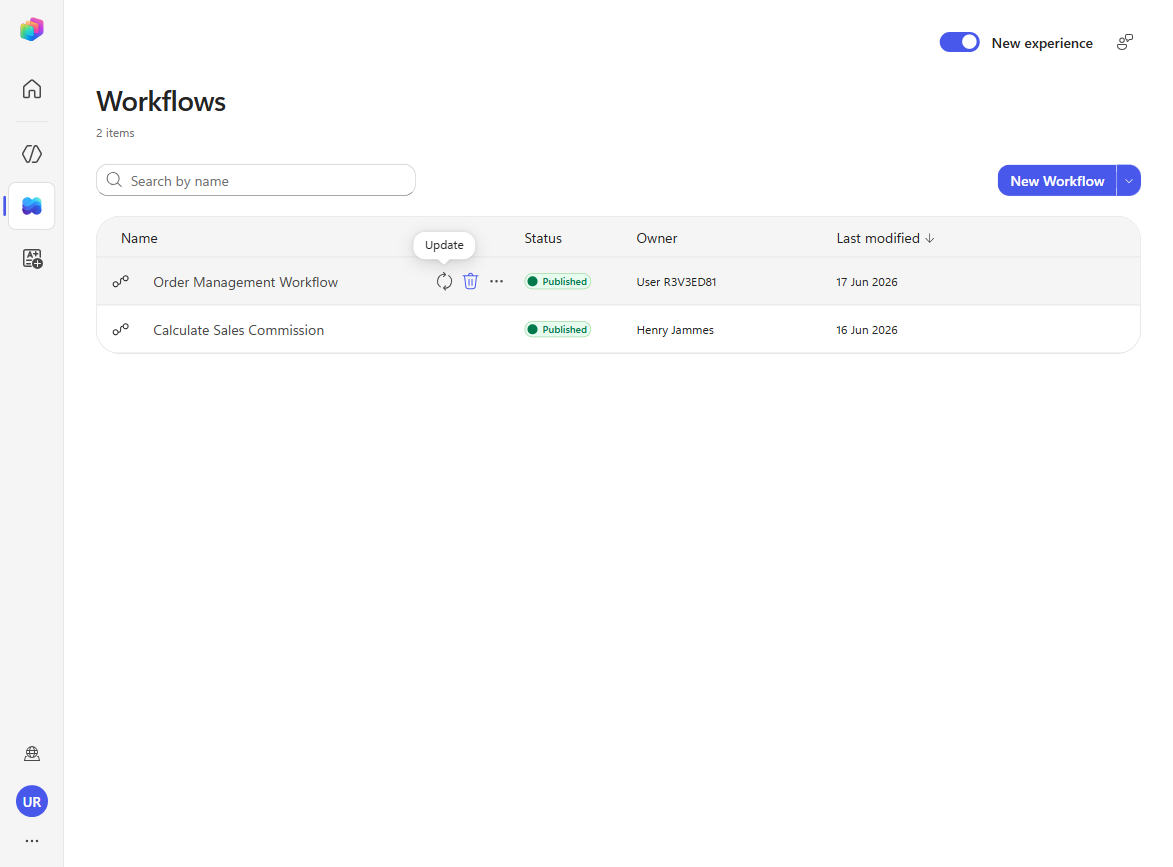
Open Workflows in Copilot Studio and confirm Order Management Workflow is listed with you in the Owner column and a status of Published.
[!IMPORTANT] This is an unmanaged solution published by CAT. Import it into a development or training environment — not production.
If a copy is already there
A freshly provisioned lab environment does not ship this solution, so on a first run there is nothing to remove — go straight to the import steps above.
Only if LAB: Order Management Workflows already appears in your Solutions list — you are re-running the lab, or someone else installed it into a shared environment — delete it first, then import your own copy. You must be the importer to own the workflow.
-
In Solutions, select the LAB: Order Management Workflows row and choose Delete on the command bar, then confirm.
[!NOTE] Power Apps warns that deleting an unmanaged solution removes the solution but not the objects inside it. If Order Management Workflow still appears in Copilot Studio → Workflows afterwards, delete it there too — its row
…menu has a Delete command — before importing your copy.
Custom MCP servers
Use Case #4 gives the inline agent a Warehouse MCP tool. That server is not part of the platform — it is a custom connector that has to already exist in your environment, and nothing inside this lab creates it. If it is missing you will not find out here; you will find out in Use Case #4, when the tool you are told to add is not in the picker.
It ships with this lab as an unmanaged Dataverse solution under assets/mcp-servers.
| Solution package | Solution name in the environment | MCP servers it installs |
|---|---|---|
EnhancedTaskCompletion_1_0_0_2.zip |
Enhanced Task Completion | Warehouse MCP — check_stock, get_restock_date, get_fulfillment_status, find_alternativesOrder Management MCP — search_orders, get_order, get_shipment, request_return, get_return_status |
Both servers run inline inside the connector as a C# script, over mock data for a fictional retailer. Nothing in them reaches a real system. This lab calls only Warehouse MCP — specifically the restock-date lookup in Use Case #4 — but the two connectors ship together in one solution and importing both is harmless.
[!NOTE] The Microsoft Dataverse MCP Server, also used in Use Case #4, is first-party and needs no import — it appears in the Model Context Protocol tool list on its own. Warehouse MCP is the only server you have to provision.
Check whether it is already loaded
Most delivery tenants ship this solution pre-provisioned. Check before importing — a duplicate import is not harmful, but it wastes lab time.
-
Go to make.powerapps.com and confirm the environment picker in the top right names the same environment you are building the workflow in. A mismatch here is the usual cause of “the tool is not in the list”.
-
Select Solutions in the left navigation and look for Enhanced Task Completion (unique name
EnhancedTaskCompletion, version 1.0.0.2). Sort by Created to bring recent imports to the top. -
Present? You are done — skip the import below. Missing? Import it.
[!TIP] Faster smoke test if you only want to know whether the agent will find it: in Copilot Studio open any Agent node, select Tools → + Add tool, filter to Model Context Protocol (MCP), and look for Warehouse MCP. The Solutions list is still the authoritative check, because it also shows you the version.
[!NOTE] First visit to make.powerapps.com on a fresh lab account? A Choose your country/region dialog opens over the page and hides the Solutions list behind it. Pick a region and select Get started to clear it.
How to import it
-
Download
EnhancedTaskCompletion_1_0_0_2.zip. Use the raw file — GitHub’s file preview will not give you a usable archive, and a.zipyour browser has helpfully unpacked will not import. -
In make.powerapps.com, confirm the environment picker, then select Solutions → Import solution.
-
Select Browse, choose the
.zip, then Next, then Import. The import runs in the background and reports success or failure in a banner when it finishes. -
Select Custom connectors in the left navigation. For each MCP connector, select Create connection — no credentials are needed, just select Create.
[!IMPORTANT] This is an unmanaged solution published by CAT. Import it into a development or training environment — not production.
[!TIP] If Warehouse MCP still does not appear in Copilot Studio’s tool picker after a successful import, select Publish all customizations on the Solutions page and search again.
The solution comes from the Enhanced Task Completion sample. It also carries two demo agents alongside the connectors; this lab does not use them.
Summary of Targets
In this lab, you’ll build several autonomous Workflows that act on event-driven triggers and hand real work to inline and published agents. By the end, you will be able to:
- Create a Workflow and configure manual, scheduled, and connector-based triggers.
- Embed a non-deterministic inline agent in a workflow, give it goal-oriented instructions, and reference earlier data with the
/dynamic-content token. - Equip agents with tools across Microsoft 365 and Dataverse (Office 365 Outlook’s Find meeting times and Create event, Update to-do, Dataverse MCP, web search) and use M365 Copilot inside a workflow.
- Add a human-in-the-loop approval step so a person validates an AI-drafted action before the workflow continues.
- Publish, run, and monitor workflows end-to-end — including calling a separate published agent from a workflow branch.
Use Cases Covered
| Step | Use Case | Value added | Effort |
|---|---|---|---|
| 1 | Automate Task Time-Blocking with a Workflow and an Inline Agent | Build an autonomous, trigger-driven Workflow whose inline agent reasons over a task and acts across your calendar and to-do list | 15 min |
| 2 | Setting Up the Order Management Workflow | Verify connections and ownership, and publish a pre-built multi-branch classification workflow | 8 min |
| 3 | Use M365 Copilot and Add a Human-in-the-Loop | Validate the Customer Inquiry path: Copilot drafts a response, human approves, workflow replies | 7 min |
| 4 | Build an Inline Agent for Inventory Management | Add an MCP-powered inline agent that checks warehouse stock and creates Dataverse tasks | 15 min |
| EC | Call a Price Quote Specialist Agent from a Workflow (Bonus) | Wire a published agent into a workflow branch to generate and send price quotes | 10 min (extra) |
The core allocations total 45 minutes and assume the prerequisites are complete. Connection or ownership repair is troubleshooting, not a required exercise when the imported workflow is already correctly configured.
Instructions by Use Case
Use Case #1: Automate Task Time-Blocking with a Workflow and an Inline Agent
Build a Workflow that watches a Microsoft To Do list and, whenever a task is added, lets an inline agent autonomously block focus time on your calendar and enrich the task.
Summary of tasks
In this section, you’ll create a To Do list to watch, build a Workflow with a To Do trigger, add a non-deterministic inline agent with goal-oriented instructions and tools, publish it, and then trigger it with a real task and verify the results.
Scenario: You capture work in Microsoft To Do but never actually reserve time to do it. You want an assistant that, the moment you jot down a task, finds an appropriate slot in your workday, books a calendar block, and updates the task with a due date, reminder, notes, and category — without you lifting a finger beyond adding the task.
Objective
Create and publish the To Do Time Block Workflow: a To Do trigger feeds a new task to an inline agent that schedules a calendar block within your working hours and updates the to-do — then run it end-to-end and confirm the calendar event and the enriched task.
Step-by-step instructions
Create the To-Do list that drives the workflow
-
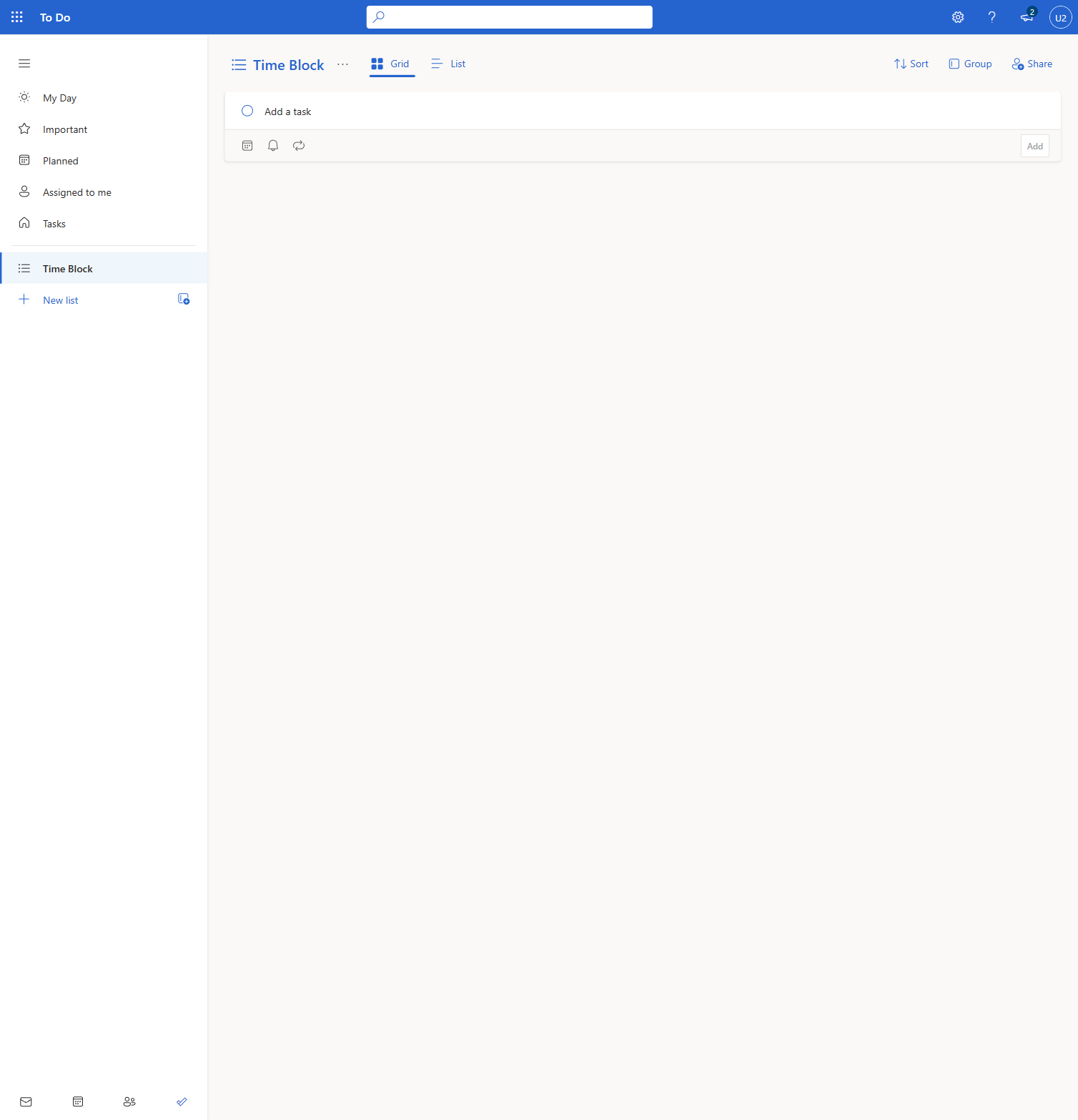
In Microsoft To Do (to-do.office.com), select New list in the left sidebar, name it Time Block, and press Enter to create it. This is the list the workflow will watch — adding a task here is what triggers the automation.
[!TIP] Sign in to To Do with the same account you use for Copilot Studio. The workflow’s trigger connects to your To Do, so the list and the workflow must live under one identity.
Create the workflow and configure its trigger
-
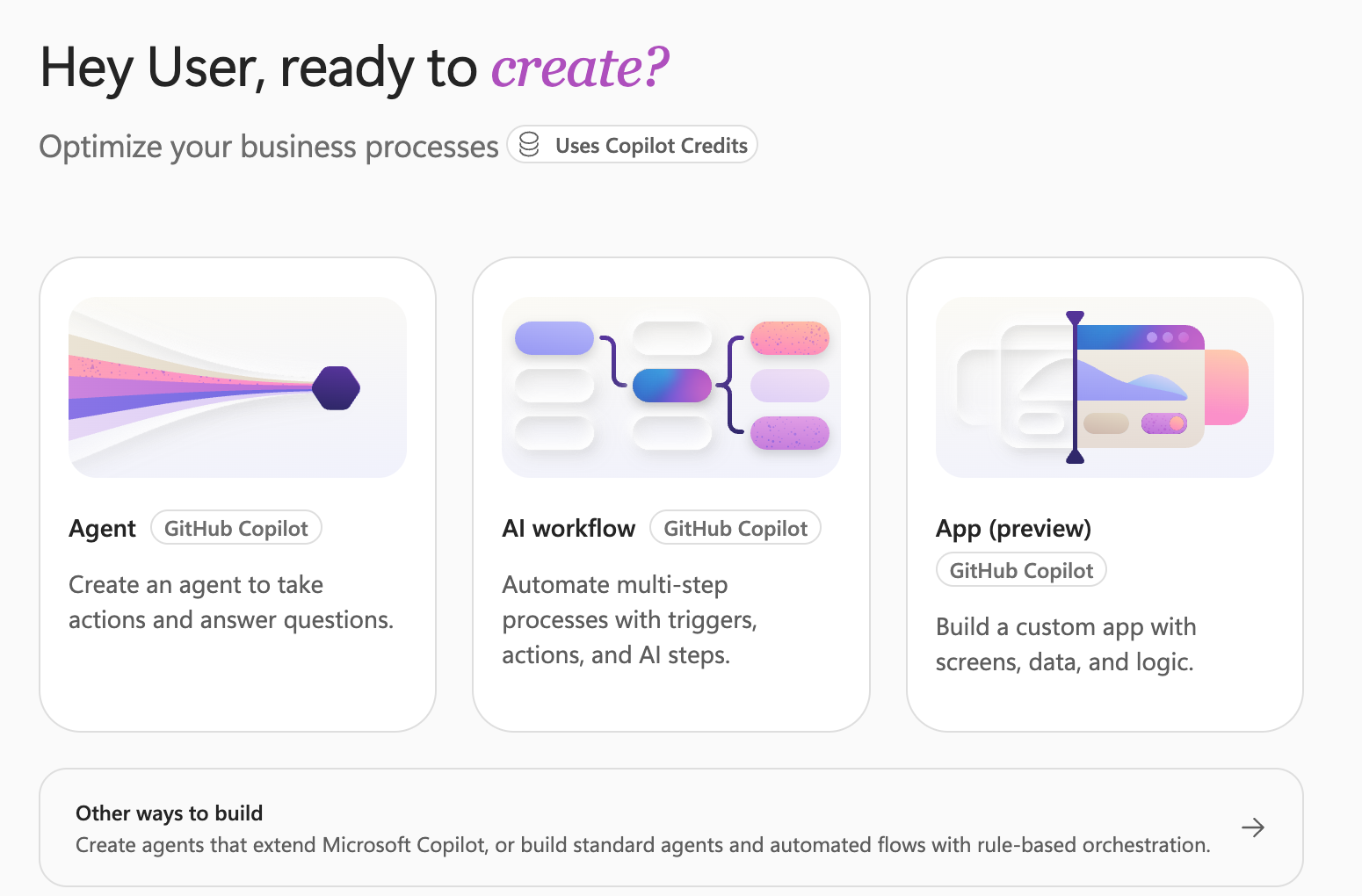
In Copilot Studio, make sure you’re in the right environment, then on the Home page select AI workflow. Rename the workflow from Untitled Workflow to To Do Time Block by selecting the title at the top of the designer.
[!TIP] Workflows are the autonomous side of Copilot Studio — they run on a trigger instead of waiting for a user to chat. You’ll find them in the left navigation next to Agents.
-
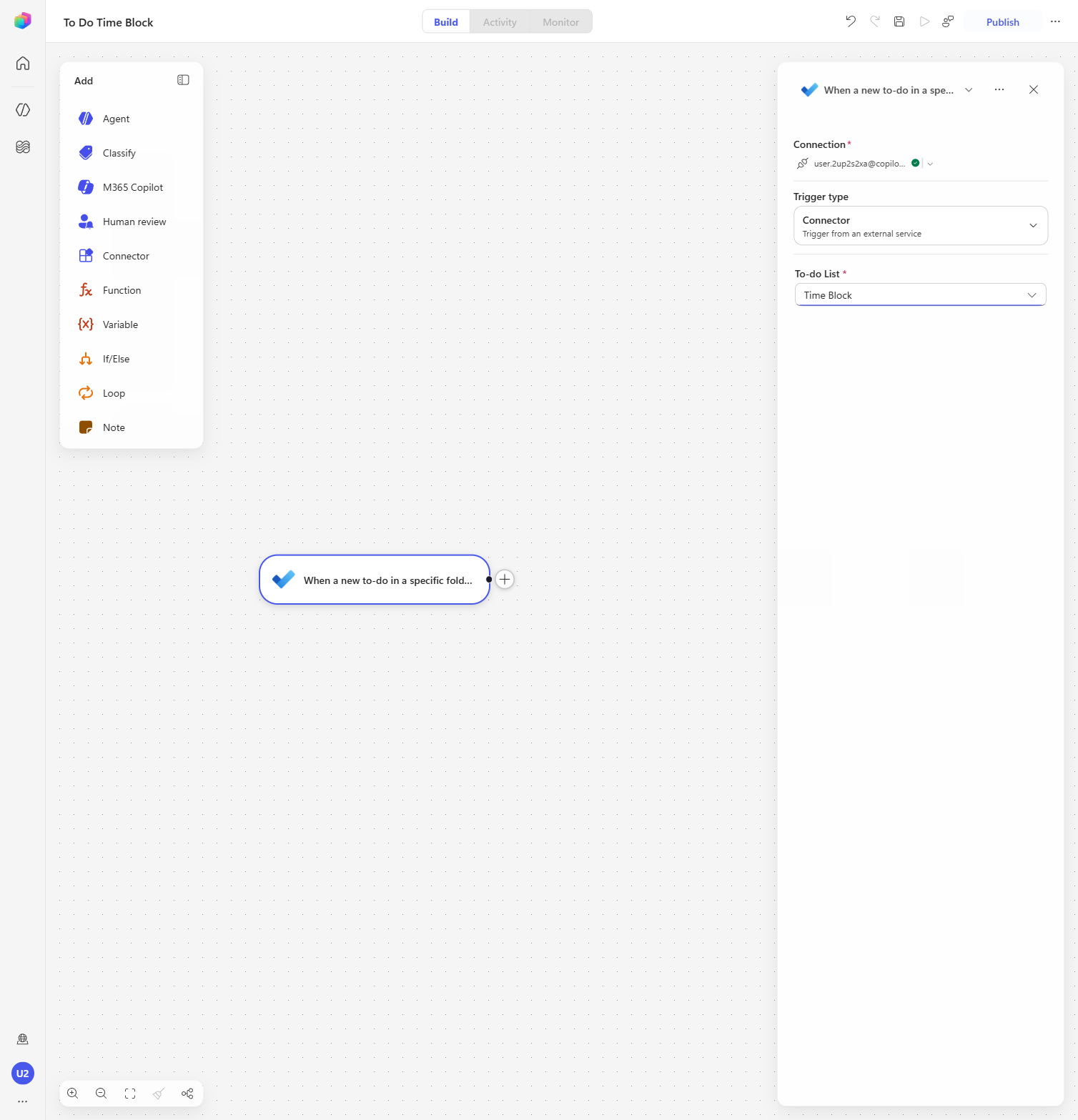
Select the Start trigger node. In the configuration panel, change Trigger type from Manual to Connector, then choose Select trigger… and search for To Do. Under Microsoft To-Do (Business), choose When a new to-do in a specific folder is created. This makes the workflow fire automatically whenever a task lands in the list you specify.
[!IMPORTANT] Pick the (Business) connector, not (Consumer) — the lab uses your work/school To Do account, which is where Copilot Studio and the calendar tools also run.
-
Wait for the connection to resolve. Reuse it if it is connected as your lab account; otherwise, select Create new connection and sign in with the same work account you’re using for this lab. Once connected, set To-do List to Time Block from the dropdown.
[!TIP] If the list picker initially appears empty, type Time Block and select the matching option or press Enter to commit the selection. Confirm the required-field/setup warning disappears before continuing.
[!WARNING] In the connection account picker, double-check you pick your lab account — not a personal or other work account. The workflow will read and write that account’s To Do and calendar.
Add and configure the inline agent
-
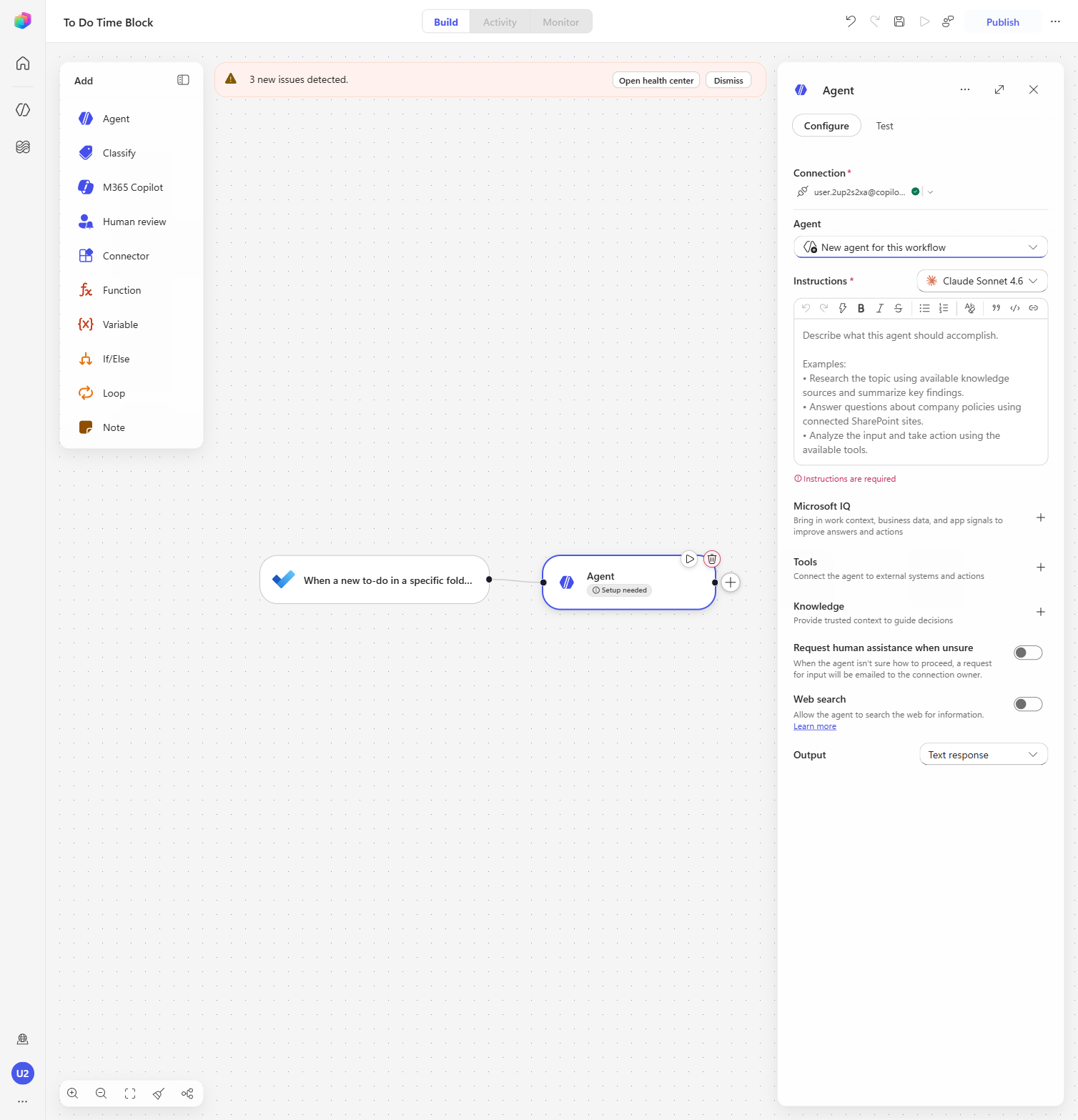
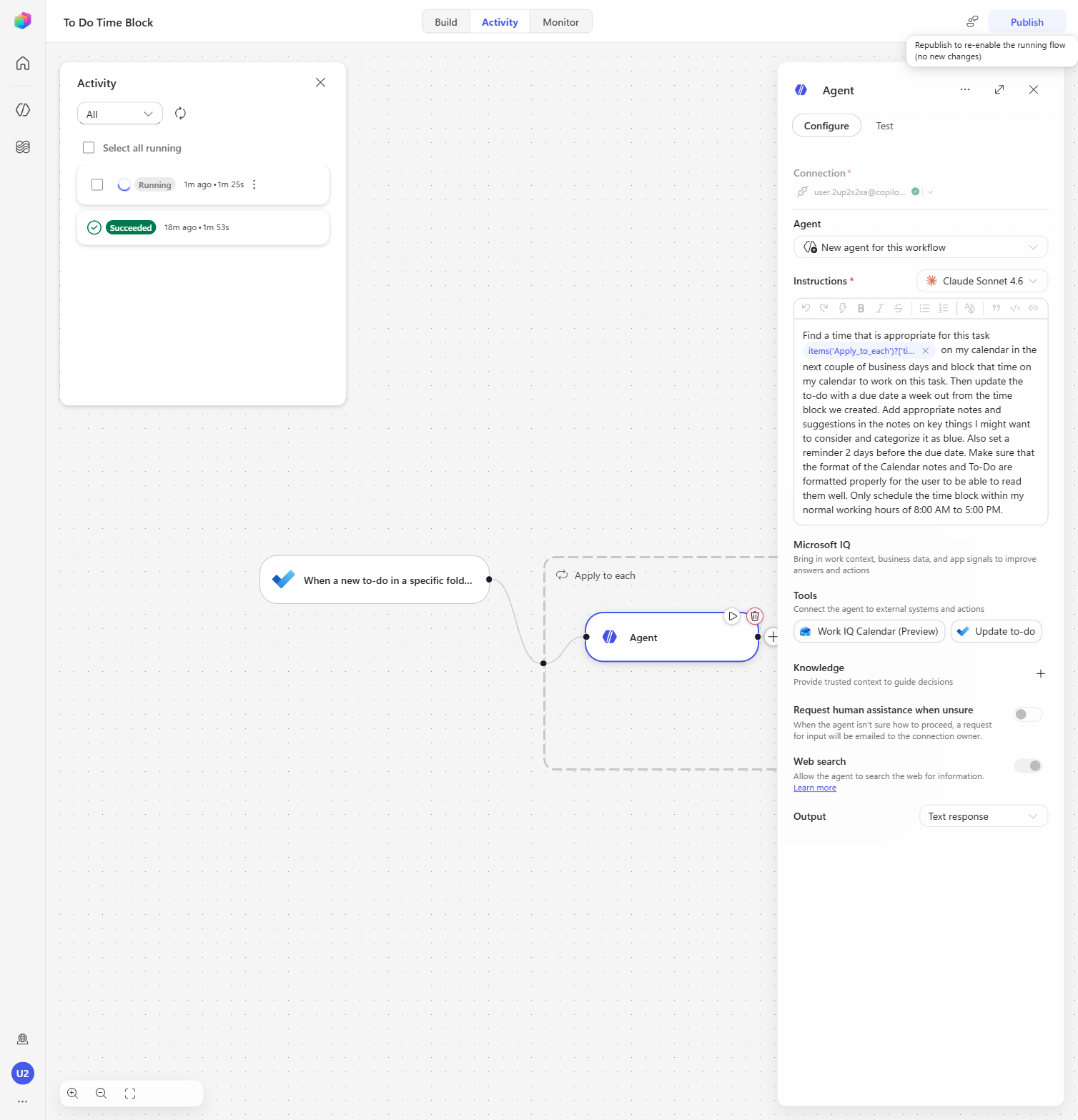
Select the + after the trigger and choose Agent to add an agent node. Reuse the connected lab-account connection, or Create new connection if needed. Leave the Agent dropdown on New agent for this workflow — this creates a brand-new, non-deterministic agent dedicated to this workflow rather than reusing an existing one.
[!TIP] This is the heart of the lab: instead of hard-coded actions, the workflow hands the task to an agent that reasons about how to schedule it.
-
In the Instructions box, give the agent its goal. Enter it in three parts so the agent receives the actual to-do title at run time:
-
Type the first line of text:
Find a time that is appropriate for this task -
Type
/to open the dynamic-content picker, then select Title (under When a new to-do in a specific folder is created). This inserts the to-do’s title as a token. Copilot Studio automatically adds an Apply to each loop when this array-item token is inserted, so the agent runs once per new to-do; the loop need not appear when you first add the Agent node. -
Continue typing the rest of the instruction right after the token:
on my calendar in the next couple of business days and block that time on my calendar to work on this task. Then update the to-do with a due date a week out from the time block we created. Add appropriate notes and suggestions in the notes on key things I might want to consider. Also set a reminder 2 days before the due date. Make sure that the format of the Calendar notes and To-Do are formatted properly for the user to be able to read them well. Only schedule the time block within my normal working hours of 8:00 AM to 5:00 PM.
[!IMPORTANT] The
/Titletoken is what makes this dynamic — the agent receives each new task’s real title, so its scheduling decision is grounded in the actual to-do rather than a fixed string. The final sentence constrains when the agent books focus time; without it, the agent may pick the first technically-free slot (even very early morning).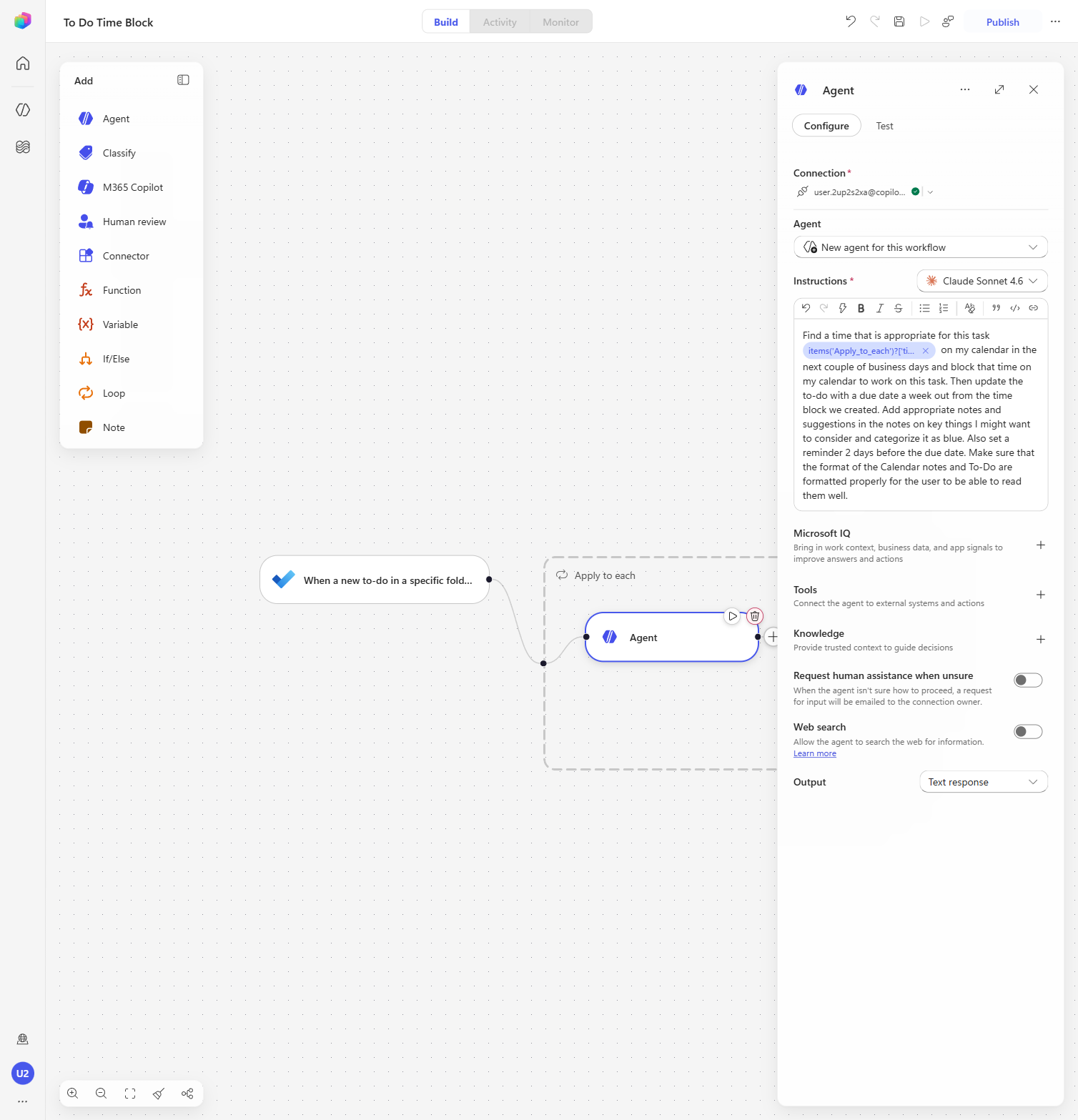
-
-
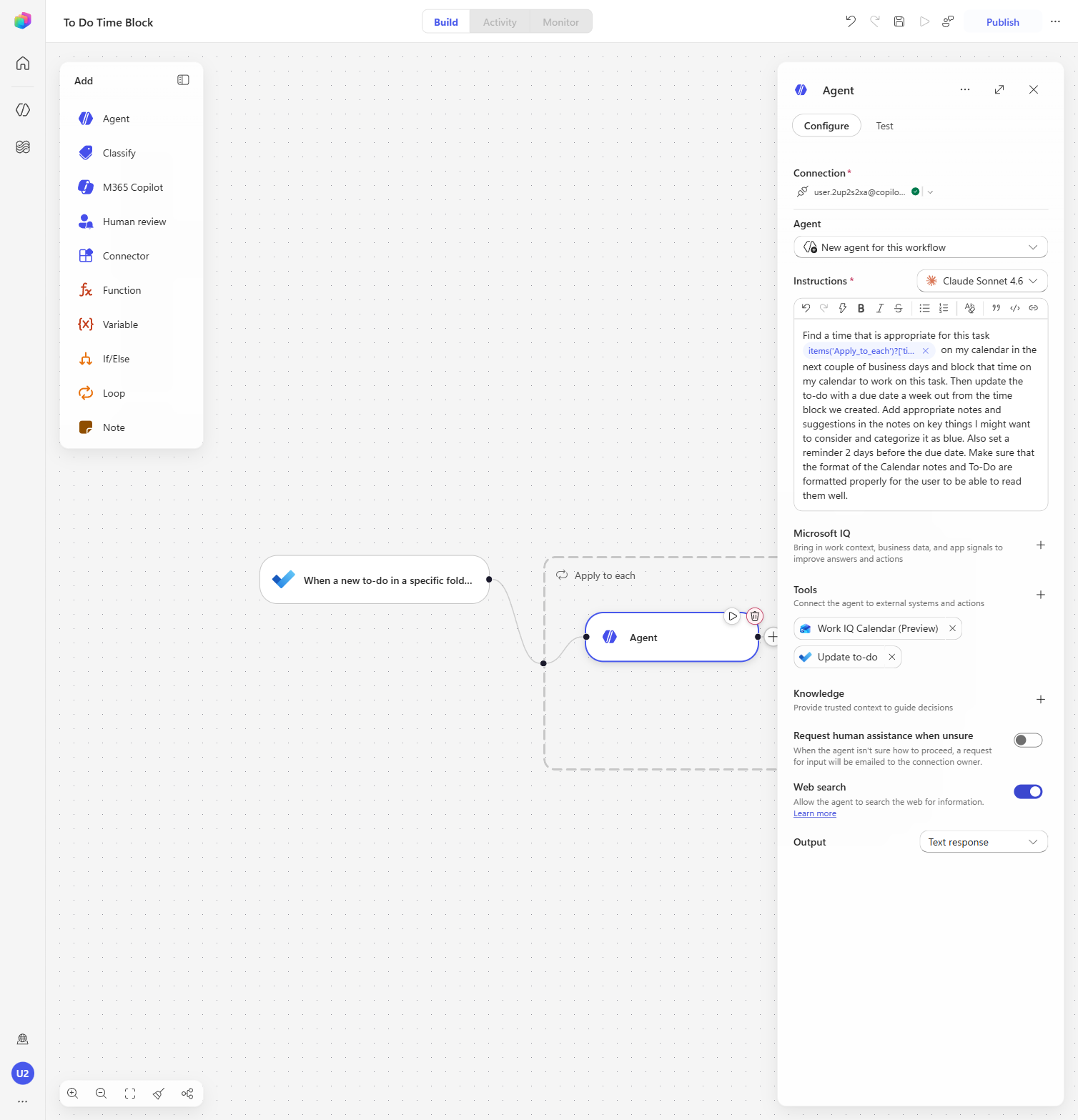
Give the agent the tools it needs to act. In the agent panel:
- Under Tools, select + (Add tool), search for Find meeting times, and choose the result whose connector is Office 365 Outlook (Find meeting time suggestions based on organizer, attendee availability, and time or location constraints). Reuse your connected lab-account connection or select Create new connection if needed, then Add.
- Add a second tool: + → search Create event → choose the Office 365 Outlook result (This operation creates a new event in a calendar) → Add (it reuses the Outlook connection you just created).
- Add a third tool: + → search Update to-do → under Microsoft To-Do (Business) choose Update to-do → reuse your lab-account connection or Create new connection if needed, then Add.
- Turn on the Web search toggle so the agent can look things up (e.g., venue or location details referenced in a task).
[!WARNING] Check the connector, not just the tool name. The picker returns several tools with near-identical names from unrelated connectors — searching
Create eventalso returns an Eventbrite “Create event” and other look-alikes. Pick the row showing the Office 365 Outlook icon; the panel names the connector under the tool title before you select Add. Choosing the wrong one leaves the agent unable to reach your calendar.[!TIP] Find meeting times lets the agent read your free/busy and propose a slot; Create event books the focus block on your Outlook calendar; Update to-do writes the due date, notes, and reminder back onto the task. Granting the two calendar actions separately — rather than one broad calendar tool — gives the agent exactly the capabilities the goal needs and nothing more.
Publish, then trigger the workflow
-
Select Save, then Publish.
[!WARNING] Publishing is required. A workflow only listens for its trigger once it has been published — so it will not run from a new to-do until you publish it. If you add the to-do before publishing, nothing happens. After publishing, the Activity and Monitor tabs become available.
-
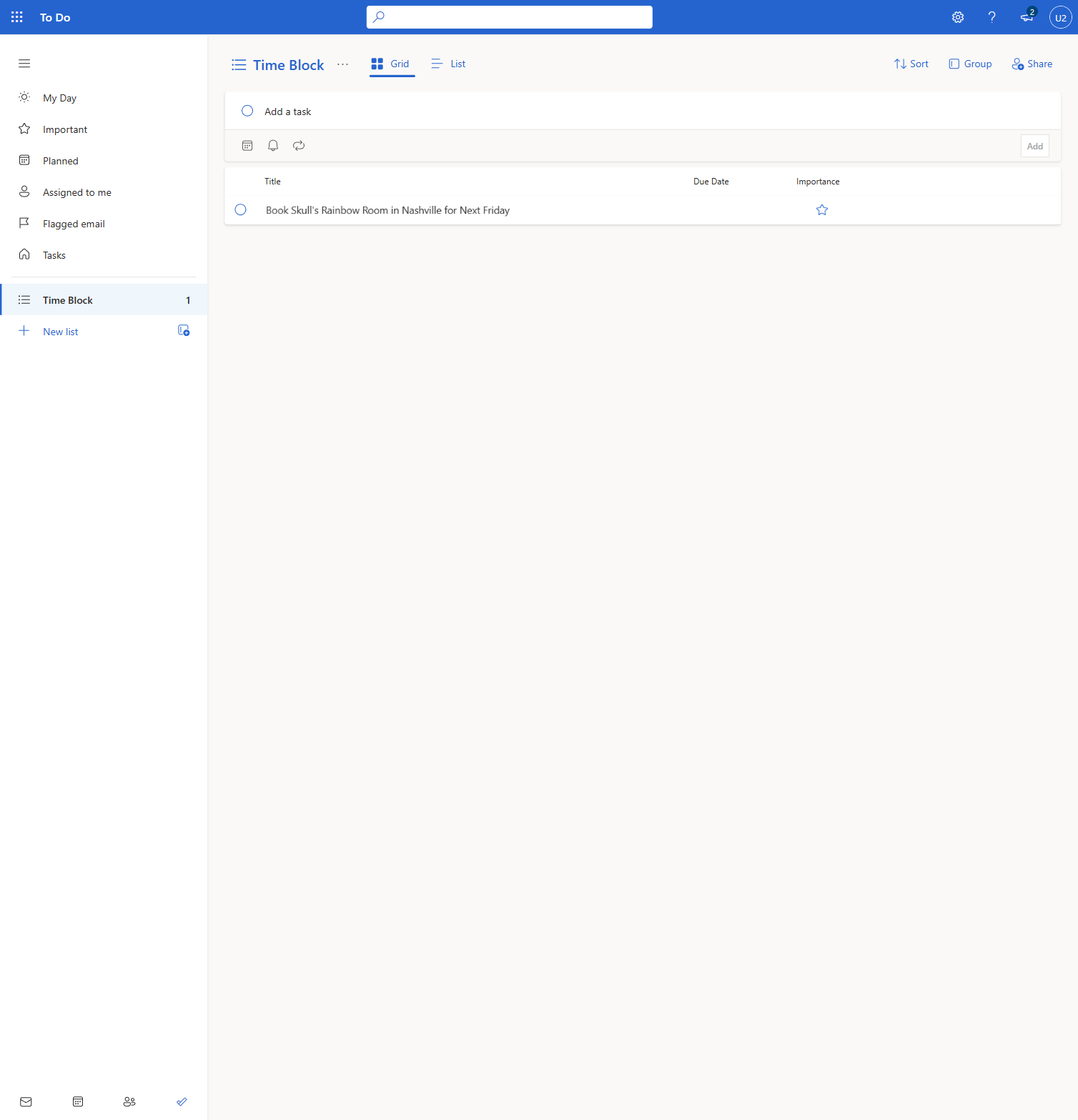
Open Microsoft To Do, go to the Time Block list, and add a new task: Book Skull’s Rainbow Room in Nashville for Next Friday. Creating this task in the watched list is what fires the workflow’s trigger.
[!TIP] Use a task whose title implies a real-world commitment with a time and place — it gives the agent something concrete to reason about (find a slot, block the calendar, look up the venue).
Watch the workflow run
-
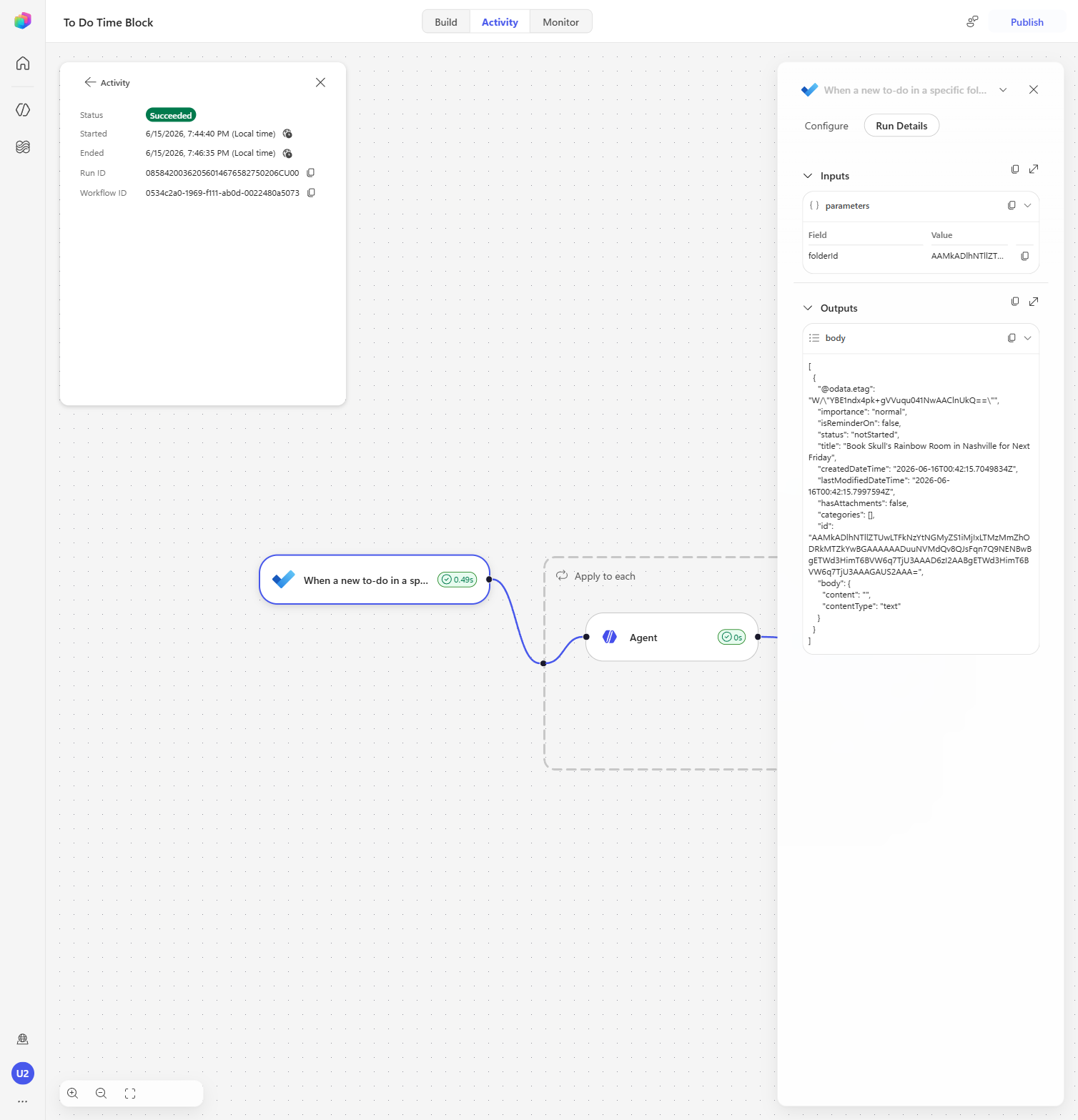
Back in the workflow, open the Activity tab and select Refresh to look for the run. When the new run appears (status Running), select it to open the run details and watch the workflow execute node-by-node (trigger → Apply to each → Agent).
[!IMPORTANT] Be patient — the To Do trigger polls on a schedule, so the run can take a few minutes to appear. Press Refresh in the Activity list a few times until it shows up.
-
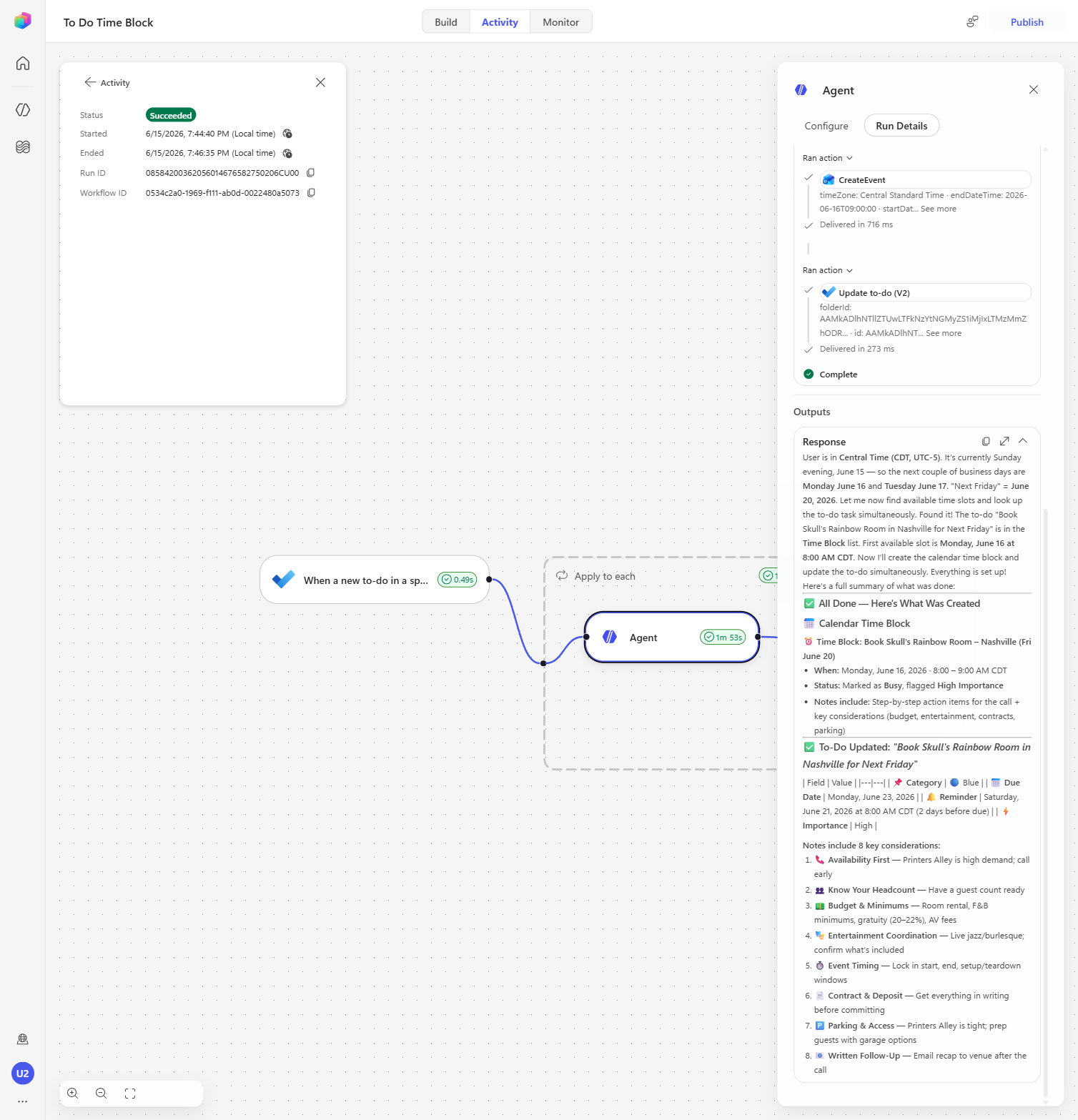
In the run details, select the Agent node to expand its details. You’ll see the agent’s own narration of what it did — checking your free/busy, choosing a time block inside your working hours, creating the calendar event, finding the to-do, and updating it. This is the non-deterministic part: the agent decided the specifics, they aren’t hard-coded in the workflow.
[!TIP] The Agent’s Outputs / Response is a great teaching moment — it shows the model reasoning step-by-step and calling the Find meeting times, Create event, and Update to-do tools on its own.
Verify the results
-
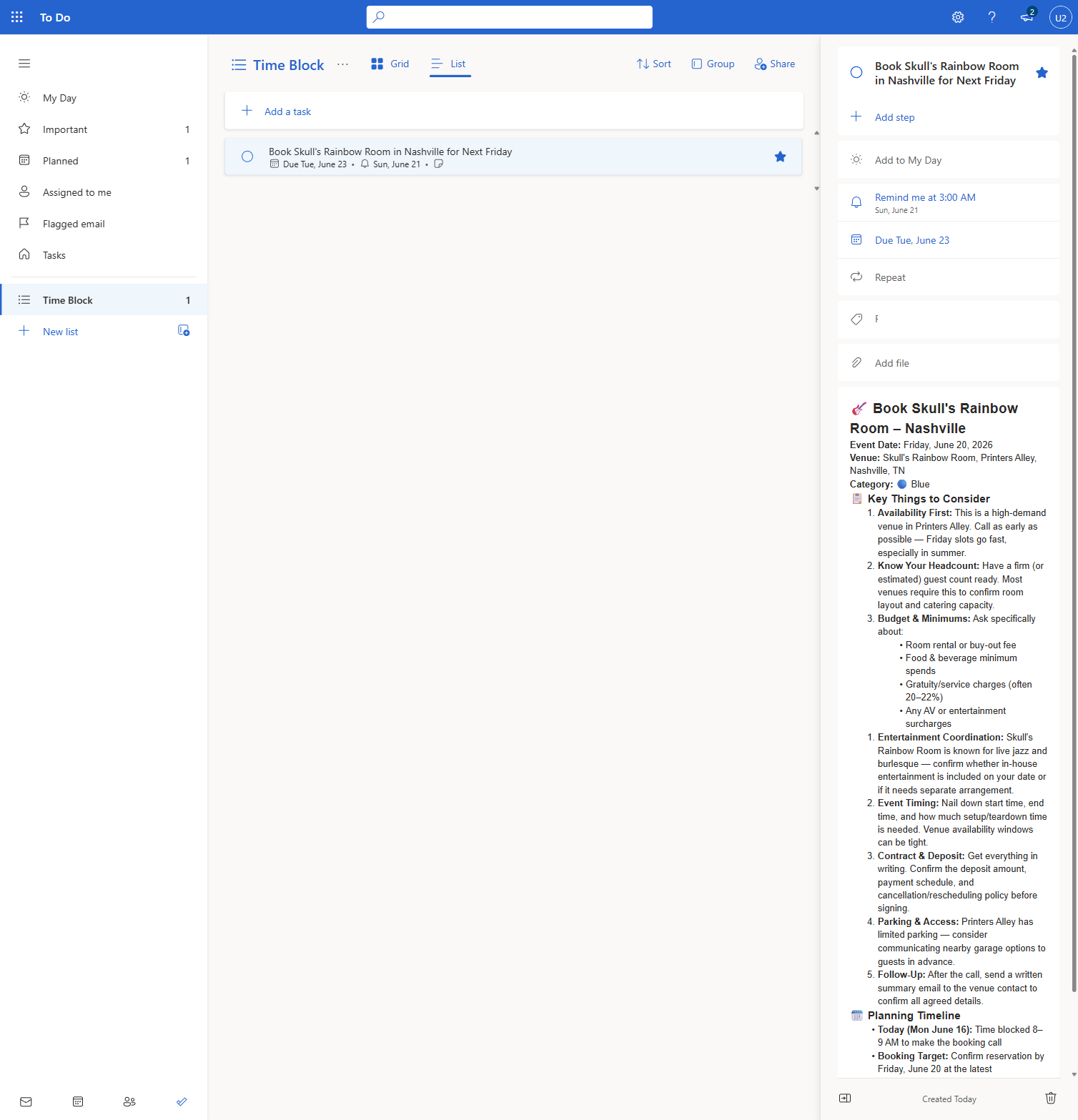
Go back to Microsoft To Do and refresh the Time Block list. Open your task — it has been updated by the agent: a due date (a week out), a reminder set 2 days before the due date, and richly formatted notes (target date, the scheduled work block, and an action checklist).
[!TIP] Switch the list to List view and open the task to see the full notes the agent wrote — it even researched the venue with web search.
-
Open Outlook → Calendar. The agent has added a time block event to reserve time to work on the task — on the next business day it found free and within your 8:00 AM–5:00 PM working hours — with a body summarizing the target date and venue. The workflow ran end-to-end with no further input from you.
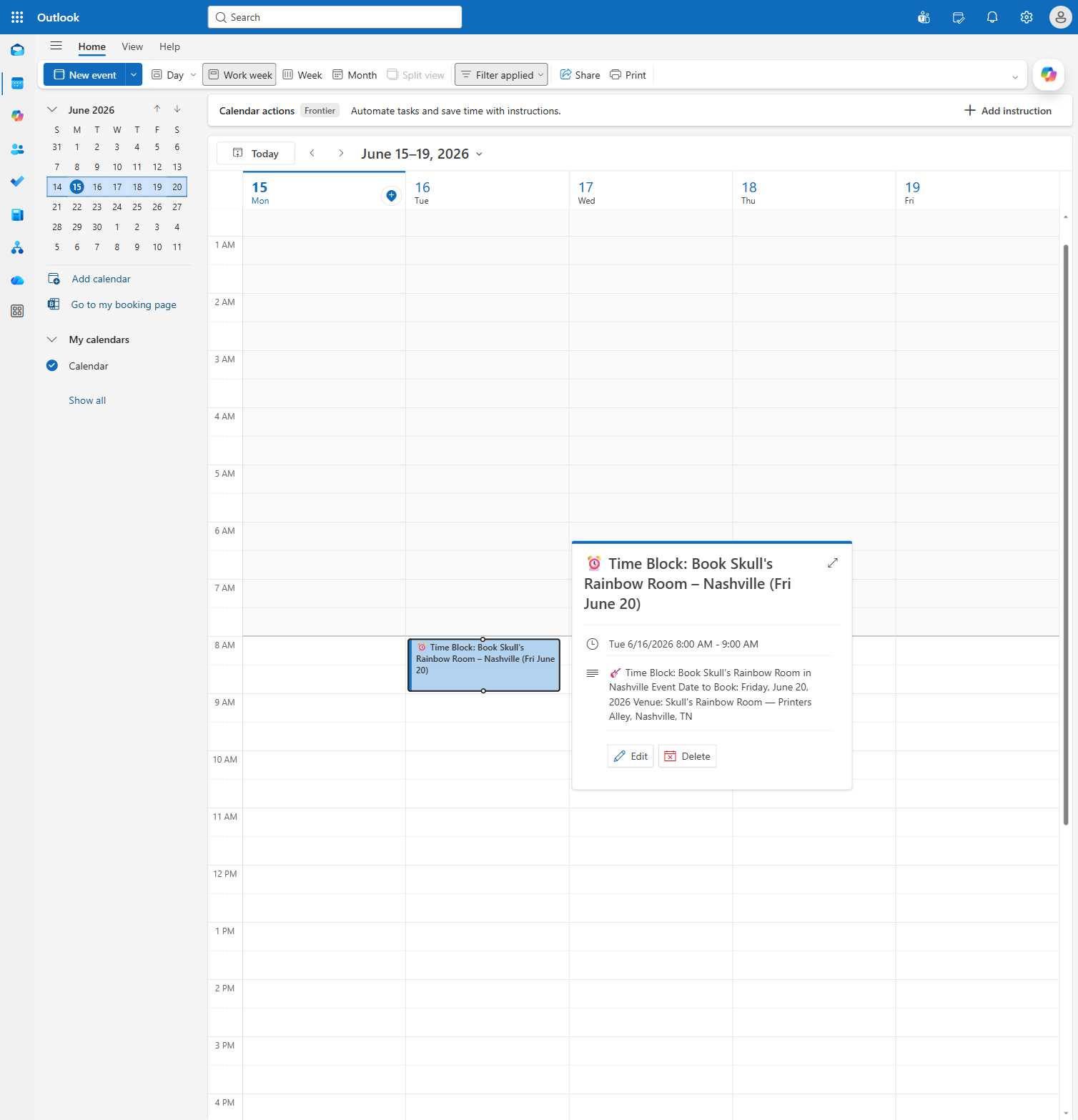
Congratulations! You’ve built an autonomous Workflow with a reasoning inline agent.
Use Case #2: Setting Up the Order Management Workflow
Configure and publish a pre-built Order Management Workflow that classifies incoming emails and routes them through different processing paths — then verify the setup end-to-end by testing the “Other” classification path.
Summary of tasks
In this section, you’ll configure connection references in the Power Apps solution, transfer workflow ownership, open the workflow to verify canvas-level connections, explore the email classification categories, publish, and verify everything works by sending a test email that triggers the “Other” classification path.
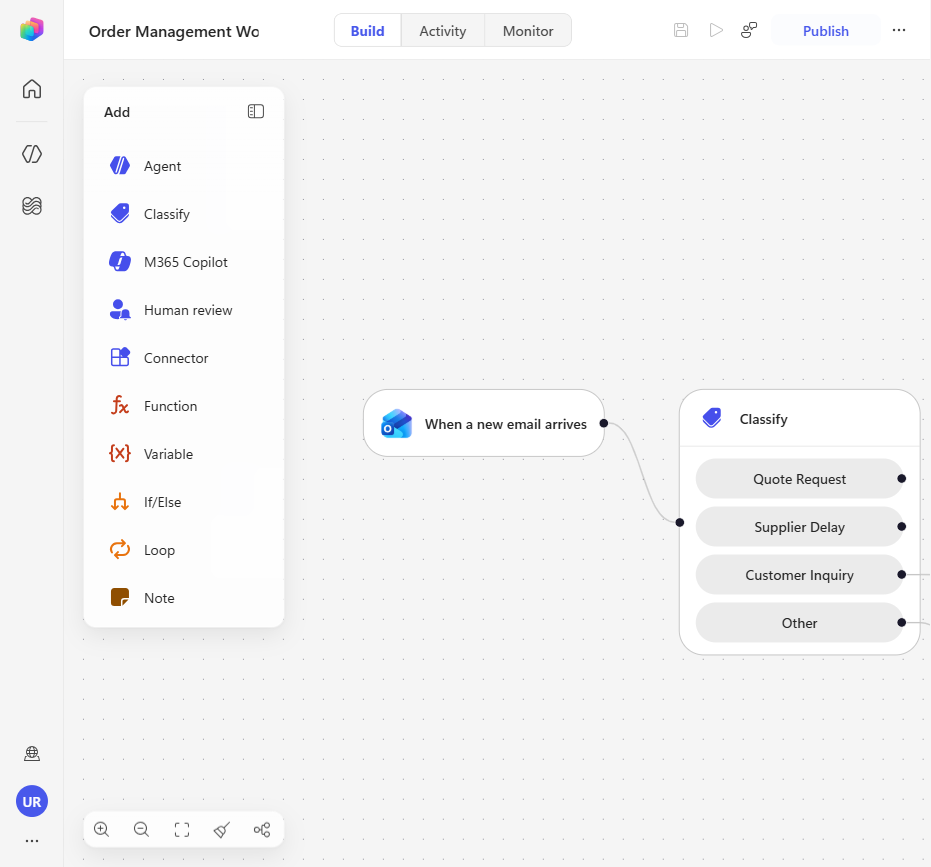
Scenario: The solution you imported in the prerequisites contains a pre-built Order Management Workflow that automatically classifies incoming emails with “Order Management” in the subject. It routes emails into one of four categories — Quote Request, Supplier Delay, Customer Inquiry, or Other — and takes different automated actions for each. Before the workflow can run, you need to configure all its connections and link them in the solution.
Objective
Complete the setup of the Order Management Workflow: configure all solution connection references, transfer ownership, verify canvas-level connections, explore the classification categories, publish, and validate end-to-end by sending a test email through the “Other” path.
[!IMPORTANT] This use case is the foundation for all subsequent use cases in this module. The connections, ownership, and publishing you complete here are required for the Customer Inquiry, Quote Request, and Supplier Delay paths covered later. Take extra care during setup — if a connection reference is missed or ownership isn’t transferred correctly, later use cases will fail silently or with hard-to-diagnose errors.
Step-by-step instructions
Take ownership and configure the solution
[!IMPORTANT] Verify the solution-level setup first. The workflow must have valid node connections, bound solution connection references, and the correct owner before it can be published or tested. Your import may already have configured these correctly: inspect them first, and use the backup repair steps only if needed.
-
In Copilot Studio, navigate to Workflows and open the Order Management Workflow.
[!NOTE] The workflow has been pre-built for your lab environment. You’ll see a trigger node (“When a new email arrives”), a Classify node, and several branch paths — one for each email category.
-
Open each node on the canvas so its connection can resolve. Start with When a new email arrives and, under Connection, wait for your lab-account connection to load. Check the Copilot and Human review nodes as well; these can also resolve automatically.
If a node remains disconnected or uses a different account, select Create new connection > Create and sign in with your lab account. Do not create duplicate connections when the existing connection is already correct.
-
Confirm you own the workflow. In Copilot Studio, select Workflows in the left navigation and find Order Management Workflow. Check the Owner column.
- It shows your own lab user — you are set. Continue to step 4.
- It shows anyone other than you — the workflow came from someone else’s import, not yours. Go back to The Order Management solution, delete the solution and import your own copy, then return here.

[!IMPORTANT] Only an owner can publish a workflow. Use Cases #2 through #5 all depend on publishing, so if the Owner column names anyone but you, the rest of this lab cannot be completed — no amount of configuration in the designer will change that.
[!NOTE] After your own import the workflow arrives with status Published, and the Publish button in the designer is greyed out. That is expected: there is nothing new to publish yet. It becomes available again as soon as you change something and select Save — which is exactly what step 4 does.
-
Go back to the workflow and select Save (or press Ctrl+S). The Publish button becomes available after saving — select Publish. If publishing succeeds, the setup is complete and you can skip step 5.
-
(Backup — only if Publish stays disabled or fails.) Complete both backup steps below.
5.1 Configure the connection references. Open Power Apps (make.powerapps.com), ensure you are in the correct environment, navigate to Solutions, and open the LAB: Order Management Workflows solution. In the left pane, select Objects, then open Connection References. For each connection reference, select Edit and choose the connection you just created from the dropdown (it should now appear).
- You should see six connection references — Office 365 Outlook, Advanced Approvals (Human review), M365 Copilot, the Agent node, Microsoft Dataverse, and the Outlook Mail MCP. Set a connection for each one.
- Select the connection and click Save, then confirm with Save changes.
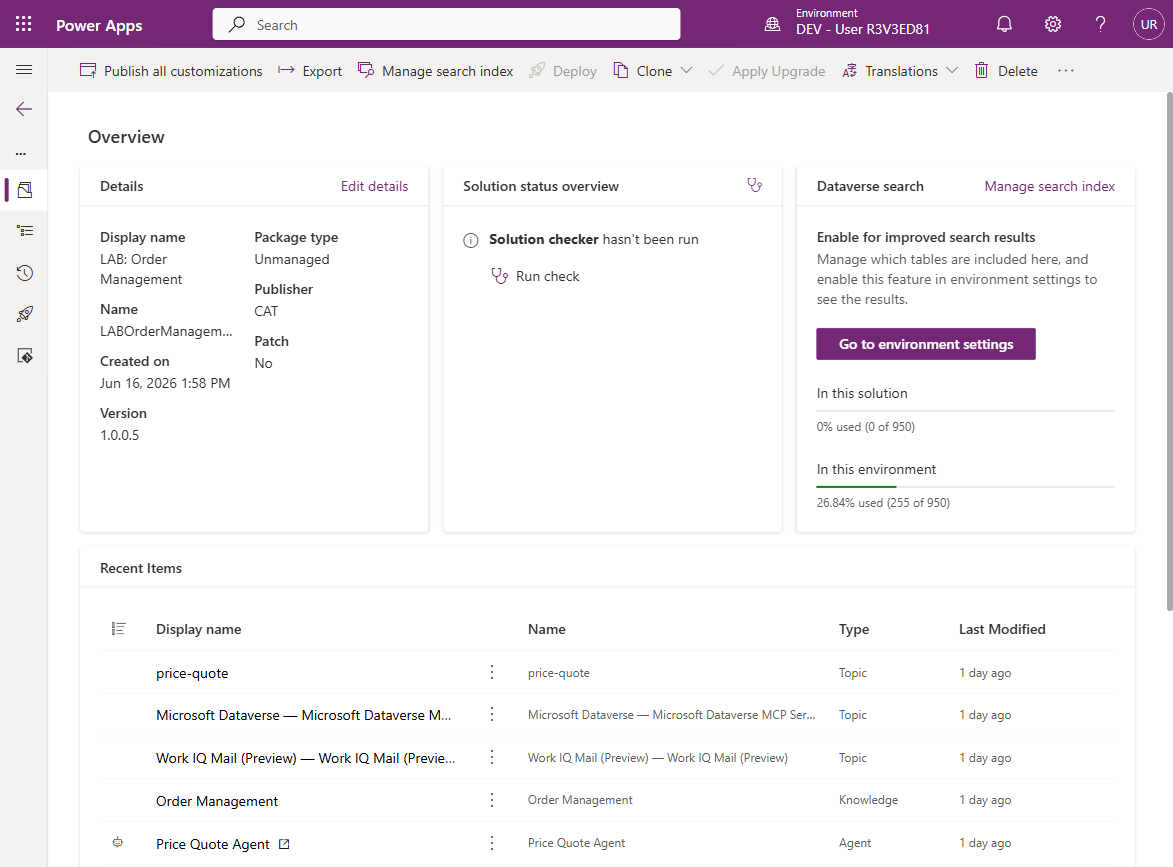
[!WARNING] Always sign in with your lab account when creating connections — not a personal or different work account. All connections in this workflow must use the same identity, or the workflow will fail at runtime with permissions errors.
5.2 Grant ownership through the Power Platform Admin Center. Open the Power Platform Admin Center (admin.powerplatform.microsoft.com) and navigate to Environments → your environment → Flows. Find the Order Management Workflow row, open More flow actions (…) → Share, add your lab user as a co-owner, and select Save. Use this only if the Owner column in step 3 still does not name you after re-importing the solution.
When done, retry step 4 (Save and Publish).
Open and explore the Order Management Workflow
-
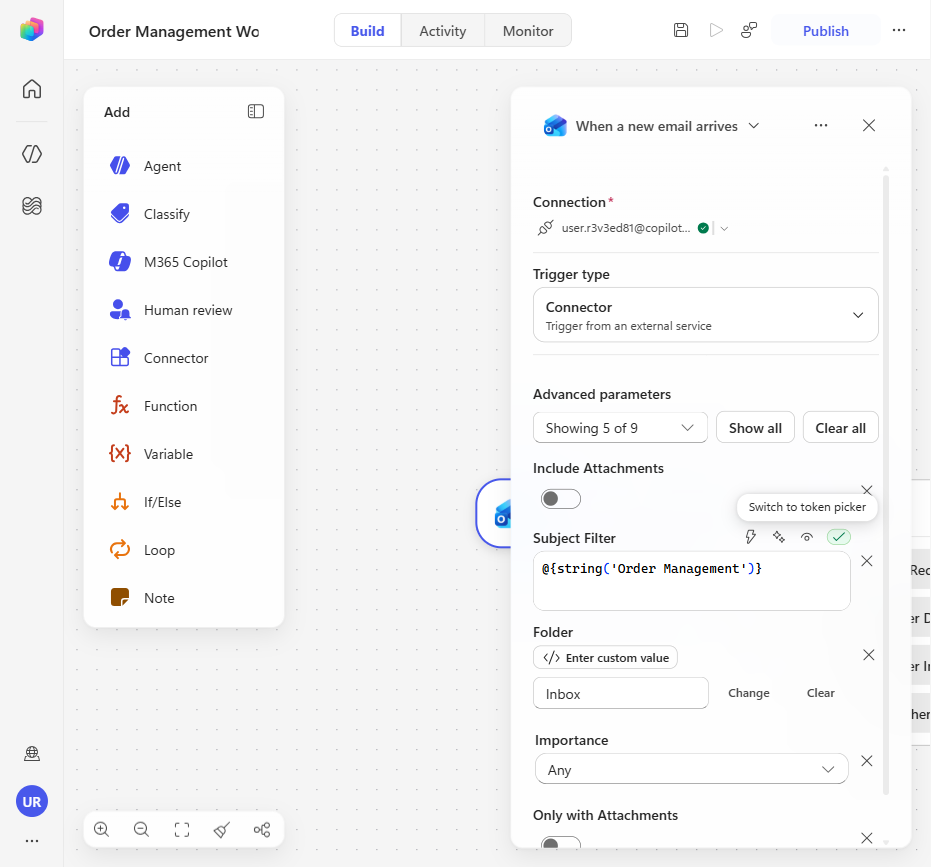
Select the trigger node (“When a new email arrives”). Next to Subject filter, select the code symbol
</>(Switch to expression mode) to reveal the expression@string('Order Management'). This means the workflow only fires for emails whose subject contains “Order Management” — all other emails are ignored.[!IMPORTANT] Keep this filter in mind when testing: every test email you send must include “Order Management” in the subject line, or the workflow will not trigger. This is a common source of confusion when tests “don’t seem to work.”
-
Select the Classify node. If no AI model is already selected or the model chosen is flagged as “retired” in a warning message, choose the default. Review the classification categories. Three are configured explicitly in the node, and the panel notes that a “Default” category is automatically created for inputs that don’t match any category — that automatic category is what the canvas shows as the Other branch. Each configured category has a name and example text that the AI model uses to determine where an incoming email should be routed:
- Quote Request — emails requesting pricing or quotes for products/services
- Supplier Delay — notifications about delays from suppliers
- Customer Inquiry — general questions from customers about orders, shipping, etc.
- Other — the automatic Default category: anything that doesn’t match the three above (spam, promotions, irrelevant). You will not find it in the Categories list, because the Classify node creates it for you.
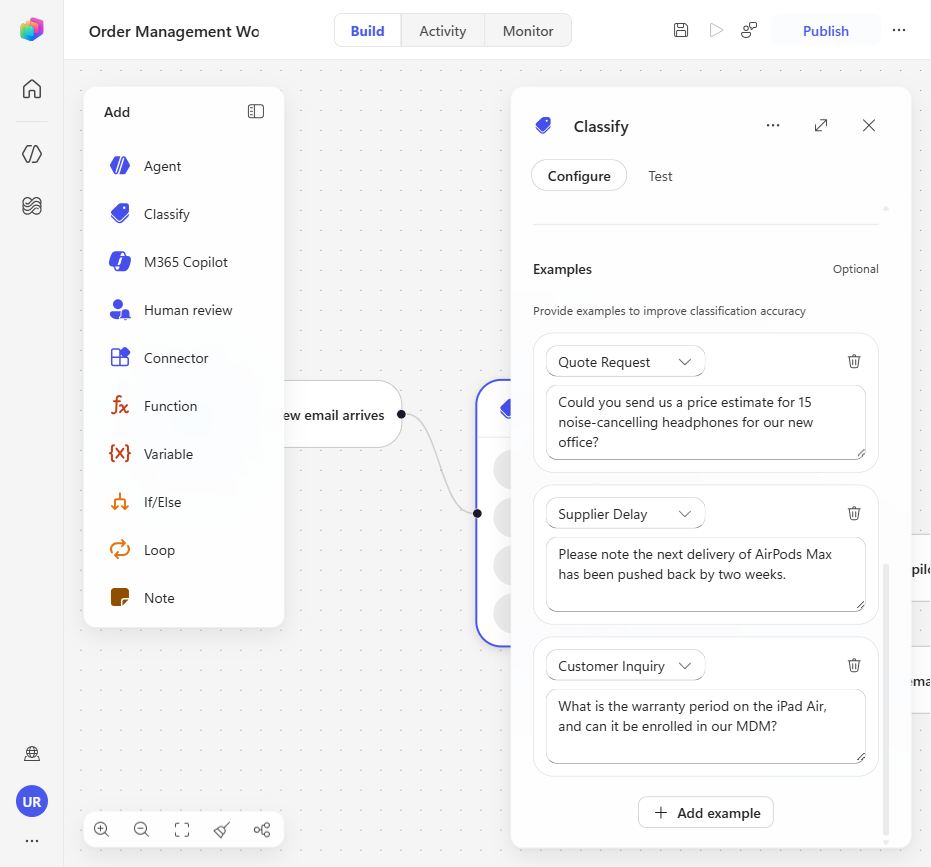
[!TIP] Improving classification accuracy: You can add multiple examples to each category to handle different phrasings and edge cases. For instance, a “Quote Request” might come as “Can you send me pricing for 500 units?” or “We’d like a formal quotation for the attached spec.” Adding diverse examples helps the model generalize better. A good testing exercise is to try common cases and edge cases using the Run node tab in the Classify node, observe how categories get assigned, and refine the category descriptions accordingly.
Test the classification
-
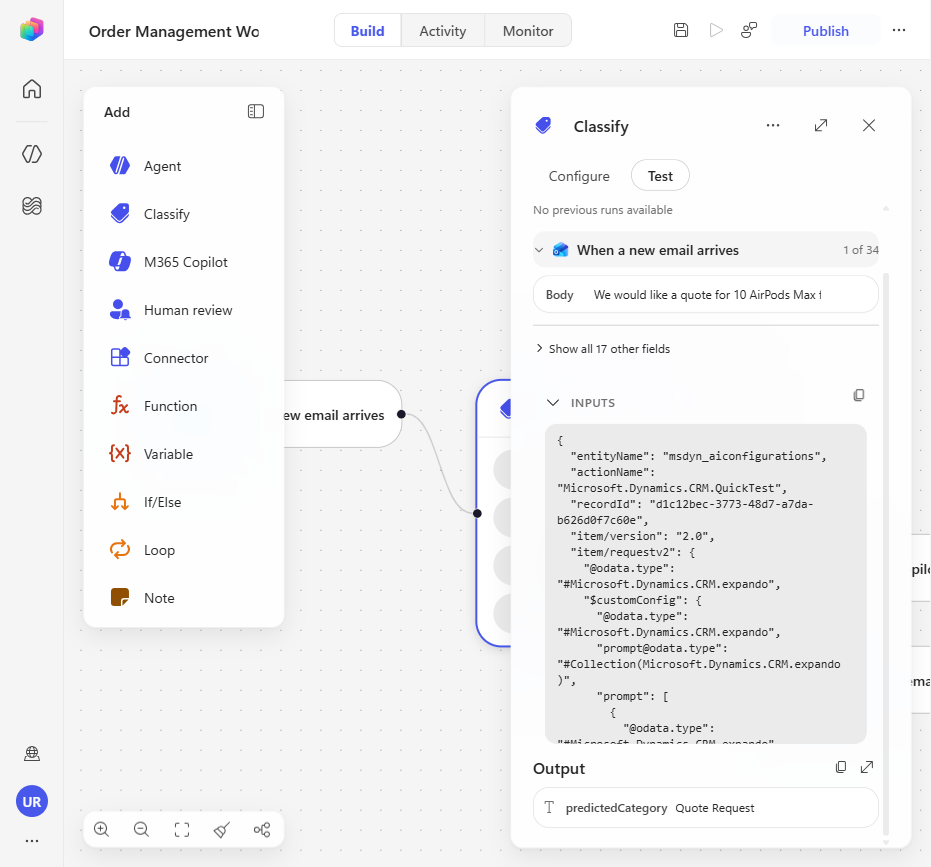
Select the Classify node’s Run node tab to test classification before sending a real email. In the When a new email arrives section, find Body (The body of the message), click into the box, and paste:
Hi, I would like to request a quote for 500 units of Product A.Select Run and observe the predicted category — it should classify as Quote Request.
Test the “Other” classification path end-to-end
-
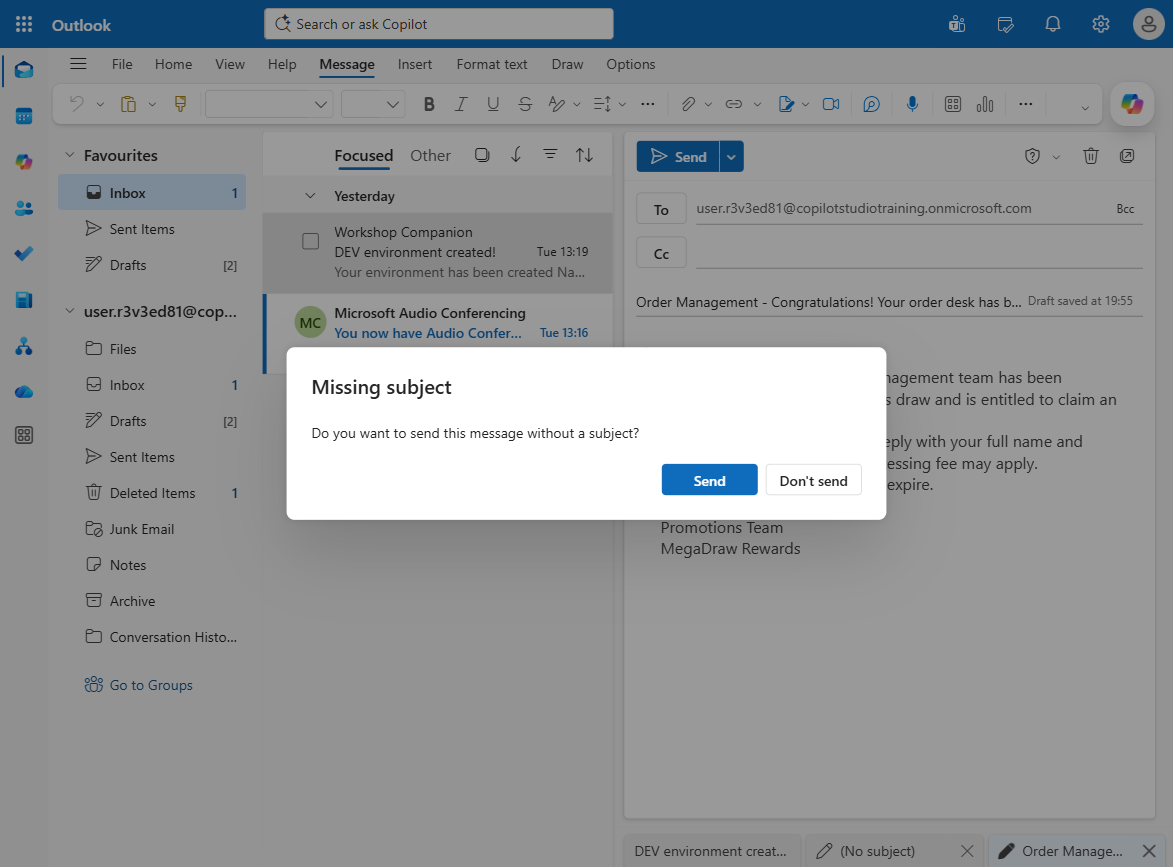
Open Outlook (outlook.office.com) and compose a new email to your lab user account with the following:
- Subject:
Order Management - Congratulations! Your order desk has been selected -
Body:
Dear Order Manager,

Congratulations! Your order management team has been selected in our monthly
business draw and is entitled to claim an exclusive cash reward.

To release your reward, please reply with your full name and contact details,
and a small processing fee may apply.

Act soon, as unclaimed rewards expire.

Regards,
Promotions Team
MegaDraw Rewards
Send the email. This spam/scam email should be classified as Other by the workflow.
[!NOTE] The subject must contain “Order Management” to match the trigger’s subject filter. The body content is intentionally irrelevant to quotes, suppliers, or customer inquiries — it should fall through to the “Other” category.
- Subject:
-
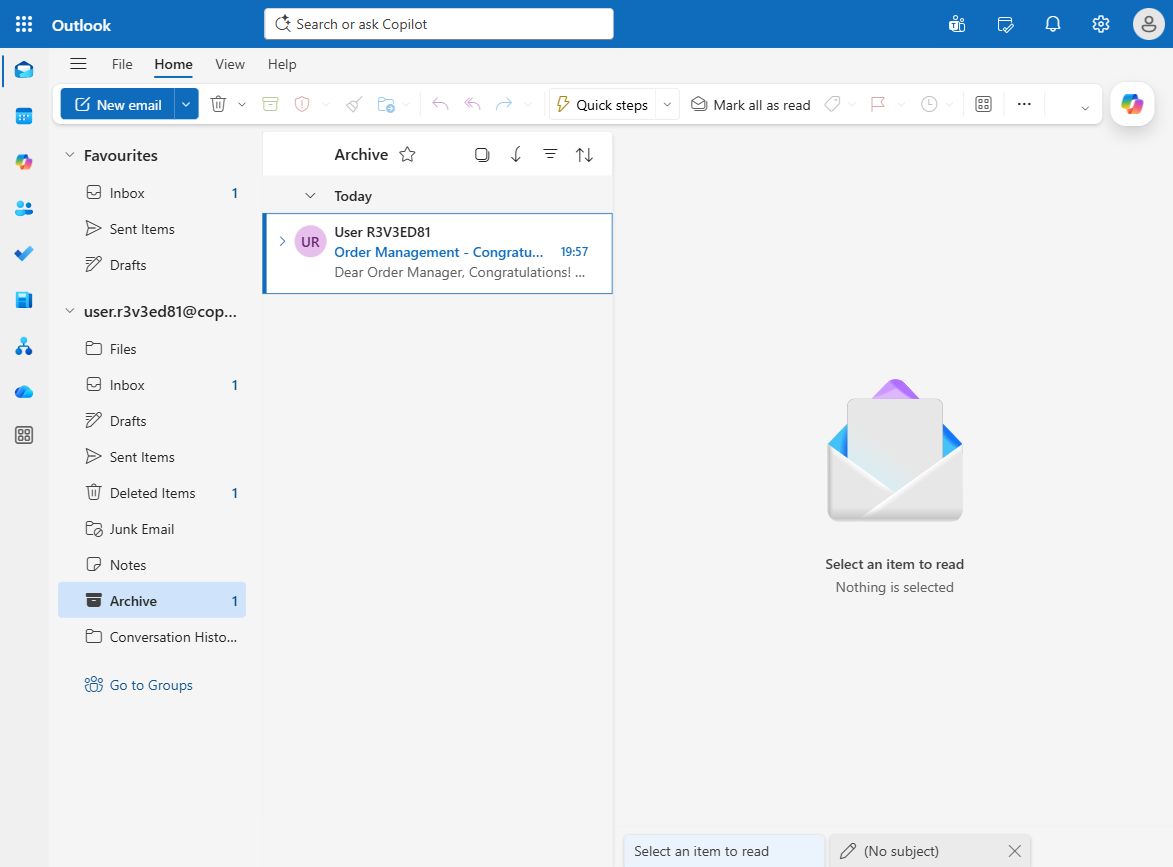
Wait a few seconds for the workflow to trigger and process the email. Then navigate to your Archive folder in Outlook. You should see the test email has been automatically moved there — confirming the “Other” classification path is working correctly.
[!TIP] If the email doesn’t appear in the Archive folder, check the Activity tab in the workflow in Copilot Studio to see if the run triggered. If no run appears, verify the workflow is Published (not Draft) and that the email subject includes “Order Management.”
Congratulations! The Order Management Workflow is now fully configured and operational.
You’ve completed the foundation that all subsequent use cases build on — the workflow is published, connections are linked, and you’ve verified the “Other” classification path works end-to-end.
Use Case #3: Use M365 Copilot and Add a Human-in-the-Loop in Order Management
Configure and validate the Customer Inquiry branch so the workflow drafts a response with M365 Copilot, pauses for a Human review, and only replies to the customer after approval.
Summary of tasks
In this section, you’ll inspect the Customer Inquiry routing branch, review how the M365 Copilot and Human review nodes are configured, publish any updates if needed, and run an end-to-end test with an approval email.
Scenario: A customer sends a product question to the order desk. Instead of crafting the answer manually every time, the workflow uses M365 Copilot to prepare a grounded draft response, sends that draft to a human reviewer for approval, and then either replies to the customer or flags the message for follow-up depending on the approver’s decision.
Objective
Validate the Customer Inquiry path of the Order Management Workflow: confirm the M365 Copilot draft prompt, inspect the Human review approval experience, test the path with a sample customer email, approve the proposed reply, and verify the customer response lands in your inbox.
Step-by-step instructions
Inspect the Customer Inquiry branch
-
In Copilot Studio, open the published Order Management Workflow and select the Classify node. Observe the Customer Inquiry branch that leaves the classification node and note how it routes customer questions into a draft-and-review sequence.
-
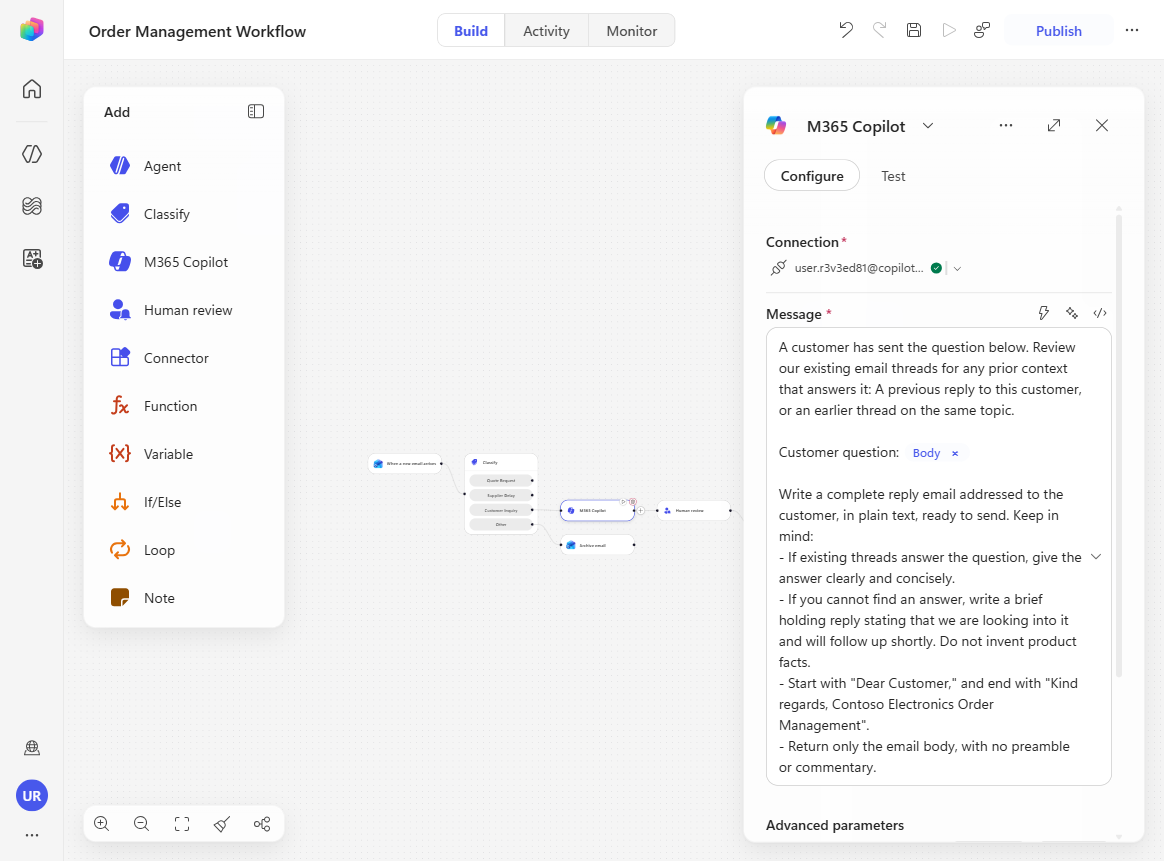
Select the Copilot node in that branch. Review the prompt and confirm it uses the Customer question input based on the incoming email body. This is the grounded draft-generation step that prepares the proposed response for the reviewer. The prompt asks M365 Copilot to read the customer’s question, search the existing email threads of the user that owns the node connection (you) for any prior context or earlier reply on the same topic, and then draft a complete, ready-to-send reply — answering clearly when it finds an answer, or writing a brief holding response when it can’t (without inventing product facts), always addressed “Dear Customer,” and signed off as “Contoso Electronics Order Management”.
[!NOTE] Copilot node scope: The node uses M365 Copilot for questions that leverage Microsoft Graph (emails, Teams chats, etc.) — think of it as prompts you would send in M365 Copilot chat. Note that the operations this node performs are read-only — it can search and retrieve information from emails, chats, and files, but it cannot send emails or Teams messages. If you need those write operations, use an Agent node with access to the relevant Work IQ tools instead.
[!NOTE] Fresh lab accounts have no history to ground on: Because this lab uses a freshly provisioned account with no prior emails or Teams messages, the M365 Copilot node won’t find real substance to build its answer from — so expect a generic holding reply. This step is illustrative: in a real mailbox with genuine history, M365 Copilot would ground the draft in actual prior threads and context.
-
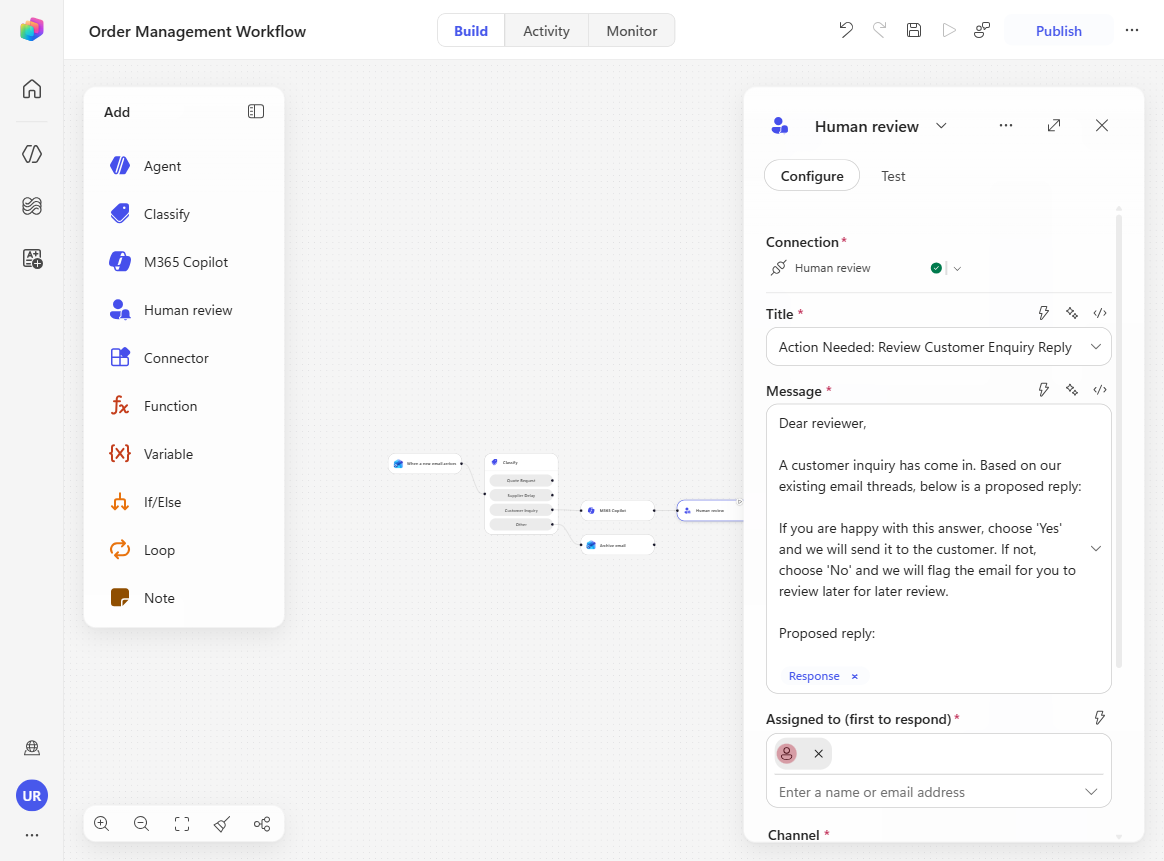
Select the Human review node and inspect its configuration carefully:
- In the message, confirm the proposed reply drafted by M365 Copilot is inserted for the reviewer to read.
- Notice that the review request is delivered over Outlook — observe how we use an Outlook email to ask a person to approve before the workflow continues.
- The reviewer responds through a single Yes/No input named Approve, with the prompt Send proposed reply?. Select + to expand and see the other input types available — text, email, number, date, and more. You don’t need to add any here, but it’s worth understanding the variety of formatted inputs you can request and then reuse cleanly in downstream nodes.
-
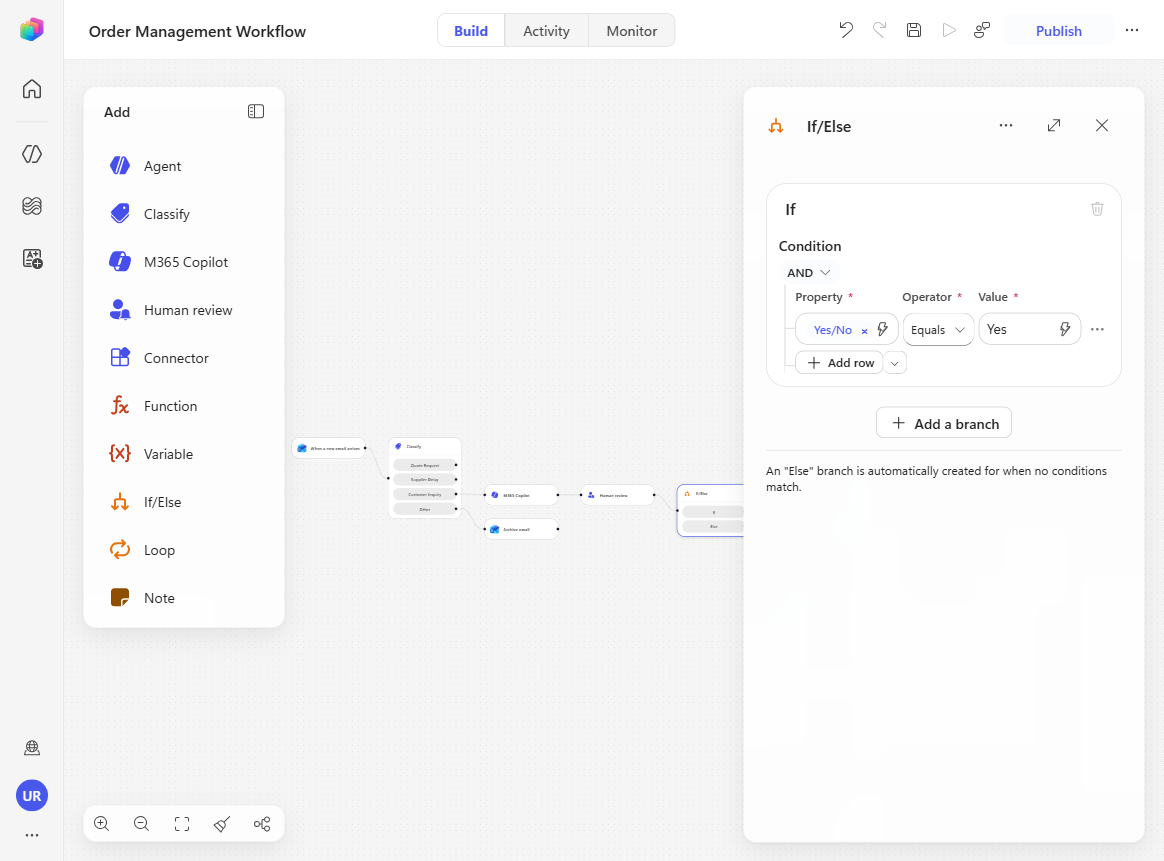
Select the If/Else node after Human review and observe the decision logic. When the reviewer answers Yes, the workflow sends the proposed reply to the customer; otherwise, the original email is flagged in the inbox for manual follow-up.
Run an end-to-end Customer Inquiry test
-
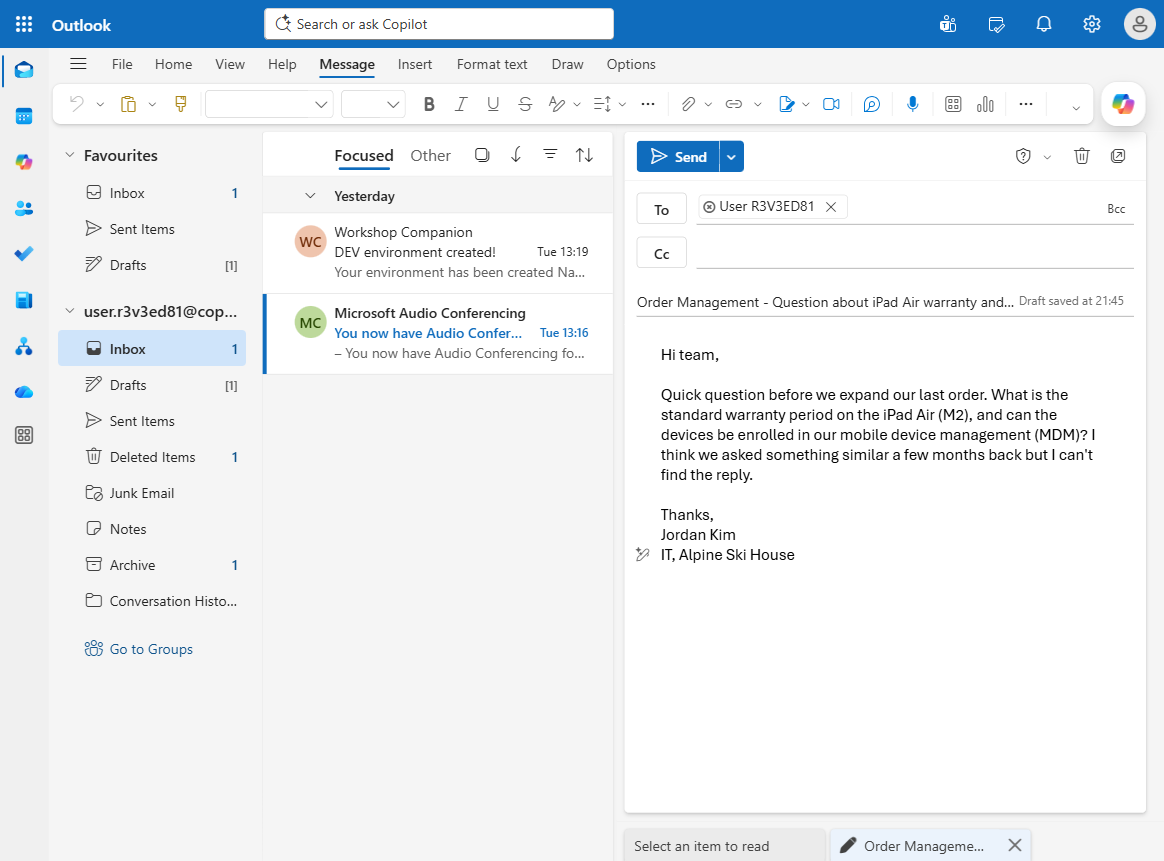
Open Outlook (outlook.office.com) and send the following email to your lab user account:
- Subject:
Order Management - Question about iPad Air warranty and MDM -
Body:
Hi team,

Quick question before we expand our last order. What is the standard warranty
period on the iPad Air (M2), and can the devices be enrolled in our mobile device
management (MDM)? I think we asked something similar a few months back but I can't
find the reply.

Thanks,
Jordan Kim
IT, Alpine Ski House
- Subject:
-
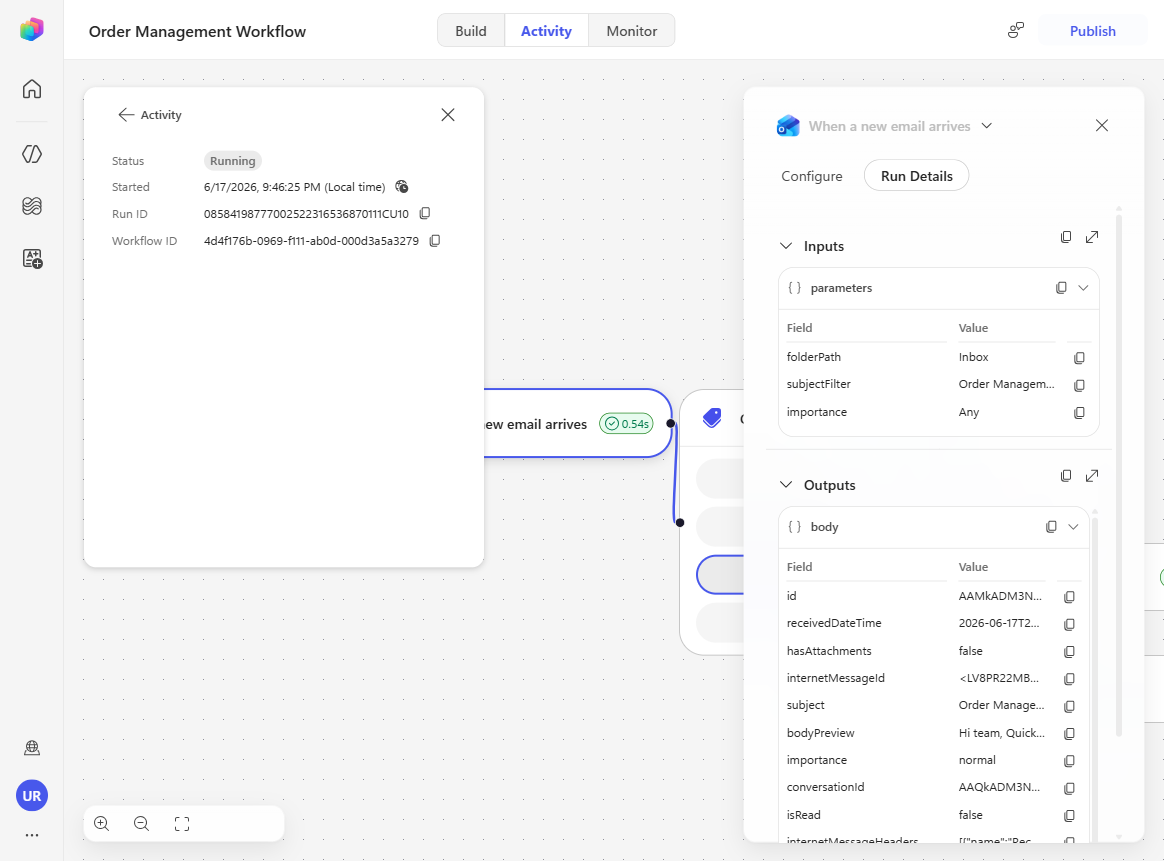
Return to the workflow and open the Activity panel. Refresh until the new run appears, then open it and observe the path: Classify → Customer Inquiry.
[!IMPORTANT] This path pauses at the approval step. If the run seems to stop, that is expected — the workflow is waiting for the Human review action to be completed from Outlook.
-
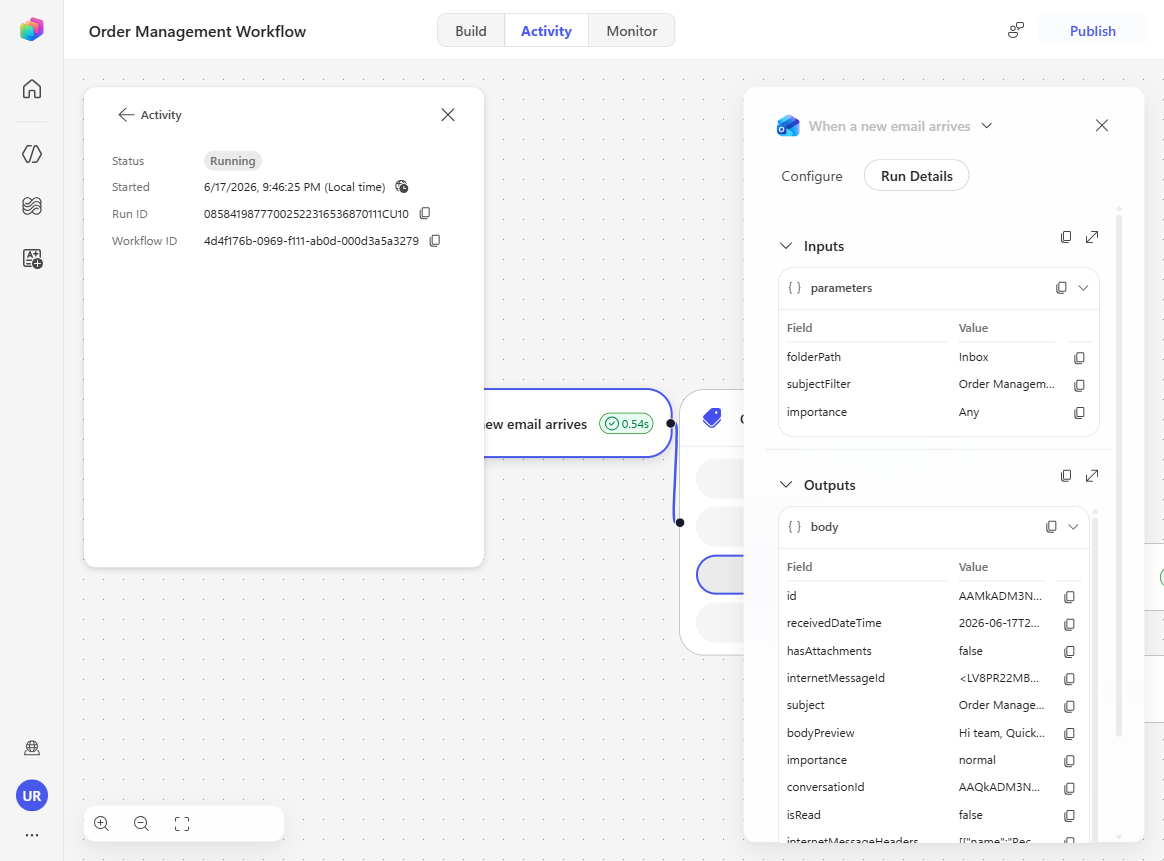
Wait until the run reaches the Human review node. The preceding Copilot node completes after drafting the response; Human review remains waiting until you submit a decision. Trigger pickup, drafting, and approval-email delivery are separate steps and may take several minutes. Refresh the run and your inbox rather than assuming that a pause is a failure.
-
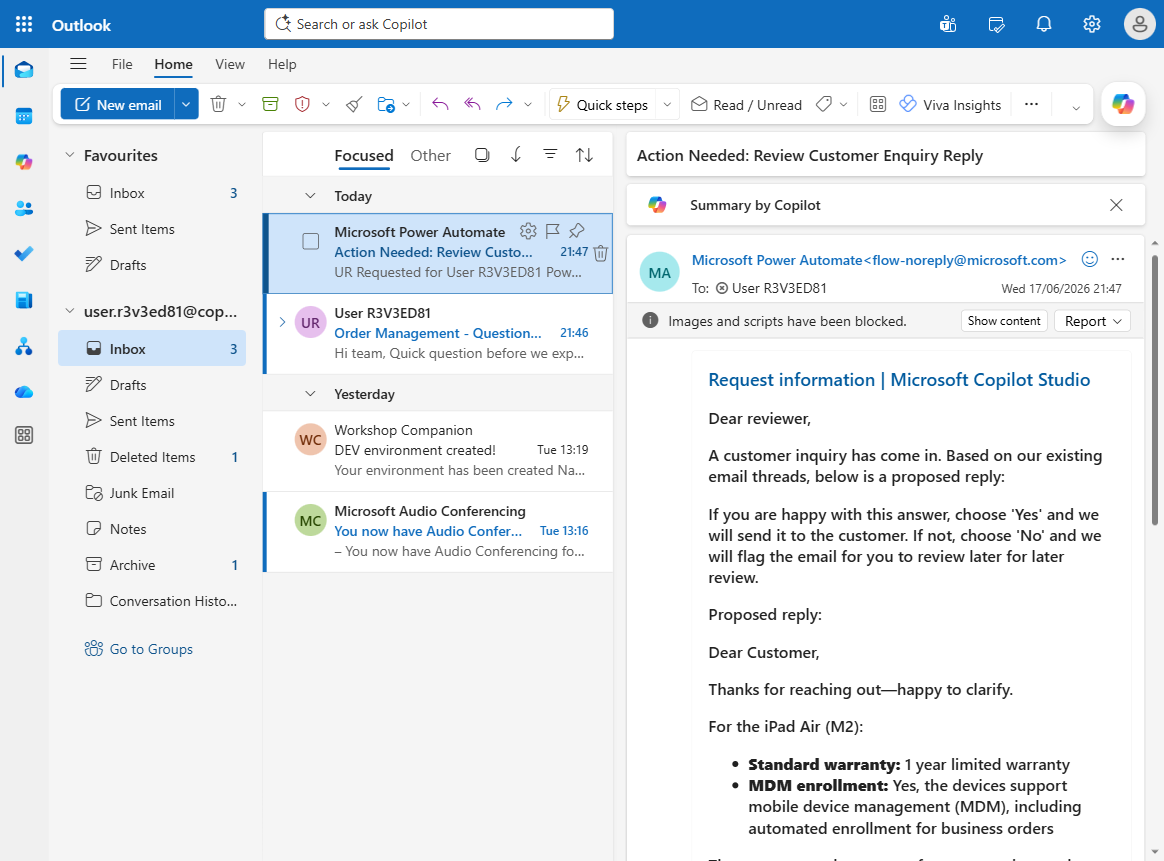
Go to Outlook and open the incoming approval email. It arrives from Microsoft Power Automate with the subject “Action Needed: Review Customer Enquiry Reply” and opens “Dear reviewer, A customer inquiry has come in…”. Review the proposed M365 Copilot reply, choose Yes under Send proposed reply?, and select Submit.
[!NOTE] The approval card is an actionable message, so Outlook renders the Yes/No choice and a Submit button inside the email itself — approving is two clicks (pick Yes, then Submit), not one. Outlook may also show a Trust sender prompt above the card; the card still works without actioning it.
[!TIP] If you don’t see the approval email, refresh Outlook and inspect the workflow run first. Confirm whether Copilot is still drafting or Human review is waiting, and check the reviewer address and Connection. Repair the connection only if it is unresolved or incorrect, then Save > Publish. Before sending another test, check whether the original run is still waiting so you do not create duplicate approval requests.
-
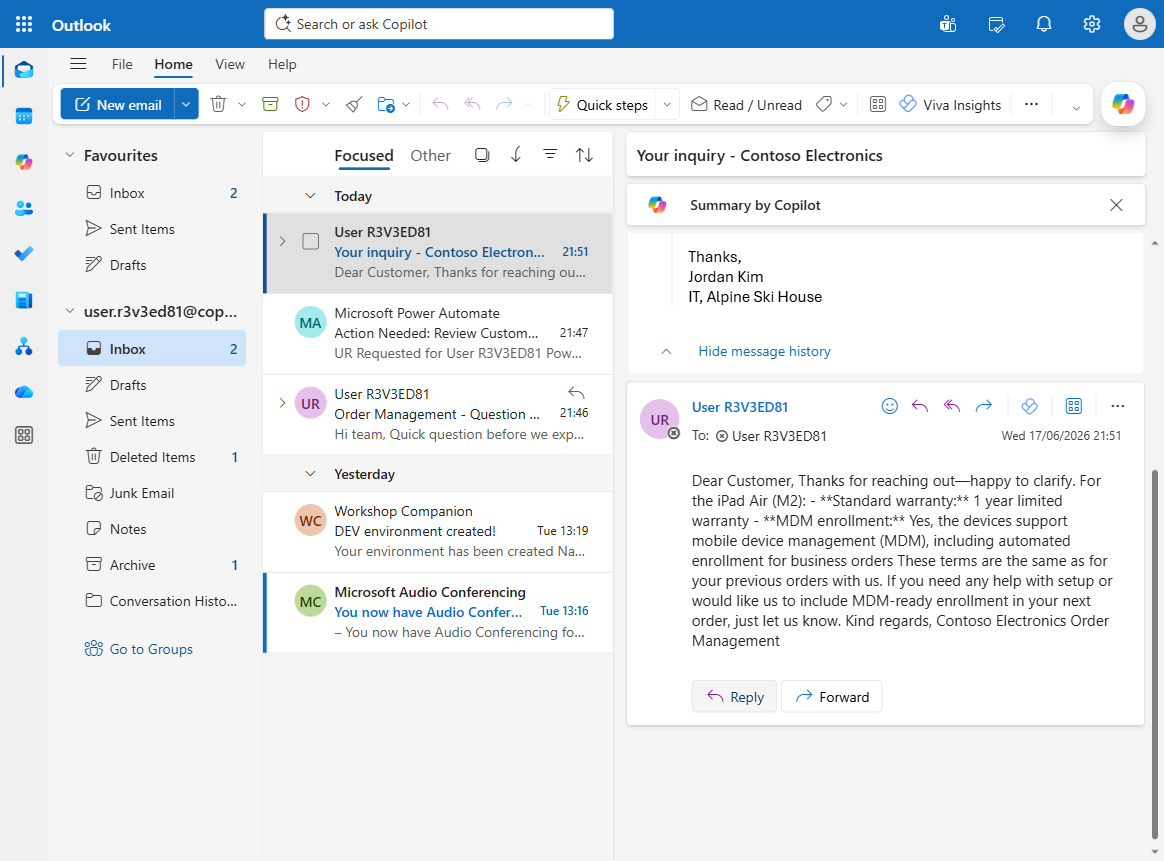
Return to your inbox and verify that the approved reply email lands there — it arrives with the subject “Your inquiry - Contoso Electronics” and opens “Dear Customer,”. This confirms the workflow resumed after human approval and sent the response automatically.
[!NOTE] Allow a couple of minutes after Submit. The workflow has to resume from the paused Human review node before it sends, so the reply does not appear instantly.
Congratulations! The Customer Inquiry path is now drafting, reviewing, and replying successfully.
You’ve confirmed that the workflow can generate a grounded response with M365 Copilot, pause for human approval, and then continue automatically based on the reviewer’s decision.
Use Case #4: Build an Inline Agent for Inventory Management
[!IMPORTANT] This use case needs the Warehouse MCP server already present in your environment. It is a custom connector, not a platform tool, and nothing earlier in this lab creates it — if it is missing, the Add tool step below has nothing to select. Two minutes now saves the detour: is it already loaded? In most delivery tenants it ships with the environment. If not, import it — the solution package is in this repo.
Extend the Supplier Delay branch with an inline Agent that uses MCP servers to reason over the delay notice, check current stock, and create a follow-up Dataverse Task.
Summary of tasks
In this section, you’ll add a new agent node to the Supplier Delay branch, connect the Warehouse and Dataverse MCP servers, define the agent’s instructions and structured output, publish the workflow, and test the scenario with a supplier delay email.
Scenario: A supplier warns that an incoming shipment is delayed. The workflow shouldn’t just forward the email — it should reason about the impact by checking current inventory, determine urgency, and create a structured Dataverse task so the replenishment team can act immediately.
Objective
Build and validate the Supplier Delay path of the Order Management Workflow by adding the Inventory Task Agent, equipping it with MCP tools, generating structured output, and verifying that it creates the expected Dataverse task after a test email is received.
Step-by-step instructions
Add and configure the Supplier Delay agent
-
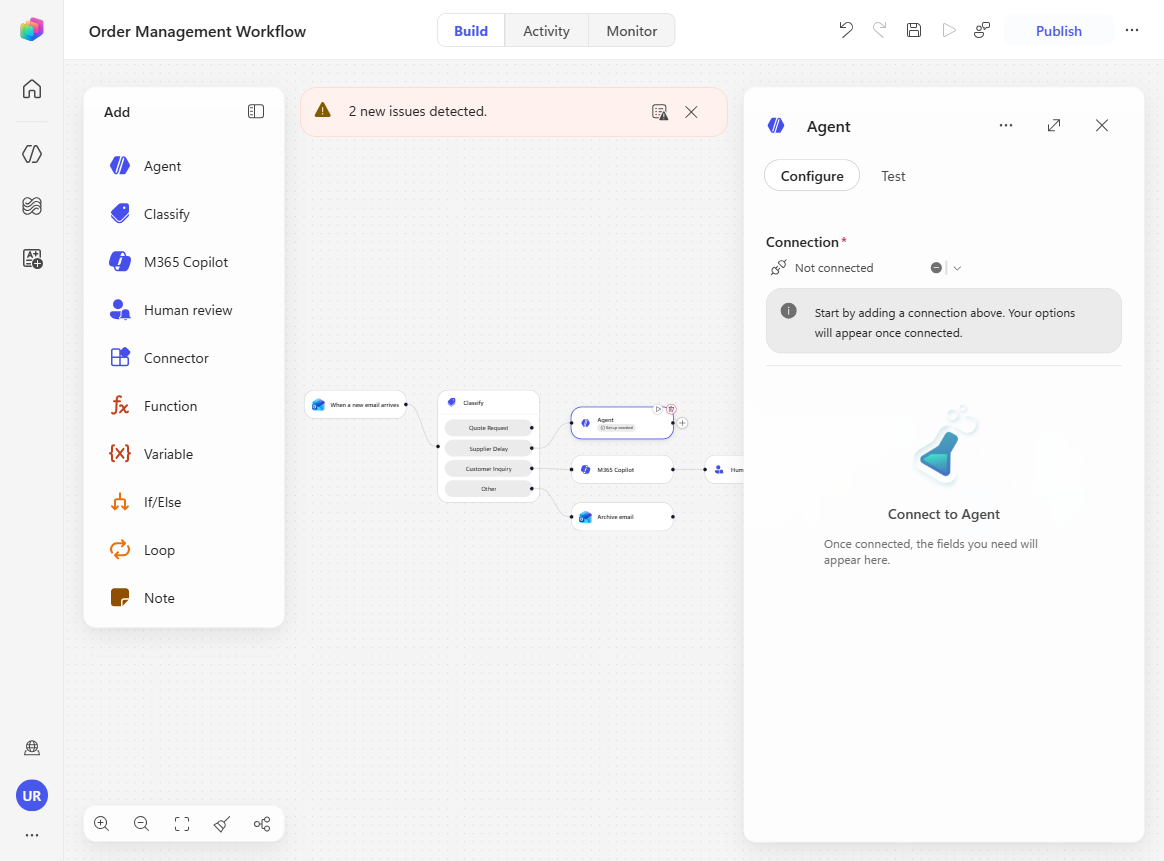
In the Classify node, locate the Supplier Delay category. Select the + next to that branch and choose Agent to add a new agent step for this path.
-
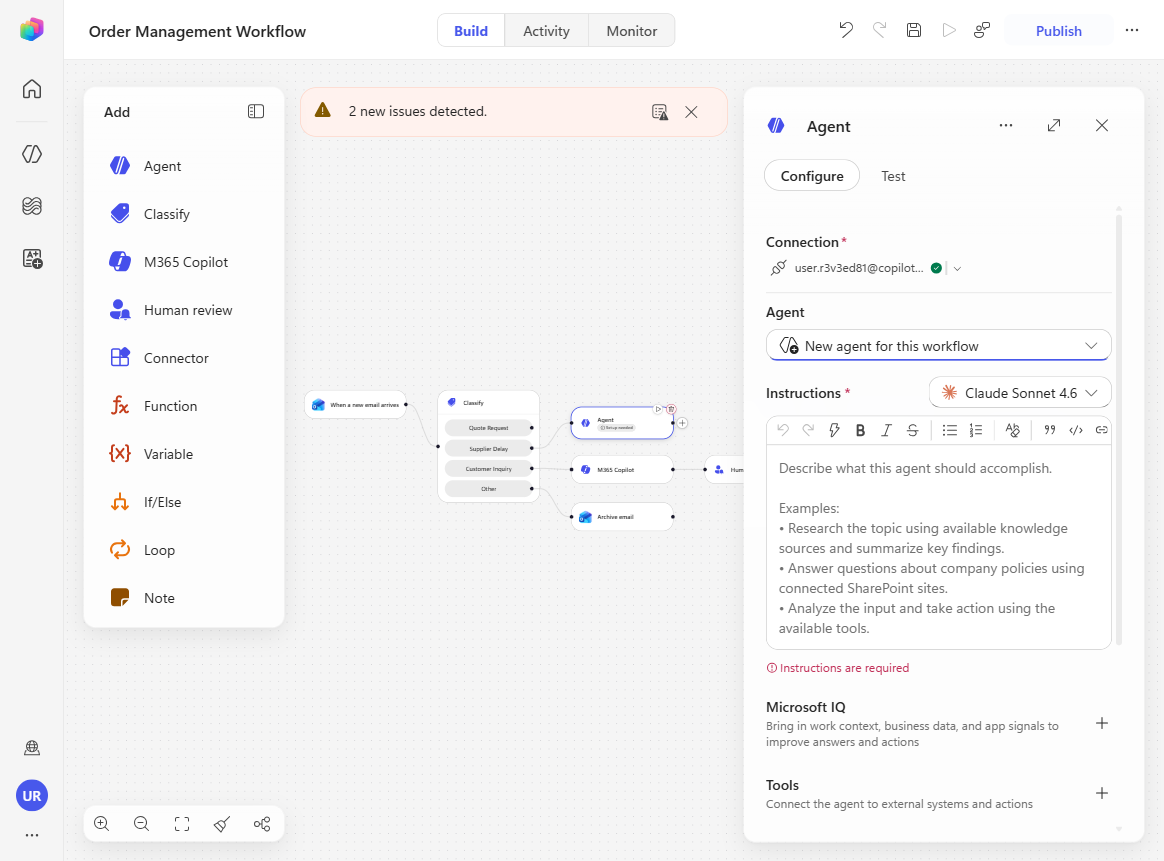
In the new node, leave Agent set to New agent for this workflow. This creates an inline agent dedicated to this workflow path. Keep the default AI model.
[!TIP] A strength of AI-native nodes in Workflows is that you can choose a different model per node. An example is an inline agent that runs on a Claude model for its reasoning, while the Classify node uses a lighter GPT model — a cost-optimization pattern. Matching the model to the work each node does keeps the workflow both capable and economical.
-
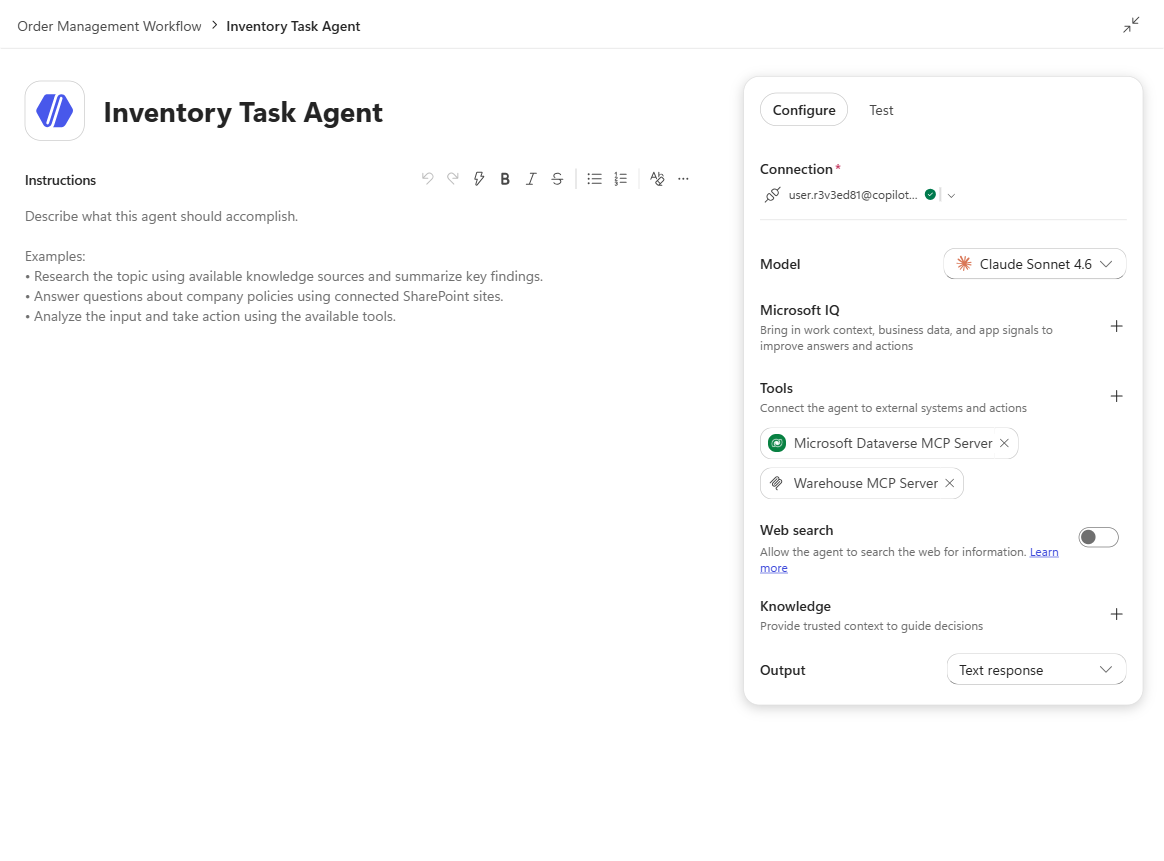
Select Expand (the two arrows next to …) so you can edit the full agent configuration, then rename the node title from Agent to Inventory Task Agent.
-
Under Tools, navigate to Model Context Protocol (MCP servers), then add and connect both of these tools:
- Microsoft Dataverse MCP Server
- Warehouse MCP Server (shown as Warehouse MCP in the tool details)
Sign in or connect as prompted so both tools show as available in the agent.
[!WARNING] Search for Warehouse under Model Context Protocol (MCP) and select Warehouse MCP Server. Its detail panel is titled Warehouse MCP. Check that it exposes Get restock date; do not choose an unrelated connector action with a similar name.
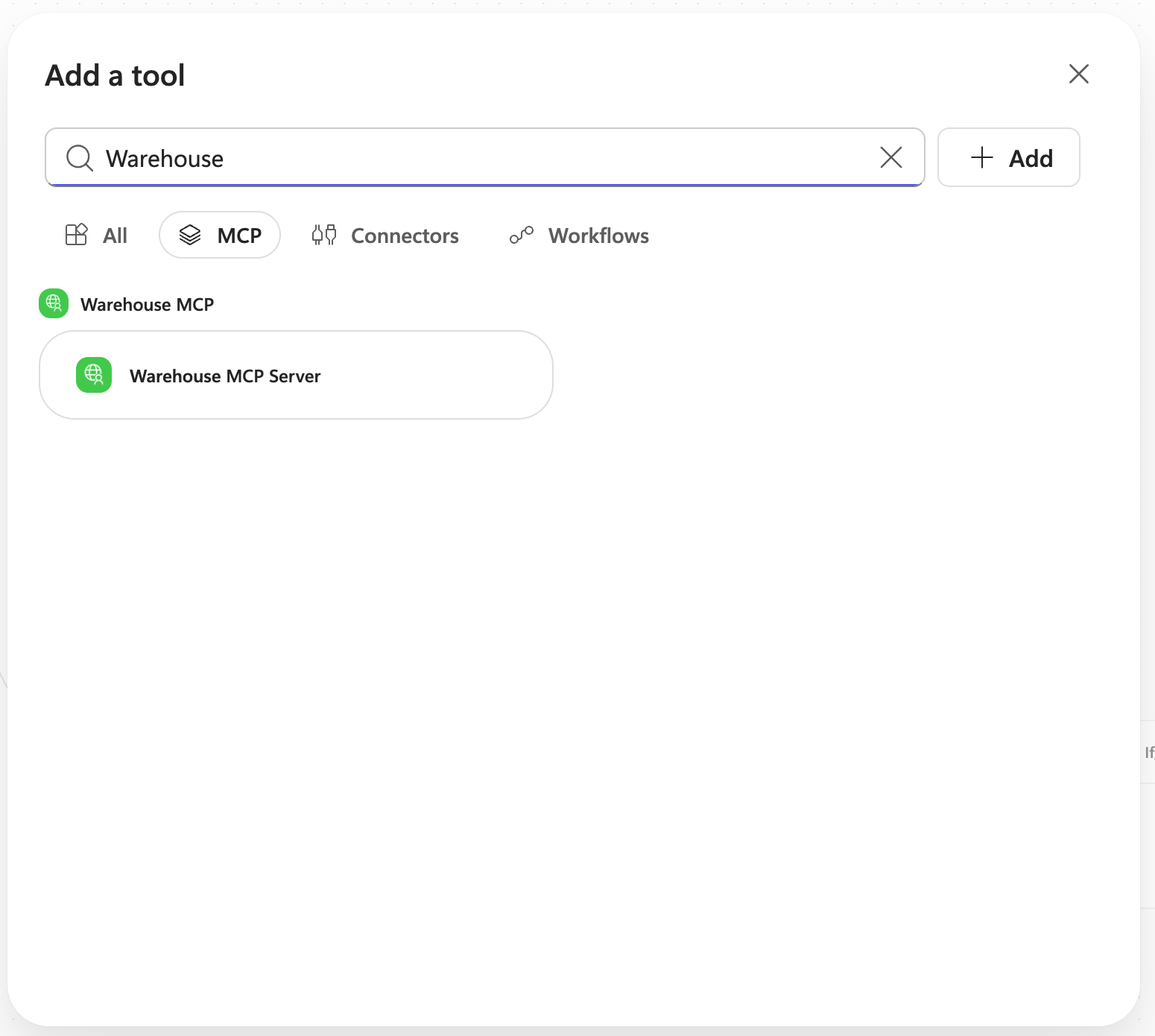
[!IMPORTANT] Inspect the tool’s operation list as well as its Connection. If the operations are already listed, keep the tool and connection as they are. Only if the panel says “No tools found”, check the connection reference and tenant availability first; if still unresolved, remove the tool from this agent and re-add it from Model Context Protocol (MCP). Save and publish the change, then verify that operations appear. A successful run alone does not prove a tool performed the expected action.
-
In the Instructions box, paste the following agent instructions:
Purpose
You triage supplier shipment-delay notices into restock tasks for Contoso Electronics. A delay notice names a delayed product but does not include stock levels, so you use the Warehouse tool to find the current stock and judge how urgent the delay is, then record a task in Dataverse.

Inputs
Delay notice: [email body]
Review by (Due Date): [due date]

Guidelines
Take the current stock and all restock details from the Warehouse tool; the email does not contain them.
Judge urgency from the current on-hand quantity: zero on-hand means the delay causes a stockout and is urgent; low but above zero means the buffer is at risk; healthy stock means the delay is tolerable.
The Warehouse is a sample-data service. If its next shipment date is in the past relative to the delay notice, state that the ETA is stale and must be reconfirmed. Do not invent a future shipment date or a warehouse location.

Steps
Read the product or SKU named in the delay notice.
Call the Warehouse restock-date lookup once, passing the exact SKU from the notice (no extra spaces). It returns the current quantity, next shipment date, expected quantity, and supplier. Do not call the stock-check tool.
Decide the urgency of the delay from the current on-hand quantity.
Use Dataverse to create one row in the Task table in the current environment, setting only these columns:
Subject: Restock delay - [product] ([SKU]).
Description: the current on-hand quantity; the next shipment date, the expected quantity, and the supplier returned by the tool; the urgency judgement; and a one-line action for the replenishment team. Include warehouse location only if the restock lookup supplies it. Flag a stale shipment date for reconfirmation.
Priority: High if the on-hand quantity is zero, otherwise Normal.
Due Date (scheduledend): set this to the exact Review by (Due Date) input above, which is the trigger email's arrival date and time plus three days.

Rules
Create exactly one Task row and set only the columns listed above.
If the product is not found in the Warehouse, record it as unrecognised for a person to check.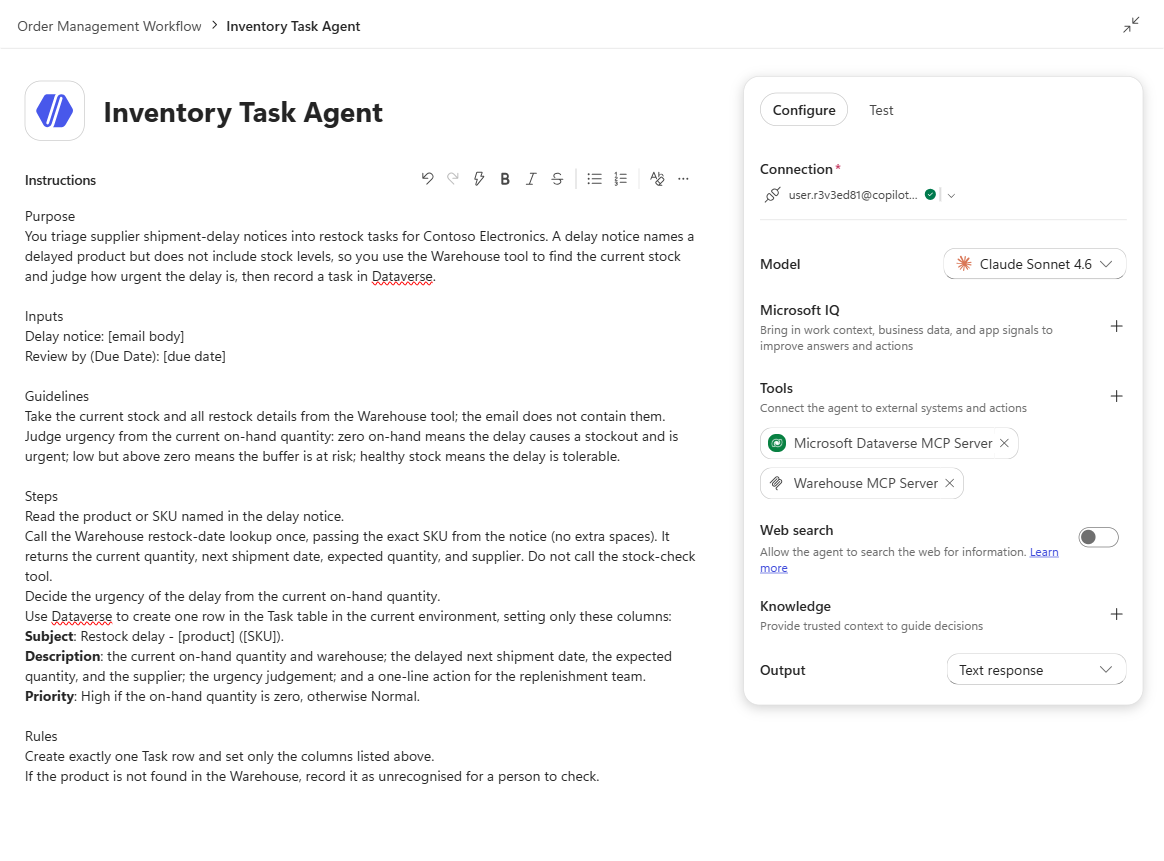
[!NOTE] The sample restock service may return a fixed shipment date (for example, April 22, 2026) and no warehouse location. These are tool-data limitations, not missing email fields. Record the actual response and flag a past ETA for confirmation; do not call the prohibited stock-check tool to fill the location. The Task’s Due Date is independent of the shipment ETA.
-
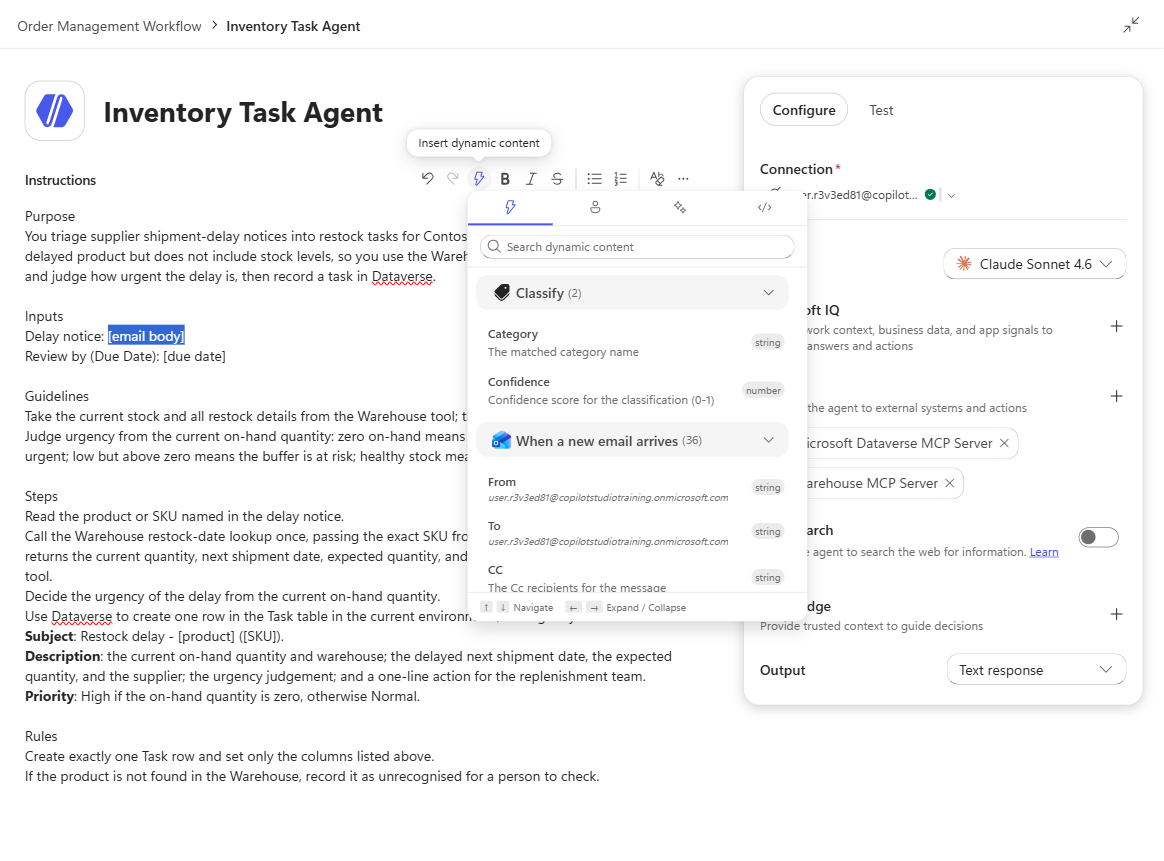
Replace the placeholders in the instructions with dynamic content:
- Select
[email body], choose the lightning icon, search for body, and insert Body from When a new email arrives. - Select
[due date], choose the lightning icon, then look above the search bar for the diamonds icon — Ask Copilot to generate an expression. - Enter: Add 3 days to the date and time of arrival of the trigger email
-
Confirm Copilot returns:
addDays(triggerOutputs()?['body/receivedDateTime'], 3)Select Insert.
- Select
-
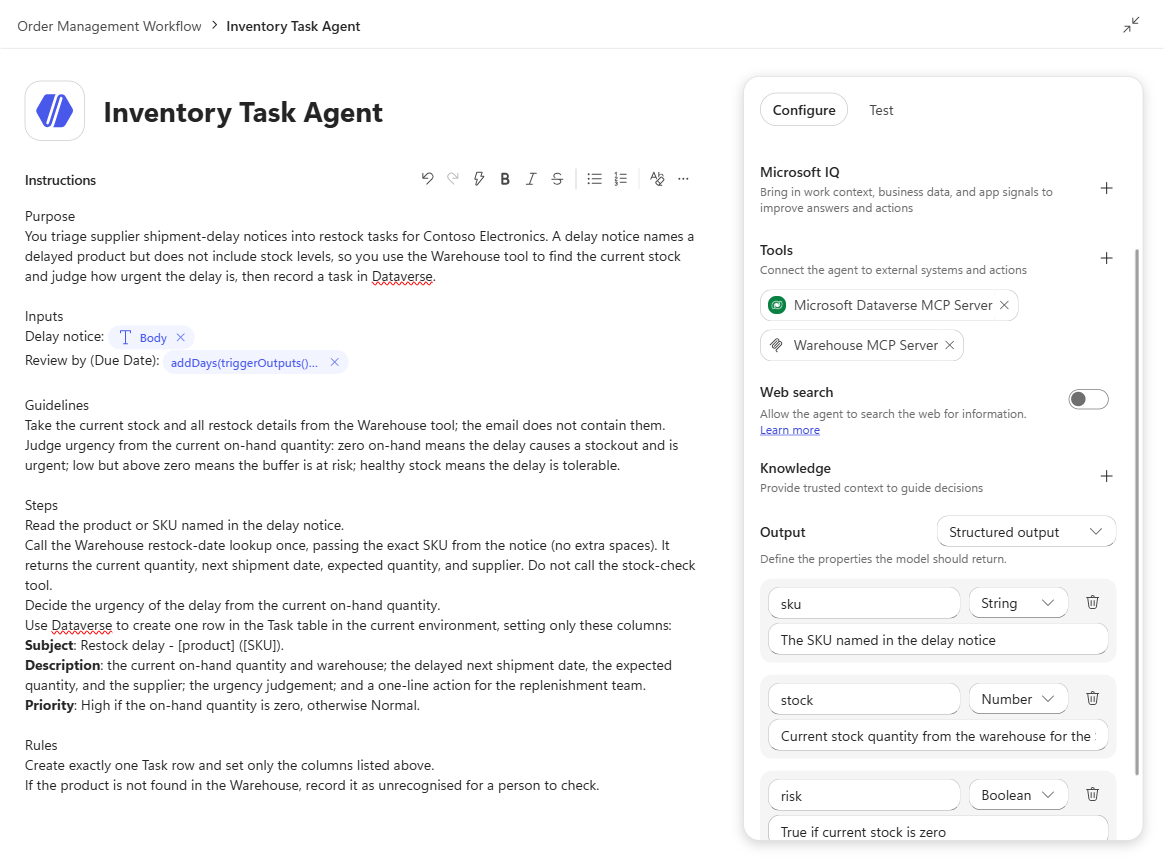
Scroll to the Output section and change the dropdown to Structured output. Add these three properties:
sku(Text, JSONstring) — The SKU named in the delay noticestock(Number, JSONnumber) — Current stock quantity from the warehouse for the SKU namedrisk(Yes/No, JSONboolean) — True if current stock is zero
[!TIP] “Request human assistance when unsure”: Notice the button in the agent configuration panel. This feature sends a structured message to the connection owner when the agent encounters ambiguity or conflicting information — it dynamically generates questions based on the problem at hand, allowing human judgment for edge cases while keeping the automation running.
-
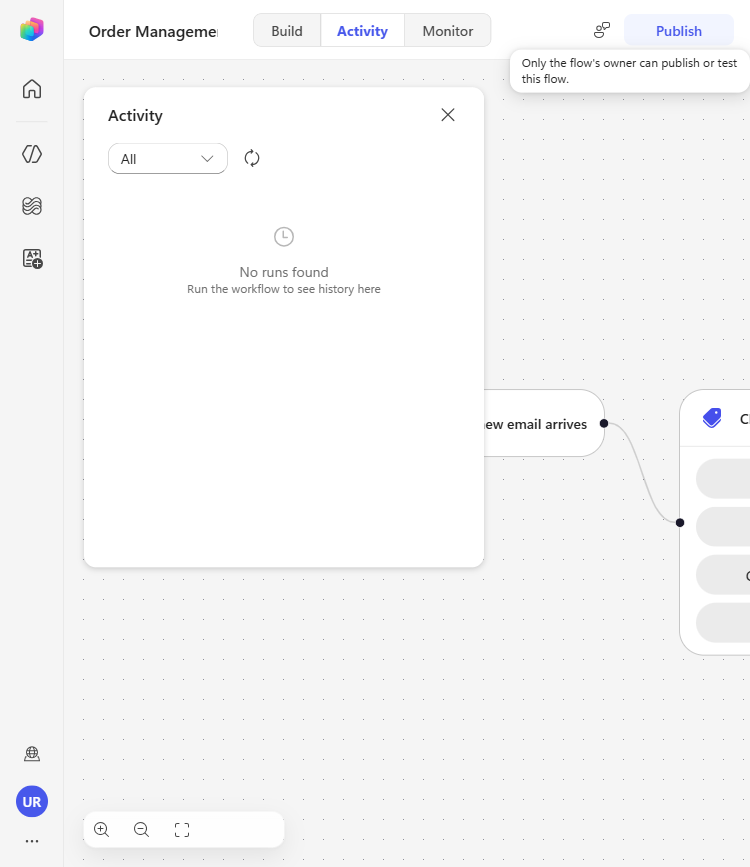
Minimize the view, then select Save and Publish so the Supplier Delay branch is live with the new agent configuration.
Test the Supplier Delay path
-
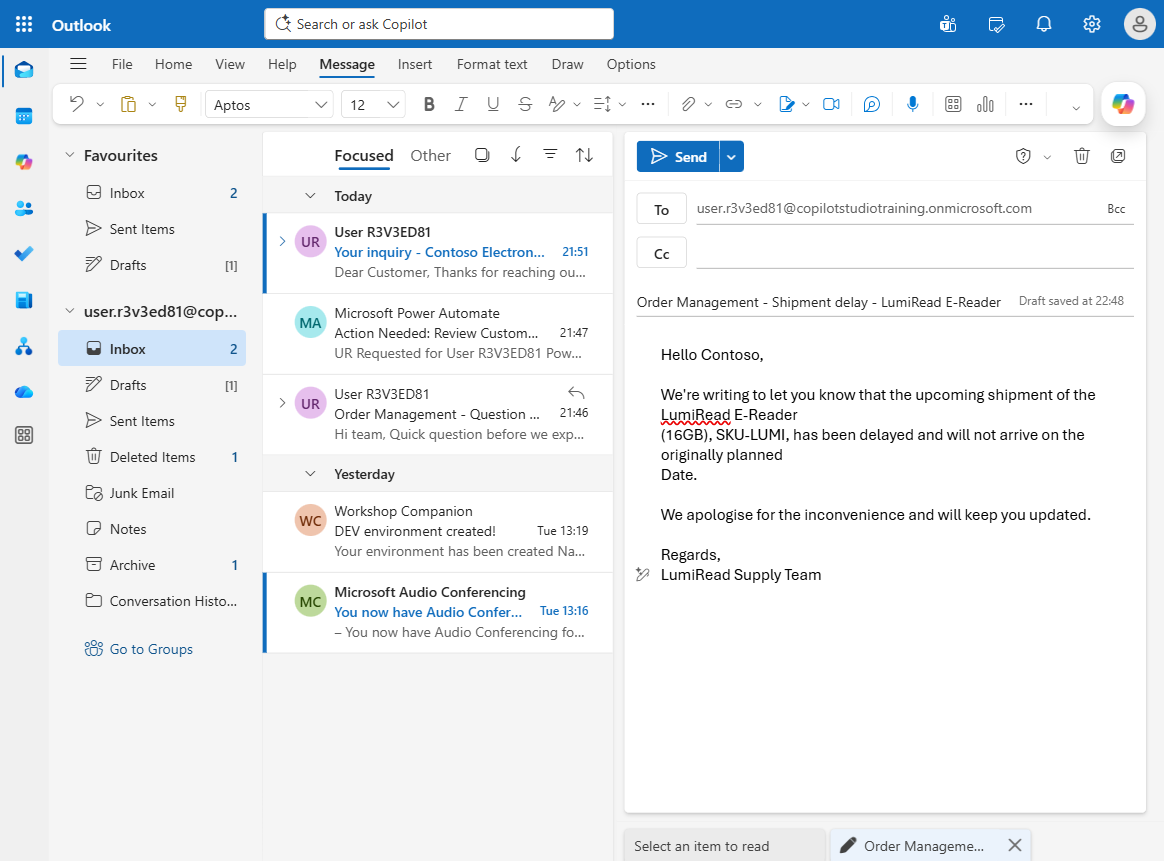
In Outlook, send the following email to your lab user account:
- Subject:
Order Management - Shipment delay - LumiRead E-Reader -
Body:
Hello Contoso,

We're writing to let you know that the upcoming shipment of the LumiRead E-Reader
(16GB), SKU-LUMI, has been delayed and will not arrive on the originally planned
date.

We apologise for the inconvenience and will keep you updated.

Regards,
LumiRead Supply Team
- Subject:
-
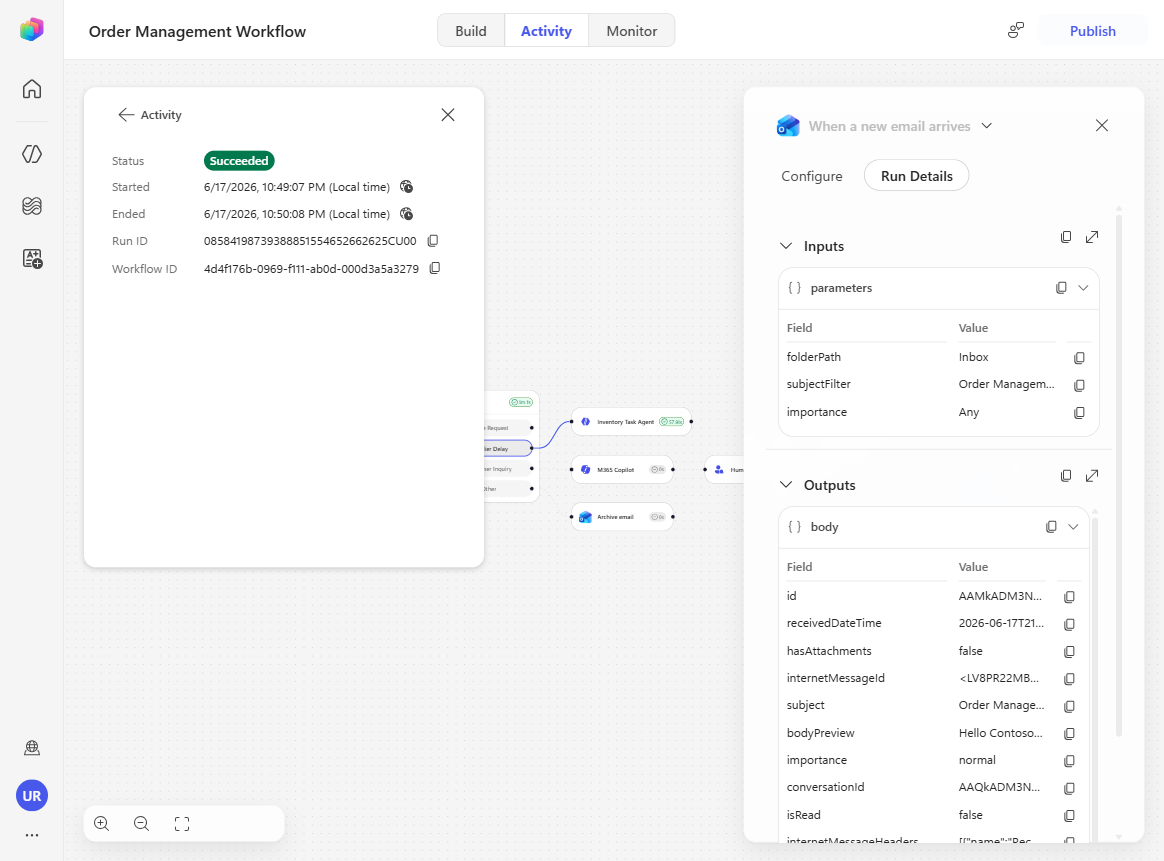
Return to the workflow’s Activity panel, refresh until the run appears, and open it. Observe the path: Classify → Supplier Delay → Inventory Task Agent.
-
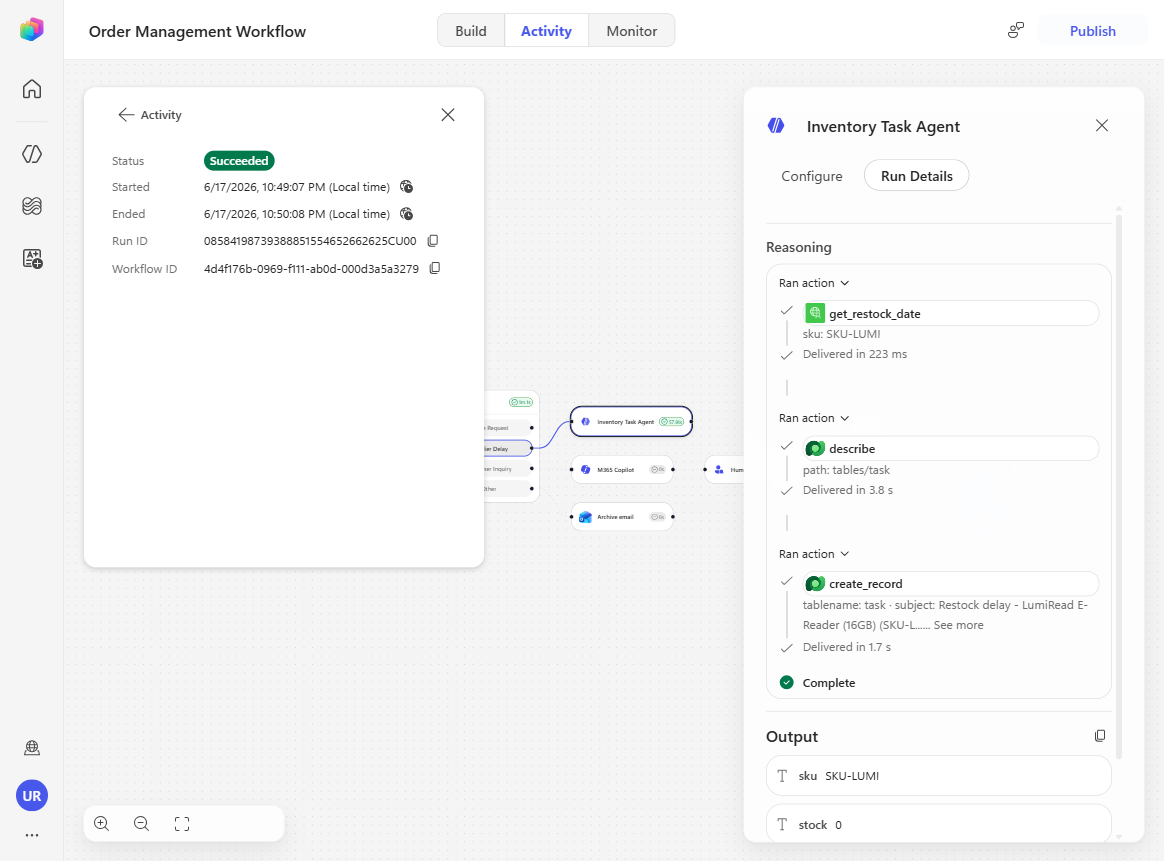
Select the Inventory Task Agent node in the run details and scroll through the tool runs. You should see the warehouse lookup and the Dataverse describe/create operations executed by the agent:
- Using the Warehouse MCP, the agent looks up the current stock for the delayed product (the SKU named in the email).
- Using Dataverse, it then inspects the Task table and creates a new row there, filling in the subject, description, priority, and due date exactly as the instructions specified.
Together, these tool calls show how the agent turned an unstructured delay email into a concrete, trackable restock task.
-
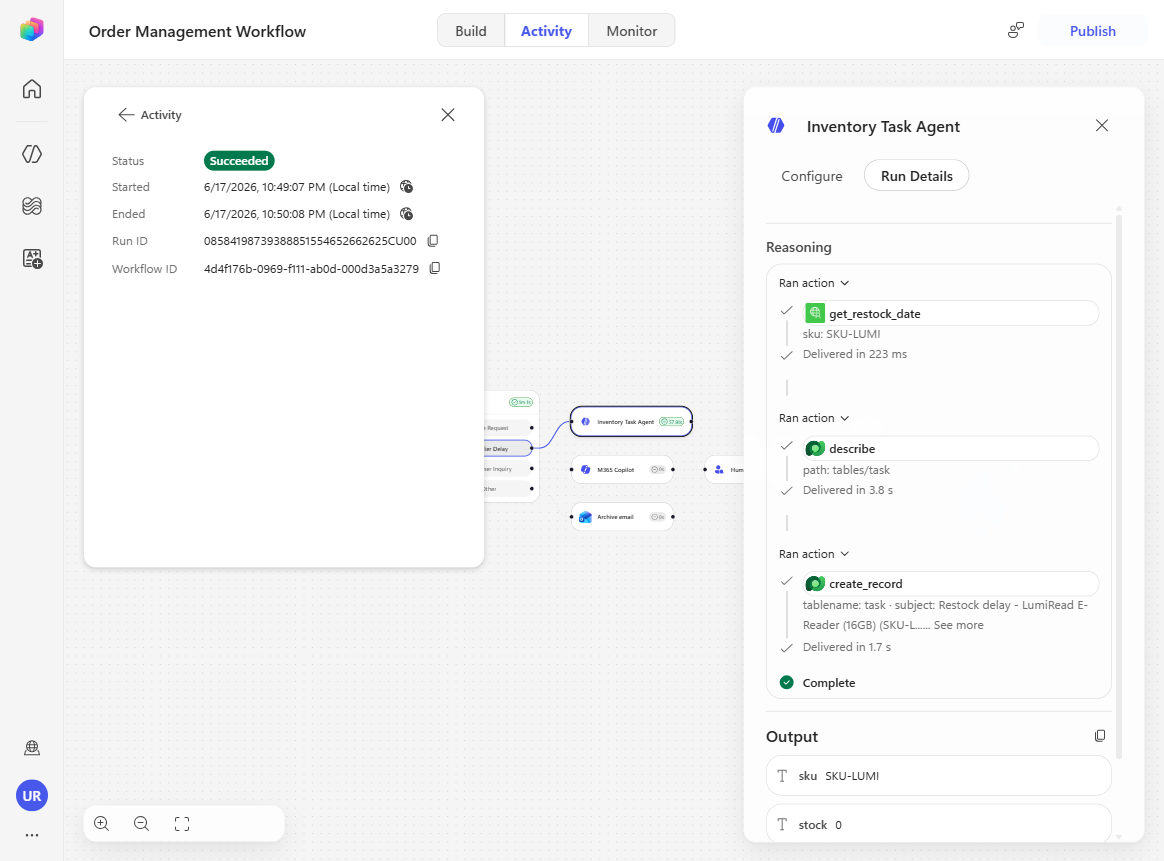
In the same run details, review the structured output and confirm it contains:
sku = SKU-LUMIstock = 0risk = true
-
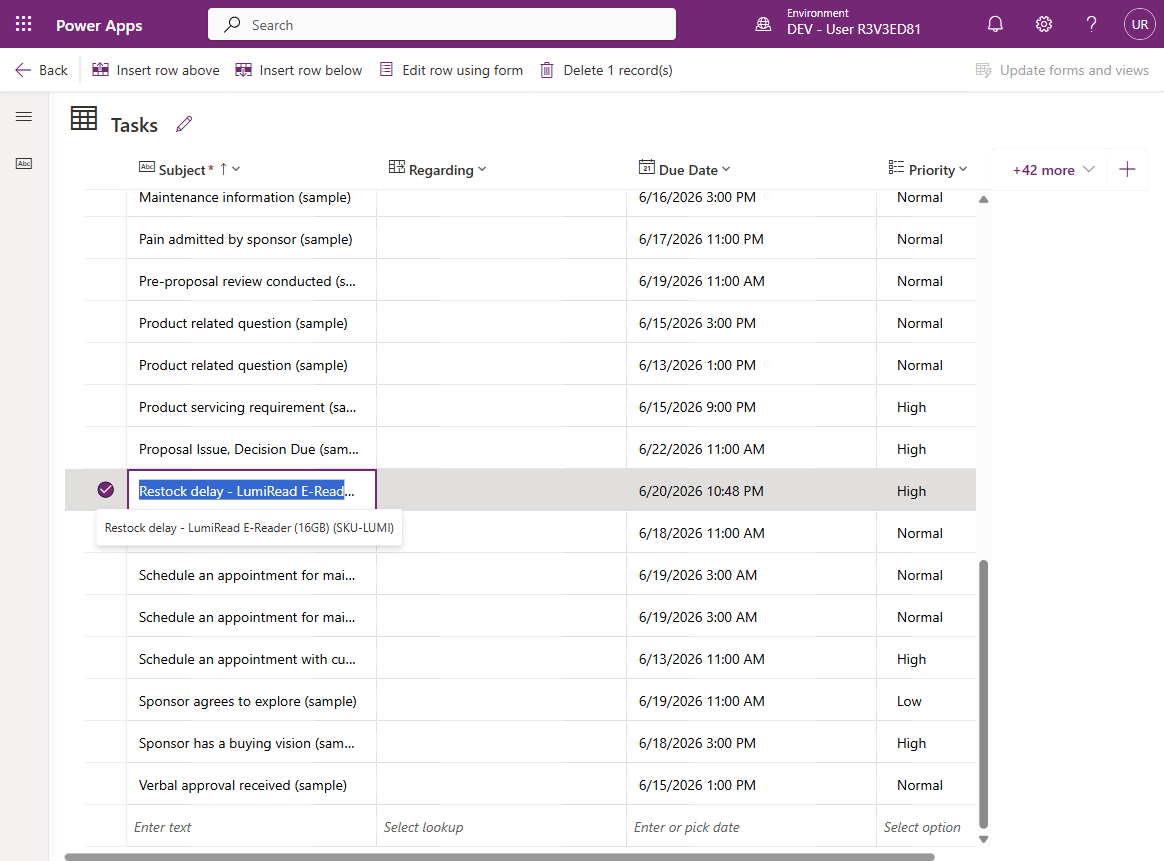
Open Power Apps (make.powerapps.com), navigate to Tables → Task, and find the newly created row Restock delay - LumiRead E-Reader (16GB) (SKU-LUMI). Refresh the grid and scroll to the row, or use the Subject column menu’s Filter by option. The +N more control adds existing columns, not more rows; use it to show Created On and Description. If earlier tests created rows with the same subject, identify the newest by Created On. Verify Due Date equals the trigger email’s arrival date and time plus three days, and Priority = High. Check the actual row even if the workflow run succeeded; a blank Due Date is not a pass. Displayed times may use your local time zone.
Congratulations! The Supplier Delay path is now using an MCP-powered inline agent.
You’ve added a reasoning agent that enriches a supplier delay notice with warehouse tool data, creates a Dataverse task, and emits structured output for downstream visibility.
Use Case #5 (Bonus): Call a Price Quote Specialist Agent from a Workflow
Optional bonus — outside the core lab duration. Connect the Quote Request branch to a reusable Price Quote Agent that combines SharePoint knowledge, Dataverse account data, and Mail to produce and send a professional quote. The agent ships inside the imported solution and may already be Published; inspect its state and publish any changes before using it.
Summary of tasks
In this section, you’ll inspect the existing Price Quote Agent, wire it into the Quote Request branch, pass the sender and email body as dynamic inputs, publish the workflow, and verify the generated quote email end-to-end.
Scenario: A customer asks for pricing on a bundle of products. Rather than rebuilding the quote logic inside the workflow, you can reuse a purpose-built agent that knows how to look up pricing guidance, combine it with product catalog data, and send a polished quote response.
Objective
Publish the Price Quote Agent, configure the Quote Request path to use it, provide it with the email sender and request body at runtime, and verify that it completes the quote process and sends the resulting email.
Step-by-step instructions
Inspect the reusable Price Quote Agent
-
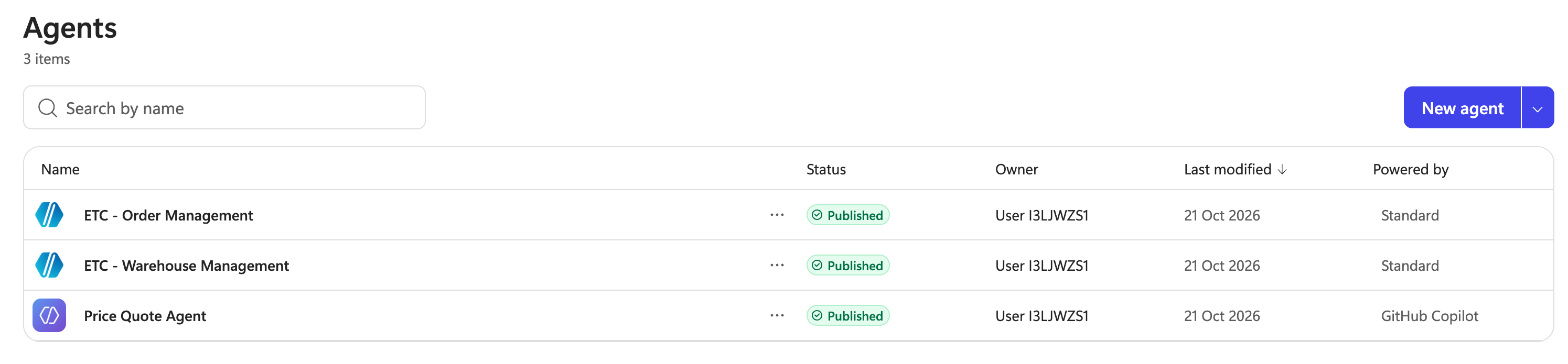
In Copilot Studio, select Agents in the left navigation and find Price Quote Agent. There is no New experience toggle to enable in the current Agents list.
-
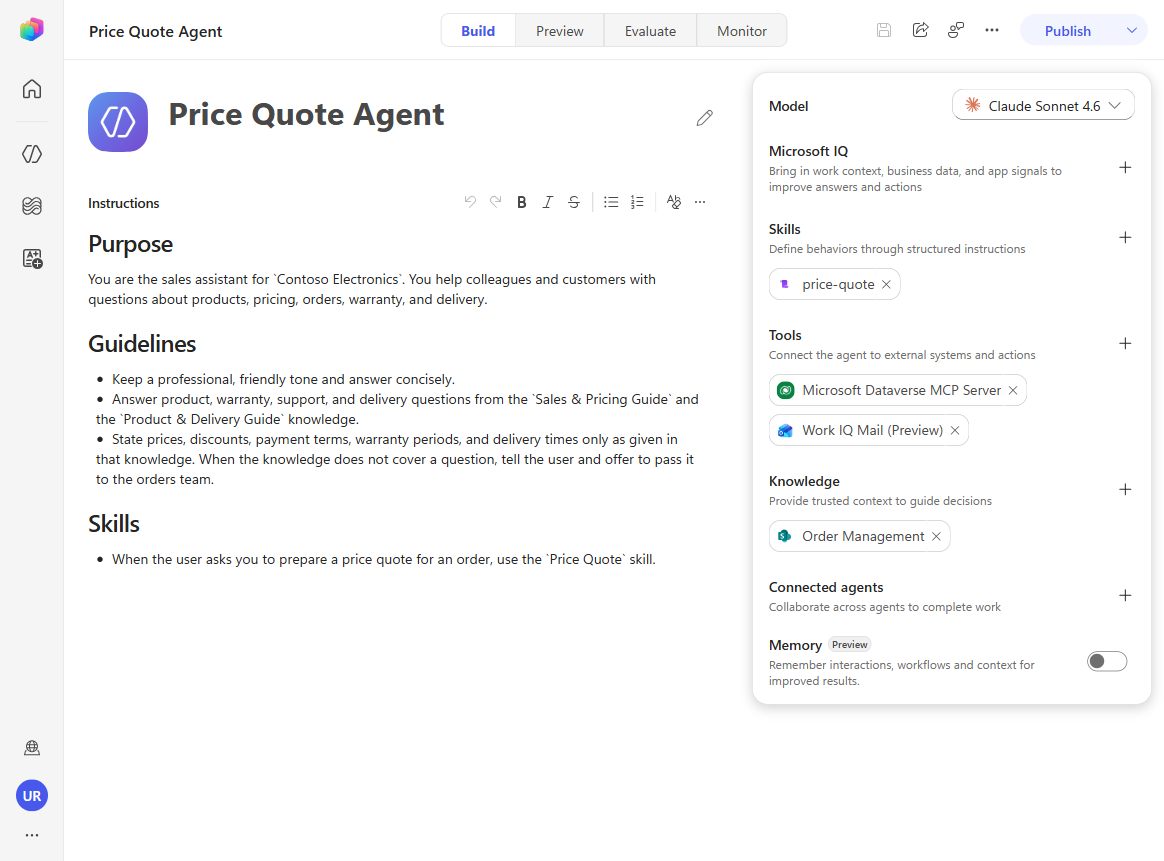
Open Price Quote Agent. In the Build tab, inspect the agent and confirm these components are present on the right-hand panel:
- Tools: Microsoft Dataverse MCP Server and Mail (formerly Work IQ Mail (Preview))
- Knowledge: Order Management (SharePoint knowledge source with pricing guidance, customer tiers, and related policy)
- Skills: price-quote — the structured skill for composing and sending the quote email
- On the left, the Instructions pane holds the agent’s broad, conversational guidelines about handling price questions. Notice they stay deliberately high-level: the precise, procedural steps live in the price-quote skill instead — a best practice that keeps the instructions readable while the repeatable logic is encapsulated in a skill.
-
Confirm each MCP tool lists its operations. Open Tools > Mail, then Tools > Microsoft Dataverse MCP Server, and check each panel:
- Connection — if it shows Not Connected, select Create new connection > Create and Confirm, signing in with your lab account.
- Tools / Inputs — this must list the operations the server exposes. Mail should show operations such as Add draft attachments, Update draft, and Send email with attachments; Microsoft Dataverse MCP Server should show Read query, Create record, and Update record (operation identifiers
read_query,create_record, andupdate_record).
If both panels already list operations, keep the existing tools and connections. If either reads “No tools found”, first check the connection reference and tenant availability described below. If still unresolved, remove only that tool from the agent’s Tools list, choose Add tool, open Model Context Protocol (MCP), pick the same server, then Save and publish. Reopen the tool to verify its operations before continuing.
[!IMPORTANT] Check operations as well as Connection. A connected tool can still have an empty operation list. Do not recreate a healthy connection or remove a working tool as a routine setup step.
If it is Microsoft Dataverse MCP Server that lists nothing, also check Dataverse connection reference — do this first — an unbound connection reference produces the same empty tool list, and re-adding the tool alone will not fix that one.
If required operations are unavailable, a run may still report Succeeded while the agent explains that it could not use the connectors. That is not a completed quote test: verify the account lookup and actual delivered email. If the list stays empty after repair, ask your instructor whether the Dataverse MCP and Mail servers are enabled for this tenant; inspect the run output for the exact limitation.
-
Open the price-quote skill and read through what it does. The skill spells out exactly how to build a quote: read the customer name and the requested items from the request, use Dataverse to look up the customer’s account and employee count and derive their pricing tier (Small / Mid / Large), take each item’s SKU and list price from the Sales & Pricing Guide, then calculate the line totals, subtotal, tier discount, and final total. It finishes by reading the payment terms and delivery lead time and using Work IQ to email a fully formatted quote to the customer — applying only the prices and discounts found in the knowledge, never estimates.
-
Check the agent’s publication state. If it is already Published and you made no changes, continue. Otherwise, save and Publish (or Save and publish, as offered) before returning to the workflow.
Configure the Quote Request branch
-
Return to the Order Management Workflow and locate the Quote Request category in the Classify node.
-
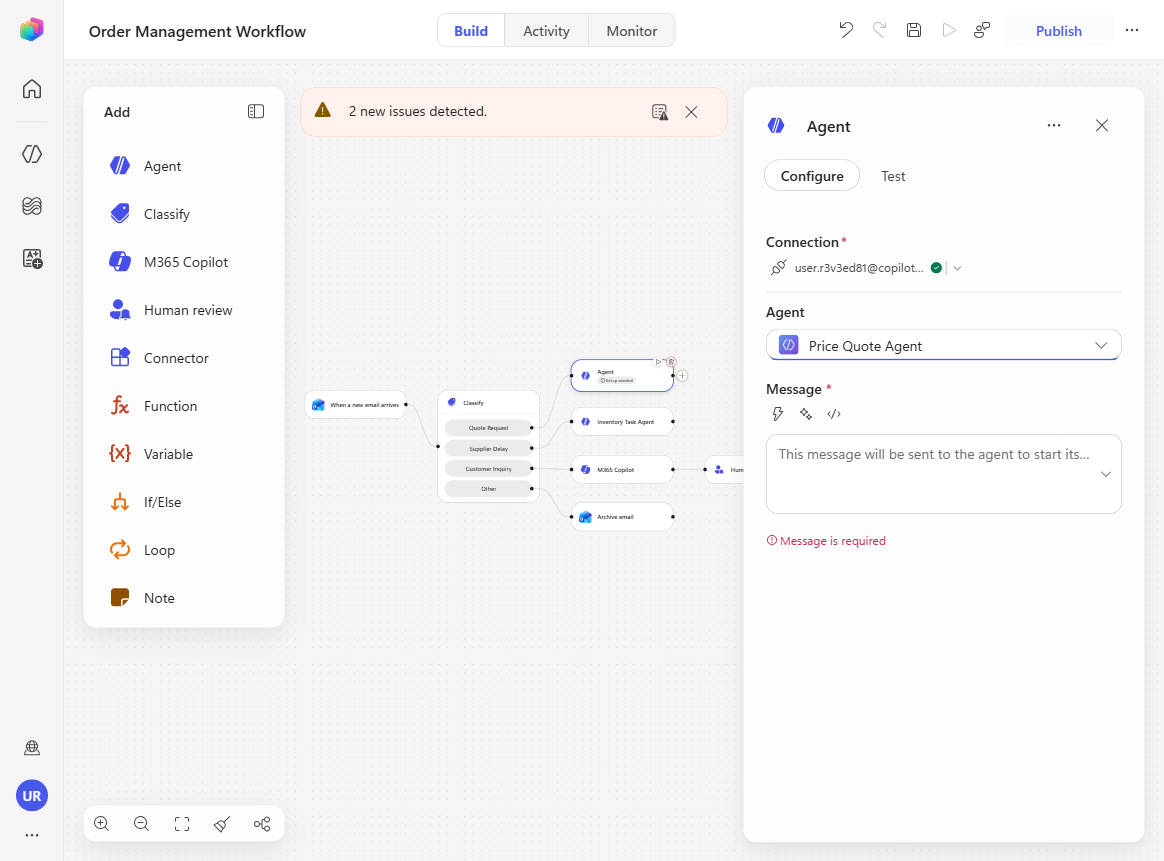
Select the + next to Quote Request and choose Agent.
-
In the Agent dropdown, select Price Quote Agent — the agent whose publication state you verified in step 5.
[!IMPORTANT] Only published agents appear in the dropdown: When using the Agent node with an existing agent, only agents that have been published (not just saved) will appear in the agent selection dropdown. If your agent is missing from the list, go to the agent page and publish it first.
-
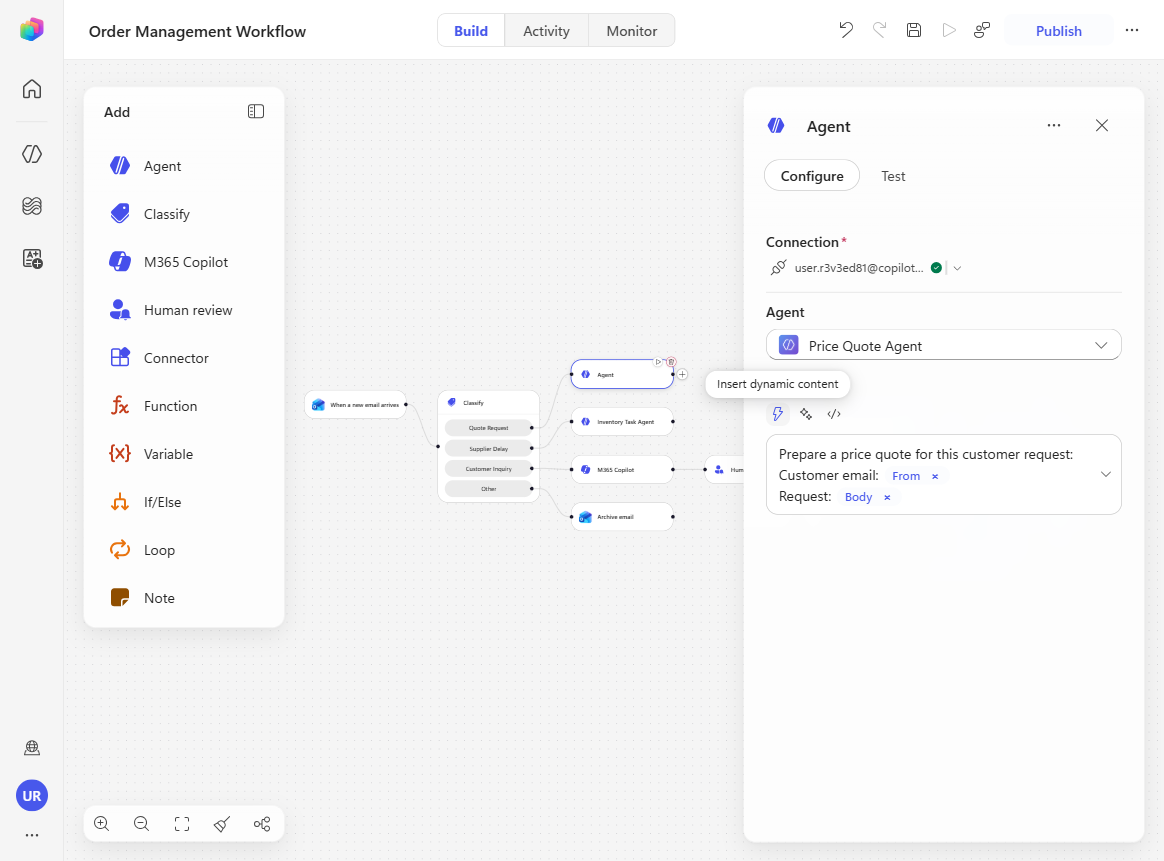
In the Message field, enter:
Prepare a price quote for this customer request: Customer email: [email sender] Request: [email body] -
Replace the placeholders with dynamic values:
- Replace the
[email sender]placeholder (select the arrow >), choose the lightning icon, search for from, and insert From. - Replace the
[email body]placeholder (select the arrow >), choose the lightning icon, search for body, and insert Body.
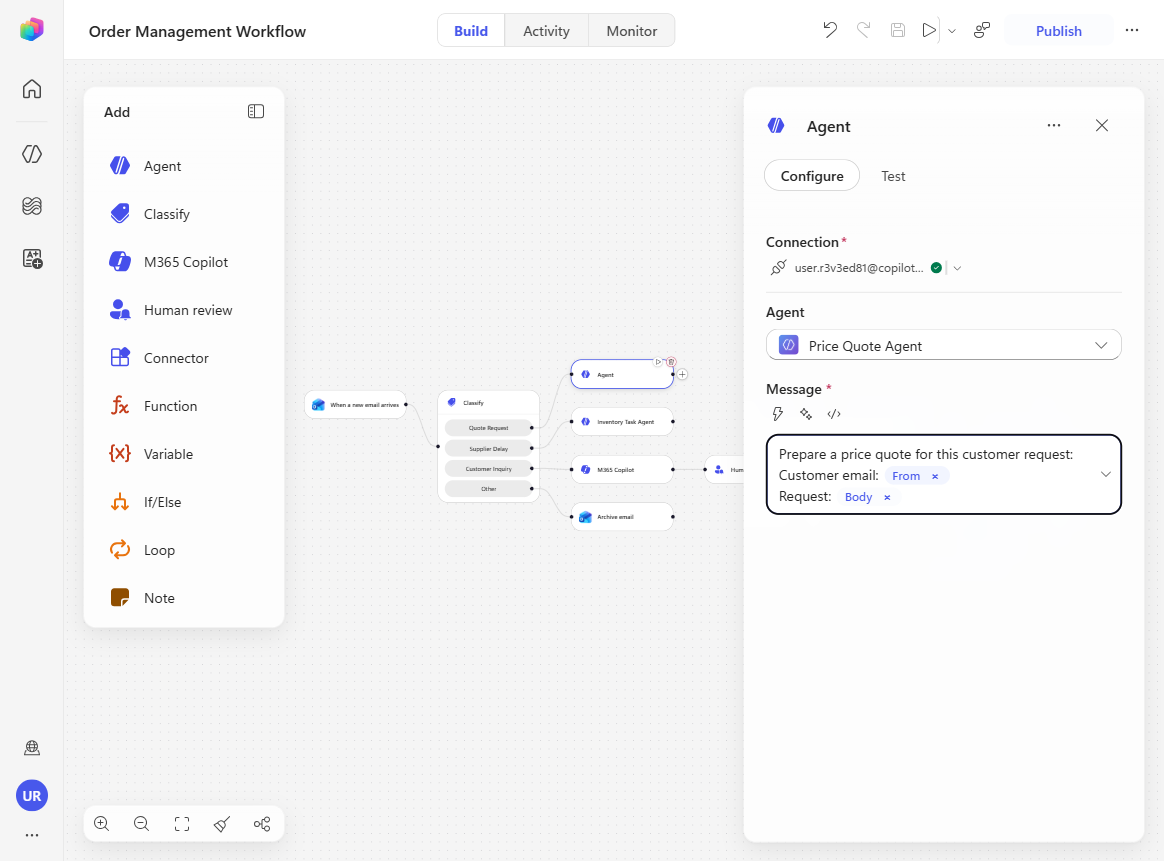
Confirm the final message contains the From and Body tokens and no literal [email sender] or [email body] text. If insertion leaves a placeholder beside the token, delete only the leftover placeholder.
-
Select Save, then Publish.
Test the Quote Request path
-
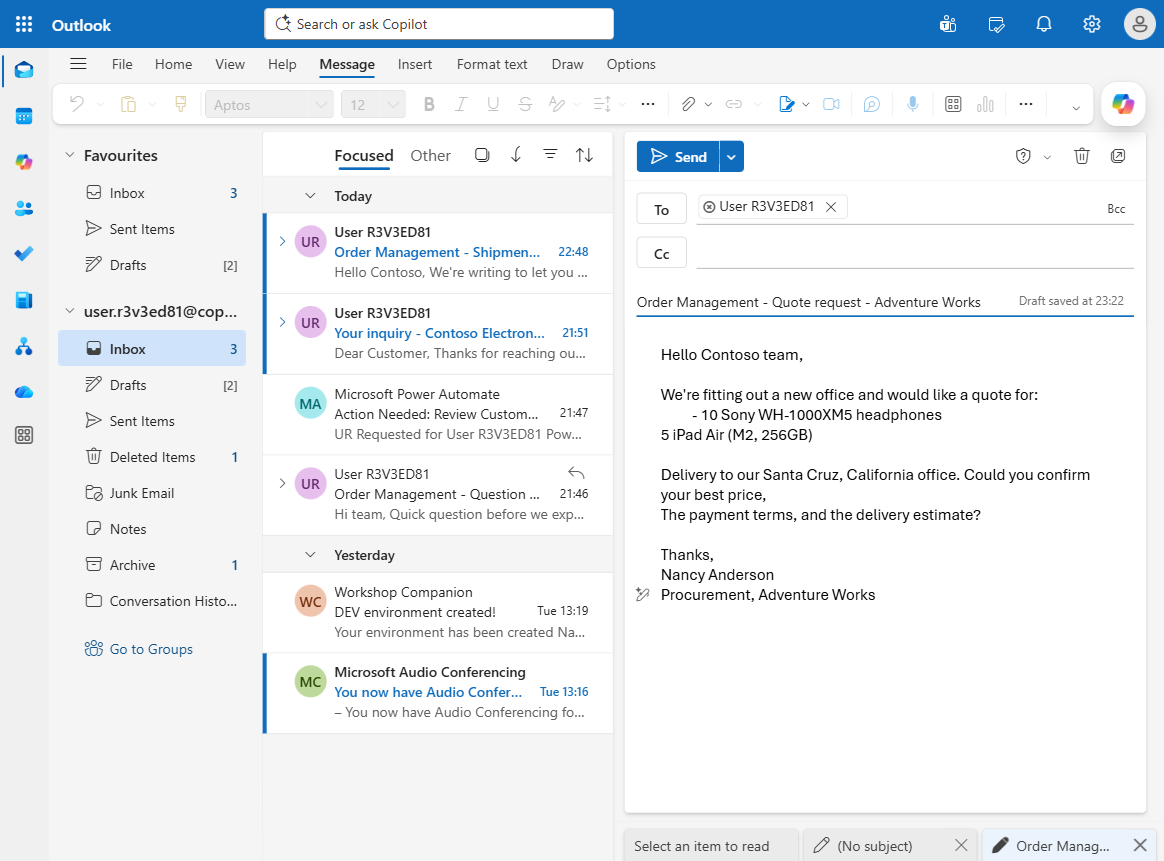
In Outlook, send the following email to your lab user account:
- Subject:
Order Management - Quote request - Adventure Works -
Body:
Hello Contoso team,

We're fitting out a new office and would like a quote for:
- 10 Sony WH-1000XM5 headphones
- 5 iPad Air (M2, 256GB)

Delivery to our Santa Cruz, California office. Could you confirm your best price,
the payment terms, and the delivery estimate?

Thanks,
Nancy Anderson
Procurement, Adventure Works
- Subject:
-
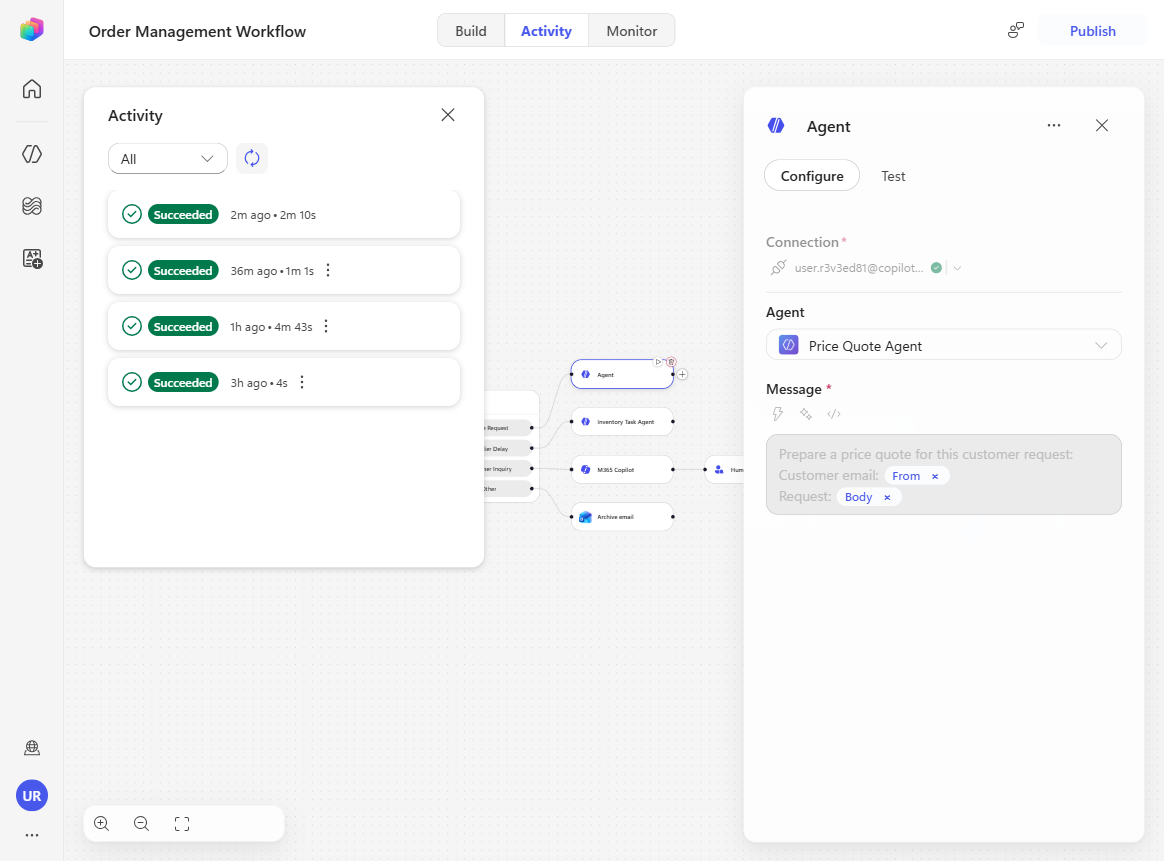
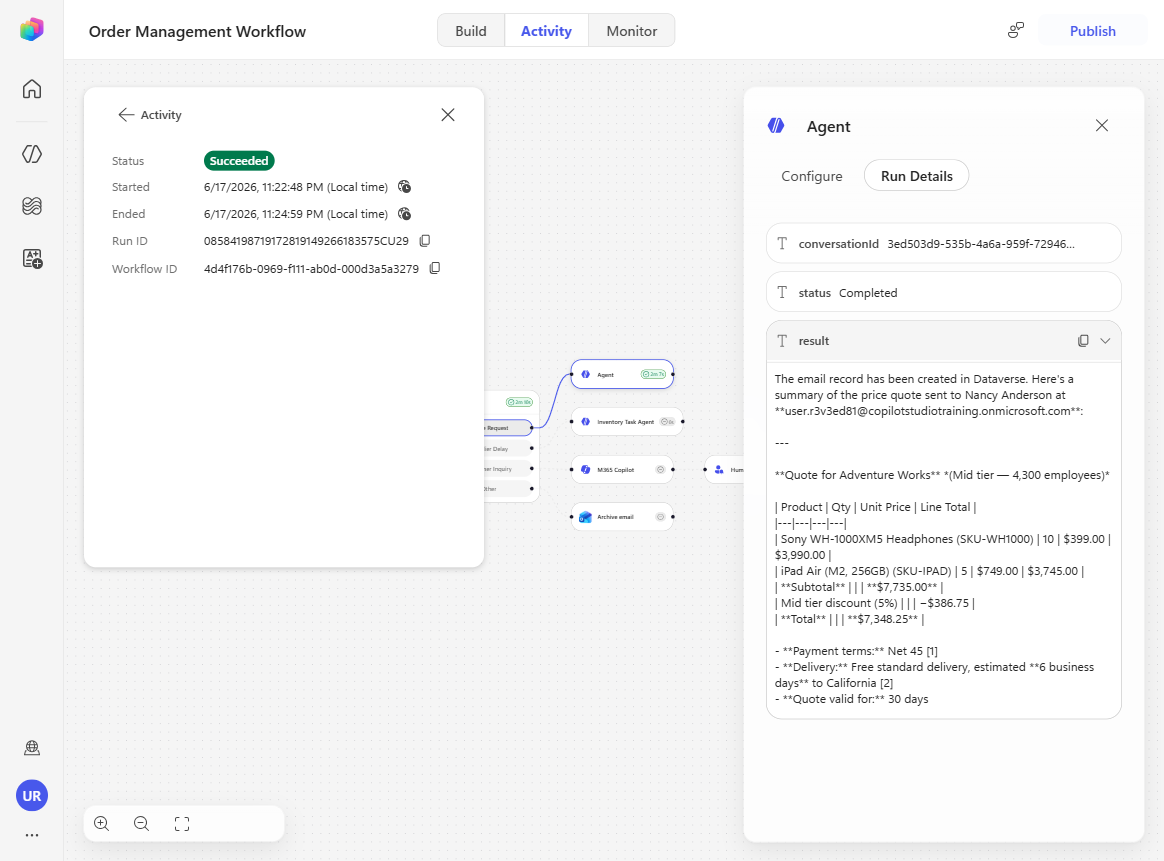
Return to the workflow’s Activity panel, refresh until the run appears, and confirm the route Classify → Quote Request → Agent completed.
-
Select the Agent node in the run details and read the completion message describing what the Price Quote Agent did to prepare the customer response.
-
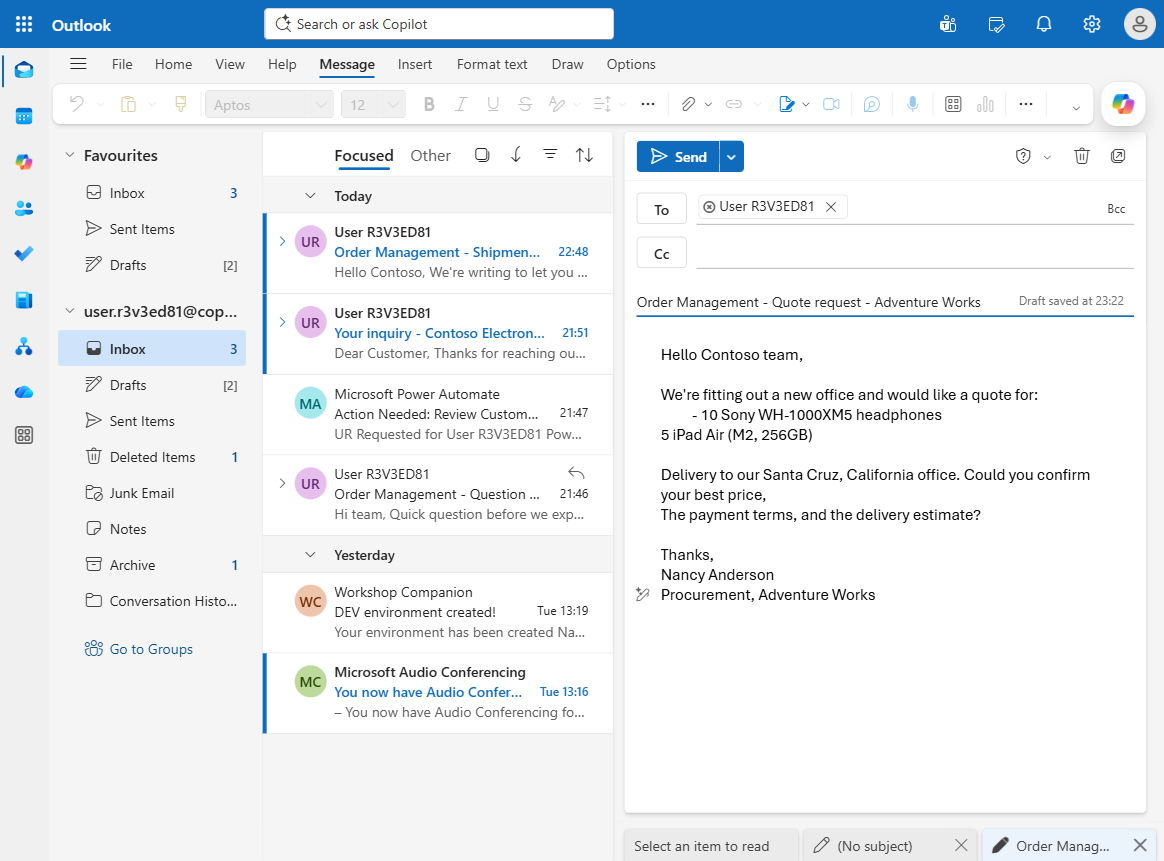
Open Outlook and verify that the generated price quote email has landed in your inbox.
-
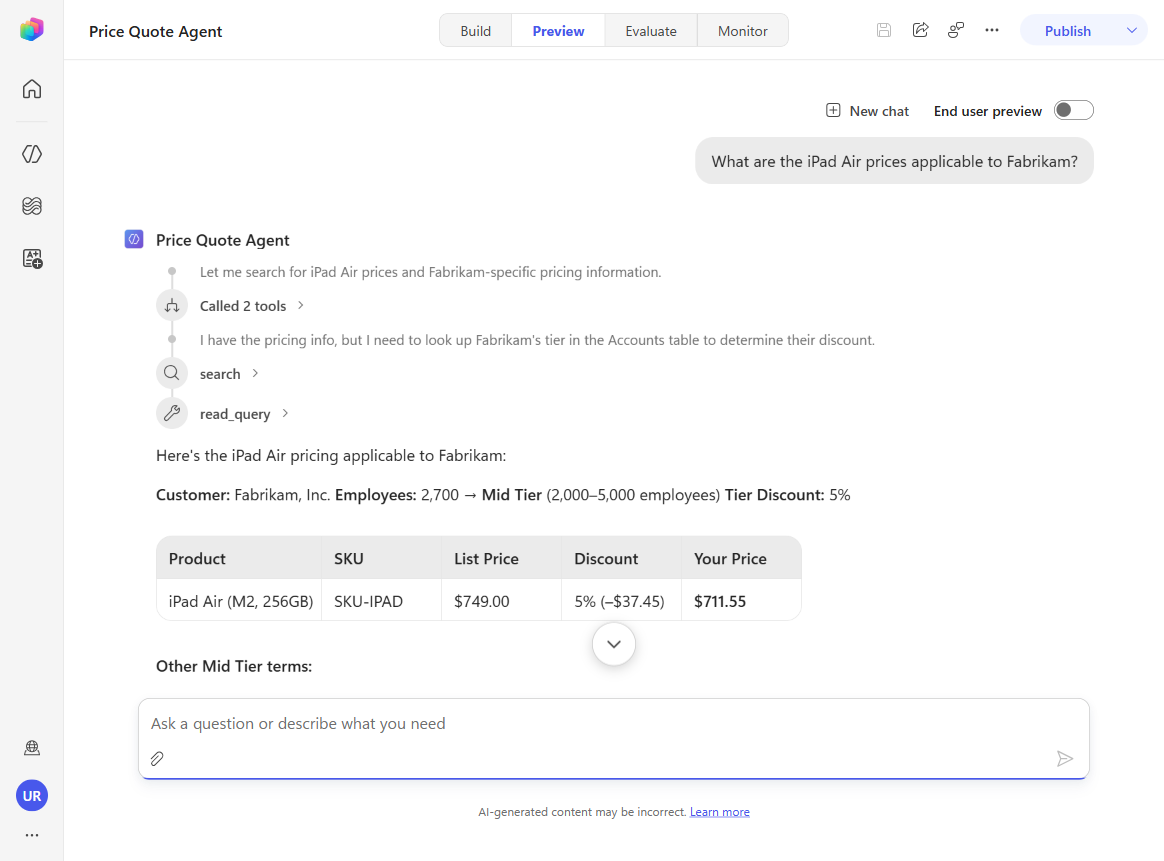
Bonus: Return to Price Quote Agent and select the Preview tab (top of the new experience). As a bonus, observe how the agent reasons over a question by combining the different tools at hand. Ask: What are the iPad Air prices applicable to Fabrikam? Watch the extended reasoning — the agent issues a Dataverse
read_querythat looks up the number of employees where the account name is Fabrikam, then connects that result with the SharePoint knowledge about customer tiers: it works out that Fabrikam falls into the Mid tier and shows the discounts the SharePoint handbook says should apply.You can also try asking We have received this customer email: [] and paste the email you used to test the workflow. You’ll see how the agent reasons over the answer — and how, this time, it loads the price-quote skill to build a full quote following the skill’s specified steps.
Congratulations! The Quote Request path is now powered by a reusable published agent.
You’ve connected a workflow branch to a published agent that blends knowledge, data, and mail actions — a strong pattern for reusing sophisticated business logic across multiple automations.
Summary of Learnings
True learning comes from doing, questioning, and reflecting — so let’s put your skills to the test.
To get the most out of Workflows in Copilot Studio:
- Trigger first, chat never — a Workflow runs on an event (a schedule or a connector trigger), so it works in the background without a user present. Pick the trigger that matches the “when” of your automation.
- Use an inline agent for the messy middle — when a step needs judgment (which slot? how to phrase the notes?), the agent node lets the model reason and act, instead of forcing every decision into deterministic logic.
- Ground the agent with dynamic content — the
/token feeds the agent the actual trigger data (the to-do Title), so each run acts on the real item, not a fixed example. - Tools are the agent’s hands — without the Find meeting times, Create event, and Update to-do tools (and web search), the agent could reason but not act. Grant exactly the tools the goal requires.
- Constrain behavior in the instructions — small additions like “only within my 8:00 AM–5:00 PM working hours” meaningfully change the agent’s choices. Iterate on the instructions, then re-publish.
- Publish before you test — the trigger is only live after a publish, and changes don’t take effect until you re-publish.
- Solution-level setup matters — connection references in the Power Apps solution must be linked to actual connections before the workflow can be activated. Canvas-level connections alone are not sufficient; always verify solution connection references.
- Classify with examples, refine with testing — the Classify node’s accuracy depends on the quality and diversity of category examples. Test with edge cases and refine descriptions iteratively to improve routing accuracy.
- Ownership is a prerequisite — workflows created by another user require an ownership transfer before you can publish or manage them. Use the Dataverse Assign function to take control.
- Use M365 Copilot when you need grounded, read-only retrieval — the M365 Copilot node is excellent for finding context in email, chats, and files, but it does not perform write actions such as sending mail. Pair it with downstream workflow actions when approval or dispatch is required.
- Human review is the safety valve for customer-facing automation — approval nodes let you insert AI-generated content into a reviewer-friendly message, capture a clear Yes/No decision, and keep the workflow paused until a person signs off.
- MCP servers turn an agent into an operational worker — by connecting the Agent node to tools like Warehouse MCP and Dataverse MCP, the workflow can retrieve live business data, make judgments, and write records into line-of-business systems.
- Structured output makes agent reasoning reusable — typed fields like
sku,stock, andriskmake it easier to inspect runs, pass results downstream, and design automations that combine non-deterministic reasoning with deterministic follow-up. - Published agents are reusable business capabilities — once an agent is published with its knowledge, tools, and skills, you can invoke it from multiple workflows instead of rebuilding the same logic in every branch.
Conclusions & Recommendations
Workflows golden rules:
- Match the trigger to the event that should start the work — manual for testing, recurrence for schedules, connector for “when something changes.”
- Reach for an inline agent when a step needs reasoning; keep deterministic actions for steps that must always behave identically.
- Reference trigger data with the
/dynamic-content token so the agent acts on the real input every run. - Give the agent only the tools it needs, and state constraints (working hours, formatting, categories) explicitly in the instructions.
- Always Save → Publish before testing, and re-publish after any change. Use the Activity and Monitor views — and the Agent node’s run details — to see exactly what the agent decided and did.
- Fix connection references at the solution level — creating connections in the canvas is not enough. Always verify and link connection references in the Power Apps solution before publishing.
- Transfer ownership early — if a workflow was created by another user, take ownership via Dataverse Assign before attempting any other management operations.
- Classify nodes are only as good as their examples — invest time in adding diverse, representative examples to each category and testing edge cases to improve classification accuracy.
- Use the Copilot node for grounded, read-only M365 retrieval and drafting, then pair it with other nodes when the workflow needs to send messages or update systems.
- Put Human review in front of customer-facing actions whenever the quality bar or business risk warrants a person-in-the-loop checkpoint.
- Use MCP-connected agents when the workflow needs to reason over live enterprise data and write operational outcomes such as Dataverse tasks.
- Prefer structured output from agents when downstream steps, monitoring, or reporting depend on predictable fields rather than free-form text.
- Reuse published agents for repeatable business capabilities — especially when they already combine knowledge sources, skills, and tools that multiple workflows can benefit from.
With these foundations, you can move from agents that talk to agents that act on their own — reacting to events, reasoning over real data, and getting work done across Microsoft 365.