In-depth user guide
Welcome to the in-depth documentation for the Quantum Development Kit (QDK) Chemistry library. This documentation provides detailed information about QDK/Chemistry’s structure, components, and usage patterns.
QDK/Chemistry provides every stage of the quantum chemistry applications pipeline in a single framework:
Classical electronic structure: SCF solvers, orbital localization, active space selection, and multi-configuration methods that produce the high-quality inputs required by quantum algorithms
Quantum algorithm building blocks: fermion-to-qubit mapping, quantum state preparation, phase estimation, Hamiltonian time evolution, and observable estimation
Composable workflow design: every algorithm is an interchangeable module — swap implementations, mix backends, and construct custom quantum–classical pipelines through a unified factory/registry architecture
The library is designed so that each stage feeds naturally into the next, while any individual component can be replaced without affecting the rest of the workflow. An example workflow diagram is shown below.
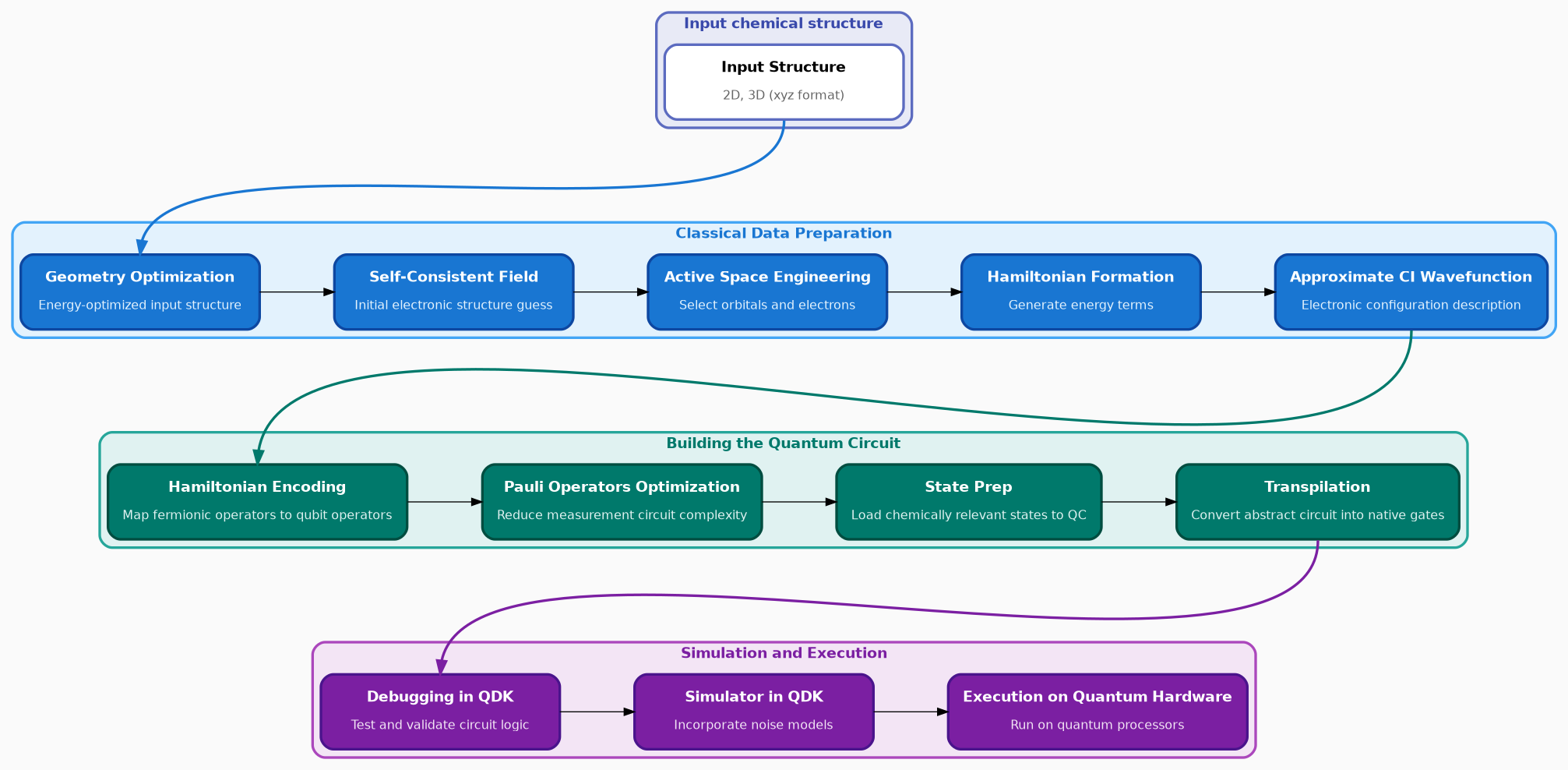
This documentation is organized into the following sections:
- High-level design
- Data classes
- Algorithm classes
- Factory pattern
- Settings
- Active space selection
- Effective Hamiltonian construction
- Energy estimation
- Hamiltonian construction
- Orbital localization
- Multi-configuration calculations
- Multi-Configuration Self-Consistent Field
- Projected Multi-Configuration calculations
- Qubit mapping
- Self-consistent field (SCF) solver
- Stability analysis
- State preparation
- Hadamard test
- Phase estimation
- Phase estimation circuit builder
- Amplitude amplification
- Evolution circuit builder
- Hamiltonian Unitary Builder
- Propagator
- Hamiltonian simulation
- Controlled circuit mapper
- Circuit execution
- Quick reference
- Term grouper
- Discovering implementations
- Available functionals and basis sets
- Model Hamiltonians
- Plugins