0379 gRPC API
- Date: 2025-09-22
- RFC PR: microsoft/trident#379
- Issue: microsoft/trident#392
Summary
In its current form, interaction with Trident is limited to its CLI and the various reporting features that have been built over time primarily for debugging purposes. The CLI is great for user interaction and simple automation, but as complexity around Trident grows, the CLI can become cumbersome. This document proposes a new standard gRPC-based API for more advanced bi-directional communication with Trident meant to be used by complex orchestrators.
Motivation and Goals
The ultimate goal of this proposal is to enable a new way for agents to interact with Trident that is fully programmatic and structured. This is achieved via a new gRPC-based API that exposes all of Trident's functionality and adds new capabilities such as structured progress reporting.
This new gRPC API would be useful for multiple scenarios where gRPC is the standard such as modern cloud-native environments, scenarios where binary execution becomes inconvenient, or applications where advanced integration is required.
CLI Interface Limitations
While the existing binary and CLI interface distributed via RPM are sufficient for many use cases, invoking Trident as a binary directly comes with some limitations because it starts as a child process of the agent, inheriting all its environment and permissions. This imposes a requirement on the agent to already be running in the proper environment and permission level. However, most agents will frequently not need all the capabilities needed by Trident.
If the agent is not running as root, then it becomes challenging to execute Trident; we currently have no good answer for how to achieve this. It is possible to start Trident via a systemd service, but that also requires enough privilege to invoke and makes obtaining the logs and result less direct.
Running Trident via the CLI also means that passing any big blob of data, such as a Host Configuration file, needs to happen via the filesystem, which adds an extra layer of complexity. In simple scenarios, this is trivial, but in complex deployments it means the file must be placed carefully so as not to place it in a read-only location, or an ephemeral one.
Any complex interaction with Trident, such as a flow requiring reading status, performing an update, and then reading the result, requires multiple invocations of the binary and parsing of the output which adds complexity to the orchestrator and increases the chances of errors.
Containerized Environments
Running Trident in a containerized environment may alleviate many of these limitation because it is possible to create a privileged container with sufficient access to the system, and that can be done by any agent with sufficient access to Docker. However, creating such a container requires a very specific configuration to guarantee all components will be working as expected. Running Trident in a container mildly complicates the process of providing a Host Configuration file, generally requiring another volume mount to the host. Containerized runtimes for Trident also increase the complexity of crafting precise SELinux policies to allow Trident to operate correctly, which may be a deterrent to use a container in some use cases.
System Extensions (sysext)
Running Trident when it is distributed as a sysext is functionally equivalent to distributing it as a regular RPM package in terms of how it is invoked, with the extra advantage that its easier to service.
Structured Observability and Reporting
Another motivation for this proposal is to establish an official programmatic and structured mechanism for getting information out of Trident. Currently, an agent executing Trident as a child process can only get unstructured stdout/stderr output and an exit code.
Because the Phonehome server is currently an internal-only interface, a calling
agent only has the raw output of the Trident process to know what it is doing.
It may also access the full log, which is structured, but this has proven to be
challenging in some scenarios as the file may not always be easily accessible.
For errors, the agent needs to parse the logs or use the dedicated get last-error subcommand, although this does not seem to be a common practice.
Systemd Socket Activation
Socket activation is a foundational feature of systemd. In a traditional approach, a daemon would need to be already running and listening to process an incoming request. With socket activation, systemd can listen on a specific socket and only start a service once a request is received.
Once a connection is received, systemd will forward the file descriptor of the incoming connection to the new process’s file descriptor #3 and let the child process know about this by setting the environment variables:
LISTEN_FDS[int]: number of sockets forwarded to the service.LISTEN_FD_NAMES[string]: Comma-separated list of names of the sockets forwarded to the service.
When using the default settings, systemd will start a single instance of the service and the process is expected to deal with the challenges of handling multiple incoming connections.
When using Unix sockets, systemd will create, own, and control the socket file1. It allows for setting specific permissions and ownership of the socket file. This can be useful for security as the caller may not need to be the root user, but any specific user or member of a particular group. For example, the ownership and mode “root:trident 660” would allow for any user in the group “trident” to invoke trident, without the user requiring sudo or root access.
Scope
Requirements
- Preserve security model: root access is a prerequisite.
- Implement a programmatic API to invoke Trident with support for all existing features.
- The API must be as easy as possible for a customer to use.
- Preserve all current CLI functionality in a client tool. No changes for CLI users.
- Live progress reporting.
- Replace remote reporting mechanisms (phonehome, logstream, and tracestream) with new API.
Out of Scope
- Trident servicing. (It is briefly discussed but not a main topic of this document)
- Rust/Go Trident gRPC client SDK (See Future Possibilities)
- Specific recommendations for customers (Left for future documentation effort)
- Any variation of Trident as a gRPC client. (See Future Possibilities)
- Streaming images through gRPC.
- Remote access. It is discussed for internal testing purposes but not a main topic of this document. (See Future Possibilities)
- Additional authorization mechanisms.
Exit Criteria
- The API has been implemented with all features usable through it.
- A new CLI client binary has been made available.
- Netlaunch & automation has been updated to leverage the new API.
- Remote reporting mechanisms are replaced by the new API.
- Systemd unit files updated to use new API.
Dependencies
N/A
Implementation
Structure Refactor
The current trident binary will be split into two separate binaries:
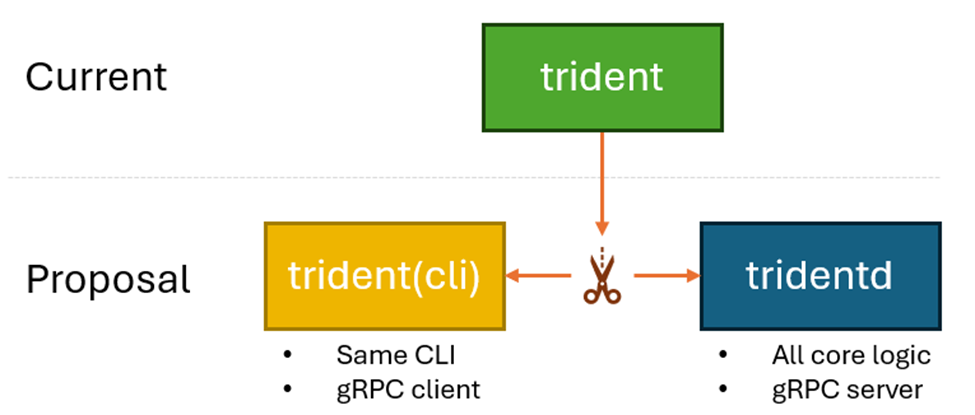
All the existing features and interfaces would be preserved, but functionality
will be split between two binaries: trident (the cli) and tridentd (the
actual agent).
Harpoon API (HAPI)
The Harpoon API (dev name, it will eventually just be the tridentd gRPC API)
is the only way in which tridentd will take instructions. The reason for this
self-imposed limitation is to decrease the number of entry points and code paths
that can invoke Trident and grow our confidence that the core logic is working
correctly. If this is the case, then client code should become relatively
trivial and interchangeable with other clients.
The Harpoon API will be defined as a protobuf file that is accessible to customers. We may ship it as a standalone RPM or simply provide it along with a release. The goal is to make it trivially simple for a customer to pick up the Trident daemon RPM and set up a client for it.
tridentd Runtime Daemon
tridentd would support two modes of execution:
- Systemd socket activation:
tridentdruns as a systemd service activated by a socket. - Manual:
tridentdcan also be executed directly.
Most scenarios would use option #1, that way Trident can be always ready but only running when needed. For specific scenarios, such as running in a container, tridentd can be executed directly and receive a path to the socket file to create or use the default:
/run/trident/listen.sock
Security Model
Trident is a very powerful agent; therefore, access to it should be extremely limited. Today, Trident’s approach to this issue is to invariably enforce that it be run with root privileges. For another process to be able to start Trident, it must already be running as root or have sudo privilege.
tridentd will have similar restrictions: it can only be started with root
privileges and will produce an error otherwise.
However, the proposed gRPC interface exposed over a Unix socket opens a new door
to interact with Trident. Fortunately, the socket is a file subject to standard
Linux access permissions. Regardless of who creates the socket file, systemd or
tridentd itself, it will always belong to the root user and be configured to
block all read/write attempts from other non-root users.
Systemd Socket Activation Implementation
A socket-activated service is inactive by default. When a client makes a request
on the socket, systemd will activate the service and clone the socket to file
descriptor #3 in the service process. tridentd will determine if it is being
executed by systemd, and if so, listen on the file descriptor. After the request
is finished, tridentd will stand by for a specific period (TBD, 5 minutes?)
and shut down gracefully if no other connections are received. The shutdown
timer is reset after every connection finishes. This graceful shutdown is meant
to free resources as calls into Trident should generally look like infrequent
groups of sequential calls in short succession. There is no need for Trident to
stay active in between updates.
Connection Persistence
Once a client starts a servicing, it may stay online listening on streaming events until the operation is finished, or it may disconnect and poll for updates. In the future, the client may also reconnect to an ongoing operation to receive live updates again.
Connection Management
The daemon can be invoked in two ways:
- As a systemd service linked to a systemd socket.
- Direct binary execution e.g.
bash –c 'tridentd'orexec("tridentd", ...)
To properly support both invocation types, management of incoming connections will be internal to the daemon.
The gRPC server will contain a Read-Write Lock to be used for each incoming
connection. Data retrieval operations such as “get status/config/error” will
lock in read mode, permitting multiple simultaneous read connections. Servicing
operations, such as update or install, will lock in write mode, effectively
enforcing a maximum of 1 connection at a time to avoid activities happening in
parallel.
Forcing Trident to hold exclusive ownership of a specific socket file also acts
as a connection lock because it guarantees that only one instance of tridentd
can be running at a time.
Servicing Lock
On top of the connection lock, tridentd will also keep a global servicing lock
as an extra layer of guarantee that at most ONE servicing operation is happening
at the same time.
The main reason for this extra layer is to avoid scenarios where a servicing is started, the client disconnects, freeing the connection lock, and another servicing is started while the first one is still ongoing. This lock will prevent the second servicing from starting until the first one is fully finished.
Local vs. Remote Connections
For security and compartmentalization reasons, Trident should only listen on local Unix sockets with very restricted permissions. This should significantly simplify Trident's security model.
Remote access could still be achieved in three ways:
- SSH socket forwarding: A remote client would need SSH access to a local user with access to the local socket.
- Reverse Proxy: A remote client could establish a connection via a reverse proxy running on the host which forwards incoming TCP connections to the local Unix socket connection.
- Reverse-Connect Proxy: (RCP) This is an agent running on the host that tries to open a connection to some external endpoint. Once the connection is established, it acts as a regular reverse proxy by forwarding incoming data from the remote connection to the local endpoint. (See more in E2E Test Infrastructure Changes)
Proposed Code Architecture
To reduce the number of changes needed, most of the core logic would remain as is. The outer layers will need some adjustments to get called by the gRPC methods as opposed to the existing main/CLI structure.
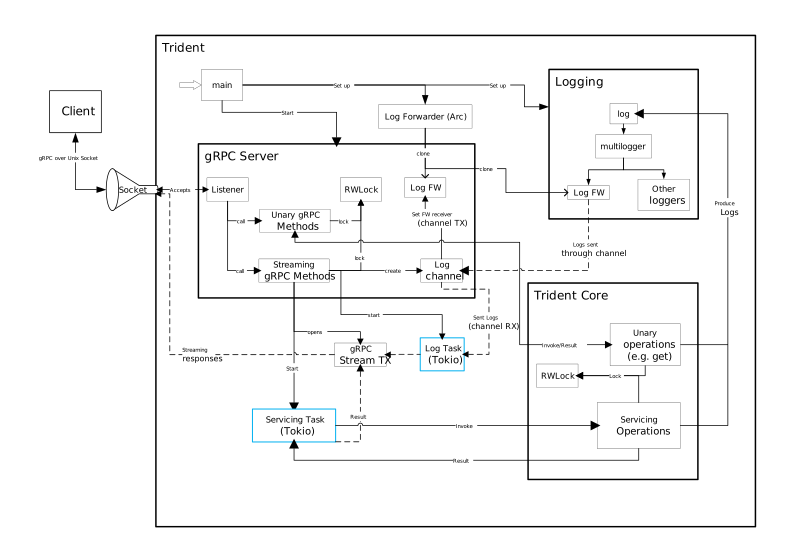
Sample implementation of this architecture: rust_grpc (internal only).
Trident CLI Client
The existing CLI interface will be ported to a standalone binary. The CLI will remain the same. Internally, the client will just be a wrapper to invoke the corresponding gRPC interfaces and receive and surface logs and status as the current CLI does today.
The expected consequence of this is that this change will be completely transparent for a user that has always used the existing CLI as the sole means of interacting with Trident.
Offline Initialize
The offline initialize command will be moved to be a native feature of the CLI binary, without needing to invoke the daemon. That way, the external API remains as:
trident offline-initialize
Autonomous Services
Trident currently has three service files that when enabled perform automated actions:
- Installation: used in test ISOs to automatically start a trident installation process.
- Network initialization: setup network in live/unconfigured/early-state scenarios.
- Commit: used on boot to commit an A/B update.
These will continue to exist by invoking the Trident CLI, but their use may dwindle.
Running in a Container
The current way Trident runs inside of a container is quite simple; Trident is the entry point of the container, and all arguments get passed directly to Trident.
A separate daemon and CLI make this no longer possible. Depending on the needs and context, Trident containers will exist in two flavors:
-
A pure daemon container:
The trident daemon (tridentd) is the entry point of the container. To interact with it, a volume MUST be mounted on the location of the socket file. This way, an agent external to the container, such as another container or a host process, may use the gRPC interface to interact with Trident. -
A combined container:
Both tridentd and trident (cli) are part of the container. The entry point is a wrapper that executes tridentd in the background and then forwards all arguments to trident (cli). No volumes for the socket are needed or used. This would be the functional equivalent of the current container.
Running in a System Extension (sysext)
Packaging tridentd and trident (CLI) in a sysext would not hinder their
usability, on the contrary, this may be the most powerful packaging decision. If
Trident is distributed via sysext, then it becomes easy to service Trident
itself while also getting the advantages of running directly in the host.
Public API Design
The full gRPC API specification is available in the PR: microsoft/trident#386: engineering: Harpoon gRPC Protobuf
Testing and Metrics
Unit Testing
Separating the client and the server means that we can test the interfaces thoroughly and mostly independently. We should be able to implement extensive unit testing on the CLI-client by setting up a mock backend, and we should be able to test the server’s interfaces by setting up a mock front end.
Furthermore, the server interfaces will ultimately be utilized during end-to-end testing as well.
E2E Test Infrastructure Changes
The feature will require some changes to our infrastructure to properly support it. Notably, most of our current infrastructure currently depends on the phonehome/logstream features as well as executing Trident as a regular binary. In the initial stages of development we will keep this intact. Until the full stack can be replaced, CLI invocation and logstream will remain in use. See Implementation Plan for more details.
Phonehome is so important to us because it is the only mechanism we have to know when the test host has started and what its IP address is. Phonehome give us this because our test images start Trident on boot, which will then start the phonehome process. The gRPC makes Trident totally passive, meaning we need a new component to start this active connection. The proposed component to do this is a reverse-connect proxy (see Local vs. Remote Access).
The reverse-connect proxy (RCP) is a lightweight service running on the test host that will read the target IP address injected by netlaunch into the ISO and continuously attempt to establish a TCP connection to that address. On the listening side, netlaunch starts listening on a given port for incoming TCP connections. Once the connection is accepted, both parties will perform a mutual TLS handshake to authenticate each other. On success, a secure channel is established, and the RCP begins forwarding all incoming data over to Trident’s local Unix socket. This way, we get the outgoing signal from the test host that we were depending on, and we also now have a mechanism for netlaunch to communicate directly with Trident.
- Sample implementation of the RCP: main.go (internal only).
- Sample implementation of the client: main.go (internal only).
Testing Exit Criteria
- Unit tests for the client end-to-end.
- Unit tests for server’s gRPC interface.
- Usage in E2E tests, potentially with multiple clients.
Servicing
The changes should be fully transparent for CLI users. Future updates to add features to Trident will change the protobuf file in a backwards compatible manner. Breaking changes may be evaluated as part of major Trident releases.
Implementation Plan
- Merge API Protos.
- Create a new CLI crate implementing gRPC client. (with UTs)
- Merge gRPC server logic.
- Create a new trident subcommand to start daemon. (with UTs)
- Refactor Trident so that the gRPC server can perform servicing operations.
- Merge new systemd unit files.
- Update container tests to use the wrapper strategy from Running in a Container.
- Rename trident binary to tridentd, deprecate existing CLI from tridentd. Start using the new trident CLI binary.
- Merge reverse-connect proxy (RCP) (see Local vs. Remote Access)
- Update Netlaunch to use RCP.
- Migrate all tests to Netlaunch+RCP.
- Deprecate phonehome & logstream.
Counter-Arguments
Drawbacks
- Complexity: Introducing a gRPC API adds complexity to the Trident codebase, which may increase maintenance overhead.
- Learning Curve: Customers may need to learn how to use gRPC, which could be a barrier for some users.
- Performance Overhead: While gRPC is generally efficient, there may be some performance overhead compared to direct CLI invocation, especially for simple tasks.
- Security Considerations: Exposing a gRPC API may introduce new security considerations that need to be addressed, such as authentication and authorization mechanisms.
- Initial Development Effort: Implementing the gRPC API will require a significant initial development effort, which may divert resources from other important features or bug fixes.
- Existing adequacy of CLI: For many users, the existing CLI may be sufficient for their needs, and the added complexity of a gRPC API may not provide enough value to justify its implementation.
Alternatives
- Pure CLI: (current) Continue using Trident as a CLI-only tool. This approach has limitations as described in the Motivation section.
- HTTP: Implement an HTTP REST API instead of gRPC. This approach would be more familiar and easier to use for customers, but it would require more work to implement and maintain. gRPC provides better performance and built-in support for streaming, which is beneficial for progress reporting, as well as schema definition via protobufs.
- WebSockets: Implement a WebSocket-based API. This approach would allow for bi-directional communication and streaming, but it would be more complex to implement and maintain compared to gRPC. gRPC provides a more structured way to define the API and handle communication.
Open Questions
Future Possibilities
- Trident CLI could become a portable Go-based binary, there is no need for it to be rust and it could allow us to easily run it in most Linux systems.
- Trident could eventually be configured to act as a client when establishing the connection to the orchestrator, so that a central orchestrator could manage multiple Trident instances remotely without necessarily knowing how to reach out to them.
Footnotes
-
Network sockets do not have an associated file in the same way, so these concepts of ownership do not apply there. ↩