DocumentDB for VS Code
User Manual — Back to User Manual
Collection View: Querying
The Collection View is the visual query interface for DocumentDB and MongoDB API databases. It provides three query editors (filter, project, sort) that let you build find queries with context-aware autocompletion, hover documentation, and real-time validation.
This page focuses on how to write queries in the Collection View and how the autocompletion works. For general information about browsing and managing documents, see the Collection View overview in the extension.
Opening the Collection View
There are several ways to open a collection in the Collection View:
- Double-click the Documents node under a collection in the tree view.
- Click the inline button: Each collection node in the tree view has an inline action button (the leftmost icon) that opens the Collection View directly.
- From the Interactive Shell: Click the
↗ Collection Viewlink that appears after query results. - From the Query Playground: Use the CodeLens link to open the referenced collection.
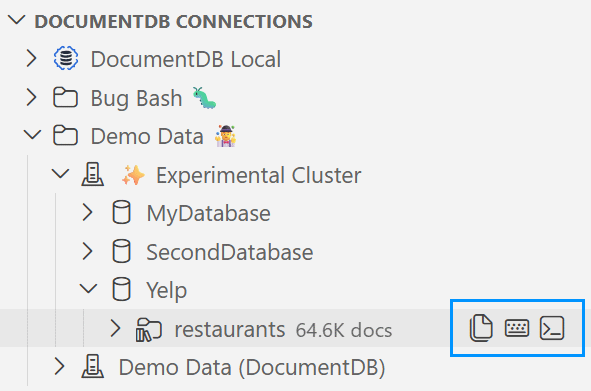
The three inline icons next to each collection node are (from left to right): Open Collection View, New Query Playground, and Open Interactive Shell.
Table of Contents
- The Three Query Editors
- Writing Filter Queries
- Writing Projections
- Writing Sort Expressions
- Autocompletion
- Hover Documentation
- Real-Time Validation
- Relaxed Query Syntax
- Navigating to Other Features
The Three Query Editors
The Collection View has three input editors that correspond to the three parameters of the DocumentDB API find() command:
| Editor | Purpose | Example |
|---|---|---|
| Filter | Select which documents to return | { status: "active", age: { $gt: 25 } } |
| Project | Choose which fields to include or exclude | { name: 1, email: 1, _id: 0 } |
| Sort | Control the order of results | { createdAt: -1 } |
Together, these editors produce a query equivalent to:
db.collection.find(filter, project).sort(sort);
Each editor provides its own autocompletion behavior tailored to what you’re writing: the filter editor suggests operators and value patterns, the project editor suggests 1 (include) and 0 (exclude), and the sort editor suggests 1 (ascending) and -1 (descending).
Writing Filter Queries
The filter editor accepts any valid DocumentDB API query expression. You can use all query operators, BSON constructors, and JavaScript expressions:
// Simple equality
{ status: "active" }

// Comparison operators
{ age: { $gt: 25, $lte: 65 } }

// Logical operators
{ $or: [{ status: "active" }, { role: "admin" }] }

// Regular expressions
{ email: { $regex: /\.com$/ } }

// BSON constructors
{ _id: ObjectId("507f1f77bcf86cd799439011") }

// Date ranges
{ createdAt: { $gt: ISODate("2025-01-01"), $lt: ISODate("2025-12-31") } }
Writing Projections
The project editor controls which fields appear in the results. Use 1 to include a field and 0 to exclude it:
// Include only name and email
{ name: 1, email: 1 }

// Exclude the _id field
{ name: 1, email: 1, _id: 0 }

// Exclude large fields
{ rawData: 0, internalNotes: 0 }
Note: You cannot mix inclusion and exclusion in the same projection, except for the
_idfield which can always be explicitly excluded.
Writing Sort Expressions
The sort editor controls the order of returned documents. Use 1 for ascending and -1 for descending:
// Sort by creation date, newest first
{ createdAt: -1 }

// Sort by multiple fields
{ status: 1, createdAt: -1 }
Autocompletion
The Collection View provides rich, context-aware autocompletion across all three editors. Suggestions appear automatically as you type, or you can trigger them manually with Ctrl+Space.
Field Name Suggestions
As you type in any of the three editors, the extension suggests field names from your collection’s actual data. Field names are discovered by analyzing documents you have already browsed or queried.
This analysis happens entirely locally: the extension examines documents that are already being fetched for display, without making additional requests to your database or sending data to external services.
Each field appears with its inferred BSON type displayed next to it:
name        String
age         Int32
email       String
createdAt   Date
tags        Array
address     Object
If a field is sparse (not present in all documents), it is marked with a (sparse) indicator.
Fields with special characters in their names (dots, hyphens, spaces) are automatically quoted in the inserted text so the query remains valid.
Field Types and Type-Aware Suggestions
The extension doesn’t just know field names, it also knows their types. This knowledge powers two behaviors:
Type-aware operator ordering: When you type a $ operator after a field, the completion list is sorted by relevance to that field’s BSON type. For example:
- After a number field (
Int32,Double,Long): comparison operators ($gt,$gte,$lt,$lte) appear first - After a string field:
$regexand$inare prioritized - After a boolean field:
true/falsevalue suggestions appear at the top
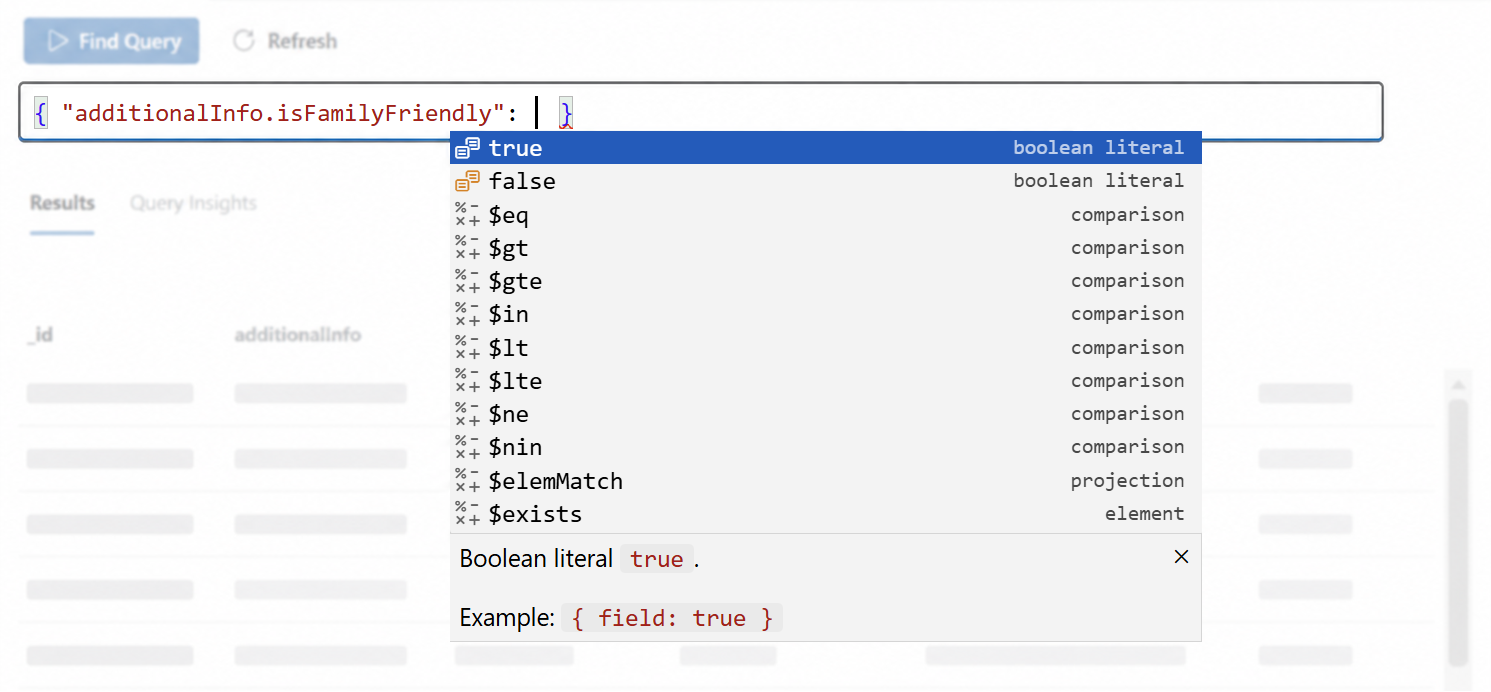
In this example, the field additionalInfo.isFamilyFriendly is a boolean. The editor suggests true and false first, followed by comparison operators sorted by relevance. The documentation panel at the bottom describes the selected item.
Type-aware value suggestions: When the cursor is at a value position and the field’s type is known, the editor suggests values appropriate for that type:
| Field Type | Suggestions |
|---|---|
Boolean |
true, false |
Int32, Double, Long, Decimal128 |
Range query snippets ({ $gt: ..., $lt: ... }) |
String |
String literal ("..."), regex pattern ({ $regex: /.../ }) |
Date |
ISODate("..."), date range snippet, relative date (Date.now() - N days) |
ObjectId |
ObjectId("...") |
Null |
null |
These type-aware suggestions appear at the top of the completion list, followed by the general operators and BSON constructors.
Context-Sensitive Completions
The autocompletion is aware of where your cursor is within the query expression and adjusts what it suggests accordingly:
| Cursor Position | What You See |
|---|---|
At a key position (e.g., { \| }) |
Field names and logical operators ($and, $or, $nor, $not) |
At a value position (e.g., { age: \| }) |
Type-aware suggestions, comparison operators, BSON constructors, JavaScript globals |
Inside an operator object (e.g., { age: { \| } }) |
Comparison and query operators without outer braces |
Inside an array (e.g., { $and: [ \| ] }) |
Same as key position (each array element is a query document) |
This means you see the right suggestions at the right time, instead of a flat list of everything.
Project and Sort Value Completions
The project and sort editors have their own specialized value completions that reflect the specific values expected in each context:
Project editor (at a value position after a field name):
| Suggestion | Description |
|---|---|
1 |
Include field |
0 |
Exclude field |
Sort editor (at a value position after a field name):
| Suggestion | Description |
|---|---|
1 |
Ascending |
-1 |
Descending |
These appear as the only value suggestions in their respective editors, keeping the completion list focused and unambiguous.
Hover Documentation
Hovering over any element in the query editors provides inline documentation:
Operators and BSON Constructors
Hover over any $-prefixed operator (e.g., $gt, $regex, $elemMatch) or BSON constructor (e.g., ObjectId, ISODate, NumberDecimal) to see:
- A description of what it does
- A link to the official DocumentDB API documentation page
Field Names
Hover over a field name to see:
- The field name with an indication if it is sparse
- The inferred BSON type(s): if a field holds different types across documents (e.g., some documents have a
String, others anInt32), all observed types are listed
Real-Time Validation
The editors validate your query as you type:
- Syntax errors are highlighted with red squiggles when the expression cannot be parsed (e.g., missing closing braces, invalid JavaScript syntax).
- Near-miss typo warnings appear as yellow squiggles when you type something close to a known BSON constructor or JavaScript global. For example, typing
ObjctId()produces a “Did you meanObjectId?” warning. This uses Levenshtein distance matching, so small typos are caught even if the misspelling is technically valid JavaScript.
Validation runs with a short debounce (300ms) so it doesn’t interfere with your typing.
Relaxed Query Syntax
The Collection View editors accept relaxed JavaScript expression syntax, not just strict JSON. This means you can write queries naturally:
| Syntax | Example | Supported? |
|---|---|---|
| Unquoted keys | { name: "Alice" } |
Yes |
| Single-quoted strings | { status: 'active' } |
Yes |
| Double-quoted keys (JSON-style) | { "name": "Alice" } |
Yes |
| BSON constructors | ObjectId("..."), ISODate("...") |
Yes |
| JavaScript expressions | Date.now(), Math.min(a, b) |
Yes |
| Regex literals | { email: /\.com$/ } |
Yes |
| Comments | { /* filter */ name: "Alice" } |
Yes |
This is a significant improvement over earlier versions of the extension, which required strict JSON and didn’t support BSON constructors or unquoted keys.
Navigating to Other Features
From the Collection View, you can move your query to other surfaces:
- Open in Playground: Click the toolbar button to export your current find query (filter, project, sort) into a new
.documentdb.jsplayground file. - Open in Shell: Click the toolbar button to pre-feed your current query into a new Interactive Shell session.
- Copy: Copy the full find expression to the clipboard for use elsewhere.
- Paste: Paste a find expression from the clipboard into the query editors. The extension parses the
find(filter, project).sort(sort)format and populates each editor. - Indexes: Open the Indexes tab to inspect, create, and manage indexes for the current collection. See Manage Indexes in Collection View.
For more details, see the Query Playground and Interactive Shell documentation.