DocumentDB for VS Code
User Manual - Back to User Manual
Interactive Shell
The Interactive Shell is a REPL (Read-Eval-Print Loop) terminal embedded in VS Code. It gives you a command-line experience for DocumentDB and MongoDB API databases, fully integrated with the extension’s connection management. Type a command, see the result, type the next one.
Unlike the Query Playground, which is file-based and suited for multi-statement scripts, the Interactive Shell is designed for quick, ad-hoc exploration: checking what databases exist, browsing collections, running one-off queries, and iterating on results.
Table of Contents
- Getting Started
- Shell Commands
- Running Queries
- Persistent Variables
- Autocompletion and Ghost Text
- Syntax Highlighting
- Cursor Iteration
- Cancelling Operations
- Multi-line Input
- Clickable Links in Results
- Navigating to Other Features
- Settings
- Tips and Best Practices
Getting Started
There are several ways to open an Interactive Shell session:
- From the tree view: Right-click a cluster, database, or collection node in the Connections, Discovery, or Azure views, then select Open Interactive Shell.
- From the inline button: Click the terminal icon (rightmost icon) next to a database or collection node in the tree view.
- From the Collection View: Use the Open in Shell toolbar button to export your current find query into a new shell session.
- From the Query Playground: Use a CodeLens link to launch a shell for the same connection.
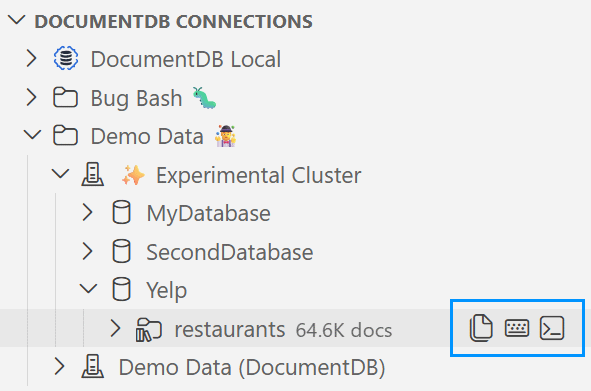
The three inline icons next to each collection node are (from left to right): Open Collection View, New Query Playground, and Open Interactive Shell.
When the shell opens, it displays a compact logo followed by the saved connection name, host, identity when available, authentication method, and active database. The prompt shows your current database name:
╭────╮
│ >_ │ DocumentDB Shell
╰────╯
Connected to: Local development (mycluster.example.com)
Identity: admin | Authentication: Username and Password (SCRAM) | Database: myDatabase
Type "help" for available commands.

myDatabase>
Shell Commands
The following built-in commands are available at the prompt:
| Command | Description |
|---|---|
show dbs |
List all databases on the server |
show collections |
List all collections in the current database |
use <database> |
Switch to a different database (updates the prompt and tab name) |
it |
Iterate to the next batch of results from the last cursor |
help |
Show available commands and usage information |
exit / quit |
Close the shell session |
cls / clear |
Clear the terminal screen |
Running Queries
Type any DocumentDB API query at the prompt and press Enter:
myDatabase> db.users.find({ status: "active" })
You can use the full query language, including:
- Find queries:
db.collection.find(),db.collection.findOne() - Aggregation pipelines:
db.collection.aggregate([...]) - Write operations:
db.collection.insertOne(),db.collection.updateMany(),db.collection.deleteOne() - BSON constructors:
ObjectId("..."),ISODate("..."),NumberDecimal("...") - JavaScript expressions:
Date.now(),Math.random(), variables, loops - Index operations:
db.collection.createIndex(),db.collection.getIndexes()
Results are displayed as formatted JSON directly in the terminal, with optional ANSI color coding for readability.
Persistent Variables
Unlike the Query Playground (where each block runs in a fresh context by default), the Interactive Shell maintains state across commands within a session:
myDatabase> const threshold = 25
myDatabase> db.users.find({ age: { $gt: threshold } })
Variables, functions, and other JavaScript state persist until you close the shell session. This makes it easy to build up complex queries incrementally.
Autocompletion and Ghost Text
The shell provides two forms of input assistance:
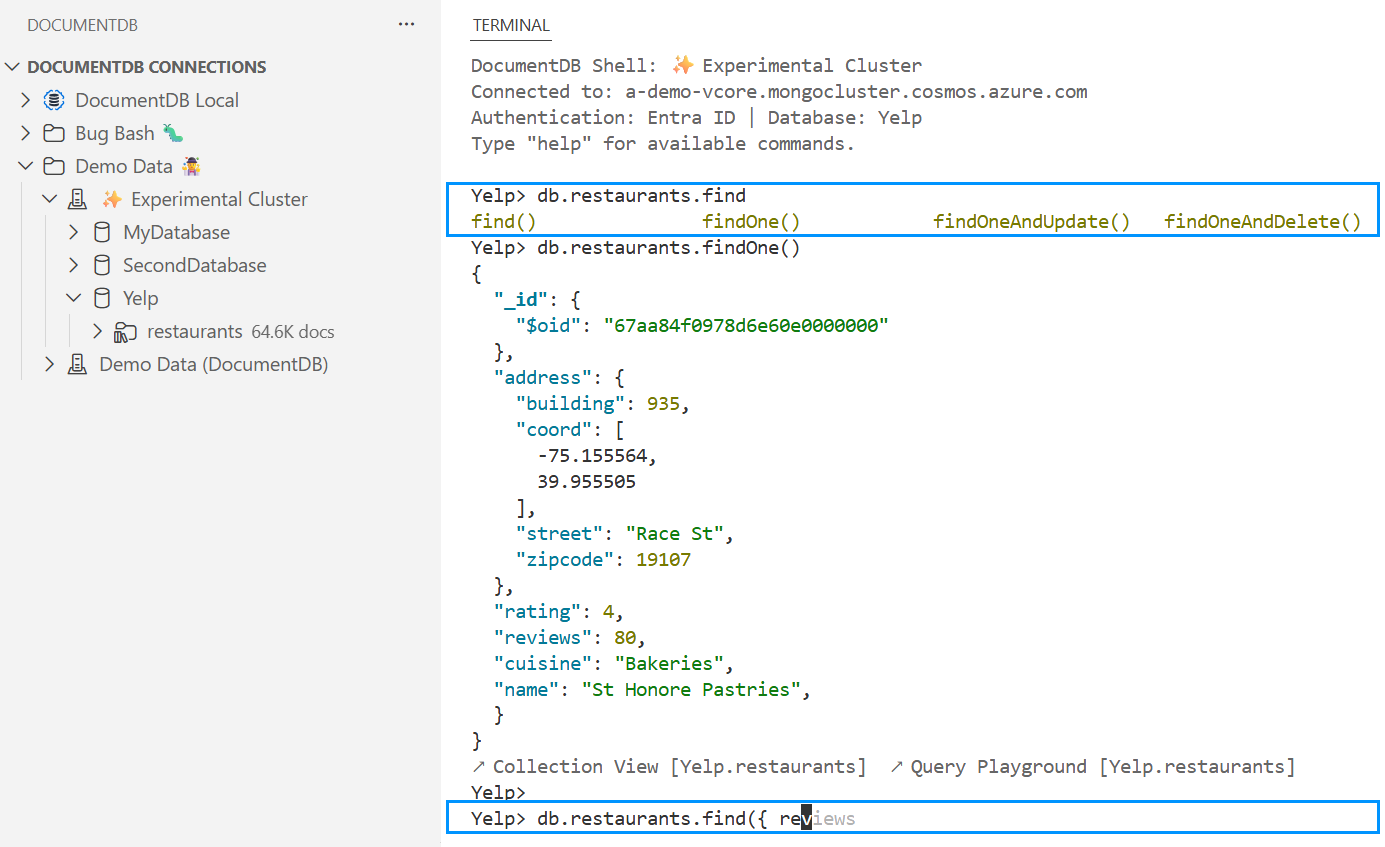
In this example, the shell suggests find(), findOne(), and other methods after typing db.restaurants.find (top). It also suggests the field name reviews as ghost text after the user typed re in a query (bottom). Field suggestions come from schema information gathered locally as you browse and query your data.
Tab Completion
Press Tab to trigger completion suggestions based on your current input:
| Context | What Tab Suggests |
|---|---|
| Empty prompt | Shell commands: show, use, db, help, exit, it, … |
After show |
dbs, collections |
After use |
Available database names |
After db. |
Collection names in the current database |
After db.collection. |
Collection methods: find(), aggregate(), insertOne(), … |
When there are multiple matches, the shell inserts the common prefix and displays all options in a
multi-column list (similar to bash/zsh). Continue typing to narrow the list; Tab cycling is not
currently supported. Collection names are loaded in the background after connecting and after
use <database>, so they are normally ready for the first completion request.
Ghost Text (Inline Suggestions)
As you type, the shell may display a dim, inline suggestion showing what it thinks you’re about to type. For example:
- Type
db.users.and seefind()appear as ghost text - Type
showand seedbsappear
The shell also suggests closing brackets automatically. When your input has unclosed brackets, parentheses, or braces, the ghost text shows the exact sequence needed to close them. For example:
- Type
db.col.find({ _id: { $exists: trueand see}})as ghost text - Type
db.col.aggregate([ { $match: { status: "active"and see} } ])as ghost text
Press Right Arrow to accept an insertable suggestion. Tab checks completion candidates first and accepts the visible suggestion only when no completion candidate applies. Keep typing to ignore either kind of suggestion.
Syntax Highlighting
The shell colorizes your input in real time as you type:
| Color | Applied To |
|---|---|
| Cyan | JavaScript keywords, BSON constructors |
| Green | Strings |
| Yellow | Numbers, $-prefixed operators, escape sequences |
| Magenta | Shell commands (show, use, it, etc.) |
| Gray | Comments |
| Red | Regex literals (and unterminated string errors) |
Syntax highlighting can be disabled via the documentDB.shell.display.colorSupport setting for accessibility (screen readers) or piped output.
Cursor Iteration
When a query returns more documents than the batch size (default: 50), the shell displays the first batch and shows a hint:
myDatabase> db.users.find({})
[
  { "_id": ObjectId("..."), "name": "Alice", ... },
  ...
]
Type "it" for more
Type it and press Enter to fetch the next batch. You can keep typing it until all results are exhausted.
The batch size is controlled by the documentDB.batchSize setting.
Cancelling Operations
If a query is taking too long, press Ctrl+C to cancel it immediately. The shell terminates the running operation and creates a fresh execution context, so you can continue working without restarting the session.
Multi-line Input
The shell detects incomplete expressions automatically. If you type an opening brace or bracket without closing it, the shell waits for more input instead of trying to execute:
myDatabase> db.orders.aggregate([
...   { $group: { _id: "$status", count: { $sum: 1 } } },
...   { $sort: { count: -1 } }
... ])
When pasting multi-line text, the shell can handle it in several ways, controlled by the documentDB.shell.multiLinePasteBehavior setting:
| Option | Behavior |
|---|---|
ask (default) |
Prompts you to choose how to process the pasted text |
alwaysAsk |
Always shows the prompt, even if VS Code’s own paste warning is enabled |
executeAsOne |
Joins pasted lines into a single expression and executes |
runLineByLine |
Runs each pasted line independently |
Clickable Links in Results
After query results that reference a known collection, the shell shows two clickable action links on the same line:
↗ Collection View [myDatabase.users] ↗ Query Playground [myDatabase.users]
- Click Collection View to open the collection in the Collection View, where you can browse results visually with table, tree, and JSON layouts.
- Click Query Playground to open a new playground file pre-connected to the same database and collection.
Navigating to Other Features
The Interactive Shell is connected to the other query surfaces in the extension:
- To Collection View: Click the
↗ Collection Viewlink that appears after query results. - To Query Playground: Click the
↗ Query Playgroundlink that appears after query results to open a playground for the same collection. - From the Collection View: The Collection View toolbar has an Open in Shell button that pre-feeds your current find query into a new shell session.
- From the Query Playground: CodeLens links let you launch a shell from within your script.
For more details on the Query Playground, see the Query Playground documentation.
Settings
Open VS Code Settings and expand Extensions > DocumentDB for VS Code. The display and paste options are under Interactive Shell. The shared connection timeout is under Connections & Discovery, and the shared batch size is under Queries & Results. You can also search for a setting ID from the table.
| Setting | Default | Description |
|---|---|---|
documentDB.connectionTimeout |
30 |
Maximum time (in seconds) to wait for the shell to connect and authenticate (shared with Query Playground) |
documentDB.shell.display.colorSupport |
true |
Enable ANSI color support for syntax highlighting and formatted output. Disable for screen readers or piped output |
documentDB.shell.display.autocompletion |
true |
Tab completion, the candidate list, and the dim inline suggestions at the cursor |
documentDB.shell.display.inlineHints |
true |
The informational hints marked with 🛈, which are never inserted into your input |
documentDB.shell.multiLinePasteBehavior |
ask |
Controls how multi-line text is handled when pasted into the shell |
documentDB.batchSize |
50 |
Number of documents to display per cursor iteration (shared with Query Playground) |
The connection timeout applies when connecting and authenticating, not while running queries. Queries
have no extension-side time limit. Press Ctrl+C to cancel, or use .maxTimeMS() on a supported query
to set a server-side limit.
Run help in the shell for a single clickable shortcut that opens the Interactive Shell settings group.
The help output also prints the full Settings search query for manual access.
Tips and Best Practices
- Use the shell for exploration, the playground for scripts: The shell is great for quick checks (
show dbs,db.collection.count()), while the playground is better for multi-step operations you want to save and re-run. - Use
show collectionsbefore querying: Quickly see what’s available in the current database. - Use variables for iteration: Store intermediate results in variables and refine your queries step by step.
- Switch databases with
use: No need to open a new shell. Just typeuse otherDatabaseand the prompt updates. - Copy queries to the playground: If an ad-hoc query grows complex, use the navigation links to move it to a playground file where you can save and refine it.
- Disable colors for accessibility: If you use a screen reader, set
documentDB.shell.display.colorSupporttofalsefor clean, unformatted output.
Related: Query Playground How It Works Behind the Scenes