

When you ask for technical support, the support team usually wants to check that the basics are working on your PC. At the request of MIDI hardware partners, mididiag.exe produces a text report of the state of MIDI on your PC that both a person and a script can read.
The report starts with your PC and Windows, then covers each part of Windows MIDI Services. It ends with a short list of findings: things the report noticed that are worth a look, each one written as a plain sentence.
The report tells you:
wdmaud2.drv and the USB MIDI class drivers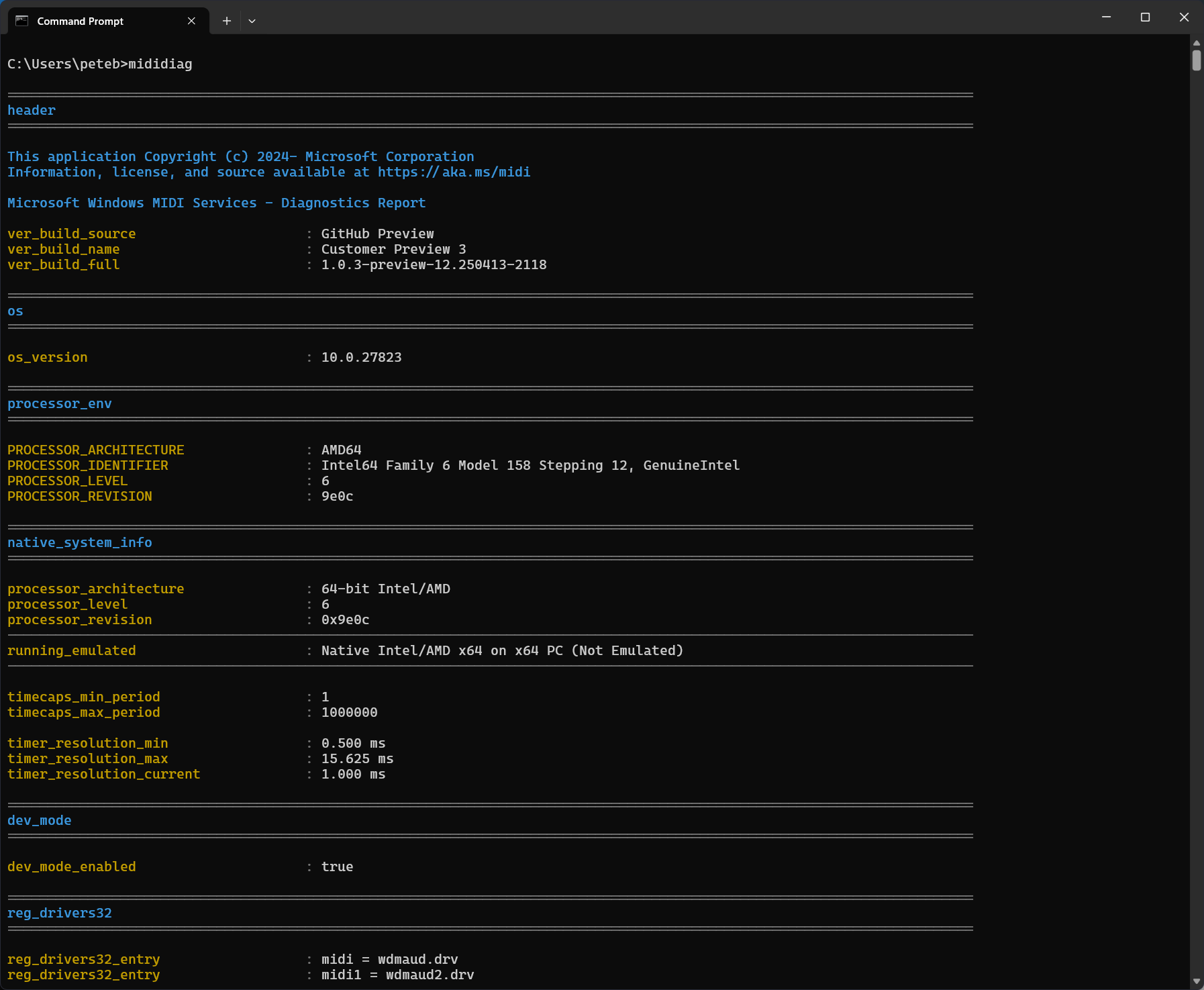 …

The easiest way is the MIDI Troubleshooting and Repair app. Its Diagnostics page runs the report and saves it as a zip file. Attach the zip to your GitHub issue or email. The full report is often too long to paste into a GitHub issue, and a zip file is a fraction of the size.
From a command prompt, save the report to a file:
C:\Users\peteb>cd Documents
C:\Users\peteb\Documents>mididiag > mididiag.txt
Then send mididiag.txt to whoever asked for it, by email, a support form upload, or any other way you like. Zip it first if it’s going into a GitHub issue.
These options change what the report includes:
| Option | What it does |
|---|---|
--include-winrt-midi1 |
Also lists the ports that apps using the older WinRT MIDI 1.0 API see. Most problems don’t need this, so it’s off unless you ask for it. |
--help |
Shows the options. |
Select View report on the Diagnostics page of MIDI Troubleshooting and Repair. It shows the report you just ran, or opens a report somebody sent you, even inside the zip file it came in. The findings come first, then any errors in red, and every section opens and closes on its own, so you don’t have to scroll through the whole text to find one device.
The report reads everything it can from Windows before it asks the MIDI service anything. If the service doesn’t answer, the report doesn’t wait forever. After a short time it stops, says which section it was working on, and still lists its findings. That way you get a useful report from the PC that has the problem, which is the one that matters.
When that happens, the MIDI Troubleshooting and Repair app offers to save a memory dump of the MIDI service. The dump shows the developers where the service is stuck. Save it before you restart, because restarting the PC clears the problem and the evidence along with it. The dump can hold private information, such as device names and network MIDI passwords, so share it only with the developers who asked for it.
Windows MIDI Services comes with Windows. Its files are in the System32 folder, and Windows has to register each one before anything can use it. To an app, a missing file and a file that isn’t registered look the same: MIDI just doesn’t work. The inbox_components section tells them apart.
It has an inbox_component line for each file that comes with Windows:
file says whether the file is in System32: present or missing.service, for midisrv.exe, and com, for the others, say where Windows loads the file from: system32, elsewhere with the path it uses instead, missing_file when there’s no file at that path, or not_registered.com_owner says who owns that COM registration in the registry. Windows keeps the ones it writes owned by trustedinstaller, so nothing else can change them. Any other owner, usually administrators, means an installer took the registration over or wrote it again.plugin, for the four transports the MIDI service loads through its Transport Plugins registry entries, says whether there’s an entry for that transport: enabled, disabled, missing, or no_clsid when the entry is there but empty.The inbox_state line sums it all up:
| Value | What it means |
|---|---|
ok |
Every file is in System32, and Windows is set up to use it. |
not_registered |
The files are in System32, but none of them are registered. |
partly_registered |
The files are in System32, but some of them aren’t registered. |
registered_elsewhere |
Some files are registered to load from outside System32, usually from a developer or preview copy. |
files_missing |
Some of the files are missing from System32. |
not_in_windows |
None of the files are in System32, so this copy of Windows doesn’t include Windows MIDI Services. |
Uninstalling the old Windows MIDI Services preview service can leave a PC not_registered or partly_registered. That preview replaced the MIDI service that comes with Windows, so removing it left Windows without one. If the Windows Installer log still has the removal, the findings say when it happened.
To find out when MIDI last worked, look at the endpoint_nodes lines in the device_nodes section. Windows keeps an entry for every endpoint the MIDI service ever made. last_seen says when the newest of the ones that are gone was last there. The DIAG endpoints come and go with the MIDI service itself, so theirs is about when the service last ran. first_installed is the oldest date Windows has for them. An upgrade to a new version of Windows can reset it.
Then look at the install_history section to see what changed around that time:
os_installed is when this version of Windows was installed, either fresh or as an upgrade.os_upgrade line is an earlier version of Windows, and when it was replaced.windows_update line is an update to Windows itself from the last 90 days, such as a monthly update. Updates to apps, drivers and Microsoft Defender are left out.installed_package line is a program with MIDI in its name that’s installed now. Windows MIDI Services comes first.package_event line is a MIDI program that Windows Installer installed, removed or changed.system_log_from and application_log_from say how far back the Windows logs go. A history with nothing in it only means nothing happened if the log goes back far enough.Other computers find Network MIDI 2.0 and RTP-MIDI hosts by name, using multicast DNS (mDNS). For each host that’s running, the report looks it up by the same name other computers look for, and writes an advertising_check line with what came back. If nothing answers, the findings say other computers may not see the host. If a different computer or port answers, the findings say that too.
This PC answers for its own hosts, so the check shows whether a host is still being advertised. It can’t prove that other computers hear the answer. That also depends on your network and your firewall, which the mdns section covers. A host that doesn’t answer adds about 2.5 seconds to the report.
The network_history section lists when networks connected and disconnected, and when the PC slept, woke and restarted, over the last 3 days. Lining those times up with when the problem started often explains it.
The report leaves out the things that identify you:
%USERPROFILE%, and other people’s profile folders as <user>, so your user name isn’t in the report.x.x.x.27 or x::7d8d. That includes the addresses of your network adapters and the addresses in firewall rules.Device serial numbers and Bluetooth addresses stay in, because they’re how the developers tell two of the same device apart. The names you’ve given your devices stay in too. So do the names and versions of installed programs that have MIDI in their names, because they often explain a problem. If any of that matters to you, read the report before you post it somewhere public.
The report is plain text with a few simple rules, so a script can read it without guessing:
== and then the section name, for example == enum_sessions., then the value. Labels never contain spaces, so the first : ` on a line is the one that ends the label.key=value pairs separated by spaces, for example flow=out number=3 group=1 name="Port 1". A value that’s empty or holds a space, an equals sign or a double quote is put in double quotes, and a double quote inside it is written twice, the same way a CSV file does it.header section has a report_format_version field. It goes up only when a change could break a script that follows these rules, such as a label that’s renamed or removed. New sections, labels and keys don’t change it, so have your script skip anything it doesn’t recognize. Don’t rely on the order of sections, fields or keys either.findings section has one finding line for each thing the report noticed. Its id is the same in every language, so match on that rather than on the text.section_timing section says how long each section took.successful_run or aborted_run section, and then end_of_file. A report without end_of_file was cut short.All the labels are defined in mididiag_field_defs.h in the mididiag source folder.
If your tool is written in C++, you don’t have to write the parser yourself. mididiag_report_parser.h and mididiag_report_parser.cpp, in the same folder, read a report into sections, records and fields, split the key=value pairs and list the findings. They also read reports from older versions of mididiag, and report files that PowerShell saved as UTF-16. Copy those two files and mididiag_field_defs.h into your project. They need C++20 and the standard library, and nothing else. The report viewer in MIDI Troubleshooting and Repair uses the same files.
All times in the report use the PC’s own time zone, written as YYYY-MM-DD HH:MM:SS with a 24-hour clock.
| Code | Meaning |
|---|---|
| 0 | The report finished. |
| 3 | An option wasn’t recognized. |
| 4 | The console couldn’t be set up. |
| 5 | The MIDI service stopped answering, so the report stopped early. |
| 6 | A section took too long, so the report stopped early. |
| 99 | Something else went wrong. The report says what. |
Windows MIDI Services is an open source project with all source available on GitHub. We have a great community on Discord as well. Between GitHub and Discord, you should find the information you are looking for.
