Skip to content

Mage-VL-CoworkA Full Training Recipe to Learn
Hybrid Computer Use from Evolved Harnesses

Microsoft Mage Team

One 4B policy that knows when to clickβ€”and when to code.

66.0% on OSWorld-Verified 50-step budget

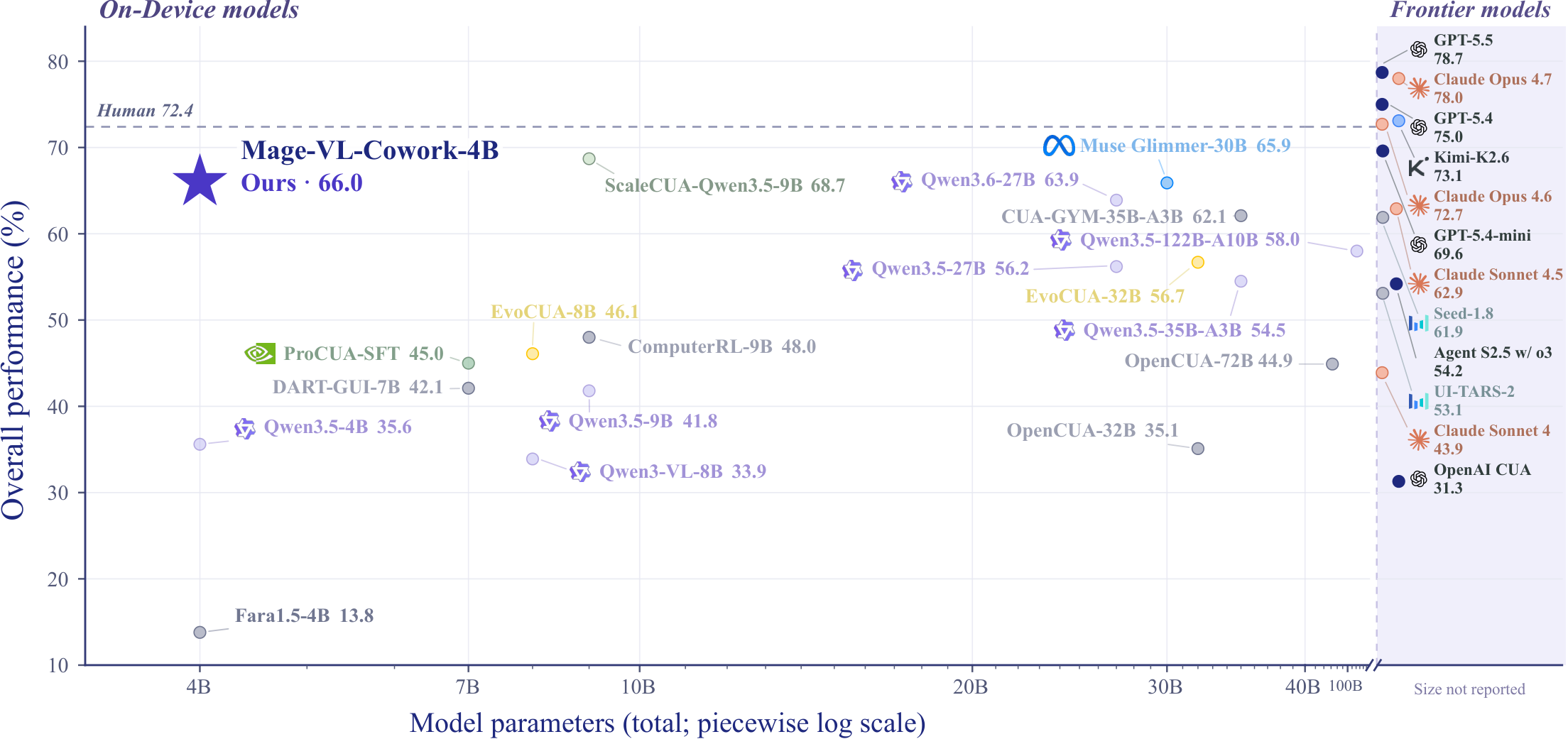
Mage-VL-Cowork achieves 66.0% on OSWorld-Verified with 4B parameters, alongside compact and larger agents.

OSWorld-Verified score versus model size.

4Bparameters
66.0%OSWorld-Verified
50step budget
+10.16 ppRL gain over Hybrid SFT
βˆ’13.0%model calls after RL
βˆ’25.4%output tokens after RL

Abstract

Effective computer-use agents should seamlessly combine visual GUI interaction with code and terminal execution within a single policy. We introduce Mage-VL-Cowork, a 4B hybrid computer-use agent trained from an intermediate Mage-VL checkpoint through an end-to-end, progressive five-stage curriculum across midtraining, SFT, and RL. Mage-CUA-Forge powers this curriculum with reusable, skill-conditioned generation workflows and application-specific preparers, synthesizing 293,806 desktop and web tasks across 6,915 skills while reducing recurring per-task expenditure by 82.6%. Rather than directly distilling a default teacher, we evolve its harness and instantiate specialized GUI, terminal, and hybrid configurations to collect stage-specific supervision, including 318,837 retained hybrid trajectories. The final policy reaches 66.0% on OSWorld-Verified under a 50-step budget, outperforming larger agents including Muse Glimmer-30B and Qwen3.6-27B. Relative to Hybrid SFT, online RL adds 10.16 percentage points while reducing mean model calls by 13.0% and output tokens by 25.4%.

Better demonstrations.
Stronger compact agents.

Improve how the teacher acts, scale what it learns from,
and teach one policy to use both channels.

Author a workflow once. Generate many executable tasks.

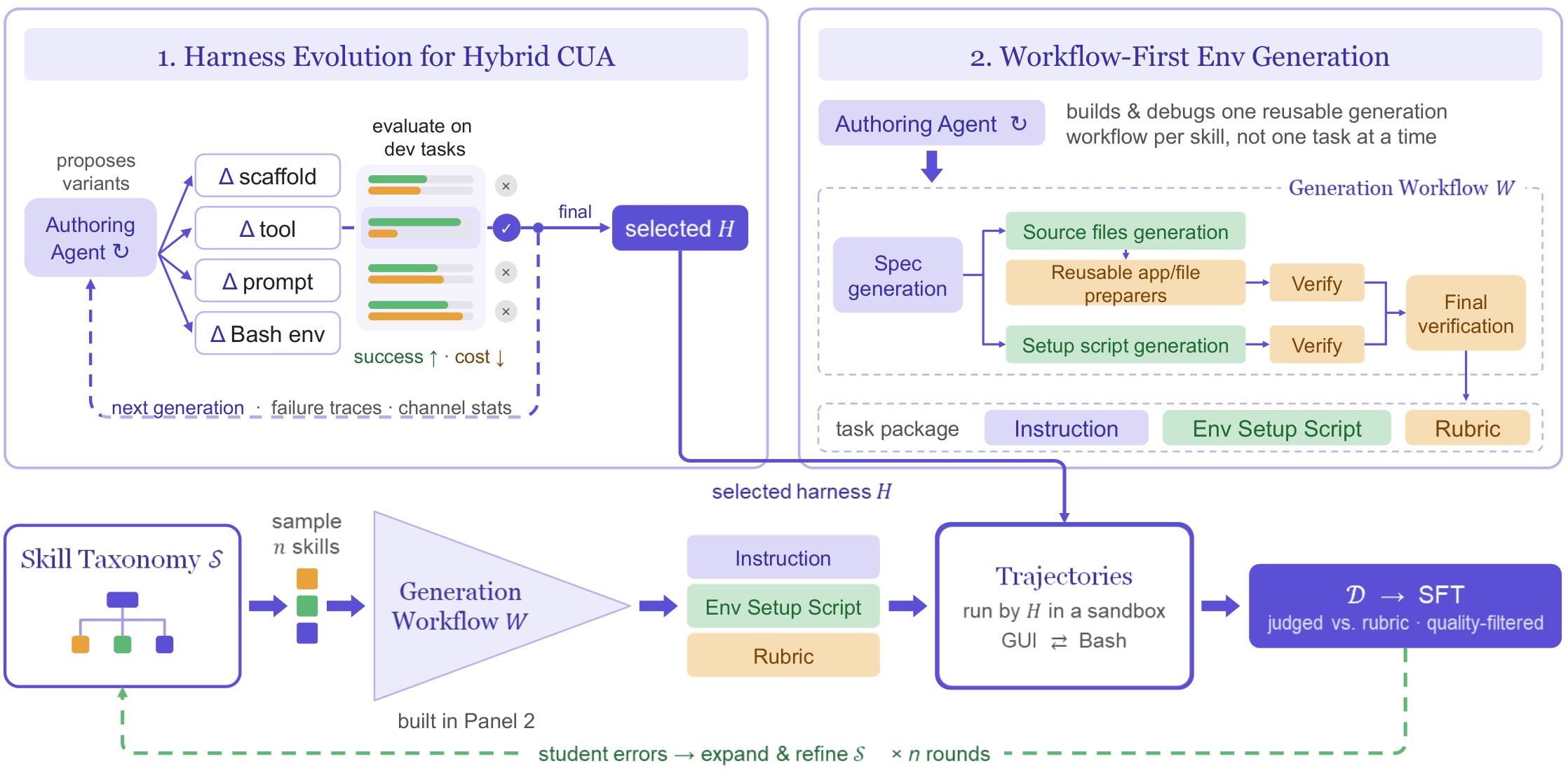
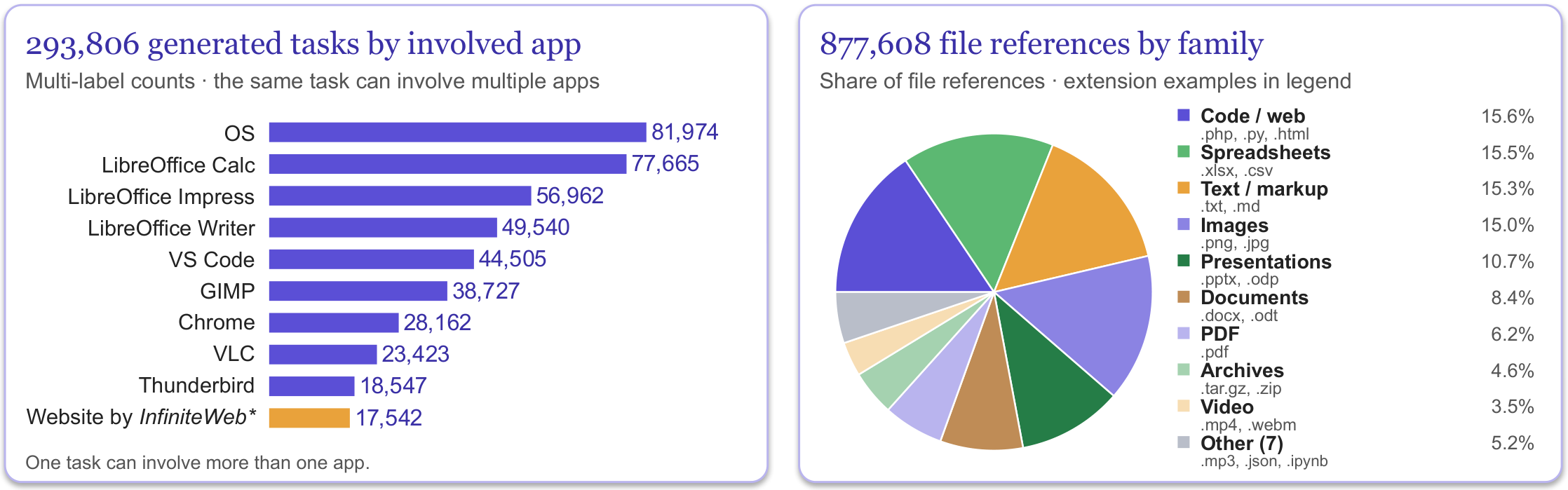
Mage-CUA-Forge replaces per-task agent construction with reusable, skill-conditioned workflows. Shared application preparers create files and desktop state; coordinated branches produce an instruction, environment setup script, and evaluation rubric. For web and cross-application tasks, synthesized InfiniteWeb environments and high-fidelity replicas built upon and expanding WebHarbor provide resettable local state. Student feedback expands and refines the skill taxonomy across generation rounds.

Two charts showing application coverage and task-file reference families.

38.24% of tasks span multiple applications.

293,806 tasks, 6,915 skills, 318,837 trajectoriesβ€”and 82.6% lower recurring generation expenditure. See the data and cost summary ↓

MAGE-CUA-FORGE

Scale supervision.
Reuse the construction.

Skill-conditioned workflows turn one-time authoring
into a reusable source of desktop tasks.

A broad foundation for hybrid learning

293,806distinct tasks
6,915atomic skills
318,837retained hybrid trajectories

Task instructions, environment setup, and evaluation rubrics are generated together. 38.24% of tasks involve multiple applications. GUI, terminal, and hybrid harnesses provide stage-specific trajectories; student feedback refines the skill taxonomy across generation rounds.

Explore workflow generation and coverage

Lower recurring generation cost

Workflow-first
βˆ’82.6%

per-task expenditure Β· $0.906 β†’ $0.158

Recurring task-generation expenditure
Env synth. methodTokens / taskUSD / task
Agent-first1,276K$0.906
Mage-CUA-Forge85K$0.158

Both approaches use the same generation model.

Hybrid computer use at 4B

66.0% on OSWorld-Verified, with strong performance
across operating-system and multi-application tasks.

Desktop task performance

Final RL Β· 4B
66.0%

OSWorld-Verified Β· 50-step budget

Selected OSWorld-Verified results
ModelSizeStepsOverall
SCALECUA-Qwen3.5-9B9B5068.7
Mage-VL-Cowork4B5066.0
Muse Glimmer-30B30Bβ€”65.9
Qwen3.6-27B27Bβ€”63.9
EvoCUA-32B32Bβ€”56.7
OpenCUA-72B72B5044.9
Fara1.5-4B4B5013.9

Across desktop workflows

OSWorld categories
87.5%
Operating system
62.7%
Multi-application workflow
Mage-VL-Cowork category scores
CategoryScore (%)
OS87.5
Office64.9
Daily65.0
Professional66.3
Workflow62.7
Overall66.0
Full OSWorld-Verified comparison from the technical report
OSWorld-Verified scores (%)
ModelStepsOSOfficeDailyProfessionalWorkflowOverall
Humanβ€”β€”β€”β€”β€”β€”72.4
Frontier models
GPT-5.5β€”β€”β€”β€”β€”β€”78.7
Claude Opus 4.7β€”β€”β€”β€”β€”β€”78.0
GPT-5.4β€”β€”β€”β€”β€”β€”75.0
Kimi-K2.6β€”β€”β€”β€”β€”β€”73.1
GPT-5.4-mini5079.268.076.669.463.369.6
Claude Sonnet 4.510070.872.661.463.249.562.9
Seed-1.810066.768.867.171.442.461.9
Agent S2.5 w/ o35075.053.854.075.539.554.2
UI-TARS-210041.761.162.161.234.153.1
Claude Sonnet 45045.843.555.155.128.543.9
OpenAI CUA5070.823.037.251.015.831.3
Models with known parameter counts
SCALECUA-Qwen3.5-9B5079.270.674.389.548.168.7
Muse Glimmer-30Bβ€”β€”β€”β€”β€”β€”65.9
Qwen3.6-27Bβ€”β€”β€”β€”β€”β€”63.9
EvoCUA-32Bβ€”β€”β€”β€”β€”β€”56.7
Qwen3.5-27Bβ€”β€”β€”β€”β€”β€”56.2
ComputerRL-9B5075.045.852.571.427.948.0
ProCUA-SFTβ€”β€”β€”β€”β€”β€”45.0
OpenCUA-72B5045.842.753.875.522.344.9
DART-GUI-7B3062.539.350.873.516.742.1
Qwen3.5-9Bβ€”β€”β€”β€”β€”β€”41.8
OpenCUA-32B5060.929.941.065.314.635.1
Fara1.5-4B5025.07.629.512.26.613.9
Mage-VL-Cowork-4B5087.564.965.066.362.766.0
Browser transfer before RL Β· 58.6% on WebVoyager-Static

The 4B Mage-VL-Cowork-SFT model achieves 58.6% success (377/643 tasks), ranking second among the evaluated models behind the specialized browser agent Fara1.5-4B (68.0%). It outperforms larger models including Qwen3-VL-8B-Thinking (53.7%) and Qwen3.5-9B (53.3%).

WebVoyager-Static reconstructs all 643 tasks across 15 websites using self-hosted replicas built upon and substantially extending WebHarbor. Verification checks page visits and required UI operations, then compares the answer and backend database state against ground truthβ€”not just the final screenshot.

WebVoyager-Static and live WebVoyager success rates
ModelWebVoyager-Static (%)Live (%)Ξ” (pp)
Open-source models
Fara1.5-4B68.080.8-12.8
Qwen3-VL-8B-Thinking53.7β€”β€”
Qwen3.5-9B53.3β€”β€”
Qwen3-VL-4B-Thinking49.6β€”β€”
OpenWebRL-4B47.174.1-27.0
MolmoWeb-8B46.878.2-31.4
MolmoWeb-4B42.675.2-32.6
Fara-7B40.473.5-33.1
Qwen3.5-4B37.3β€”β€”
Mage-VL-Cowork-SFT58.6β€”β€”

REAL-TIME DEMOS

Watch it decide when to clickβ€”and when to code

Same task, same desktop, same clock. Mage-VL-Cowork works through a hybrid GUI + CLI action space; Qwen3.6-27B works through GUI actions only, in thinking mode. Streaming reasoning, tool calls, and screen actions play back at real speed.

Spreadsheet editing in LibreOffice Calc

Merge two banner ranges, label them, add a column chart, and save a new .xlsx file.

Mage-VL-Cowork
Done at 0:39 Β· 6 steps Β· edits the workbook with Python in the terminal
Qwen3.6-27B
Done at 9:56 Β· 39 steps Β· clicks and drags through the GUI

Image editing in GIMP

Add an alpha channel, clear a solid teal background, scale the layer to 280 Γ— 210 px, and save the layered file.

Mage-VL-Cowork
Done at 1:58 Β· 15 steps Β· edits in the GUI, then checks the saved file in the terminal
Qwen3.6-27B
Stops at 7:02 Β· 29 steps Β· the saved file does not pass the task check

More capable. More efficient.

Online RL improves task scores while shortening interaction sequences
and reducing generated output.

A COMPLETE FIVE-STAGE RECIPE

  1. 01
    GUI-Oriented Midtraining

    Visual grounding, reasoning, and structured tool calling.

  2. 02
    GUI Agent SFT

    Complete workflows through screenshots, mouse, and keyboard.

  3. 03
    Coding & Terminal SFT

    Terminal, software engineering, and programmatic desktop manipulation.

  4. 04
    Hybrid CUA SFT

    Turn-level routing between GUI interaction and coding or terminal execution.

  5. 05
    Online Hybrid RL

    GRPO with asynchronous rollouts and verifiable task rewards.

STAGE 1 Β· GUI-ORIENTED MIDTRAINING

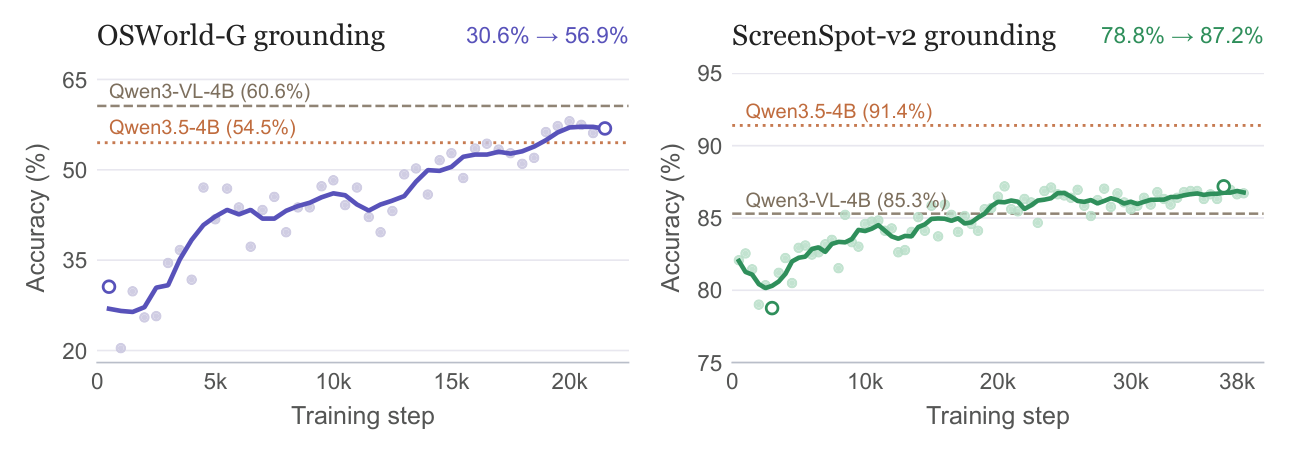
Stronger grounding before multi-step execution

30.6 β†’ 56.9%OSWorld-G
78.8 β†’ 87.2%ScreenSpot-v2

OSWorld-G surpasses Qwen3.5-4B (54.5%); ScreenSpot-v2 exceeds Qwen3-VL-4B (85.3%).

Stage 1 grounding: OSWorld-G rises from 30.6% to 56.9%; ScreenSpot-v2 rises from 78.8% to 87.2%.
Checkpoint evaluations with five-checkpoint moving averages.
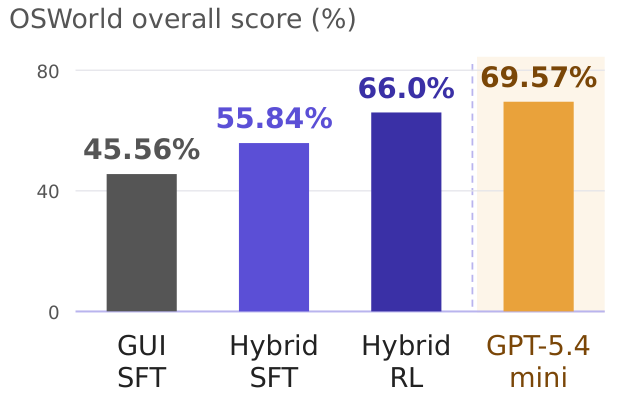
GUI SFT45.56%
Hybrid SFT55.84%
Hybrid RL66.0%
Stage-wise task performance: GUI SFT 45.56%, Hybrid SFT 55.84%, Hybrid RL 66.0%.
(a) Task performance
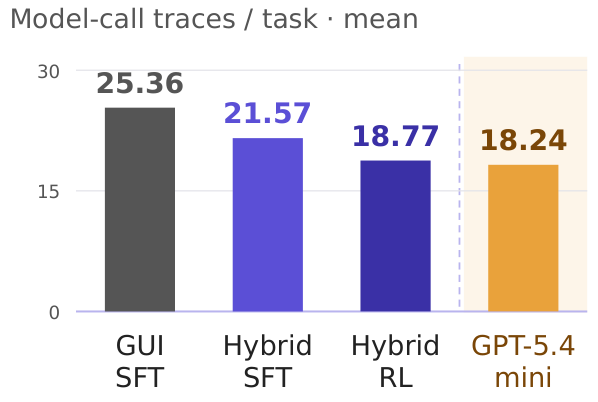
Mean model calls decrease from 25.36 to 21.57 to 18.77 across GUI SFT, Hybrid SFT, and Hybrid RL.
(b) Execution length
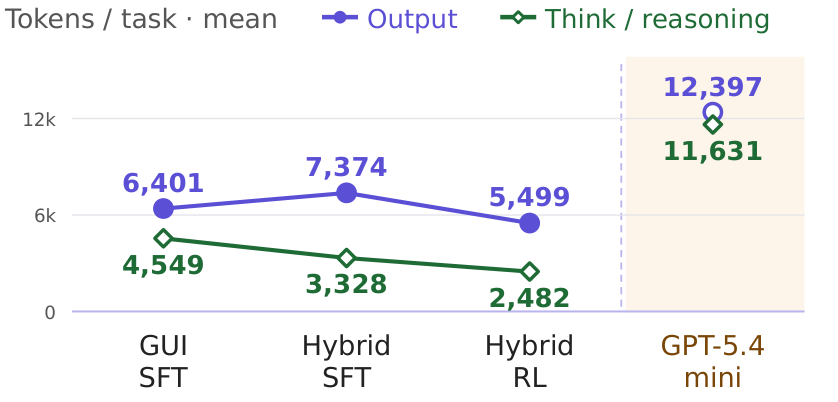
Mean output-token usage is 6,401 for GUI SFT, 7,374 for Hybrid SFT, and 5,499 for Hybrid RL.
(c) Token usage

RL adds 10.16 pp over Hybrid SFT, while mean model calls fall from 21.57 to 18.77 and mean output tokens from 7,374 to 5,499 per task. The result is a stronger policy with shorter interaction sequences and less generated output.

Midtraining design Β· grounding, reasoning, and tool calling

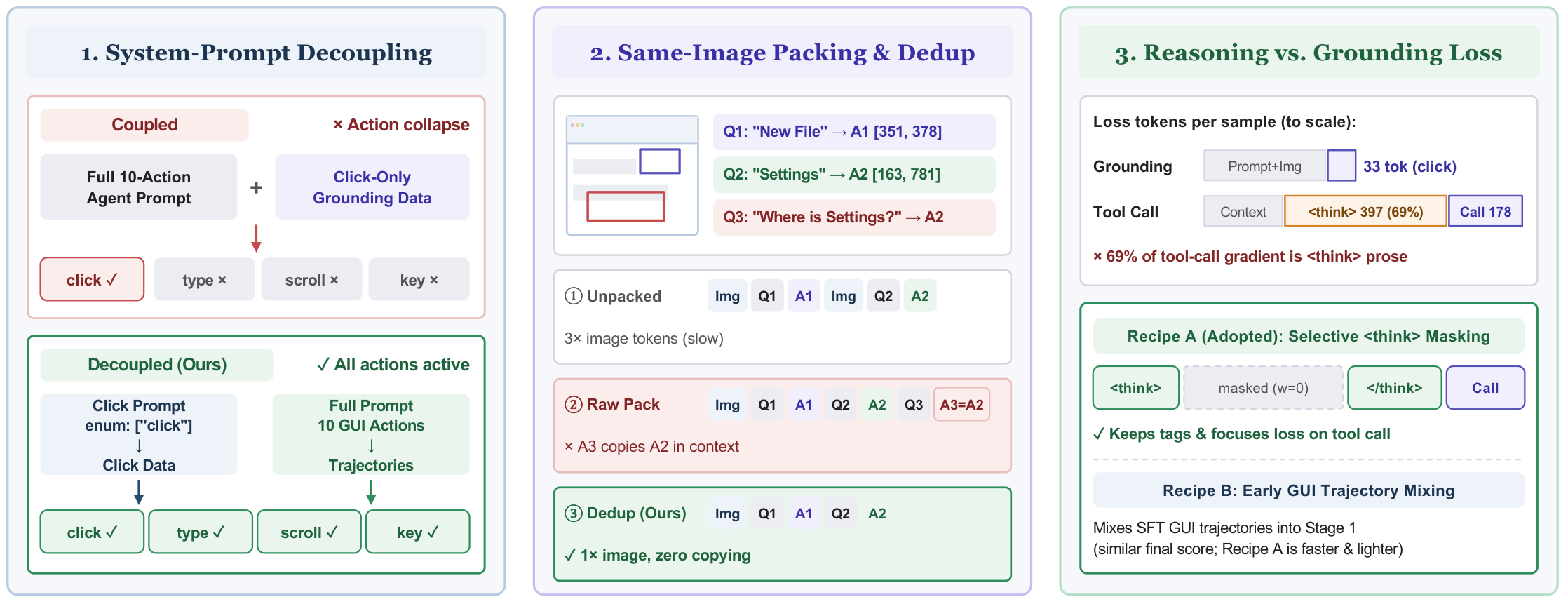
Stage 1 separates the click-only grounding prompt from the full agent schema and deduplicates repeated target locations within same-screenshot packed sequences. The adopted recipe masks the interior of <think> rationales while supervising the delimiter tags and tool calls, preserving the reasoning format while focusing the loss on tool syntax and grounding.

Three midtraining design panels: system-prompt decoupling, same-image packing and deduplication, and reasoning versus grounding loss.

Single Step Cowork Bench: 342 representative desktop interaction steps spanning eight GUI action primitives. It jointly checks reasoning/tool-call syntax, action type and arguments, and spatial hit accuracy.

Compact working memory Β· recent screenshots + folded action history

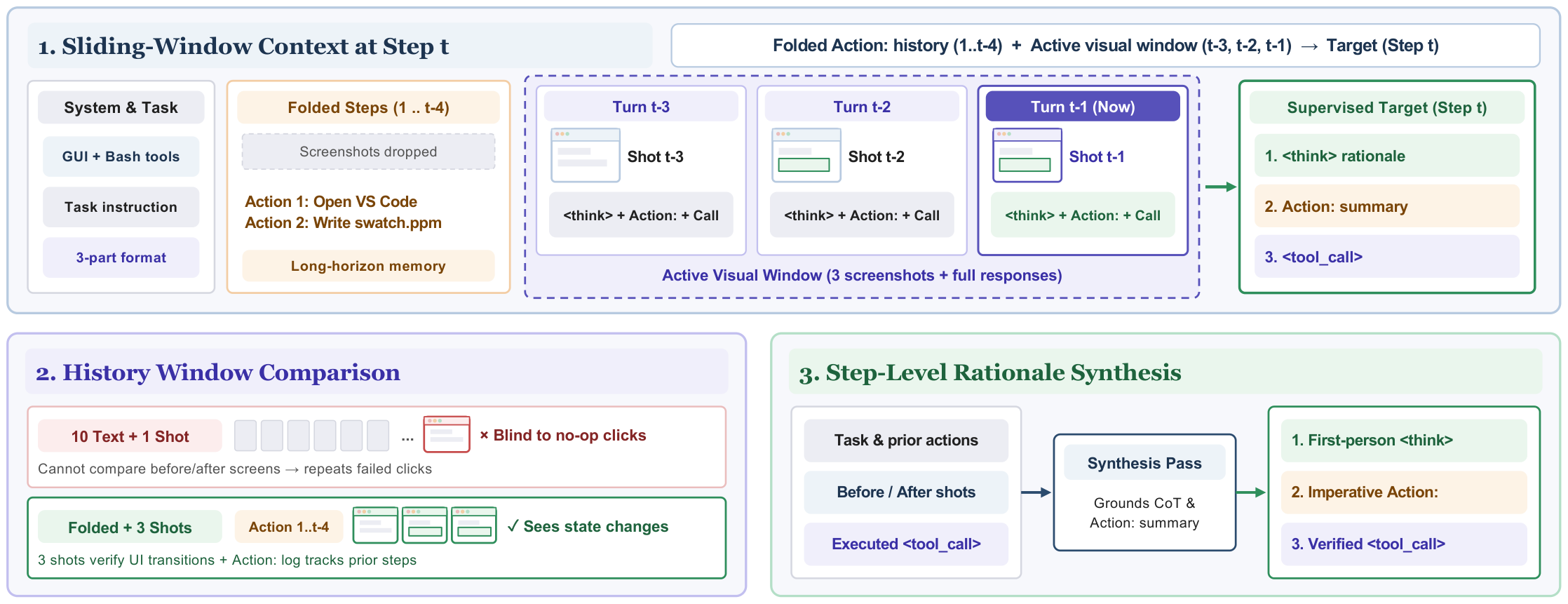
Each context retains the three most recent screenshots and four complete responses, with older steps compressed into imperative Action: summaries immediately after the system prompt. A response combines a grounded <think> rationale, an Action: summary, and the executed <tool_call>. Step-level rationale synthesis uses task context, before/after screenshots, and the executed tool call to produce this consistent format.

Sliding-window context and step-level rationale synthesis diagram.
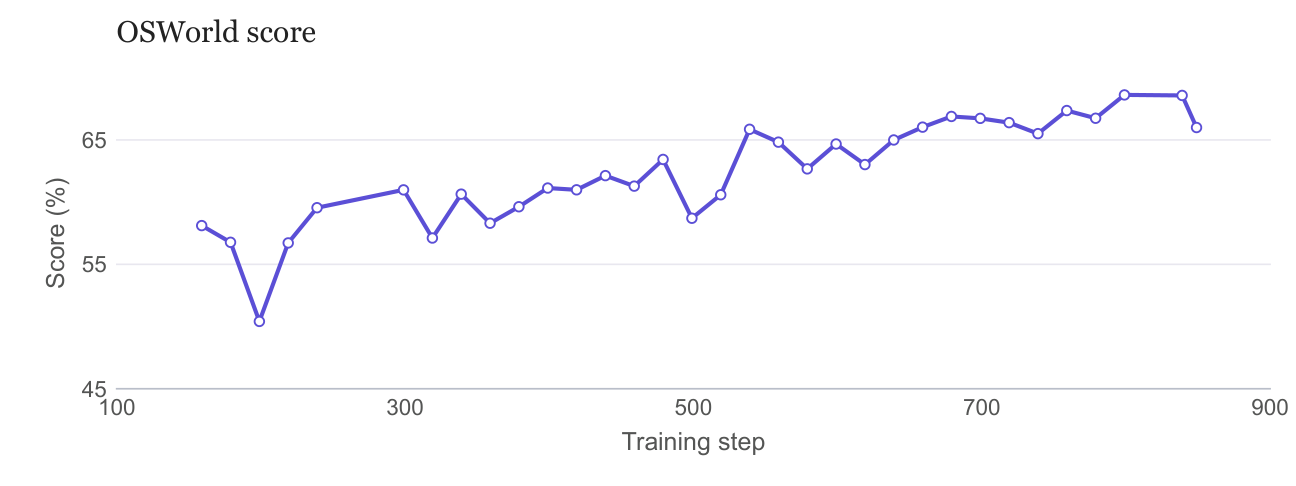
RL progression Β· all 33 recorded evaluations
OSWorld-Verified RL learning curve, ending at a final score of 66.0%.
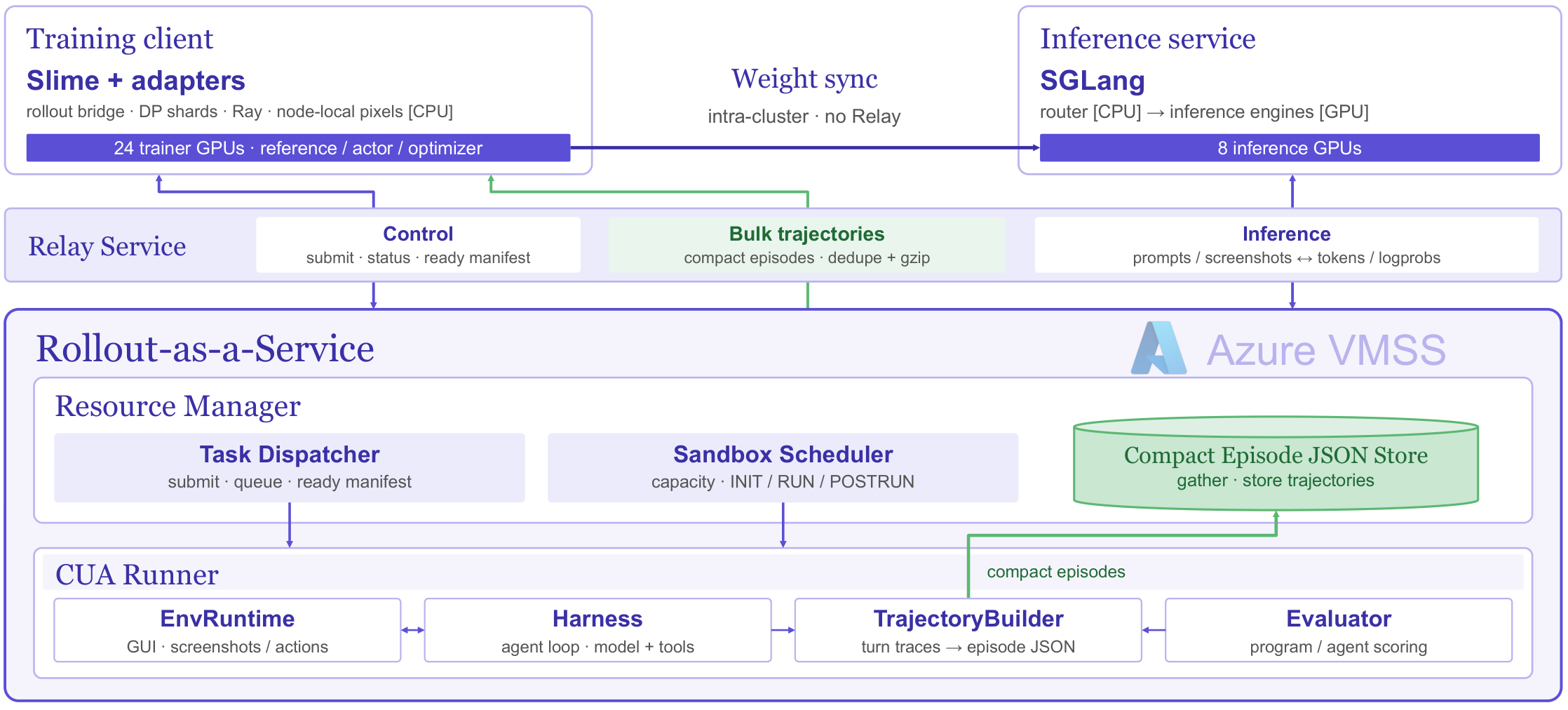
Rollout-as-a-Service Β· asynchronous desktop RL infrastructure

Desktop environments, model inference, and policy optimization scale separately. The infrastructure integrates PoLar, Slime, Azure Relay, and Azure VM Scale Sets, with SGLang serving model requests. Asynchronous rollouts let completed tasks advance training without waiting for the longest desktop episodes.

Rollout-as-a-Service architecture connecting training clients, inference servers, CPU workers, and desktop sandboxes.

Reference deployment: 1,120 GUI slots on 70 CPU hosts, with 24 B200 GPUs for training and 8 for inference. The report describes bounded policy lag and truncated importance sampling.

The harness shapes the student

Cleaner hybrid execution transfers beyond the teacher’s own score.

With the teacher model held fixed, the GUI + coding harness outperforms the AX-augmented variant in both success rate and execution steps. The same ranking carries over to the 4B students trained on their respective demonstrations, with a larger success-rate gap.

Same 672 held-out multi-application tasks; identical evaluation settings
Teacher harnessTeacher4B student
Success (%) ↑Steps ↓Success (%) ↑Steps ↓
Ξ²1 Β· GUI + coding92.025.037.630.91
Ξ²2 Β· GUI + coding + AX89.635.325.139.4

Both teachers use GPT-5.4. Each student learns from its corresponding teacher’s trajectories.

Frequently asked questions

What is Mage-VL-Cowork?

Mage-VL-Cowork is a 4B hybrid computer-use agent (CUA) from the Microsoft Mage Team. A single vision-language policy combines screenshot-grounded GUI actions with code and terminal execution, and reaches 66.0% on OSWorld-Verified under a 50-step budget.

What is a hybrid computer-use agent?

A hybrid agent can act through two channels. The GUI channel uses mouse and keyboard actions for visual layouts, rendered output, and live application state. The terminal channel uses code, command-line tools, and application libraries for documents, spreadsheets, and presentations. Mage-VL-Cowork chooses the channel at each turn inside one policy, without an external orchestrator.

How does Mage-VL-Cowork compare with larger computer-use models?

On OSWorld-Verified, the 4B model scores 66.0%, ahead of Muse Glimmer-30B (65.9%) and Qwen3.6-27B (63.9%). It scores 87.5% on operating-system tasks and 62.7% on multi-application workflows.

What does it mean to evolve the agent harness?

The agent harness is the scaffold around the model: tool interfaces, prompts, and the execution environment. Before large-scale rollout, the teacher harness is refined and pruned. On 672 held-out multi-application tasks, a GUI + coding teacher scores 92.0% versus 89.6% with an added accessibility channel, and the corresponding 4B students score 37.6% versus 25.1%.

What is Mage-CUA-Forge?

Mage-CUA-Forge is a workflow-first environment and task synthesis pipeline. Reusable, skill-conditioned workflows generate the instruction, environment setup script, and evaluation rubric together. It produced 293,806 desktop and web tasks across 6,915 skills, and lowered recurring per-task generation cost by 82.6% ($0.906 to $0.158).

How is Mage-VL-Cowork trained?

Training starts from an intermediate Mage-VL checkpoint and follows five stages: GUI-oriented midtraining, GUI agent SFT, coding and terminal SFT, hybrid CUA SFT, and online hybrid reinforcement learning with verifiable rewards. Online RL adds 10.16 percentage points over hybrid SFT while reducing model calls by 13.0% and output tokens by 25.4%.

Contributors

Xiaoyi Zhang*†, Haoqing Wang*, Xinjie Zhang, Xiang Ming, Xing Wang, Senqiao Yang, Kaichen Zhang, Zhaoyang Jia, Andong Tan, Xinjiang Wang, Jinghao Guo, Yifei Shen, Xiao Li, Peng Zhang, Xun Guo, Jiahao Li, Shicheng Zheng, Jinglu Wang, Zongyu Guo, Wenxuan Xie, Bin Li, Yan Lu

* Equal Contribution. † Project Lead (xiaoyizhang@microsoft.com).

BibTeX πŸ“š

@article{zhang2026magecowork,
  title={Mage-VL-Cowork: A Full Training Recipe to Learn Hybrid Computer Use from Evolved Harnesses},
  author={Zhang, Xiaoyi and Wang, Haoqing and Zhang, Xinjie and Ming, Xiang and Wang, Xing and Yang, Senqiao and Zhang, Kaichen and Jia, Zhaoyang and Tan, Andong and Wang, Xinjiang and others},
  journal={arXiv preprint},
  year={2026}
}