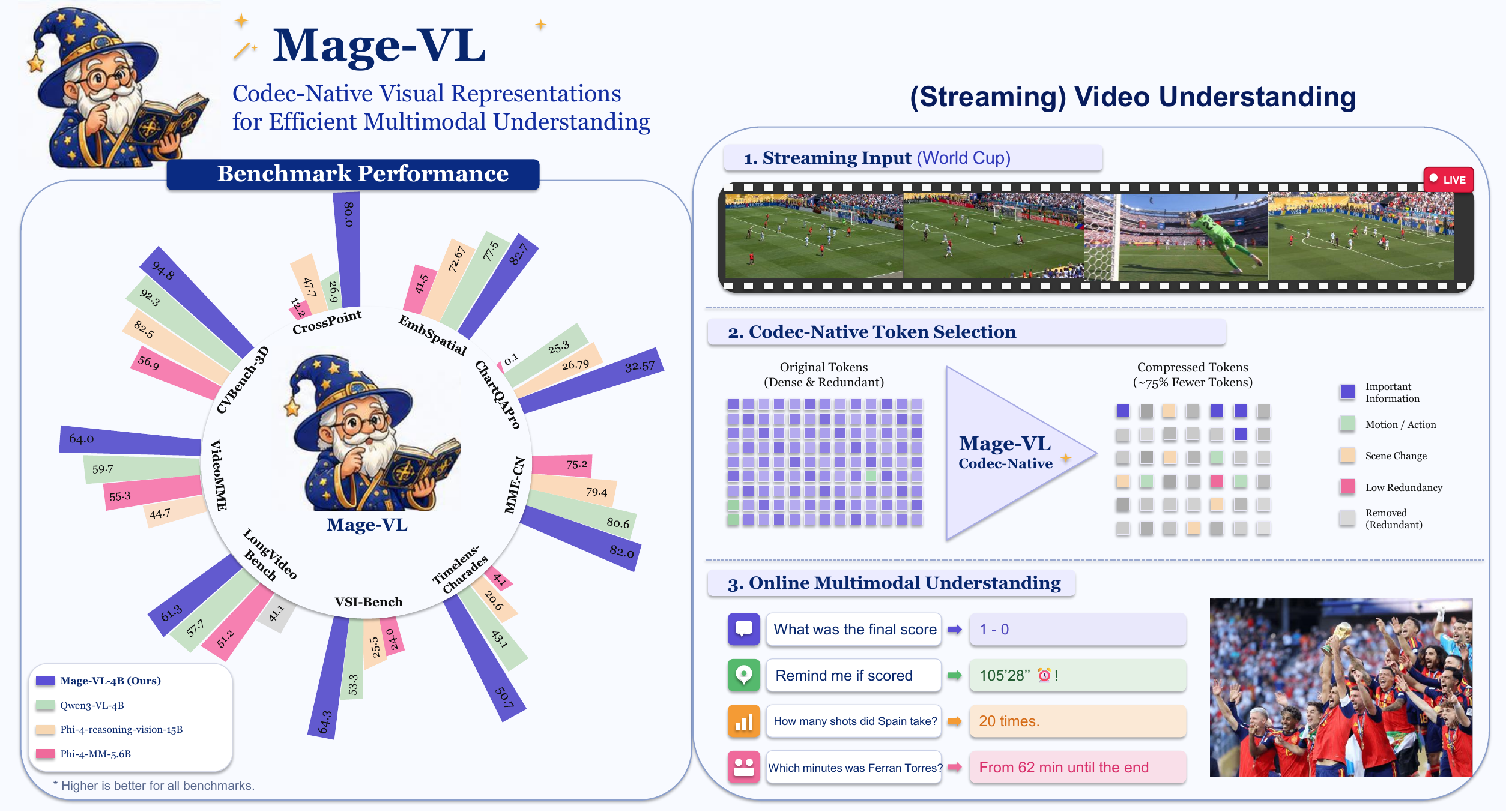
Codec-native perception
Instead of offline uniform frame sampling with a frozen encoder, Mage-VL reads video the way a codec does. Each stream is split into anchor (I) frames (kept in full) and predicted (P) frames (only motion-salient patches kept) on a 16×16 grid. A single per-patch importance interface is codec-agnostic — it accepts a traditional codec (H.264/HEVC motion + residual) or a neural codec (DCVC-RT rate map) with no change to the encoder — cutting visual tokens by over 75% for up to 3.5× faster inference.
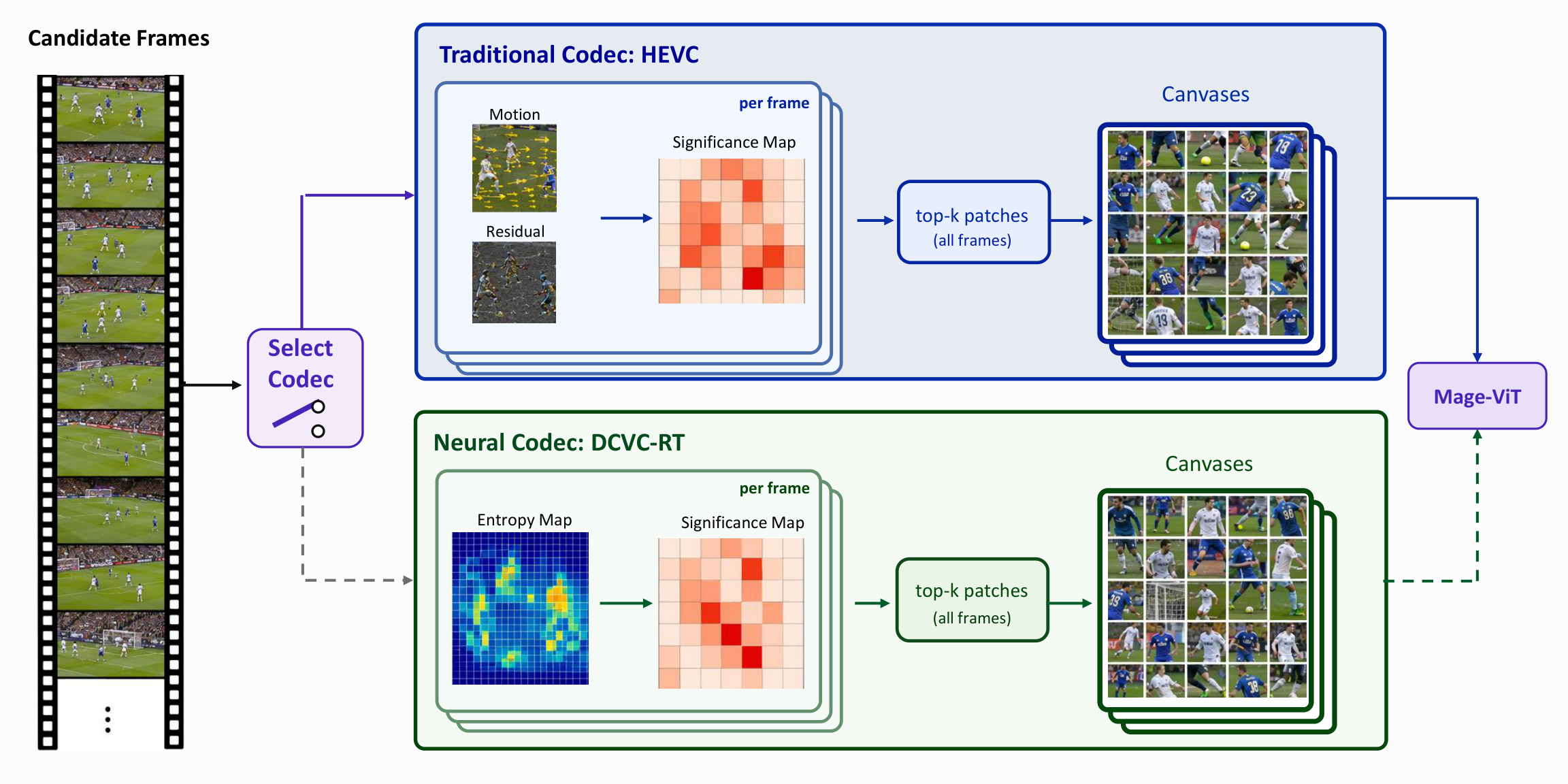
Codec-driven patch selection: HEVC (motion + residual) or DCVC-RT (entropy) → per-frame significance map → top-k patches packed into canvases for Mage-ViT.
Bio-inspired proactive streaming
A single-model System 1 & System 2 design gives low-latency, proactive responses to continuous video. A lightweight System 1 cognition gate watches each rolling codec window and decides when to speak; only when an event is response-worthy does it trigger the full System 2 VLM to generate — no multi-agent pipeline. It stays silent through routine play and speaks the moment an event completes, generalizing to real broadcasts (e.g. 2026 World Cup matches).
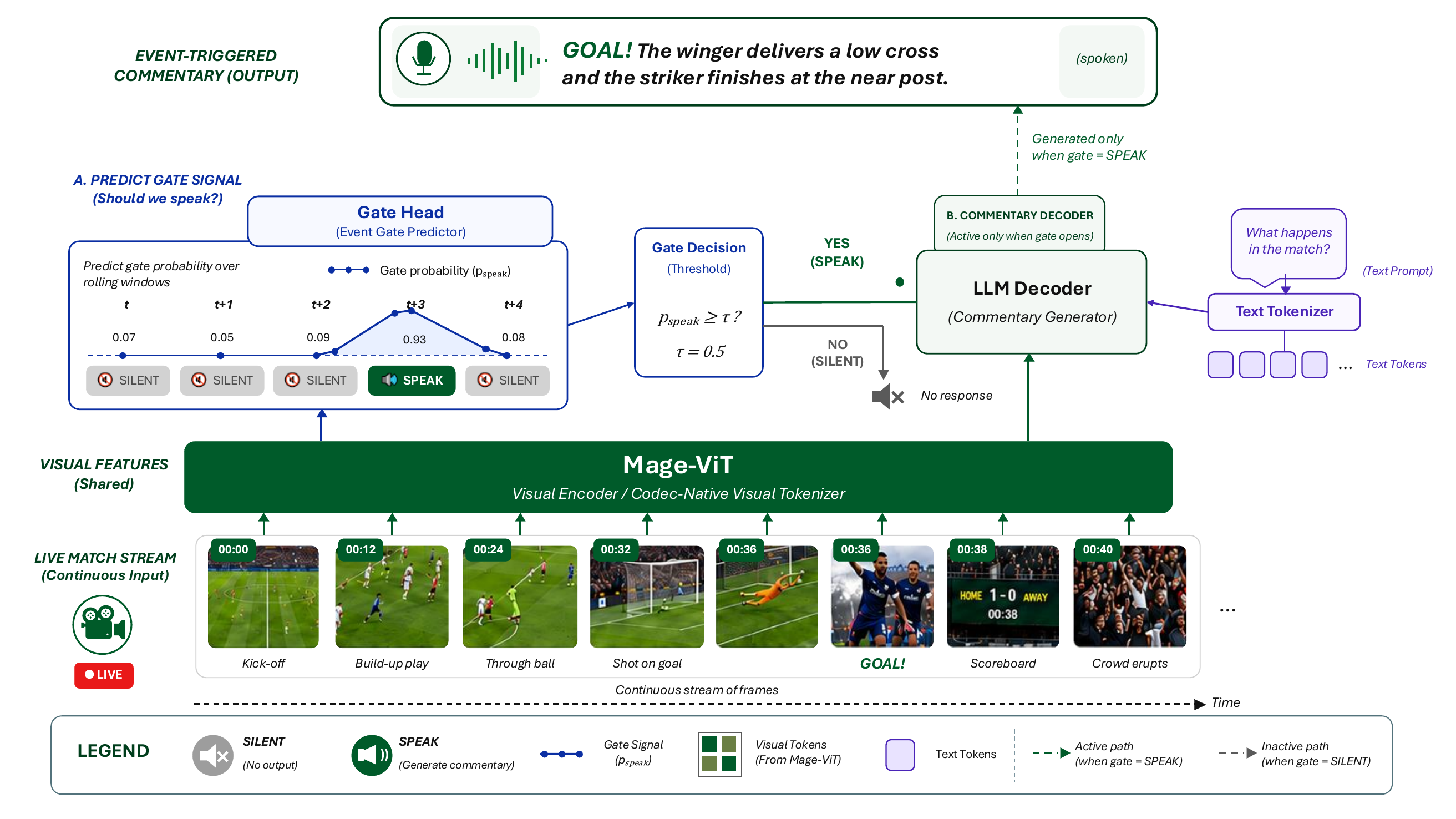
Proactive streaming: Mage-ViT features feed an event gate that stays silent until a response-worthy moment, then triggers the LLM decoder to produce event-conditioned commentary.
AI4AI data pipeline
The training data refines itself through an agentic closed loop. A frozen Qwen3-VL-32B captions images; a GPT-5 rubric scorer grades each caption on completeness, redundancy, coherence, and OCR fidelity; and a GitHub Copilot agent co-designs the prompt and harness code (e.g. rendering timestamp overlays so the captioner anchors events by OCR) under a human validation gate. Ten refine–verify iterations lift every downstream OCR / document / chart / perception benchmark (+5.6 InfoVQA, +3.8 OCRBench, +3.8 RealWorldQA); the same paradigm also drives Stage-3 data diagnostics, and this work inspired SkillOpt-Lite.
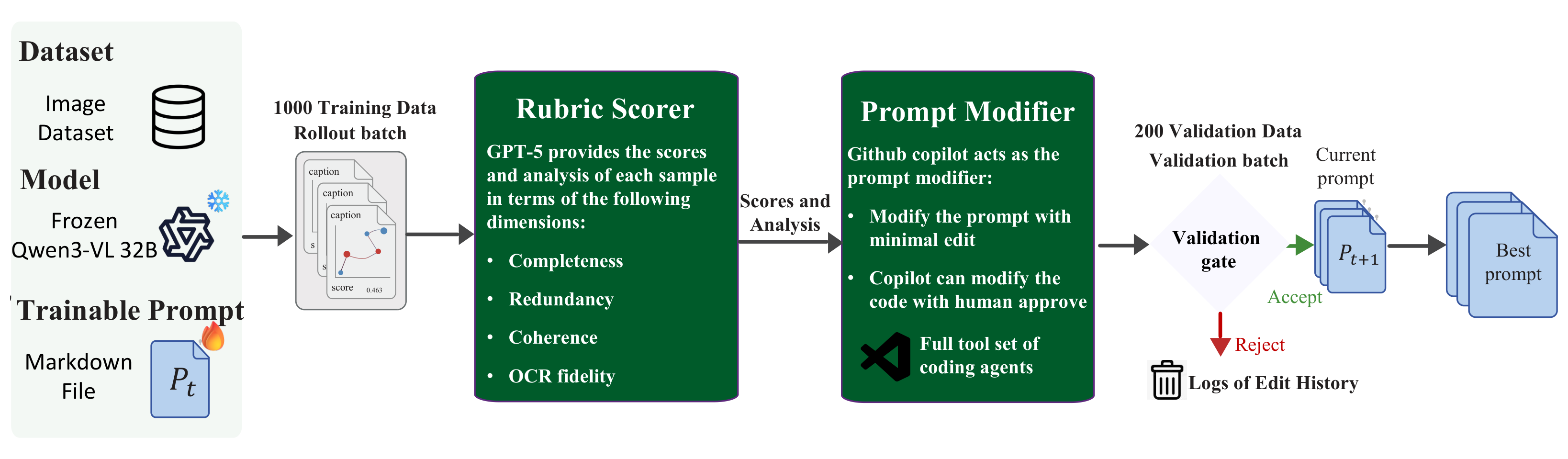
AI4AI closed loop: frozen Qwen3-VL-32B captions → GPT-5 rubric scorer → Copilot prompt/code modifier → validation gate → improved prompt Pt+1.
Emergent behavior in video caption pipeline. During pipeline iteration, the evaluation sub-agent identified that GPT-4.1 struggled with precise temporal localization when relying solely on generic text prompts. To resolve this, the harness code renders sequential timestamp overlays directly onto sampled frames, while the prompt guides the model to anchor events via visual OCR. This code–prompt co-design converts implicit temporal tracking into a visual grounding task, reducing temporal hallucinations and improving caption consistency across long videos.
AI-guided training diagnostics & recipe optimization. The same AI4AI loop also shaped our training recipe: the evaluation agent surfaced weaknesses in temporal localization — remedied by supplementing high-quality grounding data — and revealed that more frames consistently boost long-video performance, whereas dedicated long-video SFT and resolutions beyond 384 yield only marginal gains. Guided by these findings, we adopt 384-pixel inputs, set Stage-3 temporal length to 384 frames, and raise the RoPE base frequency ($\theta$) to 8M for stable long-context modeling.