DirectX-Specs
D3D12 Work Lists
GPU-Driven Rendering with Dynamic Program Selection
v0.855 10/21/2026
- Motivation
- Work Lists Overview
- System Overview
- Dispatch Model
- Work List Signature
- Secondary-list shape
- Per-binding source: primary list vs secondary list
- Argument layouts and the signature objects
- Record byte layouts
- Program table slot layout
- Supported argument types
- Per-argument-type layouts
- _INCREMENTING_CONSTANT
- _DESCRIPTOR_TABLE
- _DISPATCH_RAYS_DIMENSIONS
- _FIXED_DISPATCH
- _INLINE_ROOT_PARAMETER
- _INLINE_STATIC_SAMPLER
- _DISPATCH_LIST_HEADER_POINTER
- _PROGRAM_TABLE_POINTER
- _PRIMARY_LIST_POINTER
- _PRIMARY_RECORD_POINTER
- _SECONDARY_LIST_POINTER
- _SECONDARY_RECORD_POINTER
- _LIST_SCOPE_INSTRUMENTATION_POINTER
- _WRITE_BUFFER_IMMEDIATE
- _TIMESTAMP_QUERY
- Other argument types
- Root signature bindings
- Input Assembler bindings
- Record strides
- State leakage and reset
- Incrementing constant semantics
- Program Table
- Binding via SetProgram
- Tier 2 Dispatch Features
- Signature Selection
- Dispatch List Continuations
- Execution Order and State Scoping
- Compatibility and Validation
- GPU Timeline Validation Hooks
- Interaction with other command-list features
- Resource States and Synchronization
- Example
- Progress and Timing Instrumentation
- Feature Tiers and Capability Queries
- API
- DDI Design
- Open Issues
- Change Log
Motivation
D3D ExecuteIndirect lacks a way to express PSO (pipeline state object) / program changes, an often-requested feature present in various other graphics APIs. This limitation creates challenges for algorithms that need to operate on a large number of PSOs, where active PSOs can only be determined on the GPU timeline.
ExecuteIndirect can only express this pattern by issuing one call per possible PSO state and using a 0 indirect-argument count to skip inactive states. The approach is functionally correct but can overwhelm implementations with empty calls, starving the GPU of useful work and causing inefficiencies.
This feature is early in development. While the spec is public, implementations are not ready. Hopefully a preview can be available some time in 2027.
Work Lists Overview
Work Lists allow the GPU to select a pipeline per draw from a GPU-resident program table, dispatching work across multiple pipelines in a single API call. Applications write transparent argument buffers using work list signature layouts and organize dispatch inputs by program table index. The implementation handles pipeline selection and record execution without requiring CPU involvement in PSO bucketing.
Four core capabilities sit behind that summary, available at WORK_LISTS_TIER_1 and above:
-
GPU-driven program selection per draw. Each draw, dispatch, or
DispatchRaysissued by oneDispatchListcall can use a different PSO. The GPU picks which one by reading a per-record index into a GPU-resident table of program identifiers, so one CPU-side call can dispatch work across hundreds of PSOs in any mix, without per-PSO CPU bucketing orExecuteIndirect-style worst-case empty calls. The table is just app-managed GPU memory, so any producer (CPU upload,CopyBufferRegion, or shader UAV writes) can populate it. -
Per-PSO indirect-argument layouts. Different PSOs in the same dispatch can have different per-record argument shapes, e.g. one PSO updates a root SRV per draw while another updates a per-material root constant, or two PSOs touch different sets of root parameter slots. Each PSO’s layout (its program command signature) is associated with the program at state-object creation time, so the driver can specialize the per-PSO indirect-argument unpack and root-binding update sequences at compile time.
-
Per-binding source choice. Some bindings naturally vary per draw (per-instance vertex / instance counts, per-execution root parameters); others are shared across many draws using the same PSO (a per-material CBV, a per-batch root constant). Work Lists lets each argument declare which kind it is, so shared bindings live once in shared per-PSO-batch memory instead of being duplicated in every per-draw record (the way they would under
ExecuteIndirect). See Per-binding source for the formal model. -
GPU-resident work description. The actual record counts, records, program-table contents and dispatch input header live in GPU memory. A producer compute shader can author the work without CPU readback, within the bounds supplied in the CPU-side call descriptor. The descriptor supplies the initial header’s GPU address and sizing bounds, not the actual record counts.
Optionally, per-program local root arguments may live alongside each program identifier in the program table, the way they do in raytracing shader records, so per-program bindings that would otherwise be replicated in every record live once per PSO.
WORK_LISTS_TIER_2 adds two features for fully GPU-resident multi-phase pipelines, e.g. a compute culling pass that produces a draw list whose record count isn’t known on the CPU:
-
Cross-class chaining. A single work list signature dispatches against records of one executable class (all graphics, all compute, or all raytracing), so a multi-phase pipeline that mixes classes (e.g. a compute-class culling list followed by a graphics-class draw list) needs more than one signature. Aggregating two or more work list signatures (the per-list containers, not the per-PSO program command signatures already covered above) into an
ID3D12WorkListSignatureArraylets each list in the chain pick which one applies viaSignatureIndex, all within one CPU-side dispatch. Without this, every cross-class transition would need a separate CPU API call. -
GPU-driven chaining. Without continuations, an app running N back-to-back lists has to either decide N on the CPU up front (forcing readback of GPU intermediate counts) or always issue worst-case-many lists and let later ones no-op. With continuations, each list publishes its successor’s address via
NextDispatchList, the GPU itself decides whether to continue and what comes next. Producer/consumer chains turn into one CPU API call: the previous list’s shaders write the next list’s entire input (counts, buffers, even the address of the list after that), then the implementation walks the chain end-to-end with no CPU intervention. A list whose shaders write the next list’s input, or data it consumes, sets_END_WITH_WAIT_FOR_COMPLETION; a chain already in place needs no wait and launches through greedily.
Combined, the two let an entire GPU-driven pipeline, such as multiple rounds of compute followed by draw, live behind one DispatchList1 call. Command-list state that’s not part of the per-record argument shape (render-target binding, viewport, scissor, depth-stencil state) stays fixed across the whole chain (it’s CPU-set command-list state, set once before the dispatch), so pipelines whose phases need different render-target setups still need separate dispatches.
Work List Sketches
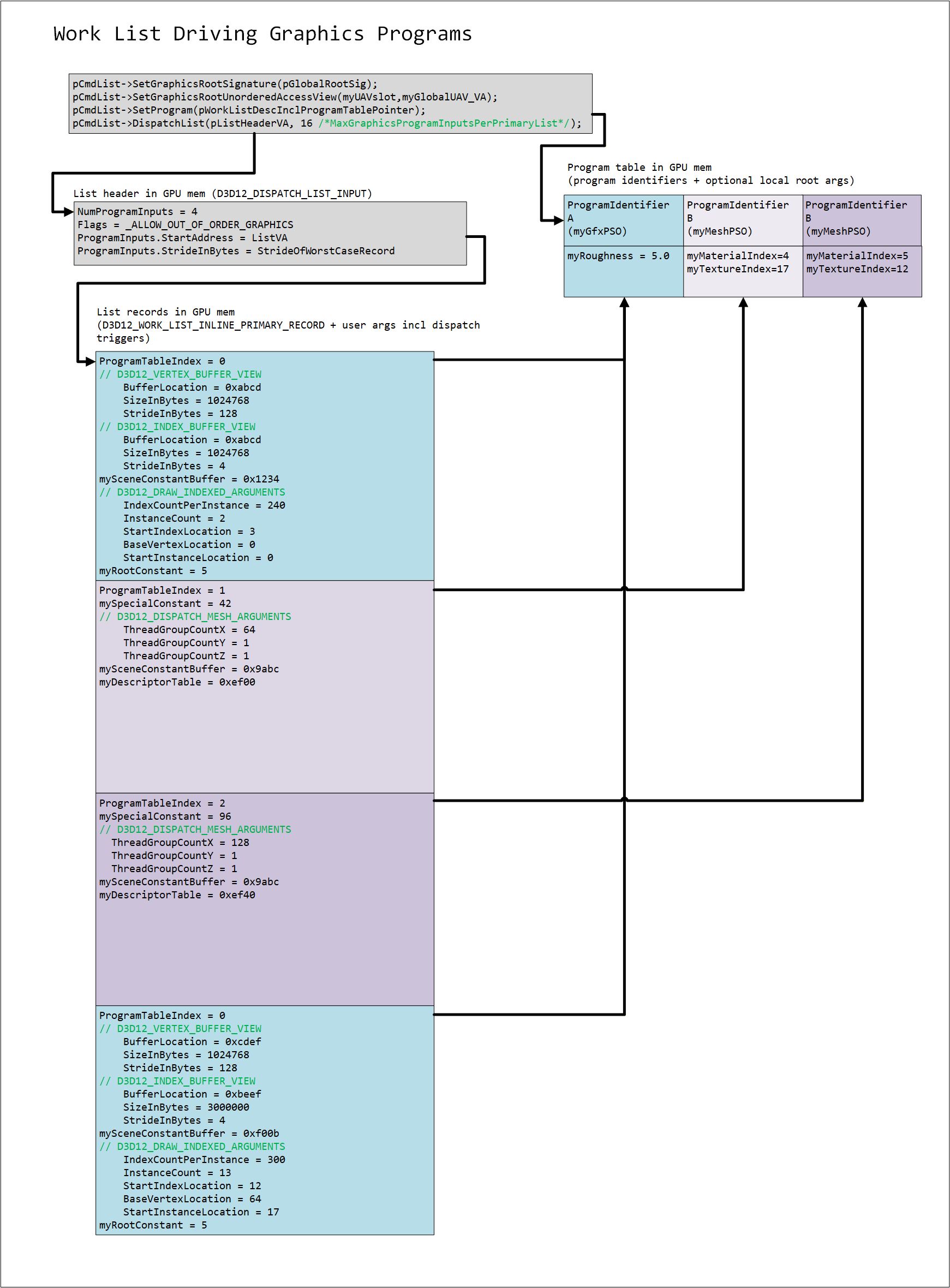
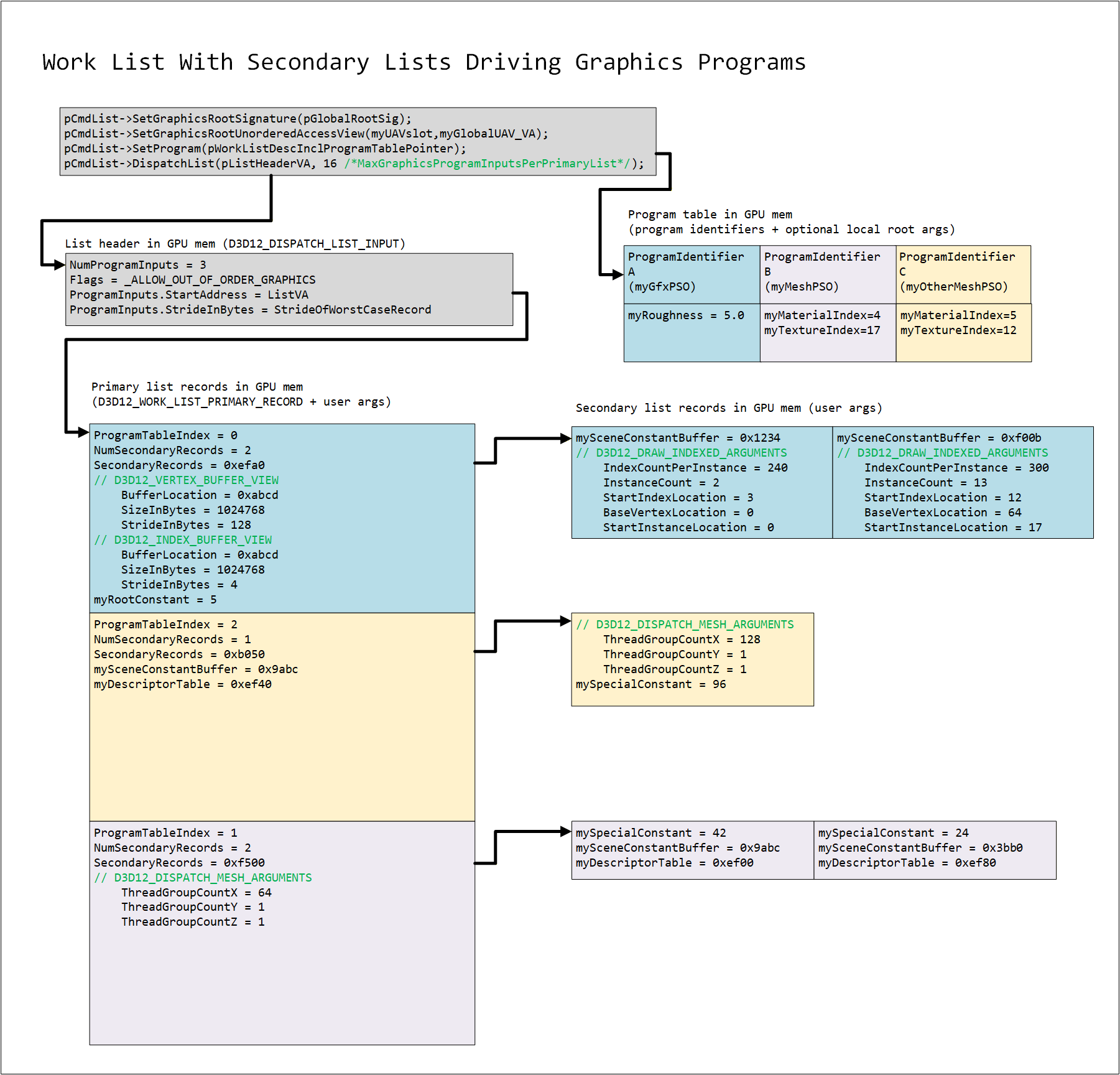
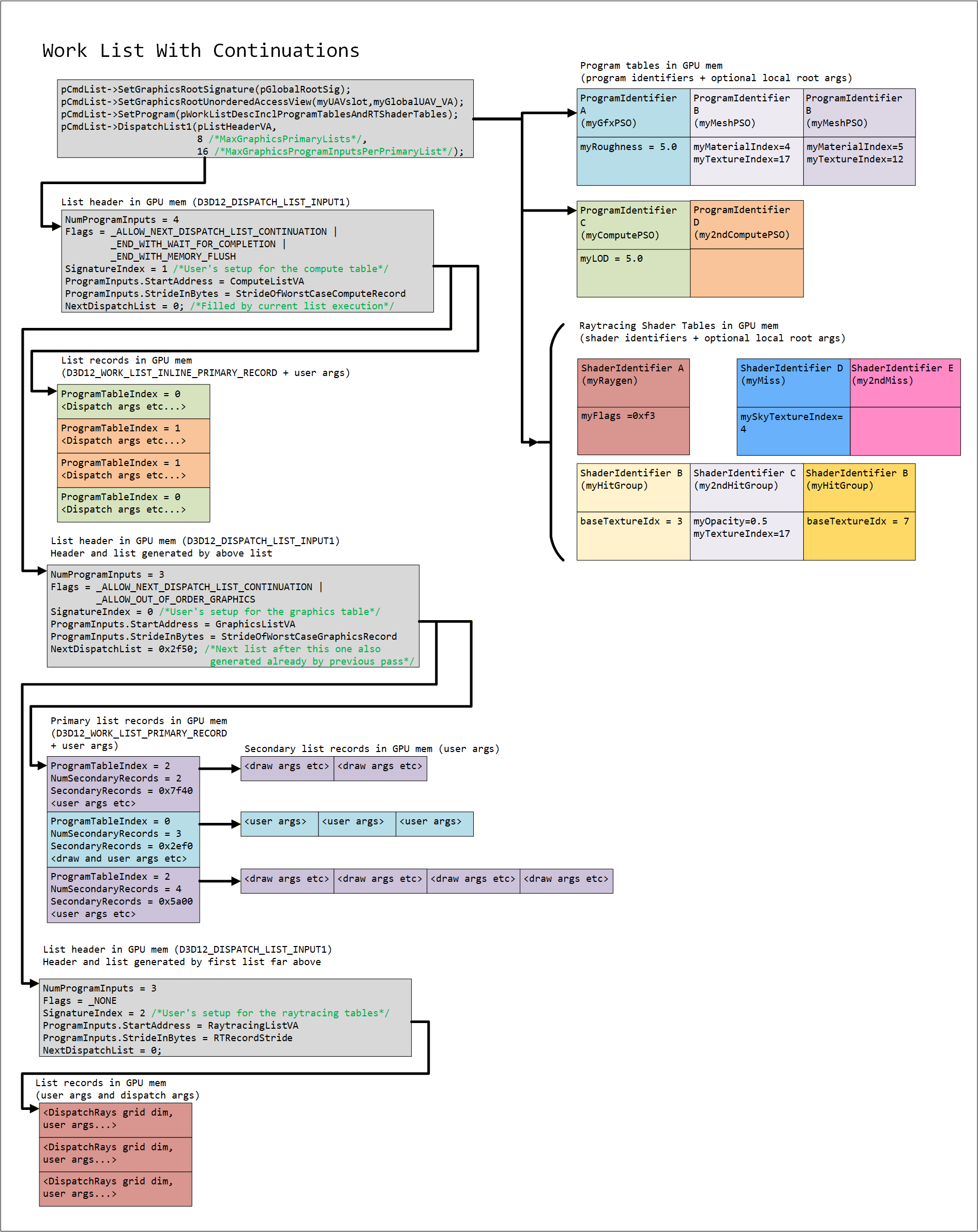
Here are a few introductory diagrams to give an idea of some of the workload shapes possible with Work Lists. For simplicity these diagrams omit the initial setup objects that let the app explain to the D3D system what the Work List shape will be. What you see here are examples of what can be done once configured. In each shape, the dispatch input header is immediately followed by its primary records. The rest of the spec covers all the details.
The simplest shape is a single list of records. Each record selects an entry in the program table, which names the pipeline that record runs, and carries that pipeline’s arguments, ending with the dispatch trigger that launches the work. One list can drive several different pipelines: below, a draw and two mesh dispatches sit side by side, and the two mesh records select different program table entries naming the same pipeline, differing only in the local root arguments bound with it.
Records can also fan out. A primary record holds the state that a group of executions shares, such as the vertex and index buffer views in the first record below, and points at a list of secondary records that each supply the arguments for one execution. The shared setup is then stored once rather than repeated per execution. Which arguments live at which level is set by the program command signature associated with each program, so the three programs below choose differently: two of them take their dispatch trigger from the secondary records while the third takes a single trigger from the primary record, and the constant buffer and descriptor table are shared in one program and per-execution in another.
Finally, a list can hand off to another list, so the GPU keeps going without returning to the CPU. Each list in the chain selects its own work list signature, and with it its own program table and executable class, so the chain below runs a compute pass, then a graphics pass, then a raytracing pass from a single DispatchList1 call. A list finds the next one through NextDispatchList, which the running list’s own shaders can fill in, letting work already in flight decide what happens next. Flags on each list control when its work is waited on and when its writes become visible to the next list; a list whose shaders write the next list’s input, or data it consumes, sets _END_WITH_WAIT_FOR_COMPLETION, while a chain already in place needs no wait.
System Overview
Work Lists has three structural pieces every dispatch hangs off of: the objects the implementation consumes (signature, signature array, program table, primary list), the workflow by which a Work List dispatch is authored and consumed across the CPU/GPU timeline, and the binding sources that determine where each shader-visible binding’s bytes come from at record execution time. The three subsections cover each in turn.
Terminology
A glossary of the terms used throughout the spec. Each entry points at the section where the concept is defined fully.
-
Program command signature (
ID3D12ProgramCommandSignature). The per-PSO indirect-argument layout; what each generic program is associated with at state-object creation. Unit of compile-time HW specialization. See Argument layouts and the signature objects. -
Program (interchangeably, PSO). A generic program declared inside an
ID3D12StateObject, with a program command signature associated to it as a subobject. Free-standingID3D12PipelineState*objects are not programs in this spec. See Program Table and State object integration for program-table programs. -
Program table. GPU-resident table the implementation reads per-record to look up which program identifier to use for each invocation. Used by graphics-class and compute-class signatures only. Named to distinguish from raytracing shader tables, though the per-slot byte layout is similar; see Program table slot layout. See Program Table.
-
Executable class. Each program command signature is classified by its dispatch-trigger argument as graphics-class (
_DRAW/_DRAW_INDEXED/_DISPATCH_MESH), compute-class (_DISPATCH/_FIXED_DISPATCH), or raytracing-class (_DISPATCH_RAYS_DIMENSIONS). See Dispatch Model and Root signature bindings. -
Primary record / primary list. A
DispatchListconsumes a primary list of primary records immediately following its fixed dispatch input header. Each primary record’s contents depend on its work list signature’s executable class and secondary-list shape, and its program command signature’s per-arg source choices; see Primary record layout. -
Secondary record / secondary list. When any of a program command signature’s args have
Source == SOURCE_SECONDARY_RECORD, each primary record points at a secondary list of secondary records (one per execution); each secondary record carries one execution’s value for those args. Signatures whose args are all primary-sourced have no secondary list. See Per-binding source. -
LRA (local root arguments). Per-PSO local-root-sig argument bytes; live in the program table slot alongside the program identifier, not in records. See Local root signatures.
-
Work list signature (
ID3D12WorkListSignature). Per-list container that aggregates one or more program command signatures under a shared global root signature. See Work List Signature. -
Continuation / continuation chain (Tier 2). The GPU follows a per-list
NextDispatchListpointer to chain into the next dispatch list autonomously; the whole sequence under one CPU-issuedDispatchList1is the continuation chain. See Dispatch List Continuations. -
Signature array (
ID3D12WorkListSignatureArray, Tier 2). Aggregates one or more work list signatures; each dispatch list in a chain picks which to use via itsSignatureIndex. See Signature Selection. -
GPU Timeline Validation Hooks (Tier 2 only, debug-layer mechanism). Mechanism for attaching validation compute programs that the implementation invokes on the GPU around dispatch-list record processing, for continuation lists that CPU-side validation cannot reach (the GPU follows continuations autonomously, so the CPU can record validation work only for the head list). See GPU Timeline Validation Hooks.
Components
The diagram below shows the objects and data structures involved in a Work List dispatch. The top half is built CPU-side at creation time; the bottom half is GPU-resident and consumed by DispatchList / DispatchList1 at execution time. The shape shown is the Tier 2 / multi-signature one; the Tier 1 shape is a subset (a single bound signature, no per-list signature selection, no continuation chain across multiple lists). Local root arguments and the shader-record-style program-table-slot layout are part of the Tier 1 baseline. See Feature Tiers and Capability Queries for the per-tier matrix.
┌────────────────────────────────────────────────────────────────────────────┐
│                        CREATION-TIME OBJECTS (CPU)                         │
│                                                                            │
│ ┌──────────────────────────────┐                                           │
│ │ ID3D12WorkListSignature      │                                           │
│ │ - pProgramCommandSignatures  │                                           │
│ │   (one or more)              │                                           │
│ │ - SubobjectMask              │                                           │
│ │                              │                                           │
│ │ (strides + slot count are    │                                           │
│ │  per-dispatch; see           │                                           │
│ │  D3D12_DISPATCH_LIST_INPUT)  │                                           │
│ └──────────────┬───────────────┘                                           │
│                │                                                           │
│  ┌─────────────▼──────────────────┐     ┌────────────────────────────┐     │
│  │ ID3D12ProgramCommandSignatures │     │ Generic Program(s)         │     │
│  │ "PCS" (one per PSO arg shape)  │     │  /  RTPSO shaders          │     │
│  │  - pArgumentDescs[]            │     │                            │     │
│  │ - SecondaryRecordStrideInBytes |◄────┤  + ProgramCommandSig assoc │     │
│  │  - pGlobalRootSignature        │     │  + (opt) LocalRootsig,     │     │
│  │    (optional; uniform across   │     │    declared in PCS' args   │     │
│  │     all PCSes in the WLS)      │     │    for convenience, or in  │     │
│  │                                │     │    a state-object subobject│     │
│  │                                │     │    + association           │     │
│  │                                │     │  (defined in               │     │
│  │                                │     │   ID3D12StateObject(s))    │     │
│  └────────────────────────────────┘     └────────────────────────────┘     │
│                                                                            │
│  Direct-bind path (Tier 1+; Tier 2 when no validation hooks attached):     │
│      bind ID3D12WorkListSignature directly via SetProgram                  │
│      (D3D12_PROGRAM_TYPE_WORK_LIST)                                        │
│                                                                            │
│  Array bind path (Tier 2 only; required for multi-signature, also          │
│  required for single-signature with GPU Timeline Validation Hooks):        │
│      CreateWorkListSignatureArray(                                         │
│          { NumSignatures, pSignatures[] } )    (NumSignatures >= 1)        │
│              │                                                             │
│              ▼                                                             │
│      ID3D12WorkListSignatureArray                                          │
│      (then bind via SetProgram,                                            │
│       D3D12_PROGRAM_TYPE_WORK_LIST1)                                       │
│                                                                            │
│  (Lists in a Tier 2 continuation chain pick from pSignatures via           │
│   SignatureIndex, switching modes between continuations.)                  │
│                                                                            │
└────────────────────────────────────────────────────────────────────────────┘
Abbreviations in diagram: PCS = program command signature; WLS = work list signature; PSO = pipeline state object; RTPSO = raytracing pipeline state object.
Legend for the components diagram:
- Generic Program(s) / RTPSO shaders: each is a shader entity declared in an
ID3D12StateObjectthat carries a program command signature association. Graphics-class / compute-class: a generic-program subobject, reached into a program table by program identifier. Raytracing-class: the raytracing shaders a dispatch invokes (raygen / miss / hit-group / callable), reached through the standard shader tables in the SetProgram-boundD3D12_WORK_LIST_RAYTRACING_BINDING; other shaders in the same RTPSO may carry a different association or none. The diagram draws one box for compactness. See State object integration for program-table programs and Raytracing pipeline programs. ID3D12WorkListSignature: the per-list container. References one or moreID3D12ProgramCommandSignatures viapProgramCommandSignatures[]plus aSubobjectMaskthat selects which state-object subobjects may vary across the associated programs. The contained PCSes must agree on their secondary-list shape. Primary-list stride travels with eachDispatchListcall inD3D12_DISPATCH_LIST_INPUT; program-table per-slot stride and slot count travel with eachSetProgrambind inD3D12_WORK_LIST_PROGRAM_TABLE_BINDING(for non-raytracing signatures).ID3D12ProgramCommandSignature: the per-PSO binding layout artifact. CarriespArgumentDescs[](each arg has aType, aSource, and aBinding),SecondaryRecordStrideInBytes, and an optionalpGlobalRootSignature(shared across every program command signature in the same work list signature when present; see Uniformity constraints). The program command signature is the single declaration of the per-PSO arg layout: which args feed which root-sig slots, where each arg’s bytes come from, and which root signature each slot lives in (the global and local root signatures complete the binding shape). Local root signature contents are authored either inline via_INLINE_*args (implicit local root signature path) or via aD3D12_LOCAL_ROOT_SIGNATUREstate-object subobject +D3D12_SUBOBJECT_TO_EXPORTS_ASSOCIATION(explicit local root signature path); see Local root signatures. Analog ofID3D12CommandSignatureinExecuteIndirect, scoped per-program rather than globally bound.+ ProgramCommandSig assoc(line inside the Generic Program(s) / RTPSO shaders box, with arrow◄─────to the program command signature box): every shader Work Lists can dispatch has a program command signature associated with it in itsID3D12StateObjectviaD3D12_SUBOBJECT_TO_EXPORTS_ASSOCIATION(the standard state-object association mechanism; see Raytracing.md’s Default associations section for the all-shaders-in-one shorthand commonly used with RTPSOs). The association is the compile-time HW specialization input. Graphics-class and compute-class generic programs carrying it remain exclusive to Work Lists. Raytracing is different: the same RTPSO can be used both by Work Lists and by ordinaryDispatchRays. Only the raytracing shaders a work list dispatch actually invokes need the selected work list signature’s program command signature. See State object integration for program-table programs and Using the same RTPSO with and without Work Lists.+ (opt) Local RS(line inside the Generic Program(s) / RTPSO shaders box): an optional per-PSO local root signature for the program. The local root signature is the per program command signature binding space (vs the global root signature which is shared across program command signatures in a work list signature); it’s what unlocks per-PSO arg customization beyond the shared global root signature. Two authoring paths: declared inline via_INLINE_*args on the program command signature (implicit local root signature path; runtime synthesizes the local root signature and auto-injects it as a state-object subobject covering the program command signature’s associated shaders), or declared as a standardD3D12_LOCAL_ROOT_SIGNATUREstate-object subobject +D3D12_SUBOBJECT_TO_EXPORTS_ASSOCIATION(explicit local root signature path; per the standardD3D12_SUBOBJECT_TO_EXPORTS_ASSOCIATIONrules, which allow per-export associations, a default-association covering everything else, or any mix). Both paths work for graphics-class and compute-class; raytracing-class supports only the explicit path (see validation rule 21). The byte storage of the resulting local root arguments differs by class: graphics-class and compute-class store them in the per-slot space following the program identifier in the program table (see Local root signatures); raytracing-class stores them in shader-table records inside the boundD3D12_WORK_LIST_RAYTRACING_BINDING(the standard raytracing shader-record layout).pSignature/pSignatures[i]: the bound work list signature (single in the direct-bind path; selected bySignatureIndexfrom the bound signature array in the array-bind path). See Binding via SetProgram for the two bind paths and Uniformity constraints for what signatures in an array must share.
Once these objects are bound (via SetProgram with D3D12_PROGRAM_TYPE_WORK_LIST), DispatchList reads the per-list inputs from GPU memory:
┌────────────────────────────────────────────────────────────────────────────┐
│                       GPU-RESIDENT DATA                                    │
│                                                                            │
│                                 ┌────────────────────────────────────────┐ │
│                                 │ D3D12_DISPATCH_LIST_INPUT1 header      │ │
│                                 │   NumPrimaryRecords                    │ │
│                                 │   PrimaryRecordStrideInBytes           │ │
│                                 │   Flags                                │ │
│                                 │   SignatureIndex = i (Tier 2)          │ │
│                                 │   NextDispatchList (Tier 2)            │ │
│                                 │ NumListScopeInstrumentationOperations │ │
│                                 │   ReservedPadding = 0                 │ │
│                                 │   ListScopeInstrumentationOperations   │ │
│                                 ├────────────────────────────────────────┤ │
│   ┌──────────────────────────┐  │ Primary List (immediately at byte 40)  │ │
│   │ Program Table[i]         │  │                                        │ │
│   │ (SetProgram-bound;       │  │ (D3D12_WORK_LIST_PRIMARY_RECORD[])     │ │
│   │  pBindings[i])           │  │                                        │ │
│   │ ┌──────────────────────┐ │  │ ┌────────────────────────────────────┐ │ │
│   │ │ slot 0: id(A) │ args │ │  │ │ [0] ProgramTableIndex      = 0     │ │ │
│   │ │ slot 1: id(B) │ args │ │  │ │     NumSecondaryRecords    = 12    │ │ │
│   │ │ slot 2: stale record │ │  │ │     SecondaryRecords ──┐           │ │ │
│   │ │ slot 3: id(C) │ args │ │  │ ├────────────────────────┼───────────┤ │ │
│   │ └──────────────────────┘ │  │ │ [1] ProgramTableIndex  │  = 3      │ │ │
│   └──────────────────────────┘  │ │     NumSecondaryRecords│  = 8      │ │ │
│                                 │ │     SecondaryRecords ──┼──┐        │ │ │
│                                 │ │     MyMaterialSRV      │  │= 0xFFFF│ │ │
│                                 │ └────────────────────────┼──┼────────┘ │ │
│                                 └──────────────────────────┼──┼──────────┘ │
│                                                            │  │            │
│            ┌───────────────────────────────────────────────┘  │            │
│            │                                  ┌───────────────┘            │
│   ┌────────▼─────────────────────┐  ┌─────────▼────────────────────┐       │
│   │ Secondary list (12 entries)  │  │ Secondary list (8 entries)   │       │
│   │ ┌──────────────────────────┐ │  │ ┌──────────────────────────┐ │       │
│   │ │ [0]                      │ │  │ │ [0]                      │ │       │
│   │ │   MyMaterialSRV= 0xAAAA  │ │  │ │   VertexCount  = 32      │ │       │
│   │ │   VertexCount  = 64      │ │  │ │   InstanceCount= 4       │ │       │
│   │ │   InstanceCount= 1       │ │  │ │   StartVertex  = 0       │ │       │
│   │ │   StartVertex  = 0       │ │  │ │   StartInstance= 0       │ │       │
│   │ │   StartInstance= 0       │ │  │ ├──────────────────────────┤ │       │
│   │ │   MyTintColor  = 0xC0FFEE│ │  │ │ [1]                      │ │       │
│   │ ├──────────────────────────┤ │  │ │   ... (and 6 more)       │ │       │
│   │ │ [1]                      │ │  │ └──────────────────────────┘ │       │
│   │ │   ... (and 10 more)      │ │  └──────────────────────────────┘       │
│   │ └──────────────────────────┘ │                                         │
│   └──────────────────────────────┘                                         │
└────────────────────────────────────────────────────────────────────────────┘
Legend for the GPU-resident diagram:
id(A),id(B),id(C): program identifiers obtained viaID3D12StateObjectProperties1::GetProgramIdentifier. Slot 2’s “stale record” might be an invalid id, such as for a program identifier whose program has been deleted, fine as long as executing lists don’t reference this slot.- Program table stride: the per-slot stride is the
Table.StrideInBytesfield of theD3D12_WORK_LIST_PROGRAM_TABLE_BINDINGsupplied atSetProgramtime, app-chosen as0or at leastsizeof(D3D12_PROGRAM_IDENTIFIER) = 32bytes. A0stride is the broadcast form (every index resolves to the single record at the table’s start address); when the stride is32, the table reduces to identifier-only records (no local root arguments). argsin each slot: the local root arguments payload, packed exactly per the local root signature associated (in the state object) with the program identified by that slot. See Local root signatures.- Primary list: starts immediately after the dispatch input header, at byte 40 for the Tier 2 header shown (byte 24 for Tier 1). Each entry is a primary record using the
D3D12_WORK_LIST_PRIMARY_RECORDhybrid header (ProgramTableIndex,NumSecondaryRecords,SecondaryRecords); every PCS in this work list signature has secondary-sourced arguments. Some entries (like[1]in this diagram) also carry inline primary-sourced arg payload after the record header (theMyMaterialSRV = 0xFFFFshown), packed in the signature’spArgumentDescsorder. - Secondary lists: each
SecondaryRecordspointer resolves to a buffer of secondary records whose layout (SecondaryRecordStrideInBytesand the per-arg byte packing) comes from the program command signature associated with the PSO that primary record’sProgramTableIndexselects. Different primary records pointing at different PSOs can have secondary lists with different shapes and strides. The example uses this freedom:- Primary record
[0]selects a PSO whose program command signature sourcesMyMaterialSRVper-execution (it appears in every secondary record) and also has an extraMyTintColorarg unique to this PSO (viaBinding == LOCAL_ROOT_SIGNATURE, which doesn’t participate in cross-program command signature uniformity). - Primary record
[1]selects a PSO whose program command signature sourcesMyMaterialSRVfrom the primary record (the inlineMyMaterialSRV = 0xFFFFshown there), so its secondary records don’t carry that arg at all and the secondary stride is smaller. - Both program command signatures share the same global root signature and touch the same global root parameters (uniformity satisfied for global-bound args); they differ in per-arg
Sourcechoice and in their local-root-sig-bound extra args.
Each buffer holds
NumSecondaryRecordsrecords; primary record[0]carries 12 secondary records (only the first two are drawn), primary record[1]carries 8. The buffers are app-allocated GPU memory. - Primary record
- Tier 2 markers: the diagram shows
D3D12_DISPATCH_LIST_INPUT1, the Tier 2 input struct. Fields marked(Tier 2)(SignatureIndex,NextDispatchList) and the_1-suffixed struct itself are absent from the Tier 1D3D12_DISPATCH_LIST_INPUT. On Tier 1 the bound thing is a single signature (no array), so there is no index to read. = i(next toSignatureIndex, Tier 2; also shown as[i]on the Program Table box):iis the value ofSignatureIndexfor this dispatch list. The same index selects in parallel from the SetProgram-boundpSignatures[](the signature) andpBindings[](the tagged binding, theProgramTablemember shown in the diagram for graphics/compute, or thepRaytracingmember for raytracing-class which carries an RTPSO + shader tables and skips the program table). See Signature Selection for the array-bind setup. On Tier 1 (or Tier 2 direct-bind) only a single signature + single binding are present; Tier 1’sD3D12_DISPATCH_LIST_INPUThas noSignatureIndexfield, and Tier 2 direct-bind requiresSignatureIndex == 0.- Continuation (Tier 2): not drawn as a pipe in the diagram. When
_ALLOW_NEXT_DISPATCH_LIST_CONTINUATIONis set inFlagsandNextDispatchListis non-null, the GPU re-enters at that address, effectively replaying the entire diagram against a freshD3D12_DISPATCH_LIST_INPUT1(which may select a different signature, possibly of a different executable class). See Dispatch List Continuations. Tier 1 does not have this field.
Workflow
The diagram below shows the order of operations across the CPU and GPU timelines.
                    ┌──────────────────────────────────────────┐
                    │           Application (CPU)              │
                    │                                          │
                    │  1. Create one or more                   │
                    │     ID3D12ProgramCommandSignatures (per- │
                    │     PSO arg layouts, per-arg Source +    │
                    │     Binding, optional GlobalRootSig and  │
                    │     LocalRootSig via inline args or      │
                    │     subobject).                          │
                    │  2. Create one or more                   │
                    │     ID3D12WorkListSignatures, each       │
                    │     wrapping a set of ProgramCommand-    │
                    │     Signatures plus a SubobjectMask      │
                    │     (compile-time HW spec input).        │
                    │  3. Create State Object(s) containing    │
                    │     generic programs (VS/PS, CS, MS)     │
                    │     each associated with one Program-    │
                    │     CommandSignature subobject.          │
                    │     GlobalRootSig: one, shared across    │
                    │     all ProgramCommandSigs in the        │
                    │     WorkListSig. LocalRootSig: per       │
                    │     ProgramCommandSig, declared inline   │
                    │     via _INLINE_* args or via state-     │
                    │     object subobject.                    │
                    │     For RT, build an RTPSO with the      │
                    │     program command signature subobject  │
                    │     associated with the raytracing       │
                    │     shaders the dispatch invokes.        │
                    │  4. (Tier 2 array bind path only)        │
                    │     CreateWorkListSignatureArray with    │
                    │     ID3D12WorkListSignature*s in         │
                    │     pSignatures[]. Required for multi-   │
                    │     signature dispatch and for single-   │
                    │     signature dispatch with GPU Timeline │
                    │     Validation Hooks. Skip on Tier 1 or  │
                    │     when binding one signature directly  │
                    │     with no validation hooks.            │
                    │  5. Source GPU memory for the dispatch   │
                    │     header + trailing primary list,      │
                    │     secondary lists                      │
                    │     (if any), and program table (non-RT  │
                    │     only; RT uses SetProgram-bound RTPSO │
                    │     + shader tables instead). Either CPU │
                    │     pre-allocation or GPU-timeline sub-  │
                    │     allocation works; step 7 fills the   │
                    │     memory.                              │
                    └──────────────┬───────────────────────────┘
                                   │
                    ┌──────────────▼───────────────────────────┐
                    │  6. Command List Recording (CPU)         │
                    │                                          │
                    │  SetProgram (bind signature or array).   │
                    │                                          │
                    │  Set persistent global root params and   │
                    │  IA bindings the records do not          │
                    │  override (CPU-state inherited per the   │
                    │  class-separated binding sets).          │
                    └──────────────┬───────────────────────────┘
                                   │
                    ┌──────────────▼───────────────────────────┐
                    │  7. Populate GPU-Resident Inputs         │
                    │                                          │
                    │  Each input is app-owned GPU memory and  │
                    │  may be filled however the app wants,    │
                    │  CPU map+copy, CopyBufferRegion upload,  │
                    │  shader UAV writes, or any mix.          │
                    │  Inputs the implementation reads:        │
                    │   - program table (non-RT signatures;    │
                    │     often CPU-uploaded once at init;     │
                    │     can be shader-written too) OR        │
                    │     RTPSO + shader tables (raytracing-   │
                    │     class signatures; bound at SetProgram│
                    │     time, no per-call upload)            │
                    │   - secondary lists (per-execution arg   │
                    │     bytes per the signature)             │
                    │   - primary list (records pointing at    │
                    │     the secondary lists and selecting    │
                    │     program-table slots)                 │
                    │   - the outer D3D12_DISPATCH_LIST_INPUT  │
                    │     header: NumPrimaryRecords,           │
                    │     PrimaryRecordStrideInBytes, Flags;   │
                    │     Tier 2 adds SignatureIndex and       │
                    │     NextDispatchList. Both carry the     │
                    │     list-scope instrumentation fields    │
                    │     (see Dispatch input layout below).   │
                    │                                          │
                    │  Whatever writes each input barriers it  │
                    │  to SHADER_RESOURCE before DispatchList  │
                    │  reads it.                               │
                    └──────────────┬───────────────────────────┘
                                   │
                    ┌──────────────▼───────────────────────────┐
                    │  8. DispatchList / DispatchList1 (GPU)   │
                    │                                          │
                    │  Implementation reads the dispatch list  │
                    │  input, selects the work list signature  │
                    │  (bound on Tier 1, or via SignatureIndex │
                    │  on Tier 2) and its SetProgram-bound     │
                    │  binding (program table for graphics or  │
                    │  compute, RTPSO + shader tables for      │
                    │  raytracing), walks the primary list,    │
                    │  fetches each primary record's secondary │
                    │  records (when applicable), and executes │
                    │  them with the program command           │
                    │  signature's argument layout for each.   │
                    │                                          │
                    │  (Tier 2) If _ALLOW_NEXT_DISPATCH_LIST_  │
                    │  CONTINUATION is set, the GPU reads      │
                    │  NextDispatchList and, if non-null,      │
                    │  starts the next list under the original │
                    │  call's bounds. The read may happen at   │
                    │  any time unless _END_WITH_WAIT_FOR_     │
                    │  COMPLETION is set, which defers it to   │
                    │  this list's retire point. The next      │
                    │  list's data must already be valid;      │
                    │  shaders here may author it only if      │
                    │  the wait is set. The SetProgram-bound   │
                    │  bindings (program tables, raytracing    │
                    │  bindings, validation program table)     │
                    │  are immutable for the entire chain      │
                    │  (Compatibility rules 14 and 18).        │
                    └──────────────────────────────────────────┘
Abbreviations in diagram: PSO = pipeline state object; RT = raytracing; RTPSO = raytracing pipeline state object; HW = hardware; IA = input assembler.
At command-list recording time, the application supplies a CPU-side D3D12_DISPATCH_LIST_DESC or D3D12_DISPATCH_LIST_DESC1 to the dispatch method. Its values are copied during the call; the GPU-resident work in steps 7 and 8 uses the recorded header address and bounds without retaining the caller’s descriptor storage.
Binding sources at record execution
A program command signature declares the per-PSO arg layout: which args feed which shader-visible slots, where each arg’s bytes come from at execution time, and which root signature each slot lives in. That arg list tells you the per-record overrides and any inline local-root-signature declarations, but not the full binding shape on its own: global-root-signature slots not overridden by any arg aren’t in it (their structure is in pGlobalRootSignature, valued from command-list state), and on the explicit-LRS path the local-root-signature slot structure is in a separate state-object subobject. (On the implicit-LRS path the args declare every local-root-signature slot, including _PROGRAM_TABLE_RECORD-sourced ones; only their bytes come from the program-table record, not their declaration.) The full binding shape is the program command signature args together with the global root signature and the local root signature.
Every shader-visible binding slot lives in one of two root signatures, and gets its per-execution value from one of two sources for that scope:
                            ┌──────────────────────────────┬──────────────────────────────┐
                            │  PER-EXECUTION OVERRIDE      │  STATIC DEFAULT              │
                            │  (per-record arg present)    │  (no per-record arg)         │
┌───────────────────────────┼──────────────────────────────┼──────────────────────────────┤
│ GlobalRootSig             │  per-record arg's bytes,     │  command-list root state     │
│ (shared across all        │  from primary/secondary      │  (set via SetGraphicsRoot*   │
│ ProgramCommandSigs in the │  record or system;           │  or SetComputeRoot* before   │
│ WorkListSig)              │  Binding == GlobalRootSig    │  DispatchList; preserved     │
│                           │                              │  at end-of-call)             │
├───────────────────────────┼──────────────────────────────┼──────────────────────────────┤
│ LocalRootSig (per-PCS;    │  per-record arg's bytes, from│  program-table record bytes  │
│ each PCS owns its own;    │  primary/secondary record or │  (LRA tail in program-table  │
│ authored inline via       │  system; Binding ==          │  slot). Implicit-LRS:        │
│ _INLINE_ROOT_PARAMETER /  │  LocalRootSig (or            │  _INLINE_ROOT_PARAMETER +    │
│ _INLINE_STATIC_SAMPLER    │  _INLINE_ROOT_PARAMETER with │  Source=_PROGRAM_TABLE_RECORD│
│ args, OR via state-object │  non-_PROGRAM_TABLE_RECORD   │  or _INLINE_STATIC_SAMPLER + │
│ D3D12_LOCAL_ROOT_SIGNATURE│  Source)                     │  Source=_STATIC for baked-in │
│ subobject + association)  │                              │  static samplers.            │
├───────────────────────────┼──────────────────────────────┼──────────────────────────────┤
│ LocalRootSig (raytracing) │  not available; RT-class     │  shader-table record bytes   │
│ (RT-class shaders use the │  PCSes cannot have LRS args  │  (standard raytracing        │
│ explicit-LRS path via     │                              │  shader-record layout, see   │
│ state-object subobject +  │                              │  Local root arguments in     │
│ association)              │                              │  raytracing-class signatures)│
└───────────────────────────┴──────────────────────────────┴──────────────────────────────┘
Abbreviations in diagram: PCS = program command signature; LRA = local root arguments; RT = raytracing.
The PSO sees the merged result: every global root signature slot the program uses (filled from one of the global root signature sources above) plus every local root signature slot the program uses (filled from one of the local root signature sources). The PSO does not see which source any binding came from, only what each slot resolves to when its record runs.
Notes on each cell:
-
global root signature / per-execution override: a program command signature arg with
Binding == _GLOBAL_ROOT_SIGNATUREandSource == _PRIMARY_RECORD/_SECONDARY_RECORD/_SYSTEMprovides the bytes for that global root signature slot per execution. The arg’sRootParameterIndexselects the slot in the sharedpGlobalRootSignature. -
global root signature / static default: global root signature slots not touched by any per-record arg keep the value that was set on the command list before
DispatchListviaSetGraphicsRoot*/SetComputeRoot*calls.DispatchListdoes not modify them. (End-of-call reset behavior, which applies to slots that ARE touched per-record, is covered in State leakage and reset.) -
local root signature / per-execution override: a program command signature arg targeting local root signature with a per-execution
Sourceprovides the bytes for that local root signature slot per invocation. Either a conventional arg type (_CONSTANT/_CONSTANT_BUFFER_VIEW/ etc.) withBinding == _LOCAL_ROOT_SIGNATURE(explicit local root signature path), or an_INLINE_ROOT_PARAMETERarg withSource == _PRIMARY_RECORD/_SECONDARY_RECORD/_SYSTEM(implicit local root signature path). Local root signature slots are per program command signature, so per-record arg variation effectively lets bindings vary per PSO (the central capability local root signature unlocks). A conventional local arg contributes record bytes sized per its argument type (see Record byte layouts), exactly as its global-scope counterpart does; it is never zero-sized. -
local root signature / static default (graphics-class and compute-class): the local-root-argument bytes not overridden per-record come from the program-table record’s LRA tail in the program-table slot. In the path where the local root signature is declared implicitly by entries in the program command signature (as opposed to associating a separately created local root signature), an
_INLINE_ROOT_PARAMETERarg withSource == _PROGRAM_TABLE_RECORDsources its DWORD sub-range from this cell (other sub-ranges of the same slot, if any, can be per-execution-overridden from the override column). On the explicit local root signature path there is no per-arg_PROGRAM_TABLE_RECORDsource: any slot not overridden by a per-execution conventional arg draws its value from the LRA tail automatically as this static default._PROGRAM_TABLE_RECORDexists only for the implicit path, which declares every slot inline and so needs an explicit way to name the tail as a source._INLINE_STATIC_SAMPLERargs (withSource == _STATIC) also live in this cell conceptually; the static sampler is baked into the local root signature at program command signature creation, so there’s no per-execution byte payload at all. Raytracing-class is a separate case: see the bottom row of the diagram, the local root arguments come from shader-table records (different storage model) and there is no per-execution override at all (validation rule 21).
Vertex/index buffer bindings follow the same partition: per-record args feed the slots a signature explicitly binds, and command-list state (whatever the application set via
IASetVertexBuffers/IASetIndexBufferbeforeDispatchList) feeds the rest. See Input Assembler bindings.
In a multi-signature Tier 2 dispatch, the Uniformity constraints require every signature of a given executable class to update the same set of root-parameter slots, so within each binding set (graphics, or compute / raytracing) the partition above (which global root signature slots are per-record-overridden vs. command-list-state-fed) is stable across the entire DispatchList call. Compute-class and raytracing-class signatures share the same compute root binding set, so their uniformity rule applies jointly across both. Graphics-class signatures write to a separate binding set, independent of compute / raytracing. The finer-grained split within per-record args (whether a given arg’s bytes come from the primary record, secondary record, or system) is not constrained to match across signatures; each signature independently chooses per arg.
Local root signature slots are inherently per program command signature, so local root signature contents/size and the split between per-execution-override and static-default slots can vary across program command signatures in a work list signature; that’s a benefit of having multiple program command signatures with different per-record arg layouts.
Dispatch Model
DispatchList (Tier 1) and DispatchList1 (Tier 2) execute work across one or more programs, with per-program batches of records specified in GPU memory. Each method takes a required pointer to a CPU-side call descriptor, D3D12_DISPATCH_LIST_DESC or D3D12_DISPATCH_LIST_DESC1, carrying the initial GPU header address and application-supplied sizing bounds. Actual counts, records, program selection and Tier 2 signature selection and continuations are read from GPU memory at execution time, so an upstream compute pass can author them without CPU readback.
The command list must have a work list signature bound via SetProgram before the call. Tier 1 binds a single signature directly via D3D12_PROGRAM_TYPE_WORK_LIST. Tier 2 additionally supports the array bind path (D3D12_PROGRAM_TYPE_WORK_LIST1 with ID3D12WorkListSignatureArray) for multi-signature dispatch and for single-signature dispatch with GPU Timeline Validation Hooks. The global root signature on the bound signature applies to every record.
The per-list input is described by D3D12_DISPATCH_LIST_INPUT (Tier 1) or D3D12_DISPATCH_LIST_INPUT1 (Tier 2, adding SignatureIndex and NextDispatchList). It is a fixed header carrying the primary-record count, shared per-list D3D12_DISPATCH_LIST_FLAGS, and primary-record byte stride, immediately followed by the primary list. Both inputs can optionally reference list-scope instrumentation. The program table remains in the SetProgram-bound binding.
Dispatch input layout
The DispatchListInput member of D3D12_DISPATCH_LIST_DESC / D3D12_DISPATCH_LIST_DESC1 addresses the fixed GPU header, not the first primary record. Each header starts at an 8-byte-aligned GPU virtual address. The primary-record array follows immediately at DispatchListInput + sizeof(header), with no intervening gap or separately supplied primary-list address:
| Field | Tier 1 byte offset | Tier 2 byte offset | Size |
|---|---|---|---|
NumPrimaryRecords (UINT) |
0 | 0 | 4 bytes |
PrimaryRecordStrideInBytes (UINT) |
4 | 4 | 4 bytes |
Flags (shared enum) |
8 | 8 | 4 bytes |
SignatureIndex (UINT) |
absent | 12 | 4 bytes |
NextDispatchList |
absent | 16 | 8 bytes |
NumListScopeInstrumentationOperations (UINT) |
12 | 24 | 4 bytes |
ReservedPadding (must be 0) |
absent | 28 | 4 bytes |
ListScopeInstrumentationOperations |
16 | 32 | 8 bytes |
| End of header / first primary record | 24 | 40 |
The header sizes are exactly 24 bytes for D3D12_DISPATCH_LIST_INPUT and 40 bytes for D3D12_DISPATCH_LIST_INPUT1. Both start with the same count, stride and flags prefix. Tier 1 places its list-scope operation count immediately after the flags, naturally aligning the following GPU virtual address without a padding field. Tier 2 has SignatureIndex followed by the naturally aligned 8-byte NextDispatchList; its ReservedPadding aligns the list-scope operation-array address. Both header sizes are multiples of 8, so an aligned header also aligns the first primary record without an extra gap. These offsets and sizes apply equally to the C++ declarations, their HLSL transcriptions, and the DDI mirrors.
PrimaryRecordStrideInBytes is a 32-bit UINT field (uint32_t in HLSL). Its value directly specifies the byte stride between primary records; there is no separate effective-stride extraction.
For primary-record index i in [0, NumPrimaryRecords), the GPU virtual address is DispatchListInput + sizeof(header) + UINT64(i) * PrimaryRecordStrideInBytes, using the header type of the dispatch entry point. The header and trailing primary records occupy a contiguous GPU virtual address span. The primary-record stride includes each record’s own header, inline argument bytes, and trailing padding, not the dispatch input header.
When NumPrimaryRecords is 0, no primary records are read or required to exist after the header, and PrimaryRecordStrideInBytes is ignored and unconstrained. No trailing primary-record storage is needed for an empty list; the list-scope instrumentation requirements, Tier 2’s zero ReservedPadding, and Tier 2 continuation rules still apply. Synthesizing a validator pointer to the nominal start of the trailing array does not read or require storage there.
Each Tier 2 continuation starts at its own header, addressed by NextDispatchList, and has its own immediately following primary list. Headers in a chain need not be adjacent to each other. Secondary lists remain independently addressed by their primary records, and program-table storage is unchanged.
Primary record layout
Each entry of the primary list immediately following the dispatch input header is a primary record. For non-raytracing-class signatures, a primary record carries the program-table index for the program to execute, optionally a pointer to a secondary list of secondary records, and optionally inline primary-sourced argument bytes. For raytracing-class signatures, the RTPSO is bound at SetProgram time so the program-table-index field is dropped; the primary record carries just the optional secondary-list pointer plus inline primary-sourced argument bytes. The work list signature’s executable class and secondary-list shape select one fixed header for every primary record in the list; the selected program’s PCS determines its inline argument layout.
| Signature class | Secondary-list shape | Primary record struct |
|---|---|---|
| Graphics / Compute | Fully inline | D3D12_WORK_LIST_INLINE_PRIMARY_RECORD |
| Graphics / Compute | Hybrid | D3D12_WORK_LIST_PRIMARY_RECORD |
| Raytracing | Fully inline | D3D12_WORK_LIST_INLINE_RAYTRACING_RECORD |
| Raytracing | Hybrid | D3D12_WORK_LIST_RAYTRACING_RECORD |
For each layout, the inline arg payload (when present) follows the fixed header in memory, packed in pArgumentDescs order. The total size of each primary record (header plus any inline tail plus trailing pad) is PrimaryRecordStrideInBytes.
The byte layouts are:
Hybrid, header is D3D12_WORK_LIST_PRIMARY_RECORD; used when the program command signature for the selected PSO has any SOURCE_SECONDARY_RECORD args.
| Bytes | Field |
|---|---|
[0..3] |
ProgramTableIndex (UINT) |
[4..7] |
NumSecondaryRecords (UINT) |
[8..15] |
SecondaryRecords (D3D12_GPU_VIRTUAL_ADDRESS) |
[16..] |
inline primary-sourced arg payload (in pArgumentDescs order, filtered to SOURCE_PRIMARY_RECORD); absent when no args are SOURCE_PRIMARY_RECORD |
Fully inline, header is D3D12_WORK_LIST_INLINE_PRIMARY_RECORD; used when the program command signature for the selected PSO has no SOURCE_SECONDARY_RECORD args.
| Bytes | Field |
|---|---|
[0..3] |
ProgramTableIndex (UINT) |
[4..] |
inline primary-sourced arg payload (in pArgumentDescs order, filtered to SOURCE_PRIMARY_RECORD); absent when no args are SOURCE_PRIMARY_RECORD |
Raytracing-class hybrid, header is D3D12_WORK_LIST_RAYTRACING_RECORD; used when the raytracing-class program command signature has any SOURCE_SECONDARY_RECORD args. No ProgramTableIndex (raytracing-class signatures don’t use a program table; the RTPSO is bound at SetProgram time).
| Bytes | Field |
|---|---|
[0..3] |
NumSecondaryRecords (UINT) |
[4..7] |
(padding for 8-byte alignment of the next field) |
[8..15] |
SecondaryRecords (D3D12_GPU_VIRTUAL_ADDRESS) |
[16..] |
inline primary-sourced arg payload (in pArgumentDescs order, filtered to SOURCE_PRIMARY_RECORD); absent when no args are SOURCE_PRIMARY_RECORD |
Raytracing-class fully inline, layout-only marker type D3D12_WORK_LIST_INLINE_RAYTRACING_RECORD; used when the raytracing-class program command signature has no SOURCE_SECONDARY_RECORD args. No fixed header at all.
| Bytes | Field |
|---|---|
[0..] |
inline primary-sourced arg payload (in pArgumentDescs order, filtered to SOURCE_PRIMARY_RECORD); absent when no args are SOURCE_PRIMARY_RECORD |
App responsibility: when NumPrimaryRecords > 0, set D3D12_DISPATCH_LIST_INPUT::PrimaryRecordStrideInBytes to fit the chosen header + inline tail + any trailing pad, 8-byte aligned. (The dispatch input declares this stride so the implementation can walk the primary list without inspecting individual records.)
Primary-record limits
The CPU-side dispatch descriptor supplies upper bounds on the GPU-resident NumPrimaryRecords. Implementations may use these bounds to size internal resources at command-list recording time. Exceeding the applicable bound at execution time is undefined behavior.
For DispatchList, D3D12_DISPATCH_LIST_DESC::MaxPrimaryRecords bounds the one primary list, whether its executable class is graphics, compute or raytracing. The class is known at recording time from the work list signature bound by SetProgram: all of its eligible program command signatures belong to that class. Determining the class requires no inspection of GPU-resident headers, records or program-table contents. The actual NumPrimaryRecords is GPU-resident and need not be known at recording time, so the application supplies the bound separately.
For DispatchList1, D3D12_DISPATCH_LIST_DESC1 supplies one bound per executable class, since GPU-resident SignatureIndex can select a different class for each list:
| Selected signature’s executable class | Bound on that list’s NumPrimaryRecords |
|---|---|
| Graphics | MaxGraphicsPrimaryRecordsPerList |
| Compute | MaxComputePrimaryRecordsPerList |
| Raytracing | MaxRaytracingPrimaryRecordsPerList |
Each bound applies to each individual list of its class, including the head and every continuation, not the chain-wide sum. These bounds count primary records, not secondary records, shader threads or total executions. All descriptor maxima remain fixed for the complete recorded call and all continuations. MaxGraphicsPrimaryLists separately bounds the number of graphics-class lists; compute-class and raytracing-class list counts have no corresponding cap.
A primary-record bound of 0 permits only empty lists of the corresponding class. A bound for a class that never executes may be zero or nonzero. An empty graphics-class list still counts against MaxGraphicsPrimaryLists, even when MaxGraphicsPrimaryRecordsPerList is zero.
Work List Signature
A work list signature (ID3D12WorkListSignature) is the per-list container that groups one or more program command signatures (per-PSO indirect-argument layouts) plus a SubobjectMask declaring which state-object subobjects may vary across the associated programs. Every contained program command signature must reference the same global root signature and agree on the secondary-list shape (the runtime enforces these at signature creation). Primary-list stride, program-table per-slot stride, and program-table slot count are not baked into the signature, they travel with each DispatchList call (see D3D12_DISPATCH_LIST_INPUT) so apps can resize / re-stride without recreating the signature.
The unit of compile-time HW specialization is the program command signature, not the work list signature: each generic program eligible to appear in the program table is associated with exactly one program command signature at state-object creation, so the driver sees that PSO’s indirect-argument layout (which args come from where, which root params they update) while it is still compiling the program.
A work list signature with a single program command signature is the common case (all PSOs in the list share one arg layout). Graphics-class and compute-class work list signatures may contain multiple program command signatures, letting different PSOs in the same list use different per-record arg layouts; each primary record selects the program and its associated signature through ProgramTableIndex. A raytracing-class work list signature contains exactly one program command signature because raytracing records have no ProgramTableIndex or other PCS selector. Tier 2 changes the raytracing PCS only by selecting a different one-PCS work list signature through SignatureIndex. Cross-class chaining likewise uses separate work list signatures; a single work list signature cannot mix executable classes.
Secondary-list shape
CreateWorkListSignature determines the secondary-list shape from the enclosed pProgramCommandSignatures[]. Every contained PCS must agree on whether its argument list contains any argument with Source == D3D12_INDIRECT_ARGUMENT_SOURCE_SECONDARY_RECORD:
- If every PCS has no such argument, all primary records use the fully-inline shape.
- If every PCS has at least one such argument, all primary records use the hybrid shape.
CreateWorkListSignature rejects a mixture of fully-inline and hybrid program command signatures. The shape is inferred from the PCS set; no separate mode flag or description field is supplied. Both shapes are supported at every Work Lists tier, with no additional capability query.
This invariant concerns only the presence of secondary-sourced arguments. Corresponding arguments need not have identical sources, layouts and secondary strides may differ per PCS, and the dispatch trigger need not be secondary-sourced: a primary-sourced trigger with a secondary-sourced binding is hybrid too. SecondaryRecordStrideInBytes == 0 does not determine shape; it is also the legal broadcast stride for a hybrid PCS.
The consistency requirement is per work list signature, not per signature array or continuation chain. Different work list signatures in a Tier 2 array may have different shapes while retaining the existing array-wide global-root-signature and binding uniformity constraints.
Per-binding source: primary list vs secondary list
Each argument in a program command signature has a source indicating where its value comes from, the D3D12_INDIRECT_ARGUMENT_SOURCE enum on each D3D12_PROGRAM_COMMAND_SIGNATURE_ARGUMENT_DESC selects SOURCE_PRIMARY_RECORD (per-primary-record bytes; shared across every execution under that primary record), SOURCE_SECONDARY_RECORD (per-execution bytes in the secondary list), or SOURCE_SYSTEM (value synthesized by the implementation at invocation time; no record bytes are read for the arg). Most arg types accept SOURCE_PRIMARY_RECORD or SOURCE_SECONDARY_RECORD; arg types whose value the implementation supplies (e.g., _INCREMENTING_CONSTANT, and the validation pointer arg types) require SOURCE_SYSTEM.
SOURCE_PRIMARY_RECORD is useful when a binding (e.g., a per-material root constant or CBV) is the same across many invocations of one program selection, it lives once in the primary record instead of being duplicated in every secondary record. When no argument of a given program command signature is SOURCE_SECONDARY_RECORD, primary records selecting that command sig don’t have a secondary list at all and the primary record IS the record (see Primary record layout).
Within the work list signature’s consistent secondary-list shape, different program command signatures can independently choose per-arg sources, so one PSO’s secondary record can be small (few SOURCE_SECONDARY_RECORD args) while another’s is large; each program command signature carries its own SecondaryRecordStrideInBytes.
Argument layouts and the signature objects
The per-record argument layout is described by an array of D3D12_PROGRAM_COMMAND_SIGNATURE_ARGUMENT_DESC entries on a program command signature, each carrying a Type (from the shared D3D12_INDIRECT_ARGUMENT_TYPE enum), a Source (from D3D12_INDIRECT_ARGUMENT_SOURCE), a Binding (from D3D12_INDIRECT_ARGUMENT_BINDING), and a type-specific payload (root parameter index, vertex buffer slot, etc.). Each program command signature also carries its own optional pGlobalRootSignature (must match across all program command signatures in a work list signature when non-null; see Uniformity constraints and its own SecondaryRecordStrideInBytes. Local root signature for the program command signature is authored either inline via _INLINE_ROOT_PARAMETER / _INLINE_STATIC_SAMPLER args in pArgumentDescs (implicit local root signature path) or via a standard D3D12_LOCAL_ROOT_SIGNATURE state-object subobject + association (explicit local root signature path); see Local root signatures. A program command signature is created via CreateProgramCommandSignature from a D3D12_PROGRAM_COMMAND_SIGNATURE_DESC.
The set of program command signatures that may be referenced by a single list, plus the SubobjectMask over varying state-object subobjects, is described by D3D12_WORK_LIST_SIGNATURE_DESC, which CreateWorkListSignature consumes to produce an ID3D12WorkListSignature. Primary-list stride, program-table stride, and program-table slot count come in per-dispatch via D3D12_DISPATCH_LIST_INPUT. Compile-time HW specialization happens once each program command signature is associated with generic programs in a state object (see State object integration for program-table programs); the driver sees the per-PSO indirect-argument layout while it is still compiling the program.
Record byte layouts
The program command signature arg list determines the byte layout of three record types at execution time:
- Primary record: a fixed header (
D3D12_WORK_LIST_PRIMARY_RECORD,D3D12_WORK_LIST_INLINE_PRIMARY_RECORD,D3D12_WORK_LIST_RAYTRACING_RECORD, orD3D12_WORK_LIST_INLINE_RAYTRACING_RECORD; see Primary record layout for which) plus an inline tail containing the program command signature’sSource == _PRIMARY_RECORDargs inpArgumentDescs[]order. - Secondary record: the program command signature’s
Source == _SECONDARY_RECORDargs inpArgumentDescs[]order, one record per execution. - Program-table record (the local-root-argument bytes not overridden per-record): for graphics-class and compute-class, the LRA tail bytes in each program-table slot; for raytracing-class, shader-table records inside the SetProgram-bound
D3D12_WORK_LIST_RAYTRACING_BINDING. Local root signature slot order in the program-table record follows the local root signature slot order (synthesized from_INLINE_*args’ first-appearance order in the implicit local root signature path, or the explicit local root signature’s declared order in the explicit local root signature path).
Per-arg natural alignment
Each arg occupies the size below and is placed at its natural alignment within its record, with the implementation adding any necessary padding between args to satisfy alignment:
| Arg payload | Size | Alignment |
|---|---|---|
Root descriptor (CBV / SRV / UAV; D3D12_GPU_VIRTUAL_ADDRESS) |
8 bytes | 8-byte |
Descriptor table (D3D12_GPU_DESCRIPTOR_HANDLE) |
8 bytes | 8-byte |
Root constants (a single _CONSTANT arg, N tightly packed DWORDs) |
N * 4 bytes |
4-byte |
D3D12_VERTEX_BUFFER_VIEW / D3D12_INDEX_BUFFER_VIEW |
16 bytes | 4-byte (struct alignment of the contained members) |
D3D12_DRAW_ARGUMENTS |
16 bytes | 4-byte |
D3D12_DRAW_INDEXED_ARGUMENTS |
20 bytes | 4-byte |
D3D12_DISPATCH_ARGUMENTS / D3D12_DISPATCH_MESH_ARGUMENTS |
12 bytes | 4-byte |
D3D12_DISPATCH_RAYS_DIMENSIONS (per-execution raytracing payload) |
12 bytes | 4-byte |
_INLINE_ROOT_PARAMETER |
wrapped root parameter’s size (recurse) | wrapped root parameter’s alignment |
_INCREMENTING_CONSTANT / validator pointer types / _INLINE_STATIC_SAMPLER / _FIXED_DISPATCH |
0 (no per-execution byte payload) | N/A |
_WRITE_BUFFER_IMMEDIATE (Dest, Value) |
12 bytes | 8-byte |
_TIMESTAMP_QUERY (QueryIndex) |
4 bytes | 4-byte |
Record argument footprint limit
For each program command signature (PCS), derive the minimum packed size of one primary record: start with the class- and shape-specific primary header (zero bytes for fully-inline raytracing), place all SOURCE_PRIMARY_RECORD payloads in pArgumentDescs[] order at their natural alignment, and round the resulting size up to a multiple of 8 bytes. For a hybrid PCS, independently place all SOURCE_SECONDARY_RECORD payloads from offset zero in their filtered pArgumentDescs[] order with natural alignment, then round that size up to a multiple of 8 bytes. Count this minimum secondary size even when SecondaryRecordStrideInBytes == 0 broadcasts a single record. A fully-inline PCS has no secondary record and contributes zero secondary bytes. System-generated and other zero-byte arguments contribute no payload bytes; program-table and shader-table records and the dispatch input header are not part of this calculation.
The sum of these two minimum packed sizes is the PCS-derived combined record-argument footprint. CreateProgramCommandSignature rejects a PCS whose combined footprint exceeds the limit selected by the device’s effective shader-instrumentation state: 7,168 bytes (7 KiB) in normal mode, or 8,192 bytes (8 KiB) total when shader instrumentation is enabled for the device through ID3D12Tools::EnableShaderInstrumentation(TRUE). The enabled-mode total includes application and instrumentation arguments; the 1,024-byte difference from the normal limit provides instrumentation headroom. Drivers must support layouts up to the enabled-mode total.
Limit selection follows the same effective per-device shader-instrumentation state and device-creation semantics as root-signature validation’s instrumentation capacity. ID3D12Tools::ShaderInstrumentationEnabled() queries the controller’s state. Changing that controller after device creation does not retroactively change the device’s selected footprint limit or already-created PCSes. On an instrumentation-enabled device, CreateProgramCommandSignature accepts a PCS under the larger limit independently of tool authorship; no cap field or global-root-signature flag selects the limit. D3D12_WORK_LIST_SIGNATURE_FLAG_ENABLE_EMPTY_RECORD_INSTRUMENTATION controls empty-record observations and does not select this limit.
These limits constrain declared, packed record arguments, not the application-chosen PrimaryRecordStrideInBytes + SecondaryRecordStrideInBytes. Larger nonzero strides and the zero secondary broadcast stride are legal under Stride derivation. App-owned trailing data may follow the packed arguments when backed by accessible record storage; it cannot be inserted between declared packed arguments. Applications and tools may use the system-generated _PRIMARY_RECORD_POINTER and, for hybrid executions, _SECONDARY_RECORD_POINTER root descriptors to read farther into their respective records from shaders. The pointers contribute zero record bytes. Reads must stay within the actual backing storage, including for a broadcast secondary record, and obey the root-binding, resource-state, and input-lifetime rules.
Stride derivation
The PCS footprint calculation also yields the minimum size of each record class: each arg is placed at the next natural-alignment boundary, including padding, and each result is rounded up to a multiple of 8 bytes. User-specified strides must not be less than the minimum size (they may be larger if the app wants extra trailing padding per record). The one exception is SecondaryRecordStrideInBytes, which may also be 0 as a broadcast form (every secondary index resolves to the record at the secondary list’s start address); the minimum secondary size still counts toward the PCS footprint.
PrimaryRecordStrideInBytes(per dispatch): whenNumPrimaryRecords > 0, must be ≥ the minimum primary-record size (header + inline tail) and 8-byte aligned.SecondaryRecordStrideInBytes(per program command signature, onD3D12_PROGRAM_COMMAND_SIGNATURE_DESC): must be0or at least the minimum secondary-record size, and (when non-zero) 8-byte aligned. A0stride is the broadcast form: every secondary index resolves to the record at the secondary list’s start address. A program command signature with noSource == _SECONDARY_RECORDargs must use0.
Apps that want to know the resulting per-arg offsets can compute them with the same rule, applied to their _INLINE_* args’ declaration order (which is the order the runtime uses when synthesizing the local root signature). The synthesized ID3D12RootSignature* itself is also available via GetSynthesizedLocalRootSignature for inspection, reuse, or association with a different state object.
Divergence from ExecuteIndirect
ExecuteIndirect packs args tightly with no per-arg alignment padding (“Indirect argument structures have no padding” per IndirectDrawing.md); WL diverges from this rule to keep alignment consistent with the raytracing-shader-record convention that LRA tail already uses. Apps moving between EI and WL see different record layouts for the same arg list: EI records are tightly packed, WL records are padded per-arg-natural. The implementation handles the difference; apps only need to be aware when authoring per-record byte writers / readers manually.
Program table slot layout
Slot N occupies bytes [N * ByteStride .. (N+1) * ByteStride - 1], where the stride is supplied at SetProgram time via D3D12_WORK_LIST_PROGRAM_TABLE_BINDING::Table.StrideInBytes (a 0 stride is the broadcast form: every index resolves to the single record at the table’s start address):
| Bytes | Field |
|---|---|
[0..31] |
D3D12_PROGRAM_IDENTIFIER (system) |
[32..32 + LRA_N - 1] |
Program-table-record local root arguments (system); LRA_N is the size of program N’s program-table-record LRA portion (the LRA bytes not overridden per-record by program command signature args), or 0 if program N has no LRS |
[32 + LRA_N..] |
App-defined padding (ignored by the system) |
App responsibility: set the ByteStride in the SetProgram-bound D3D12_WORK_LIST_PROGRAM_TABLE_BINDING to 0 (the broadcast form: every index resolves to the single record at the table’s start address, holding one program identifier plus that program’s LRA) or >= 32 + max(program-table-record LRA size across all program identifiers actually present in the bound table), 8-byte aligned when non-zero. Full validation requires per-dispatch GPU validation by the debug layer (against actually-present program identifiers; see GPU Timeline Validation Hooks and Compatibility and Validation rule 6). App storage not interpreted by the system is supported by setting a larger stride than the minimum.
Supported argument types
The following argument types are supported in Work List work list signatures:
| Argument Type | Description |
|---|---|
D3D12_INDIRECT_ARGUMENT_TYPE_DRAW |
Draw arguments (vertex count, instance count, etc.) |
D3D12_INDIRECT_ARGUMENT_TYPE_DRAW_INDEXED |
Indexed draw arguments |
D3D12_INDIRECT_ARGUMENT_TYPE_DISPATCH |
Compute dispatch arguments |
D3D12_INDIRECT_ARGUMENT_TYPE_FIXED_DISPATCH |
Compute dispatch trigger whose thread-group counts are fixed on the arg (not read from a record). General-purpose; motivated by GPU-based validation (GBV). Not in the ExecuteIndirect arg set; Work-Lists-specific. |
D3D12_INDIRECT_ARGUMENT_TYPE_DISPATCH_MESH |
Mesh shader dispatch arguments |
D3D12_INDIRECT_ARGUMENT_TYPE_CONSTANT |
Root constant values |
D3D12_INDIRECT_ARGUMENT_TYPE_CONSTANT_BUFFER_VIEW |
Root CBV |
D3D12_INDIRECT_ARGUMENT_TYPE_SHADER_RESOURCE_VIEW |
Root SRV |
D3D12_INDIRECT_ARGUMENT_TYPE_UNORDERED_ACCESS_VIEW |
Root UAV |
D3D12_INDIRECT_ARGUMENT_TYPE_VERTEX_BUFFER_VIEW |
Vertex buffer binding |
D3D12_INDIRECT_ARGUMENT_TYPE_INDEX_BUFFER_VIEW |
Index buffer binding |
D3D12_INDIRECT_ARGUMENT_TYPE_INCREMENTING_CONSTANT |
Auto-incrementing constant per shader invocation. See _INCREMENTING_CONSTANT layout for the payload and Incrementing constant semantics for the runtime behavior. |
D3D12_INDIRECT_ARGUMENT_TYPE_DESCRIPTOR_TABLE |
Update a descriptor-table root parameter per record. See Per-argument-type layouts. Not in the ExecuteIndirect argument set; Work-Lists-specific. |
D3D12_INDIRECT_ARGUMENT_TYPE_DISPATCH_RAYS_DIMENSIONS |
Work-Lists-specific raytracing dispatch trigger. Its record payload is only D3D12_DISPATCH_RAYS_DIMENSIONS (Width, Height, Depth); the RTPSO and shader tables are bound separately via D3D12_WORK_LIST_RAYTRACING_BINDING. Supported only on devices that report D3D12_FEATURE_DATA_WORK_LISTS::DispatchRaysSupported == TRUE. |
D3D12_INDIRECT_ARGUMENT_TYPE_DISPATCH_RAYS |
ExecuteIndirect full-descriptor raytracing argument (D3D12_DISPATCH_RAYS_DESC). This existing argument type is not valid in a Work Lists program command signature; Work Lists uses _DISPATCH_RAYS_DIMENSIONS so its 12-byte record payload is unambiguous. |
D3D12_INDIRECT_ARGUMENT_TYPE_INLINE_ROOT_PARAMETER |
Inline declaration of a local root signature root parameter; payload wraps D3D12_ROOT_PARAMETER1. Triggers implicit local root signature synthesis on the containing program command signature (see Local root signatures). Graphics-class and compute-class only; see validation rule 21. |
D3D12_INDIRECT_ARGUMENT_TYPE_INLINE_STATIC_SAMPLER |
Inline declaration of a local root signature static sampler; payload wraps D3D12_STATIC_SAMPLER_DESC1. Baked into the synthesized local root signature at program command signature creation. Graphics-class and compute-class only; see validation rule 21. |
D3D12_INDIRECT_ARGUMENT_TYPE_DISPATCH_LIST_HEADER_POINTER |
System-generated validator pointer arg; only valid for primary-list or signature-selection validators (Tier 2 GPU Timeline Validation Hooks). |
D3D12_INDIRECT_ARGUMENT_TYPE_PROGRAM_TABLE_POINTER |
System-generated pointer arg; valid in a primary-list-validator program command signature (Tier 2) and in a program command signature not used as a validator (Tier 1; for GBV / conformance testing). Graphics/compute only. |
D3D12_INDIRECT_ARGUMENT_TYPE_PRIMARY_LIST_POINTER |
System-generated validator pointer arg; only valid in primary-list-validator program command signatures (Tier 2). |
D3D12_INDIRECT_ARGUMENT_TYPE_PRIMARY_RECORD_POINTER |
System-generated pointer arg; valid in a secondary-list-validator program command signature (Tier 2) and in a program command signature not used as a validator (Tier 1+; bound per-execution, available to applications and tools). |
D3D12_INDIRECT_ARGUMENT_TYPE_SECONDARY_LIST_POINTER |
System-generated validator pointer arg; only valid in secondary-list-validator program command signatures (Tier 2). |
D3D12_INDIRECT_ARGUMENT_TYPE_SECONDARY_RECORD_POINTER |
System-generated pointer arg; valid only in a program command signature not used as a validator (Tier 1+; bound per-execution to the current secondary record, available to applications and tools in hybrid lists). |
D3D12_INDIRECT_ARGUMENT_TYPE_LIST_SCOPE_INSTRUMENTATION_POINTER |
System-generated pointer to the current list’s instrumentation operation array. Primary list validator only (Tier 2). |
D3D12_INDIRECT_ARGUMENT_TYPE_WRITE_BUFFER_IMMEDIATE |
Optional progress instrumentation. The record supplies a 4-byte-aligned destination GPU VA and a UINT32 value; the arg declares BEGIN or END. Work-Lists-specific. |
D3D12_INDIRECT_ARGUMENT_TYPE_TIMESTAMP_QUERY |
Optional timing instrumentation. The record supplies an index relative to the range of timestamp query-heap slots bound through SetProgram; the arg declares BEGIN or END. Work-Lists-specific. |
Each program command signature must contain exactly one dispatch-trigger argument from this set: D3D12_INDIRECT_ARGUMENT_TYPE_DRAW, D3D12_INDIRECT_ARGUMENT_TYPE_DRAW_INDEXED, D3D12_INDIRECT_ARGUMENT_TYPE_DISPATCH, D3D12_INDIRECT_ARGUMENT_TYPE_DISPATCH_MESH, D3D12_INDIRECT_ARGUMENT_TYPE_DISPATCH_RAYS_DIMENSIONS, or D3D12_INDIRECT_ARGUMENT_TYPE_FIXED_DISPATCH. This argument’s type determines the program command signature’s executable class (see Root signature bindings). Unlike ExecuteIndirect’s command signatures, the dispatch-trigger argument’s position in the arg list is not constrained, it may appear at any index, and (except for _FIXED_DISPATCH, whose dimensions are fixed on the arg and read no record bytes) may use either Source (SOURCE_PRIMARY_RECORD or SOURCE_SECONDARY_RECORD) per the signature’s per-binding source choices.
D3D12_INDIRECT_ARGUMENT_TYPE_DESCRIPTOR_TABLE is part of the D3D12_INDIRECT_ARGUMENT_TYPE enumeration. Its D3D12_PROGRAM_COMMAND_SIGNATURE_ARGUMENT_DESC payload identifies which root parameter slot the per-record handle targets:
struct
{
    UINT RootParameterIndex; // must reference a descriptor-table root parameter
} DescriptorTable;
Per-argument-type layouts
_INCREMENTING_CONSTANT
_INCREMENTING_CONSTANT consumes no bytes in either the primary record or the secondary record (the counter is supplied by the system, not by the app), but its D3D12_PROGRAM_COMMAND_SIGNATURE_ARGUMENT_DESC::IncrementingConstant payload carries a Work-Lists-specific Flags field beyond the ExecuteIndirect {RootParameterIndex, DestOffsetIn32BitValues} pair. See Incrementing constant semantics for the runtime behavior (counting unit, per-list reset, per-secondary-list reset).
struct
{
    UINT                                 RootParameterIndex;
    UINT                                 DestOffsetIn32BitValues;
    D3D12_INCREMENTING_CONSTANT_FLAGS    Flags;
} IncrementingConstant;
typedef enum D3D12_INCREMENTING_CONSTANT_FLAGS
{
    D3D12_INCREMENTING_CONSTANT_FLAG_NONE                      = 0x0,
    D3D12_INCREMENTING_CONSTANT_FLAG_RESET_PER_SECONDARY_LIST  = 0x1,
} D3D12_INCREMENTING_CONSTANT_FLAGS;
DEFINE_ENUM_FLAG_OPERATORS(D3D12_INCREMENTING_CONSTANT_FLAGS);
| Flag | Description |
|---|---|
_NONE |
Supplies the execution’s zero-based structural index across the current list, including executions of every program command signature whether or not they have an incrementing constant. |
_RESET_PER_SECONDARY_LIST |
The shader sees the execution’s zero-based index within the current primary record’s secondary list instead of its list-wide index; selecting this mode does not reset the list-wide index used by other program command signatures. Valid only when the program command signature is hybrid (has at least one SOURCE_SECONDARY_RECORD arg); on a fully-inline signature the flag has no effect because there is no secondary list. |
The Source field on the _INCREMENTING_CONSTANT arg desc must be SOURCE_SYSTEM: the value is system-supplied (an incrementing per-execution counter), not record-supplied. Any other Source value is rejected at CreateProgramCommandSignature.
Each program command signature may contain at most one _INCREMENTING_CONSTANT argument total, regardless of Flags, destination (RootParameterIndex / DestOffsetIn32BitValues), or Binding; additional arguments of this type are rejected at CreateProgramCommandSignature. A work list signature may contain multiple counter-bearing program command signatures, each choosing its Flags independently, subject to the existing secondary-list shape and uniformity constraints.
_DESCRIPTOR_TABLE
For _DESCRIPTOR_TABLE, the in-buffer record layout is:
| Argument Type | Per-record bytes | In-buffer payload |
|---|---|---|
D3D12_INDIRECT_ARGUMENT_TYPE_DESCRIPTOR_TABLE |
8 | A D3D12_GPU_DESCRIPTOR_HANDLE (8-byte aligned) for the start of the descriptor table, the same value passed to SetGraphicsRootDescriptorTable / SetComputeRootDescriptorTable. It must address the currently bound descriptor heap of the appropriate type. |
This is the ordinary 8-byte D3D12_GPU_DESCRIPTOR_HANDLE an application binds everywhere else, whether through SetGraphicsRootDescriptorTable / SetComputeRootDescriptorTable on a command list or by writing it into a raytracing shader record. As in those cases, the descriptor heap of the required type (CBV/SRV/UAV vs. sampler) must be bound via SetDescriptorHeaps when DispatchList executes; the handle resolves within the bound heap and is not a self-contained pointer the way a D3D12_GPU_VIRTUAL_ADDRESS-based root argument is.
The 1-DWORD root-signature cost of a descriptor table (see ResourceBinding.md) is root-signature-budget accounting, unrelated to this 8-byte record payload; to an application a descriptor table has always been an 8-byte handle.
Different records in the same list may freely use different handles and may target different sub-tables of the same bound heap. If, at
DispatchListtime, no descriptor heap of the required type is bound on the command list, behavior for any record that actually executes aDESCRIPTOR_TABLEargument is undefined. If both a CBV/SRV/UAV heap and a sampler heap are bound, the implementation routes each record’s handle to whichever bound heap matches the root parameter’s declared type.
Local descriptor tables. A descriptor table that is a local root argument (an
_INLINE_ROOT_PARAMETERwithParameterType == DESCRIPTOR_TABLE, or an explicit-path conventional_DESCRIPTOR_TABLEarg withBinding == _LOCAL_ROOT_SIGNATURE) uses this same 8-byteD3D12_GPU_DESCRIPTOR_HANDLE, whether it comes from a record or from the program-table LRA tail, matching how raytracing local root signatures store descriptor tables.
_DISPATCH_RAYS_DIMENSIONS
Capability gate. Use of
_DISPATCH_RAYS_DIMENSIONSrequiresD3D12_FEATURE_DATA_WORK_LISTS::DispatchRaysSupported == TRUEon the device, orthogonal toD3D12_WORK_LISTS_TIER. See Raytracing pipeline programs for the full RT-class authoring story.
For _DISPATCH_RAYS_DIMENSIONS, the in-buffer per-execution payload is a D3D12_DISPATCH_RAYS_DIMENSIONS value:
| Argument Type | Per-execution bytes | In-buffer payload |
|---|---|---|
D3D12_INDIRECT_ARGUMENT_TYPE_DISPATCH_RAYS_DIMENSIONS |
12 | A D3D12_DISPATCH_RAYS_DIMENSIONS: UINT Width, UINT Height, UINT Depth. |
This Work-Lists-specific type is distinct from the existing D3D12_INDIRECT_ARGUMENT_TYPE_DISPATCH_RAYS, whose ExecuteIndirect payload is the full D3D12_DISPATCH_RAYS_DESC. The distinct enum values make record size and interpretation explicit: Work Lists supplies only dimensions per execution because the RTPSO and four shader tables are bound at command-list level via D3D12_WORK_LIST_RAYTRACING_BINDING.
The dispatch-trigger behavior otherwise matches the other dispatch-trigger types (_DRAW, _DRAW_INDEXED, _DISPATCH, _DISPATCH_MESH): the signature’s other arguments update root parameters of the active raytracing pipeline’s global root signature, and the dimensions then launch one ray dispatch. The Source field may be SOURCE_PRIMARY_RECORD or SOURCE_SECONDARY_RECORD per the signature’s per-binding source choices.
_FIXED_DISPATCH
Tier 1+.
_FIXED_DISPATCH is a compute dispatch-trigger whose thread-group counts are declared on the arg (fixed at CreateProgramCommandSignature) rather than read from a record. It makes the program command signature compute-class, exactly like _DISPATCH, except the grid is a compile-time constant on the signature instead of a per-execution D3D12_DISPATCH_ARGUMENTS value pulled from the record. It reads no per-execution record bytes; its Source must be _STATIC.
This is a general-purpose fixed-grid compute trigger. Its motivating consumer is GPU-Based Validation, which drives validation work lists whose per-execution programs need a launch grid decoupled from the app’s (possibly-invalid) record-sourced dimensions: the validation program launches at a fixed grid (e.g. (1,1,1)) while reading the app’s dimensions as data (via _SECONDARY_RECORD_POINTER) to validate them. There is no restriction on its use, any work list may use it for a fixed-grid compute step.
Payload in D3D12_PROGRAM_COMMAND_SIGNATURE_ARGUMENT_DESC’s union:
struct
{
    UINT ThreadGroupCountX;
    UINT ThreadGroupCountY;
    UINT ThreadGroupCountZ;
} FixedDispatch;
Each of ThreadGroupCountX / Y / Z is validated at CreateProgramCommandSignature against the device’s compute dispatch grid caps, using the same rules as a compute Dispatch: each dimension is at most D3D12_CS_DISPATCH_MAX_THREAD_GROUPS_PER_DIMENSION (65,535), except a 1D grid (ThreadGroupCountY == 1 and ThreadGroupCountZ == 1) may set ThreadGroupCountX up to the device’s driver-reported D3D12_FEATURE_DATA_D3D12_OPTIONS22::Max1DDispatchSize (see Increased 1D dispatch dimensions; this cap is at least 65,535, and is 65,535 on devices without the feature). Since the dimensions are fixed on the signature, this is a create-time check against the reported device caps; values above the cap are rejected there, and so is a zero in any dimension: each of ThreadGroupCountX / Y / Z must be at least 1, because a fixed zero-thread-group grid is a program that can never dispatch (unlike a record-sourced _DISPATCH, whose per-execution dimensions are not known at creation and so may legally be zero at run time). The signature’s other arguments update root parameters and are sourced as usual; only the dispatch dimensions are fixed. The arg type is Work-Lists-specific (not in the ExecuteIndirect set) and appears in the shared D3D12_INDIRECT_ARGUMENT_TYPE / D3D12DDI_INDIRECT_ARGUMENT_TYPE enum; the driver launches the declared (X, Y, Z) compute grid per execution with no record read.
_INLINE_ROOT_PARAMETER
Tier 1+. Local root signature root parameter declared inline; see Local root signatures.
_INLINE_ROOT_PARAMETER declares one root parameter slot in the program command signature’s synthesized local root signature, inline in the program command signature arg list. This is a convenience: apps can declare local root signature slots directly in the PCS args without authoring a separate ID3D12RootSignature* object and wiring it up via a D3D12_LOCAL_ROOT_SIGNATURE state-object subobject + association. Each such arg defines BOTH the slot itself (full D3D12_ROOT_PARAMETER1 content) AND the slot’s byte-sourcing semantics (via Source and, for constants, DestOffsetIn32BitValues / Num32BitValuesToSet) in a single arg. The runtime synthesizes the local root signature from these args and auto-injects it as a state-object subobject covering the program command signature’s associated shaders. Apps that prefer to author a separate local root signature object can still use the standard subobject + association path; see Local root signatures for both paths.
Payload in D3D12_PROGRAM_COMMAND_SIGNATURE_ARGUMENT_DESC’s union:
typedef struct D3D12_WORK_LIST_INLINE_ROOT_PARAMETER
{
    D3D12_ROOT_PARAMETER1 RootParameter;     // slot definition: ParameterType (CBV/SRV/UAV/
                                             // CONSTANTS/DESCRIPTOR_TABLE), register binding,
                                             // descriptor ranges, flags, ShaderVisibility
    // For ParameterType == D3D12_ROOT_PARAMETER_TYPE_32BIT_CONSTANTS only: the DWORD
    // sub-range [DestOffsetIn32BitValues, DestOffsetIn32BitValues + Num32BitValuesToSet)
    // of the slot this arg fills, from whichever Source the arg specifies. Both must be 0
    // for other ParameterTypes. A whole-slot fill is DestOffset 0, Num = the slot's
    // Num32BitValues; the footprint is always explicit (no implicit whole-slot default).
    UINT DestOffsetIn32BitValues;
    UINT Num32BitValuesToSet;
} D3D12_WORK_LIST_INLINE_ROOT_PARAMETER;
The arg’s Binding must be _LOCAL_ROOT_SIGNATURE (this arg type is local-root-signature-only; there is no analog for the global root signature because the global root signature is shared across program command signatures in a work list signature; see Local root signatures for the asymmetry rationale).
The arg’s Source says where this slot’s bytes come from:
_PRIMARY_RECORD/_SECONDARY_RECORD/_SYSTEM: per-record byte override (same semantics as existing arg types)_PROGRAM_TABLE_RECORD: the arg’s DWORD sub-range is sourced from the program-table record’s LRA storage (the LRA tail bytes in the program-table slot). One copy per program-table record, shared across every execution of that program. The program-table tail carries exactly the DWORDs sourced this way.
The wrapped RootParameter.ShaderVisibility must be _ALL (local root signature slots are always visible to all shader stages per Raytracing.md’s Note on shader visibility).
Multiple _INLINE_ROOT_PARAMETER args may target the same local root signature slot (matching ShaderRegister + RegisterSpace + ParameterType) only when ParameterType == _32BIT_CONSTANTS, and only if their wrapped RootParameter content is identical (apart from DestOffsetIn32BitValues / Num32BitValuesToSet and Source). This composes one constants slot from multiple sources at non-overlapping DWORD sub-ranges, in any mix (e.g., DWORDs 0-3 from the program-table record for a custom per-program arg, DWORDs 4-7 from a secondary record). No DWORD may be sourced more than once. For non-constant ParameterTypes, only one inline arg per slot is valid. See validation rule 23.
Raytracing-class signatures cannot use this arg type (see validation rule 21).
_INLINE_STATIC_SAMPLER
Tier 1+. Local root signature inline static-sampler declaration; see Local root signatures.
_INLINE_STATIC_SAMPLER declares one static sampler in the program command signature’s synthesized local root signature, inline in the program command signature arg list. This is a convenience matching _INLINE_ROOT_PARAMETER: apps can declare the static sampler directly in the PCS args without authoring a separate ID3D12RootSignature* with the static sampler declared there and wiring it up via a D3D12_LOCAL_ROOT_SIGNATURE state-object subobject + association. The sampler is baked into the local root signature at program command signature creation; there is no per-execution byte payload of any kind. Apps that prefer to author a separate local root signature object can still use the standard subobject + association path; see Local root signatures for both paths.
Payload in D3D12_PROGRAM_COMMAND_SIGNATURE_ARGUMENT_DESC’s union:
D3D12_STATIC_SAMPLER_DESC1 InlineStaticSampler;     // full static-sampler definition
                                                    // (filter, address modes, comparison
                                                    // func, register binding, flags,
                                                    // etc.); ShaderVisibility must be _ALL
The arg’s Binding must be _LOCAL_ROOT_SIGNATURE.
The arg’s Source must be _STATIC (the value the spec uses to explicitly say “no per-execution byte payload”; static samplers are baked into the local root signature at program command signature creation).
The standard static-sampler uniformity constraints from raytracing local root signatures apply: multiple LRSes (across multiple program command signatures) defining the same (ShaderRegister, RegisterSpace) static sampler must define it identically; the total unique static samplers across the global root signature and all LRSes in a state object must fit the binding-model static-sampler limit. See Local root signatures vs global root signatures in Raytracing.md.
Raytracing-class signatures cannot use this arg type (see validation rule 21).
_DISPATCH_LIST_HEADER_POINTER
Tier 2 only. Validation hooks API.
System-generated GPU virtual address bound as a root descriptor in the primary list validator or the signature-selection validator. The value is the GPU virtual address of the current dispatch list’s D3D12_DISPATCH_LIST_INPUT1. Per-record byte count: 0 (the value is not pulled from any record; the implementation synthesizes it at invocation time).
The Source field on the arg desc must be SOURCE_SYSTEM: the value is system-supplied. Any other Source value is rejected at CreateProgramCommandSignature. The Binding field must be GLOBAL_ROOT_SIGNATURE: the synthesized value targets the validation program’s global root signature at the slot identified by RootParameterIndex. LOCAL_ROOT_SIGNATURE is rejected at CreateProgramCommandSignature, because the value is invocation-level context, not a per-record local root argument. The slot must be a root-descriptor slot (typed as a UAV in the validator’s root signature if the validator intends to write back via the Validator defensive neutralization patterns).
This arg type is only valid for a primary list validator (selected by a non-zero ListValidationProgramTableIndex) or a signature-selection validator (selected by a non-zero SignatureSelectionValidationProgramTableIndex on D3D12_SET_WORK_LIST_DESC1). A structurally valid description can be created before either use is selected; Pointer argument validation stages defines its record-enrollment and selected-validator-stage checks.
_PROGRAM_TABLE_POINTER
Validator use is Tier 2 (validation hooks); use for record execution is Tier 1.
System-generated GPU virtual address bound as a root descriptor in the primary list validator or in a program command signature not used as a validator (see availability). The value is the StartAddress field of the D3D12_WORK_LIST_PROGRAM_TABLE_BINDING bound at SetProgram time for the current list’s selected signature (pBindings[SignatureIndex].ProgramTable.StartAddress for the Tier 2 array-bind case, or the single binding’s ProgramTable.StartAddress for the direct-bind case). Per-record byte count: 0. For record execution (including GBV or conformance testing), the same table start address is bound as the list shader executes; the shader reaches the current program’s slot from the primary record’s ProgramTableIndex and the bound ByteStride. This arg type only applies to graphics-class and compute-class signatures (those that use a program table); declaring it on a raytracing-class program command signature is rejected at CreateProgramCommandSignature, because raytracing-class signatures have no program table.
Source must be SOURCE_SYSTEM; Binding must be GLOBAL_ROOT_SIGNATURE, as for _DISPATCH_LIST_HEADER_POINTER. Valid for a primary list validator and for record execution; see System-generated pointer arg types for availability and Pointer argument validation stages for enforcement timing.
_PRIMARY_LIST_POINTER
Tier 2 only. Validation hooks API.
System-generated GPU virtual address bound as a root descriptor in the primary list validator. The value is the current dispatch list header’s GPU virtual address plus sizeof(D3D12_DISPATCH_LIST_INPUT1) (40 bytes; see D3D12_DISPATCH_LIST_INPUT1), the start of its trailing primary-record array. It is synthesized from the header address, not read from a field. This synthesis does not access the array; when NumPrimaryRecords == 0, the nominal array address need not have storage behind it and must not be dereferenced. Per-record byte count: 0.
Source must be SOURCE_SYSTEM; Binding must be GLOBAL_ROOT_SIGNATURE, as for _DISPATCH_LIST_HEADER_POINTER. Only valid for a primary list validator; checks follow Pointer argument validation stages.
_PRIMARY_RECORD_POINTER
Validator use is Tier 2 (validation hooks); use for record execution is Tier 1.
System-generated GPU virtual address bound as a root descriptor in the secondary list validator or in a program command signature not used as a validator (see availability). The value is the GPU virtual address of the primary record currently driving the invocation: in a secondary list validator, the primary record driving secondary list validation; during record execution, the primary record driving the current execution. Applications and tools can use this pointer to read backed bytes beyond the declared arguments, subject to the record footprint and backing rules. Per-record byte count: 0. It applies to all executable classes (graphics-class, compute-class, and raytracing-class); every list has primary records.
Source must be SOURCE_SYSTEM; Binding must be GLOBAL_ROOT_SIGNATURE, as for _DISPATCH_LIST_HEADER_POINTER. Valid for a secondary list validator (selected through the bound validation program table by a non-zero RecordValidationProgramTableIndex) and for record execution; see System-generated pointer arg types for availability and Pointer argument validation stages for enforcement timing.
_SECONDARY_LIST_POINTER
Tier 2 only. Validation hooks API.
System-generated GPU virtual address bound as a root descriptor in validation programs. The value is the GPU virtual address read from the current primary record’s SecondaryRecords field, or null when that record is fully-inline and so has no such field. It may be declared on a validator program command signature of any executable class; declaring it does not require the validated records to be hybrid. Per-record byte count: 0.
Source must be SOURCE_SYSTEM; Binding must be GLOBAL_ROOT_SIGNATURE, as for _DISPATCH_LIST_HEADER_POINTER. Only valid for a secondary list validator (selected through the bound validation program table by a non-zero RecordValidationProgramTableIndex); checks follow Pointer argument validation stages.
_SECONDARY_RECORD_POINTER
Tier 1. Not valid in validator program command signatures.
System-generated GPU virtual address bound as a root descriptor in a program command signature not used as a validator. The value is the GPU virtual address of the secondary record driving the current execution. Per-record byte count: 0. Defined only for executions driven by a secondary record (hybrid lists of any executable class, including raytracing-class hybrid lists); for a primary-only list it has no defined value and must not appear in the program command signature.
Source must be SOURCE_SYSTEM; Binding must be GLOBAL_ROOT_SIGNATURE, as for _DISPATCH_LIST_HEADER_POINTER. Valid only for hybrid record execution, including application and tool use to read backed bytes beyond the declared secondary arguments under the record footprint and backing rules; it has no validator use, because a secondary list validator processes the whole secondary list via _SECONDARY_LIST_POINTER rather than a single record. See System-generated pointer arg types for availability and Pointer argument validation stages for enforcement timing.
_LIST_SCOPE_INSTRUMENTATION_POINTER
Tier 2 only. Validation hooks API.
System-generated GPU virtual address bound as a root descriptor in the primary list validator. The value is the current input’s ListScopeInstrumentationOperations, or null when the selected signature enables neither list-scope operation type or NumListScopeInstrumentationOperations is zero. Synthesizing the binding does not dereference the array; the validator must establish that the array range is valid before accessing it. An invalid array can instead be disabled through the header (see Instrumentation neutralization).
Source must be _SYSTEM and Binding must be _GLOBAL_ROOT_SIGNATURE. Per-record byte count: 0. ListScopeInstrumentationPointer.RootParameterIndex selects the validator’s root-descriptor slot, which must be a UAV for writeback. This argument is valid only for primary-list validators, not signature-selection validators, secondary list validators, or record execution; checks follow Pointer argument validation stages.
_WRITE_BUFFER_IMMEDIATE
Tier 1+.
D3D12_INDIRECT_ARGUMENT_TYPE_WRITE_BUFFER_IMMEDIATE writes an application-supplied UINT32 progress value to an application-supplied GPU virtual address at the time indicated by the Trigger setting: BEGIN or END, as defined by D3D12_WORK_LIST_INSTRUMENTATION_TRIGGER. Its Source selects the primary or secondary record scope.
struct
{
    D3D12_WORK_LIST_INSTRUMENTATION_TRIGGER Trigger;
} WriteBufferImmediate;
The record payload is:
typedef struct D3D12_WORK_LIST_WRITE_BUFFER_IMMEDIATE_PARAMETER
{
    D3D12_GPU_VIRTUAL_ADDRESS Dest;
    UINT32                    Value;
} D3D12_WORK_LIST_WRITE_BUFFER_IMMEDIATE_PARAMETER;
The record payload occupies 12 bytes. The Dest field starts at an 8-byte-aligned offset in the record buffer; Value follows 8 bytes later. The GPU address stored in Dest must point to a 4-byte-aligned region with four writable bytes in a buffer accessible with copy-destination access. C/C++ trailing struct padding is not part of the record payload; the next argument follows the per-arg alignment rules. Source may be _PRIMARY_RECORD in a fully-inline or hybrid PCS, or _SECONDARY_RECORD in a hybrid PCS; a hybrid primary payload observes the entire primary batch, not one write per secondary execution. Binding must be D3D12_INDIRECT_ARGUMENT_BINDING_NOT_APPLICABLE, validated at signature creation.
See BEGIN/END semantics for the ordering guarantees and Instrumentation operations for the comparison with WriteBufferImmediate modes.
_TIMESTAMP_QUERY
Tier 1+.
D3D12_INDIRECT_ARGUMENT_TYPE_TIMESTAMP_QUERY records a timestamp observation in the bound timestamp-query heap for the Trigger setting: BEGIN or END, as defined by D3D12_WORK_LIST_INSTRUMENTATION_TRIGGER. All timestamps actually written by instrumentation for one execution of a primary list share a common logical domain and timebase, including list, primary-batch, and secondary-execution observations. This does not provide a command-queue-wide common timebase.
struct
{
    D3D12_WORK_LIST_INSTRUMENTATION_TRIGGER Trigger;
} TimestampQuery;
The record payload is one UINT:
typedef struct D3D12_WORK_LIST_TIMESTAMP_QUERY_PARAMETER
{
    UINT QueryIndex; // relative to TimestampQueryBinding.StartIndex
} D3D12_WORK_LIST_TIMESTAMP_QUERY_PARAMETER;
The payload is 4 bytes with 4-byte alignment. Source may be _PRIMARY_RECORD in a fully-inline or hybrid PCS, or _SECONDARY_RECORD in a hybrid PCS; a hybrid primary payload samples its batch scope once, not once per secondary execution. Binding must be D3D12_INDIRECT_ARGUMENT_BINDING_NOT_APPLICABLE, validated at signature creation. QueryIndex is relative to StartIndex within the bound timestamp query heap. See Timestamp query binding and resolution for heap binding, index validity, slot initialization, and resolving results.
Other argument types
For all other argument types in the table above, the per-record byte layout is the one specified in IndirectDrawing.md; that layout is normative for Work Lists too and is not redefined here.
Root signature bindings
- Work list signature arguments specify a
RootParameterIndexto identify which root signature entry they apply to.RootParameterIndexvalues index into the shared global root signature, the same one each signature was created with, sourced as described in Uniformity constraints across signatures. - Each program command signature’s executable class (determined by its dispatch-trigger argument’s type) selects which command-list binding state it writes to. Graphics-class signatures (
_DRAW/_DRAW_INDEXED/_DISPATCH_MESHtrailing) write the graphics root binding state and the IA bindings; compute-class (_DISPATCH/_FIXED_DISPATCHtrailing) and raytracing-class (_DISPATCH_RAYS_DIMENSIONStrailing) signatures write the compute root binding state (raytracing dispatches use the compute binding set, matching standaloneDispatchRays). These binding sets are independent: a graphics signature in a continuation chain does not interact with the compute root binding state, and vice versa. This is why the Uniformity constraints on “the same set of root parameters touched” apply per class rather than across the whole signature array. - Entries in the global root signature that are not updated by any work list signature retain their command-list-level bindings unmodified throughout the entire
DispatchListcall (and every continuation list inside it). - Entries that are updated by a work list signature follow the state leakage and reset rules below.
Input Assembler bindings
VertexBuffer and IndexBuffer bindings work the same way they do under ExecuteIndirect. For each VB slot (and the IB), if a signature includes a VERTEX_BUFFER_VIEW / INDEX_BUFFER_VIEW argument that targets the slot, every record’s per-record bytes supply that binding; otherwise the binding the application set on the command list before DispatchList (via IASetVertexBuffers / IASetIndexBuffer) is used. Touched slots reset at end-of-call (after the chain finishes) per State leakage and reset; untouched slots are preserved unchanged. In multi-signature Tier 2 dispatch, all graphics-class signatures in a signature array must touch the same set of VB slots and agree on IB presence, see the IA-uniformity rule in Uniformity constraints, so the per-record-vs-command-list partition is stable across the call regardless of which signature is active.
Record strides
Two strides describe the in-memory layout of records, both 8-byte aligned:
PrimaryRecordStrideInBytesis the stride between primary records immediately following the dispatch input header. WhenNumPrimaryRecords > 0, it must fit the chosen primary record header, one ofD3D12_WORK_LIST_PRIMARY_RECORD,D3D12_WORK_LIST_INLINE_PRIMARY_RECORD,D3D12_WORK_LIST_RAYTRACING_RECORD, orD3D12_WORK_LIST_INLINE_RAYTRACING_RECORDper the work list signature’s executable class and secondary-list shape, plus any inline arg payload plus trailing pad.SecondaryRecordStrideInBytes, on eachD3D12_PROGRAM_COMMAND_SIGNATURE_DESC, the stride between secondary records in each secondary list (pointed at byD3D12_WORK_LIST_PRIMARY_RECORD::SecondaryRecords). A non-zero stride must fit the packedSOURCE_SECONDARY_RECORDargs plus trailing pad; a0stride is the broadcast form (every secondary index resolves to the list’s start address), which is also the required value when the program command signature has noSOURCE_SECONDARY_RECORDargs.
If natural arg packing yields a non-8-byte-multiple size (e.g. a signature containing D3D12_INDIRECT_ARGUMENT_TYPE_CONSTANT / _DISPATCH / _DISPATCH_MESH / _DRAW_INDEXED in some combinations), the app pads up to the next 8-byte boundary. The implementation walks the primary list using the dispatch header’s stride and each secondary list using its PCS’s stride; individual records do not override those strides.
State leakage and reset
State leakage is governed by these rules, applied once at the end of the entire DispatchList call (after the original list and any continuation lists have all retired), not between lists in a chain:
- If any signature in the chain binds a VB to a particular slot, that VB slot is reset to NULL.
- If any signature in the chain binds an IB, the IB is reset to NULL.
- If any signature in the chain sets a root constant (literal or incrementing), the root constant value is reset to 0.
- If any signature in the chain sets a root view (CBV/SRV/UAV), the root view is reset to NULL.
- If any signature in the chain sets a descriptor table root parameter, that parameter is reset to a NULL descriptor table handle.
Resets apply to the appropriate binding set per signature class, graphics-class signature touches reset graphics root binding state and IA bindings; compute-class and raytracing-class signature touches reset compute root binding state. See Root signature bindings.
Within the chain (between continuation lists, governed by Dispatch List Continuations), no state is reset. This is safe because no shader invocation ever observes a binding “inherited” from a previous record or list: the Uniformity constraints ensure every shader gets a complete set of bindings from its own record’s bytes. (Wherever the Execution Order rules permit out-of-order execution, “previous” doesn’t even have a defined meaning.) The deferred reset is purely about end-state, what the next non-Work-Lists command on the command list will observe after DispatchList returns.
Deferring resets to end-of-call avoids wasted NULL-binds between continuation lists that would just be re-bound by the next list anyway.
The reset rules match what
ExecuteIndirectapplies at the end of an indirect call; apps that already use those rules can carry the same mental model into Work Lists. The only difference is that Work Lists’ “end of call” can encompass a continuation chain rather than a single dispatch.
Reset-to-zero vs. restore-original is an open question, see Open Issues.
Incrementing constant semantics
D3D12_INDIRECT_ARGUMENT_TYPE_INCREMENTING_CONSTANT exposes a system-supplied 32-bit unsigned integer structural index to the shader as a root constant. The argument writes the root constant identified by the D3D12_PROGRAM_COMMAND_SIGNATURE_ARGUMENT_DESC::IncrementingConstant payload ({ RootParameterIndex, DestOffsetIn32BitValues, Flags }); from the shader’s point of view, it is an ordinary root constant. The argument occupies no space in either record buffer; it is resolved at execution time by the implementation.
Counting unit. Every logical execution (one PSO launch, not an individual shader thread) occupies one position in the list’s zero-based structural execution sequence, regardless of which program command signature it uses or whether that signature contains an incrementing constant. An incrementing-constant argument consumes an index from that sequence, not a mutable per-program-command-signature counter. The exact mapping:
- For hybrid signatures (signatures with any
SOURCE_SECONDARY_RECORDarg), one secondary record = one logical execution. List-wide indices run0, 1, 2, ...across the secondary records, in array order, across all primary records in primary-list order. Primary records themselves add no executions; they only delimit batches of secondary records. - For fully-inline signatures (no
SOURCE_SECONDARY_RECORDargs), each primary record is one logical execution (no secondary list under it). List-wide indices run0, 1, 2, ...across the primary records in primary-list order.
Within a list:
- With
D3D12_INCREMENTING_CONSTANT_FLAG_NONE, the argument supplies the execution’s list-wide index. This index is 0 for the first logical execution and continues across primary record boundaries and program command signature changes, including executions whose signature has no incrementing constant. - With
D3D12_INCREMENTING_CONSTANT_FLAG_RESET_PER_SECONDARY_LIST, a hybrid signature’s argument instead supplies the execution’s zero-based index within the current primary record’s secondary list. This selects a different structural index for that argument; it does not reset or otherwise alter the list-wide index. - Program command signatures in the same work list signature choose their
Flagsindependently: one may useNONEand anotherRESET_PER_SECONDARY_LIST. They still obey the existing class, secondary-list shape, and root-binding uniformity rules.
For example, a legal hybrid work list signature contains program command signatures A (NONE) and B (RESET_PER_SECONDARY_LIST), each writing the same global root constant slot. Three primary records select A, B, A with 2, 3, 2 secondary executions respectively. A’s first batch observes 0, 1; B observes 0, 1, 2; A’s final batch observes 5, 6, not 2, 3. A compatible third signature with no incrementing constant (for example, one that writes a literal constant to the same global root slot) also contributes all its executions to subsequent list-wide indices. This does not relax the requirement that signatures of the same class update the same set of global root parameter slots.
Across lists:
- Every new list, including a continuation, starts a fresh structural execution sequence at 0.
- Any given list may or may not use incrementing constants. Counter-bearing program command signatures independently choose their
Flagsand destinations (RootParameterIndex/DestOffsetIn32BitValues), subject to the existing uniformity constraints across signatures used together.
The cardinality limit is at most one incrementing-constant argument per program command signature, not per work list signature, even when two arguments would use different flags, destinations, or Binding values.
Other indexing variations via primary-sourced constants. The system provides only the two indexing modes above (list-wide or per-secondary-list); any further per-invocation index the app wants is best built by writing a primary-sourced constant in each primary record. Examples: a primary-record index (write
0, 1, 2, ...per record at authoring time); a prefix sum of secondary-record counts so the shader can recover the list-wide flat index asprefix + per_secondary_indexeven with_RESET_PER_SECONDARY_LIST; a per-program or per-batch tag for “which logical bucket am I in”. The asymmetry (system handles linear counting, app handles structural locating info) matches how the data naturally flows: the implementation has to count invocations anyway, but only the app knows what structural metadata is meaningful for its workload. If a particular structural value (e.g. system-computed prefix sum) turns out to be a consistent cost driver across apps, such a value can be promoted to a system-provided addition; the current spec leaves it to the app.
Numbering versus scheduling. The incrementing-constant value is the execution’s position in the list-wide sequence (
NONE) or in its primary record’s secondary list (RESET_PER_SECONDARY_LIST), in the array order described above. Numbering is deterministic regardless of physical scheduling:_ALLOW_OUT_OF_ORDER_GRAPHICSrelaxes execution ordering, not numbering, and compute-class and raytracing-class execution order is never guaranteed. WithNONE, execution N’s shader always sees index N, but execution N may begin or retire before execution N-1. Shaders that rely on the index as a stable structural key (e.g. as a UAV index) therefore work unchanged with out-of-order execution; shaders that interpret it as an execution-order index do not.
The single-list counter behavior (modulo Work Lists’ primary/secondary record split and the per-secondary-list reset flag) matches the same argument type in
ExecuteIndirect(see Incrementing constant in IndirectDrawing.md). The cross-list reset and per-secondary-list reset behaviors are specific to Work Lists.
Program Table
The program table is a GPU-resident array of records that maps UINT32 indices to programs. Used by graphics-class and compute-class signatures; raytracing-class signatures don’t use a program table at all (the RTPSO and shader tables are bound directly at SetProgram time; see Raytracing pipeline programs). It is a transparent, app-managed buffer, there is no opaque per-slot data and no dedicated update API. The application allocates the buffer, writes records into it directly (CPU upload, CopyBufferRegion, or shader UAV writes), and may freely re-populate slots between SetProgram bindings (the bound table is immutable for the duration of any in-flight DispatchList, per Compatibility rule 14).
A given program table corresponds to one ID3D12WorkListSignature* bound at SetProgram time. At Tier 2, the SetProgram-bound pBindings[] array may hold multiple program tables, one per signature slot whose Type is _PROGRAM_TABLE; each list in the continuation chain picks the signature/binding pair its SignatureIndex selects. Two slots may pair the same signature pointer with different program-table bindings (e.g., the same signature over a per-list table of currently-active programs), and different lists in the chain pick whichever pair fits their workload.
Program table record layout
Each program table slot is a D3D12_PROGRAM_IDENTIFIER followed by the slot’s program-table-record local root arguments (the local-root-argument bytes NOT overridden per-record by program command signature args; see rule 6):
record = { D3D12_PROGRAM_IDENTIFIER (32 bytes) | local root arguments }
D3D12_PROGRAM_IDENTIFIERis a 32-byte opaque identifier (the same value type used by Work Graphs and Raytracing for the same purpose), obtained viaID3D12StateObjectProperties1::GetProgramIdentifier.- The program-table-record local root arguments (the local-root-argument bytes sourced from the program-table record, i.e. not overridden per-record by program command signature args) are packed in the order declared by the local root signature, using the same per-field packing rules raytracing applies to its shader records (root descriptors and descriptor handles are each 8 bytes and 8-byte aligned; root constants are an array of DWORD values with no extra padding). The tail is packed over only the not-overridden subset: a per-record-overridden arg contributes zero tail bytes, so overridden slots leave no dead-space placeholder (the tail is compressed, not the full local-root-signature layout with holes).
- The per-slot stride is
Table.StrideInBytesfield of theSetProgram-boundD3D12_WORK_LIST_PROGRAM_TABLE_BINDING, app-chosen as0or at leastsizeof(D3D12_PROGRAM_IDENTIFIER) = 32bytes, 8-byte aligned when non-zero. A0stride is the broadcast form: every index resolves to the single record at the table’s start address. Combined with the 8-byte alignment requirement on the program table buffer’s GPU VA (seeD3D12_WORK_LIST_PROGRAM_TABLE_BINDING::Table.StartAddress), every slot starts at an 8-byte-aligned offset (slotNlives atN * ByteStride). Whether HW needs more alignment for program-identifier fetch is an open question.
When no program in the table uses a local root signature, every slot is just the 32-byte identifier (apps may still set ByteStride > 32 for app-side padding).
The per-field packing of local root arguments matches raytracing’s shader records, so apps already familiar with shader-table authoring should find this natural. Per-slot and per-buffer alignment requirements are looser (8 bytes vs. raytracing’s 32/64); whether they should be tightened is an open question.
Subobject variation mask
The SubobjectMask field on D3D12_WORK_LIST_SIGNATURE_DESC selects which D3D12_PIPELINE_STATE_SUBOBJECT_TYPE values may vary across entries in this program table. Programs reachable through a given table may differ only in the subobjects identified by this mask, see the subobject-mask-adherence rule in Compatibility and Validation for the validation story (which is necessarily GPU-side, since the table is app-authored opaque memory). Must be sufficient to distinguish the program variants the application intends to enroll (e.g., different VS/PS combinations).
typedef enum D3D12_PIPELINE_STATE_SUBOBJECT_MASK
{
    D3D12_PIPELINE_STATE_SUBOBJECT_MASK_VS              = (1 << D3D12_PIPELINE_STATE_SUBOBJECT_TYPE_VS),
    D3D12_PIPELINE_STATE_SUBOBJECT_MASK_PS              = (1 << D3D12_PIPELINE_STATE_SUBOBJECT_TYPE_PS),
    D3D12_PIPELINE_STATE_SUBOBJECT_MASK_DS              = (1 << D3D12_PIPELINE_STATE_SUBOBJECT_TYPE_DS),
    D3D12_PIPELINE_STATE_SUBOBJECT_MASK_HS              = (1 << D3D12_PIPELINE_STATE_SUBOBJECT_TYPE_HS),
    D3D12_PIPELINE_STATE_SUBOBJECT_MASK_GS              = (1 << D3D12_PIPELINE_STATE_SUBOBJECT_TYPE_GS),
    D3D12_PIPELINE_STATE_SUBOBJECT_MASK_CS              = (1 << D3D12_PIPELINE_STATE_SUBOBJECT_TYPE_CS),
    D3D12_PIPELINE_STATE_SUBOBJECT_MASK_STREAM_OUTPUT   = (1 << D3D12_PIPELINE_STATE_SUBOBJECT_TYPE_STREAM_OUTPUT),
    D3D12_PIPELINE_STATE_SUBOBJECT_MASK_BLEND           = (1 << D3D12_PIPELINE_STATE_SUBOBJECT_TYPE_BLEND),
    D3D12_PIPELINE_STATE_SUBOBJECT_MASK_SAMPLE_MASK     = (1 << D3D12_PIPELINE_STATE_SUBOBJECT_TYPE_SAMPLE_MASK),
    D3D12_PIPELINE_STATE_SUBOBJECT_MASK_RASTERIZER      = (1 << D3D12_PIPELINE_STATE_SUBOBJECT_TYPE_RASTERIZER),
    D3D12_PIPELINE_STATE_SUBOBJECT_MASK_DEPTH_STENCIL   = (1 << D3D12_PIPELINE_STATE_SUBOBJECT_TYPE_DEPTH_STENCIL),
    D3D12_PIPELINE_STATE_SUBOBJECT_MASK_INPUT_LAYOUT    = (1 << D3D12_PIPELINE_STATE_SUBOBJECT_TYPE_INPUT_LAYOUT),
    D3D12_PIPELINE_STATE_SUBOBJECT_MASK_IB_STRIP_CUT_VALUE = (1 << D3D12_PIPELINE_STATE_SUBOBJECT_TYPE_IB_STRIP_CUT_VALUE),
    D3D12_PIPELINE_STATE_SUBOBJECT_MASK_PRIMITIVE_TOPOLOGY = (1 << D3D12_PIPELINE_STATE_SUBOBJECT_TYPE_PRIMITIVE_TOPOLOGY),
    D3D12_PIPELINE_STATE_SUBOBJECT_MASK_SAMPLE_DESC     = (1 << D3D12_PIPELINE_STATE_SUBOBJECT_TYPE_SAMPLE_DESC),
    D3D12_PIPELINE_STATE_SUBOBJECT_MASK_VIEW_INSTANCING = (1 << D3D12_PIPELINE_STATE_SUBOBJECT_TYPE_VIEW_INSTANCING),
    D3D12_PIPELINE_STATE_SUBOBJECT_MASK_AS              = (1 << D3D12_PIPELINE_STATE_SUBOBJECT_TYPE_AS),
    D3D12_PIPELINE_STATE_SUBOBJECT_MASK_MS              = (1 << D3D12_PIPELINE_STATE_SUBOBJECT_TYPE_MS),
} D3D12_PIPELINE_STATE_SUBOBJECT_MASK;
Note: This enum lists only the subobject types that are permitted to vary across program-table entries. States that must be uniform across the table (e.g. the global root signature) aren’t included.
Note: A mask of 0 is valid but uncommon; it only makes sense when every entry has the same
D3D12_PROGRAM_IDENTIFIERand just the local root arguments differ slot-to-slot. Most apps that use a program table want program variation and will set at least one bit.
Program table entries
Each program table slot holds a single D3D12_PROGRAM_IDENTIFIER followed by the configured local-root-arguments payload. Identifiers are obtained from state-object generic programs via:
D3D12_PROGRAM_IDENTIFIER ID3D12StateObjectProperties1::GetProgramIdentifier(
    LPCWSTR pProgramName
);
The application is free to obtain identifiers once at state-object creation time and reuse them, or to look them up on demand.
Any given table entry is only referenced if an executing list points to it and has records to invoke on it; otherwise the memory doesn’t need to be initialized.
Every referenced program must satisfy the eligibility rules in State object integration for program-table programs below, and must be compatible with this signature, including the SubobjectMask constraint that programs in the same table may differ only in the subobjects covered by the mask, and the local root signature constraint that each program’s program-table-record LRA portion (the LRA bytes not overridden per-record by program command signature args) must fit within ByteStride - sizeof(D3D12_PROGRAM_IDENTIFIER).
State object integration for program-table programs
Programs whose identifiers may appear in a program table are sourced exclusively from generic programs declared in an ID3D12StateObject. Free-standing ID3D12PipelineState* objects created via CreateGraphicsPipelineState / CreateComputePipelineState are not eligible. (This section covers the graphics-class and compute-class case. Raytracing-class shaders are also state-object-resident and use the same D3D12_SUBOBJECT_TO_EXPORTS_ASSOCIATION mechanism to attach a program command signature, but they live inside an RTPSO and are reached via shader-table records rather than program-table slots; see Raytracing pipeline programs for that path.)
This restriction is what makes compile-time hardware specialization possible. A program command signature is associated with each participating generic program at state object creation time, so the driver sees the per-PSO indirect-argument layout while it is still compiling the program and may emit specialized code for each binding access. Because that layout is fixed before compilation, the driver compiles each binding access directly into the program with the per-binding offsets baked in. At execution the system supplies only the base addresses of this invocation’s data (the records and program-table slot it draws from), and the compiled code fetches each binding’s value at a fixed offset into the appropriate one; a system-supplied Source (an incrementing constant, say) is computed at invocation instead. This holds for every binding the program command signature feeds, whatever its Binding (global or local root signature) and whatever its Source: the Source only selects where each binding’s value comes from, governing where the value lives and how often it varies, not when it is resolved. Every binding is resolved per execution, for every Source, including _PROGRAM_TABLE_RECORD.
The association uses a Program Command Signature subobject (D3D12_STATE_SUBOBJECT_TYPE_PROGRAM_COMMAND_SIGNATURE) and the standard D3D12_SUBOBJECT_TO_EXPORTS_ASSOCIATION mechanism.
A single program command signature subobject can be associated with one or many generic programs in the state object via D3D12_SUBOBJECT_TO_EXPORTS_ASSOCIATION, the same way Root Signatures are associated. Programs that share the same per-PSO arg layout naturally share one program command signature. The association lets the program command signature supply two pieces of root state to each associated program automatically, with different override rules for each:
- Global root signature (
pGlobalRootSignature, required when any arg targets the global root signature (Binding == _GLOBAL_ROOT_SIGNATURE) or any associated shader has a global root signature in scope; the program command signature may override some, all, or none of those bindings per-record via args withBinding == _GLOBAL_ROOT_SIGNATURE; see validation rule 26): when supplied, it’s supplied to every associated program. A program may declare its own global root signature association in the state object only if it matches the program command signature’spGlobalRootSignature; declaring a different one is invalid. All program command signatures referenced by the sameID3D12WorkListSignaturemust share this samepGlobalRootSignature(when non-null). The global root signature is optional so that apps that don’t need common bindings across PSOs can skip it. - Local root signature: optional, per program command signature. Authored either inline via
_INLINE_ROOT_PARAMETER/_INLINE_STATIC_SAMPLERargs on the program command signature (implicit local root signature path; runtime auto-injects the synthesized local root signature as a state-object subobject covering the program command signature’s associated programs), or via a standardD3D12_LOCAL_ROOT_SIGNATUREstate-object subobject +D3D12_SUBOBJECT_TO_EXPORTS_ASSOCIATION(explicit local root signature path; per the standardD3D12_SUBOBJECT_TO_EXPORTS_ASSOCIATIONrules, which allow per-export associations, a default-association covering everything else, or any mix). Both paths apply to graphics-class and compute-class generic programs; raytracing-class shaders are restricted to the explicit path (see validation rule 21, and LRS apply to shader tables for raytracing, not touched by Program Command Signatures). The local root signature is optional so that apps that don’t need per-program unique bindings can skip it. See Local root signatures for how the per-slot local-root-arguments layout follows.
Since most programs need at least some resource bindings, a typical program command signature supplies at least one of: a global root signature (via pGlobalRootSignature), a local root signature (via inline args or a separate state-object subobject + association), or both. A program command signature with neither is valid but only useful for shaders that declare no typical resource bindings, perhaps only using vertex buffer inputs for instance.
Requirements:
- Every generic program whose identifier may appear in a program table must have a program command signature subobject associated with it.
- The associated program command signature must be one of the
ID3D12ProgramCommandSignatures referenced (viapProgramCommandSignatures[]) by theID3D12WorkListSignaturethat the dispatch list runs against (the directly-bound work list signature in the direct-bind path, or the work list signature selected viaSignatureIndexfrom the boundID3D12WorkListSignatureArrayin the array bind path) at the time the slot is referenced. - A generic program with a program command signature association is exclusive to Work Lists. It can only be referenced via its program identifier as a slot value in a program table, it cannot be bound directly via
SetProgram, used as a work-graph node, or invoked through any non-DispatchListpath. Attempting to do so is invalid.- If the same shader configuration is needed both inside and outside Work Lists, declare it as two generic programs: one with the program command signature associated (for Work Lists) and one without (for direct use). The two can live in different state objects, or in the same state object under different program names.
Mixing state objects in a single table. A program table may hold identifiers for programs sourced from more than one ID3D12StateObject. The only constraints are the per-program requirements above, each program must have a program command signature associated that is one of those referenced by the bound work list signature, and each program must satisfy the table’s SubobjectMask. Apps may freely partition their programs across state objects for build-time or lifetime reasons without affecting program table eligibility.
Partial graphics programs. A program command signature is a compile-time specialization input in the same sense as a local or global root signature: the driver compiles its argument-unpack semantics directly into the shader code, and the program command signature is associated with the shaders via D3D12_SUBOBJECT_TO_EXPORTS_ASSOCIATION. Like a root signature, it must be associated with the shaders at partial-program construction for them to be usable with Work Lists; shaders compiled without one are not Work-Lists-capable. The construction-time association is carried into any generic program that references those shaders by name, via the underlying export. A program command signature association is only valid on shader exports: the state-object validator rejects any attempt to declare one at the link step, so there is no link-time program command signature that could differ from the construction-time association. A program command signature has no in-shader form (unlike a root signature), so it is specified purely by association with the shaders.
Local root signatures
In the context of Work Lists, the local root signature (LRS) is the per program command signature binding space. Where the global root signature (GRS) is shared across every program command signature in a work list signature (see Uniformity constraints), each program command signature has its own local root signature, which is what makes per-PSO arg customization possible: different PSOs in the same work list signature can have different local root signature layouts and different per-record arg behaviors, beyond what their shared global root signature supports.
Two authoring paths
A program command signature can author its local root signature one of two ways:
-
Implicit (inline via program command signature args) (graphics-class and compute-class only). A convenience path that produces a synthesized local root signature from inline args, removing the need to author a separate
ID3D12RootSignature*object and wire it up via a state-object subobject + association. Apps add_INLINE_ROOT_PARAMETERand_INLINE_STATIC_SAMPLERargs to the program command signature’spArgumentDescs[]withBinding == _LOCAL_ROOT_SIGNATURE. Each such arg defines one root sig entry inline (its fullD3D12_ROOT_PARAMETER1content for root params, orD3D12_STATIC_SAMPLER_DESC1for static samplers) AND its byte-sourcing semantics (viaSource). The runtime synthesizes the local root signature from these args and auto-injects it as a state-objectD3D12_LOCAL_ROOT_SIGNATUREsubobject covering every shader the program command signature is associated with. Apps that want to inspect or share the synthesized local root signature can retrieve it viaID3D12ProgramCommandSignature::GetSynthesizedLocalRootSignaturebut don’t need to in the common case. See validation rules 22-23 for path semantics and constraints. -
Explicit (state-object subobject + association): the standard D3D12 path, available for all three executable classes. App authors an
ID3D12RootSignature*(with theD3D12_ROOT_SIGNATURE_FLAG_LOCAL_ROOT_SIGNATUREflag), wraps it in aD3D12_STATE_SUBOBJECT_TYPE_LOCAL_ROOT_SIGNATUREstate-object subobject, and associates it with shaders viaD3D12_SUBOBJECT_TO_EXPORTS_ASSOCIATION(per the standard association mechanism: per-export or default-association covering everything else, in any mix). Program command signature args withBinding == _LOCAL_ROOT_SIGNATUREusing conventional types (_CONSTANT/_CONSTANT_BUFFER_VIEW/ etc.) reference the local root signature’s slots byRootParameterIndex. This is the only path available for raytracing-class.
Within a single program command signature, the two paths are mutually exclusive (mixing _INLINE_* local root signature args with conventional Binding == _LOCAL_ROOT_SIGNATURE args is rejected; see validation rule 22). Different program command signatures in the same work list signature can independently pick different paths.
Why no implicit-args path for the global root signature
When present, the global root signature is authored as a separate ID3D12RootSignature* and shared across every program command signature in a work list signature (see Uniformity constraints). Inline root signature declarations apply only to the per-program-command-signature local root signature; the global root signature has no implicit-args authoring path.
Storage of local root arguments
Byte storage of local root arguments differs by class:
- Graphics-class and compute-class: the program-table-record portion of the local root arguments (the local-root-argument bytes not overridden per-record by program command signature args) lives in the bytes that follow the program identifier in each program-table slot, the way local root arguments do in a raytracing shader record. Per-record-overridden bytes come from the records instead (see Record byte layouts): a per-record-overridden arg contributes zero tail bytes, so the tail is packed over only the not-overridden subset with no dead-space placeholder for overridden slots.
- Raytracing-class: local root arguments live in shader-table records inside the SetProgram-bound
D3D12_WORK_LIST_RAYTRACING_BINDING; the standard raytracing shader-record layout. See Local root arguments in raytracing-class signatures.
The argument-packing layout is the same in both: each argument is placed at its individual alignment (root descriptors and descriptor handles 8-byte; root constants tightly packed DWORDs) in declaration order, matching the layout specified for raytracing local root signatures. See Record byte layouts for how the program command signature arg list determines record byte layouts (primary record, secondary record, LRA tail).
A nice-to-have follow-on, HLSL inline syntax for declaring a local root signature next to a non-library-target shader, analogous to the
RootSignature("...")attribute that already works for global root signatures and lib-target locals, is captured under Open Issues. It is not required for Work Lists to be usable; the programmatic associations above are sufficient.
Rules
- Binding completeness (uniform across all classes). The combination of a shader’s global root signature (the one shared across every program command signature in a bound work list signature) and its applicable local root signature must define all resource bindings the shader declares, with no overlap, exactly as in raytracing.
Rules for the graphics-class and compute-class program-table storage path (for raytracing-class shaders see Local root arguments in raytracing-class signatures):
- Different programs in the same table may have different local root signatures (or none). Each slot’s LRA bytes are interpreted per the local root signature of whichever program identifier the slot currently holds; the byte span used per slot is the program-table-record portion of that program’s local root signature (the bytes not overridden per-record by program command signature args; see rule 6).
- For every program that may appear in a given table with a non-zero stride, the program-table-record portion of its local root arguments (the local-root-argument bytes not overridden per-record by program command signature args; sized using raytracing local-root-signature size calculations over that subset) must be ≤
Table.StrideInBytes - sizeof(D3D12_PROGRAM_IDENTIFIER). A program with no local root signature is always compatible. Under the broadcast form (Table.StrideInBytes == 0) this ceiling does not apply: every index resolves to the single record at the table’s start address, which holds the identifier plus that program’s LRA with no next-slot boundary. - If no program command signature in the work list signature has a local root signature (neither inline-args nor associated state-object subobject) and no programs in the table have a local root signature association, every slot’s LRA portion is empty;
ByteStrideonly needs to fit the program identifier (32 bytes, plus any app-side padding), or be0for the broadcast form.
The hardware-specialization story is the same as for raytracing: the driver sees the local root signature (along with the program command signature’s per-arg layout) at state-object compile time and can emit specialized argument unpack code.
What the local root signature carries vs. what the program command signature args carry. The two are orthogonal, and the driver needs both to emit the unpack code. The local root signature is the binding structure: which local slots exist and what each is (type, register binding, descriptor ranges, size), the target each unpacked value is written into. The program command signature args are the per-record sourcing partition: for each local slot, whether it is sourced per-record (overridden by a per-execution arg, occupying bytes in the primary or secondary record) or takes its static default from the LRA tail, which record each sourced slot occupies, and, for
_32BIT_CONSTANTSslots, the DWORD sub-range split. The local root signature is silent on this partition, so a local slot’s record-byte contribution is set by the args, not derivable from the local root signature. That is why every per-record-sourced local arg, non-constant ones (CBV / SRV / UAV / descriptor table) included, contributes to the record byte layout and must be counted when sizing the record (rule 25(e)); it is never zero-sized. The driver correspondingly does not receive the full root-parameter structure a second time through the args: that arrives once via the local root signature, and the args carry only the sourcing partition plus the constant sub-range split.
Raytracing pipeline programs
Raytracing is the third executable class for Work Lists, alongside graphics (which includes mesh shaders via _DISPATCH_MESH) and compute. Unlike graphics-class and compute-class, raytracing-class signatures do not use a program table at all: each list dispatches against exactly one raytracing pipeline state object (RTPSO) plus its four shader tables, all bound at command-list level via D3D12_WORK_LIST_RAYTRACING_BINDING at SetProgram time. The per-execution payload of _DISPATCH_RAYS_DIMENSIONS is then just the dimensions (D3D12_DISPATCH_RAYS_DIMENSIONS: Width, Height, Depth).
Capability gate. The entire raytracing-class is gated by
D3D12_FEATURE_DATA_WORK_LISTS::DispatchRaysSupported, reported viaCheckFeatureSupportand orthogonal toD3D12_WORK_LISTS_TIER(a Tier 1 device may or may not expose it). On devices that don’t report this cap,CreateProgramCommandSignaturefails for any program command signature whose dispatch-trigger argument isD3D12_INDIRECT_ARGUMENT_TYPE_DISPATCH_RAYS_DIMENSIONS. Apps must check the cap before authoring any raytracing-class program command signature.
The RTPSO is bound directly as ID3D12StateObject* in the raytracing binding’s pRaytracingStateObject member; there is no Work-Lists-specific identifier the app must extract from the RTPSO. Each raytracing-class binding in a Tier 2 signature array may reference a different RTPSO and shader-table set. SignatureIndex selects the one-PCS raytracing work list signature and its paired RTPSO/shader-table binding together, so continuation lists may switch RTPSO and program command signature. The array-wide shared-global-root-signature rule applies: every PCS in every work list signature in the array references the same pGlobalRootSignature, matching the single command-list compute-root binding state across the full dispatch and continuation chain.
Every raytracing shader that a work list dispatch actually invokes must have the selected work list signature’s single program command signature associated with it, through the standard D3D12_SUBOBJECT_TO_EXPORTS_ASSOCIATION resolution rules. Shaders that sit in a bound shader table but are never invoked are unconstrained, and other shaders in the same RTPSO may use a different program command signature or none. This is the same scoping raytracing already uses for global root signatures (see Raytracing.md), which likewise constrains only the shaders a dispatch invokes. A missing or mismatched association on an invoked shader is invalid and results in undefined behavior. The core runtime cannot validate it. Diagnosing it requires GPU-based validation, a sub-feature of the debug layer: the shader identifiers live in GPU memory, and which shaders a dispatch invokes is only knowable as it executes.
Shader-table records (raygen, miss, hit groups, callables) are populated using ID3D12StateObjectProperties1::GetShaderIdentifier(LPCWSTR shaderName); those shader tables are then named in the D3D12_WORK_LIST_RAYTRACING_BINDING at SetProgram time.
Local root arguments in raytracing-class signatures
Local root signature association for raytracing-class shaders uses the standard state-object subobject + association mechanism (D3D12_LOCAL_ROOT_SIGNATURE subobject + D3D12_SUBOBJECT_TO_EXPORTS_ASSOCIATION; per-export or default-association covering everything else, in any mix); see Local root signatures. Where the bytes live differs by class: for graphics-class and compute-class the local root argument bytes live in the per-slot space following the program identifier in the program table; for raytracing-class they live in shader-table records pointed at by the bound D3D12_WORK_LIST_RAYTRACING_BINDING (the standard raytracing shader-record layout). This uses the standard raytracing shader-table-record storage path.
Per-invocation local root signature arg customization is NOT supported for raytracing-class signatures. The asymmetry comes from how the two classes store local root arguments. For graphics-class and compute-class, local root arguments live in the per-slot space following the program identifier in the program table; program command signature args with Binding == _LOCAL_ROOT_SIGNATURE can override individual fields per record, so those overridden fields don’t need to be carried in the program-table slot at all. For raytracing-class, local root arguments live in shader-table records (the standard raytracing storage), which program command signatures don’t touch; raytracing-class shaders read shader-table-record bytes as-is, with no machinery for the program command signature to substitute fields. Raytracing-class still gets per-invocation variation through the standard raytracing shader-table indexing: different geometry/instance/hit-group combinations select different shader-table records, each carrying its own local root argument bytes. Per-invocation variation on the global root signature side can still come from program command signature args targeting the global root signature (those are unrestricted for raytracing-class). Enforced by validation rule 21.
Using the same RTPSO with and without Work Lists
The same RTPSO can serve both Work Lists and ordinary raytracing. An RTPSO may hold shaders associated with different program command signatures, and shaders with no association at all. A work list dispatch constrains only the shaders it actually invokes: those must carry the selected work list signature’s program command signature. Violating that is undefined behavior. Diagnosing it requires GPU-based validation, a sub-feature of the debug layer, and validation never changes command-list execution.
Every valid raytracing-class PCS preserves the standard RTPSO shader-table local-root layout. Validation rule 21 rejects every raytracing-class PCS arg with Binding == _LOCAL_ROOT_SIGNATURE and rejects _INLINE_ROOT_PARAMETER and _INLINE_STATIC_SAMPLER, so a PCS cannot alter or synthesize the RTPSO’s local root signature layout or source local-root bytes outside standard shader-table records.
PCS associations do not change ordinary DispatchRays or ExecuteIndirect ray-dispatch semantics. Direct and indirect ray dispatch obtain dimensions, shader tables, and root state through their ordinary APIs; no Work Lists record sourcing or argument-unpack behavior is applied. Shader identifiers and shader-table records may be reused across ordinary and Work Lists invocation, provided that on the Work Lists path every invoked shader satisfies the program command signature and global root signature requirements above (rules 1 and 19). Outside Work Lists, the PCS does not execute and performs no root-parameter updates, including for system-sourced args.
This specification does not require one program command signature across an entire RTPSO and does not prescribe how a driver represents this internally. Within a single work list, every raytracing shader the dispatch invokes shares one program command signature, the one on the selected work list signature. Across a continuation chain the program command signature can still vary, because each list selects its own work list signature and paired binding through SignatureIndex.
App-side flow
// 1. Build the raytracing-class program command signature first. It has one
// _DISPATCH_RAYS_DIMENSIONS trigger arg (per-execution Width/Height/Depth) plus
// any other args the shaders' global root signature needs to update per
// execution. Raytracing-class PCSes have no per-invocation LRS arg support
// (rule 21); LRS for RT shaders is configured purely via the standard
// D3D12_LOCAL_ROOT_SIGNATURE state-object subobject + association mechanism
// in the RTPSO, with bytes living in shader-table records.
ComPtr<ID3D12ProgramCommandSignature> pPCS = /* CreateProgramCommandSignature(...) */;

// 2. Build the RTPSO with a D3D12_STATE_SUBOBJECT_TYPE_PROGRAM_COMMAND_SIGNATURE
// subobject pointing at pPCS, associated with every shader this work list
// dispatch invokes, via the standard
// D3D12_SUBOBJECT_TO_EXPORTS_ASSOCIATION rules (per-export or default). Other
// shaders in the same RTPSO may use a different PCS or none.
ComPtr<ID3D12StateObject> pRTPipelineSO = /* CreateStateObject(...) */;

// 3. Wrap the program command signature in a work list signature. Its shape
// follows pPCS: hybrid if any arg is SOURCE_SECONDARY_RECORD, or fully inline
// otherwise (e.g. PRIMARY_RECORD-sourced ray dimensions only).
ComPtr<ID3D12WorkListSignature> pWLS = /* CreateWorkListSignature with pPCS */;

// 4. Build the SetProgram binding. The Type discriminator is _RAYTRACING; the
// union's pRaytracing member points to the RTPSO + four-shader-table payload
// (same shape and semantics as D3D12_DISPATCH_RAYS_DESC's shader-table fields).
D3D12_WORK_LIST_RAYTRACING_BINDING rtBinding = {};
rtBinding.pRaytracingStateObject    = pRTPipelineSO.Get();
rtBinding.RayGenerationShaderRecord = /* ... */;
rtBinding.MissShaderTable           = /* ... */;
rtBinding.HitGroupTable             = /* ... */;
rtBinding.CallableShaderTable       = /* ... */;

D3D12_SET_WORK_LIST_DESC setDesc    = {};
setDesc.pSignature                  = pWLS.Get();
setDesc.Binding.Type                = D3D12_WORK_LIST_BINDING_TYPE_RAYTRACING;
setDesc.Binding.pRaytracing         = &rtBinding;

D3D12_SET_PROGRAM_DESC progDesc = {};
progDesc.Type     = D3D12_PROGRAM_TYPE_WORK_LIST;
progDesc.WorkList = setDesc;
pCmdList->SetProgram(&progDesc);

// 5. Per-execution, the primary list (or its secondary list, depending on the
// program command signature's Source choice) carries D3D12_DISPATCH_RAYS_DIMENSIONS values: 12 bytes
// of {Width, Height, Depth}. The bound RTPSO and shader tables apply to every
// dispatch. The primary list immediately follows D3D12_DISPATCH_LIST_INPUT.
D3D12_DISPATCH_LIST_DESC dispatchDesc = {};
dispatchDesc.DispatchListInput = /* GPU VA of D3D12_DISPATCH_LIST_INPUT */;
dispatchDesc.MaxPrimaryRecords = /* upper bound on emitted primary records */;
pCmdList->DispatchList(&dispatchDesc);
Populating the program table
The program table is just an ordinary buffer; there is no dedicated update API. The application writes records into the buffer using whatever mechanism best fits the data flow:
- CPU upload,
memcpyinto a mapped upload-heap buffer, optionally followed byCopyBufferRegionto a default-heap buffer. - GPU copy,
CopyBufferRegionfrom a staging buffer that already holds records. - Compute-shader writes, a UAV write of records chosen on the GPU, e.g. by a per-frame culling/binning pass that picks active programs and authors their local root arguments.
Slot N lives at byte offset N * ByteStride (from the SetProgram-bound D3D12_WORK_LIST_PROGRAM_TABLE_BINDING) within the buffer. Sparse / partial updates are natural: write only the slots that change, and a DispatchList that doesn’t index unwritten slots is unaffected by their contents.
After the writes complete (and any necessary barrier from D3D12_BARRIER_ACCESS_UNORDERED_ACCESS / _COPY_DEST to D3D12_BARRIER_ACCESS_COMMON or _SHADER_RESOURCE), the SetProgram-bound D3D12_WORK_LIST_PROGRAM_TABLE_BINDING::Table.StartAddress is dereferenced at DispatchList time and slot ProgramTableIndex is read (from each primary record) to identify the program (and supply its local root arguments) for that primary record’s executions. The program table buffer itself may be GPU-written between SetProgram calls (e.g. by an upstream compute pass that picks active programs); its contents must remain stable from when SetProgram executes on the GPU until every referencing DispatchList / DispatchList1 chain completes (per Compatibility and Validation rule 14).
Binding via SetProgram
Before calling DispatchList / DispatchList1, the application binds the work list signature (or signature array) and its paired tagged binding on the command list via SetProgram. The tagged binding is a program table (for graphics-class and compute-class signatures) or an RTPSO + shader tables (for raytracing-class signatures). Both Work Lists descriptions may also supply an optional timestamp query-heap binding.
The direct-bind path uses D3D12_PROGRAM_TYPE_WORK_LIST and D3D12_SET_WORK_LIST_DESC (one signature + one tagged binding, no validation hooks), valid on every Tier 1+ device. The array bind path uses D3D12_PROGRAM_TYPE_WORK_LIST1 and D3D12_SET_WORK_LIST_DESC1 (pSignatureArray with one or more signatures + parallel pBindings[] + optional ValidationProgramTable), only valid on devices reporting WORK_LISTS_TIER_2.
For DispatchList, the directly bound work list signature determines the executable class at command-list recording time, so MaxPrimaryRecords bounds that single list for any class. For DispatchList1, the selected signature determines which per-class primary-record bound applies to each list.
Each signature’s paired binding is carried in a D3D12_WORK_LIST_BINDING: for graphics-class and compute-class signatures the binding’s ProgramTable member (D3D12_WORK_LIST_PROGRAM_TABLE_BINDING) names the program-table buffer (plus its stride and slot count); for raytracing-class signatures the binding’s pRaytracing member (D3D12_WORK_LIST_RAYTRACING_BINDING) names the RTPSO and four shader tables. A single binding for the direct-bind case, or one per signature in the array case. All bindings persist across continuations and are shared by every list in the chain (per Compatibility rules 14 and 18); apps that need to change a binding must re-issue SetProgram. The bound signature (or signature array) remains bound until SetProgram or SetPipelineState is called with a different program or pipeline state.
Compatibility of bind type with dispatch method
| Bound | DispatchList (Tier 1) |
DispatchList1 (Tier 2) |
|---|---|---|
single binding (WORK_LIST) |
valid | valid, SignatureIndex must be 0 |
array binding (WORK_LIST1) |
invalid (array bindings are Tier 2 only) | valid, SignatureIndex indexes the bound array |
A Tier 2 caller that needs only single-signature dispatch (and where the debug layer / tools are not attaching GPU Timeline Validation Hooks) can bind a signature directly via D3D12_PROGRAM_TYPE_WORK_LIST and use DispatchList1; this is the right pattern when continuations are needed without per-list signature selection. The common wait and flush flags alone do not require this path. When the debug layer / tools attach validation hooks for a single signature, the array path is required (D3D12_PROGRAM_TYPE_WORK_LIST1 with NumSignatures == 1 in the array and SignatureIndex == 0 in every dispatch input), since D3D12_SET_WORK_LIST_DESC has no ValidationProgramTable field.
Tier 2 Dispatch Features
Tier 2 adds GPU-driven continuation chains, multi-signature dispatch, and the GPU Timeline Validation Hooks mechanism. The added surface:
DispatchList1, the Tier 2 dispatch entry point; takes a CPU-sideD3D12_DISPATCH_LIST_DESC1with the GPU address of the firstD3D12_DISPATCH_LIST_INPUT1, per-class primary-record bounds, and theMaxGraphicsPrimaryListsbound.D3D12_DISPATCH_LIST_INPUT1, per-list input addingSignatureIndex(multi-signature selection) andNextDispatchList(continuation pointer)._ALLOW_NEXT_DISPATCH_LIST_CONTINUATION, theDispatchList1-only bit in the sharedD3D12_DISPATCH_LIST_FLAGSenum. Out-of-order graphics, wait, and memory-flush controls are common to both tiers.CreateWorkListSignatureArray, creates the multi-signature aggregation objectID3D12WorkListSignatureArray, bound for dispatch viaSetProgramwithD3D12_PROGRAM_TYPE_WORK_LIST1.- GPU Timeline Validation Hooks, validation-program-table mechanism for catching corrupted dispatch list contents on the GPU timeline (debug-layer use case; see the linked section for the full mechanism and why it’s array-bind-only).
Continuation chains use _INPUT1 end-to-end, every NextDispatchList in a Tier 2 chain points at another D3D12_DISPATCH_LIST_INPUT1. Tier 1 implementations expose none of this surface; Tier 1 callers never see it.
MaxGraphicsPrimaryLists
The MaxGraphicsPrimaryLists member of D3D12_DISPATCH_LIST_DESC1 is the application’s upper bound on the number of graphics-class primary lists in this call’s continuation chain (including the head list when it is graphics-class). Empty graphics-class lists count too. A value of 0 permits no graphics-class lists, even empty ones. Graphics-class includes signatures whose dispatch-trigger argument is _DRAW, _DRAW_INDEXED, or _DISPATCH_MESH. Implementations may use this bound to size resources allocated at command-list recording time. Exceeding the bound at execution time is undefined behavior.
Examples:
| Chain | MaxGraphicsPrimaryLists |
|---|---|
| single graphics primary list, no chain | 1 |
| single compute primary list, no chain | 0 |
| compute → graphics → compute → graphics → compute | 2 |
| compute → compute → compute → compute | 0 |
| graphics → graphics → graphics | 3 |
| mesh → graphics → mesh | 3 |
| compute → mesh → graphics → raytracing | 2 |
Signature Selection
Tier 2 only. Signature selection lets a single
SetProgrambind a set of work list signatures from which each dispatch list in a continuation chain picks one per-execution viaSignatureIndex; needed when a multi-phase pipeline has phases with different signatures (e.g., variable compute phases followed by graphics). The array path is accessed by creating anID3D12WorkListSignatureArrayviaCreateWorkListSignatureArray, binding it viaSetProgramwithD3D12_PROGRAM_TYPE_WORK_LIST1, and dispatching withDispatchList1. See Binding via SetProgram for when each bind path applies.
A signature array carries one or more work list signatures. Each dispatch list selects exactly one of them via D3D12_DISPATCH_LIST_INPUT1::SignatureIndex (which must be 0 when NumSignatures == 1); different lists in a continuation chain may freely pick different signatures (when there are multiple).
When the array carries multiple signatures, a single GPU-driven multi-list pipeline can switch among logical modes between continuation lists, for example, alternating between a draw-shaped signature and a dispatch-shaped one, or between two draw signatures that update different incidental state, without any CPU intervention between phases.
Uniformity constraints across program command signatures
With the two-level signature object model (a work list signature wrapping one or more program command signatures), Uniformity constraints apply to the set of program command signatures used together within a single DispatchList call. That set is:
- For a single
ID3D12WorkListSignaturebound directly: its ownpProgramCommandSignatures[]. Validated atCreateWorkListSignature. - For Tier 2 multi-signature dispatch via
ID3D12WorkListSignatureArray: the union ofpProgramCommandSignatures[]across every bound work list signature in the array. Validated atCreateWorkListSignatureArray; within a single work list signature it’s already validated by the constructor.
The secondary-list shape is uniform within each work list signature, but need not match across work list signatures in an array. The following constraints apply to the relevant set:
- Shared global root signature. Every program command signature in the set must reference the same
pGlobalRootSignature. Within a single work list signature this is validated byCreateWorkListSignature, which sources the shared root signature frompProgramCommandSignatures[0]->pGlobalRootSignatureand validates that every other program command signature in the work list signature uses the same one. Across work list signatures in a signature array,CreateWorkListSignatureArrayvalidates thatpSignatures[0]->pProgramCommandSignatures[0]->pGlobalRootSignaturematches the same field for every other program command signature reachable from every other work list signature in the array. This remains one shared GRS even when continuation slots select different RTPSOs: the command list has one compute-root binding state across the completeDispatchList1call and its continuations, and command-list-provided global arguments not overridden by records come from that state. - Identical set of updated root parameters within a class. Graphics-class program command signatures (
_DRAW/_DRAW_INDEXED/_DISPATCH_MESHtrailing) all write the same set of graphics root parameter indices; compute-class (_DISPATCH/_FIXED_DISPATCHtrailing) and raytracing-class (_DISPATCH_RAYS_DIMENSIONStrailing) program command signatures all write the same set of compute root parameter indices. Graphics-class may touch a completely different set ofRootParameterIndexvalues than compute-class, because the two classes write to independent binding sets, see Root signature bindings. Within a class, different program command signatures may use different argument types for a given root parameter (e.g. one updates root constant 3 withINCREMENTING_CONSTANT, another with a literalCONSTANT), but each must update exactly the same set of root parameter slots in its class’s binding set. The rule applies perBinding: args declared withBinding == GLOBAL_ROOT_SIGNATUREparticipate in this uniformity check on the shared global root signature; args declared withBinding == LOCAL_ROOT_SIGNATUREare program-local and need not match across program command signatures. This guarantees that no global root parameter is unexpectedly carried over from a previous list when a new list of the same class with a different program command signature starts. - Identical set of touched IA slots across graphics-class program command signatures. Graphics-class program command signatures must agree on the set of vertex-buffer slot indices touched by their
_VERTEX_BUFFER_VIEWargs and on the presence/absence of an_INDEX_BUFFER_VIEWarg, see Input Assembler bindings. Same rationale as the root-parameter-uniformity constraint above, but applied to the IA binding state (which is independent of the root parameter binding state). Without this, an IA slot a previous program command signature wrote per-record would leak into a later graphics-class program command signature’s executions that expect to inherit the slot from command-list state (IASetVertexBuffers/IASetIndexBuffer). Compute-class and raytracing-class program command signatures do not use IA bindings, so this constraint is vacuous for them. - Class compatibility within a chain. A single list operates against records of one executable class (all graphics, all compute, or all raytracing), as described in Compatibility and Validation. Different lists in a continuation chain may select work list signatures whose referenced program command signatures are of different classes, e.g. a compute list (GPU-side culling) followed by a graphics list that consumes the records it produced. The command list must satisfy the bind requirements of every class actually used (e.g. render targets bound for graphics lists, a descriptor heap of matching type for descriptor-table records).
- Exactly one raytracing-class PCS per work list signature. A raytracing-class work list signature must contain exactly one program command signature. Raytracing records carry no
ProgramTableIndex, so no per-record selector can choose among multiple PCSes. The one PCS also supplies that signature’sRecordValidationProgramTableIndex. Tier 2 switches PCS only by selecting a different raytracing work list signature throughSignatureIndex. Graphics-class and compute-class work list signatures may contain multiple PCSes because each primary record selects a program and its associated PCS throughProgramTableIndex. Validated atCreateWorkListSignature.
Incrementing-constant Flags are not a uniformity constraint: multiple program command signatures in a work list signature may each contain one incrementing constant and choose different flags. Their destinations remain subject to the root-binding rules above; this does not permit incompatible global root update sets. See Incrementing constant semantics.
Dispatch List Continuations
Tier 2 only. Continuations let the GPU autonomously chain into the next dispatch list by reading a per-list
NextDispatchListpointer; needed for fully GPU-generated multi-phase pipelines where the number and content of the phases is determined on the fly on the GPU (e.g., variable producer/consumer compute phases followed by graphics). Continuations are accessed viaDispatchList1withD3D12_DISPATCH_LIST_INPUT1. Tier 1 work list dispatches execute exactly one list perDispatchListcall.
The _ALLOW_NEXT_DISPATCH_LIST_CONTINUATION flag (in D3D12_DISPATCH_LIST_FLAGS) lets the GPU-resident work of one list determine the next list to run, all inside a single CPU-issued DispatchList1 call.
Next-list pointer semantics
When a list is issued with _ALLOW_NEXT_DISPATCH_LIST_CONTINUATION set:
- The GPU reads
D3D12_DISPATCH_LIST_INPUT1::NextDispatchListfrom GPU memory. The timing of this read depends on_END_WITH_WAIT_FOR_COMPLETION(see below). - If the value is null, the
DispatchList1call ends after the current list retires. - If the value is non-null, the GPU starts another list at that GPU header address under the original call’s recorded
D3D12_DISPATCH_LIST_DESC1bounds. It re-evaluatesNumPrimaryRecords,Flags,SignatureIndex,PrimaryRecordStrideInBytes, the primary records immediately following that header, any enabled list-scope instrumentation, and (potentially) anotherNextDispatchList. The selected signature determines which primary-record bound applies;MaxGraphicsPrimaryListscontinues to bound the graphics-list count across the whole chain. No CPU descriptor is read or modified by following the pointer. There is no recursion limit imposed by the API beyond that graphics-list bound; each chained list follows the state-leakage and reset rules and may itself opt into further continuation.
The timing of the NextDispatchList read depends only on whether this list sets _END_WITH_WAIT_FOR_COMPLETION. Whether a graphics-class list retires its records in order, which is what _ALLOW_OUT_OF_ORDER_GRAPHICS controls, does not affect it. That flag describes retirement order within a list, while a continuation is about launch order, and the implementation may run ahead on that:
No wait: the next list may launch before this one retires. With only _ALLOW_NEXT_DISPATCH_LIST_CONTINUATION set, the implementation may read NextDispatchList at any time, including at launch, and may overlap the launch of the next list with the tail of the current one. The app asserts that the next D3D12_DISPATCH_LIST_INPUT1 (the header this list’s NextDispatchList points at, its trailing primary records, and what they reference) is already valid by the time this list runs, written from the CPU, by earlier GPU work with appropriate barriers before the DispatchList1 call, or by an earlier list in the chain that set the wait. Shaders in this list must not author any part of it, nor any data the next list consumes; a list that does either sets the wait instead (rule 13). Such a chain runs with no barrier between its lists, and the implementation launches through it as greedily as it has room for.
Wait: the next list launches only after preceding work retires. The app sets _END_WITH_WAIT_FOR_COMPLETION. The implementation defers reading NextDispatchList until preceding work has fully retired, so shaders inside the current list are free to write into the memory holding the next D3D12_DISPATCH_LIST_INPUT1 (its header, trailing primary records, and referenced record buffers) and then publish the pointer by writing it into the NextDispatchList field. Any list whose shaders author the next list’s input needs this, whatever its class. An in-order graphics-class list is no exception: its records retire in order, but that says nothing about when the implementation reads the pointer, and the shader that wrote it may belong to any record.
The deferral covers the whole of the next D3D12_DISPATCH_LIST_INPUT1 header and its trailing primary-record array, not just the current list’s NextDispatchList field that points at it. Step 3 above re-evaluates the next list’s NumPrimaryRecords, Flags, SignatureIndex, PrimaryRecordStrideInBytes and primary records as a consequence of following the pointer, so none of them is read before the retire point and a producer shader may author any of them. Those reads occur after any _END_WITH_MEMORY_FLUSH the producing list also requested. NextDispatchList is named on its own in step 1 only because it is the field whose read timing the flag controls.
When list-scope instrumentation is used, its input fields and operation array follow the same read-timing rules. List END operations are available only with the wait set, and complete before the next list’s BEGIN operations. Without the wait, list END is unavailable; list BEGIN and eligible record operations do not add cross-list ordering.
Per-list wait boundary. For A(wait) -> B(no-wait) -> C, where A continues to B within one DispatchList1 call and C is an ordinary command recorded after the call, the wait at A’s end is satisfied once A and all work preceding that boundary in the command list have retired. This happens before either B or C starts. The wait does not order B before C: they may overlap subject to other execution-order and dependency rules.
Memory visibility of a producer’s writes (so the next list actually sees them, rather than stale cached values) is the app’s call between two options:
- Shader-managed: producer shaders use globally-coherent UAV writes. The coherent write is what makes a value visible beyond the local cache;
DeviceMemoryBarrierorders writes against other operations in the same shader and is not itself what publishes them, so no barrier is required after the final store for the next list to observe it, this list having been sequenced ahead of the next one by the wait that rule 13 requires of a producer either way. Each write pays its own coherence cost; for producer phases with many writes this can be significantly less efficient than the implementation-managed alternative below. - Implementation-managed: the app additionally sets
_END_WITH_MEMORY_FLUSH, and producer shaders can use normal cached writes. The implementation makes those writes visible at list-end, so the next list reads fresh values. Likely lower overhead when the producer phase has many writes: the writes themselves can hit in cache, and the cost is paid once at the end rather than on every write.
Supplying neither is an application error. These two options are the only mechanisms that make a producer’s writes visible to the next list, and _END_WITH_WAIT_FOR_COMPLETION is not a third: it orders the next list after the current one but publishes nothing. Without one of the two there is no mechanism to make the writes visible, so what the next list reads is undefined (rule 28).
Under either option, a producer publishing to the next list does not need to order its own writes against each other. That relief comes from _END_WITH_WAIT_FOR_COMPLETION rather than from the flush, and a producer sets that flag anyway under rule 13: with the wait set the next list does not begin until the current list has retired, so it cannot observe intermediate state whichever option is chosen. What is unnecessary in both cases is splitting the writes into phases: record bodies first, a barrier placed to separate them, then the fields that trigger consumption. What the implementation-managed option changes is the cost of making those writes visible, one flush at list-end rather than per-write coherence. Neither option speaks to ordering that shaders within the current list must observe of each other.
The memory holding the next D3D12_DISPATCH_LIST_INPUT1 header, its trailing primary records, and every input array they reference is subject to the same resource-state and alignment requirements as the original list’s input, see Resource States and Synchronization.
Continuation chain length is bounded for graphics, otherwise unbounded.
D3D12_DISPATCH_LIST_DESC1::MaxGraphicsPrimaryListscaps the count of graphics-class lists the chain may execute; non-graphics lists do not count and the chain may followNextDispatchListfor them indefinitely. Each continuation runs a fresh per-list dispatch under the original call’s fixed bounds. The primary-record limits bound each list individually, not the number of compute-class or raytracing-class lists. Chains do not accumulate driver state and do not require unbounded internal storage.What does still apply is normal command-list execution timing. A
DispatchList1call (one list or a long chain) executes inside the GPU scheduler’s preemption / TDR (Timeout Detection and Recovery) window. A multi-second chain may be killed by TDR exactly the same way an oversizedDispatchorExecuteIndirectwould be, this is a host/scheduler property, not a Work-Lists-specific limit. Apps needing long-running chains must disable the timeout through their environment’s mechanism; this spec does not include one.
Chain length and termination. Graphics-class chain length is bounded by
MaxGraphicsPrimaryLists. Compute-class and raytracing-class chains have no spec-level length cap: a primary list with_ALLOW_NEXT_DISPATCH_LIST_CONTINUATIONset and a non-nullNextDispatchListalways continues, including pathological cases like a producer-shader bug that writes a self-referencingNextDispatchList(in which case the chain is bounded only by GPU-engine TDR). Apps should treat the producer code that authorsNextDispatchListvalues as correctness-critical: it alone decides whether the chain terminates.
Effect of continuations on per-list state
Each list in a continuation chain runs as a fresh per-list dispatch, but the state-leakage and reset rules apply once at the end of the entire chain, not at each list boundary. No shader invocation in the chain observes a binding “inherited” from a previous record or list (the Uniformity constraints ensure each record’s bytes fully supply its shader’s bindings), so the deferred reset isn’t about preserving inter-list state for shaders to read, it’s about avoiding per-list overhead that would have no observable effect anyway.
- Incrementing-constant indices start fresh at every list. The list-wide sequence counts every logical execution regardless of program command signature or presence of an incrementing constant: every primary record for fully-inline signatures, every secondary record (but not the primary itself) for hybrid signatures.
NONEselects that list-wide index; a hybrid signature’sRESET_PER_SECONDARY_LISTselects the index within the current primary’s secondary list without altering the list-wide sequence. - The selected
SignatureIndexis re-evaluated per list in the chain, picking the per-list signature and its paired tagged binding from the SetProgram-boundpSignatureArrayandpBindings[]arrays. Different lists may select differentSignatureIndexvalues, picking different signatures or different bindings as needed; raytracing-class slots may select different RTPSO, PCS, and shader-table combinations. The bindings themselves (program tables, raytracing bindings, validation program table) are immutable for the entire chain per Compatibility rules 14 and 18; what varies per list is which one is selected, not the contents of the bound things. - Command-list-level bindings (descriptor heaps, render targets, viewport/scissor, root parameters not touched by any signature) persist across the chain unchanged. The application supplies them once on the CPU before
DispatchListis called; the GPU never alters them between lists. - Bindings touched by any signature in the chain are reset once at end-of-call per state leakage and reset. The set of bindings that get reset is the union of bindings touched by every signature actually used in the chain, partitioned by class (graphics-class touches → graphics binding state + IA; compute-class and raytracing-class touches → compute binding state).
Debug-layer validation of continuation chains is handled by the GPU Timeline Validation Hooks mechanism (Tier 2; see that section).
Execution Order and State Scoping
This section summarizes the execution-order and binding-lifetime rules defined in detail elsewhere in the spec; the cross-references below point to the normative definitions. It’s intended as a quick reference for readers who want one place to look up “what happens when, and what state crosses what boundary.”
- Graphics-class records (
DRAW,DRAW_INDEXED,DISPATCH_MESH) execute in array order: primary records in primary-list order, and within each primary record its secondary records in array order. TheD3D12_DISPATCH_LIST_FLAG_ALLOW_OUT_OF_ORDER_GRAPHICSflag opts the list out of this ordering, in which case graphics records may launch and retire in any order across primary records and across the secondary records within a primary record. - For graphics record ordering at a list boundary, only the next list’s graphics-ordering flag is consulted. A graphics-class list without
_ALLOW_OUT_OF_ORDER_GRAPHICSlands after work already in flight, so rasterization and output-merger results stay in submission order across the boundary; one that sets the flag may overtake it. Anything a shader reads needs_END_WITH_WAIT_FOR_COMPLETIONon the earlier list either way. See Ordering across a list boundary in the flag description, and rule 13. - Compute records (
DISPATCH) and raytracing records (_DISPATCH_RAYS_DIMENSIONS) are never guaranteed to be launched or to execute in primary-list order, with or without the flag above, matching standaloneDispatchandDispatchRayswhich have no inter-invocation ordering. - For graphics-class and compute-class records, the program is selected once per primary record based on its
ProgramTableIndexand applies to every execution that primary record drives (one execution in the fully-inline case;NumSecondaryRecordsexecutions in the hybrid case); local root arguments are sourced from the same program-table slot, alongside the program identifier. For raytracing-class records (whose primary record headers have noProgramTableIndex), the RTPSO is fixed for the entire list, bound atSetProgramtime viaD3D12_WORK_LIST_RAYTRACING_BINDING; per-shader local root arguments come from the shader-table records named in that binding, per the standard raytracing model. - Within a list, each record’s shader invocation receives the per-record arg values supplied by its own record’s bytes; the Uniformity constraints ensure complete coverage so no record “inherits” from another. Records may execute in any order (always for compute-class and raytracing-class; opt-in via
_ALLOW_OUT_OF_ORDER_GRAPHICSfor graphics-class), so “previous record” has no defined meaning at the per-execution view. - At end of the entire
DispatchListcall (after every continuation list has retired), bindings touched by any signature in the chain are reset per State leakage and reset. There is no reset between lists within the chain, because no in-flight binding state is observable to any shader invocation (each gets a fully configured set from its own record’s bytes). - Entries in the global root signature that are not updated by any work list signature retain their command-list-level bindings throughout the entire
DispatchListcall. - Every logical execution contributes to a list-wide structural sequence, regardless of program command signature or presence of an incrementing constant. For hybrid signatures, each secondary record contributes one execution and the primary contributes none; for fully-inline signatures, each primary record contributes one execution. An incrementing-constant argument with
NONEselects that list-wide index;_RESET_PER_SECONDARY_LISTon a hybrid signature instead selects the current primary’s secondary-list index without resetting or altering the list-wide sequence. Program command signatures independently choose their flags and destinations subject to the existing Uniformity constraints. Every new list (including a continuation) starts a fresh sequence. See Incrementing constant semantics.
Compatibility and Validation
The constraints below apply at three different points, and where a rule can be enforced determines who enforces it.
- Object creation (
CreateProgramCommandSignature,CreateWorkListSignature,CreateWorkListSignatureArray, state-object creation). Everything needed is present in the descs and objects the app passes in, so the core runtime validates here and fails the creation call, with the debug layer reporting a matching message. Most rules below are of this kind. - Command list recording (
SetProgram,DispatchList/DispatchList1). The core runtime performs essentially no validation of command-list recording methods. A violation is invalid, and the debug layer reports it by printing a message without altering command-list behavior. - Execution. Some rules cannot be settled before the work runs, either because the deciding bytes live in GPU memory that need not be written yet (program-table and shader-table records), or because the answer depends on run-time control flow (which program a record selects, which raytracing shaders a dispatch invokes). Violations are undefined behavior, and diagnosis requires GPU-based validation, a sub-feature of the debug layer that observes execution rather than scanning the bound buffers.
Each rule below states which point it applies at. The program tables themselves are opaque buffers of records from the runtime’s perspective; misuse at dispatch time (an out-of-range or never-written slot index, a bad continuation pointer, an invalid signature index) falls under the GPU Timeline Validation Hooks mechanism for the structural-error cases, plus the GPU-validation rules tracked in Open Issues for cases the validation hooks don’t cover.
Pointer argument validation stages distinguishes description checks at CreateProgramCommandSignature, record-use checks at CreateWorkListSignature, and compatibility with the validator stage selecting a program from the GPU-resident validation table.
Per-program / per-table:
- Program command signature association. Every program or RTPSO shader invoked by a Work Lists dispatch must have a program command signature associated with it as a state-object subobject (see State object integration for program-table programs for the graphics-class and compute-class case, Raytracing pipeline programs for the raytracing-class case). For graphics-class and compute-class: every program whose identifier may appear in work list signature
i’s program table must have one ofpSignatures[i]->pProgramCommandSignatures[]associated with it viaD3D12_SUBOBJECT_TO_EXPORTS_ASSOCIATIONin itsID3D12StateObject. For raytracing-class: the work list signature contains exactly one program command signature, and every shader the dispatch actually invokes must have that one associated throughD3D12_SUBOBJECT_TO_EXPORTS_ASSOCIATION. Shaders present in a bound shader table but never invoked are unconstrained, and other shaders in the same RTPSO may carry a different program command signature or none. A missing or mismatched association on an invoked shader is invalid and results in undefined behavior. The core runtime cannot validate it; diagnosing it requires GPU-based validation, a sub-feature of the debug layer. Because the requirement is scoped to invocation rather than to table contents, scanning the bound shader tables is not sufficient: validation must observe the shaders the dispatch actually invokes. This requirement does not restrict ordinaryDispatchRaysorExecuteIndirectray-dispatch use of the RTPSO. - Global root signature compatibility. Every such program must use a global root signature that matches its associated program command signature’s
pGlobalRootSignature, which by construction matches the shared global root signature of the containing work list signature (and, in a Tier 2 array, every other work list signature too). For raytracing-class, an invoked shader may alternatively use no global root signature at all; see rule 19. See Uniformity constraints for how the shared global root signature is sourced. - Program-class compatibility. Every program (graphics-class / compute-class) or RTPSO shader (raytracing-class) carrying a program command signature association must be compatible with that program command signature’s dispatch-trigger argument type:
_DRAW/_DRAW_INDEXEDrequires graphics programs,_DISPATCHrequires compute,_DISPATCH_MESHrequires mesh, and_DISPATCH_RAYS_DIMENSIONSrequires raytracing-pipeline shaders (raygen / miss / hit-group / callable, in an RTPSO bound viaD3D12_WORK_LIST_RAYTRACING_BINDINGatSetProgramtime). - Program class uniformity within a table. All programs reachable through a given program table must be of one executable class, all graphics or all compute. Mixing classes within the same table is not supported. (Raytracing-class signatures do not use a program table at all; see Raytracing pipeline programs.) Different work list signatures may use different classes (Tier 2). Within graphics-class, a single table is allowed to mix mesh and non-mesh PSOs (VS+PS, MS+PS, etc.) provided the table’s
SubobjectMaskcovers every subobject that varies across the programs (e.g._VS | _PS | _MS). - Subobject variation mask adherence. Programs reachable through a given program table may differ only in the subobjects identified by that table’s
SubobjectMask. Violations are invalid; full CPU-side diagnosis isn’t possible (the table is app-authored GPU memory), so the debug layer / GPU validation may catch them, otherwise behavior is undefined. - Program-table-record LRA footprint. The program table is fixed-stride and array-indexable: every slot occupies the same number of bytes (
ByteStride, set in the boundD3D12_WORK_LIST_PROGRAM_TABLE_BINDINGatSetProgramtime), and slotNlives at byte offsetN * ByteStride. A0Table.StrideInBytesis the broadcast form: every index resolves to the single record at the table’s start address, so the per-slot LRA ceiling below does not apply (that record holds the identifier plus the program’s LRA). A non-zeroByteStridemust accommodate the worst-case program identifier that could appear in the bound table. For every such program with an associated local root signature (declared inline on its program command signature via_INLINE_ROOT_PARAMETER/_INLINE_STATIC_SAMPLERargs, OR via a state-objectD3D12_LOCAL_ROOT_SIGNATUREsubobject associated with the program), the program-table-record portion of its local root arguments (the local-root-argument bytes NOT overridden per-record by program command signature args; computed using the raytracing local-root-signature sizing rules) must be ≤Table.StrideInBytes - sizeof(D3D12_PROGRAM_IDENTIFIER). Bytes overridden per-record by program command signature args don’t take program-table bytes; they come from the args at execution time. Override granularity is per-DWORD for root constants slots (a slot can be split: some DWORDs sourced from the program-table record, others overridden per-record) and whole-slot for other parameter types, so the program-table tail carries exactly the bytes sourced from it. The runtime can only partially validate this CPU-side, since it doesn’t know in advance which state object’s identifiers the app populates the table with; the full check against actually-present program identifiers requires per-dispatch GPU validation by the debug layer via GPU Timeline Validation Hooks. Without that validation, mismatch is undefined behavior.
Across program command signatures (within a work list signature, and across work list signatures in a Tier 2 array):
- Shared global root signature. Every program command signature in the set used together must reference the same global root signature. See Uniformity constraints for sourcing.
- Identical set of updated root parameters within a class. Graphics-class program command signatures write the same set of
RootParameterIndexvalues (for args withBinding == GLOBAL_ROOT_SIGNATURE); compute-class program command signatures (including raytracing-class) write the same set. Cross-class sets may differ (the two classes write to independent binding sets). Args withBinding == LOCAL_ROOT_SIGNATUREare program-local and need not match. See Uniformity constraints for the underlying rule. - Identical set of touched IA slots across graphics-class program command signatures. Graphics-class program command signatures used together must touch the same set of vertex-buffer slot indices (via
_VERTEX_BUFFER_VIEWargs) and agree on the presence/absence of an_INDEX_BUFFER_VIEWarg. See Uniformity constraints for the underlying rule.
Dispatch bounds and Tier 2 chains:
- Continuation chains use
_INPUT1throughout. EveryD3D12_DISPATCH_LIST_INPUT1::NextDispatchListin a Tier 2 chain must point at anotherD3D12_DISPATCH_LIST_INPUT1(not a Tier 1D3D12_DISPATCH_LIST_INPUT). The implementation reads chain entries as_INPUT1. MaxGraphicsPrimaryListsupper bound. The number of graphics-class lists actually executed by aDispatchList1call’s chain must not exceed theMaxGraphicsPrimaryListsvalue recorded fromD3D12_DISPATCH_LIST_DESC1. A list counts whether or not it executes any records, since in a produced chain the app cannot know which links will turn out empty and so could not evaluate a bound that excluded them. Exceeding the bound is undefined behavior.- Primary-record upper bounds. For
DispatchList, the single list’sNumPrimaryRecordsmust not exceedD3D12_DISPATCH_LIST_DESC::MaxPrimaryRecords, regardless of executable class. ForDispatchList1, each list’sNumPrimaryRecordsmust not exceed the originalD3D12_DISPATCH_LIST_DESC1’sMaxGraphicsPrimaryRecordsPerList,MaxComputePrimaryRecordsPerListorMaxRaytracingPrimaryRecordsPerList, according to the selected signature’s class. The bounds apply per list, not to sums across continuations. Exceeding a bound is undefined behavior. Actual counts are GPU-resident, so this is an execution-time requirement, not a check made by reading GPU memory during command-list recording; no normal-path GPU validation is required. - A list whose shaders author the next list must set the wait. Record ordering does not sequence a continuation.
_ALLOW_OUT_OF_ORDER_GRAPHICSdescribes retirement order within a graphics-class list, and compute-class and raytracing-class records never have a defined order at all. ReadingNextDispatchListand launching the next list is launch order, which the implementation is free to run ahead on. A list whose shaders write any part of the nextD3D12_DISPATCH_LIST_INPUT1, or data the next list consumes, must set_END_WITH_WAIT_FOR_COMPLETION, whatever its class. Without it the implementation may read the pointer and launch the next list before the shader that wrote it has retired.
Program table binding stability:
- Bound program tables are immutable from
SetProgram(GPU execution) until every referencingDispatchList/DispatchList1call has completed. The buffer pointed to bybinding.ProgramTable.Table.StartAddress(for eachD3D12_WORK_LIST_BINDINGwithType == _PROGRAM_TABLE, single in the direct-bind case, every such entry in the Tier 2pBindings[]array case), plus the buffer pointed to byD3D12_SET_WORK_LIST_DESC1’sValidationProgramTable.Table.StartAddressif present, must not be written by the GPU or the CPU during this window. The window opens whenSetProgramexecutes on the GPU and closes when every dispatch chain that references the binding has fully retired (including all continuations within each such chain). Chain retirement is what closes the window, not a subsequentSetProgram; apps may mutate the buffer as soon as every referencing chain finishes, even if aSetProgramthat replaces the binding is still in flight on the command list. This is what enables a debug layer (or any other consumer) to swap a bound table for a debug variant transparently to the producer shader (no producer cooperation needed) and see stable contents until the dispatch chain finishes. Apps that need to mutate a table’s contents must complete those writes (with appropriate barriers) before the nextSetProgram, or after every referencing dispatch chain completes. The rule does forbid the pattern of a compute pass inside the same chain populating the next phase’s program table; apps that need GPU-side table generation between phases must split into multipleDispatchList/DispatchList1calls on the CPU side, withSetProgramre-bound between calls. GPU-driven continuations cannot re-bind the program table mid-chain becauseSetProgramis a command-list-recording operation, not something the GPU executes between continuation lists. (Raytracing-class bindings have an analogous immutability requirement; see rule 18.)
Raytracing-class:
- Raytracing-class local root arguments live in shader-table records. Local root signature association for raytracing-class shaders uses the standard state-object subobject + association mechanism (
D3D12_LOCAL_ROOT_SIGNATUREsubobject +D3D12_SUBOBJECT_TO_EXPORTS_ASSOCIATION); see Local root signatures. The byte storage differs by class: graphics-class and compute-class store local root arguments in the per-slot space following the program identifier in the program table; raytracing-class stores them in shader-table records pointed to by the SetProgram-boundD3D12_WORK_LIST_RAYTRACING_BINDING(standard raytracing shader-record mechanism). Raytracing-class signatures do not support per-invocation local root signature arg override (see rule 21). - DispatchRays capability requirement. Any program command signature with a dispatch-trigger argument of
D3D12_INDIRECT_ARGUMENT_TYPE_DISPATCH_RAYS_DIMENSIONSrequiresD3D12_FEATURE_DATA_WORK_LISTS::DispatchRaysSupported == TRUEon the device.CreateProgramCommandSignaturefails on devices that don’t support it.
SetProgram binding-class matching:
-
D3D12_WORK_LIST_BINDINGTypemust match the bound signature’s executable class. ForD3D12_SET_WORK_LIST_DESC:Binding.Type == _PROGRAM_TABLEwhenpSignatureis graphics-class or compute-class;Binding.Type == _RAYTRACINGwhenpSignatureis raytracing-class. ForD3D12_SET_WORK_LIST_DESC1: for everyi,pBindings[i].Typemust match the executable class ofpSignatureArray->pSignatures[i]by the same rule. A mismatch is invalid; the debug layer reports it atSetProgram. -
Bound raytracing-class state is immutable from
SetProgram(GPU execution) until every referencingDispatchList/DispatchList1call has completed. When aD3D12_WORK_LIST_BINDINGwithType == _RAYTRACINGis selected (directly inD3D12_SET_WORK_LIST_DESC, or viaSignatureIndexintoD3D12_SET_WORK_LIST_DESC1’spBindings[]), theD3D12_WORK_LIST_RAYTRACING_BINDING’spRaytracingStateObjectreference and its four shader-table address/range/stride values must not change during this window. The window opens whenSetProgramexecutes on the GPU and closes when every dispatch chain that references the binding has fully retired (including all continuations within each such chain). Parallels rule 14 for program tables and enables debug-layer consumers to substitute the binding transparently to the producer shader (no producer cooperation needed). -
Raytracing-class global root signature match. When
Binding.Type == _RAYTRACING, every raytracing shader the dispatch actually invokes must use the sharedpGlobalRootSignature(the one that every program command signature used together in thisDispatchListcall was created against, the set defined under Uniformity constraints, which covers both bind paths), or no global root signature at all. This ensures the per-execution arg payloads delivered through the signature update the same root parameter space the invoked shaders read from. This matches the scoping raytracing already uses (see Raytracing.md): one state object may hold shaders using different global root signatures, and only the shaders a given dispatch invokes are constrained, so shaders sitting unused in a bound shader table place no requirement on the binding. The core runtime cannot validate this atSetProgramtime, since the shader identifiers live in GPU memory and which shaders a dispatch invokes is only knowable as it executes; diagnosing it requires GPU-based validation, a sub-feature of the debug layer, observing the shaders actually invoked rather than scanning the bound tables. -
Independent RTPSO bindings across continuation slots. Each
_RAYTRACINGentry inD3D12_SET_WORK_LIST_DESC1’spBindings[]may reference an independent RTPSO and shader-table set.SignatureIndexselects the work list signature and paired binding together, so continuation lists may switch RTPSO and program command signature. Each selected RTPSO and shader-table set must satisfy rules 1, 18, and 19 with its paired one-PCS raytracing work list signature. This flexibility does not relax the array-wide shared-global-root-signature rule: every PCS across the signature array still references the samepGlobalRootSignature, and all command-list-provided global arguments come from the one compute-root binding state for the complete dispatch chain. -
Raytracing-class signatures cannot customize local root signature args per invocation. No arg in a raytracing-class program command signature’s
pArgumentDescs[]may haveBinding == _LOCAL_ROOT_SIGNATURE, AND no arg may use the_INLINE_ROOT_PARAMETERor_INLINE_STATIC_SAMPLERarg types (implicit local root signature surface; also local root signature-only and thus equally invalid for RT-class). Rationale: RT shaders’ local root signature values come from shader-table records with no per-record override path in the RT dispatch machinery; per-invocation customization is structurally unavailable, and inline local root signature declaration via program command signature args has no place to flow because RT shaders’ local root signature lives in shader-table-record bytes the runtime cannot synthesize at program command signature-creation time. RT apps that need per-invocation variation must put it in shader-table-record bytes (different records for different invocations) or in the global root signature; RT apps that need a fixed local root signature use the standardD3D12_LOCAL_ROOT_SIGNATUREstate-object subobject + association mechanism. Rejected atCreateProgramCommandSignature. -
Implicit local root signature path: the args define the local root signature, no resolved overlap with a state-object association. When any
_INLINE_ROOT_PARAMETERor_INLINE_STATIC_SAMPLERarg appears in a program command signature’spArgumentDescs[], the program command signature synthesizes the local root signature from those args and the runtime auto-injects it as aD3D12_LOCAL_ROOT_SIGNATUREstate-object subobject covering every shader the program command signature is associated with viaD3D12_SUBOBJECT_TO_EXPORTS_ASSOCIATION. Any explicitD3D12_LOCAL_ROOT_SIGNATUREassociation that resolves to a shader the program command signature is associated with (after the standardD3D12_SUBOBJECT_TO_EXPORTS_ASSOCIATIONpreemption, where a per-export association beats a default) is rejected at state-object creation: the synthesized local root signature is itself injected as a per-export association over those shaders and defines their local root signature, not a default. A defaultD3D12_LOCAL_ROOT_SIGNATUREassociation covering other exports is not rejected; it simply does not apply to the program command signature’s shaders, which the synthesized per-export association preempts. Also: mixing_INLINE_*arg types with conventional types havingBinding == _LOCAL_ROOT_SIGNATUREwithin the same program command signature is rejected atCreateProgramCommandSignature; pick one local root signature authoring path per program command signature. -
Implicit local root signature arg constraints (
_INLINE_*arg types). For_INLINE_ROOT_PARAMETERand_INLINE_STATIC_SAMPLERargs withBinding == _LOCAL_ROOT_SIGNATURE: (a) Multiple_INLINE_ROOT_PARAMETERargs may target the same local root signature slot (matchingShaderRegister + RegisterSpace + ParameterType) only whenRootParameter.ParameterType == _32BIT_CONSTANTSand only if their wrappedD3D12_ROOT_PARAMETER1content is identical apart from per-argDestOffsetIn32BitValues/Num32BitValuesToSet; non-constantParameterTypes require a single inline arg per slot. (b)_INLINE_STATIC_SAMPLERargs sharing the sameShaderRegister + RegisterSpaceare rejected (one inline static-sampler arg per register binding). (c)_INLINE_ROOT_PARAMETERrequiresRootParameter.ShaderVisibility == _ALL(local root signature slots are always visible to all shader stages per Raytracing.md’s Note on shader visibility). (d)_INLINE_STATIC_SAMPLERrequiresSource == _STATIC. (e) For_INLINE_ROOT_PARAMETERconstants slots (RootParameter.ParameterType == _32BIT_CONSTANTS),DestOffsetIn32BitValues/Num32BitValuesToSetselect the DWORD sub-range of the slot the arg covers, independent of the arg’sSource: a_PROGRAM_TABLE_RECORDarg’s sub-range is sourced from the program-table record’s LRA tail (the same bytes for every execution of that program), while a per-execution-source (_PRIMARY_RECORD/_SECONDARY_RECORD/_SYSTEM) arg’s sub-range is sourced from the driving record or a system value (which can vary per execution). A single constants slot may be composed from any mix of these sources at different sub-ranges (e.g. DWORDs 0-3 from the program-table record for a custom per-program arg, DWORDs 4-7 from a secondary record); the only sourcing constraint is that no DWORD is sourced more than once (see (f)). Each arg requiresNum32BitValuesToSet > 0andDestOffsetIn32BitValues + Num32BitValuesToSet <= RootParameter.Constants.Num32BitValuesof the slot it declares; a whole-slot fill isDestOffsetIn32BitValues == 0withNum32BitValuesToSet ==the slot size. The program-table footprint is always stated explicitly (the author declares how many DWORDs the program-table record carries; there is no implicit whole-slot default). (f) When multiple_INLINE_ROOT_PARAMETERargs target the same constants slot, they must be placed adjacent inpArgumentDescs[]in ascending order ofDestOffsetIn32BitValues, with no overlap between their[DestOffsetIn32BitValues, DestOffsetIn32BitValues + Num32BitValuesToSet)write ranges (mirrors rule 24(c) for the conventional path). All checks atCreateProgramCommandSignature. -
Program command signature arg list well-formedness. Within
pArgumentDescs[]: (a) Sort byRootParameterIndexwithin eachBindingscope. Args withBinding == _GLOBAL_ROOT_SIGNATUREthat have aRootParameterIndexfield must appear in ascending order ofRootParameterIndex; same for args withBinding == _LOCAL_ROOT_SIGNATUREusing conventional types (explicit local root signature path). The twoBindingscopes can be freely interleaved within the arg list (each scope’s sort is enforced independently). Argument types without aRootParameterIndex, including instrumentation args and the_INLINE_ROOT_PARAMETER/_INLINE_STATIC_SAMPLERarg types, are exempt from this sort requirement (inline multi-arg-per-slot layout is governed by rule 23). Instrumentation args instead follow the per-source order and payload-block rule. Sorting eases driver-side parsing of the arg list (adopted fromExecuteIndirect’s convention). (b) Single arg per non-constants slot. This rule applies only to argument types that carry aRootParameterIndex; instrumentation args do not participate. Each(Binding, RootParameterIndex)tuple may be referenced by multiple args only when the targeted root parameter is a root constants slot (D3D12_ROOT_PARAMETER_TYPE_32BIT_CONSTANTS). For other root parameter types (CBV / SRV / UAV / descriptor table / validator pointer types), each(Binding, RootParameterIndex)is referenced by at most one arg. Note: a_CONSTANTarg and an_INCREMENTING_CONSTANTarg are both legal multi-arg participants on the same constants slot at non-overlappingDestOffsetIn32BitValuesranges (see (c) below). Inline local root signature multi-arg-per-slot is governed by rule 23. (c) Multi-arg-per-constants-slot sub-update ordering. When multiple args share a(Binding, RootParameterIndex)tuple targeting a root constants slot (any mix of_CONSTANTand_INCREMENTING_CONSTANT), they must appear in ascending order ofDestOffsetIn32BitValues(placed adjacent inpArgumentDescs[]) with no overlap between their write ranges._CONSTANTwritesNum32BitValuesToSetDWORDs starting atDestOffsetIn32BitValues;_INCREMENTING_CONSTANTimplicitly writes 1 DWORD atDestOffsetIn32BitValues. Adopted fromExecuteIndirect’s convention for ease of driver parsing. Rejected atCreateProgramCommandSignature. -
Per-arg integrity. Each arg in
pArgumentDescs[]: (a) Sizing: for_CONSTANTargs,Num32BitValuesToSet > 0ANDDestOffsetIn32BitValues + Num32BitValuesToSet <= Num32BitValuesof the targeted root constant slot. For_INCREMENTING_CONSTANTargs,DestOffsetIn32BitValues < Num32BitValuesof the targeted root constant slot (writes one DWORD per invocation). Inline-declared constants slots (_INLINE_ROOT_PARAMETERwithParameterType == _32BIT_CONSTANTS) have their per-arg DWORD-sub-range sizing covered by rule 23 (sameDestOffset + Num <= slot sizebound, applied to the slot the inline arg declares, for everySource). (b) Range:RootParameterIndexmust be a valid index into the targeted root sig (pGlobalRootSignatureforBinding == _GLOBAL_ROOT_SIGNATURE; the synthesized or explicit local root signature forBinding == _LOCAL_ROOT_SIGNATURE). For_VERTEX_BUFFER_VIEWargs, the VB slot index must be within valid D3D12 VB slot range. (c) IA arg validity per executable class: compute-class and raytracing-class program command signatures (dispatch-trigger_DISPATCH/_FIXED_DISPATCH/_DISPATCH_RAYS_DIMENSIONS) must not contain_VERTEX_BUFFER_VIEWor_INDEX_BUFFER_VIEWargs (no IA bindings in these classes)._INDEX_BUFFER_VIEWfurther requires the program command signature’s dispatch-trigger to be_DRAW_INDEXED, and at most one such arg per program command signature. (d) VB slot uniqueness: no single VB slot may be touched by more than one_VERTEX_BUFFER_VIEWarg in a single program command signature. (e) Stride sizing: whenNumPrimaryRecords > 0,PrimaryRecordStrideInBytesonD3D12_DISPATCH_LIST_INPUT/D3D12_DISPATCH_LIST_INPUT1must be 8-byte aligned AND at least the minimum-required-size for that record class (computed per the per-arg natural alignment packing rules; see Record byte layouts).SecondaryRecordStrideInBytes(per program command signature, onD3D12_PROGRAM_COMMAND_SIGNATURE_DESC) must be0or at least the minimum secondary-record size, and 8-byte aligned when non-zero; a0stride is the broadcast form, and is the required value when the program command signature has noSource == _SECONDARY_RECORDargs. (f) Combined record-argument footprint: the PCS-derived packed primary and secondary sizes must satisfy the device’s mode-specific creation limit. Per-PCS violations are rejected atCreateProgramCommandSignature. The per-dispatch stride and contiguous input addressing requirements apply at execution, since the header is GPU-authored; violations are undefined behavior and require GPU-based validation to diagnose. pGlobalRootSignaturepresence.D3D12_PROGRAM_COMMAND_SIGNATURE_DESC::pGlobalRootSignaturemust be non-null when the program command signature has any arg with aRootParameterIndexandBinding == _GLOBAL_ROOT_SIGNATURE(those args reference root-parameter slots in it, per rule 25(b)), OR when any program/shader the program command signature is associated with has a global root signature in scope (an explicitD3D12_GLOBAL_ROOT_SIGNATUREsubobject or a DXIL-embedded root signature, whether or not the shader references any of its parameters), so the runtime can bind it on the command list for those shaders. The program command signature may override some, all, or none of those bindings per-record via args withBinding == _GLOBAL_ROOT_SIGNATURE. May be null only when the program command signature has no arg with aRootParameterIndexandBinding == _GLOBAL_ROOT_SIGNATURE, and no associated shader has a global root signature in scope. When non-null, must equal thepGlobalRootSignatureof every other program command signature in the same work list signature (Uniformity constraints). Rejected atCreateProgramCommandSignature(presence/absence based on arg content) or at state-object creation (when an associated program has a global root signature in scope that the program command signature doesn’t supply).- A fully-inline raytracing-class signature takes no secondary list validator.
D3D12_PROGRAM_COMMAND_SIGNATURE_DESC::RecordValidationProgramTableIndexmust be0when a raytracing-class program command signature has noSOURCE_SECONDARY_RECORDargs. The restriction is raytracing-specific because the validator fires only for raytracing-class hybrid primary records, so a fully-inline raytracing-class signature would designate a validator that can never be invoked. Graphics-class and compute-class signatures invoke it once per primary record whether or not that record has a secondary list, so a fully-inline signature of those classes may legitimately designate one to validate its primary records. This is not the same condition asSecondaryRecordStrideInBytes == 0, which is also the legal broadcast form for a signature that does have secondary-sourced args. Rejected atCreateProgramCommandSignature. - Producer writes must be published, and the consumer must be sequenced after them. A producer shader whose writes are consumed by a later list in a continuation chain must publish them. It does that either by using globally coherent writes, or by the list setting
_END_WITH_MEMORY_FLUSH. Doing neither is undefined behavior. Publication alone is not sufficient: the consumer must also not read early, which comes only from_END_WITH_WAIT_FOR_COMPLETIONon the producing list (see rule 13).DeviceMemoryBarrieris not a third mechanism and does not substitute for either: it orders writes within a shader rather than making them visible. Unlike the other rules here this one is undiagnosable: the flush is visible to the debug layer as a flag, but whether a shader used globally coherent writes is a shader-authoring property that no API-entry check and no GPU-timeline validator observes. - Instrumentation argument description. At
CreateProgramCommandSignature,_WRITE_BUFFER_IMMEDIATEand_TIMESTAMP_QUERYmust use a validBEGINorENDpoint and theBindingvalue_NOT_APPLICABLE. A fully-inline PCS may source instrumentation from_PRIMARY_RECORD; a hybrid PCS may source it from both_PRIMARY_RECORDfor its batch and_SECONDARY_RECORDfor each secondary execution. Secondary-sourced instrumentation requires a non-instrumentation secondary-sourced argument already making the PCS hybrid; instrumentation alone cannot create a secondary list. Per-source pair uniqueness, canonical relative order, and contiguous diagnostic payloads are also creation-time checks. Instrumentation arguments do not participate in root-parameter binding or uniformity checks. Their payloads participate in the packed record footprint and minimum-size calculations for the source carrying them. The runtime rejects violations at object creation. - Instrumentation record payloads. At execution, record operations skipped by the empty-record rule, including a hybrid primary batch with zero secondary records, do not read or validate their payloads and do not access their destinations or query slots. For an operation that executes, each
_WRITE_BUFFER_IMMEDIATEdestination must be 4-byte aligned, address four bytes in a live buffer, and satisfy the existing WriteBufferImmediate destination-access requirements. A zero secondary stride broadcasts a secondary-sourced payload to every secondary execution whose instrumentation is not skipped; primary batch instrumentation still occurs once per primary record. Unordered timestamp writes to the same query index, including broadcast executions, or an out-of-range timestamp index leave the affected query slot undefined without invalidating the rest of the dispatch. Ordered writes to one query index preserve the last sample. These values are GPU-resident and may be authored after command-list recording. GPU-based validation can check the destination address against its GPUVA metadata without reading the destination contents; Dynamic Buffer Objects is not required for that check. - Timestamp binding at SetProgram. When either Work Lists
SetProgramdescription supplies a non-nullpTimestampQueryBinding, the core runtime validates thatpQueryHeapis non-null, is a timestamp heap compatible with the command-list type, and that its range fits the heap without overflow: if the heap containsHeapCountelements,StartIndex <= HeapCountandCount <= HeapCount - StartIndex. A null binding skips timestamp payload reads and query-slot accesses, without disabling immediate writes or other work. It does not disable the selected signature’s list-scope type opt-in or the structural entry checks in rule 32. - List-scope instrumentation arrays. Reads follow the selected signature’s list-scope opt-in flags and access order; ignored count, pointer, trigger, and payload fields are unconstrained and are not validated. When list-scope instrumentation is enabled, a zero count requires
ListScopeInstrumentationOperations == 0; a non-zero count requires an 8-byte-aligned pointer to a complete array of 24-byte operations. EachTyperead must be valid. An entry whose type is enabled by the selected signature must have a validTrigger;ENDis invalid on either dispatch path without_END_WITH_WAIT_FOR_COMPLETIONin the current input header. Flush alone or an external command-list barrier does not satisfy this prerequisite. This check precedes payload access and applies even with a null timestamp binding or zeroNumPrimaryRecords. Types disabled by the signature retain their ignoredTriggerand payload behavior. Payloads of operations that execute meet rule 30; a null timestamp binding skipsQueryIndexaccess and range validation, not the enabled entry’s structural checks. Tier 2’sReservedPaddingmust be zero; Tier 1 has no padding field. Unused operation-payload bytes are ignored. Violations in fields that are not ignored are execution-time invalid input and, unless neutralized, have undefined behavior. The debug layer reports a validation error through GPU-based validation when it observes an unsupported enabledEND; the implementation must not silently ignore that entry or synthesize a wait. These array contents may be GPU-authored after command recording, so CPU API-entry checks cannot diagnose them. The pre-dispatch validation path and Tier 2 hooks inspect the consumed GPU data and can apply instrumentation neutralization before observation operations execute. Apply the combination checks at their defined validation stage. - Instrumentation storage lifetime and reuse. The input structs, record buffers, and any list-operation arrays the implementation or shaders read must remain alive from their earliest possible read until the associated list has completed. Ignored list-scope fields and payload bytes, and skipped empty-record instrumentation payloads, need not be initialized or kept immutable; unread operation arrays and skipped operations’ output destinations need not be valid. This does not relax the structural record-size, stride, or backing-storage requirements, including for app-owned trailing bytes actually read through record pointers. The remaining input contents must remain unmodified during that interval, except for the current input’s
NextDispatchListwhen_END_WITH_WAIT_FOR_COMPLETIONdefers its read: the current list’s shaders may write that field before retiring, subject to the publication requirements in Next-list pointer semantics. Validator writes are separately permitted within the documented validation stages and neutralization patterns. Destinations of immediate writes that execute remain alive through completion of the complete call. The timestamp heap remains alive until every dispatch using its binding, and any resolve consuming its results, has completed. Timestamp-slot reuse follows Timestamp query binding and resolution. - Work list signature shape consistency.
CreateWorkListSignaturerejects a mixture of fully-inline and hybrid PCSes under the secondary-list shape rule. Shape is inferred from secondary-source presence in the contained PCSes, not supplied through an additional field. This is a per-work-list-signature check, not an array-wide shape constraint. - Dispatch input flag validity. Both input headers use
D3D12_DISPATCH_LIST_FLAGS, butDispatchListaccepts only the common bits (0xD), whileDispatchList1also accepts continuation (0xFtotal).DispatchListrejects_ALLOW_NEXT_DISPATCH_LIST_CONTINUATIONeven on a Tier 2 device; its input has noNextDispatchList, and the shared enum does not authorize reading a continuation pointer from that header or its trailing records. Any bit outside the respective valid mask is invalid input with undefined behavior, diagnosed as a validation error by GPU-based validation against the consumed header. These GPU-resident flags cannot be validated by inspecting future values at CPU command recording. ListENDvalidation separately requires the current header’s wait bit; neither flush nor an external barrier supplies it.
GPU Timeline Validation Hooks
Tier 2 only. GPU Timeline Validation Hooks are a debug-layer mechanism for validating Work List records on the GPU at dispatch time, complementing the validation rules in Compatibility and Validation. Where the API-entry rules check what can be known from the descs and objects the app passes in (signature shape, immutability windows), GPU-timeline hooks check record contents: bytes that only exist in GPU memory and are read at dispatch time. A third category, covered by rules 1 and 19, is decidable only from what actually executes and needs GPU-based validation that observes invocation. For any list dispatched directly by the app (a Tier 1
DispatchList, or the head list of a Tier 2 continuation chain), the debug layer validates by recording its own computeDispatchListinto the command list immediately before the app’sDispatchListat command-list-record time. The GPU then executes the debug-layer validation work first, against the same input data, then executes the app’s work. No API surface is required for that path; it is just ordinary command-list authoring. The mechanism described in this section exists for the case command-list-record-time injection cannot reach: continuation lists are jumped to by the GPU autonomously, so the CPU can record validation work only for the head list, not for any subsequent continuation list. One element of this area is available at Tier 1 without any hook: use of the three record pointers,_PROGRAM_TABLE_POINTER,_PRIMARY_RECORD_POINTER, and_SECONDARY_RECORD_POINTER, in program command signatures executing records, which lets tier-1 GPU-Based Validation read records inside the patched list shaders while it self-serves the pre-launch checks as above.
A validator program command signature is a program command signature associated with a validation program invoked through the structural validation hooks. This describes its use, not a distinct API type, flag, or creation mode. A program command signature does not become a validator program command signature merely because its record-executed shaders contain injected GPU-based validation code.
Most validation rules in Compatibility and Validation are decidable from the descs and objects the app passes in, and the runtime checks those at API entry points. They don’t catch GPU-time corruption: errors in values the producer writes into GPU-resident records, or in the producer-emitted GPU virtual addresses themselves. Examples include any value the producer compute shader writes incorrectly into a primary record, a secondary record, a dispatch list header, or a program table slot. The runtime has no way to inspect those bytes at API entry-point time; they exist only in GPU memory and are read at dispatch time. The mechanism in this section fills that gap for continuation chains (the head dispatch list is already covered by the CPU-side path noted above).
The mechanism described in this section is for the debug layer and/or tools (PIX-style profilers, frame-capture tools, validation suites). It gives them a way to attach validation programs that the implementation invokes at well-defined points during dispatch list processing. Each invocation receives system-generated GPU virtual address bindings (header, primary list, current primary record, current secondary list, program table) so it can read the relevant memory without depending on app-bound descriptors. The mechanism is bound at command-list level, so it persists across every continuation in a chain without producer cooperation.
Apps must not populate the validation hook fields themselves. When an app sets any validation index field on a program command signature or work list signature (or the SignatureSelectionValidationProgramTableIndex on D3D12_SET_WORK_LIST_DESC1), or binds a ValidationProgramTable at SetProgram time, the debug layer and tools (the intended consumers of this mechanism) likely will not be able to staple their validation compute shader code to the app’s compute shader code and therefore may be unable to function properly.
Validation hook areas
Four validation areas cover the layers of state a dispatch list reads as it executes. Each area is independently optional and uses its own mechanism. The order of operations is a strict pipeline: signature-selection validation runs first, guarding the SignatureIndex that selects everything else; then the two structural validators (primary list and secondary list) complete before any of the work list’s record processing begins; shader validation runs inside each record’s execution as it fires, because the debug layer has woven validation code into the shaders themselves. This separation guarantees that a bad SignatureIndex, a bad header, a bad primary record, or a bad secondary record is caught and (if the validator chooses) neutralized before the implementation starts processing records, so a corrupted list cannot reach record execution. See Validator invocation order and barriers for the full sequence.
The first three areas (signature-selection, primary list, secondary list) use the validation-program-table machinery described in the rest of this section; the fourth (shader validation) is a debug-layer-only behavior with no API surface, included here for completeness.
-
Signature-selection validation, designated by
D3D12_SET_WORK_LIST_DESC1::SignatureSelectionValidationProgramTableIndex. Invoked once per dispatch list, before the work list signature is selected from the bound array (that is, before the per-signature primary list validation, which runs after selection). Binding:DISPATCH_LIST_HEADER_POINTERonly. Although the trailing primary list’s address is derivable from the header address, its decoding context and the program-table binding depend on the signature not yet selected; no other pointer arg is exposed at this stage. The GPU validation shader readsSignatureIndexfrom theD3D12_DISPATCH_LIST_INPUT1header and range-checks it against the boundNumBindings, which the GPU validation implementation delivers via additional bindings on the validation shader, sourced from tracking structures the debug layer maintains (the same way the other areas receive non-header context). On an out-of-range index it neutralizes the list, clampingSignatureIndexto0and zeroingNumPrimaryRecords(see Validator defensive neutralization patterns), so the following selection dereferences a valid slot and processes no records. This is the only area not reached throughpSignatures[SignatureIndex], which is exactly why it is the only placeSignatureIndexitself can be validated. Unlike the primary-list and secondary-list validators, which loop over variable-length lists and declare their grid via a_FIXED_DISPATCHarg on their own program command signature, this validator inspects only the fixed-size header, so it declares a(1, 1, 1)grid. -
Primary list validation, designated by
D3D12_WORK_LIST_SIGNATURE_DESC::ListValidationProgramTableIndex. Invoked once per dispatch list, before any record processing. Bindings:DISPATCH_LIST_HEADER_POINTER,PROGRAM_TABLE_POINTER,PRIMARY_LIST_POINTER, and_LIST_SCOPE_INSTRUMENTATION_POINTER. The GPU validation shader can read theD3D12_DISPATCH_LIST_INPUT1header at the header pointer, the trailing primary list bytes at the synthesized primary-list pointer, and bytes at the program-table pointer. For a nonzero count, the primary-list span isUINT64(NumPrimaryRecords) * PrimaryRecordStrideInBytes, computable from the header; the validator must establish valid, non-overflowing addressing and accessible storage before reading records. For zero count it ignores the stride and does not read any trailing record bytes. State not present in those bytes (the recorded primary-record bound for the selected signature’s class, the SetProgram-boundSlotCountandByteStride, the argument layout each program command signature defines, descriptor heap bases) is not directly visible; the GPU validation implementation delivers any such context via additional bindings on the validation shader, sourced from tracking structures the debug layer maintains (whether those bindings live in the validation shader’s global root signature or local root signature is an implementation detail). Dispatched at the grid declared by a_FIXED_DISPATCHarg on the primary list validator’s own program command signature (typically(N, 1, 1)). The validation shader picks a convenient[numthreads(...)]size and loops internally overNumPrimaryRecordsprimary records as needed; the implementation does not scale the grid by the data. -
Secondary list validation, designated by
D3D12_PROGRAM_COMMAND_SIGNATURE_DESC::RecordValidationProgramTableIndex. Invoked per primary record whose program command signature declares a non-zero index, after the primary list validation shader and a barrier, before that primary record’s program executions. For graphics-class and compute-class the record selects its program command signature via itsProgramTableIndex; for raytracing-class (whose records carry noProgramTableIndex) the program command signature is the single one bound with the RTPSO, so the validator fires once per raytracing-class hybrid primary record over that record’s secondary list. A raytracing-class program command signature whose records are fully-inline (noSOURCE_SECONDARY_RECORDargs) can never invoke the validator, since it fires only for hybrid raytracing-class records, and must set the index to 0 per rule 27. Graphics-class and compute-class signatures are not restricted this way: the validator is invoked per primary record for them, so a fully-inline signature may designate one to validate its primary records. The selected work list signature’s single raytracing-class program command signature supplies the index; no per-record selection picks among program command signatures (see Uniformity constraints). Bindings:PRIMARY_RECORD_POINTER,SECONDARY_LIST_POINTER. The GPU validation shader can read the primary record at the primary-record pointer and bytes at the secondary-list pointer. For a fully-inline graphics-class or compute-class signature there is no secondary list, so the secondary-list pointer is null and there are no secondary records to step; the validator runs once for that primary record and validates the record itself. State not present in those bytes (the program command signature’s secondary-record stride needed to step record-to-record, the program command signature’s argument layout needed to interpret each record’s contents, descriptor heap bases) is not directly visible; the GPU validation implementation delivers any such context via additional bindings on the validation shader, sourced from tracking structures the debug layer maintains (root-signature placement is an implementation detail). Dispatched at the grid declared by a_FIXED_DISPATCHarg on the secondary list validator’s own program command signature (typically(N, 1, 1)). The validation shader picks a convenient[numthreads(...)]size and loops internally overNumSecondaryRecordssecondary records as needed, or over none in the fully-inline case; the implementation does not scale the grid by the data. -
Shader validation (debug-layer mechanism; no API surface). Distinct from the primary list and secondary list validators: instead of being invoked as a separate compute dispatch around record processing, this area patches validation logic into the user’s shaders themselves. The debug layer intercepts state object creation and rewrites or wraps the user’s shaders, prepending (or interleaving) validation code that runs inside each execution. What the injected code can check is bounded by what’s expressible in HLSL inside the patched shader, plus whatever extra debug-layer-bound resources the rewrite plumbs into the shader’s root signatures. This area’s mechanism is intentionally not specified beyond its existence and intent: there is no spec-level API surface, because the debug layer accomplishes it purely via shader rewriting and PSO substitution. The category is included here so the model of “four validation areas” is complete; any concrete checks belong to the debug-layer implementation, not the spec. To let the patched shaders read record data (for example, to validate descriptor handles), the three record pointers available during record execution,
_PROGRAM_TABLE_POINTER,_PRIMARY_RECORD_POINTER, and_SECONDARY_RECORD_POINTER, are bound per-execution just as they are for unpatched list shaders; the debug-layer rewrite plumbs them into the patched shader’s root signature. These three record pointers are available at Tier 1 (unlike the validator hooks, which are Tier 2), so this shader-validation style of GBV works on tier-1 dispatch lists: the debug layer self-serves the pre-launch structural checks by recording its own validation dispatch beforeDispatchList(see the section intro), and reads records inside the patched list shaders through these pointers.
After all secondary list validator invocations complete for the dispatch list and a barrier, the implementation re-reads the (possibly modified) header to determine which records to actually process. See Validator defensive neutralization patterns.
Validation program table
The set of validation programs available during a dispatch list is the validation program table: a GPU-resident table of program identifiers, structurally identical to the regular program table. Each slot is D3D12_PROGRAM_IDENTIFIER-sized (32 bytes) followed by zero or more bytes of local root arguments (per the program’s local root signature; identical to the program table convention; see Program table slot layout). Slot 0 is reserved as a sentinel meaning “no validator at this index”; an index value of 0 on a signature field disables the corresponding validator tier for that signature.
Validation programs are regular generic compute programs declared in ID3D12StateObjects. Their identifiers are obtained via ID3D12StateObjectProperties1::GetProgramIdentifier, written into the validation program table by the consumer (typically the debug layer). The associated local root signature, if any, gives each validator slot-specific bindings beyond the system-generated pointer args (e.g., a per-validator debug log buffer, per-validator severity thresholds).
The validation program table is bound at command-list level alongside the work list signature; see Binding the validation program table. Once bound, it persists for the duration of the SetProgram binding, including across every continuation in the chain. Producers writing continuation D3D12_DISPATCH_LIST_INPUT1 entries are unaware of the validation table; the implementation looks it up from the bound command-list state regardless of which signature the continuation selects.
System-generated validator pointer arg types
Validation programs receive context through system-generated argument types. Each appears in the validator’s D3D12_PROGRAM_COMMAND_SIGNATURE_ARGUMENT_DESC list, with RootParameterIndex identifying the validator’s root-signature slot the implementation should bind to. Binding must be GLOBAL_ROOT_SIGNATURE: these args carry invocation-level context (a system-synthesized GPU virtual address), not per-record or per-slot data, so LOCAL_ROOT_SIGNATURE is not meaningful for them and is rejected at CreateProgramCommandSignature. The validator’s own local root signature (see Validation program table) still carries its slot-specific bindings; those are separate from these pointer args. Each is a root descriptor (8-byte GPU virtual address); the value is synthesized by the implementation at invocation time.
Most of these are validator-only, but three pointers are also valid in program command signatures not used as validators: _PROGRAM_TABLE_POINTER and _PRIMARY_RECORD_POINTER in addition to their validator use, and _SECONDARY_RECORD_POINTER, which is not valid in validator program command signatures. The implementation binds them per-execution as the list shader runs (the current primary record, the current secondary record, and the program-table start address). Applications and tools can use the record pointers to read backed record bytes beyond the declared arguments under the footprint and backing rules. They also let the shader-validation area (GBV) read record data in patched list shaders and make the system-supplied values directly conformance-testable. During record execution they occupy GLOBAL_ROOT_SIGNATURE root-parameter slots like any other such arg and are subject to the same uniformity rules (see Compatibility and Validation). DISPATCH_LIST_HEADER_POINTER, PRIMARY_LIST_POINTER, SECONDARY_LIST_POINTER, and _LIST_SCOPE_INSTRUMENTATION_POINTER remain validator-only. Use of the three pointers during record execution is available at Tier 1 (the validator use and dispatches themselves are Tier 2), so tier-1 GPU-Based Validation can read records inside patched list shaders.
| Argument Type | What the implementation binds | Available to |
|---|---|---|
D3D12_INDIRECT_ARGUMENT_TYPE_DISPATCH_LIST_HEADER_POINTER |
GPU virtual address of the current dispatch list’s D3D12_DISPATCH_LIST_INPUT1 |
Primary list validator; signature-selection validator |
D3D12_INDIRECT_ARGUMENT_TYPE_PROGRAM_TABLE_POINTER |
GPU virtual address of the program table (the StartAddress field of the SetProgram-bound binding for the current signature; graphics/compute only) |
Primary list validator; record execution (GBV / conformance testing) |
D3D12_INDIRECT_ARGUMENT_TYPE_PRIMARY_LIST_POINTER |
GPU virtual address of the trailing primary list, synthesized as the current header GPUVA + sizeof(D3D12_DISPATCH_LIST_INPUT1); synthesis does not access record storage |
Primary list validator |
D3D12_INDIRECT_ARGUMENT_TYPE_PRIMARY_RECORD_POINTER |
GPU virtual address of the primary record driving the current invocation | Secondary list validator; record execution (applications and tools) |
D3D12_INDIRECT_ARGUMENT_TYPE_SECONDARY_LIST_POINTER |
GPU virtual address of the secondary list (from the current primary record’s SecondaryRecords field), or null for a fully-inline primary record |
Secondary list validation |
D3D12_INDIRECT_ARGUMENT_TYPE_SECONDARY_RECORD_POINTER |
GPU virtual address of the secondary record driving the current execution (hybrid lists) | Record execution only (applications and tools) |
D3D12_INDIRECT_ARGUMENT_TYPE_LIST_SCOPE_INSTRUMENTATION_POINTER |
Current list’s instrumentation operation-array GPU virtual address, or null when disabled or empty | Primary list validator |
Each contributes a same-shape payload member to the D3D12_PROGRAM_COMMAND_SIGNATURE_ARGUMENT_DESC union, one per type (matching the per-type pattern used by DescriptorTable, IncrementingConstant, etc.):
struct { UINT RootParameterIndex; } DispatchListHeaderPointer;   // _DISPATCH_LIST_HEADER_POINTER
struct { UINT RootParameterIndex; } ProgramTablePointer;         // _PROGRAM_TABLE_POINTER
struct { UINT RootParameterIndex; } PrimaryListPointer;          // _PRIMARY_LIST_POINTER
struct { UINT RootParameterIndex; } PrimaryRecordPointer;        // _PRIMARY_RECORD_POINTER
struct { UINT RootParameterIndex; } SecondaryListPointer;        // _SECONDARY_LIST_POINTER
struct { UINT RootParameterIndex; } SecondaryRecordPointer;      // _SECONDARY_RECORD_POINTER
struct { UINT RootParameterIndex; } ListScopeInstrumentationPointer; // _LIST_SCOPE_INSTRUMENTATION_POINTER
RootParameterIndex on each selects the validator’s root-descriptor slot the synthesized GPU virtual address is written to.
_PROGRAM_TABLE_POINTER is valid for primary-list validation and _PRIMARY_RECORD_POINTER for secondary-list validation. Both are also valid for record execution, with per-execution bindings as described above. _SECONDARY_RECORD_POINTER is valid only for hybrid record execution, not validator use. The other four pointers are validator-only. The signature-selection validator runs before a signature is chosen and exposes only DISPATCH_LIST_HEADER_POINTER, as specified under Validation hook areas; deriving the trailing array address does not expand this stage’s pointer-arg availability. The checks below apply to these use restrictions without assigning a role at PCS description creation.
Pointer argument validation stages
- Description creation.
CreateProgramCommandSignaturechecks supported argument types,Source == SOURCE_SYSTEM,Binding == GLOBAL_ROOT_SIGNATURE, and the declared root-parameter index and root-descriptor requirements. Executable-class, record-shape, and capability requirements that are knowable from the description and supplied objects remain creation-time checks. The declared argument set must be legal in at least one permitted context in the pointer availability matrix; creation rejects intrinsically incompatible sets without assigning a future role. For example,_DISPATCH_LIST_HEADER_POINTERpermits signature-selection or primary-list validation, while_PRIMARY_RECORD_POINTERpermits secondary-list validation or record execution: combining them has no legal context and is rejected at creation. Combining a validator-only pointer with_SECONDARY_RECORD_POINTERlikewise has no legal context. Fixed-compute requirements for structural validators remain creation-time checks where inferable from the description. Creation does not select a future validator stage or reject an otherwise structurally valid pointer declaration merely because its eventual use is not yet known. - Record enrollment. Membership in
CreateWorkListSignature’spProgramCommandSignatures[]establishes record-execution use. The runtime rejects a member PCS containing_DISPATCH_LIST_HEADER_POINTER,_PRIMARY_LIST_POINTER,_SECONDARY_LIST_POINTER, or_LIST_SCOPE_INSTRUMENTATION_POINTERat this enrollment point. This is not a blanket rejection of system-supplied arguments or programs with injected GBV code:_PROGRAM_TABLE_POINTERand_PRIMARY_RECORD_POINTERremain valid for record execution, and_SECONDARY_RECORD_POINTERremains valid for hybrid record execution, subject to their existing class, shape, root-binding, and uniformity requirements. - Selected validator use. The applicable validation-index field (
SignatureSelectionValidationProgramTableIndex,ListValidationProgramTableIndex, orRecordValidationProgramTableIndex) identifies the stage; the consumed entry in the bound validation program table identifies the program and its associated PCS. That use must satisfy the availability matrix above. When the program/PCS and intended context are CPU-known, compatibility is checked at the corresponding enrollment or binding point under the object-creation and command-recording validation conventions. The validation table contains opaque program identifiers in GPU memory;SetProgramCPU recording cannot inspect future table contents or prove compatibility of every selected PCS. Incompatible stage/program use knowable only from the consumed entry is execution-time invalid input, diagnosed by GPU-based validation when observed under the same conventions. This does not require a normal-path GPU validation pass or alter the documented observation and repair sequence.
Binding the validation program table
The validation program table is provided alongside the work list signature binding via the SetProgram extended desc. Only D3D12_SET_WORK_LIST_DESC1 (Tier 2 only) carries the ValidationProgramTable field; the direct-bind D3D12_SET_WORK_LIST_DESC does not. When ValidationProgramTable is non-null on D3D12_SET_WORK_LIST_DESC1, every validation index field on every signature in the bound array (and on every program command signature referenced), plus the SignatureSelectionValidationProgramTableIndex on D3D12_SET_WORK_LIST_DESC1 itself, is interpreted against this table. The table memory must be accessible as a shader resource (same access rules as the regular program table; see Resource States and Synchronization) and must remain valid for the duration of the binding. The binding persists across continuations within the bound SetProgram scope.
Validator invocations select programs exclusively through slots in the bound validation program table, not through a work list signature’s pProgramCommandSignatures[]. Record enrollment and selected-validator use follow Pointer argument validation stages; neither use is a separate PCS creation mode. A validation program uses its own global root signature, while the record-program uniformity requirements apply to the members of work list signatures. Validator-only pointer declarations cannot be enrolled for record execution. Each validator program command signature declares its dispatch grid with a _FIXED_DISPATCH arg (Source == _STATIC), the same fixed-grid compute trigger available to program command signatures executing records; the debug layer sets it when it creates the validator program command signature. There are no dedicated validation-grid fields on the app-facing descs.
When ValidationProgramTable is null on D3D12_SET_WORK_LIST_DESC1, the implementation ignores all validation index fields on the bound signatures; no validators are invoked. This is the steady-state retail-build behavior; the binding has zero cost when validation is off. When binding via the direct-bind path (D3D12_SET_WORK_LIST_DESC, no ValidationProgramTable field), no validators are invoked regardless of any index fields the signature carries; the debug layer covers this path via its CPU-side validation injection instead.
Validator invocation order and barriers
The order is a strict pipeline: signature-selection validation runs first (guarding the SignatureIndex that selects everything else), then the two structural validators (primary list and secondary list) complete before any record processing begins. Once validation passes, the work list executes; shader validation is woven into each execution by the debug layer’s shader rewriting and so runs automatically as the executions fire. This separation guarantees that bad inputs are caught before they reach the implementation’s record-processing path.
For each dispatch list (the head list of a DispatchList / DispatchList1 call and every continuation list in the chain) when a ValidationProgramTable is bound (Tier 2 array-bind via D3D12_SET_WORK_LIST_DESC1 with non-null ValidationProgramTable), the implementation:
- Signature-selection validation. If the bound
D3D12_SET_WORK_LIST_DESC1’sSignatureSelectionValidationProgramTableIndexis non-zero, dispatches the signature-selection validator with aDISPATCH_LIST_HEADER_POINTERbinding synthesized from the header, beforeSignatureIndexis read for selection. The dispatch grid is declared by a_FIXED_DISPATCHarg on the signature-selection validator’s own program command signature, typically(1, 1, 1)since the check inspects only the fixed-size header. When the index field is zero, no signature-selection validator runs and an out-of-rangeSignatureIndexis undefined behavior. - Waits for signature-selection validation to complete (UAV barrier; the validator may have clamped
SignatureIndexand/or zeroedNumPrimaryRecords) and re-reads the header. From this pointSignatureIndexis in range[0, NumBindings)and is treated as fixed for selection. - Reads the dispatch list header to identify the work list signature via
pSignatures[SignatureIndex](array bind is the prerequisite for any validator invocation; direct bind never enters this cycle sinceD3D12_SET_WORK_LIST_DESChas noValidationProgramTablefield). - Primary list validation. If the signature’s
ListValidationProgramTableIndexis non-zero, dispatches the primary list validator withDISPATCH_LIST_HEADER_POINTERbound to the current header GPUVA,PROGRAM_TABLE_POINTERfrom the selected binding,PRIMARY_LIST_POINTERsynthesized as header GPUVA + 40, the size ofD3D12_DISPATCH_LIST_INPUT1, and_LIST_SCOPE_INSTRUMENTATION_POINTERfrom the current list’s instrumentation fields. Synthesizing these bindings does not read the primary records or instrumentation-operation array. The dispatch grid is declared by a_FIXED_DISPATCHarg on the primary list validator’s own program command signature (typically(N, 1, 1)). The validator shader picks its own[numthreads(...)]size and loops internally overNumPrimaryRecordsrecords as needed; the implementation does not scale the grid by the data. - Waits for primary list validation to complete (UAV barrier; the validator may have written to the header to neutralize the list).
- Re-reads the header and uses its current
NumPrimaryRecordsandPrimaryRecordStrideInBytesto traverse the trailing primary list for secondary validation. Zero count means no primary records are read, regardless of the stride. Subsequent modifications are restricted by rule 33. - Secondary list validation (all primary records in parallel). For each primary record whose program command signature has a non-zero
RecordValidationProgramTableIndex, dispatches the secondary list validator withPRIMARY_RECORD_POINTERandSECONDARY_LIST_POINTERbindings (for raytracing-class the program command signature is the single RTPSO-bound one, and only hybrid primary records have a secondary list to dispatch against; for a fully-inline graphics-class or compute-class record the secondary-list pointer is null and there are no secondary records). The dispatch grid is declared by a_FIXED_DISPATCHarg on the secondary list validator’s own program command signature (typically(N, 1, 1)). The validator shader picks its own[numthreads(...)]size and loops internally overNumSecondaryRecordsrecords as needed; the implementation does not scale the grid by the data. Per-primary-record secondary list validation invocations are independent and the implementation may run them concurrently. - Waits for all secondary list validator invocations to complete (UAV barrier across the entire set of per-primary-record dispatches). Validators may have written to their primary records to truncate
NumSecondaryRecords, to the header to truncateNumPrimaryRecords, or to neutralize via the Validator defensive neutralization patterns. - Re-reads the header and per-primary-record fields, consuming the current count and record contents rather than values cached before validation. If the count is zero, no trailing primary-record storage is read. From this point on, the primary list and each primary record’s
NumSecondaryRecords/SecondaryRecordsare treated as immutable for execution purposes. - Proceeds with record processing as defined by Dispatch Model. Shader validation runs automatically: if the debug layer has wrapped or rewritten the user’s shaders to inject validation code, each execution carries that validation code with it; the implementation does not explicitly invoke a separate shader-validation dispatch.
The implementation defers reading list-operation array contents until any scheduled signature-selection and primary list validation completes and the header has been re-read; validators may access the array during validation. Instrumentation, including list BEGIN, executes only after all structural validators for that list complete and their writes are visible. It consumes the repaired header, list-operation array, and record payloads rather than any prefetched values. The validation stages themselves are outside the instrumented scopes.
The empty-record tests use repaired NumSecondaryRecords for a hybrid primary batch and repaired dispatch-trigger values for fully-inline primaries and hybrid secondaries, before any instrumentation payload is read. When a test skips a record scope’s instrumentation, the implementation must not prefetch or otherwise access its diagnostic payload bytes on behalf of observation operations; structural primary-header and record-backing requirements remain.
The per-record secondary list validator can be invoked either per primary record (one dispatch per record) or batched per (program command signature, set of records using it) pair (one dispatch per pair, with internal thread fan-out across records). The choice is an implementation detail. Either way, all secondary list validation invocations together must complete and their writes be visible before any record processing begins.
For continuation chains, the entire ten-step cycle above repeats per list. Each list in the chain gets its own full structural validation (primary list and secondary list) using the validators looked up via that list’s selected signature, before any of its own records execute. The validation program table binding does not need re-issuing; it persists for the entire chain (and across all chains within the same SetProgram scope).
Within each list, the order described above is strict (primary list and secondary list validation complete and barrier before record processing begins). Across continuation boundaries the implementation has more freedom: when the current list’s D3D12_DISPATCH_LIST_FLAG_END_WITH_WAIT_FOR_COMPLETION is not set, the GPU may overlap the current list’s record processing with reads and primary-list / secondary-list validation dispatches of the next continuation. The next list’s record processing still cannot begin until its own signature-selection, primary-list, and secondary-list validation complete and their writes are visible, but the next list’s signature-selection and primary-list validation dispatches may begin before the previous list’s record processing fully retires. With _END_WITH_WAIT_FOR_COMPLETION set, the next continuation’s cycle does not begin until the previous list’s record processing fully retires.
Validator defensive neutralization patterns
A validation shader can defensively neutralize bad records by writing back through any of its bindings declared as a UAV-bound root descriptor (the alternative is read-only, for shaders that only inspect). On detecting an unrecoverable error, the validator writes zeros to a count field that the implementation re-reads, or zeros to an arg-count field inside a record that becomes a no-op draw / dispatch. Four levels of neutralization are available, choose whichever scopes the damage to the right granularity:
- Signature selection. The signature-selection validator, with a UAV-bound
DISPATCH_LIST_HEADER_POINTER, clamps an out-of-rangeSignatureIndexinto range (e.g. to0) and writesNumPrimaryRecords = 0, so selection lands on a valid slot and the list executes no records. The implementation re-reads the header after signature-selection validation, before selecting the signature. - Whole list. A primary list validator with a UAV-bound
DISPATCH_LIST_HEADER_POINTERwritesNumPrimaryRecords = 0(or a smaller value, to truncate processing at the first invalid record). An invalid stride or inaccessible trailing-record range can therefore be neutralized without accessing any primary-record storage. There is no primary-list address field to repair or redirect; the primary list stays immediately after the same header. The implementation re-reads the header before record processing. - One primary record’s secondary list (hybrid records only). A secondary list validator with a UAV-bound
PRIMARY_RECORD_POINTERwritesNumSecondaryRecords = 0on its dispatched-against primary record (or a smaller value, to truncate processing at the first invalid secondary record). A fully-inline primary record has no such field, and offset 4 there is inline arg payload, so a validator must not write it and should neutralize through the per-execution pattern below instead. The implementation re-reads the affected primary record’s fields before processing it. - One per-execution invocation. Any validator with UAV access to the record carrying a dispatch-trigger arg (the primary record via
PRIMARY_LIST_POINTERorPRIMARY_RECORD_POINTER, or a secondary record viaSECONDARY_LIST_POINTER) can zero the dispatch-trigger arg’s bytes for that invocation:VertexCountPerInstance = 0/InstanceCount = 0for_DRAW,IndexCountPerInstance = 0/InstanceCount = 0for_DRAW_INDEXED,ThreadGroupCountX/Y/Z = 0for_DISPATCH/_DISPATCH_MESH,Width = 0/Height = 0/Depth = 0for_DISPATCH_RAYS_DIMENSIONS. The implementation still invokes the dispatch-trigger but the GPU produces no shader work. Useful when only some executions in a record are bad and the validator wants to keep the rest.
The implementation guarantees that the re-reads in steps 2, 6, and 9 of Validator invocation order and barriers see the documented repairs to the header, primary and secondary record payloads, and list-operation arrays. Writing other header fields (e.g., NextDispatchList) has implementation-defined effect; validators should restrict modifications to these documented patterns.
These patterns let validation prevent bad execution rather than only detect it after the fact. That matters most for continuation chains, where a corrupted intermediate list could otherwise crash the GPU and lose the entire chain’s debug context.
Instrumentation neutralization
GPU-based validation (GBV) may repair instrumentation inputs during structural validation, before the affected operations execute. Zeroing NumPrimaryRecords does not disable list-scope operations. Zeroing a hybrid primary’s NumSecondaryRecords removes its secondary executions and instrumentation and makes its primary batch empty: without the selected signature’s empty-record opt-in, no primary diagnostic payload or output is accessed, while with the opt-in the primary batch observations still execute. Zeroing a fully-inline or secondary dispatch trigger skips that record scope’s instrumentation by default; zeroing a trigger shared from a hybrid primary does not make its positive-count batch empty, even when all secondaries do no shader work. With _ENABLE_EMPTY_RECORD_INSTRUMENTATION set, an empty-trigger repair suppresses shader work but not that record scope’s instrumentation. Use the following repairs for observations that still execute:
- Immediate writes. A validator with UAV access to the record payload or list-operation array may replace
Destwith a 4-byte-aligned address in a GBV-owned buffer. The buffer must provide four writable bytes, satisfy the immediate-write resource requirements, and remain alive through completion of the dispatch and writable for all redirected writes. - Timestamp queries. A validator may replace an invalid
QueryIndexwith an index in the bound range; zero is valid only whenCount > 0. To neutralize timestamps with an empty range, GBV supplies a null timestamp binding or a valid nonempty GBV-owned query range when recordingSetProgram. A validation shader cannot change that binding. Redirected samples may overwrite results or collide under the usual query-slot rules; their measurement values need not be preserved. - List-operation arrays. A signature-selection or primary list validator may write both
NumListScopeInstrumentationOperations = 0andListScopeInstrumentationOperations = 0throughDISPATCH_LIST_HEADER_POINTER, disabling the list’s operations without accessing an invalid array. The primary list validator may instead repair entries through_LIST_SCOPE_INSTRUMENTATION_POINTER, or replace the count and pointer with a valid GBV-owned array. The resulting enabled operations must satisfy rule 32. Ignored fields remain ignored.
For an unsupported enabled list END, validation reports the error before neutralizing it. The existing array repair can disable the list-operation array, or replace it with a valid array omitting unsupported entries, retaining supported entries if desired. It must not reinterpret END as BEGIN or add _END_WITH_WAIT_FOR_COMPLETION as a repair. A null timestamp binding and zero NumPrimaryRecords are not repairs for this structural error. Primary- and secondary-record instrumentation and ordinary record processing otherwise retain their existing behavior.
Repairs use the barriers and re-reads in Validator invocation order and barriers. For directly issued lists, the debug layer’s pre-dispatch validation injection must provide the same visibility before instrumentation executes. Validation woven into the work’s shaders is too late to repair BEGIN instrumentation.
Validation hooks in continuation chains
Each list in a continuation chain triggers its own set of validators based on the signature it selects via SignatureIndex (see Binding the validation program table for the prerequisite that a ValidationProgramTable is bound; the direct-bind path runs no validators). The bound validation program table persists for all continuations within the same SetProgram scope; the implementation looks up validators in it for each continuation list independently.
A continuation chain that crosses executable classes (e.g., a compute list followed by a graphics list selected via SignatureIndex) gets per-class validation automatically: the compute list’s signature selects compute-class validators, the graphics list’s signature selects graphics-class validators. No producer involvement is required at any continuation boundary.
A GPU validation shader has no implicit knowledge of where in a chain its list sits (head, first continuation, etc.). If the validation implementation needs that context, it derives it from external state the implementation maintains (e.g., a per-chain UAV counter the debug layer increments). How that state is plumbed into the validation shader (global vs local root sig, root constant vs root descriptor) is an implementation detail.
Validation hooks limitations
The validators can reach the buffers the implementation knows how to synthesize as root descriptors: the dispatch list header, the primary list buffer, the current primary record, the current secondary list buffer, the program table, and the list-scope instrumentation array. They cannot follow GPU virtual addresses stored inside records (e.g., a Root SRV virtual address contained in a secondary record), because HLSL does not support dereferencing arbitrary GPU virtual addresses bound as values rather than as descriptors.
GPU-based validation can check a record-stored address against its GPUVA and resource-state metadata without dereferencing that address. Reading the resource contents through that address is a separate operation that requires Dynamic Buffer Objects or an appropriate resource descriptor.
Interaction with other command-list features
The subsections below define how DispatchList interacts with command-list features that are not specific to Work Lists (predication, bundles, queue type, queries, lifetime, debug). Each rule is normative for Work Lists; comparisons to ExecuteIndirect appear only where the analogy aids understanding.
Predication
When command-list predication is active and the predicate evaluates to “skip,” the entire DispatchList or DispatchList1 call is dropped, including every list in any continuation chain and every instrumentation operation. The predicate is sampled once at the start of the call; the chain is not re-predicated per list.
Bundles
DispatchList is not allowed inside a bundle command list. The GPU-resident indirection (signatures, program tables, continuation pointers) is not bundle-friendly, and there is no compelling use case for it in the recorded-state model that bundles support. Recording DispatchList into a bundle is invalid.
Command queue type
DispatchList and DispatchList1 are valid on direct command lists for any class of signature. On compute command lists they are valid when every signature actually used by the call is compute-class or raytracing-class, the single bound signature in the Tier 1 case, or every signature reached via SignatureIndex across the continuation chain in the Tier 2 case. A compute-class or raytracing-class signature is one whose dispatch-trigger argument is D3D12_INDIRECT_ARGUMENT_TYPE_DISPATCH, D3D12_INDIRECT_ARGUMENT_TYPE_FIXED_DISPATCH, or D3D12_INDIRECT_ARGUMENT_TYPE_DISPATCH_RAYS_DIMENSIONS. This mirrors standalone Dispatch and DispatchRays, both of which are legal on compute queues. Both methods are invalid on copy or video command lists. Tier 2 multi-signature chains that mix graphics with anything else therefore require a direct command list.
Render passes
Render passes are optional brackets that apps can put around graphics work, see Render Passes. They aren’t required for work lists in general. The rule that matters here is which work lists can be used inside a render pass scope (between ID3D12GraphicsCommandList4::BeginRenderPass and EndRenderPass):
- Graphics-class lists can be recorded inside a render pass scope (or outside, just like any other graphics work).
- Compute-class and raytracing-class lists cannot be recorded inside a render pass scope. This follows directly from the existing render-pass rule that
Dispatch*calls are disallowed inside a render pass; compute-class and raytracing-class lists are dispatches and inherit that prohibition.
For Tier 2 mixed-class chains the call is rejected inside a render pass if any signature reachable via SignatureIndex across the chain is compute-class or raytracing-class, even when the first list is graphics-class.
Queries and counters
Occlusion and pipeline-statistics queries that wrap a DispatchList call account for the entire call, including continuation lists, as they would for any other GPU work. Progress and timing instrumentation adds timestamp observations at selected primary-record, secondary-record, and list boundaries. Ordinary command-list timestamps surrounding the call and these internal observations obey the timestamp-domain limits; they do not provide precise cross-domain bracketing. Instrumentation does not add per-record occlusion or pipeline-statistics queries.
Object lifetime
CreateWorkListSignatureArray takes references on each ID3D12WorkListSignature* in its pSignatures[]. The shared global root signature is reachable transitively through the signatures (each signature holds a reference to its root signature from CreateWorkListSignature), so the signature array does not take an additional reference on it directly. In the single-signature direct-bind case (Tier 1 and Tier 2 with D3D12_PROGRAM_TYPE_WORK_LIST), no aggregating object exists; the command-list bind does not take a reference on the signature.
The state objects that source program identifiers are not referenced by the bound work list signature (or signature array), the runtime treats program identifiers as opaque values once they are in a table. Applications must keep referenced state objects alive while any outstanding DispatchList work could use their identifiers, exactly as they would for any SetProgram consumer.
The CPU-side D3D12_DISPATCH_LIST_DESC / D3D12_DISPATCH_LIST_DESC1 storage need only remain valid for the API call. Its values are copied during command recording; this does not shorten the lifetimes of the GPU input, record or resource storage used by the recorded dispatch.
PIX and debug
DispatchList is markable like any other command-list operation (BeginEvent / EndEvent). Tools may surface signatures, continuation chains, and per-list flags as part of the trace; the exact UX is tool-specific and out of scope for this spec.
Instrumentation resources
The destination buffer of a _WRITE_BUFFER_IMMEDIATE operation that executes must have D3D12_BARRIER_ACCESS_COPY_DEST access, or legacy D3D12_RESOURCE_STATE_COPY_DEST, matching WriteBufferImmediate. The application keeps that memory alive until the complete dispatch chain retires and performs any required transition before the dispatch begins; Work Lists performs no implicit resource transition.
See Timestamp query binding and resolution for query-heap initialization, lifetime, and reuse requirements.
Immediate-write destinations and timestamp query-heap slots are instrumentation output memory and may be written by the implementation. The record bytes containing destination addresses or query indices and every list-operation array are input memory. Skipped empty-record operations, including zero-child primary batches, read no diagnostic payload and access no output; their destinations need no instrumentation-specific lifetime or resource transition. Record headers, backing storage, and any non-instrumentation accesses retain their normal requirements. See rule 33 for how long inputs that are read must remain valid and when they may be modified.
Resource States and Synchronization
Buffer resource states required during DispatchList / DispatchList1 execution. Dispatch inputs are read by the GPU, while immediate-write destinations are outputs; the application is responsible for transitioning them to the listed state before the dispatch call and keeping them there until every referencing dispatch (including continuation lists in a chain) has retired. The runtime performs no implicit transitions; the table is the full contract for the required states, and the prose below the table covers the barriers and producer-shader rules needed to get resources into those states. The “Required State” column lists both enhanced barrier access values (D3D12_BARRIER_ACCESS_*) and legacy resource state values (D3D12_RESOURCE_STATE_*) that are equivalent.
| Resource | Required State |
|---|---|
D3D12_DISPATCH_LIST_INPUT / D3D12_DISPATCH_LIST_INPUT1 header (including continuation targets) |
Accessible as a shader resource (D3D12_BARRIER_ACCESS_COMMON or D3D12_BARRIER_ACCESS_SHADER_RESOURCE, or with legacy resource state D3D12_RESOURCE_STATE_COMMON or D3D12_RESOURCE_STATE_NON_PIXEL_SHADER_RESOURCE) |
| Primary list (primary records, plus any secondary lists they reference) | Accessible as a shader resource (D3D12_BARRIER_ACCESS_COMMON or D3D12_BARRIER_ACCESS_SHADER_RESOURCE, or with legacy resource state D3D12_RESOURCE_STATE_COMMON or D3D12_RESOURCE_STATE_NON_PIXEL_SHADER_RESOURCE) |
| Record buffers, including any backed trailing bytes read via record pointers | Accessible as a shader resource (D3D12_BARRIER_ACCESS_COMMON or D3D12_BARRIER_ACCESS_SHADER_RESOURCE, or with legacy resource state D3D12_RESOURCE_STATE_COMMON or D3D12_RESOURCE_STATE_NON_PIXEL_SHADER_RESOURCE) |
Program table buffer(s) bound at SetProgram (via D3D12_WORK_LIST_PROGRAM_TABLE_BINDING::Table.StartAddress; one per non-raytracing signature in the array case). Contents must be immutable from when SetProgram executes on the GPU until every referencing DispatchList / DispatchList1 chain completes (per Compatibility rule 14). |
Accessible as a shader resource (D3D12_BARRIER_ACCESS_COMMON or D3D12_BARRIER_ACCESS_SHADER_RESOURCE, or with legacy resource state D3D12_RESOURCE_STATE_COMMON or D3D12_RESOURCE_STATE_NON_PIXEL_SHADER_RESOURCE) |
Raytracing-class shader-table buffers (RayGenerationShaderRecord, MissShaderTable, HitGroupTable, CallableShaderTable) bound at SetProgram via D3D12_WORK_LIST_RAYTRACING_BINDING for raytracing-class signatures. Contents must be immutable from when SetProgram executes on the GPU until every referencing DispatchList / DispatchList1 chain completes (per Compatibility rule 18). |
Accessible as a shader resource per the standard raytracing shader-table rules (see Raytracing.md). |
Dispatch input ListScopeInstrumentationOperations arrays read under the signature opt-in flags |
Accessible as a shader resource (D3D12_BARRIER_ACCESS_COMMON or D3D12_BARRIER_ACCESS_SHADER_RESOURCE, or with legacy resource state D3D12_RESOURCE_STATE_COMMON or D3D12_RESOURCE_STATE_NON_PIXEL_SHADER_RESOURCE) |
| Destination buffers of immediate writes that execute | D3D12_BARRIER_ACCESS_COPY_DEST, or legacy D3D12_RESOURCE_STATE_COPY_DEST |
The resources backing each dispatch input header and its contiguous trailing primary-record array must remain alive and GPU-addressable until all referencing dispatches retire. Shader reads through _PRIMARY_RECORD_POINTER or _SECONDARY_RECORD_POINTER into app-owned trailing bytes require actual backing storage for those bytes (including a broadcast secondary record), the declared root-descriptor binding, the record-buffer readable state above, and the input lifetime. The packed footprint cap does not relax those requirements or permit gaps between declared argument payloads. An empty list requires no trailing primary-record storage, as specified in Dispatch input layout; enabled list-scope instrumentation retains its input and output requirements. Contiguous storage does not change producer publication or validator writeback timing.
The application writes records into each program table buffer (see Populating the program table). The application must ensure those writes are complete and the buffer is transitioned to a readable state before DispatchList reads it. The barrier kind depends on how the table was populated (UAV writes vs. copy operations vs. initial CPU upload).
If a shader populates a D3D12_DISPATCH_LIST_INPUT or D3D12_DISPATCH_LIST_INPUT1 struct, the primary list, any secondary lists, the program table, any other record buffers, or an instrumentation-operation array that will be read (compute is most common, but any shader’s UAV writes work), appropriate barriers must be inserted between the producer work and the DispatchList / DispatchList1 call.
For continuations (Tier 2): resource states cannot change between lists in a chain, the GPU runs the chain without CPU intervention to issue barriers. The app must put every next-list input resource (D3D12_DISPATCH_LIST_INPUT1 header and its trailing primary-record array, referenced record buffers, the SetProgram-bound program-table or raytracing shader-table buffers depending on signature class, and any instrumentation-operation array that will be read) into *_COMMON or *_SHADER_RESOURCE access before the original DispatchList1 is issued, and leave it there for the duration. For incrementally generated or sequenced chains (_END_WITH_WAIT_FOR_COMPLETION), producer shaders inside an earlier list write into these same buffers as UAVs, the buffers must therefore be in an access state that also permits UAV writes (typically _COMMON); the producers must publish their writes by one of the two mechanisms described under Next-list pointer semantics, globally coherent writes or the list setting _END_WITH_MEMORY_FLUSH, so the implementation observes consistent contents when the wait completes. Supplying neither is undefined behavior, see rule 28.
Example
A full end-to-end walkthrough of a GPU-driven culling+draw pipeline implemented with Work Lists: the application runs a culling compute shader that classifies visible instances by material, then issues a single DispatchList that draws every classified instance with the right per-material pipeline. The example shows how the program table, primary list, secondary lists, and per-list signature binding fit together for a representative use case, and demonstrates the inline local root signature authoring path on the program command signature (_INLINE_ROOT_PARAMETER + _INLINE_STATIC_SAMPLER for per-material state) plus GetSynthesizedLocalRootSignature for runtime inspection.
GPU culling and work list emission
This example shows a compute shader that performs frustum culling, writes per-execution argument records into per-program secondary lists, builds the primary list, and populates the D3D12_DISPATCH_LIST_INPUT struct for DispatchList. It uses a Tier 1 work list (single signature, no continuations) (the simplest possible work list) so it works on every Tier 1+ device. The program command signature also declares a per-material local root signature inline via _INLINE_ROOT_PARAMETER (per-material tint constant, sourced per-program from the program-table-record LRA tail) and _INLINE_STATIC_SAMPLER (a linear/wrap sampler the per-material pixel shader uses).
The signature’s per-execution args are a Root SRV + _DRAW, both sourced from the secondary list (SOURCE_SECONDARY_RECORD); the primary list is therefore a hybrid primary list with D3D12_WORK_LIST_PRIMARY_RECORD entries and no inline root-args tail. In addition, the signature declares two inline local root signature args: a per-material tint root constant (_INLINE_ROOT_PARAMETER with Source == _PROGRAM_TABLE_RECORD, contributing 16 bytes per program to each program-table-record’s LRA tail), and a static sampler (_INLINE_STATIC_SAMPLER with Source == _STATIC, baked into the synthesized local root signature, no per-program or per-execution bytes).
HLSL, culling shader:
struct SecondaryRecord
{
    // Matches the signature's SOURCE_SECONDARY_RECORD args:
    //   Root SRV   (8 bytes)
    //   _DRAW args (16 bytes)
    uint64_t MaterialBufferSRV;
    uint VertexCountPerInstance;
    uint InstanceCount;
    uint StartVertexLocation;
    uint StartInstanceLocation;
};

struct ObjectData
{
    float3 BoundsCenter;
    float BoundsRadius;
    uint VertexCount;
    uint StartVertex;
    uint ProgramTableIndex;  // Which PSO to use
    uint64_t MaterialSRV;
};

// Per-program region in g_SecondaryBuffer is reserved as a fixed slab
// (app-defined upper bound).
#define MAX_RECORDS_PER_PIPELINE 256

cbuffer Constants : register(b0)
{
    float4x4 g_ViewProjection;
    uint g_ObjectCount;
};

StructuredBuffer<ObjectData> g_Objects : register(t0);

// Per-program secondary list (one buffer per ProgramTableIndex; app manages
// sub-allocation as a contiguous region within g_SecondaryBuffer).
RWStructuredBuffer<SecondaryRecord> g_SecondaryBuffer : register(u0);
RWByteAddressBuffer g_SecondaryCounts : register(u1);

[numthreads(64, 1, 1)]
void CullAndEmit(uint3 dtid : SV_DispatchThreadID)
{
    if (dtid.x >= g_ObjectCount) return;

    ObjectData obj = g_Objects[dtid.x];

    // Frustum cull
    float4 clipPos = mul(float4(obj.BoundsCenter, 1.0), g_ViewProjection);
    bool visible = (abs(clipPos.x) - obj.BoundsRadius <= clipPos.w) &&
                   (abs(clipPos.y) - obj.BoundsRadius <= clipPos.w) &&
                   (clipPos.z + obj.BoundsRadius >= 0) &&
                   (clipPos.z - obj.BoundsRadius <= clipPos.w);
    if (!visible) return;

    // Atomically allocate a slot for this program's secondary list.
    uint slotInList;
    g_SecondaryCounts.InterlockedAdd(obj.ProgramTableIndex * 4, 1, slotInList);

    // Write the secondary record into the per-program region.
    uint globalSlot = obj.ProgramTableIndex * MAX_RECORDS_PER_PIPELINE + slotInList;

    SecondaryRecord rec;
    rec.MaterialBufferSRV       = obj.MaterialSRV;
    rec.VertexCountPerInstance  = obj.VertexCount;
    rec.InstanceCount           = 1;
    rec.StartVertexLocation     = obj.StartVertex;
    rec.StartInstanceLocation   = 0;

    g_SecondaryBuffer[globalSlot] = rec;
}

// --- Not shown ----------------------------------------------------------------
// A real implementation also writes:
//
//   1. D3D12_DISPATCH_LIST_INPUT at byte 0 of pDispatchInputBuffer:
//        {
//          NumPrimaryRecords          = count of active primary records,
//          PrimaryRecordStrideInBytes = sizeof(D3D12_WORK_LIST_PRIMARY_RECORD),   // 16
//          Flags                      = D3D12_DISPATCH_LIST_FLAG_NONE,
//          NumListScopeInstrumentationOperations = 0,
//          ListScopeInstrumentationOperations    = 0,
//        }
//      (program table GPU VA, stride, and slot count are not in the input;
//       they are bound at SetProgram time below.)
//
//   2. The primary list (D3D12_WORK_LIST_PRIMARY_RECORD[]) immediately after
//      that 24-byte header in the SAME buffer, at byte 24 + uint64_t(primaryIndex) * 16:
//        ProgramTableIndex   = i
//        NumSecondaryRecords = g_SecondaryCounts[i]
//        SecondaryRecords    = GPU VA of i's region inside g_SecondaryBuffer
//      One primary record per active ProgramTableIndex; no inline arg tail
//      because no arg is SOURCE_PRIMARY_RECORD. For zero active programs,
//      only the header is needed and no primary records are written.
//
// Both writes happen in GPU memory; no CPU readback is required between
// CullAndEmit and DispatchList. Omitted to keep the focus on the per-program
// secondary-record write pattern.
// -----------------------------------------------------------------------------
CPU-side setup:
// 1. Create the program command signature.
//    Per-execution args:
//      - Root SRV (GRS slot 1, from secondary record)
//      - _DRAW dispatch trigger (from secondary record)
//    Inline local root signature args (synthesized into a local root signature
//    covering associated shaders; no separate ID3D12RootSignature* needed):
//      - Per-material tint constant (LRS root constants slot 0, space 1; bytes
//        come from the program-table-record LRA tail, one copy per program).
//      - Static sampler (LRS sampler register s0, space 1; baked into the
//        synthesized local root signature at PCS creation; no per-program or
//        per-execution bytes).

D3D12_PROGRAM_COMMAND_SIGNATURE_ARGUMENT_DESC args[4] = {};

// args[0]: Root SRV (GRS) - material buffer pointer, per-execution
args[0].Type    = D3D12_INDIRECT_ARGUMENT_TYPE_SHADER_RESOURCE_VIEW;
args[0].Source  = D3D12_INDIRECT_ARGUMENT_SOURCE_SECONDARY_RECORD;
args[0].Binding = D3D12_INDIRECT_ARGUMENT_BINDING_GLOBAL_ROOT_SIGNATURE;
args[0].ShaderResourceView.RootParameterIndex = 1;

// args[1]: _DRAW dispatch trigger, per-execution
args[1].Type    = D3D12_INDIRECT_ARGUMENT_TYPE_DRAW;
args[1].Source  = D3D12_INDIRECT_ARGUMENT_SOURCE_SECONDARY_RECORD;
args[1].Binding = D3D12_INDIRECT_ARGUMENT_BINDING_GLOBAL_ROOT_SIGNATURE;

// args[2]: _INLINE_ROOT_PARAMETER - per-material tint root constant (float4,
//          16 bytes), declared as LRS slot 0. Source is _PROGRAM_TABLE_RECORD:
//          the 16 bytes for this slot come from the program-table-record LRA
//          tail, one copy per program (set when populating the program table below).
args[2].Type    = D3D12_INDIRECT_ARGUMENT_TYPE_INLINE_ROOT_PARAMETER;
args[2].Source  = D3D12_INDIRECT_ARGUMENT_SOURCE_PROGRAM_TABLE_RECORD;
args[2].Binding = D3D12_INDIRECT_ARGUMENT_BINDING_LOCAL_ROOT_SIGNATURE;
args[2].InlineRootParameter.RootParameter.ParameterType        = D3D12_ROOT_PARAMETER_TYPE_32BIT_CONSTANTS;
args[2].InlineRootParameter.RootParameter.Constants.ShaderRegister = 0;
args[2].InlineRootParameter.RootParameter.Constants.RegisterSpace  = 1;
args[2].InlineRootParameter.RootParameter.Constants.Num32BitValues = 4;     // float4 tint
args[2].InlineRootParameter.RootParameter.ShaderVisibility     = D3D12_SHADER_VISIBILITY_ALL;
// LRS slots are always visible to all shader stages; _ALL is required for inline LRS args.
// DestOffset/Num select the slot DWORD sub-range this arg covers. Here the whole 4-DWORD
// slot is sourced from the program-table record (DestOffset 0, Num 4); the footprint is
// explicit. A mixed slot could instead take DWORDs 0-1 from here and DWORDs 2-3 from a
// secondary record, as long as the ranges don't overlap.
args[2].InlineRootParameter.DestOffsetIn32BitValues = 0;
args[2].InlineRootParameter.Num32BitValuesToSet     = 4;   // whole slot, explicit footprint

// args[3]: _INLINE_STATIC_SAMPLER - linear/wrap sampler, baked into the
//          synthesized LRS at PCS creation. No per-program or per-execution
//          bytes (Source must be _STATIC).
args[3].Type    = D3D12_INDIRECT_ARGUMENT_TYPE_INLINE_STATIC_SAMPLER;
args[3].Source  = D3D12_INDIRECT_ARGUMENT_SOURCE_STATIC;
args[3].Binding = D3D12_INDIRECT_ARGUMENT_BINDING_LOCAL_ROOT_SIGNATURE;
args[3].InlineStaticSampler.Filter           = D3D12_FILTER_MIN_MAG_MIP_LINEAR;
args[3].InlineStaticSampler.AddressU         = D3D12_TEXTURE_ADDRESS_MODE_WRAP;
args[3].InlineStaticSampler.AddressV         = D3D12_TEXTURE_ADDRESS_MODE_WRAP;
args[3].InlineStaticSampler.AddressW         = D3D12_TEXTURE_ADDRESS_MODE_WRAP;
args[3].InlineStaticSampler.ShaderRegister   = 0;
args[3].InlineStaticSampler.RegisterSpace    = 1;
args[3].InlineStaticSampler.MaxLOD           = D3D12_FLOAT32_MAX;  // zero-init would leave 0.0, restricting the sampler to mip 0 only
args[3].InlineStaticSampler.ShaderVisibility = D3D12_SHADER_VISIBILITY_ALL;  // inline LRS args are always _ALL

D3D12_PROGRAM_COMMAND_SIGNATURE_DESC pcsDesc = {};
pcsDesc.NumArgumentDescs           = 4;
pcsDesc.pArgumentDescs             = args;
pcsDesc.SecondaryRecordStrideInBytes  = sizeof(SecondaryRecord);             // 24 bytes
pcsDesc.pGlobalRootSignature       = pRootSig;
// args[2]/args[3] declare the implicit local root signature for this PCS.
// The explicit path uses a separate D3D12_LOCAL_ROOT_SIGNATURE state-object
// subobject + association (not used here).

ComPtr<ID3D12ProgramCommandSignature> pPCS;
device->CreateProgramCommandSignature(&pcsDesc, IID_PPV_ARGS(&pPCS));

// 1b. (Optional) Extract the synthesized local root signature interface.
//     Useful for migrating an inline LRS declaration to the explicit-LRS path
//     (associate the returned ID3D12RootSignature* with shaders in another state
//     object via D3D12_LOCAL_ROOT_SIGNATURE subobject + D3D12_SUBOBJECT_TO_EXPORTS_
//     ASSOCIATION), or for sharing the synthesized LRS across multiple state
//     objects. Returns S_OK with the runtime's internally-created
//     ID3D12RootSignature*; returns S_FALSE when the program command signature
//     has no inline LRS args (not applicable here, since args[2]/args[3] are
//     declared).
ComPtr<ID3D12RootSignature> pSynthesizedLRS;
HRESULT hr = pPCS->GetSynthesizedLocalRootSignature(IID_PPV_ARGS(&pSynthesizedLRS));
// hr == S_OK; pSynthesizedLRS holds the synthesized root signature with:
//   - 1 root parameter (32BIT_CONSTANTS, 4 dwords, b0 space1, all-stages visible per rule 23(c))
//   - 1 static sampler (linear/wrap, s0 space1, all-stages visible per static-sampler rules)

// 2. Create the work list signature wrapping the program command signature plus
//    the `SubobjectMask`. Per-dispatch strides + slot count come below. No arg has
//    Source == _PRIMARY_RECORD, so primary records reduce to the hybrid header
//    (no inline arg tail).

ID3D12ProgramCommandSignature* pcsArray[1] = { pPCS.Get() };
D3D12_WORK_LIST_SIGNATURE_DESC wlsDesc = {};
wlsDesc.NumProgramCommandSignatures = 1;
wlsDesc.pProgramCommandSignatures   = pcsArray;
wlsDesc.SubobjectMask               = D3D12_PIPELINE_STATE_SUBOBJECT_MASK_VS
                                    | D3D12_PIPELINE_STATE_SUBOBJECT_MASK_PS;

ComPtr<ID3D12WorkListSignature> pWlSig;
device->CreateWorkListSignature(&wlsDesc, IID_PPV_ARGS(&pWlSig));

// Per-dispatch strides + slot count we will use below in D3D12_DISPATCH_LIST_INPUT.
// No arg has Source == _PRIMARY_RECORD -> primary record is just the hybrid header.
const UINT kPrimaryRecordStrideInBytes = sizeof(D3D12_WORK_LIST_PRIMARY_RECORD);    // 16 bytes
const UINT64 kDispatchInputBufferSize = sizeof(D3D12_DISPATCH_LIST_INPUT)
                                       + UINT64(3) * kPrimaryRecordStrideInBytes; // 24 + 3 * 16 = 72
// Allocate pDispatchInputBuffer with kDispatchInputBufferSize bytes for the
// fixed header and up to three primary records. No separate primary-list buffer.
// Stride = 32-byte identifier + 16 bytes (float4 per-material tint LRA tail), 8-byte aligned.
// args[2] declares an LRS root constant slot whose Source is _PROGRAM_TABLE_RECORD,
// so per-program bytes for that slot live in the LRA tail of each program-table record.
const UINT64 kPerProgramRecordLRAStride = 16;                                        // 4 dwords = float4 tint
const UINT64 kProgramTableByteStride    = sizeof(D3D12_PROGRAM_IDENTIFIER)           // 32 (identifier)
                                        + kPerProgramRecordLRAStride;                // + 16 (LRA tail) = 48
const UINT   kProgramTableSlotCount   = 64;

// 3. Allocate the program table buffer.
//    UPLOAD heap here so the Map() below works without a staging copy. A
//    production app would typically place the table in a DEFAULT heap and
//    upload via a staging buffer + CopyBufferRegion for faster GPU reads.
//    Size = SlotCount * ByteStride.

UINT64 tableSize = kProgramTableSlotCount * kProgramTableByteStride;
// ... CreateCommittedResource with D3D12_HEAP_TYPE_UPLOAD,
//     D3D12_RESOURCE_STATE_GENERIC_READ, size tableSize, into pProgramTableBuffer ...

// 4. Populate the program table. Each slot is laid out as:
//      [0..31]   D3D12_PROGRAM_IDENTIFIER
//      [32..47]  per-program LRA tail bytes (16 bytes = float4 tint), consumed
//                by args[2]'s _INLINE_ROOT_PARAMETER (Source = _PROGRAM_TABLE_RECORD)
//    Each referenced state object was created with pPCS associated with its
//    programs via D3D12_SUBOBJECT_TO_EXPORTS_ASSOCIATION. The runtime's
//    auto-injected synthesized-LRS subobject covers those programs as well.

ComPtr<ID3D12StateObjectProperties1> pMaterialProps, pShadowProps;
pMaterialStateObject->QueryInterface(IID_PPV_ARGS(&pMaterialProps));
pShadowStateObject  ->QueryInterface(IID_PPV_ARGS(&pShadowProps));

struct ProgramSlot {
    D3D12_PROGRAM_IDENTIFIER id;
    float                    tint[4];   // matches args[2]'s float4 LRA
};
static_assert(sizeof(ProgramSlot) == 48, "ProgramSlot must match ByteStride");

ProgramSlot slots[3] = {};
slots[0].id      = pMaterialProps->GetProgramIdentifier(L"OpaqueProgram");
slots[0].tint[0] = 1.0f; slots[0].tint[1] = 1.0f; slots[0].tint[2] = 1.0f; slots[0].tint[3] = 1.0f;  // white
slots[1].id      = pMaterialProps->GetProgramIdentifier(L"TransparentProgram");
slots[1].tint[0] = 0.5f; slots[1].tint[1] = 0.7f; slots[1].tint[2] = 1.0f; slots[1].tint[3] = 0.5f;  // blue-ish, 50% alpha
slots[2].id      = pShadowProps  ->GetProgramIdentifier(L"ShadowProgram");
slots[2].tint[0] = 0.0f; slots[2].tint[1] = 0.0f; slots[2].tint[2] = 0.0f; slots[2].tint[3] = 1.0f;  // black (shadow caster)

void* pMapped = nullptr;
pProgramTableBuffer->Map(0, nullptr, &pMapped);
memcpy(pMapped, slots, sizeof(slots));
pProgramTableBuffer->Unmap(0, nullptr);

// 5. Barrier: program table buffer -> SHADER_RESOURCE.
//    UPLOAD heap: no transition needed (resource stays in GENERIC_READ).
//    DEFAULT heap with staging copy: transition COPY_DEST -> NON_PIXEL_SHADER_RESOURCE
//    (or D3D12_BARRIER_ACCESS_SHADER_RESOURCE under the enhanced-barrier API).

// 6. Dispatch the culling shader: fills secondary list, primary list, and
//    D3D12_DISPATCH_LIST_INPUT (see the "Not shown" note in the HLSL).
cmdList->SetPipelineState(pCullPSO);
cmdList->Dispatch((maxObjectCount + 63) / 64, 1, 1);

// 7. Barriers: compute UAV writes -> shader-resource reads for DispatchList.
//    Each producer buffer (g_SecondaryBuffer, pDispatchInputBuffer with its trailing primary list)
//    transitions UNORDERED_ACCESS -> NON_PIXEL_SHADER_RESOURCE (or, under enhanced
//    barriers, ACCESS_UNORDERED_ACCESS -> ACCESS_SHADER_RESOURCE with SYNC_COMPUTE_SHADING
//    -> SYNC_EXECUTE_INDIRECT).

// 8. Bind the work list signature AND the program table directly via SetProgram.
//    This direct-bind path (D3D12_PROGRAM_TYPE_WORK_LIST) needs no wrapping
//    "program" object. For Tier 2 multi-signature dispatch, or for Tier 2
//    single-signature dispatch with GPU Timeline Validation Hooks, use the
//    array bind path instead: call CreateWorkListSignatureArray to build an
//    ID3D12WorkListSignatureArray, then bind that with
//    D3D12_PROGRAM_TYPE_WORK_LIST1 and one D3D12_WORK_LIST_BINDING per
//    signature in the array.

D3D12_SET_WORK_LIST_DESC setWorkListDesc = {};
setWorkListDesc.pSignature = pWlSig.Get();
// Signature is graphics-class, so Binding.Type is PROGRAM_TABLE; the
// union's ProgramTable member carries the GPU VA, stride, and slot count.
setWorkListDesc.Binding.Type                             = D3D12_WORK_LIST_BINDING_TYPE_PROGRAM_TABLE;
setWorkListDesc.Binding.ProgramTable.Table.StartAddress  = pProgramTableBuffer->GetGPUVirtualAddress();
setWorkListDesc.Binding.ProgramTable.Table.SizeInBytes   = tableSize;
setWorkListDesc.Binding.ProgramTable.Table.StrideInBytes = kProgramTableByteStride;
setWorkListDesc.Binding.ProgramTable.SlotCount           = kProgramTableSlotCount;

D3D12_SET_PROGRAM_DESC setProgramDesc = {};
setProgramDesc.Type     = D3D12_PROGRAM_TYPE_WORK_LIST;
setProgramDesc.WorkList = setWorkListDesc;
cmdList->SetProgram(&setProgramDesc);

// 9. DispatchList: the header (count, flags, primary-record stride) and its
//    immediately following primary records live in GPU memory authored by the
//    culling shader; the program table is supplied by SetProgram above.
//    MaxPrimaryRecords = 3 here: the table is populated
//    with 3 candidate programs (Opaque, Transparent, Shadow) and the design
//    emits one primary record per active ProgramTableIndex, so NumPrimaryRecords
//    is at most 3 (0-3 depending on which programs have visible objects this
//    frame). Supply the bound even though the GPU authors the actual count.
D3D12_DISPATCH_LIST_DESC dispatchDesc = {};
dispatchDesc.DispatchListInput = pDispatchInputBuffer->GetGPUVirtualAddress();
dispatchDesc.MaxPrimaryRecords = 3;
cmdList->DispatchList(&dispatchDesc);
Progress and Timing Instrumentation
Work Lists instrumentation lets an application report progress and measure time within a dispatch at list scope and at record scope. A fully-inline primary observes one execution; a hybrid primary observes its batch of secondary executions, while each hybrid secondary observes its own execution:
- Progress reporting: write an application-chosen 32-bit value when a selected primary record, secondary record, or list reaches a defined point.
- Timing: record timestamp observations at those points to measure intervals within a timestamp domain, subject to the cross-domain limits.
Every Work Lists implementation supports both operations at primary-record, secondary-record, and list scope; list END requires an explicit current-header wait on either dispatch path. An application requests record-scope operations through instrumentation arguments in its program command signatures and opts into list-scope operation types through its work list signature, with live operations supplied by its dispatch inputs. Instrumentation may affect performance.
Ordinary command-list timestamp queries and Work Lists observations do not provide precise cross-domain bracketing of DispatchList or DispatchList1. List-scope instrumentation reports individual lists, not the complete continuation chain.
Command-list-level WriteBufferImmediate calls can report progress around the complete dispatch. For example, a write using its MARKER_OUT mode after the dispatch reports completion; an arbitrary pair of immediate writes does not by itself bracket the call.
Instrumentation operations
The two operations use different output storage:
- Immediate write. Write an application-supplied
UINT32to a 4-byte-aligned GPU virtual address. The destination follows the existing WriteBufferImmediate rules, including copy-destination access. An absent progress value does not prove that its boundary was never reached: write visibility may lag execution. - Timestamp query. Record an observation in the executed list’s common logical timestamp domain into a slot of a bound timestamp query heap. The application later extracts the values using ordinary
ResolveQueryData. Timestamp differences within that list execution can be converted to time usingID3D12CommandQueue::GetTimestampFrequency; that conversion does not align different list executions or ordinary command-list timestamps. Instrumentation does not resolve timestamps implicitly.
The timestamp query heap is bound through SetProgram; GPU-resident records and list operations contain relative query indices, not object pointers.
Instrumentation observes a list or record rather than preceding commands in a command stream. BEGIN and END correspond to the intent of the MARKER_IN and MARKER_OUT modes defined by WriteBufferImmediate. Its DEFAULT mode adds no ordering restrictions relative to surrounding work, so it cannot report a scope beginning or completing and has no counterpart here. See BEGIN and END semantics for the instrumentation guarantees.
Timestamp domains
All timestamps actually written by Work Lists instrumentation for one execution of a primary list share one common logical timestamp domain and timebase. This includes the list’s BEGIN and END, every instrumented fully-inline primary execution, every instrumented hybrid primary batch, and every instrumented hybrid secondary execution, including their BEGIN and END observations. The contract applies to graphics-, compute-, and raytracing-class lists. It does not create samples for operations skipped by the instrumentation rules.
These samples are numerically comparable within that list execution. Every scope’s actually written BEGIN / END pair is therefore same-domain, and list, primary, and secondary samples can be compared using the observation-point and containment rules. Ordered observations can have equal values at the clock’s resolution; the contract does not require a strict numeric increase or serialize sibling executions. The implementation supplies this observable logical timebase regardless of which physical hardware units produce the samples; no application-visible domain ID, mapping, or calibration API is required.
The guarantee is per list execution, not per header address, signature, executable-class label, heap, or query range. There is no comparability guarantee across lists (including continuations within one call), repeated executions of the same list, separate dispatch invocations, command queues, or between Work Lists and ordinary command-list timestamps. Reusing an input buffer or query slot does not extend the guarantee. A wait orders work; it does not calibrate or join timestamp domains.
Neither ResolveQueryData, GetTimestampFrequency, nor query-slot initialization aligns separate list executions or external observations. Ordinary EndQuery initializer values left in skipped or unsampled slots are not Work Lists-produced samples and are outside the list’s guarantee. Applications must track which observation produced a value and obey the query-slot overwrite and undefined-result rules; a shared timebase does not make a collided, overwritten, uninitialized, or otherwise undefined result usable as the intended sample.
Instrumentation scope
The operation’s placement and payload source determine its scope:
- An instrumentation argument with
Source == D3D12_INDIRECT_ARGUMENT_SOURCE_PRIMARY_RECORDobserves its primary record once: the one execution of a fully-inline PCS, or the entire batch of secondary executions under a hybrid PCS. A hybrid primary batch begins before any of its secondary executions and ends after all of them, even when the dispatch trigger is sourced from the primary. - An instrumentation argument with
Source == D3D12_INDIRECT_ARGUMENT_SOURCE_SECONDARY_RECORDis valid only in a hybrid PCS. It observes the one execution driven by that secondary record, even when the dispatch-trigger arguments are shared from the primary record. - List-scope instrumentation is described by the dispatch input’s
ListScopeInstrumentationOperationsarray and executes once for that list.D3D12_DISPATCH_LIST_INPUTsupplies the array for the one Tier 1 list;D3D12_DISPATCH_LIST_INPUT1supplies it independently for every list in a Tier 2 continuation chain.
List-scope operation types and points are separate controls: both types support BEGIN at either tier, while list END requires the current header’s wait flag at either tier. Primary- and secondary-record END do not require a list wait.
The work list signature’s Flags opt into list-scope immediate writes and timestamps independently. Each list uses its selected signature’s flags, including after SignatureIndex selection in a continuation. For a call that is not dropped by predication, list-operation reads and checks follow this order:
- If neither list-scope type flag is set,
NumListScopeInstrumentationOperationsandListScopeInstrumentationOperationsare ignored and the array is not read._ENABLE_EMPTY_RECORD_INSTRUMENTATIONalone does not enable either list-scope type. - Otherwise, a zero count opts out for that list, with the pointer zero as required by rule 32. A nonzero count supplies the shared array; each entry’s
Typeis read and validated. - If the selected signature disables that type, the entry’s per-type
Triggerand payload are ignored and unconstrained. NoEND-availability check or output access is performed for that entry. - For an enabled type,
WriteBufferImmediate.TriggerorTimestampQuery.Triggeris read and validated, including the listENDprerequisite, before accessingDest,Value, orQueryIndex. A null timestamp binding then skipsQueryIndexreads and query-slot access for timestamp entries, but does not hide an invalid enabledEND. Other executing entries consume their payload under the normal validation and resource rules.
A hybrid PCS may declare both primary- and secondary-sourced instrumentation, independently subject to the per-source combination and packing rules. Secondary-sourced instrumentation requires another, non-instrumentation secondary-sourced argument in the PCS; instrumentation alone cannot create a secondary list. These constraints are validated at signature creation (rule 29); see Primary record layout for the record formats. They do not restrict the separate list-scope operation array.
With SecondaryRecordStrideInBytes == 0, every secondary execution whose instrumentation is not skipped reads the same secondary-sourced instrumentation payload. For an immediate write, both the destination and value are identical: execution order may vary, but every executing operation writes the same progress value to the same address. This does not identify which execution wrote it or how many executions completed. Each timestamp operation that executes takes its own sample. If those writes are ordered, the last sample survives; unordered writes to the same query slot leave its result undefined without invalidating the dispatch. Primary-sourced batch operations still run once per primary record, not once per broadcast secondary execution. See Multiple operations for shared-destination behavior.
Empty record scopes
By default, both BEGIN and END record instrumentation are skipped for an empty record scope. Setting D3D12_WORK_LIST_SIGNATURE_FLAG_ENABLE_EMPTY_RECORD_INSTRUMENTATION opts into those observations for both immediate writes and timestamps. The flag is chosen at CreateWorkListSignature and applies to every eligible primary and secondary record of the selected signature, including after signature selection in a continuation. It does not add instrumentation arguments or override a null timestamp binding or command-list predication.
A hybrid primary batch is empty exactly when its repaired NumSecondaryRecords is zero. With a positive count it is not empty, even if every child dispatch trigger requests zero shader work. When the count is zero, no secondary record or secondary instrumentation operation executes, whether or not the empty-record flag is set. A fully-inline primary or a hybrid secondary is empty when its dispatch trigger requests no work. Its trigger is checked after structural validation and repairs, regardless of whether its arguments come from that record or are shared from a hybrid primary:
| Dispatch trigger | Empty when |
|---|---|
_DRAW |
VertexCountPerInstance == 0 or InstanceCount == 0 |
_DRAW_INDEXED |
IndexCountPerInstance == 0 or InstanceCount == 0 |
_DISPATCH / _DISPATCH_MESH |
Any of ThreadGroupCountX, ThreadGroupCountY, or ThreadGroupCountZ is zero |
_DISPATCH_RAYS_DIMENSIONS |
Any of Width, Height, or Depth is zero |
_FIXED_DISPATCH |
Never empty: all three signature-defined dimensions must be at least one at PCS creation |
The dispatch-trigger test is an argument-value test, not a test for shader output or eventual GPU activity. A nonempty draw that is culled, or an execution that produces no output, does not become an empty record. The flag does not change dispatch-trigger processing, non-instrumentation argument handling, record layout, minimum strides, or required record-buffer extent.
When a primary or secondary record scope’s instrumentation is skipped, the implementation does not read or validate its instrumentation payload bytes (Dest, Value, or QueryIndex) or access its immediate-write destinations or timestamp query slots on behalf of those operations. This includes a hybrid primary with zero secondary records. The skipped payload bytes may be uninitialized and their unused destinations need not address valid memory; the primary header and record backing required for traversal remain valid. Creation-time argument validation and SetProgram timestamp-binding validation still apply. No timestamp value is written or implicitly initialized; resolve and initialization requirements apply to any slot the application later resolves.
With the flag set, an empty record scope has BEGIN and END observations without shader work, and their normal payload, ordering, destination, and query-slot requirements apply. A hybrid primary with zero secondary records can therefore report an empty batch, but has no secondary observations. Empty lists remain separate: neither setting nor clearing this flag suppresses enabled list-scope instrumentation when NumPrimaryRecords == 0.
BEGIN and END semantics
typedef enum D3D12_WORK_LIST_INSTRUMENTATION_TRIGGER
{
    D3D12_WORK_LIST_INSTRUMENTATION_TRIGGER_BEGIN = 0,
    D3D12_WORK_LIST_INSTRUMENTATION_TRIGGER_END   = 1,
} D3D12_WORK_LIST_INSTRUMENTATION_TRIGGER;
BEGIN and END are observation points around the associated scope:
BEGINidentifies the beginning of the associated scope. ABEGINimmediate write cannot occur before the scope has begun, but later work, including work in that scope, need not wait for the write to complete. ABEGINtimestamp records an observation associated with the scope’s beginning in the list execution’s common timestamp domain.ENDidentifies completion of the associated scope. AnENDoperation cannot occur before every dispatch-trigger execution belonging to that scope has completed. A recordENDdoes not block an otherwise-independent later scope from beginning. ListENDis available only with the explicit current-header wait; the wait, not the observation request, provides synchronization at that boundary.
For a fully-inline primary or a hybrid secondary, BEGIN reports that processing of its one execution has begun and END reports that it has completed. For a hybrid primary, the scope is the whole batch: BEGIN precedes processing any of its secondary executions, and END follows completion of all of them. With the empty-record opt-in, a zero-child batch can still have both observations. For list scope, BEGIN reports that processing of the list has begun, after any structural validation, and an available END follows completion of all record executions in that list at the explicitly requested wait. Zero NumPrimaryRecords does not suppress available and enabled list-scope operations, or waive the wait requirement for list END.
Where the operations are available and requested, scopes preserve execution containment: list BEGIN precedes each record BEGIN, and each record END precedes list END. A hybrid primary’s BEGIN precedes every contained secondary BEGIN, and every secondary END precedes that primary’s END. These edges concern observations that actually occur; they do not create skipped operations or serialize sibling primary batches or secondary executions. Their timestamp observations share the list execution’s common domain and reflect these ordered points at the clock’s resolution; equal values are permitted.
For one instrumented scope, every END operation is ordered after every BEGIN operation, including for a very short execution or an empty record scope explicitly opted into instrumentation. Its actually written timestamp pair is same-domain and measures the interval between those observations, which may be zero at the clock’s resolution. END for one primary batch or secondary execution need not precede BEGIN for its sibling when the existing Work Lists ordering rules permit overlap.
An instrumentation point is not predicated independently. If command-list predication drops the complete DispatchList call, none of its instrumentation executes. When the call executes, its observations remain subject to the empty-record opt-in, list-scope type opt-ins, and timestamp binding.
List END availability
List END immediate writes and timestamps are available through both DispatchList and DispatchList1 when the current input header’s Flags includes _END_WITH_WAIT_FOR_COMPLETION (0x4). This applies to every list independently, whether it is the single Tier 1 list, a Tier 2 head, a continuation, the final list, or an empty list. Signature opt-ins enable operation types; they do not enable a wait or remove this prerequisite.
| Scope and point | Tier 1 DispatchList path |
Tier 2 DispatchList1 path |
|---|---|---|
Primary- and secondary-record BEGIN and END |
Supported, subject to the empty-record rule; no list wait required | Supported under the same rule; no list wait required |
List BEGIN |
Supported | Supported; no list wait required |
List END |
Requires the current list’s _END_WITH_WAIT_FOR_COMPLETION |
Same requirement |
Requesting an observation never inserts an implicit wait. On either dispatch path, ordered graphics retirement, _END_WITH_MEMORY_FLUSH alone, or a barrier recorded after the call does not substitute for the current header’s explicit wait flag. The wait has the same command-list-wide synchronization scope on both paths. Tier 2’s next-input read deferral remains unchanged; instrumentation does not add memory publication or a resource transition.
An entry of a type enabled by the selected signature is invalid input if it requests list END without that current-header wait, on either dispatch path. GPU-based validation reports a validation error; this is not an ignored operation or an implicit wait. Rule 32 defines the GPU-data check and safe neutralization. The error also applies to an empty list or an enabled timestamp entry with a null query binding. An entry whose type is disabled by the signature remains ignored, and an unread array or a predicated-away call does not create an END-entry check.
For the single-list Tier 1 call, applications can place ordinary command-list WriteBufferImmediate operations and timestamp queries around DispatchList. A following immediate write using MARKER_OUT reports completion of preceding work, including that call. Ordinary timestamps remain command-list-domain observations: a same-domain pair can measure its own observation interval, but cannot be compared precisely with internal Work Lists timestamps or used as precise numeric bounds around them.
Multiple operations
Each primary-record, secondary-record, and list scope permits at most one instrumentation operation for each (Type, Trigger) pair:
| Type | Trigger |
|---|---|
| Immediate write | BEGIN |
| Timestamp query | BEGIN |
| Immediate write | END |
| Timestamp query | END |
Any subset is permitted, subject to the existing scope, opt-in, and observation-point eligibility rules. A duplicate pair is invalid even if its destination, value, or query index differs. Thus a scope has at most four effective operations. The two record sources are independent: a hybrid PCS may declare the same pair once for its primary batch and once for each secondary execution, for up to eight declared operations (four per source) in the PCS. A declaration executes once for each eligible record of its source, not just once per list. An immediate write and a timestamp at the same point are allowed together.
Within each record source independently, selected instrumentation arguments follow this canonical relative order in their filtered physical layout: _WRITE_BUFFER_IMMEDIATE BEGIN, _TIMESTAMP_QUERY BEGIN, _WRITE_BUFFER_IMMEDIATE END, _TIMESTAMP_QUERY END. Only the declared argument payloads are packed at their natural alignment; an omitted pair contributes no bytes or reserved space, and there is no fixed four-slot record structure. They form one contiguous block of record payloads: no other payload sourced from that record may occur between them; natural alignment padding is permitted. In the unfiltered pArgumentDescs[], zero-byte or system-sourced args and args sourced from the other record may be interleaved if the filtered record payloads remain contiguous and in canonical relative order. The two blocks need not be adjacent in the unfiltered array. Existing non-instrumentation ordering and packing rules still apply. Declaration order does not impose execution ordering on observations sharing a point.
For example, if a record source declares only _WRITE_BUFFER_IMMEDIATE END and _TIMESTAMP_QUERY END, its instrumentation block contains the 12-byte immediate-write payload (Dest, Value) followed immediately by the 4-byte timestamp payload (QueryIndex): 16 bytes total, starting at an 8-byte-aligned offset. Neither omitted BEGIN pair has a payload or placeholder. Type and Trigger are declared in the PCS, not inserted into these per-record bytes. The existing packing of surrounding arguments and record-stride rounding still applies.
For record instrumentation, the runtime rejects duplicate pairs within either source, noncanonical relative order, or an interrupted payload block at CreateProgramCommandSignature. A pair in each source is not a duplicate. List-scope operation arrays have no canonical order or contiguity requirement: only entries whose Type is enabled by the selected work list signature participate in the per-list uniqueness check. After the existing type and trigger gating, and before payload access, duplicate enabled pairs are invalid GPU input and GPU-based validation reports a validation error, including when timestamp binding is null or the list is empty. Types disabled by the signature remain ignored and impose no uniqueness or ordering constraint. There is no raw NumListScopeInstrumentationOperations limit under this rule: disabled entries may coexist with the enabled pairs. The existing instrumentation neutralization can disable or replace an invalid array before operations execute.
Operations at the same scope and point share the boundary but are not mutually ordered. Applications should use a distinct query index for every timestamp operation execution whose value they need. If multiple unordered executions write the same query index, the value in that slot is undefined; other query slots and the rest of the dispatch remain valid. If the timestamp writes are ordered, the last sample survives intact. This includes ordered graphics END operations and continuation operations separated by the wait; it does not imply ordering between overlapping BEGIN operations. Immediate-write operations may intentionally target one location; the value left there is from whichever write becomes visible last and does not identify which other records executed. Applications that need per-record progress history use distinct destinations.
Timestamp query binding and resolution
SetProgram binds the timestamp query heap and index range using D3D12_WORK_LIST_TIMESTAMP_QUERY_BINDING. The binding is shared across signatures and applies to subsequent Work Lists dispatches and their continuations. Each Work Lists SetProgram call replaces it; a null pointer clears it, skipping timestamp payload and query-slot accesses while immediate writes and other work continue. This does not skip an enabled list entry’s structural checks.
SetProgram copies the binding during recording, so its description storage need not outlive the call. Rebinding does not affect previously recorded dispatches. Query-heap contents remain writable outputs, unlike the immutable program-table inputs.
Every record-supplied or list-supplied query index used by a timestamp operation that executes is relative to the binding’s StartIndex and must be less than Count. An out-of-range index makes only the targeted timestamp result undefined, not the rest of the dispatch. A skipped empty record scope, including a zero-child hybrid primary batch, does not read or validate its query index and leaves every query slot unchanged.
The heap must be a timestamp query heap compatible with the command-list type. Work Lists are valid on direct and compute command lists, both of which support ordinary timestamp heaps. Instrumented timestamp operations follow the containing Work Lists dispatch’s predication and do not execute when that call is dropped. This differs from an ordinary command-list EndQuery, which is not predicated.
If the application needs a query slot’s current value, it must complete ResolveQueryData for that value before reusing the slot. A valid instrumentation sample belongs to the common timestamp domain of the particular list execution that wrote it; resolving or reusing a slot does not align it with another execution or an ordinary command-list observation. The application must retain that provenance when interpreting resolved values.
Every slot included in a resolve must have been initialized by a completed query; resolving an uninitialized query is invalid. GPU-authored control flow, skipped empty-record instrumentation, a null timestamp binding, or predication can leave instrumentation slots unsampled. Applications must either resolve only slots known to have completed samples, or initialize every potentially resolved slot with an ordinary timestamp EndQuery before the Work Lists dispatch. Initialization must complete before instrumentation can reuse those slots, and the resolve must follow completion of any instrumentation that can write them.
Timestamp instrumentation provides no built-in validity indicator. Such initialization makes a slot valid to resolve, not part of a Work Lists execution’s timebase. If instrumentation does not overwrite it, the slot still contains the ordinary command-list-domain initialization value, outside the per-list guarantee. The resolved bits alone cannot distinguish an untouched initializer from a Work Lists-produced sample.
An application may interpret a resolved value as a Work Lists timestamp only when it knows by independent means that the corresponding operation executed, while retaining the sample provenance and query-slot reuse rules above. For a completed dispatch or list, a known non-skipped, non-predicated operation with a valid timestamp binding follows the ordinary completion and resolve rules. Completion alone does not establish that a GPU-authored scope was reached or that its instrumentation was not skipped. Without independent application control-flow or progress knowledge establishing execution, the result is ambiguous and must not be interpreted as a Work Lists observation.
An immediate write is the explicit progress or reached-boundary operation, but operations at the same scope and point are not mutually ordered. Observing an immediate write during an unfinished or hung dispatch does not by itself prove that a timestamp at the same boundary completed; a paired immediate write is not a timestamp-validity indicator. This does not change immediate-write visibility or ordering guarantees.
Interaction with graphics ordering
Not setting _ALLOW_OUT_OF_ORDER_GRAPHICS orders graphics-class records and the executions they drive, but does not serialize those executions. Implementations may overlap work while preserving graphics retirement order. Because an END operation cannot occur before its scope completes, attached END operations for in-order graphics scopes retire in record order. This does not turn them into cross-record waits, and BEGIN of a later record may occur while an earlier record remains in flight.
When _ALLOW_OUT_OF_ORDER_GRAPHICS is set, attached operations may appear in the order their scopes begin or complete, which need not match record array order. Applications use distinct destinations or query indices when they need to associate observations with record identity.
The flag does not affect compute-class or raytracing-class ordering; those record executions remain unordered. It also does not sequence continuation launch. A producer that writes the next list, or data it reads, still uses _END_WITH_WAIT_FOR_COMPLETION as required by rule 13.
Fully ordered boundaries are not part of the feature
A fully ordered record boundary would require all work in one record scope to complete, then an instrumentation operation to complete, before any later record scope could begin. This is not equivalent to requesting both BEGIN and END, which bracket each scope but add no END(N) -> BEGIN(N+1) edge.
Work Lists has no per-record wait; _END_WITH_WAIT_FOR_COMPLETION is list-scope only.
Feature Tiers and Capability Queries
Work Lists exposes a single tier capability, D3D12_WORK_LISTS_TIER, reported via CheckFeatureSupport with D3D12_FEATURE_DATA_WORK_LISTS. An orthogonal cap, DispatchRaysSupported, indicates whether the device exposes the raytracing-class indirect argument type (D3D12_INDIRECT_ARGUMENT_TYPE_DISPATCH_RAYS_DIMENSIONS), this can be supported at either tier independently. Progress and timing instrumentation is required at every Work Lists tier and has no separate capability query.
Reporting Work Lists support at the API requires the native CPU query resolution driver contract. Availability of CPU query resolution through runtime emulation alone does not satisfy this prerequisite.
Tier 1
Tier 1 is the baseline: program command signature creation (CreateProgramCommandSignature) plus work list signature creation (CreateWorkListSignature) wrapping one or more program command signatures, direct work list signature binding via SetProgram with D3D12_PROGRAM_TYPE_WORK_LIST, GPU-driven program selection from a program table (for graphics-class and compute-class signatures), D3D12_INDIRECT_ARGUMENT_TYPE_DESCRIPTOR_TABLE (a Work-Lists-specific argument type not in the ExecuteIndirect argument set), the shared out-of-order graphics, wait, and memory-flush flags, progress and timing instrumentation, and DispatchList with a CPU-side D3D12_DISPATCH_LIST_DESC whose MaxPrimaryRecords bounds the single list for any executable class. List END instrumentation requires the current header’s explicit wait; continuation is not supported on this path. Local root arguments are supported (the ByteStride declared at SetProgram time may exceed the identifier size to hold them); the shader-record-style record layout is part of the baseline.
Tier 1 devices that additionally report DispatchRaysSupported can also create and bind raytracing-class program command signatures (those with a _DISPATCH_RAYS_DIMENSIONS dispatch-trigger argument) via the same direct-bind path, with the RTPSO and shader tables bound as a D3D12_WORK_LIST_RAYTRACING_BINDING in D3D12_SET_WORK_LIST_DESC instead of a program table; see Raytracing pipeline programs.
The separate capability bit for raytracing support from Work Lists isn’t expected to be permanent. By the time the feature ships the hope is this can just be a requirement of Tier 1.
Tier 2
At Tier 2 the entire Tier 2 Dispatch Features surface is available: DispatchList1 with a CPU-side D3D12_DISPATCH_LIST_DESC1 carrying per-class primary-record bounds and MaxGraphicsPrimaryLists, D3D12_DISPATCH_LIST_INPUT1, the continuation bit of the shared D3D12_DISPATCH_LIST_FLAGS in addition to the common controls, CreateWorkListSignatureArray with D3D12_WORK_LIST_SIGNATURE_ARRAY_DESC (the array bind path, used both for multi-signature dispatch via SignatureIndex and for single-signature dispatch when validation hooks are needed), and the GPU Timeline Validation Hooks mechanism (validation index fields on the signature descs, a ValidationProgramTable field on D3D12_SET_WORK_LIST_DESC1 only, system-generated pointer arg types, and the SetProgram-bound binding immutability rules on program tables and raytracing bindings for the duration of dispatch (Compatibility rules 14 and 18)). At Tier 1 there is no GPU-side validation hook surface; the debug layer validates work lists by recording its own compute DispatchList into the command list immediately before the app’s DispatchList (the GPU runs the validation work first, then the app’s work), with no API surface required.
API
The Work Lists API surface is gathered below. Each method’s parameter and result types are defined locally underneath it, in the order a reader would encounter them walking outward from the method (which is the opposite of header-include order). Conceptual material (what a signature IS, how primary records and secondary records flow, when continuations apply, what state crosses a list boundary, etc.) lives in the narrative sections above (Dispatch Model, Work List Signature, Program Table, Binding via SetProgram, Tier 2 Dispatch Features, Signature Selection, Dispatch List Continuations). This section is the formal reference.
Device methods
Methods on ID3D12Device14 that the application calls at signature-creation time. None of these methods touch a command list; they produce immutable signature / signature-array objects (and a capability struct) that subsequent command-list calls bind and dispatch against.
CheckFeatureSupport
The standard D3D12 ID3D12Device::CheckFeatureSupport method, queried with D3D12_FEATURE_WORK_LISTS and a D3D12_FEATURE_DATA_WORK_LISTS output, reports the device’s Work Lists support level. See Feature tiers and capability queries for the conceptual overview.
CheckFeatureSupport Structures
D3D12_FEATURE_DATA_WORK_LISTS
typedef struct D3D12_FEATURE_DATA_WORK_LISTS
{
    D3D12_WORK_LISTS_TIER Tier;
    BOOL DispatchRaysSupported;         // independent of Tier; may be TRUE on either
                                        // Tier 1 or Tier 2 devices
} D3D12_FEATURE_DATA_WORK_LISTS;
| Field | Description |
|---|---|
Tier |
The supported Work Lists tier. _NOT_SUPPORTED indicates Work Lists are unavailable. |
DispatchRaysSupported |
TRUE if the device supports D3D12_INDIRECT_ARGUMENT_TYPE_DISPATCH_RAYS_DIMENSIONS as a signature’s dispatch-trigger argument and accepts a D3D12_WORK_LIST_BINDING with Type == _RAYTRACING at SetProgram. Independent of Tier, a Tier 1 device may report TRUE (a single RT-class signature is fully usable at Tier 1; multi-signature and continuations are not required for DispatchRays support), and a Tier 2 device may report either value. The two axes are reported independently. |
Queried via:
D3D12_FEATURE_DATA_WORK_LISTS data = {};
device->CheckFeatureSupport(D3D12_FEATURE_WORK_LISTS, &data, sizeof(data));
Used by:
- CheckFeatureSupport -
pFeatureSupportDataparameter
D3D12_WORK_LISTS_TIER
typedef enum D3D12_WORK_LISTS_TIER
{
    D3D12_WORK_LISTS_TIER_NOT_SUPPORTED = 0,
    D3D12_WORK_LISTS_TIER_1             = 10,
    D3D12_WORK_LISTS_TIER_2             = 20,
} D3D12_WORK_LISTS_TIER;
| Tier | Capabilities |
|---|---|
_NOT_SUPPORTED |
Work Lists are not available on this device. |
_TIER_1 |
All of the core Work List API surface, including primary-record, secondary-record, and list BEGIN / END progress and timing instrumentation, with list END requiring the current header’s wait: CreateProgramCommandSignature (per-PSO arg layout), CreateWorkListSignature (per-list container wrapping one or more program command signatures plus the SubobjectMask), DispatchList (with D3D12_DISPATCH_LIST_DESC::MaxPrimaryRecords for the single list’s executable class), direct signature binding via SetProgram with D3D12_PROGRAM_TYPE_WORK_LIST, GPU-driven program selection from a program table, D3D12_INDIRECT_ARGUMENT_TYPE_DESCRIPTOR_TABLE (a Work-Lists-specific argument type not in the ExecuteIndirect argument set), and the shared out-of-order graphics, wait, and memory-flush flags. Local root arguments are supported (the ByteStride declared at SetProgram time may exceed the identifier size to hold them); the shader-record-style record layout is part of the baseline. |
_TIER_2 |
Covers everything in _TIER_1 plus the entire Tier 2 Dispatch Features surface: DispatchList1 (with D3D12_DISPATCH_LIST_DESC1’s per-class primary-record bounds and MaxGraphicsPrimaryLists), D3D12_DISPATCH_LIST_INPUT1, the continuation bit of the shared D3D12_DISPATCH_LIST_FLAGS, and CreateWorkListSignatureArray with D3D12_WORK_LIST_SIGNATURE_ARRAY_DESC (multi-signature dispatch via SignatureIndex). Enables multi-signature dispatch and GPU-driven continuations, with each continuation list supplying its own instrumentation array. |
The Tier 1 API surface (program command signature + work list signature creation + direct binding + DispatchList) is available on every Tier 1+ device. Tier 2 additionally exposes the _1 dispatch surface plus CreateWorkListSignatureArray (the array bind path, used for multi-signature dispatch and for single-signature dispatch with GPU Timeline Validation Hooks); Tier 1 devices don’t expose these entry points. Calling a Tier 2 entry point on a Tier 1 device fails at the API boundary.
Used by:
- D3D12_FEATURE_DATA_WORK_LISTS -
Tiermember
CreateProgramCommandSignature
interface ID3D12ProgramCommandSignature : ID3D12DeviceChild { };

HRESULT ID3D12DeviceN::CreateProgramCommandSignature(
    _In_  const D3D12_PROGRAM_COMMAND_SIGNATURE_DESC* pDesc,
          REFIID                                        riid,
    _Out_ void**                                        ppCommandSignature
);
A program command signature describes the per-PSO arg layout: how each argument is sourced (primary record vs secondary record), which root signature binding each updates, and the per-PSO local root signature (if any). A work list signature carries one or more of these; each generic program eligible to appear in this list’s program table is associated with exactly one of them at state-object creation time, so the driver knows the per-PSO arg layout while it is still compiling the program.
All command signatures bound together inside a single ID3D12WorkListSignature must reference the same pGlobalRootSignature when non-null (see Uniformity constraints). Within the work list signature’s consistent secondary-list shape, what CAN vary across them: which root args are sourced from primary record vs secondary record vs command-list state, the per-PSO secondary record stride, the IncrementingConstant.Flags choice (with at most one such argument per program command signature), and the per-PSO local root signature (each program command signature has its own local root signature, declared inline via _INLINE_* args or via state-object subobject + association; see Local root signatures).
See Work List Signature for the conceptual overview of the two-level signature object model (work list signature + program command signatures).
CreateProgramCommandSignature Structures
D3D12_PROGRAM_COMMAND_SIGNATURE_DESC
Desc input to CreateProgramCommandSignature.
typedef struct D3D12_PROGRAM_COMMAND_SIGNATURE_DESC
{
    // Argument layout (includes _INLINE_ROOT_PARAMETER + _INLINE_STATIC_SAMPLER args
    // with Binding = _LOCAL_ROOT_SIGNATURE when using the implicit-LRS path).
    UINT NumArgumentDescs;
    const D3D12_PROGRAM_COMMAND_SIGNATURE_ARGUMENT_DESC* pArgumentDescs;
    UINT SecondaryRecordStrideInBytes;        // stride of each secondary record under this
                                           // program command sig; required to be 0 when no
                                           // arg is SOURCE_SECONDARY_RECORD, and also legal
                                           // as the broadcast form when such args do exist

    // Global root signature. Optional (may be null when the PCS has no args targeting GRS
    // AND associated shaders use no GRS bindings). When non-null, must match the
    // pGlobalRootSignature of every other program command sig in a given
    // ID3D12WorkListSignature
    ID3D12RootSignature* pGlobalRootSignature;

    // Local root signature: authored either inline via _INLINE_ROOT_PARAMETER /
    // _INLINE_STATIC_SAMPLER args in pArgumentDescs above (implicit-LRS path; PCS
    // synthesizes the LRS and auto-injects it as a state-object subobject covering
    // its associated shaders), OR via a standard D3D12_LOCAL_ROOT_SIGNATURE state-
    // object subobject + D3D12_SUBOBJECT_TO_EXPORTS_ASSOCIATION (explicit-LRS path).
    // No PCS field for either path. See Local root signatures section.

    // List validation (optional; 0 = no record validator). See GPU Timeline Validation Hooks.
    UINT RecordValidationProgramTableIndex;
} D3D12_PROGRAM_COMMAND_SIGNATURE_DESC;
| Member | Description |
|---|---|
NumArgumentDescs / pArgumentDescs |
Argument layout for PSOs associated with this program command sig. Its primary and secondary payloads must satisfy the combined packed record-argument footprint limit and per-source diagnostic argument rules at creation. See D3D12_PROGRAM_COMMAND_SIGNATURE_ARGUMENT_DESC. |
SecondaryRecordStrideInBytes |
Byte stride of each secondary record under a primary record selecting this program command sig. Its minimum size is derived from secondary-sourced arg sizes with alignment and final 8-byte rounding; declared explicitly so the implementation can walk secondary lists without re-deriving. A 0 stride is the broadcast form (every secondary index resolves to the record at the secondary list’s start address), matching raytracing shader tables and Work Graphs; it is also the required value when the program command signature has no SOURCE_SECONDARY_RECORD args. A non-zero stride must be at least the minimum secondary-record size. Even with a zero broadcast stride, the combined footprint counts that minimum size for a hybrid PCS. |
pGlobalRootSignature |
Optional. Required when the program command signature has any arg with a RootParameterIndex and Binding == _GLOBAL_ROOT_SIGNATURE, or when any associated shader has a global root signature in scope; may be null otherwise. When non-null, must match the pGlobalRootSignature of every other program command sig held by the same ID3D12WorkListSignature per Uniformity constraints. Args declared in pArgumentDescs with a RootParameterIndex and Binding == _GLOBAL_ROOT_SIGNATURE update root-parameter slots in this root signature. There is no implicit-global root signature path on the program command signature (global root signature is shared across program command signatures; defining it inline per program command signature would create redundancy; apps that want to skip authoring a separate root sig pass the same ID3D12RootSignature* to every program command signature in the work list signature via this field). |
RecordValidationProgramTableIndex |
(Tier 2 only; must be 0 at Tier 1) Optional. If non-zero, identifies the slot in the bound validation program table of the secondary list validator the implementation invokes for each primary record selecting this program command signature. 0 disables this validation area for this program command signature. Must be 0 when a raytracing-class program command signature has no SOURCE_SECONDARY_RECORD args, per rule 27, which explains why the restriction is raytracing-specific, distinguishes it from SecondaryRecordStrideInBytes == 0, and gives its enforcement point. For raytracing-class (whose records carry no ProgramTableIndex to select among them), the work list signature’s single program command signature supplies this index, per Uniformity constraints. The exactly-one-raytracing-program-command-signature requirement is enforced at CreateWorkListSignature. The validator’s dispatch grid is declared by a _FIXED_DISPATCH arg on the validator’s own program command signature, not here. See GPU Timeline Validation Hooks. |
Used by:
- CreateProgramCommandSignature -
pDescparameter
D3D12_PROGRAM_COMMAND_SIGNATURE_ARGUMENT_DESC
Describes a single argument in a program command signature’s arg list. See Argument layouts and the signature object for the conceptual overview and Supported argument types for the type enum.
typedef struct D3D12_PROGRAM_COMMAND_SIGNATURE_ARGUMENT_DESC
{
    D3D12_INDIRECT_ARGUMENT_TYPE    Type;       // shared enum with ExecuteIndirect
    D3D12_INDIRECT_ARGUMENT_SOURCE  Source;     // where the arg's bytes come from
    D3D12_INDIRECT_ARGUMENT_BINDING Binding;    // which root sig the arg targets
    union {
        // ... existing per-arg-type payload structs ...

        // Progress/timing instrumentation payloads.
        struct {
            D3D12_WORK_LIST_INSTRUMENTATION_TRIGGER Trigger;
        } WriteBufferImmediate;
        struct {
            D3D12_WORK_LIST_INSTRUMENTATION_TRIGGER Trigger;
        } TimestampQuery;
    };
} D3D12_PROGRAM_COMMAND_SIGNATURE_ARGUMENT_DESC;
| Member | Description |
|---|---|
Type |
Argument kind. Uses the D3D12_INDIRECT_ARGUMENT_TYPE enum shared with ExecuteIndirect. See Supported argument types. |
Source |
Where this arg’s value comes from. _PRIMARY_RECORD / _SECONDARY_RECORD for arg types that read from a record; _SYSTEM for arg types the implementation synthesizes at invocation time; _PROGRAM_TABLE_RECORD for _INLINE_ROOT_PARAMETER args whose DWORD sub-range is sourced from the program-table record’s LRA tail (fixed per program-table record); _STATIC for _INLINE_STATIC_SAMPLER and _FIXED_DISPATCH args (no per-execution byte payload; the value is fixed on the arg). See D3D12_INDIRECT_ARGUMENT_SOURCE. |
Binding |
Which root signature this arg targets, or _NOT_APPLICABLE for instrumentation. _GLOBAL_ROOT_SIGNATURE (updates a slot in the program command signature’s pGlobalRootSignature) or _LOCAL_ROOT_SIGNATURE (graphics-class and compute-class only; rejected on raytracing-class program command signatures, see validation rule 21). Updates a slot in the applicable local root signature, either declared inline via _INLINE_ROOT_PARAMETER / _INLINE_STATIC_SAMPLER args on the same program command signature, or declared as a D3D12_LOCAL_ROOT_SIGNATURE state-object subobject associated with the program command signature’s shaders; see Local root signatures). See D3D12_INDIRECT_ARGUMENT_BINDING. Ignored for arg types that don’t have a RootParameterIndex payload, namely the dispatch-trigger args (_DRAW, _DRAW_INDEXED, _DISPATCH, _DISPATCH_MESH, _DISPATCH_RAYS_DIMENSIONS, _FIXED_DISPATCH) and the IA bindings (_VERTEX_BUFFER_VIEW, _INDEX_BUFFER_VIEW). Meaningful for root-binding arg types (_CONSTANT, _CONSTANT_BUFFER_VIEW, _SHADER_RESOURCE_VIEW, _UNORDERED_ACCESS_VIEW, _DESCRIPTOR_TABLE, _INCREMENTING_CONSTANT) and the validator pointer types (_DISPATCH_LIST_HEADER_POINTER, _PROGRAM_TABLE_POINTER, _PRIMARY_LIST_POINTER, _PRIMARY_RECORD_POINTER, _SECONDARY_LIST_POINTER, _SECONDARY_RECORD_POINTER, _LIST_SCOPE_INSTRUMENTATION_POINTER). For _INLINE_ROOT_PARAMETER and _INLINE_STATIC_SAMPLER arg types, Binding must be _LOCAL_ROOT_SIGNATURE (these arg types are local root signature-only). Immediate-write and timestamp operation args require Binding == _NOT_APPLICABLE, validated at signature creation; they do not participate in root-parameter binding or uniformity checks. |
Used by:
- D3D12_PROGRAM_COMMAND_SIGNATURE_DESC -
pArgumentDescsmember
D3D12_INDIRECT_ARGUMENT_SOURCE
typedef enum D3D12_INDIRECT_ARGUMENT_SOURCE
{
    D3D12_INDIRECT_ARGUMENT_SOURCE_PRIMARY_RECORD   = 1,   // per-primary-record bytes;
                                                           // shared across every execution
                                                           // under that primary record
    D3D12_INDIRECT_ARGUMENT_SOURCE_SECONDARY_RECORD = 2,   // per-execution bytes in the
                                                           // secondary list
    D3D12_INDIRECT_ARGUMENT_SOURCE_SYSTEM           = 3,   // value is system-supplied;
                                                           // no per-execution record bytes
                                                           // are read for this arg
    D3D12_INDIRECT_ARGUMENT_SOURCE_PROGRAM_TABLE_RECORD   = 4,   // bytes from per-program
                                                           // record (LRA tail in the program-
                                                           // table slot); valid only on
                                                           // _INLINE_ROOT_PARAMETER with
                                                           // Binding = _LOCAL_ROOT_SIGNATURE
                                                           // when the slot has no per-execution
                                                           // override
    D3D12_INDIRECT_ARGUMENT_SOURCE_STATIC           = 5,   // no per-execution byte payload; the value is
                                                           // fixed on the arg. Valid on _INLINE_STATIC_SAMPLER
                                                           // (baked static sampler) and _FIXED_DISPATCH
                                                           // (fixed dispatch grid).
} D3D12_INDIRECT_ARGUMENT_SOURCE;
| Value | Description |
|---|---|
_PRIMARY_RECORD |
The arg’s bytes are sourced from the primary record (an entry of the primary list immediately following the dispatch input header). One copy per primary record, shared across every execution that primary record drives. |
_SECONDARY_RECORD |
The arg’s bytes are sourced from the secondary record (the per-execution entry of the secondary list the primary record points at). One copy per execution. |
_SYSTEM |
The arg’s value is synthesized by the implementation at invocation time; no record bytes are read for this arg. Required for arg types whose value is system-supplied (e.g. _INCREMENTING_CONSTANT, validator pointer arg types). |
_PROGRAM_TABLE_RECORD |
The arg’s bytes are sourced from the program-table record’s LRA storage (LRA tail bytes in the program-table slot). One copy per program-table record, shared across every execution of that program. Valid only on _INLINE_ROOT_PARAMETER args with Binding == _LOCAL_ROOT_SIGNATURE. The arg’s DestOffsetIn32BitValues / Num32BitValuesToSet DWORD sub-range of a constants slot (or a whole non-constants slot) comes from the program-table record’s LRA bytes set when populating the program table. Composable with per-execution sources at other sub-ranges of the same constants slot. See Local root signatures. |
_STATIC |
No per-execution byte payload at all: the value is fixed on the arg at program command signature creation. Required on _INLINE_STATIC_SAMPLER args (the static sampler is baked into the synthesized local root signature) and on _FIXED_DISPATCH args (the thread-group counts are declared on the arg). |
SOURCE_PRIMARY_RECORD is useful when a binding (e.g., a per-material root constant or CBV) is the same across many invocations of one program selection, it lives once in the primary record instead of being duplicated in every secondary record. When no argument is SOURCE_SECONDARY_RECORD, the secondary list isn’t read at all and the primary record IS the record (see Primary record layout below).
SOURCE_SYSTEM is the source for arg types whose value the implementation synthesizes at invocation time (e.g., _INCREMENTING_CONSTANT, and the validation pointer arg types); no bytes for the arg are read from the primary or secondary record. Arg types that require SOURCE_SYSTEM will say so in their per-arg-type definition; using a different source on such an arg is rejected at CreateProgramCommandSignature. Arg types that allow record-sourced data must not use SOURCE_SYSTEM.
Used by:
- D3D12_PROGRAM_COMMAND_SIGNATURE_ARGUMENT_DESC -
Sourcemember
D3D12_INDIRECT_ARGUMENT_BINDING
typedef enum D3D12_INDIRECT_ARGUMENT_BINDING
{
    D3D12_INDIRECT_ARGUMENT_BINDING_NOT_APPLICABLE        = 0,
    D3D12_INDIRECT_ARGUMENT_BINDING_GLOBAL_ROOT_SIGNATURE = 1,   // arg updates a
                                                                 // slot in the program command
                                                                 // signature's pGlobalRootSignature
    D3D12_INDIRECT_ARGUMENT_BINDING_LOCAL_ROOT_SIGNATURE  = 2,   // arg updates a slot in the
                                                                 // applicable local root signature
                                                                 // (declared inline on the PCS
                                                                 // via _INLINE_* args, or via
                                                                 // D3D12_LOCAL_ROOT_SIGNATURE
                                                                 // state-object subobject +
                                                                 // association). Graphics-class
                                                                 // and compute-class only.
} D3D12_INDIRECT_ARGUMENT_BINDING;
| Value | Description |
|---|---|
_NOT_APPLICABLE |
No root-signature target. Required for immediate-write and timestamp operation arguments; invalid for arguments that require a root-signature binding. |
_GLOBAL_ROOT_SIGNATURE |
The arg’s RootParameterIndex indexes into the program command signature’s pGlobalRootSignature, updating one of its slots for this invocation. Matches the ExecuteIndirect convention. |
_LOCAL_ROOT_SIGNATURE |
The arg’s RootParameterIndex indexes into the program’s applicable local root signature, updating one of its slots for this invocation. The byte payload otherwise residing for that slot in the program-table slot is overwritten. Graphics-class and compute-class only; raytracing-class signatures cannot use this binding (RT shaders’ local root signature values come from shader-table records with no per-invocation override path; see Local root arguments in raytracing-class signatures and rule 21). |
Selects which root signature a D3D12_PROGRAM_COMMAND_SIGNATURE_ARGUMENT_DESC’s RootParameterIndex is interpreted against, the program command signature’s global root signature or the per-program local root signature. Arguments that require a root-signature binding must select it explicitly; _NOT_APPLICABLE is rejected for them at CreateProgramCommandSignature.
LOCAL_ROOT_SIGNATURE is useful when the per-record indirect args want to update bindings that vary per program rather than across all programs in a list. Examples: a per-material descriptor table or root constant that the local root signature already declares as part of the program-specific binding shape. Without LOCAL_ROOT_SIGNATURE, the same effect requires either parking those args on the global root signature (forcing them on every program in the list) or storing them as static bytes in the program-table slot (no per-execution variation).
Tier note.
LOCAL_ROOT_SIGNATUREoverriding via per-record args uses infrastructure beyond plain local root signature support, especially for graphics-class on HW that tracks global-root-table values in dedicated state. This binding option is available at Tier 1; apps that only useGLOBAL_ROOT_SIGNATUREupdate global binding state without local root argument overrides.
Used by:
- D3D12_PROGRAM_COMMAND_SIGNATURE_ARGUMENT_DESC -
Bindingmember
CreateWorkListSignature
interface ID3D12WorkListSignature : ID3D12DeviceChild { };

HRESULT ID3D12DeviceN::CreateWorkListSignature(
    _In_  const D3D12_WORK_LIST_SIGNATURE_DESC* pDesc,
          REFIID                                riid,
    _Out_ void**                                ppSignature
);
A work list signature is the per-list container for one or more program command signatures plus a SubobjectMask that selects which state-object subobjects may vary across the associated programs. Creation checks secondary-list shape consistency across the contained PCSes and rejects validator-only pointer arguments at record enrollment. The driver sees the full set of per-PSO arg layouts at signature creation time and can infer their common shape; it also sees the per-PSO arg layouts at state-object association time, enabling compile-time specialization. Primary-list stride, program-table stride, and program-table slot count are per-dispatch (see D3D12_DISPATCH_LIST_INPUT).
See Work List Signature for the conceptual overview.
CreateWorkListSignature Structures
D3D12_WORK_LIST_SIGNATURE_DESC
Desc input to CreateWorkListSignature.
typedef struct D3D12_WORK_LIST_SIGNATURE_DESC
{
    // Per-PSO command signatures
    UINT NumProgramCommandSignatures;
    ID3D12ProgramCommandSignature* const* pProgramCommandSignatures;

    // Subobject variation mask (compile-time HW spec input)
    D3D12_PIPELINE_STATE_SUBOBJECT_MASK SubobjectMask;

    // List validation (optional; 0 = no validator). See GPU Timeline Validation Hooks.
    UINT ListValidationProgramTableIndex;

    D3D12_WORK_LIST_SIGNATURE_FLAGS Flags;
} D3D12_WORK_LIST_SIGNATURE_DESC;
| Member | Description |
|---|---|
NumProgramCommandSignatures / pProgramCommandSignatures |
The set of ID3D12ProgramCommandSignatures this signature contains. Every program command sig must reference the same pGlobalRootSignature; the runtime sources the shared global root signature from pProgramCommandSignatures[0]->pGlobalRootSignature and validates that every other program command sig uses the same one. Each generic program eligible to appear in this signature’s program table is associated with exactly one of these program command sigs at state-object creation time. Raytracing-class signatures differ: they contain exactly one program command signature, use no program table, and constrain only the raytracing shaders a dispatch actually invokes, which must carry that association (see Raytracing pipeline programs). |
SubobjectMask |
Standard state-object subobject variation mask narrowing the set of state-object subobjects used by associated generic programs. See Subobject variation mask. |
ListValidationProgramTableIndex |
(Tier 2 only; must be 0 at Tier 1) Optional. If non-zero, identifies the slot in the bound validation program table of the primary list validator the implementation invokes once per dispatch list (before any record processing) for every dispatch list whose selected work list signature is this one. The primary list validator covers both header-level checks and primary-list-level checks in a single dispatch. The validator’s dispatch grid is declared by a _FIXED_DISPATCH arg on the validator’s own program command signature, not here. 0 disables this validation area for this work list signature. See GPU Timeline Validation Hooks. |
Flags |
Instrumentation controls, fixed at signature creation: independent list-scope operation-type opt-ins and an empty-record instrumentation opt-in. _NONE disables list-scope operations and skips empty-record instrumentation, without disabling nonempty record instrumentation declared by the PCSes. |
Strides and table size are per-call, not per-signature. The primary-record stride travels with each
DispatchListcall inD3D12_DISPATCH_LIST_INPUT; the program-table per-slot stride and slot count travel with eachSetProgrambind inD3D12_WORK_LIST_PROGRAM_TABLE_BINDING(for non-raytracing signatures; raytracing-class signatures don’t use a program table, see Raytracing pipeline programs). Apps can grow or shrink the program table or change the primary-record / per-slot strides between calls without recreating the signature, the same way raytracing apps can resize a shader table without rebuilding the RTPSO.
Used by:
- CreateWorkListSignature -
pDescparameter
D3D12_WORK_LIST_SIGNATURE_FLAGS
typedef enum D3D12_WORK_LIST_SIGNATURE_FLAGS
{
    D3D12_WORK_LIST_SIGNATURE_FLAG_NONE                               = 0x0,
    D3D12_WORK_LIST_SIGNATURE_FLAG_ENABLE_LIST_WRITE_BUFFER_IMMEDIATE = 0x1,
    D3D12_WORK_LIST_SIGNATURE_FLAG_ENABLE_LIST_TIMESTAMP_QUERY        = 0x2,
    D3D12_WORK_LIST_SIGNATURE_FLAG_ENABLE_EMPTY_RECORD_INSTRUMENTATION = 0x4,
} D3D12_WORK_LIST_SIGNATURE_FLAGS;
DEFINE_ENUM_FLAG_OPERATORS(D3D12_WORK_LIST_SIGNATURE_FLAGS);
These flags select the list-scope operation types a signature permits and whether empty primary and secondary record scopes are instrumented. The driver receives them at CreateWorkListSignature; record instrumentation arguments remain defined by the program command signatures. Each list uses its selected signature’s flags. Unrecognized bits are rejected at signature creation.
| Flag | Description |
|---|---|
_NONE |
No list-scope instrumentation; its live count and pointer are ignored. Empty-record instrumentation is skipped; nonempty record instrumentation is unaffected. |
_ENABLE_LIST_WRITE_BUFFER_IMMEDIATE |
Enable list-scope immediate writes: BEGIN at either tier, and END only with the current-header wait, also at either tier. |
_ENABLE_LIST_TIMESTAMP_QUERY |
Enable list-scope timestamp queries: BEGIN at either tier, and END only with the current-header wait, also at either tier. Uses the timestamp binding supplied through SetProgram; a null binding still skips timestamp operations. |
_ENABLE_EMPTY_RECORD_INSTRUMENTATION |
Enable BEGIN and END immediate writes and timestamp queries on empty record scopes, including zero-child hybrid primary batches. Does not create secondary executions or affect list-scope opt-ins, including on empty lists. |
See Instrumentation scope for operation-array reads and per-list opt-out.
CreateWorkListSignatureArray
Tier 2 only.
CreateWorkListSignatureArray creates an ID3D12WorkListSignatureArray carrying an array of one or more signatures. The array path enables per-list signature selection via SignatureIndex (Tier 2 multi-signature dispatch) and is also the entry point for attaching GPU Timeline Validation Hooks (a debug-layer Tier 2 mechanism whose binding field lives only on D3D12_SET_WORK_LIST_DESC1; see that section for why). Apps that don’t need either capability should bind a single signature directly via SetProgram with D3D12_PROGRAM_TYPE_WORK_LIST, no array object is needed.
HRESULT ID3D12DeviceN::CreateWorkListSignatureArray(
    _In_  const D3D12_WORK_LIST_SIGNATURE_ARRAY_DESC* pDesc,
    REFIID                                            riid,
    _Out_ void**                                      ppSignatureArray
);
The signature array is the right place for the implementation to do per-(signature-set) precompute work, uniformity validation, signature-selection dispatch table, etc., once at creation time, reused across every SetProgram binding and every DispatchList1 call against the array.
CreateWorkListSignatureArray Structures
D3D12_WORK_LIST_SIGNATURE_ARRAY_DESC
Desc input to CreateWorkListSignatureArray.
typedef struct D3D12_WORK_LIST_SIGNATURE_ARRAY_DESC
{
    UINT                            NumSignatures;
    ID3D12WorkListSignature*const*  pSignatures;
} D3D12_WORK_LIST_SIGNATURE_ARRAY_DESC;
| Member | Description |
|---|---|
NumSignatures |
Number of entries in pSignatures. Must be >= 1. The single-signature direct-bind path (D3D12_SET_WORK_LIST_DESC) is the simpler choice for NumSignatures == 1 and is what apps typically use; NumSignatures == 1 here is also legitimate, for example when the debug layer transparently rewraps a single-signature app binding into the array path to attach a ValidationProgramTable for the chain’s continuation lists. |
pSignatures |
Array of ID3D12WorkListSignature*; each D3D12_DISPATCH_LIST_INPUT1::SignatureIndex selects one of these by index. The signatures must satisfy the Uniformity constraints across signatures. The same ID3D12WorkListSignature pointer may appear at multiple slots; this is the intended pattern for apps that want to pair one signature with different per-slot bindings (e.g., the same signature paired with a different program table, or, for raytracing-class signatures, a different shader-tables binding (subject to validation rule 20)) and select among them per-list via SignatureIndex. Each slot is an independent (signature, per-slot binding) tuple from the SetProgram perspective. |
Used by:
- CreateWorkListSignatureArray -
pDescparameter
Command list methods
Methods on ID3D12GraphicsCommandListN that the application calls during command-list recording. SetProgram binds the signature (or array); DispatchList / DispatchList1 issue the actual dispatch with the input pointer and (Tier 2) the graphics-list cap.
SetProgram
The standard D3D12 ID3D12GraphicsCommandList::SetProgram method, called with a D3D12_PROGRAM_TYPE of _WORK_LIST (with a D3D12_SET_WORK_LIST_DESC payload) or _WORK_LIST1 (with a D3D12_SET_WORK_LIST_DESC1 payload, Tier 2 only), binds either a single work list signature or a signature array. The signature (or array) remains bound until SetProgram or SetPipelineState is called with a different program. See Binding via SetProgram for the conceptual overview, including the bind-vs-dispatch-method compatibility matrix.
SetProgram Structures
D3D12_PROGRAM_TYPE
typedef enum D3D12_PROGRAM_TYPE
{
    D3D12_PROGRAM_TYPE_GENERIC_PIPELINE          = 1,
    D3D12_PROGRAM_TYPE_RAYTRACING_PIPELINE       = 4,
    D3D12_PROGRAM_TYPE_WORK_GRAPH                = 5,
    D3D12_PROGRAM_TYPE_WORK_LIST           = 7,   // bind one signature + its tagged binding
                                                  // (program table OR raytracing); Tier 1+
    D3D12_PROGRAM_TYPE_WORK_LIST1          = 8,   // bind a signature array + per-signature
                                                  // tagged bindings + optional validation
                                                  // program table; Tier 2 only
} D3D12_PROGRAM_TYPE;
_GENERIC_PIPELINE, _RAYTRACING_PIPELINE, and _WORK_GRAPH name other program kinds; _WORK_LIST and _WORK_LIST1 select these Work Lists bind paths:
| Value | Description |
|---|---|
_WORK_LIST |
Direct-bind path. Pairs with a D3D12_SET_WORK_LIST_DESC that carries one ID3D12WorkListSignature* plus its single tagged D3D12_WORK_LIST_BINDING (program-table or raytracing). Available on Tier 1+. |
_WORK_LIST1 |
Array-bind path. Pairs with a D3D12_SET_WORK_LIST_DESC1 that carries an ID3D12WorkListSignatureArray* plus a parallel pBindings[] of tagged bindings and an optional ValidationProgramTable for GPU Timeline Validation Hooks. Tier 2 only. |
Used by:
- SetProgram -
Typemember ofD3D12_SET_PROGRAM_DESC
D3D12_WORK_LIST_BINDING_TYPE
typedef enum D3D12_WORK_LIST_BINDING_TYPE
{
    D3D12_WORK_LIST_BINDING_TYPE_PROGRAM_TABLE = 0,  // non-RT signatures: program table holds program identifiers
    D3D12_WORK_LIST_BINDING_TYPE_RAYTRACING    = 1,  // RT signatures: RTPSO + shader tables bound directly
} D3D12_WORK_LIST_BINDING_TYPE;
| Value | Description |
|---|---|
_PROGRAM_TABLE |
The bound signature is graphics-class or compute-class; the binding’s ProgramTable union member is read. The implementation looks up program identifiers in the program table at dispatch time. |
_RAYTRACING |
The bound signature is raytracing-class; the binding’s pRaytracing union member is read. The implementation dispatches against the bound RTPSO + its four shader tables; no program table is read. |
Discriminator for the per-signature D3D12_WORK_LIST_BINDING payload. The value must match the executable class of the signature it pairs with: a PROGRAM_TABLE binding pairs with a graphics-class or compute-class signature; a RAYTRACING binding pairs with a raytracing-class signature. A mismatch is invalid; the debug layer reports it at SetProgram.
Used by:
- D3D12_WORK_LIST_BINDING -
Typemember
D3D12_DISPATCH_RAYS_DIMENSIONS
typedef struct D3D12_DISPATCH_RAYS_DIMENSIONS
{
    UINT Width;
    UINT Height;
    UINT Depth;
} D3D12_DISPATCH_RAYS_DIMENSIONS;   // 12 bytes
The per-execution payload for the _DISPATCH_RAYS_DIMENSIONS dispatch-trigger argument in a Work Lists raytracing-class program command signature. Matches the dimensions fields at the tail of the standard D3D12_DISPATCH_RAYS_DESC (the shader-table fields are bound separately via D3D12_WORK_LIST_RAYTRACING_BINDING at SetProgram time, so they do not appear per-record).
| Member | Description |
|---|---|
Width / Height / Depth |
Ray dispatch grid dimensions for this invocation, identical in meaning to the same fields on D3D12_DISPATCH_RAYS_DESC. |
Used by:
_DISPATCH_RAYS_DIMENSIONS- per-execution payload for the dispatch-trigger argument in raytracing-class program command signatures
D3D12_WORK_LIST_RAYTRACING_BINDING
typedef struct D3D12_WORK_LIST_RAYTRACING_BINDING
{
    ID3D12StateObject*                          pRaytracingStateObject;
    D3D12_GPU_VIRTUAL_ADDRESS_RANGE             RayGenerationShaderRecord;
    D3D12_GPU_VIRTUAL_ADDRESS_RANGE_AND_STRIDE  MissShaderTable;
    D3D12_GPU_VIRTUAL_ADDRESS_RANGE_AND_STRIDE  HitGroupTable;
    D3D12_GPU_VIRTUAL_ADDRESS_RANGE_AND_STRIDE  CallableShaderTable;
} D3D12_WORK_LIST_RAYTRACING_BINDING;
Describes the RTPSO + shader-table bundle the command list will dispatch against for a raytracing-class signature. Bound at command-list level via SetProgram, persists across continuations, and may be substituted by a consumer (debug layer, profiler) transparently to the producer shader. The shader-table fields have the same shape (and same semantics) as the corresponding fields on the standard D3D12_DISPATCH_RAYS_DESC; only the grid dimensions (Width / Height / Depth) are not part of this binding, those are per-execution and supplied by the _DISPATCH_RAYS_DIMENSIONS arg’s payload.
| Member | Description |
|---|---|
pRaytracingStateObject |
The raytracing pipeline state object whose shaders are dispatched per-record. Must be D3D12_STATE_OBJECT_TYPE_RAYTRACING_PIPELINE; any other type is invalid and the debug layer reports it at SetProgram, as for Binding.Type in rule 17. Every raytracing shader the dispatch actually invokes must use the shared pGlobalRootSignature (the one that every program command signature used together in this DispatchList call was created against, the set defined under Uniformity constraints, which covers both bind paths), or no global root signature at all; other shaders in the same RTPSO are unconstrained. The core runtime cannot check this at SetProgram, since which shaders a dispatch invokes is only knowable as it executes; a violation is undefined behavior, diagnosable only by GPU-based validation. See validation rule 19. When one SetProgram carries multiple raytracing-class bindings, each entry may reference a different RTPSO and shader-table set; SignatureIndex selects the work list signature and paired binding together. See validation rule 20. |
RayGenerationShaderRecord / MissShaderTable / HitGroupTable / CallableShaderTable |
Shader tables in the standard raytracing shader-table format. Same address-range and stride semantics as the corresponding fields on D3D12_DISPATCH_RAYS_DESC. Memory must be accessible as a shader resource for the duration of the binding. |
Contents (RTPSO pointer and shader-table addresses/strides) must not be mutated from when SetProgram executes on the GPU until every referencing DispatchList / DispatchList1 chain completes; see Resource States and Synchronization and Compatibility and Validation rule 18.
Used by:
- D3D12_WORK_LIST_BINDING -
pRaytracingunion member (whenType == RAYTRACING)
D3D12_WORK_LIST_BINDING
typedef struct D3D12_WORK_LIST_BINDING
{
    D3D12_WORK_LIST_BINDING_TYPE Type;
    union {
        D3D12_WORK_LIST_PROGRAM_TABLE_BINDING            ProgramTable;  // when Type == PROGRAM_TABLE
        const D3D12_WORK_LIST_RAYTRACING_BINDING*        pRaytracing;   // when Type == RAYTRACING
    };
} D3D12_WORK_LIST_BINDING;
| Member | Description |
|---|---|
Type |
A D3D12_WORK_LIST_BINDING_TYPE discriminator selecting which union member is consumed. Must match the executable class of the signature this binding pairs with (graphics or compute → PROGRAM_TABLE; raytracing → RAYTRACING); a mismatch is invalid and the debug layer reports it at SetProgram. |
ProgramTable |
When Type == _PROGRAM_TABLE, the by-value D3D12_WORK_LIST_PROGRAM_TABLE_BINDING carrying the program table’s physical byte range, per-slot stride, and logical slot count. |
pRaytracing |
When Type == _RAYTRACING, non-null pointer to a D3D12_WORK_LIST_RAYTRACING_BINDING carrying the RTPSO pointer and the four shader-table ranges. The descriptor pointer must remain valid for the duration of the synchronous SetProgram call; the implementation consumes or copies the descriptor there. The referenced RTPSO and GPU resources retain their separately documented execution-lifetime requirements. |
Tagged per-signature binding. The Type discriminator selects which union member is consumed and must match the executable class of the signature this binding pairs with (graphics or compute → PROGRAM_TABLE; raytracing → RAYTRACING). A mismatch is invalid; the debug layer reports it at SetProgram.
The direct-bind (D3D12_SET_WORK_LIST_DESC) path carries one D3D12_WORK_LIST_BINDING; the array bind (D3D12_SET_WORK_LIST_DESC1) path carries a pBindings[] array parallel to the signature array, with each entry’s Type matched to the corresponding signature’s class.
Used by:
- D3D12_SET_WORK_LIST_DESC -
Bindingmember - D3D12_SET_WORK_LIST_DESC1 -
pBindings[]member (one per signature in the array)
D3D12_WORK_LIST_PROGRAM_TABLE_BINDING
typedef struct D3D12_WORK_LIST_PROGRAM_TABLE_BINDING
{
    D3D12_GPU_VIRTUAL_ADDRESS_RANGE_AND_STRIDE       Table;        // physical byte range + per-slot stride
    UINT                                             SlotCount;    // logical valid-index count
} D3D12_WORK_LIST_PROGRAM_TABLE_BINDING;
Describes a single program-table binding the command list will dispatch against. The program table is bound at command-list level via SetProgram so the binding persists across continuations and so a consumer (debug layer, profiler, etc.) can substitute the program table transparently to the producer shader.
| Member | Description |
|---|---|
Table |
Physical program-table buffer range and per-slot stride. Table.StartAddress must be 8-byte aligned. Table.StrideInBytes must be 0 or at least sizeof(D3D12_PROGRAM_IDENTIFIER) = 32 (and at most D3D12_PROGRAM_TABLE_MAX_BYTE_STRIDE), and a multiple of 8 bytes when non-zero. A 0 stride is the broadcast form: every logical index resolves to the single record at Table.StartAddress. For a non-zero stride, Table.SizeInBytes must be at least SlotCount * Table.StrideInBytes. For a zero stride, Table.SizeInBytes must hold the single broadcast record (one program identifier plus that program’s program-table-record LRA). Extra trailing bytes are allowed. The application populates this shader-resource-accessible range with records (see Populating the program table); contents must remain immutable from when SetProgram executes on the GPU until every referencing dispatch chain completes. |
SlotCount |
Logical valid-index count, independent of the physical Table.SizeInBytes. Every primary record’s ProgramTableIndex must be in [0, SlotCount). Keeping this separate is necessary for stride-0 broadcast, where many logical indices resolve to one physical record. Apps can change this between SetProgram binds without recreating the signature. |
Used by:
- D3D12_WORK_LIST_BINDING -
ProgramTableunion member (whenType == PROGRAM_TABLE) - D3D12_SET_WORK_LIST_DESC1 -
ValidationProgramTablemember
D3D12_WORK_LIST_TIMESTAMP_QUERY_BINDING
typedef struct D3D12_WORK_LIST_TIMESTAMP_QUERY_BINDING
{
    ID3D12QueryHeap* pQueryHeap; // non-null when the binding is supplied
    UINT             StartIndex;
    UINT             Count;
} D3D12_WORK_LIST_TIMESTAMP_QUERY_BINDING;
Optional timestamp query-heap binding supplied through the Work Lists SetProgram descriptions. StartIndex and Count select a range of slots in pQueryHeap; instrumentation indices are relative to StartIndex. See Timestamp query binding and resolution for use and lifetime, and rule 31 for validation.
D3D12_SET_WORK_LIST_DESC
typedef struct D3D12_SET_WORK_LIST_DESC
{
    ID3D12WorkListSignature* pSignature;
    D3D12_WORK_LIST_BINDING  Binding;  // tagged: program table OR raytracing, must match pSignature's class
    const D3D12_WORK_LIST_TIMESTAMP_QUERY_BINDING* pTimestampQueryBinding; // optional
} D3D12_SET_WORK_LIST_DESC;
Tier 1+ single-signature SetProgram payload. Carries the precreated signature plus a single tagged binding whose contents (and Type discriminator) depend on the signature’s executable class. No validation-hook field appears here; the ValidationProgramTable binding lives on D3D12_SET_WORK_LIST_DESC1 only (see GPU Timeline Validation Hooks for why).
| Member | Description |
|---|---|
pSignature |
The ID3D12WorkListSignature this command list will dispatch against. Static, precreated; lifetime is independent of the per-call Binding. |
Binding |
The tagged binding for this signature. Binding.Type must match pSignature’s executable class: _PROGRAM_TABLE for graphics-class and compute-class signatures (the union’s ProgramTable member is consumed); _RAYTRACING for raytracing-class signatures (the union’s pRaytracing member is consumed). A mismatch is invalid; the debug layer reports it at SetProgram. The binding persists across continuations and may be substituted by a consumer (debug layer, profiler) transparently to the producer shader. |
pTimestampQueryBinding |
Optional timestamp query-heap binding. Null disables timestamp operations. See rule 31 for validation. |
Used by:
- SetProgram -
WorkListunion member ofD3D12_SET_PROGRAM_DESC
D3D12_SET_WORK_LIST_DESC1
Tier 2 only.
Payload for SetProgram when binding a signature array, when using GPU Timeline Validation Hooks, or both. See Signature Selection for the conceptual overview.
typedef struct D3D12_SET_WORK_LIST_DESC1
{
    ID3D12WorkListSignatureArray*         pSignatureArray;

    // Per-signature tagged bindings, parallel to pSignatureArray->pSignatures[]:
    // pBindings[i].Type must match the executable class of pSignatures[i] (the
    // signature and binding for index i are selected together by
    // D3D12_DISPATCH_LIST_INPUT1::SignatureIndex). NumBindings must equal
    // pSignatureArray->NumSignatures.
    UINT                                  NumBindings;
    const D3D12_WORK_LIST_BINDING*        pBindings;
    const D3D12_WORK_LIST_TIMESTAMP_QUERY_BINDING* pTimestampQueryBinding; // optional, shared across signatures

    // List validation table (optional; ProgramTable == 0 means no validation).
    // Shared across all signatures in the array. See GPU Timeline Validation Hooks.
    D3D12_WORK_LIST_PROGRAM_TABLE_BINDING ValidationProgramTable;

    // Signature-selection validation (optional; 0 = no validator). Runs before
    // SignatureIndex selects a signature. See GPU Timeline Validation Hooks.
    UINT                                  SignatureSelectionValidationProgramTableIndex;
} D3D12_SET_WORK_LIST_DESC1;
| Member | Description |
|---|---|
pSignatureArray |
The ID3D12WorkListSignatureArray to bind. Each D3D12_DISPATCH_LIST_INPUT1::SignatureIndex indexes into this array and, in parallel, into pBindings[]. Apps that need one signature paired with several different bindings put the same signature pointer at more than one slot in the array passed to CreateWorkListSignatureArray, and give each of those slots its own pBindings[] entry. A continuation chain uses this to swap program tables between phases, or, for raytracing-class, to swap the RTPSO and shader tables while keeping the one program command signature that signature carries. A signature array of size 1 is allowed; the array form is also the way to attach a ValidationProgramTable to a single-signature Tier 2 setup. |
NumBindings / pBindings |
Per-signature tagged bindings, parallel to pSignatureArray->pSignatures[]. Must satisfy NumBindings == pSignatureArray->NumSignatures, and pBindings[i].Type must match the executable class of pSignatureArray->pSignatures[i] (a non-RT signature pairs with a PROGRAM_TABLE binding; an RT signature pairs with a RAYTRACING binding). Bindings persist across continuations. Apps that need the same binding paired with multiple different signatures may simply repeat the same binding values at multiple slots. Each array slot may pair a different one-PCS raytracing work list signature with a different RTPSO and shader-table binding. The binding itself carries no program command signature; that comes from the parallel pSignatureArray->pSignatures[i] slot (see validation rule 20). |
pTimestampQueryBinding |
Optional timestamp query-heap binding. Null disables timestamp operations. See rule 31 for validation. |
ValidationProgramTable |
Optional validation program table binding. ValidationProgramTable.Table.StartAddress == 0 means no validation, in which case ByteStride and SlotCount must also be 0. When non-null, every non-zero validation index field on every signature in the array (and on every program command signature referenced by any signature in the array), plus the SignatureSelectionValidationProgramTableIndex on this struct, is interpreted against this table; slot 0 is reserved as the “no validator” sentinel. See GPU Timeline Validation Hooks. |
SignatureSelectionValidationProgramTableIndex |
(Tier 2 only.) Optional; 0 = no validator. If non-zero, the slot in the bound ValidationProgramTable of the signature-selection validator, dispatched once per dispatch list before SignatureIndex selects a signature, to range-check SignatureIndex against NumBindings and neutralize a bad list (clamp the index to 0, zero NumPrimaryRecords). Interpreted against ValidationProgramTable; ignored when that table is null. See GPU Timeline Validation Hooks. |
Used by:
- SetProgram -
WorkList1union member ofD3D12_SET_PROGRAM_DESC
DispatchList
DispatchList is a command list method that executes one primary list across one or more programs. The CPU-side descriptor supplies the GPU input header address and a bound on primary records; actual counts and records are read from GPU memory at execution time. DispatchList1 is the Tier 2 dispatch entry point; it adds support for multi-signature dispatch and GPU-driven continuation chains.
void ID3D12GraphicsCommandList::DispatchList(
    _In_ const D3D12_DISPATCH_LIST_DESC* pDesc
);
| Parameter | Description |
|---|---|
pDesc |
Required CPU pointer to a D3D12_DISPATCH_LIST_DESC. The descriptor is copied during command recording and need only remain valid for this API call. |
The command list must have a single work list signature bound directly via SetProgram with D3D12_PROGRAM_TYPE_WORK_LIST before calling DispatchList. Its executable class is known at command-list recording time and MaxPrimaryRecords bounds that list for whichever class the signature uses. The global root signature on the bound signature applies to every record. Array bindings require DispatchList1; see Compatibility of bind type with dispatch method.
DispatchList Structures
D3D12_DISPATCH_LIST_DESC
typedef struct D3D12_DISPATCH_LIST_DESC
{
    D3D12_GPU_VIRTUAL_ADDRESS DispatchListInput;
    UINT                      MaxPrimaryRecords;
} D3D12_DISPATCH_LIST_DESC;
CPU-side call descriptor for DispatchList. Its values are copied during command recording; it is not part of the GPU input layout or an HLSL payload.
| Member | Description |
|---|---|
DispatchListInput |
GPU virtual address of a D3D12_DISPATCH_LIST_INPUT header, not of this CPU descriptor. Must be 8-byte aligned. The memory must be accessible as a shader resource (D3D12_BARRIER_ACCESS_COMMON or D3D12_BARRIER_ACCESS_SHADER_RESOURCE, or with legacy resource state D3D12_RESOURCE_STATE_COMMON or D3D12_RESOURCE_STATE_NON_PIXEL_SHADER_RESOURCE). |
MaxPrimaryRecords |
Upper bound on the single list’s NumPrimaryRecords, for the executable class of the directly bound work list signature. 0 permits an empty list. See Primary-record limits. |
Used by:
- DispatchList -
pDescparameter
D3D12_DISPATCH_LIST_INPUT
typedef struct D3D12_DISPATCH_LIST_INPUT
{
    UINT                       NumPrimaryRecords;
    UINT                       PrimaryRecordStrideInBytes;
    D3D12_DISPATCH_LIST_FLAGS  Flags;
    UINT                       NumListScopeInstrumentationOperations;
    D3D12_GPU_VIRTUAL_ADDRESS  ListScopeInstrumentationOperations;
    // Primary records immediately follow this fixed header at byte 24.
} D3D12_DISPATCH_LIST_INPUT;    // 24 bytes; GPU address must be 8-byte aligned
GPU-side fixed header for DispatchList, followed immediately by its primary-record array as defined in Dispatch input layout. This struct definition shown from d3d12.h can be copied to HLSL with the following definitions; shader byte-buffer loads and stores use the same field offsets:
typedef uint32_t UINT;
typedef uint32_t D3D12_DISPATCH_LIST_FLAGS;
typedef uint64_t UINT64;
typedef uint64_t D3D12_GPU_VIRTUAL_ADDRESS;
| Member | Description |
|---|---|
NumPrimaryRecords |
Number of primary records immediately following the header, subject to the primary-record limits. Read from GPU memory at DispatchList time. 0 is legal: the list executes no records, with the empty-list storage and stride rules in Dispatch input layout. In a Tier 2 continuation chain this includes a list in the middle of the chain, which continues into the next list if it sets _ALLOW_NEXT_DISPATCH_LIST_CONTINUATION with a non-null NextDispatchList (this use of the shared flag and the pointer are restricted to D3D12_DISPATCH_LIST_INPUT1). The Tier 2 signature-selection validator depends on 0 being legal, since it neutralizes a list it rejects by zeroing this field alone. Neutralizing a list that way suppresses its records but not its continuation: a list rejected for an out-of-range SignatureIndex still follows its NextDispatchList, authored by the same producer, which is part of why that producer code is correctness-critical. |
PrimaryRecordStrideInBytes |
32-bit byte stride between primary records in the trailing array. When NumPrimaryRecords > 0, the stride must be 8-byte aligned and fit the worst-case primary record across every program command signature this dispatch will reference (primary-record header + inline primary-sourced tail + trailing pad). The array’s address is derived from the header address, not stored in this field. Its memory has the same shader-resource access requirements as the header. See Dispatch input layout for the wide address/range arithmetic and zero-count rules. |
Flags |
A bitwise OR of shared D3D12_DISPATCH_LIST_FLAGS values controlling per-list options. The valid mask is 0xD; continuation is invalid on this input path. |
NumListScopeInstrumentationOperations |
Number of list-scope operations in ListScopeInstrumentationOperations. Ignored when the selected signature enables neither list-scope operation type; otherwise 0 opts out for this list. |
ListScopeInstrumentationOperations |
GPU virtual address of a D3D12_WORK_LIST_INSTRUMENTATION_OPERATION[NumListScopeInstrumentationOperations] array. Ignored when the selected signature enables neither list-scope operation type. Otherwise, must be 0 when the count is 0, or 8-byte aligned and address the complete array when the count is nonzero. |
To omit list-scope instrumentation from a list whose signature enables it, CPU and GPU producers of D3D12_DISPATCH_LIST_INPUT write NumListScopeInstrumentationOperations = 0 and ListScopeInstrumentationOperations = 0.
The SetProgram-bound tagged binding (either a program-table binding’s GPU VA / per-slot stride / slot count, or a raytracing binding’s RTPSO + shader tables) is bound at command-list level via
SetProgramand persists across continuations. SeeD3D12_SET_WORK_LIST_DESC(Tier 1+, single signature + single binding, direct-bind path) andD3D12_SET_WORK_LIST_DESC1(Tier 2, signature array + parallel bindings keyed bySignatureIndex).
Multi-signature dispatch (selecting a signature per list) and continuation chains (a list reading the next list’s address from GPU memory) are Tier 2 additions; the additional per-list fields they need live on
D3D12_DISPATCH_LIST_INPUT1.
A single-program dispatch is just
NumPrimaryRecords == 1; there is no separate single-input flavor. The struct is namedD3D12_DISPATCH_LIST_INPUT(singular) because it describes a single list.
Used by:
- D3D12_DISPATCH_LIST_DESC -
DispatchListInputmember
D3D12_DISPATCH_LIST_FLAGS
One shared per-list flags enum, used by both D3D12_DISPATCH_LIST_INPUT::Flags and D3D12_DISPATCH_LIST_INPUT1::Flags.
typedef enum D3D12_DISPATCH_LIST_FLAGS
{
    D3D12_DISPATCH_LIST_FLAG_NONE                                  = 0x0,
    D3D12_DISPATCH_LIST_FLAG_ALLOW_OUT_OF_ORDER_GRAPHICS           = 0x1,
    D3D12_DISPATCH_LIST_FLAG_ALLOW_NEXT_DISPATCH_LIST_CONTINUATION = 0x2,
    D3D12_DISPATCH_LIST_FLAG_END_WITH_WAIT_FOR_COMPLETION          = 0x4,
    D3D12_DISPATCH_LIST_FLAG_END_WITH_MEMORY_FLUSH                 = 0x8,
} D3D12_DISPATCH_LIST_FLAGS;
DEFINE_ENUM_FLAG_OPERATORS(D3D12_DISPATCH_LIST_FLAGS);
Both dispatch paths support the common _ALLOW_OUT_OF_ORDER_GRAPHICS (0x1), _END_WITH_WAIT_FOR_COMPLETION (0x4), and _END_WITH_MEMORY_FLUSH (0x8) controls with identical semantics. Continuation (0x2) is legal only for DispatchList1. Tier 1’s header wait enables list END under the same prerequisite as Tier 2; no implicit wait is inserted.
_NONE requests none of these controls. The valid-bit mask is 0xD for DispatchList and 0xF for DispatchList1: setting the continuation bit on DispatchList, even on a Tier 2 device, or any unrecognized bit on either path is invalid GPU input reported by GPU-based validation. A shared enum does not add a continuation pointer or continuation support to the Tier 1 input. See rule 35.
For commands after the call, an application can express the corresponding end-of-call ordering and shader-UAV flush with ordinary command-list barriers instead. The header flags are convenient at Tier 1 and consistent with Tier 2, where they also apply at GPU-driven continuation boundaries. An external barrier does not retroactively satisfy the current-header wait requirement for list END.
| Flag | Description |
|---|---|
_ALLOW_OUT_OF_ORDER_GRAPHICS |
Permits the implementation to launch and retire graphics-class records (DRAW, DRAW_INDEXED, DISPATCH_MESH) out of primary-list order and out of per-program record order. Apps that need rasterization order across the records of a list (e.g. for blending or stencil correctness) must leave this flag clear. Compute-class (_DISPATCH, _FIXED_DISPATCH) and raytracing-class (_DISPATCH_RAYS_DIMENSIONS) records are never guaranteed to be launched or retired in primary-list order, with or without this flag. Leaving the flag clear also carries a cost at a list boundary: the list lands after work already in flight, and the implementation may retire that work first, so the boundary may serialize. Setting it gives that up in both directions. See Execution Order and State Scoping, and the note below on ordering across a list boundary. |
_ALLOW_NEXT_DISPATCH_LIST_CONTINUATION |
DispatchList1 only; invalid on DispatchList. The GPU reads NextDispatchList and, if non-null, starts another list at that GPU header address under the original call’s recorded bounds. See Dispatch List Continuations for read-timing semantics. |
_END_WITH_WAIT_FOR_COMPLETION |
Supplies the synchronization half of a barrier at the end of this list, with D3D12_BARRIER_SYNC_ALL as both the SyncBefore and the SyncAfter scope. It transitions no access and flushes nothing; see _END_WITH_MEMORY_FLUSH for the access half. Both later continuation work and commands recorded after DispatchList or DispatchList1 in the same command list are after this barrier and do not begin until this list and all work preceding its boundary in the command list have fully retired. On DispatchList1, the wait applies even if _ALLOW_NEXT_DISPATCH_LIST_CONTINUATION is unset or NextDispatchList is null; DispatchList has no continuation pointer. Within a continuation chain, this defers the read of NextDispatchList to the retire point, and with it the whole of the next D3D12_DISPATCH_LIST_INPUT1 header and its trailing primary-record array. That read follows any _END_WITH_MEMORY_FLUSH this list also requested. A list sets the wait when its shaders write the next list or produce data the next list consumes, whatever its class. When the sole DispatchList list or the final DispatchList1 list sets the wait, commands after the call are synchronized as if the app had recorded a corresponding synchronization barrier immediately after the call; an external barrier does not enable an in-list END observation. A wait on an earlier list does not, by itself, require later unflagged lists to finish before commands after DispatchList1 can begin (see Per-list wait boundary). Record ordering does not substitute for a required wait: output-merger operations stay in submission order across a list boundary when the next list is an in-order graphics-class list, but record ordering supplies no ordering for other data dependencies (see Execution Order and State Scoping). |
_END_WITH_MEMORY_FLUSH |
Lets shaders in this list write UAVs normally, without having to make those writes globally coherent, and still have what follows see them once it runs. Visibility only: it does not hold following work back, so a producer in a continuation chain pairs it with _END_WITH_WAIT_FOR_COMPLETION (rule 13). What follows means the next list in a Tier 2 continuation chain, or the commands recorded after DispatchList or DispatchList1 in the same command list, and those cases are treated alike. At the end of this list the implementation makes the writes visible, including any still sitting in caches that later work would not otherwise see. That applies across the whole command list rather than only this list’s shaders. In barrier terms this is the access half, over shader UAV writes (D3D12_BARRIER_ACCESS_UNORDERED_ACCESS). The precise access scope is tracked in Open Issues. Rasterizer-ordered view writes are included too, since those are UAV writes as well. D3D12_BARRIER_ACCESS_RENDER_TARGET and D3D12_BARRIER_ACCESS_DEPTH_STENCIL_WRITE are not covered, and do not need to be. Later lists draw into the same bound targets, blending and depth/stencil testing against earlier output. When the next list is an in-order graphics-class list, it lands after work already in flight, so those results stay coherent across lists as they do across draws. What output-merger results need at a list boundary is ordering, not visibility, and the next list provides it whenever it is an in-order graphics-class list (see Execution Order and State Scoping). Independent of _END_WITH_WAIT_FOR_COMPLETION because the two are the two halves of a barrier: this flag is the access half, the wait is the sync half, and an app asks for either or both. Setting both is a global barrier at the end of the list. Flush alone does not authorize list END instrumentation. |
Scope: the in-order guarantee covers records and the executions they drive, not what happens inside an execution. A list without this flag runs its records in order, and where a record has secondary records, those run in order too. The guarantee follows the order the records are walked. It stops at the execution: one execution is one
DRAW, oneDRAW_INDEXED, or oneDispatchMesh, and this flag does not change what happens inside it. The same holds for rasterizer-ordered views, whose ordering guarantee covers overlapping pixel shader invocations generated by a single draw, and so by a single execution. Whether setting the flag should additionally relax rasterization order within an execution is an open issue.
Mesh and amplification shaders inside an execution. Thread group ordering within a
DispatchMeshis defined by MeshShader.md’s Rasterization order, and this flag does not reach it. That ordering is already only partial when an amplification shader is present, since the child mesh shader thread groups produced by a single amplification shader thread group may retire rasterized output in any order. So an in-order list implies no change to existing mesh and amplification shader semantics.
Graphics retirement ordering across a list boundary. Without an explicit wait or barrier, the graphics-ordering behavior at a boundary is decided by
_ALLOW_OUT_OF_ORDER_GRAPHICSon the next list, not the one it follows. The implementation need not remember the previous list’s graphics-ordering bit. This does not override an earlier list’s explicit wait.
A graphics-class list that does not set
_ALLOW_OUT_OF_ORDER_GRAPHICSretires its records in order among themselves, and lands after work already in flight. An implementation may retire that outstanding work first, whatever produced it and whatever flags it carried. A list that does set_ALLOW_OUT_OF_ORDER_GRAPHICSmay instead overtake work still in flight, and may itself still be in flight when what follows begins.
The four transitions, each following from that rule:
- Ordered list followed by an ordered list. The new list lands after the earlier list’s records, so rasterization and output-merger results stay in submission order across the boundary. This is the back-to-back case, and it needs no wait/flush flags on either list.
- Ordered list followed by an unordered list. The new list may begin launching and retiring before the earlier list’s records have retired, so results may interleave. The earlier list being ordered does not hold it back: the second list’s flag is what decides.
- Unordered list followed by an ordered list. The new list lands after all outstanding work, the earlier list’s included, and the implementation may retire that work first even though the earlier list never asked to be ordered. Again the second list’s flag decides.
- Unordered list followed by an unordered list. Neither is contained, and nothing is ordered across the boundary.
Longer chains need no separate rule, since each boundary is decided by the list starting at it. Ordered, then unordered, then ordered gives a third list that lands after everything outstanding from both of the first two, while those two remain unordered with respect to each other.
Ordinary commands recorded after
DispatchListorDispatchList1behave as an ordered list in the second position: they are themselves ordered, so they land after work in flight. That pins the trailing graphics-retirement boundary of the call with no flag needed. An app that wants an unordered list contained at a boundary nothing else already pins sets_END_WITH_WAIT_FOR_COMPLETIONthere.
What does not carry is anything a shader reads. Launch order can run ahead of the earlier work’s retirement, so a UAV write from the earlier list may land after a later list’s shader has already read that memory, whatever either list’s ordering. A dependency of that kind needs
_END_WITH_WAIT_FOR_COMPLETIONon the earlier list, which holds back everything, since its reach is the oneD3D12_BARRIER_SYNC_ALLdescribes. A list whose shaders produce the next list’s input is exactly such a dependency (see rule 13 and Next-list pointer semantics).
Only
_ALLOW_NEXT_DISPATCH_LIST_CONTINUATIONis restricted to the Tier 2 dispatch path. The shared wait and flush controls are available on both paths.
Used by:
- D3D12_DISPATCH_LIST_INPUT -
Flagsmember - D3D12_DISPATCH_LIST_INPUT1 -
Flagsmember
Primary record headers
Each entry of the primary list immediately following the dispatch input header is a primary record. For non-raytracing-class signatures, a primary record carries the program-table index, optionally a pointer to a secondary list, and optionally inline primary-sourced argument bytes. For raytracing-class signatures, the RTPSO is bound at SetProgram time so the program-table-index field is absent. The work list signature’s executable class and secondary-list shape determine the fixed header for every primary record; the selected PCS determines the inline payload.
| Signature class | Secondary-list shape | Primary record struct |
|---|---|---|
| Graphics / Compute | Fully inline | D3D12_WORK_LIST_INLINE_PRIMARY_RECORD |
| Graphics / Compute | Hybrid | D3D12_WORK_LIST_PRIMARY_RECORD |
| Raytracing | Fully inline | D3D12_WORK_LIST_INLINE_RAYTRACING_RECORD |
| Raytracing | Hybrid | D3D12_WORK_LIST_RAYTRACING_RECORD |
For each layout, the inline arg payload (when present) follows the fixed header in memory, packed in pArgumentDescs order. The total size of each primary record (header plus any inline tail plus trailing pad) is PrimaryRecordStrideInBytes.
Used by:
- D3D12_DISPATCH_LIST_INPUT / D3D12_DISPATCH_LIST_INPUT1 - trailing primary-record array (element type)
D3D12_WORK_LIST_PRIMARY_RECORD
Header used when the signature has any SOURCE_SECONDARY_RECORD args.
typedef struct D3D12_WORK_LIST_PRIMARY_RECORD
{
    UINT                      ProgramTableIndex;
    UINT                      NumSecondaryRecords;
    D3D12_GPU_VIRTUAL_ADDRESS SecondaryRecords;     // stride = signature's
                                                    // SecondaryRecordStrideInBytes
    // Followed in memory by inline primary-sourced arg payload (variable size),
    // packed per the signature's SOURCE_PRIMARY_RECORD args in pArgumentDescs order.
    // Padded so total primary record size == PrimaryRecordStrideInBytes.
} D3D12_WORK_LIST_PRIMARY_RECORD;
| Member | Description |
|---|---|
ProgramTableIndex |
Index into the program table identifying which program to use for the executions this primary record drives. Must be a valid index within the bound program table’s SlotCount (from D3D12_WORK_LIST_PROGRAM_TABLE_BINDING at SetProgram time). |
NumSecondaryRecords |
Number of entries in the secondary list. Each secondary record drives one execution with the program selected by ProgramTableIndex. |
SecondaryRecords |
GPU virtual address of the secondary list, an array of NumSecondaryRecords secondary records, each SecondaryRecordStrideInBytes bytes (from the signature). The address must be 8-byte aligned. The memory must be accessible as a shader resource (D3D12_BARRIER_ACCESS_COMMON or D3D12_BARRIER_ACCESS_SHADER_RESOURCE, or with legacy resource state D3D12_RESOURCE_STATE_COMMON or D3D12_RESOURCE_STATE_NON_PIXEL_SHADER_RESOURCE). |
Multiple primary records may reference the same ProgramTableIndex. This allows batching of executions with the same program from different contiguous secondary-list buffers.
Used by:
- D3D12_DISPATCH_LIST_INPUT / D3D12_DISPATCH_LIST_INPUT1 - trailing primary-record array (hybrid-signature element type)
D3D12_WORK_LIST_INLINE_PRIMARY_RECORD
Header used when no signature arg is SOURCE_SECONDARY_RECORD (no secondary list).
typedef struct D3D12_WORK_LIST_INLINE_PRIMARY_RECORD
{
    UINT ProgramTableIndex;
    // Followed in memory by inline arg payload (variable size),
    // packed per every signature arg in pArgumentDescs order.
    // Padded so total primary record size == PrimaryRecordStrideInBytes.
} D3D12_WORK_LIST_INLINE_PRIMARY_RECORD;
| Member | Description |
|---|---|
ProgramTableIndex |
Index into the program table identifying which program to use for the single execution this primary record drives. Must be a valid index within the bound program table’s SlotCount (from D3D12_WORK_LIST_PROGRAM_TABLE_BINDING at SetProgram time). |
Each primary record drives exactly one execution. NumSecondaryRecords and SecondaryRecords are absent: with no secondary list there is nothing to count or point at, and there is no “batch”, one primary record, one execution.
Used by:
- D3D12_DISPATCH_LIST_INPUT / D3D12_DISPATCH_LIST_INPUT1 - trailing primary-record array (fully-inline-signature element type)
D3D12_WORK_LIST_RAYTRACING_RECORD
Header used when a raytracing-class signature has any SOURCE_SECONDARY_RECORD args. Mirrors D3D12_WORK_LIST_PRIMARY_RECORD with the ProgramTableIndex field dropped (raytracing-class signatures bind their RTPSO + shader tables via D3D12_WORK_LIST_RAYTRACING_BINDING at SetProgram time; there is no program table for raytracing).
typedef struct D3D12_WORK_LIST_RAYTRACING_RECORD
{
    UINT                      NumSecondaryRecords;
    UINT                      ReservedPadding;      // must be 0; aligns the GPUVA field below
    D3D12_GPU_VIRTUAL_ADDRESS SecondaryRecords;     // stride = signature's
                                                    // SecondaryRecordStrideInBytes
    // Followed in memory by inline primary-sourced arg payload (variable size),
    // packed per the signature's SOURCE_PRIMARY_RECORD args in pArgumentDescs order.
    // Padded so total primary record size == PrimaryRecordStrideInBytes.
} D3D12_WORK_LIST_RAYTRACING_RECORD;
| Member | Description |
|---|---|
NumSecondaryRecords |
Number of entries in the secondary list. Each secondary record drives one ray-dispatch execution against the bound RTPSO + shader tables. |
SecondaryRecords |
GPU virtual address of the secondary list, an array of NumSecondaryRecords secondary records, each SecondaryRecordStrideInBytes bytes (from the signature). The address must be 8-byte aligned. The memory must be accessible as a shader resource (D3D12_BARRIER_ACCESS_COMMON or D3D12_BARRIER_ACCESS_SHADER_RESOURCE, or with legacy resource state D3D12_RESOURCE_STATE_COMMON or D3D12_RESOURCE_STATE_NON_PIXEL_SHADER_RESOURCE). |
For a raytracing-class signature with a single _DISPATCH_RAYS_DIMENSIONS arg whose Source is SECONDARY_RECORD, each secondary record is a D3D12_DISPATCH_RAYS_DIMENSIONS value (12 bytes). The same primary record can drive many ray dispatches with varying grid dimensions, batched under one entry in the primary list.
Used by:
- D3D12_DISPATCH_LIST_INPUT / D3D12_DISPATCH_LIST_INPUT1 - trailing primary-record array (raytracing-class hybrid-signature element type)
D3D12_WORK_LIST_INLINE_RAYTRACING_RECORD
This type is shown only to illustrate that a raytracing-class fully-inline record has no header. When a raytracing-class signature has no SOURCE_SECONDARY_RECORD args (no secondary list), the record mirrors D3D12_WORK_LIST_INLINE_PRIMARY_RECORD with the ProgramTableIndex field dropped (the RTPSO is bound at SetProgram time, so there is no program-table index to carry): each primary record is just the inline arg payload, starting at byte 0.
Not a real struct.
D3D12_WORK_LIST_INLINE_RAYTRACING_RECORDis not defined in the D3D12 headers; it is named here only to mark this degenerate case, a raytracing-class fully-inline record with no per-record header.
typedef struct D3D12_WORK_LIST_INLINE_RAYTRACING_RECORD
{
    // empty - no per-record header
} D3D12_WORK_LIST_INLINE_RAYTRACING_RECORD;
For a raytracing-class signature with a single _DISPATCH_RAYS_DIMENSIONS arg whose Source is PRIMARY_RECORD, each primary record is a D3D12_DISPATCH_RAYS_DIMENSIONS value (12 bytes). This is the most compact ray-dispatch list shape: each primary list entry is one ray dispatch with Width / Height / Depth directly in the record.
Each primary record drives exactly one execution. NumSecondaryRecords and SecondaryRecords are absent: with no secondary list there is nothing to count or point at.
Used by:
- D3D12_DISPATCH_LIST_INPUT / D3D12_DISPATCH_LIST_INPUT1 - trailing primary-record array (raytracing-class fully-inline-signature element type)
Instrumentation structures
These operations instrument the whole list, independently of its primary- and secondary-record operations. DispatchList and DispatchList1 read them from the array referenced by D3D12_DISPATCH_LIST_INPUT and D3D12_DISPATCH_LIST_INPUT1, respectively, when enabled by the signature flags. Both paths support list BEGIN; list END requires the current input’s explicit wait on either path. Their Trigger values and scope semantics are defined in Progress and Timing Instrumentation.
typedef enum D3D12_WORK_LIST_INSTRUMENTATION_TYPE
{
    D3D12_WORK_LIST_INSTRUMENTATION_TYPE_WRITE_BUFFER_IMMEDIATE = 0,
    D3D12_WORK_LIST_INSTRUMENTATION_TYPE_TIMESTAMP_QUERY        = 1,
} D3D12_WORK_LIST_INSTRUMENTATION_TYPE;

typedef struct D3D12_WORK_LIST_INSTRUMENTATION_WRITE_BUFFER_IMMEDIATE_PARAMETERS
{
    D3D12_GPU_VIRTUAL_ADDRESS Dest;
    UINT32                    Value;
    D3D12_WORK_LIST_INSTRUMENTATION_TRIGGER Trigger;
} D3D12_WORK_LIST_INSTRUMENTATION_WRITE_BUFFER_IMMEDIATE_PARAMETERS;

typedef struct D3D12_WORK_LIST_INSTRUMENTATION_TIMESTAMP_QUERY_PARAMETERS
{
    UINT QueryIndex;
    D3D12_WORK_LIST_INSTRUMENTATION_TRIGGER Trigger;
} D3D12_WORK_LIST_INSTRUMENTATION_TIMESTAMP_QUERY_PARAMETERS;

typedef struct D3D12_WORK_LIST_INSTRUMENTATION_OPERATION
{
    D3D12_WORK_LIST_INSTRUMENTATION_TYPE Type;
    union
    {
        D3D12_WORK_LIST_INSTRUMENTATION_WRITE_BUFFER_IMMEDIATE_PARAMETERS WriteBufferImmediate;
        D3D12_WORK_LIST_INSTRUMENTATION_TIMESTAMP_QUERY_PARAMETERS TimestampQuery;
    };
} D3D12_WORK_LIST_INSTRUMENTATION_OPERATION; // 24 bytes, 8-byte alignment
Each list operation is 24 bytes and 8-byte aligned. Type selects the union member, including its Trigger. The immediate-write parameters occupy 16 bytes; the timestamp-query parameters occupy 8 bytes. The record payloads use their separate *_PARAMETER types; their trigger is specified by the program command signature.
| Field | Byte offset | Size |
|---|---|---|
Type |
0 | 4 |
| Ignored alignment padding | 4 | 4 |
WriteBufferImmediate.Dest / TimestampQuery.QueryIndex |
8 | 8 / 4 |
TimestampQuery.Trigger |
12 | 4 |
WriteBufferImmediate.Value |
16 | 4 |
WriteBufferImmediate.Trigger |
20 | 4 |
For timestamp entries, bytes 16 through 23 are ignored. Alignment padding and unused bytes need not be zero. Reads follow the type-gating and per-type trigger checks.
Each variant’s Trigger uses the same observation points: primary- and secondary-record END require no list wait, while list END requires the current header’s explicit wait at either tier. The HLSL producer helpers below have the same restrictions.
GPU producers can use these concrete HLSL helpers for the two existing operation types. Each helper represents a complete 24-byte, 8-byte-aligned list-operation entry, with the field offsets specified above:
struct D3D12_WORK_LIST_INSTRUMENTATION_WRITE_BUFFER_IMMEDIATE_OPERATION
{
    uint     Type;
    uint     IgnoredPadding;
    uint64_t Dest;
    uint     Value;
    uint     Trigger;
};

struct D3D12_WORK_LIST_INSTRUMENTATION_TIMESTAMP_QUERY_OPERATION
{
    uint     Type;
    uint     IgnoredPadding0;
    uint     QueryIndex;
    uint     Trigger;
    uint64_t IgnoredPadding1;
};
Set Type to D3D12_WORK_LIST_INSTRUMENTATION_TYPE_WRITE_BUFFER_IMMEDIATE or D3D12_WORK_LIST_INSTRUMENTATION_TYPE_TIMESTAMP_QUERY, respectively. All IgnoredPadding* fields are ignored and unconstrained. The timestamp helper’s IgnoredPadding1 occupies bytes 16 through 23 to maintain the common array stride. The array may mix both operation types in any order, subject to the list-scope combination rules.
DispatchList1
Tier 2 only.
void ID3D12GraphicsCommandListN::DispatchList1(
    _In_ const D3D12_DISPATCH_LIST_DESC1* pDesc
);
| Parameter | Description |
|---|---|
pDesc |
Required CPU pointer to a D3D12_DISPATCH_LIST_DESC1. The descriptor is copied during command recording and need only remain valid for this API call. Its maxima apply unchanged to the head list and all continuations. |
The command list must have a work list signature or signature array bound through one of the compatible SetProgram bind paths. Each list uses the primary-record bound for its selected signature’s executable class.
Mixing Tier 1 inputs (D3D12_DISPATCH_LIST_INPUT) into a Tier 2 chain is invalid; see Dispatch List Continuations for chain semantics.
DispatchList1 Structures
D3D12_DISPATCH_LIST_DESC1
Tier 2 only.
typedef struct D3D12_DISPATCH_LIST_DESC1
{
    D3D12_GPU_VIRTUAL_ADDRESS DispatchListInput;
    UINT                      MaxGraphicsPrimaryRecordsPerList;
    UINT                      MaxComputePrimaryRecordsPerList;
    UINT                      MaxRaytracingPrimaryRecordsPerList;
    UINT                      MaxGraphicsPrimaryLists;
} D3D12_DISPATCH_LIST_DESC1;
CPU-side call descriptor for DispatchList1. Its values are copied during command recording; it is not part of the GPU input layout or an HLSL payload. Each continuation follows another GPU header while retaining the original call’s bounds.
| Member | Description |
|---|---|
DispatchListInput |
GPU virtual address of the first D3D12_DISPATCH_LIST_INPUT1 header. Must be 8-byte aligned, with the same resource-state requirements as D3D12_DISPATCH_LIST_DESC::DispatchListInput. |
MaxGraphicsPrimaryRecordsPerList |
Upper bound on NumPrimaryRecords in each individual graphics-class list, including the head and any continuations. See Primary-record limits. |
MaxComputePrimaryRecordsPerList |
Upper bound on NumPrimaryRecords in each individual compute-class list, including the head and any continuations. See Primary-record limits. |
MaxRaytracingPrimaryRecordsPerList |
Upper bound on NumPrimaryRecords in each individual raytracing-class list, including the head and any continuations. See Primary-record limits. |
MaxGraphicsPrimaryLists |
Upper bound on the number of graphics-class lists in the complete chain, including empty graphics-class lists. See MaxGraphicsPrimaryLists. |
For example, a chain with any number of compute lists of at most 8 primary records each, at most one graphics list of at most 3 primary records, and any number of raytracing lists of at most 2 primary records uses:
D3D12_DISPATCH_LIST_DESC1 dispatchDesc = {};
dispatchDesc.DispatchListInput                  = firstDispatchInputVA;
dispatchDesc.MaxGraphicsPrimaryRecordsPerList   = 3;
dispatchDesc.MaxComputePrimaryRecordsPerList    = 8;
dispatchDesc.MaxRaytracingPrimaryRecordsPerList = 2;
dispatchDesc.MaxGraphicsPrimaryLists            = 1;
cmdList->DispatchList1(&dispatchDesc);
Used by:
- DispatchList1 -
pDescparameter
D3D12_DISPATCH_LIST_INPUT1
Tier 2 only.
typedef struct D3D12_DISPATCH_LIST_INPUT1
{
    UINT                       NumPrimaryRecords;
    UINT                       PrimaryRecordStrideInBytes;
    D3D12_DISPATCH_LIST_FLAGS  Flags;
    UINT                       SignatureIndex;   // selects both the signature and its paired
                                                 // binding (program table or raytracing) from
                                                 // the SetProgram-bound parallel arrays
    D3D12_GPU_VIRTUAL_ADDRESS  NextDispatchList; // GPU VA of another INPUT1 header, or 0
    UINT                       NumListScopeInstrumentationOperations;
    UINT                       ReservedPadding; // must be 0; aligns the GPU VA below
    D3D12_GPU_VIRTUAL_ADDRESS  ListScopeInstrumentationOperations;
    // Primary records immediately follow this fixed header at byte 40.
} D3D12_DISPATCH_LIST_INPUT1;    // 40 bytes; GPU address must be 8-byte aligned
GPU-side fixed header for DispatchList1, followed immediately by its primary-record array. Dispatch input layout defines the shared count/stride/flags prefix, naturally aligned NextDispatchList, and instrumentation fields. Copy this declaration to HLSL with the same aliases as D3D12_DISPATCH_LIST_INPUT, including its single uint32_t alias for D3D12_DISPATCH_LIST_FLAGS; no Tier 2 flags type is needed.
| Member | Description |
|---|---|
NumPrimaryRecords |
Same as D3D12_DISPATCH_LIST_INPUT::NumPrimaryRecords. |
PrimaryRecordStrideInBytes |
Same 32-bit stride and empty-list rules as D3D12_DISPATCH_LIST_INPUT::PrimaryRecordStrideInBytes. For a nonempty list the stride must fit the worst-case primary record across every program command signature reachable from the work list signature selected by SignatureIndex. |
Flags |
A bitwise OR of shared D3D12_DISPATCH_LIST_FLAGS values. The valid mask is 0xF, including the continuation bit restricted to this input path. |
SignatureIndex |
Index into the bound D3D12_SET_WORK_LIST_DESC1’s parallel arrays, selecting both the signature (pSignatureArray->pSignatures[SignatureIndex]) and the paired binding (pBindings[SignatureIndex]) for this list. The two arrays are parallel and the same index picks both. Apps that want to mix and match (e.g. use the same signature with different bindings across continuations, or the same binding with different signatures) achieve this by repeating the signature pointer or the binding values at multiple slots in the respective arrays. Must be 0 when a signature is bound directly via D3D12_SET_WORK_LIST_DESC (single bound signature + single bound binding). See Signature Selection. |
NextDispatchList |
GPU virtual address of another D3D12_DISPATCH_LIST_INPUT1, or 0 (no continuation). Must be 0 or 8-byte aligned. Ignored unless D3D12_DISPATCH_LIST_FLAG_ALLOW_NEXT_DISPATCH_LIST_CONTINUATION is set in Flags. See Dispatch List Continuations. |
NumListScopeInstrumentationOperations |
Number of list-scope operations in ListScopeInstrumentationOperations. Ignored when the selected signature enables neither list-scope operation type; otherwise 0 opts out for this list. |
ReservedPadding |
Must be 0. Aligns ListScopeInstrumentationOperations to 8 bytes. |
ListScopeInstrumentationOperations |
GPU virtual address of a D3D12_WORK_LIST_INSTRUMENTATION_OPERATION[NumListScopeInstrumentationOperations] array. Ignored when the selected signature enables neither list-scope operation type. Otherwise, must be 0 when the count is 0, or 8-byte aligned and address the complete array when the count is nonzero. Producer writes are subject to rule 13. |
To omit list-scope instrumentation from a list whose signature enables it, CPU and GPU producers of D3D12_DISPATCH_LIST_INPUT1 write NumListScopeInstrumentationOperations = 0 and ListScopeInstrumentationOperations = 0.
Used by:
- D3D12_DISPATCH_LIST_DESC1 -
DispatchListInputmember
Interfaces
ID3D12ProgramCommandSignature
The per-PSO command-signature object created by CreateProgramCommandSignature. Opaque to apps after creation; carries the per-PSO indirect-argument layout, secondary record stride, optional shared global root signature, and (when the implicit local root signature path is used) a runtime-synthesized local root signature. Associated with one or more generic programs via the Program command signature state-object subobject, and referenced inside an ID3D12WorkListSignature via D3D12_WORK_LIST_SIGNATURE_DESC::pProgramCommandSignatures[]. See Work List Signature for the conceptual overview of the two-level signature object model (work list signature + program command signatures) and Local root signatures for the local root signature authoring options.
Derives from ID3D12DeviceChild. Methods:
interface ID3D12ProgramCommandSignature : ID3D12DeviceChild
{
    // Returns the LRS the PCS synthesized from its inline _INLINE_ROOT_PARAMETER /
    // _INLINE_STATIC_SAMPLER args (implicit-LRS path). Returns S_FALSE with *ppLocalRootSignature
    // set to nullptr when the PCS does not use the implicit-LRS path (i.e., LRS comes from a
    // state-object subobject + association, or the PCS has no LRS at all).
    //
    // Apps don't need to call this in the common case; the runtime feeds the synthesized
    // LRS into the state-object infra automatically. Provided as a convenience for apps
    // that want to inspect, reuse, or compare the synthesized LRS (e.g., for debugging,
    // migration from explicit-LRS, or sharing the LRS with another state object).
    //
    // The returned interface is AddRef'd (the caller owns the reference and must Release it).
    // Its lifetime is independent of the program command signature (it survives the PCS's
    // release), and repeated calls return the same underlying object (identity-stable).
    HRESULT GetSynthesizedLocalRootSignature(
        REFIID                              riid,
        _COM_Outptr_opt_ void**             ppLocalRootSignature
    );

    // Returns the immutable creation description retained by this PCS.
    // The returned pointer and all nested pointers remain valid while this PCS is alive.
    const D3D12_PROGRAM_COMMAND_SIGNATURE_DESC* GetDesc();
};
Used by:
- CreateProgramCommandSignature
- D3D12_WORK_LIST_SIGNATURE_DESC -
pProgramCommandSignaturesmember - Program command signature state-object subobject -
pProgramCommandSignaturemember
ID3D12WorkListSignature
The per-list signature object created by CreateWorkListSignature. Opaque to apps after creation; references one or more ID3D12ProgramCommandSignatures (the per-PSO arg layouts) plus a SubobjectMask that selects which state-object subobjects may vary across associated programs. Its secondary-list shape is inferred from the contained PCSes and checked for consistency at creation. Primary-list stride, program-table stride, and program-table slot count are per-dispatch (see D3D12_DISPATCH_LIST_INPUT). Bound for dispatch directly via SetProgram with D3D12_PROGRAM_TYPE_WORK_LIST, and referenced inside an ID3D12WorkListSignatureArray for Tier 2 multi-signature dispatch. See Work List Signature for the conceptual overview.
Derives from ID3D12DeviceChild. No own methods.
Used by:
- CreateWorkListSignature
- D3D12_WORK_LIST_SIGNATURE_ARRAY_DESC -
pSignaturesmember - D3D12_SET_WORK_LIST_DESC -
pSignaturemember
ID3D12WorkListSignatureArray
Tier 2 only.
The signature-array object created by CreateWorkListSignatureArray. Holds one or more ID3D12WorkListSignature* plus any implementation-side precompute (uniformity validation, signature-selection dispatch table) for the array path. Bound via SetProgram with D3D12_PROGRAM_TYPE_WORK_LIST1. Indexed at dispatch time by D3D12_DISPATCH_LIST_INPUT1::SignatureIndex. See Signature Selection for the conceptual overview.
Derives from ID3D12DeviceChild. No own methods. Tier 2 only.
Used by:
- D3D12_SET_WORK_LIST_DESC1 -
pSignatureArraymember
Additional state object subobjects
Program command signature state-object subobject
A state object subobject type that associates an ID3D12ProgramCommandSignature* with one or more generic programs declared in the same state object. The association uses the standard D3D12_SUBOBJECT_TO_EXPORTS_ASSOCIATION mechanism. See State object integration for program-table programs for full semantics, including how the program command signature’s pGlobalRootSignature and (when the implicit local root signature path is used) its synthesized local root signature auto-propagate to associated programs.
enum D3D12_STATE_SUBOBJECT_TYPE
{
    ...
    D3D12_STATE_SUBOBJECT_TYPE_PROGRAM_COMMAND_SIGNATURE,
};

typedef struct D3D12_PROGRAM_COMMAND_SIGNATURE_SUBOBJECT
{
    ID3D12ProgramCommandSignature* pProgramCommandSignature;
} D3D12_PROGRAM_COMMAND_SIGNATURE_SUBOBJECT;
| Member | Description |
|---|---|
pProgramCommandSignature |
The ID3D12ProgramCommandSignature* this subobject carries. The subobject is associated with one or more shaders in the same ID3D12StateObject via D3D12_SUBOBJECT_TO_EXPORTS_ASSOCIATION (the standard state-object association mechanism). |
Used by:
- CreateProgramCommandSignature - state-object association mechanism
Constants
D3D12_PROGRAM_TABLE_MAX_BYTE_STRIDE
#define D3D12_PROGRAM_TABLE_MAX_BYTE_STRIDE 4096
Maximum allowed value of D3D12_WORK_LIST_PROGRAM_TABLE_BINDING::Table.StrideInBytes. Matches raytracing’s max shader-record stride. Whether Work Lists actually needs this cap (vs. dropping it entirely) is tracked as an open issue.
Used by:
- D3D12_WORK_LIST_PROGRAM_TABLE_BINDING -
ByteStridemember
DDI Design
The Work Lists operation entry points and GPU-resident structs mirror the API’s Tier 1 / Tier 2 split: Tier 1 implements the base entry points and structs; Tier 2 adds the signature-array entry points and DispatchList1. All Work Lists tiers require the native CPU query resolution driver contract.
DDI entry points
Native CPU query resolution prerequisite
The runtime may expose Work Lists only when the driver has supported native D3D12DDI_FEATURE_0119_CPU_QUERY_RESOLVE, with a negotiated version at least D3D12DDI_FEATURE_VERSION_CPU_QUERY_RESOLVE_0119_0 and an actual loaded D3D12DDI_TABLE_TYPE_0119_CPU_QUERY_RESOLVE table. Its D3D12DDI_CPU_QUERY_RESOLVE_FUNCS_0119 table must provide non-null pfnCalcPrivateQueryHeapSize, pfnCreateQueryHeap, and pfnResolveQueryData. An advertised capability or runtime-emulated availability of the CPU query resolution API does not substitute for this negotiated native feature and complete table.
The prerequisite is checked before enabling, filling, or reading the Work Lists experiment table and before determining the Work Lists capabilities reported by CheckFeatureSupport. When it is absent or malformed, the runtime’s cached D3D12_FEATURE_DATA_WORK_LISTS reports Tier == D3D12_WORK_LISTS_TIER_NOT_SUPPORTED and DispatchRaysSupported == FALSE, and Work Lists creation and entry are rejected through their existing validation paths. The device, other features, and ordinary non-Work-Lists CPU query resolution remain available under their own contracts. This applies to all Work Lists tiers and does not depend on whether a particular Work Lists binding uses a CPU_RESOLVE query heap or enables timestamp instrumentation.
This is a driver-eligibility prerequisite, not an application requirement to create CPU_RESOLVE heaps or use CPU resolution. A normal NONE timestamp heap with ordinary GPU ResolveQueryData, or a null Work Lists timestamp binding, is valid when the driver satisfies Work Lists eligibility. Ordinary non-Work-Lists CPU query resolution supports native and runtime-emulated paths. Work Lists timestamp binding, initialization, sample validity, logical timebase, and ordering follow the timestamp rules; native support does not imply a zero-copy implementation.
Shared between Tier 1 and Tier 2
// Creates a program command signature: per-PSO arg layout (with per-binding
// SOURCE_PRIMARY_RECORD / SOURCE_SECONDARY_RECORD / SOURCE_PROGRAM_TABLE_RECORD /
// SOURCE_SYSTEM / SOURCE_STATIC choice and per-arg GLOBAL/LOCAL root sig
// Binding; inline LRS root params/static samplers via the _INLINE_*
// arg types), SecondaryRecordStrideInBytes, optional pGlobalRootSignature
// (uniform across all program command signatures in the parent work list signature).
typedef HRESULT (APIENTRY* PFND3D12DDI_CREATEPROGRAMCOMMANDSIGNATURE)(
    D3D12DDI_HDEVICE                                  hDevice,
    const D3D12DDI_PROGRAM_COMMAND_SIGNATURE_DESC*    pDesc,
    D3D12DDI_HPROGRAMCOMMANDSIGNATURE                 hProgramCommandSignature
);

// Creates the work list signature: contains one or more hProgramCommandSignatures
// plus the SubobjectMask (compile-time HW spec input).
// Secondary-list shape is inferred from the contained PCSes.
// Primary-record stride is per-dispatch in D3D12DDI_DISPATCH_LIST_INPUT(_1);
// program-table stride and slot count are per-binding in the
// D3D12DDI_WORK_LIST_BINDING the runtime forwards at SetProgram time
// (raytracing-class signatures don't use a program table; the binding's
// raytracing-variant carries an RTPSO + shader tables instead).
typedef HRESULT (APIENTRY* PFND3D12DDI_CREATEWORKLISTSIGNATURE)(
    D3D12DDI_HDEVICE                         hDevice,
    const D3D12DDI_WORK_LIST_SIGNATURE_DESC* pDesc,
    D3D12DDI_HWORKLISTSIGNATURE              hWorkListSignature
);

typedef struct D3D12DDI_WORK_LIST_TIMESTAMP_QUERY_BINDING_0125
{
    D3D12DDI_HQUERYHEAP hQueryHeap;
    UINT                StartIndex;
    UINT                Count;
} D3D12DDI_WORK_LIST_TIMESTAMP_QUERY_BINDING_0125;
The runtime validates secondary-list shape consistency at CreateWorkListSignature. The driver derives the same shape from the forwarded PCS set: secondary-source presence, not secondary stride, determines the shape. No DDI shape flag or description field is used; shape need not be uniform across a Tier 2 signature array.
The runtime rejects PCSes exceeding the device’s mode-specific combined packed record-argument footprint limit before forwarding them to the driver. The effective device shader-instrumentation state selects that limit; no additional DDI cap field or tool-authorship distinction is used.
Synthesized local root signature handoff. When a program command signature uses the implicit local root signature path (its pArgumentDescs[] contains _INLINE_* args), the runtime synthesizes an ID3D12RootSignature from those args and injects it into the state object as an ordinary D3D12_LOCAL_ROOT_SIGNATURE subobject, associated (via D3D12_SUBOBJECT_TO_EXPORTS_ASSOCIATION) with the same shaders the program command signature is associated with, through the existing state-object-creation DDI. So the driver ends up seeing the inline-defined local root signature as a normal subobject association on those shaders, exactly as it would an app-authored explicit local root signature: the local-root-signature slot structure reaches the driver through that association, and the driver does not synthesize the local root signature object itself. The _INLINE_* args forwarded separately in D3D12DDI_PROGRAM_COMMAND_SIGNATURE_DESC convey only the per-record byte layout (which local-root-signature bytes are sourced per-record versus from the program-table record), not a request to construct the local root signature object. Each forwarded _INLINE_ROOT_PARAMETER carries its Source and, for constants slots, DestOffsetIn32BitValues / Num32BitValuesToSet, so the driver can place each DWORD sub-range (a single constants slot may be split across the program-table record and per-record sources).
typedef enum D3D12DDI_WORK_LIST_SIGNATURE_FLAGS_0125
{
    D3D12DDI_WORK_LIST_SIGNATURE_FLAG_NONE_0125                               = 0x0,
    D3D12DDI_WORK_LIST_SIGNATURE_FLAG_ENABLE_LIST_WRITE_BUFFER_IMMEDIATE_0125 = 0x1,
    D3D12DDI_WORK_LIST_SIGNATURE_FLAG_ENABLE_LIST_TIMESTAMP_QUERY_0125        = 0x2,
    D3D12DDI_WORK_LIST_SIGNATURE_FLAG_ENABLE_EMPTY_RECORD_INSTRUMENTATION_0125 = 0x4,
} D3D12DDI_WORK_LIST_SIGNATURE_FLAGS_0125;
DEFINE_ENUM_FLAG_OPERATORS(D3D12DDI_WORK_LIST_SIGNATURE_FLAGS_0125);
The Flags member of D3D12DDI_WORK_LIST_SIGNATURE_DESC uses D3D12DDI_WORK_LIST_SIGNATURE_FLAGS_0125, matching D3D12_WORK_LIST_SIGNATURE_FLAGS. The runtime forwards it unchanged at PFND3D12DDI_CREATEWORKLISTSIGNATURE; the driver uses the selected signature’s flags to control list-scope instrumentation reads and the empty-record opt-in. Without _ENABLE_EMPTY_RECORD_INSTRUMENTATION_0125, a zero-child hybrid primary batch or a zero-work fully-inline primary or secondary causes no BEGIN or END instrumentation-payload read or output access. The flag does not change record eligibility, layouts, or empty-list instrumentation.
Tier 1 DDI
typedef struct D3D12DDI_DISPATCH_LIST_DESC_0125
{
    D3D12DDI_GPU_VIRTUAL_ADDRESS DispatchListInput;
    UINT                         MaxPrimaryRecords;
} D3D12DDI_DISPATCH_LIST_DESC_0125;

typedef void (APIENTRY* PFND3D12DDI_DISPATCHLIST)(
    D3D12DDI_HCOMMANDLIST                        hCommandList,
    _In_ const D3D12DDI_DISPATCH_LIST_DESC_0125* pDesc
);
pDesc is a required CPU pointer, consumed during command recording; its storage need only remain valid for the DDI call. D3D12DDI_DISPATCH_LIST_DESC_0125 mirrors D3D12_DISPATCH_LIST_DESC: DispatchListInput directly addresses the GPU-resident D3D12DDI_DISPATCH_LIST_INPUT_0125 header, and MaxPrimaryRecords bounds the one list for the executable class of the bound work list signature. The driver may use the bound for resource sizing without knowing the GPU-resident actual count.
Tier 1 has no separate program-object create DDI; a work list signature is bound directly via the runtime’s SetProgram plumbing (with the runtime forwarding hWorkListSignature to the driver).
Tier 2 additions
// CreateWorkListSignatureArray: takes a desc carrying an array of one or more
// hWorkListSignatures. Implementations do their per-(signature-set) precompute
// (uniformity validation, dispatch table, ...) here, once, reused across all
// binds of the resulting array.
typedef HRESULT (APIENTRY* PFND3D12DDI_CREATEWORKLISTSIGNATUREARRAY)(
    D3D12DDI_HDEVICE                                 hDevice,
    const D3D12DDI_WORK_LIST_SIGNATURE_ARRAY_DESC*   pDesc,
    D3D12DDI_HWORKLISTSIGNATUREARRAY                 hWorkListSignatureArray
);

typedef struct D3D12DDI_DISPATCH_LIST_DESC1_0125
{
    D3D12DDI_GPU_VIRTUAL_ADDRESS DispatchListInput;
    UINT                         MaxGraphicsPrimaryRecordsPerList;
    UINT                         MaxComputePrimaryRecordsPerList;
    UINT                         MaxRaytracingPrimaryRecordsPerList;
    UINT                         MaxGraphicsPrimaryLists;
} D3D12DDI_DISPATCH_LIST_DESC1_0125;

typedef void (APIENTRY* PFND3D12DDI_DISPATCHLIST_1)(
    D3D12DDI_HCOMMANDLIST                         hCommandList,
    _In_ const D3D12DDI_DISPATCH_LIST_DESC1_0125* pDesc
);
pDesc is a required CPU pointer, consumed during command recording; its storage need only remain valid for the DDI call. D3D12DDI_DISPATCH_LIST_DESC1_0125 mirrors D3D12_DISPATCH_LIST_DESC1: DispatchListInput directly addresses the first GPU-resident D3D12DDI_DISPATCH_LIST_INPUT1_0125 header. Each class-specific maximum bounds NumPrimaryRecords in each individual list of that class, while MaxGraphicsPrimaryLists separately bounds the number of graphics-class lists, including empty ones. The driver may use the recorded bounds for resource sizing; they remain fixed across the complete call and all continuations, with the same zero-count and execution-validity rules as the API.
GPU-resident structs
The GPU-resident input and record structs (D3D12DDI_DISPATCH_LIST_INPUT_0125, D3D12DDI_DISPATCH_LIST_INPUT1_0125, D3D12DDI_WORK_LIST_PRIMARY_RECORD_0125, D3D12DDI_WORK_LIST_INLINE_PRIMARY_RECORD_0125, D3D12DDI_WORK_LIST_RAYTRACING_RECORD_0125, and D3D12DDI_WORK_LIST_INSTRUMENTATION_OPERATION_0125) have the same byte layout as their API counterparts. The API’s D3D12_WORK_LIST_INLINE_RAYTRACING_RECORD is a specification-only marker for the absence of a fixed header, so it has no DDI struct counterpart. Drivers walk the concrete structs directly from GPU memory at dispatch time; the runtime does not transform them between API and DDI.
Both DDI input headers use the same flags type below, with the API’s bit values and semantics. Wait and flush apply to both dispatch DDIs with the same command-list-wide sync/access scopes. Continuation is valid only for PFND3D12DDI_DISPATCHLIST1; its bit is rejected on PFND3D12DDI_DISPATCHLIST under rule 35. Tier 2 next-header/input reads follow the continuation wait and publication rules.
typedef enum D3D12DDI_DISPATCH_LIST_FLAGS_0125
{
    D3D12DDI_DISPATCH_LIST_FLAG_NONE_0125                                  = 0x0,
    D3D12DDI_DISPATCH_LIST_FLAG_ALLOW_OUT_OF_ORDER_GRAPHICS_0125           = 0x1,
    D3D12DDI_DISPATCH_LIST_FLAG_ALLOW_NEXT_DISPATCH_LIST_CONTINUATION_0125 = 0x2,
    D3D12DDI_DISPATCH_LIST_FLAG_END_WITH_WAIT_FOR_COMPLETION_0125          = 0x4,
    D3D12DDI_DISPATCH_LIST_FLAG_END_WITH_MEMORY_FLUSH_0125                 = 0x8,
} D3D12DDI_DISPATCH_LIST_FLAGS_0125;
DEFINE_ENUM_FLAG_OPERATORS(D3D12DDI_DISPATCH_LIST_FLAGS_0125);

typedef struct D3D12DDI_DISPATCH_LIST_INPUT_0125
{
    UINT                                NumPrimaryRecords;
    UINT                                PrimaryRecordStrideInBytes;
    D3D12DDI_DISPATCH_LIST_FLAGS_0125   Flags;
    UINT                                NumListScopeInstrumentationOperations;
    D3D12DDI_GPU_VIRTUAL_ADDRESS        ListScopeInstrumentationOperations;
} D3D12DDI_DISPATCH_LIST_INPUT_0125;    // 24 bytes; GPU address must be 8-byte aligned

typedef struct D3D12DDI_DISPATCH_LIST_INPUT1_0125
{
    UINT                                NumPrimaryRecords;
    UINT                                PrimaryRecordStrideInBytes;
    D3D12DDI_DISPATCH_LIST_FLAGS_0125   Flags;
    UINT                                SignatureIndex;
    D3D12DDI_GPU_VIRTUAL_ADDRESS        NextDispatchList;
    UINT                                NumListScopeInstrumentationOperations;
    UINT                                ReservedPadding; // must be 0
    D3D12DDI_GPU_VIRTUAL_ADDRESS        ListScopeInstrumentationOperations;
} D3D12DDI_DISPATCH_LIST_INPUT1_0125;   // 40 bytes; GPU address must be 8-byte aligned
The DDI input GPUVA and NextDispatchList address the 8-byte-aligned headers above. Primary records start immediately at header GPUVA + 24 or + 40, respectively, with the exact offsets and addressing rules in Dispatch input layout. No independently addressed primary-list pointer or range is forwarded or read. Validator PRIMARY_LIST_POINTER bindings are synthesized from the current header GPUVA, not fetched from a header field; all existing validation scheduling, header re-read, and continuation wait/publication rules apply to this trailing storage.
Progress and timing instrumentation is part of D3D12DDI_FEATURE_VERSION_WORK_LISTS_EXPERIMENT_0125_0.
D3D12_INDIRECT_ARGUMENT_TYPE_WRITE_BUFFER_IMMEDIATE    = 23;
D3D12_INDIRECT_ARGUMENT_TYPE_TIMESTAMP_QUERY           = 24;
D3D12DDI_INDIRECT_ARGUMENT_TYPE_WRITE_BUFFER_IMMEDIATE = 23;
D3D12DDI_INDIRECT_ARGUMENT_TYPE_TIMESTAMP_QUERY        = 24;
D3D12_INDIRECT_ARGUMENT_TYPE_LIST_SCOPE_INSTRUMENTATION_POINTER    = 25;
D3D12DDI_INDIRECT_ARGUMENT_TYPE_LIST_SCOPE_INSTRUMENTATION_POINTER = 25;

typedef enum D3D12DDI_WORK_LIST_INSTRUMENTATION_TRIGGER_0125
{
    D3D12DDI_WORK_LIST_INSTRUMENTATION_TRIGGER_BEGIN_0125 = 0,
    D3D12DDI_WORK_LIST_INSTRUMENTATION_TRIGGER_END_0125   = 1,
} D3D12DDI_WORK_LIST_INSTRUMENTATION_TRIGGER_0125;

typedef enum D3D12DDI_WORK_LIST_INSTRUMENTATION_TYPE_0125
{
    D3D12DDI_WORK_LIST_INSTRUMENTATION_TYPE_WRITE_BUFFER_IMMEDIATE_0125 = 0,
    D3D12DDI_WORK_LIST_INSTRUMENTATION_TYPE_TIMESTAMP_QUERY_0125        = 1,
} D3D12DDI_WORK_LIST_INSTRUMENTATION_TYPE_0125;

typedef struct D3D12DDI_WORK_LIST_WRITE_BUFFER_IMMEDIATE_PARAMETER_0125
{
    D3D12DDI_GPU_VIRTUAL_ADDRESS Dest;
    UINT32                       Value;
} D3D12DDI_WORK_LIST_WRITE_BUFFER_IMMEDIATE_PARAMETER_0125;

typedef struct D3D12DDI_WORK_LIST_INSTRUMENTATION_WRITE_BUFFER_IMMEDIATE_PARAMETERS_0125
{
    D3D12DDI_GPU_VIRTUAL_ADDRESS Dest;
    UINT32                       Value;
    D3D12DDI_WORK_LIST_INSTRUMENTATION_TRIGGER_0125 Trigger;
} D3D12DDI_WORK_LIST_INSTRUMENTATION_WRITE_BUFFER_IMMEDIATE_PARAMETERS_0125;

typedef struct D3D12DDI_WORK_LIST_INSTRUMENTATION_TIMESTAMP_QUERY_PARAMETERS_0125
{
    UINT QueryIndex;
    D3D12DDI_WORK_LIST_INSTRUMENTATION_TRIGGER_0125 Trigger;
} D3D12DDI_WORK_LIST_INSTRUMENTATION_TIMESTAMP_QUERY_PARAMETERS_0125;

typedef struct D3D12DDI_WORK_LIST_INSTRUMENTATION_OPERATION_0125
{
    D3D12DDI_WORK_LIST_INSTRUMENTATION_TYPE_0125 Type;
    union
    {
        D3D12DDI_WORK_LIST_INSTRUMENTATION_WRITE_BUFFER_IMMEDIATE_PARAMETERS_0125 WriteBufferImmediate;
        D3D12DDI_WORK_LIST_INSTRUMENTATION_TIMESTAMP_QUERY_PARAMETERS_0125 TimestampQuery;
    };
} D3D12DDI_WORK_LIST_INSTRUMENTATION_OPERATION_0125; // 24 bytes, 8-byte alignment
The DDI operation uses the API operation’s layout, including per-type Trigger offsets and ignored padding. Drivers check the enabled type before accessing its trigger and other parameters.
The D3D12DDI_PROGRAM_COMMAND_SIGNATURE_ARGUMENT_DESC_0125 union includes WriteBufferImmediate.Trigger, TimestampQuery.Trigger, and ListScopeInstrumentationPointer.RootParameterIndex.
List-operation END availability mirrors the API: the current input header on either path must set the _END_WITH_WAIT_FOR_COMPLETION bit (0x4) for list END. An enabled entry violating this requirement is invalid input, diagnosed through the GPU-data validation path in rule 32, not by inspecting future GPU arrays at command recording. The driver must not silently ignore it or add an implicit wait; flush alone and an external barrier are not substitutes. Disabled operation types retain their ignored fields; a null timestamp binding skips query payload and slot access only after the enabled entry’s structural checks. Primary- and secondary-record END are available at both tiers without a list wait. See List END availability.
Drivers provide the per-list-execution logical timestamp domain across all actually written list, primary-batch, and secondary-execution samples, including raytracing. The contract is expressed through query outputs; no domain identifiers, calibration, or binding fields are supplied. Results follow the query overwrite and collision rules and initialization and provenance requirements.
The runtime enforces the API’s per-source instrumentation constraints before forwarding a program command signature: a hybrid PCS may contain both primary batch and secondary execution observations, subject to independent pair uniqueness, canonical argument order, and contiguous diagnostic payloads in each record. Instrumentation alone cannot make a PCS hybrid. The driver consumes each source’s packed payload and scope; a zero secondary stride broadcasts the secondary payload to each secondary execution, while the primary batch is observed once.
The D3D12DDI_PROGRAM_COMMAND_SIGNATURE_ARGUMENT_DESC_0125::Binding field uses the following values, matching D3D12_INDIRECT_ARGUMENT_BINDING:
typedef enum D3D12DDI_INDIRECT_ARGUMENT_BINDING_0125
{
    D3D12DDI_INDIRECT_ARGUMENT_BINDING_NOT_APPLICABLE_0125        = 0,
    D3D12DDI_INDIRECT_ARGUMENT_BINDING_GLOBAL_ROOT_SIGNATURE_0125 = 1,
    D3D12DDI_INDIRECT_ARGUMENT_BINDING_LOCAL_ROOT_SIGNATURE_0125  = 2,
} D3D12DDI_INDIRECT_ARGUMENT_BINDING_0125;
The per-execution payload of _DISPATCH_RAYS_DIMENSIONS in a raytracing-class program command signature is a D3D12DDI_DISPATCH_RAYS_DIMENSIONS_0125 (1:1 mirror of D3D12_DISPATCH_RAYS_DIMENSIONS: Width, Height, Depth, 12 bytes); the RTPSO and shader tables are bound separately at command-list level (see the per-signature binding subsection below).
Per-signature binding
The DDI counterparts of D3D12_SET_WORK_LIST_DESC and D3D12_SET_WORK_LIST_DESC1 include an optional const D3D12DDI_WORK_LIST_TIMESTAMP_QUERY_BINDING_0125* pTimestampQueryBinding. The runtime translates pQueryHeap to hQueryHeap and forwards StartIndex and Count unchanged. The driver records the binding with the same semantics as SetProgram.
Each bound signature carries a tagged D3D12DDI_WORK_LIST_BINDING (1:1 mirror of the API struct: a D3D12DDI_WORK_LIST_BINDING_TYPE discriminator plus a union of D3D12DDI_WORK_LIST_PROGRAM_TABLE_BINDING for graphics-class and compute-class signatures, or a pointer to D3D12DDI_WORK_LIST_RAYTRACING_BINDING for raytracing-class signatures). The runtime forwards the appropriate binding to the driver at SetProgram plumbing, alongside the work list signature handle (single-signature bind) or signature array handle (array bind, Tier 2). For the array bind, the runtime forwards a parallel array of D3D12DDI_WORK_LIST_BINDING entries (one per signature in the bound array, each entry’s Type matching the corresponding signature’s executable class). Drivers must treat the bound binding contents as immutable from when SetProgram executes on the GPU until every referencing DispatchList / DispatchList1 chain completes; see Compatibility and Validation rule 14 (program-table-side) and rule 18 (raytracing-binding-side).
Validation hooks DDI
The GPU Timeline Validation Hooks feature (see GPU Timeline Validation Hooks) mirrors 1:1 into the DDI: the corresponding DDI desc structs gain the same fields as the API desc structs (RecordValidationProgramTableIndex on D3D12DDI_PROGRAM_COMMAND_SIGNATURE_DESC; ListValidationProgramTableIndex on D3D12DDI_WORK_LIST_SIGNATURE_DESC; a ValidationProgramTable field of type D3D12DDI_WORK_LIST_PROGRAM_TABLE_BINDING (using the same struct as the regular program table binding) and a SignatureSelectionValidationProgramTableIndex field on the DDI counterpart of D3D12_SET_WORK_LIST_DESC1 only; the DDI counterpart of D3D12_SET_WORK_LIST_DESC has no ValidationProgramTable field). No additional DDI entry points are required: validation programs are regular generic compute programs declared in state objects (their identifiers acquired via the existing program-identifier DDI), the validation program table is opaque GPU memory the driver walks at dispatch time, and the table is bound through the existing SetProgram desc path.
The system-generated argument types (_DISPATCH_LIST_HEADER_POINTER, _PROGRAM_TABLE_POINTER, _PRIMARY_LIST_POINTER, _PRIMARY_RECORD_POINTER, _SECONDARY_LIST_POINTER, _SECONDARY_RECORD_POINTER, _LIST_SCOPE_INSTRUMENTATION_POINTER) appear in the same D3D12DDI_INDIRECT_ARGUMENT_TYPE enum as the existing arg types. The driver synthesizes the GPU virtual address values at dispatch time from the current header and record addresses, relevant header / record fields, and the selected SetProgram binding as specified under System-generated validator pointer arg types. It binds them as root descriptors at the declared RootParameterIndex: into the validation program’s root signature for the validator-context args, and into the executing list shader’s root signature (per-execution) for the three record pointers (_PROGRAM_TABLE_POINTER, _PRIMARY_RECORD_POINTER, _SECONDARY_RECORD_POINTER) declared in a program command signature used for record execution. The driver invokes the signature-selection validator, the primary list validator, and the secondary list validators (one per program command signature) in the order described in Validator invocation order and barriers, including the instrumentation writeback and visibility requirements.
Capability reporting for GPU Timeline Validation Hooks support is unconditional within Tier 2: every Tier 2 implementation supports the validation hooks; Tier 1 has no validation-hook surface (no validators, no validation program table) and uses CPU-side debug-layer validation instead (see the section’s opening callout). Program command signatures executing records at Tier 1 also expose _PROGRAM_TABLE_POINTER, _PRIMARY_RECORD_POINTER, and _SECONDARY_RECORD_POINTER for applications and tools, including tier-1 GPU-Based Validation’s patched list shaders.
DDI capability reporting
D3D12DDICAPS_TYPE_WORK_LISTS reads the following capability data:
typedef struct D3D12DDI_OPTIONS_DATA_WORK_LISTS
{
    D3D12DDI_WORK_LISTS_TIER Tier;                  // _TIER_1 or _TIER_2
    BOOL                     DispatchRaysSupported; // orthogonal to Tier
} D3D12DDI_OPTIONS_DATA_WORK_LISTS;
A driver reporting _TIER_2 must implement every entry point listed above (Tier 1 + Tier 2 additions); a driver reporting _TIER_1 implements only the Tier 1 set. DispatchRaysSupported is a separate cap and may be reported at either tier.
The runtime reports Work Lists support at the API only after the native CPU_QUERY_RESOLVE_0119 feature and loaded table prerequisite is satisfied. Availability of CPU query resolution through runtime emulation is not sufficient.
Every driver reporting _TIER_1 or _TIER_2 supports primary-record, secondary-record, and list BEGIN / END progress and timing instrumentation. List END requires the explicit current-header wait at either tier. Support is implied by the Work Lists tier; no additional query exists.
Open Issues
-
Ability for Work List records to set additional state, in particular graphics state. The more state that Work Lists can modify, the lower the likelihood that apps will have to break batches because an unsupported state change is needed. Below are some candidates to consider - just listing the command list API name for which a Work List equivalent command argument could be defined. Even if a bunch of these turn out to be easy, it’s also possible that supporting too many at once will have unique overhead, so we may want to limit to the most important + cheapest. We might also defer these additions to a future Tier and/or limit to the most critical states, mostly to allow the rest of the feature to be shipped first:
IASetPrimitiveTopologyOMSetStencilRef/OMSetFrontAndBackStencilRefOMSetDepthBoundsRSSetShadingRateOMSetRenderTargets- expected to be hardRSSetScissorRects- expected to be hardRSSetViewports- expected to be hard
-
Ordinary RTPSO and program command signature binding. Work Lists selects the raytracing program command signature through the bound work list signature, but the ordinary
DispatchRaysandExecuteIndirectpaths have no equivalent selector:SetPipelineState1names an RTPSO only. Implementations whose specialization is program-command-signature-agnostic need nothing here. If some implementations do need to name a program command signature explicitly on the non-Work-Lists paths, the cleanest shape is a new additiveSetProgramvariant pairing an RTPSO with a program command signature rather than changing the existing identifier-only payload. IHV input requested; under active discussion. -
Graphics-class and compute-class program portability. A raytracing shader carrying a program command signature association stays usable on ordinary ray-dispatch paths, because validation rule 21 keeps such a program command signature from altering the shader-table local-root layout. The graphics-class and compute-class analogue is unresolved: those programs are reached through a program table and may carry per-record local root argument overrides and Work-Lists-only system-sourced args, so whether an equivalent portability guarantee is possible (and what would have to be excluded to get it) has not been investigated.
-
High-frequency shader-table fields. Whether the raytracing binding should let some shader-table state vary at a higher frequency than currently defined at
SetProgram, or list continuations picking from an array of settings atSetProgram. Should primary/secondary records be able to pick some/all shader table entries? Implications on GPU based validation’s ability to debug would need to be thought through. -
Capability limits. The mode-specific combined record-argument footprint limits are defined. Are other per-call / per-table size limits needed? If so, the spec should define guaranteed minimums apps can rely on without querying (so a cap field becomes opt-in headroom, not mandatory plumbing). The Program Table
ByteStridecap is fixed at 4096 bytes (see also the Program table max stride open issue); if devices need a per-device override, that’s the most likely cap to come back, with a guaranteed minimum. -
Shared graphics/compute global root binding state flag. The spec keeps graphics-class and compute/raytracing-class global root binding state strictly separate (Root signature bindings, Uniformity constraints per-class). A convenience flag analogous to Work Graphs’
D3D12_STATE_OBJECT_FLAG_WORK_GRAPHS_USE_GRAPHICS_STATE_FOR_GLOBAL_ROOT_SIGNATUREcould opt a chain into treating the two as a single shared set, sparing apps the need to issue pairedSetGraphicsRoot...+SetComputeRoot...calls when they want identical bindings on both sides. This is mostly a developer convenience (apps can issue both calls themselves; an implementation may even fold them under the hood). Deferred pending feedback on whether the strict-separation default holds up across real engines; the flag is straightforward to add if demand emerges. -
Program table buffer / per-slot alignment. 8 bytes for both the buffer’s GPU VA and the per-slot stride (
sizeof(D3D12_PROGRAM_IDENTIFIER) + roundup(LRA, 8)). 8 is sufficient for per-field packing of local root args. Whether HW needs more for program-identifier fetch is unverified; raytracing’s analogous shader-table values are 64-byte buffer base / 32-byte per-record (the raytracing spec doesn’t state the rationale, so we can’t predict whether the same constraints apply here). Open question for IHV review: are the 8-byte values right? Tightening to 32-byte per-slot wastes memory for small LRA (e.g., LRA=8 → stride 40→64), so the answer should be evidence-driven. -
Program table max stride.
D3D12_PROGRAM_TABLE_MAX_BYTE_STRIDEis 4096, matching raytracing’s max shader-record stride. Whether Work Lists actually needs a maximum-stride cap (and if so, whether 4096 is the right value) is unverified. -
HLSL inline syntax for local root signatures on non-library generic programs. Local root signatures already work for Work Lists via two runtime paths (declaring inline args on the program command signature via
_INLINE_ROOT_PARAMETER/_INLINE_STATIC_SAMPLER, or declaringD3D12_LOCAL_ROOT_SIGNATUREand associating viaD3D12_SUBOBJECT_TO_EXPORTS_ASSOCIATION) on every shader profile. What’s missing is an HLSL-source-level convenience syntax for “this entry point’s root signature is local,” analogous to the[RootSignature("...")]attribute that works for global root sigs everywhere and for local root sigs onlib_6_*-only. Not a blocker; Work Lists is fully usable via the programmatic association in Local root signatures. Quality-of-life ask for HLSL/DXC. Options: (a) extend[RootSignature(...)](or add[LocalRootSignature(...)]) to non-library targets; (b) define a state-object subobject opting a generic program’s root sig into “local” semantics with no compiler change. Out of scope for the Work Lists API itself. -
End-of-call reset policy. Whether bindings touched by any signature in the chain reset to zero/NULL (current EI behavior) at the end of the entire
DispatchListcall, or restore to the command-list-level state the application had set before the call. Restore-original helps engines with stable per-frame root-binding setup but costs more state tracking. -
Preprocess. Whether a preprocess step (analogous to the one in the opaque command model) is needed for
DispatchList. The transparent record model may simplify this, but implementations that need to translate records to native command packets may benefit from an explicit preprocess API. -
Preemption granularity scope. Devices report a preemption granularity (the smallest GPU work unit they’re willing to preempt at, instruction / dispatch / draw / command-buffer / etc.). How does it compose with
DispatchList: per record, per list, or only perDispatchListinvocation? -
Does out-of-order graphics relax rasterization order within an execution?
_ALLOW_OUT_OF_ORDER_GRAPHICSis currently defined as relaxing order across the records of a list and across the executions a record drives, stopping at the execution. An app that sets it is declaring it does not depend on rasterization order in that list, which suggests the same freedom could reasonably extend inside a single execution, letting an implementation retire one draw’s primitives, or oneDispatchMesh’s thread groups, out of order as well. That would hand implementations more scheduling freedom, at the cost of a draw behaving differently inside a work list than the same draw issued outside one, and it would interact with the partial ordering amplification shaders already have (see Rasterization order). It would also have to settle what happens to rasterizer-ordered views, whose whole purpose is ordering overlapping pixel shader invocations within a draw: either that guarantee is carved out and preserved, or setting the flag quietly makes ROVs meaningless for the records of that list. Whether this flag should carry that broader meaning, whether a separate opt-in is cleaner, and how much of the freedom hardware could actually use, is TBD with IHVs. - Barrier expression for each flag used alone. The two flags are described as the sync half and the access half of a barrier, which is a useful model but does not map onto a legal
D3D12_BARRIERon its own.D3D12_BARRIER_ACCESS_UNORDERED_ACCESSmust be paired with sync bits, andD3D12_BARRIER_ACCESS_NO_ACCESSpairs only withD3D12_BARRIER_SYNC_NONE, so neither the flush alone nor the wait’s “transitions no access” has a clean expression. Settle whether each flag should be given one, or whether the halves framing stays a description rather than a mapping. TBD with IHVs. -
Exact access scope of
_END_WITH_MEMORY_FLUSH. The flag is defined as the access half of a barrier over shader UAV writes, with the wait supplying the sync half. The mapping toD3D12_BARRIER_ACCESSbits is not settled on either side. On the available side, whether it is exactlyD3D12_BARRIER_ACCESS_UNORDERED_ACCESSor also reaches other shader-reachable writes such asD3D12_BARRIER_ACCESS_STREAM_OUTPUT. On the visible side, what the consumer’s access is at all, since a continuation reads the next list’s records as dispatch input rather than binding them as a resource. Being conservative until this is settled: the row states the direction and names UAV writes, without claiming an exhaustive bit set. TBD with IHVs. -
App-provided sort-key hint. The work list signature can declare the location of its payload to act as a sort key:
{argument index, byte offset, bit count (up to 32)}. The implementation may choose to use this key to sort work (similar to Shader Execution Reordering in raytracing). Requires_ALLOW_OUT_OF_ORDER_GRAPHICSwhen used with graphics-class records. A cap bit could indicate whether the implementation actually uses the hint, mirroring SER’sShaderExecutionReorderingActuallyReorders. - Convenience path from
ID3D12PipelineStateto a state-object generic program. Many existing engines build PSOs viaCreateGraphicsPipelineState/CreateComputePipelineStateand would benefit from a way to use them with Work Lists without manually authoring a state object. Options to investigate:- A
d3dx12.hhelper that, given anID3D12PipelineState*plus a work list signature, produces anID3D12StateObjectcontaining a single equivalent generic program with the requested association already in place. Pure header-only convenience, no runtime changes. - Runtime support for accepting an
ID3D12PipelineState*(along with a work list signature) at program-identifier-acquisition time and synthesizing the equivalent state-object generic program internally, so apps never have to touch state objects for this case. - Doing nothing and requiring apps to use state objects directly. TBD which (if any) is worth the cost.
- A
Change Log
| Version | Date | Description |
|---|---|---|
| v0.1 | 4/21/2025 | <ul><li>Initial writeup.</li></ul> |
| v0.2 | 4/24/2025 | <ul><li>Reframed as Command Signatures + Work Lists.</li></ul> |
| v0.3 | 10/24/2025 | <ul><li>Removed tiered capability system; single flag for Work Lists support.</li></ul> |
| v0.4 | 2/25/2026 | <ul><li>Resolved TODOs: diagram descriptions, SV_Draw status, expanded PIX section.</li></ul> |
| v0.5 | 4/14/2026 | <ul><li>Rewritten around a WorkList dispatch model.</li><li>GPU-driven dispatch input.</li><li>Pipeline table for program identifiers.</li><li>Defined Execution Order and State Scoping and Compatibility and Validation sections.</li></ul> |
| v0.6 | 4/22/2026 | <ul><li>State-object-only program sourcing (RT-style compile-time HW specialization).</li><li>Pipeline table renamed to program table throughout (avoids collision with raytracing shader tables).</li><li>Dispatch verb renamed WorkList -> DispatchList.</li><li>Dispatch input fully GPU-resident, count included.</li><li>Program table simplified to an app-managed buffer of D3D12_PROGRAM_IDENTIFIERs.</li></ul> |
| v0.7 | 5/15/2026 | <ul><li>Bindings not touched by a config’s cmd sig inherit command-list state (matches ExecuteIndirect).</li><li>New arg types _DESCRIPTOR_TABLE and _DISPATCH_RAYS (raytracing becomes a fourth executable class).</li><li>Per-slot local root arguments (raytracing-shader-record style).</li><li>Tier 2: GPU-resident continuations + multi-config dispatch + _END_WITH_WAIT_FOR_COMPLETION.</li><li>New Interaction with other command-list features section.</li><li>DispatchRaysSupported is an independent capability orthogonal to tier.</li></ul> |
| v0.75 | 5/27/2026 | <ul><li>Work List Signature consolidation: single ID3D12WorkListSignature replaces v0.7’s three-object model.</li><li>Per-binding source choice (_PRIMARY_RECORD vs _SECONDARY_RECORD).</li><li>Program table layout absorbed into the signature desc.</li><li>Root signatures absorbed: pGlobalRootSignature required, pDefaultLocalRootSignature optional.</li><li>Tier 1 / Tier 2 dispatch surface split: DispatchList + _INPUT + _FLAGS at Tier 1; DispatchList1 + _INPUT1 + _FLAGS1 (continuations, _END_WITH_WAIT_FOR_COMPLETION, _END_WITH_MEMORY_FLUSH) at Tier 2.</li><li>Multi-signature Tier 2 dispatch via ID3D12WorkListSignatureArray.</li><li>End-of-call reset is once per DispatchList call (not per continuation list).</li><li>Class-separated binding sets called out (graphics-class vs compute / raytracing-class).</li><li>Fresh type isolates from ExecuteIndirect.</li></ul> |
| v0.76 | 6/9/2026 | <ul><li>Two-level signature split: new ID3D12ProgramCommandSignature (per-PSO arg layout, secondary record stride, global root signature, optional default local root signature); ID3D12WorkListSignature becomes the per-list container wrapping one or more.</li><li>Per-arg override of which root signature an arg targets (_GLOBAL_ROOT_SIGNATURE vs _LOCAL_ROOT_SIGNATURE), so each PSO may have a different number of local-root args.</li><li>Uniformity constraints rewritten to apply across the set of program command signatures used together.</li><li>MaxGraphicsProgramInputsPerPrimaryList added to DispatchList / DispatchList1.</li><li>Primary-list and program-table shape (stride, slot count) moved from the signature desc to per-dispatch.</li><li>Program table moved from _DISPATCH_LIST_INPUT to SetProgram time, with contents immutable for the binding’s lifetime (rule 14).</li><li>New tagged D3D12_WORK_LIST_BINDING (_PROGRAM_TABLE, _RAYTRACING); SetProgram types unified as _WORK_LIST / _WORK_LIST1.</li><li>Program command signatures must be associated with RTPSO shaders as they are with generic programs.</li><li>Raytracing redesign: RTPSO and four shader tables move out of the program table into a SetProgram-bound _RAYTRACING binding; _DISPATCH_RAYS payload shrinks 100 to 12 bytes (dimensions only). Two raytracing-class primary record headers added, D3D12_WORK_LIST_RAYTRACING_RECORD and D3D12_WORK_LIST_INLINE_RAYTRACING_RECORD.</li><li>GPU Timeline Validation Hooks (Tier 2): three-area validation model, _SYSTEM arg source, five validator pointer arg types, RecordValidationProgramTableIndex / ListValidationProgramTableIndex with per-area DispatchGridX, ValidationProgramTable on _DESC1, neutralization patterns.</li><li>Validation rules 14 to 20 added.</li></ul> |
| v0.77 | 6/14/2026 | <ul><li>Implicit local root signature authoring via inline args (graphics-class and compute-class only). New _INLINE_ROOT_PARAMETER / _INLINE_STATIC_SAMPLER arg types declare a local root signature inline; the runtime synthesizes it and auto-injects it as a state-object subobject. The explicit path is preserved. No implicit-global analog.</li><li>New _PROGRAM_TABLE_RECORD source: bytes from the program-table record’s LRA tail, valid only on _INLINE_ROOT_PARAMETER args with Binding == _LOCAL_ROOT_SIGNATURE. New _STATIC source: no per-execution payload, required on _INLINE_STATIC_SAMPLER args.</li><li>pDefaultLocalRootSignature removed; pGlobalRootSignature is now optional.</li><li>New GetSynthesizedLocalRootSignature, returning S_FALSE on the explicit path.</li><li>Raytracing-class signatures cannot customize local root signature args per invocation (rule 21): RT local root values come from shader-table records, so both Binding == _LOCAL_ROOT_SIGNATURE and the _INLINE_* types are forbidden there. Documentation correction; earlier text implied otherwise.</li><li>Validation rules 22 to 26 added: implicit local root signature semantics, inline arg constraints, arg-list well-formedness, per-arg integrity, pGlobalRootSignature presence.</li><li>Per-arg natural alignment in record byte layouts, deliberately unlike ExecuteIndirect’s tight packing.</li></ul> |
| v0.78 | 6/17/2026 | <ul><li>_PROGRAM_TABLE_RECORD generalized to a composable sub-range source. Previously it claimed the whole constants slot (DestOffsetIn32BitValues / Num32BitValuesToSet forced to 0, no mixing with per-execution sources on the slot). Now an _INLINE_ROOT_PARAMETER arg with Source == _PROGRAM_TABLE_RECORD fills an explicit DestOffset / Num DWORD sub-range like any other constants source, so a single constants slot can compose per-program (program-table-record) and per-execution sub-ranges, non-overlapping. The program-table footprint is always stated explicitly (no implicit whole-slot default). See validation rules 23 and 25.</li><li>GetSynthesizedLocalRootSignature return-object contract specified: the returned ID3D12RootSignature* is AddRef’d (caller releases), its lifetime is independent of the program command signature, and repeated calls are identity-stable.</li><li>pGlobalRootSignature presence condition completed (validation rule 26): non-null is also required when any arg targets the global root signature, not only when associated shaders use global root signature bindings.</li><li>DDI: the synthesized local root signature handoff is documented. The runtime synthesizes the ID3D12RootSignature from the inline args and injects it as an ordinary D3D12_LOCAL_ROOT_SIGNATURE subobject; the driver treats it like an app-authored explicit local root signature.</li><li>Internal-consistency reconciliation: program-table local root arguments are described uniformly as the per-program-record portion (the bytes not overridden per-record) across all sites; inline multi-arg constants ordering and sizing rules completed (validation rules 23-25); cross-references tidied.</li></ul> |
| v0.79 | 6/24/2026 | <ul><li>Rule 26 (pGlobalRootSignature presence) disambiguation. Replaced the ambiguous ‘uses global root signature bindings’ phrasing with a precise ‘has a global root signature in scope (an explicit D3D12_GLOBAL_ROOT_SIGNATURE subobject or a DXIL-embedded root signature, whether or not the shader references any of its parameters)’ definition, applied across validation rule 26, the state-object-integration global-root-signature bullet, and the pGlobalRootSignature member-table row. Normative-text-only; the in-scope reading matches the state-object-association-overrides-DXIL semantics and the shared global-root-signature uniformity constraint.</li><li>Program table ByteStride 8-byte alignment. ByteStride must now be a multiple of 8 bytes, so every array-indexed slot at N * ByteStride keeps its D3D12_PROGRAM_IDENTIFIER 8-byte aligned.</li><li>Record-class determination made complementary. A primary record is fully-inline when the program command signature has no SOURCE_SECONDARY_RECORD args (the exact complement of the hybrid condition), replacing the ‘every arg is SOURCE_PRIMARY_RECORD’ phrasing that left a record-byte-transparent SOURCE_SYSTEM arg such as _INCREMENTING_CONSTANT falling between fully-inline and hybrid. Both determination tables and the fully-inline byte-layout rows (now filtered to SOURCE_PRIMARY_RECORD, matching hybrid) updated. Clarification only; matches shipping behavior.</li></ul> |
| v0.80 | 7/4/2026 | <ul><li>Raytracing-class secondary-list validators defined. The validator fires once per raytracing-class hybrid primary record using the single RTPSO-bound signature’s RecordValidationProgramTableIndex, which must be 0 when that signature has no SOURCE_SECONDARY_RECORD args and uniform across the raytracing-class signatures reachable together.</li><li>Broadcast strides. SecondaryRecordStrideInBytes == 0 and program-table Table.StrideInBytes == 0 now both mean every index resolves to the record at the start address, matching raytracing shader tables. Non-zero strides keep their existing floors.</li><li>Signature-selection validation area added (SignatureSelectionValidationProgramTableIndex), running once per list before selection to range-check SignatureIndex and neutralize a bad list. Array-level because a per-signature validator is itself selected by the index it would check.</li><li>Record pointers usable in data shaders for GBV and conformance testing: _PROGRAM_TABLE_POINTER, _PRIMARY_RECORD_POINTER and the new _SECONDARY_RECORD_POINTER are valid in a data program command signature, bound per-execution, available at Tier 1. The header, primary-list and secondary-list pointers stay validator-only.</li><li>Record-pointer executable-class scope. _PROGRAM_TABLE_POINTER is graphics-class and compute-class only; the record pointers are valid on all classes.</li><li>New _FIXED_DISPATCH compute dispatch-trigger, thread-group counts fixed on the arg. Validator dispatch grids are now declared this way, replacing the removed RecordValidationDispatchGridX and ListValidationDispatchGridX fields.</li><li>Program command signatures are a compile-time specialization input, associated with shader exports via D3D12_SUBOBJECT_TO_EXPORTS_ASSOCIATION; link-step association is rejected.</li><li>Local root argument sourcing clarified. A descriptor table’s record payload is the 8-byte D3D12_GPU_DESCRIPTOR_HANDLE; conventional local args on the explicit path are record or system sourced and draw un-overridden bytes from the LRA tail, with _PROGRAM_TABLE_RECORD implicit-path-only.</li><li>Record-class complement completed at SecondaryRecordStrideInBytes, and the per-arg alignment table now lists each arg’s record size alongside its alignment.</li></ul> |
| v0.81 | 7/9/2026 | <ul><li>Public contract corrections. Documented ID3D12ProgramCommandSignature::GetDesc() and its object-lifetime-bound returned description; adopted the canonical D3D12DDI_OPTIONS_DATA_WORK_LISTS capability-data name; made the raytracing binding union arm an indirect pRaytracing payload for stable array-element extensibility; and reused standard GPU-VA meta-types for program-table, primary-list, and raytracing shader-table bindings.</li></ul> |
| v0.82 | 7/24/2026 | <ul><li>Raytracing continuation and program command signature scoping. Tier 2 continuation slots may bind different RTPSO, PCS, and shader-table combinations; SignatureIndex selects each one-PCS raytracing work list signature and its paired binding. Every PCS across the signature array still shares one pGlobalRootSignature, matching the command list’s single compute-root binding state across the full chain. PCS compatibility is scoped to the shaders a dispatch actually invokes, leaving unused shader-table entries unconstrained; mismatch is undefined behavior and diagnosing it requires GPU-based validation. Whole-RTPSO PCS uniformity is not required. This supersedes the v0.80 constraint that RecordValidationProgramTableIndex be uniform across the raytracing-class program command signatures reachable together: a raytracing work list signature now contains exactly one program command signature, and that one supplies the index. PCS associations do not change ordinary direct or indirect ray-dispatch semantics, so compatible shader identifiers and shader tables remain reusable.</li><li>Work-Lists-specific ray dimensions argument. Added D3D12_INDIRECT_ARGUMENT_TYPE_DISPATCH_RAYS_DIMENSIONS with a 12-byte D3D12_DISPATCH_RAYS_DIMENSIONS record payload. The existing D3D12_INDIRECT_ARGUMENT_TYPE_DISPATCH_RAYS remains the ExecuteIndirect full-D3D12_DISPATCH_RAYS_DESC argument and is not valid in a Work Lists PCS.</li></ul> |
| v0.83 | 8/20/2026 | <ul><li>Restatement corrections. RecordValidationProgramTableIndex no longer equates having no SOURCE_SECONDARY_RECORD args with SecondaryRecordStrideInBytes == 0, which v0.80 separated by making a 0 stride the broadcast form. The condition becomes rule 27, scoped to raytracing-class because the validator fires only for hybrid raytracing-class records; graphics-class and compute-class signatures invoke it once per primary record and may designate one even when fully-inline, in which case the secondary-list pointer is null and the validator validates the primary record. The pRaytracingStateObject row and rule 19 attribute the shared global root signature to the program command signatures used together in one DispatchList call, covering the direct-bind and array-bind paths alike, name their enforcement points, and drop the description of pGlobalRootSignature as a work list signature member. Completes the v0.81 pRaytracing union-arm rename.</li><li>Continuation clarifications. _END_WITH_WAIT_FOR_COMPLETION defers the whole of the next D3D12_DISPATCH_LIST_INPUT1, not just the NextDispatchList field pointing at it, and that read happens after any _END_WITH_MEMORY_FLUSH the list requested. Zero NumPrimaryRecords is legal anywhere in a chain: no records execute, ProgramInputs is unread and unconstrained, and the list still counts against MaxGraphicsPrimaryLists. Publishing to the next list never requires ordering a producer’s own writes under either visibility option, since the wait rather than the flush is what stops the next list observing intermediate state; neither speaks to ordering within the current list. New rule 28: a producer must publish by coherent writes or by the flush, and doing neither is undefined and undiagnosable. The coherent write is what publishes; DeviceMemoryBarrier orders within a shader, and is neither a publication mechanism nor required after the final store.</li></ul> |
| v0.84 | 8/21/2026 | <ul><li>Added introductory diagrams.</li><li>In Open Issues listed we need to consider the option for Work Lists to change states like primitive topology, stencil ref etc., perhaps in a future release to give more time, and/or scoped to the most critical to limit complexity.</li></ul> |
| v0.85 | 8/22/2026 | <ul><li>Moving to the next list does not always need a barrier. (Withdrawn in v0.851; retained for history. Record retirement does not sequence a continuation, and a producer sets the wait whatever its class, per rule 13.) If a graphics-class list runs its records in order, the next list starts once the last record finishes, and NextDispatchList is read at that point. Nothing else has to finish first, so work that was already running when DispatchList1 was called keeps going. A list whose records have no defined order still needs _END_WITH_WAIT_FOR_COMPLETION. Applications set the same flags as before. What changed is why: an in-order list is sequenced by its own last record retiring, rather than by a wait the spec supplied on its behalf.</li><li>The wait is no longer implied, and covers more when set. (The clause “and does not need it, since the sequencing above already orders the chain” was withdrawn in v0.851; the rest of this bullet stands.) An in-order graphics-class list no longer supplies _END_WITH_WAIT_FOR_COMPLETION implicitly, and does not need it, since the sequencing above already orders the chain. A list that sets it explicitly gets a wider barrier than v0.84 described: v0.84 scoped it to the work the list itself launched, and it now covers all preceding work in the command list, which is what D3D12_BARRIER_SYNC_ALL describes.</li><li>The flush no longer requires the wait. _END_WITH_MEMORY_FLUSH may now be set on its own. It says when this list’s writes become visible. The wait says what is ordered after them. It now states that it applies to shader writes, including ROVs, and not to output-merger results.</li><li>Out-of-order scope. _ALLOW_OUT_OF_ORDER_GRAPHICS is now stated to apply across records and the executions they drive, and not within an execution.</li><li>Producer code. Authoring NextDispatchList is now described as correctness-critical rather than security-critical.</li><li>New Open Issues. Whether the flag should also relax ordering within an execution, and whether output-merger results stay coherent across a list boundary.</li></ul> |
| v0.851 | 8/25/2026 | <ul><li>In-order no longer advances the chain. v0.85 said an in-order graphics list’s NextDispatchList is read after its last record retires, so the chain moved on with no barrier. Withdrawn. Record ordering says when records retire, while a continuation is about when the next list launches. A list whose shaders write the next list, or data it reads, now sets _END_WITH_WAIT_FOR_COMPLETION, whatever its class. A chain already in place needs no wait.</li><li>The next list’s flags decide what happens at a boundary. An implementation reads only the flags of the list it is starting. An ordered list lands after work already in flight and may retire it first, so rasterization and output-merger results stay in submission order with no flag. An unordered list may overtake, and is pinned only where what follows is itself ordered. Anything a shader reads is the exception and still needs the wait. All four transitions are spelled out in the flag description. Because the next list, when ordered, may retire outstanding work, the guarantee holds without knowing what the previous list did, so the v0.85 open issue asking whether hardware provides it is removed.</li><li>_ALLOW_OUT_OF_ORDER_GRAPHICS also decides whether a boundary may serialize, where it used to be about rasterization order within a list only.</li><li>The flags are the two halves of a barrier. The wait is the sync half, with D3D12_BARRIER_SYNC_ALL on both sides. The flush is the access half, over shader UAV writes. Setting both is a global barrier at the end of the list. Two new Open Issues cover the exact access scope and how each flag alone would be expressed.</li><li>Follow-through. The overview stated the producer requirement correctly and then contradicted it in the sketch walkthrough; the walkthrough now matches. The shader-managed publication note credits the wait that sequences a producer, and the v0.85 row above is marked where it still read as current.</li></ul> |
| v0.852 | 9/11/2026 | <ul><li>Consistent record shape. CreateWorkListSignature requires all contained program command signatures to be fully inline or all hybrid, without a new flag. Different work list signatures may use different shapes.</li><li>Contiguous primary records. Dispatch input headers use NumPrimaryRecords and 32-bit PrimaryRecordStrideInBytes, with primary records immediately following the 16-byte Tier 1 or 24-byte Tier 2 header. API, HLSL, DDI and validation follow the new layout.</li><li>CPU-side dispatch descriptors. DispatchList and DispatchList1 take D3D12_DISPATCH_LIST_DESC and D3D12_DISPATCH_LIST_DESC1 pointers instead of scalar arguments; DDI entry points mirror the change.</li><li>Primary-record limits. Bounds are MaxPrimaryRecords for Tier 1 and per-list graphics, compute and raytracing maxima for Tier 2, fixed across continuations. MaxGraphicsPrimaryLists remains a separate graphics-list-count bound.</li></ul> |
| v0.853 | 9/28/2026 | <ul><li>PCS-owned argument description. Renamed D3D12_WORK_LIST_ARGUMENT_DESC to D3D12_PROGRAM_COMMAND_SIGNATURE_ARGUMENT_DESC and its DDI mirror to reflect PCS ownership; no argument-layout change.</li><li>Progress and timing. Added record and list _WRITE_BUFFER_IMMEDIATE / _TIMESTAMP_QUERY observations. Fully-inline primaries observe one execution; hybrid primaries observe the entire batch and secondaries each observe one execution. Both sources may coexist, with per-source unique, ordered, contiguous diagnostics; enabled list-array pairs remain unique without an order restriction. Empty record scopes skip by default unless the work list signature opts in; list END requires the current header wait. Actually written samples within one list share a logical timebase; query binding, validity, and neutralization rules are specified.</li><li>Dispatch layouts and controls. List instrumentation extends Tier 1 and Tier 2 GPU headers to 24 and 40 bytes. Both use shared out-of-order, wait, and flush flags, with continuation legal only on DispatchList1; per-list waits and next-input publication/deferral retain their defined scope.</li><li>Record size and tool headroom. The combined minimum packed primary-plus-secondary footprint follows the device’s shader-instrumentation mode, using the existing ID3D12Tools::EnableShaderInstrumentation control for expanded capacity. Larger app-selected strides and backed trailing record data remain legal.</li></ul> |
| v0.854 | 10/19/2026 | <ul><li>Incrementing constants are limited per PCS, not per work list signature. Lifted the work-list-signature-wide restriction: multiple program command signatures may each contain one incrementing constant and independently choose NONE or RESET_PER_SECONDARY_LIST, subject to existing class, shape, and root-binding uniformity. Each PCS still permits at most one incrementing-constant argument total, regardless of flags, destination, or binding.</li><li>Structural indexing clarified. Every logical execution contributes to the list-wide index, including executions with no incrementing constant. Reset mode selects the current secondary-list index without resetting the global ordinal; mixed A/B/A batches illustrate this. Array-order numbering is independent of scheduling, and every new list starts fresh. No API/DDI layout or feature-version change.</li></ul> |
| v0.855 | 10/21/2026 | <ul><li>Instrumentation subset packing clarified. Omitted record instrumentation pairs reserve no payload bytes or slots. Aligned the allowed-pair table with the existing canonical relative record order and added a compact immediate-write END plus timestamp END example. Natural alignment, per-source filtering and contiguity, record-stride rounding, and unordered list-scope operation arrays are unchanged; no API/DDI layout or behavior change.</li></ul> |