Vector Sets (Preview)
Vector Sets are a Garnet data type backed by the DiskANN algorithm — Microsoft's graph-based approximate nearest-neighbor (ANN) index — coupled with the scalable storage performance of Tsavorite, Garnet's storage engine for holding the state. They let you insert high-dimensional vector embeddings under a Garnet key and perform fast similarity search over them, with optional JSON attributes for filtering.
The command surface is inspired by Redis' V* Vector Set commands but is implemented natively on top of Garnet's
storage stack and DiskANN. Some commands are Garnet-specific extensions (prefixed X*).
Vector Sets are a preview feature. Commands and on-disk layout are subject to change. Enable the feature with the
--enable-vector-set-preview server flag (see Configuration). All V* commands return
ERR Vector Set (preview) commands are not enabled when the flag is off.
Performance
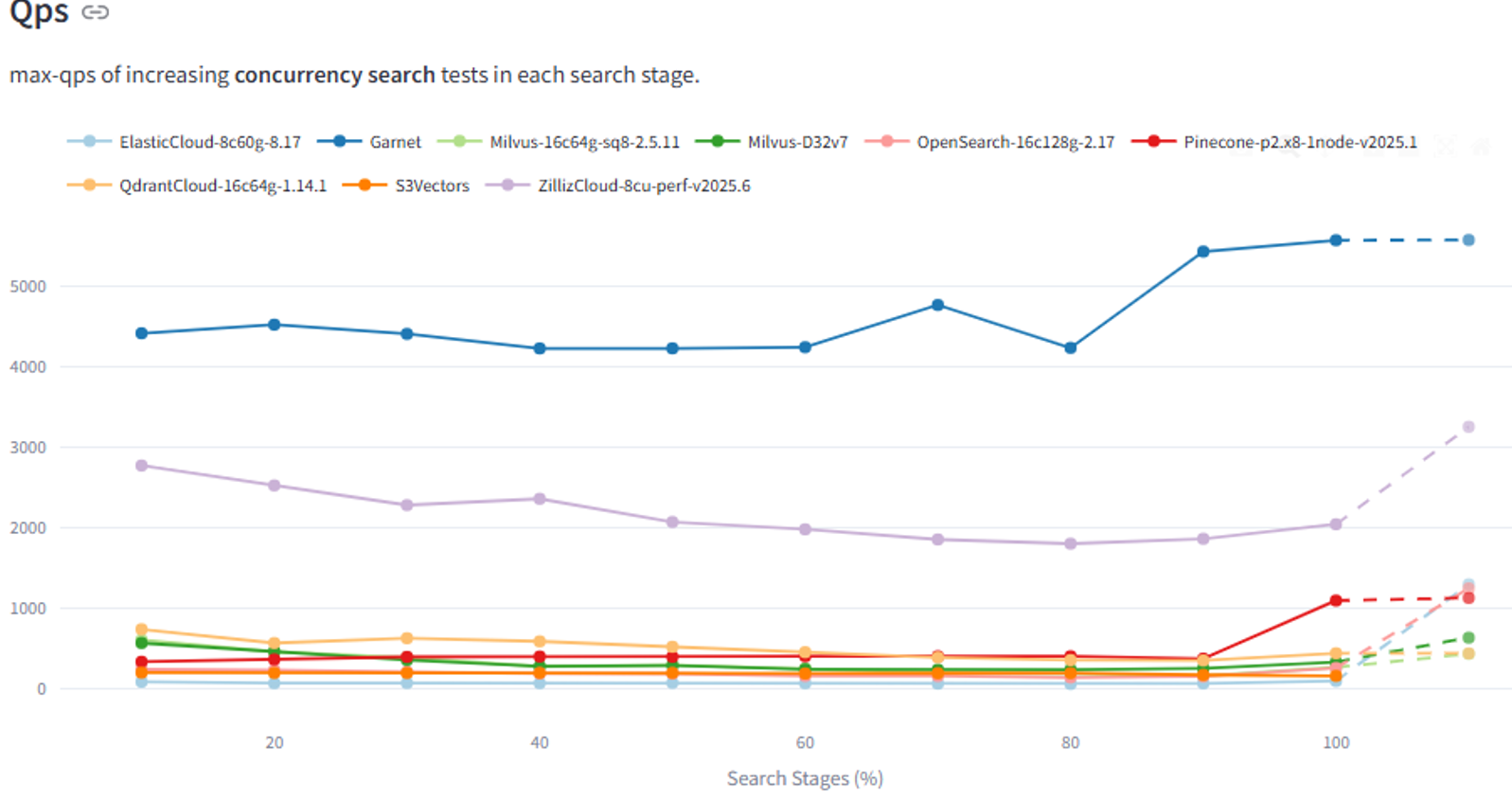
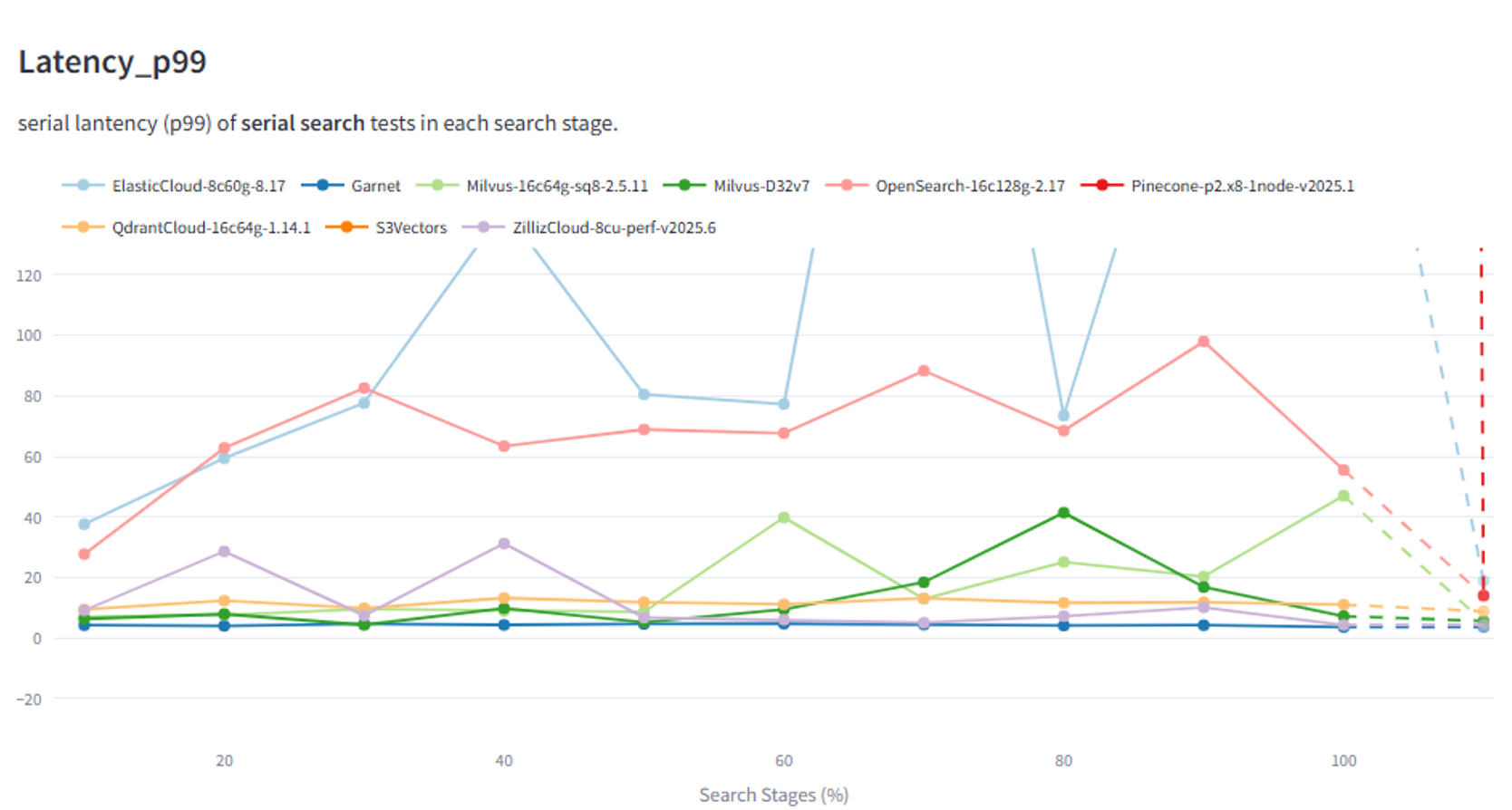
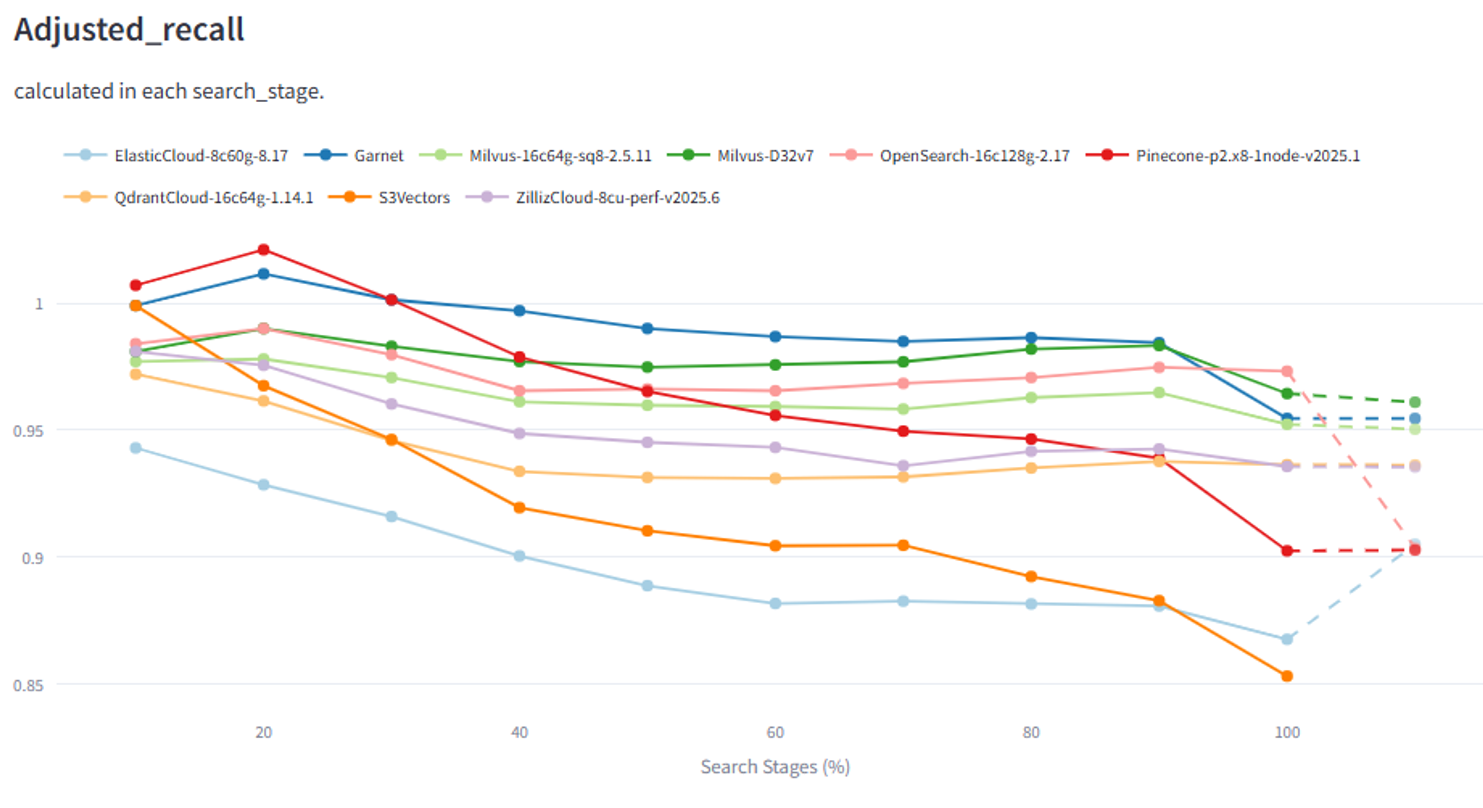
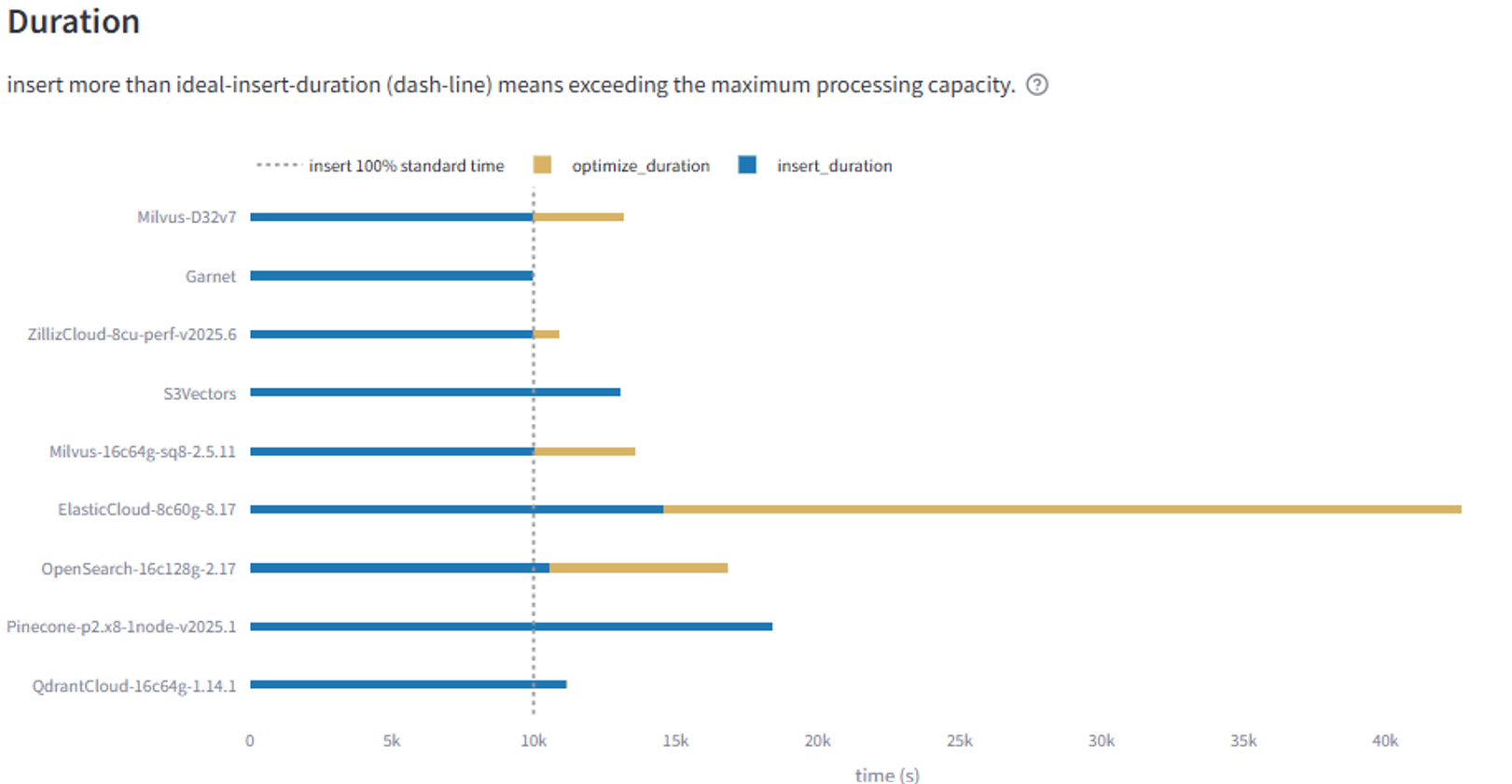
Garnet Vector Sets can deliver substantially higher throughput, lower tail latency, and higher recall than many specialized vector databases, while keeping up with continuous ingestion.
The numbers below are based on our initial results on the Wikipedia-10M + Cohere Embeddings dataset (768-dimensional FP32, ~10M vectors) run with Zilliz's VectorDBBench (streaming) on an Azure D32v6 VM. The workload inserts 1,000 vectors/second in the background while measuring foreground query throughput, p99 latency, and recall. Numbers for other vector databases are taken from the public benchmark site. More details are on the DiskANN wiki.
Headline results:
- ~2× the QPS of Zilliz (the next-best system) and 5–10× the QPS of every other vector DB in the comparison.
- p99 search latency stays under 5 ms under sustained background ingestion — most other systems sit in the tens to hundreds of milliseconds and fluctuate heavily.
- Highest recall in the comparison across all search stages.
- Fastest ingestion — Garnet completes the load close to the ideal-insert duration. Several other systems cannot even keep up with the 1,000 vector/sec ingestion rate. Ingestion is even faster outside the benchmark harness.
The gap widens further at larger scale and higher embedding dimensions.
Queries per second (higher is better)
p99 search latency (lower is better, ms)
Adjusted recall (higher is better)
Ingestion duration (shorter is better, s)
For source and reproduction instructions, see the
vectorset and
diskann-garnet crates in the DiskANN repository.
Overview
Each Vector Set is identified by a Garnet key in the store. Under the hood, the key holds a small index "stub"
that points at a DiskANN graph index. The vector algorithms themselves are stateless — they offload all of their state, both
the per-element vectors and the graph adjacency lists, into key-value pairs in Tsavorite (kept in dedicated internal
namespaces alongside per-element attributes). They reach that state through read/write/delete callbacks rather
than owning any in-process storage. From the user's point of view, the key behaves like a single Garnet object: it
can be inspected with TYPE, deleted with DEL/UNLINK, expired with EXPIRE/PEXPIRE, flushed with
FLUSHDB/FLUSHALL, and migrated across cluster nodes.
A typical workflow is:
- Insert vectors with
VADD, which implicitly creates the index on the first call. - Search for nearest neighbors with
VSIM. - Inspect the index with
VINFO/VDIM, read individual entries withVEMB/VGETATTR. - Remove individual elements with
VREM, or drop the whole index withDEL.
Element IDs
Element IDs are byte strings up to 1024 bytes; they may be variable-length or fixed-length, including binary content (e.g. a 4-byte big-endian counter). IDs are opaque to Garnet — they are stored verbatim and returned verbatim in search results.
Persistence and Replication
- Checkpoint (BGSAVE) — The index stub, per-element vectors and attributes, and the nearest neighbor graph adjacency lists all live in the Tsavorite store, so they are persisted as part of the standard Tsavorite checkpoint. On recovery, only the in-memory DiskANN handle needs to be rebuilt; it is lazily reconstituted over the persisted records the first time a Vector Set command touches the key, inside an exclusive lock so other readers wait.
- AOF —
VADDandVREMare appended to the AOF as synthetic write entries. Replicas reapply them in parallel using a pool of worker tasks (configurable via--vector-set-replay-task-count); this is intentionally non-deterministic so the replica's graph topology may not bit-identically match the primary's, but the search semantics are preserved. FLUSHDB/FLUSHALLblock all Vector Set writes for the duration of the flush so that the in-memory vector indices can be safely dropped.
Cluster
Vector Sets participate in cluster sharding by their key. MIGRATE is supported and ships both the index stub and
all internal per-element data.
Lifecycle Commands
VADD
Insert a vector with the given element ID into a Vector Set, creating the index on the first call.
Syntax
VADD key [REDUCE dim] (FP32 vector | XB8 vector | VALUES n v1 ... vN) element
         [CAS] [NOQUANT | XPREQ8] [EF n] [SETATTR attr] [M n]
         [XDISTANCE_METRIC L2 | COSINE | IP | XCOSINE_NORMALIZED]
Vector Input Forms
| Form | Description |
|---|---|
FP32 <bytes> | Raw little-endian float32 blob. Length must be a multiple of 4. |
XU8 <bytes> | Raw uint8 byte blob. Each byte is one dimension. |
XI8 <bytes> | Raw int8 byte blob. Each byte is one dimension. |
VALUES n v1 v2 ... vN | n textual floats. |
Options
| Option | Default | Description |
|---|---|---|
REDUCE dim | disabled | Project the input vector down to dim dimensions. dim must be ≤ the input dimensions. Not allowed with XPREQ8. Only honored on the first VADD (when the index is created). |
CAS | off | Accepted for parser compatibility with Redis; currently a no-op. |
NOQUANT | BIN | Q8 | XNOQUANT_U8 | XNOQUANT_I8 | XBIN_I8 | XBIN_U8 | Q8 | Quantization (see Quantization). |
EF n | 200 | Build-time exploration factor (DiskANN R candidate-list size). Must be in [1, 1000000]. |
SETATTR attr | none | Attach an arbitrary byte string to the element (typically a JSON object). Retrieve later with VGETATTR or via WITHATTRIBS on VSIM. |
M n | 16 | DiskANN max out-degree per node. Must be in [4, 4096]. |
XDISTANCE_METRIC | L2 | Distance function (see Distance Metrics). |
Once the index is created, subsequent VADD calls must agree on REDUCE, quantization, M, and distance metric;
mismatches return errors like ERR asked M value mismatch with existing vector set.
Examples
# Create + insert with FP32 input, COSINE distance, M=32, EF=200 (default)
VADD movies FP32 <16-byte float blob> dune XDISTANCE_METRIC COSINE M 32

# Insert via VALUES (3 dimensions) with an attribute and explicit metric
VADD movies VALUES 3 0.12 0.34 0.56 inception \
     NOQUANT SETATTR "{\"year\":2010,\"rating\":4.2}" XDISTANCE_METRIC COSINE

# Insert a uint8 vector with the XPREQ8 pseudo-quantizer
VADD photos XB8 <128-byte blob> photo:42 XPREQ8
Resp Reply
- RESP2: integer
:1if a new element was inserted,:0if the element was already present. - RESP3: boolean
true/false. - Errors include
ERR Vector dimension mismatch,ERR REDUCE dimension must be <= vector dimensions,ERR M must be an integer between 4 and 4096,ERR EF must be an integer between 1 and 1000000,ERR vector exceeds maximum of 65536 dimensions,ERR Vector Set key cannot be empty.
VINFO
Return metadata about a Vector Set.
Syntax
VINFO key
Resp Reply
RESP2 returns an array of 14 elements (7 alternating field-name / value pairs); RESP3 returns a map with the same 7 fields:
| Field | Type | Description |
|---|---|---|
quant-type | simple string | One of f32, bin, q8, xpreq8 |
distance-metric | simple string | One of l2, cosine, inner-product, cosine-normalized |
input-vector-dimensions | integer | Dimensions of the input vector |
reduced-dimensions | integer | Dimensions stored in the index (after REDUCE); same as input-vector-dimensions if no projection |
build-exploration-factor | integer | EF used at build time |
num-links | integer | M (max out-degree) |
size | integer | Number of elements currently in the index |
Returns a null array in RESP2 or null in RESP3 if the key does not exist; WRONGTYPE if the key holds a different data type.
RESP2 example:
> VINFO movies
 1) "quant-type"
 2) "f32"
 3) "distance-metric"
 4) "cosine"
 5) "input-vector-dimensions"
 6) (integer) 768
 7) "reduced-dimensions"
 8) (integer) 768
 9) "build-exploration-factor"
10) (integer) 200
11) "num-links"
12) (integer) 16
13) "size"
14) (integer) 1024
VDIM
Return the input vector dimensions (i.e. the dimension before any REDUCE).
Syntax
VDIM key
Resp Reply
Integer reply. Returns ERR Key not found if the key does not exist; WRONGTYPE if the key holds a different
data type.
> VDIM movies
(integer) 768
DEL / UNLINK
Deleting a Vector Set uses the standard DEL or UNLINK commands. Garnet asynchronously drops the vector index
and releases all internal per-element storage.
DEL movies
UNLINK movies
If a delete is interrupted (for example, by a crash), the index key remains in a "partially deleted" state. Any Vector Set command on that key returns:
ERR Vector Set is in a partially deleted state - re-execute DEL to complete deletion
Re-running DEL key (or letting expiration / FLUSHDB cover it) finishes the cleanup.
TYPE / EXPIRE / PERSIST
Standard key-management commands work on Vector Set keys:
TYPE keycurrently reportsstringfor Vector Set keys (a dedicated reply name is not yet wired up).EXPIRE/PEXPIRE/EXPIREAT/PERSIST/TTL/PTTLset, query, and clear TTLs the same way as any other key. When a Vector Set key expires, the vector index is dropped in the background, matching the behavior of explicitDEL.
Write Commands
VREM
Remove an element from a Vector Set.
Syntax
VREM key element
Resp Reply
RESP2: integer :1 if the element was removed, :0 if it was not present (or the key does not exist).
RESP3: boolean true / false.
> VREM movies inception
(integer) 1
Read Commands
VEMB
Return the stored vector for an element as an array of textual floats.
Syntax
VEMB key element
Resp Reply
Array of bulk strings, one per dimension. Returns an empty array if the element is not present in the index.
> VEMB movies dune
1) "0.12"
2) "0.34"
3) "0.56"
...
The RAW form (VEMB key element RAW) is parsed but not yet implemented — invoking it currently throws.
VGETATTR
Return the attribute that was attached to an element via VADD ... SETATTR.
Syntax
VGETATTR key element
Resp Reply
Bulk string reply with the raw attribute bytes, or nil if the element exists but has no attribute / does not exist.
> VGETATTR movies inception
"{\"year\":2010,\"rating\":4.2}"
Search Commands
VSIM
Find the nearest neighbors of a query vector or an existing element.
Syntax
VSIM key (ELE element | FP32 vector | XB8 vector | VALUES n v1 ... vN)
         [WITHSCORES] [WITHATTRIBS]
         [COUNT n] [EPSILON delta] [EF n]
         [FILTER expr] [FILTER-EF n]
         [TRUTH] [NOTHREAD]
Query Input Forms
| Form | Description |
|---|---|
ELE element | Use the vector already stored under element as the query. |
FP32 <bytes> | Raw little-endian float32 query blob. |
XB8 <bytes> | Raw uint8 query blob. |
VALUES n v1 ... vN | n textual floats. |
The query's effective dimension must match the index's input-vector-dimensions.
Options
| Option | Default | Description |
|---|---|---|
WITHSCORES | off | Also return the distance/similarity score for each result. |
WITHATTRIBS | off | Also return the attribute (set with VADD ... SETATTR) for each result. |
COUNT n | 10 | Maximum number of results to return. Must be in [0, 100000000]. |
EPSILON delta | 2.0 | DiskANN L_search epsilon — controls how aggressively the graph is explored beyond the current best. |
EF n | 100 | Search-time exploration factor (L_search candidate-list size). Must be in [1, 1000000]. |
FILTER expr | none | Filter results by an attribute expression (see Filter Expressions). |
FILTER-EF n | 16 | Scale factor for adaptive inline filter search. Must be in [4, 256]. This controls how high the EF will scale based on selectivity. |
TRUTH | off | Accepted for compatibility; exact / brute-force search is not yet wired up. |
NOTHREAD | off | Accepted for compatibility; currently ignored (search always runs on the calling thread). |
Resp Reply
A flat RESP array. The number of elements per result depends on which WITH* flags are set:
| Flags | Items per result | Order |
|---|---|---|
| (none) | 1 | id |
WITHSCORES | 2 | id, score |
WITHATTRIBS | 2 | id, attr |
WITHATTRIBS WITHSCORES | 3 | id, score, attr |
Scores are returned as bulk strings (decimal text). When WITHATTRIBS is set and an element has no attribute, the
slot is an empty bulk string. The result is in similarity order (closest first). Results may be fewer than COUNT
if the candidate set is smaller.
VSIM currently only supports RESP2. Calling it in a RESP3 session is not yet implemented.
Examples
# Top-5 nearest to an existing element, with scores
VSIM movies ELE dune COUNT 5 WITHSCORES

# Top-10 nearest to a VALUES query, with attributes, default COUNT
VSIM movies VALUES 3 0.10 0.20 0.30 WITHATTRIBS

# Filtered search: only movies from after 1950, with both scores and attributes
VSIM movies VALUES 3 0.0 0.0 0.0 \
     FILTER ".year > 1950" COUNT 5 WITHSCORES WITHATTRIBS
Filter Expressions
VSIM ... FILTER <expr> filters candidates by their JSON attribute. The expression is compiled once and
evaluated against each candidate's attribute.
Syntax
- Field access: dot notation —
.year,.rating,.tags - Arithmetic:
+,-,*,/,%,** - Comparison:
==,!=,>,<,>=,<= - Logical:
and,or,not(also&&,||,!) — case-sensitive lowercase - Containment:
in- Tuple membership:
.director in ["Spielberg", "Nolan"] - JSON array membership:
"classic" in .tags(when.tagsis a JSON array) - Substring:
"act" in .genre(when.genreis a string)
- Tuple membership:
- Grouping: parentheses
() - Values: integers, floats, single/double-quoted strings (with
\"escapes),true/false,null
Operator Precedence (low → high)
| Precedence | Operators |
|---|---|
| 0 | or, || |
| 1 | and, && |
| 2 | >, >=, <, <=, ==, !=, in |
| 3 | +, - |
| 4 | *, /, % |
| 5 | ** (right-associative) |
| 6 | not, ! |
Limits
Filters are compiled and evaluated with zero heap allocation on the hot path, so they have fixed upper bounds:
| Limit | Value | What it bounds |
|---|---|---|
| Max tokens | 128 | Total operators + operands in the expression (~18 AND/OR clauses) |
| Max tuple elements | 64 | Total elements across all [...] literals |
| Max runtime array elements | 64 | Per candidate; total elements pulled from JSON array fields |
| Max unique selectors | 32 | Distinct .field references in one expression |
| Max eval stack depth | 16 | Postfix evaluation depth |
| Max parenthesis nesting | 128 | Bounded by the token buffer |
Missing attributes cause the filter to evaluate to false for that candidate. Compile errors yield an empty result set rather than a server-side error.
Examples
VSIM movies ELE dune FILTER ".year >= 1980 and .rating > 7"
VSIM movies ELE dune FILTER ".genre == \"action\" && .rating > 8.0"
VSIM movies ELE dune FILTER "\"classic\" in .tags"
VSIM movies ELE dune FILTER ".director in [\"Spielberg\", \"Nolan\"]"
VSIM movies VALUES 3 0.12 0.34 0.56 FILTER ".year != null and .rating >= 4.0"
Quantization
The active quantizer determines how vectors are stored internally and which input forms are valid.
| Token | Status | Notes |
|---|---|---|
NOQUANT | ✅ Supported | Store input as float32, use unquantized forms for graph search. |
Q8 | ✅ Supported | Store input as float32, use 8-bit quantized forms for graph search. |
BIN | ✅ Supported | Store input as float32, use 1-bit quantized forms for graph search. |
XNOQUANT_U8 | ✅ Supported | Garnet extension: stores input as uint8 bytes with no further quantization. Incompatible with REDUCE. |
XNOQUANT_I8 | ✅ Supported | Garnet extension: stores input as int8 bytes with no further quantization. Incompatible with REDUCE. |
XBIN_U8 | ✅ Supported | Garnet extension: stores input uint8 bytes, uses 1-bit quantized forms for graph search. Incompatible with REDUCE. |
XBIN_I8 | ✅ Supported | Garnet extension: stores input int8 bytes, uses 1-bit quantized forms for graph search. Incompatible with REDUCE. |
If no quantizer is specified on the first VADD, the default is Q8. Matching input format and storage format improves performance by removing a conversion step in VADD.
Distance Metrics
| Token | Description |
|---|---|
L2 (default) | Squared Euclidean distance. |
COSINE | Cosine distance. Vectors are normalized internally. |
IP | Inner product (larger is closer). |
XCOSINE_NORMALIZED | Garnet extension: cosine distance with no internal normalization — caller guarantees inputs are already unit-length. |
XDISTANCE_METRIC is honored only on the first VADD that creates the index. Subsequent VADDs must agree, or
they return ERR Distance metric mismatch.
Type Safety
Vector Set keys are type-safe:
GET/SET/INCR/ etc. on a Vector Set key returnWRONGTYPE.V*commands on a non-Vector-Set key returnWRONGTYPE.- Element data is stored in private internal namespaces — issuing
GET/SET/DELon an element ID does not see or disturb the vector. You can freely use the same byte string as both a Garnet string key and a Vector Set element ID without collision. DEL/UNLINK/TYPE/EXPIRE/TTL/RENAME/RENAMENX/DEBUGwork on any key type, including Vector Sets.
Example Session
> VADD movies VALUES 3 1.0 2.0 3.0 dune NOQUANT SETATTR "{\"year\":1984,\"rating\":4.3}" XDISTANCE_METRIC COSINE
(integer) 1

> VADD movies VALUES 3 2.0 3.0 4.0 inception NOQUANT SETATTR "{\"year\":2010,\"rating\":4.2}"
(integer) 1

> VADD movies VALUES 3 1.5 2.5 3.5 matrix NOQUANT SETATTR "{\"year\":1999,\"rating\":4.7}"
(integer) 1

> VINFO movies
 1) "quant-type"
 2) "f32"
 3) "distance-metric"
 4) "cosine"
 5) "input-vector-dimensions"
 6) "3"
 7) "reduced-dimensions"
 8) "3"
 9) "build-exploration-factor"
10) "200"
11) "num-links"
12) "16"
13) "size"
14) "3"

> VDIM movies
(integer) 3

> VEMB movies dune
1) "1"
2) "2"
3) "3"

> VGETATTR movies inception
"{\"year\":2010,\"rating\":4.2}"

> VSIM movies VALUES 3 1.4 2.4 3.4 COUNT 3 WITHSCORES WITHATTRIBS
1) "matrix"
2) "0.000113"
3) "{\"year\":1999,\"rating\":4.7}"
4) "dune"
5) "0.001052"
6) "{\"year\":1984,\"rating\":4.3}"
7) "inception"
8) "0.001241"
9) "{\"year\":2010,\"rating\":4.2}"

> VSIM movies VALUES 3 1.4 2.4 3.4 FILTER ".year > 1990" COUNT 3 WITHATTRIBS
1) "matrix"
2) "{\"year\":1999,\"rating\":4.7}"
3) "inception"
4) "{\"year\":2010,\"rating\":4.2}"

> VREM movies dune
(integer) 1

> VSIM movies ELE inception COUNT 3
1) "inception"
2) "matrix"

> DEL movies
(integer) 1
Configuration
Enable Vector Sets with the server flag:
garnet-server --enable-vector-set-preview
Or in garnet.conf:
"EnableVectorSetPreview": true
| Option | Default | Description |
|---|---|---|
--enable-vector-set-preview / EnableVectorSetPreview | false | Master switch for all V* commands. When off, every Vector Set command returns ERR Vector Set (preview) commands are not enabled. |
--vector-set-replay-task-count / VectorSetReplayTaskCount | 0 (= CPU count) | Number of worker tasks used by replicas to replay VADD/VREM from the AOF in parallel. |
Limits
| Limit | Value | Source |
|---|---|---|
| Maximum vector dimensions | 65,536 | VectorManager.MaxVectorDimensions |
| Maximum build / search EF | 1,000,000 | VectorManager.MaxExplorationFactor |
Maximum COUNT | 100,000,000 | VectorManager.MaxRetrieveCount |
Maximum FILTER-EF | 256 | VectorManager.MaxFilteringScaleFactor |
| Maximum elements per Vector Set | 2³² − 1 | DiskANN limit |
| Concurrent Vector Sets per instance | (2³² − 8)/8 (approx. 500 million) | Internal context metadata limit |
| Empty Vector Set keys | not allowed | Returns ERR Vector Set key cannot be empty (preview restriction) |
Supported ACL Category
All V* commands belong to the @vector ACL category in addition to the per-command categories. You can grant or
revoke access in bulk via standard ACL SETUSER syntax, for example:
ACL SETUSER alice on >secret ~vec:* +@vector