Message Reactions
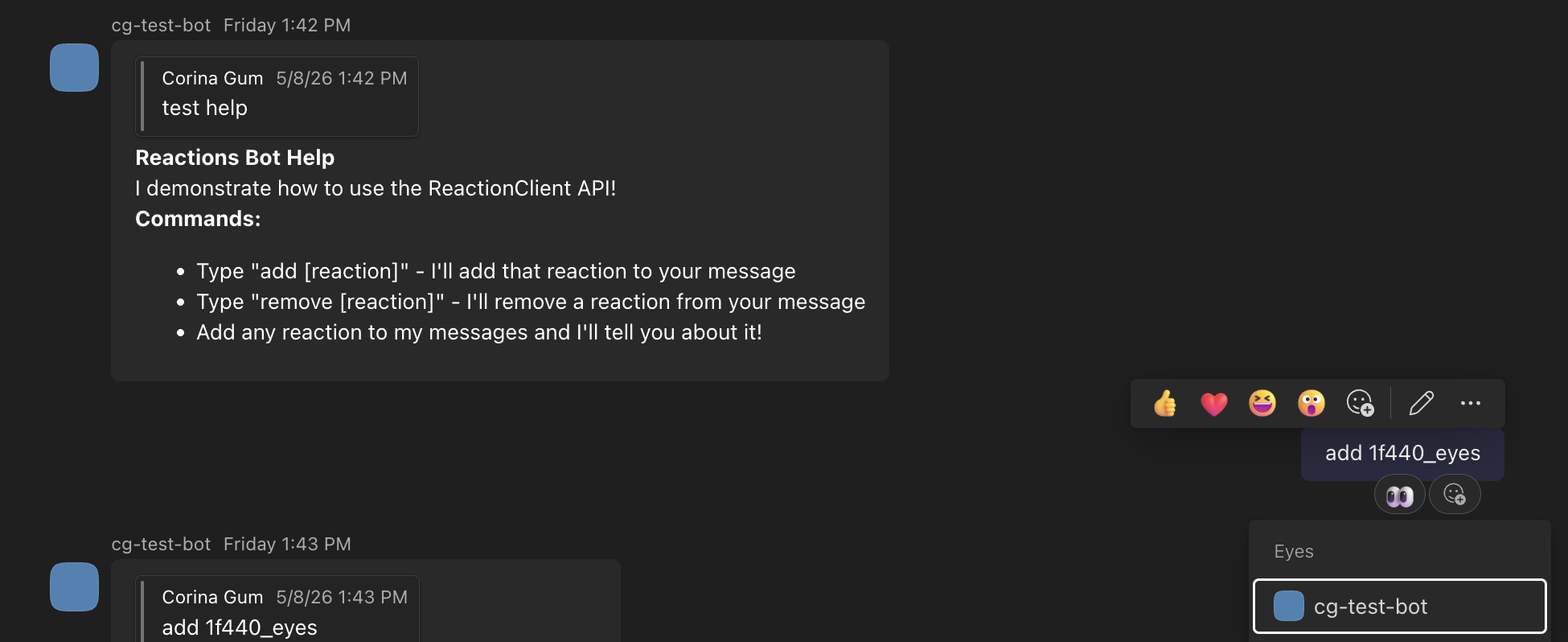
Message reactions allow your agent to add or remove emoji reactions on messages in a Teams conversation, and to react to reactions added by users. This gives your agent a quick, low-friction way to acknowledge messages or signal status without sending a full text reply.
Adding a Reaction
To add a reaction to a message, use the reactions client through the API client:
- SDK 2.0 (Legacy)
- SDK 2.1 (current)
using Microsoft.Teams.Apps.Annotations;

[TeamsController]
public class MessageController
{
    [Message]
    public async Task OnMessage([Context] IContext context, CancellationToken cancellationToken)
    {
        await context.Client.Send("Hello! I'll react to your message.");

        await context.Api.Conversations.Reactions.AddAsync(
            context.Activity.Conversation.Id,
            context.Activity.Id,
            ReactionType.Like,
            cancellationToken
        );
    }
}
using Microsoft.Teams.Apps;

app.OnMessage(async (context, cancellationToken) =>
{
    await context.SendAsync("Hello! I'll react to your message.", cancellationToken);

    // Add a reaction to the incoming message
    await context.Api.Conversations.AddReactionAsync(
        context.Activity.Conversation.Id,
        context.Activity.Id,
        ReactionType.Like,
        cancellationToken: cancellationToken
    );
});
Removing a Reaction
You can also remove reactions that your agent has previously added:
- SDK 2.0 (Legacy)
- SDK 2.1 (current)
using Microsoft.Teams.Apps.Annotations;

[TeamsController]
public class MessageController
{
    [Message]
    public async Task OnMessage([Context] IContext context, CancellationToken cancellationToken)
    {
        // First, add a reaction
        await context.Api.Conversations.Reactions.AddAsync(
            context.Activity.Conversation.Id,
            context.Activity.Id,
            ReactionType.Heart,
            cancellationToken
        );

        // Wait a bit, then remove it
        await Task.Delay(2000, cancellationToken);
        await context.Api.Conversations.Reactions.DeleteAsync(
            context.Activity.Conversation.Id,
            context.Activity.Id,
            ReactionType.Heart,
            cancellationToken
        );
    }
}
using Microsoft.Teams.Apps;

app.OnMessage(async (context, cancellationToken) =>
{
    // First, add a reaction
    await context.Api.Conversations.AddReactionAsync(
        context.Activity.Conversation.Id,
        context.Activity.Id,
        ReactionType.Heart,
        cancellationToken: cancellationToken
    );

    // Wait a bit, then remove it
    await Task.Delay(2000, cancellationToken);
    await context.Api.Conversations.DeleteReactionAsync(
        context.Activity.Conversation.Id,
        context.Activity.Id,
        ReactionType.Heart,
        cancellationToken: cancellationToken
    );
});
Receiving Reactions
Your agent can also listen for reactions that users add or remove on messages in conversations it participates in. The activity carries ReactionsAdded and ReactionsRemoved collections.
.NET exposes a single OnMessageReaction handler plus dedicated OnMessageReactionAdded / OnMessageReactionRemoved sub-handlers.
- SDK 2.0 (Legacy)
- SDK 2.1 (current)
using Microsoft.Teams.Apps.Annotations;

[TeamsController]
public class ReactionController
{
    [Message.Reaction]
    public void OnMessageReaction([Context] IContext context)
    {
        foreach (var reaction in context.Activity.ReactionsAdded ?? [])
        {
            Console.WriteLine($"User added reaction: {reaction.Type}");
        }

        foreach (var reaction in context.Activity.ReactionsRemoved ?? [])
        {
            Console.WriteLine($"User removed reaction: {reaction.Type}");
        }
    }
}
using Microsoft.Teams.Apps;

app.OnMessageReactionAdded(async (context, cancellationToken) =>
{
    foreach (var reaction in context.Activity.ReactionsAdded ?? [])
    {
        Console.WriteLine($"User added reaction: {reaction.Type}");
    }
});

app.OnMessageReactionRemoved(async (context, cancellationToken) =>
{
    foreach (var reaction in context.Activity.ReactionsRemoved ?? [])
    {
        Console.WriteLine($"User removed reaction: {reaction.Type}");
    }
});
If you only need a single handler that runs for both adds and removes, use app.OnMessageReaction instead.
Available Reaction Types
The SDK ships a small set of named reaction constants for the most common reactions, exposed via the ReactionType class.
Any string-valued reaction ID is accepted, so you can pass any reaction ID from the Teams reactions reference page.
ReactionType.Like— 👍ReactionType.Heart— ❤️ReactionType.Checkmark— ✅ReactionType.Pushpin— 📌ReactionType.Laugh— 😄ReactionType.Surprise— 😮ReactionType.Sad— 😢ReactionType.Angry— 😠ReactionType.Hourglass— ⏳ReactionType.Exclamation— ❗
Skin Tones
Reactions tagged Diverse in the Teams reactions reference support five skin-tone variants. Append -tone1 through -tone5 to the reaction ID to select a variant:
1f44b_wavinghand-tone4
Rate Limits
Agents are limited to two reactions per second. Calls that exceed this limit are throttled and return a 429 response. Implement exponential backoff and honor the Retry-After header.
Best Practices
- Use reactions sparingly. Reactions work best when they signal something specific (acknowledgement, completion, an error). Reacting to every message creates noise.
- Match the reaction to the context. Different reactions carry different meanings. Choose one that aligns with your agent's purpose.
- Replace, don't stack. If your agent has already added a reaction and needs to update it, remove the existing reaction first, then add the new one. Adding a reaction that's already present is a no-op.
- Handle errors. Reaction operations can fail if the message no longer exists or the agent isn't a member of the conversation. Handle exceptions appropriately.
Differences from Feedback
Message reactions are different from the feedback feature:
- Reactions are quick emoji responses your agent adds to or removes from messages programmatically, and reactions users add to messages your agent can listen for.
- Feedback are interactive UI components (like/dislike buttons) that users can click to provide structured feedback on agent responses.
Use reactions when your agent wants to acknowledge or respond to a message with emoji. Use feedback when you want to collect user opinions about your agent's responses.