Architecture
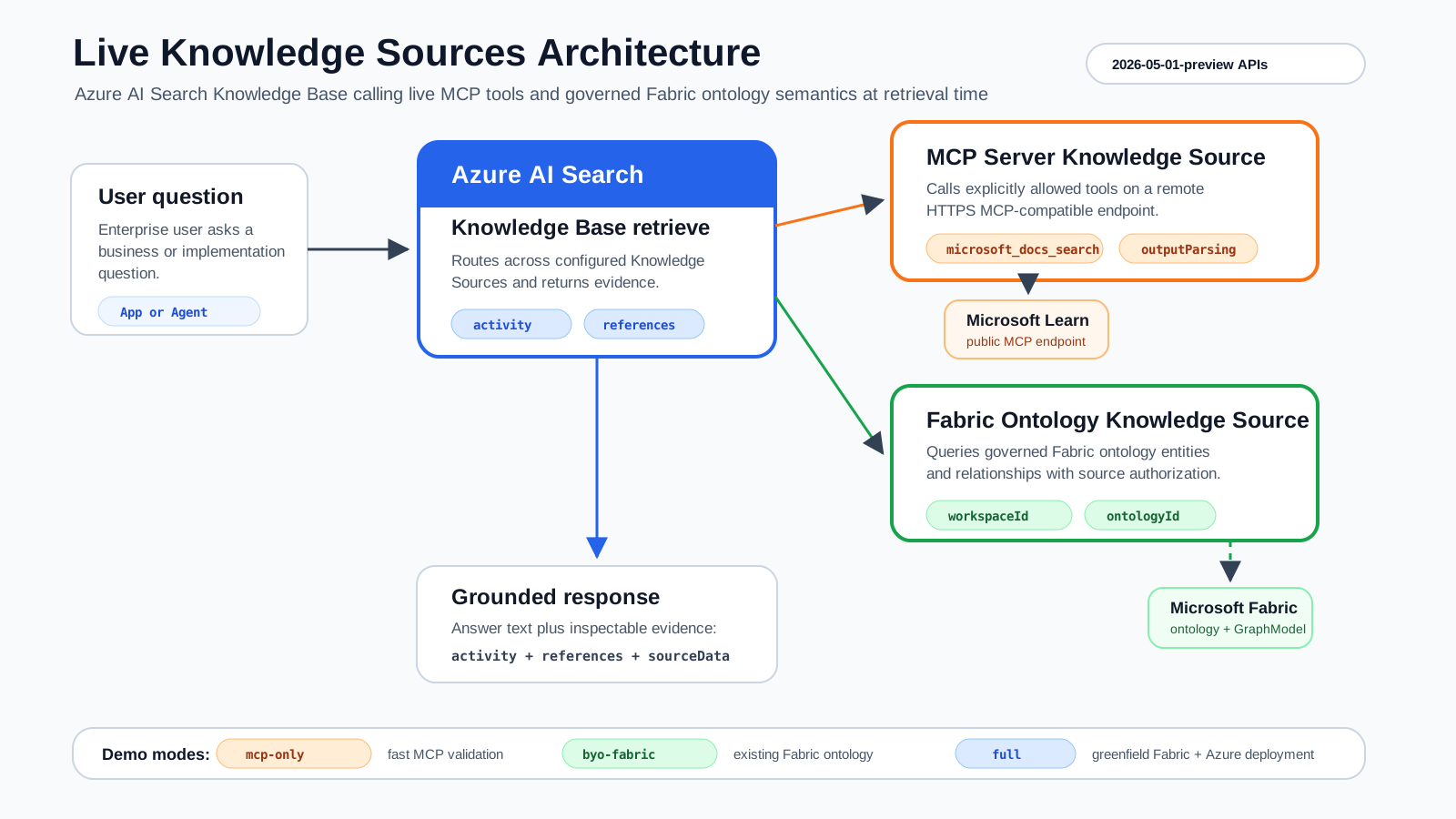
The architecture centers on Azure AI Search Knowledge Base retrieval. A user question enters through a Foundry Agent or custom app, the Knowledge Base calls configured live Knowledge Sources at retrieval time, and the response includes answer text plus inspectable activity, references, and sourceData.
flowchart LR
  User["User question"]
  Agent["Foundry Agent or custom app"]
  MCP["MCP Server KS\nRemote HTTPS tools"]
  Fabric["Fabric Ontology KS\nEntities, relationships"]
  KB["Azure AI Search Knowledge Base"]
  Answer["Grounded answer\nreferences + activity"]

  User --> Agent --> KB
  KB --> MCP
  KB --> Fabric
  MCP --> Answer
  Fabric --> Answer
Northbound MCP vs Southbound MCP
There are two useful MCP directions to distinguish:
Northbound MCP:
  A Knowledge Base is exposed as an MCP server so MCP clients can call it.

Southbound MCP Server KS:
  A Knowledge Base calls an external MCP server as a Knowledge Source.
The deployment demonstrates the southbound MCP Server Knowledge Source pattern. The execution manual also validates the northbound endpoint with ./liveks mcp, so operators can prove the complete client-to-Knowledge-Source path without confusing the two MCP roles.
For the representative managed-organization scenario:
MCP client
  -> Knowledge Base MCP endpoint
    -> Foundry IQ planning and grounding
      -> Fabric Ontology Knowledge Source
  -> MCP text content
Use the retrieve API evidence from ./liveks verify to prove that fabricOntology ran. The current native MCP result provides result.content[], but not the retrieve API's separate activity and references arrays. Pair that trace with ./liveks mcp --expect-term <known-fact> because a text block by itself proves only protocol execution.
Trace The Diagram To Executable Proof
The visual architecture is backed by checked-in configuration, implementation, and verification boundaries. Use this map instead of treating the diagram or a successful deployment message as proof by itself.
| Concern | Source of truth | Executable proof | Boundary |
|---|---|---|---|
| Profile and authored configuration | profiles/mcp-search-index.yaml, profiles/three-source.yaml, profiles/mcp-only.yaml, profiles/byo-fabric.yaml, and config/schema.yaml |
./liveks init, doctor, and plan as documented in the MCP execution contract |
YAML is the ignored human-authored ledger. Unknown fields fail closed and secrets use environment references. |
| MCP Server Knowledge Source and MCP-only Knowledge Base | src/ks_factory/mcp_server.py, src/ks_factory/knowledge_base.py, and scripts/postprovision.py |
./liveks up --env liveks-mcp creates the source and Knowledge Base after plan, ARM preview, and exact confirmation. |
plan builds and dry-runs only; up is the provisioning boundary. |
| Live retrieve evidence | src/liveks/cli.py and static-app/api/retrieve-mcp/index.js |
./liveks verify --env <environment> must report the applicable source-specific retrieve check as pass. |
Read/call only. A live badge plus matching activity or references is required; answer text alone is insufficient. |
| Native Knowledge Base MCP endpoint | src/liveks/mcp_client.py, samples/python/knowledge_base_mcp_consumer.py, and Knowledge Base MCP Client |
The independent consumer must pass endpoint, authentication, tools/list, tools/call, text-content, and known-fact checks. liveks mcp --expect-term <known-fact> retains the lifecycle-bound equivalent. |
Read/call only. Pair MCP content with the source-specific retrieve trace before naming the source that ran. |
| Local and pull-request validation | scripts/validate-local.sh, .github/workflows/validate.yml, and .github/workflows/pages.yml |
bash scripts/validate-local.sh plus the Linux, Windows, and manual-build checks. |
Validate has contents: read. A pull request builds the manual and demo but does not upload or deploy Pages; public main publishes the manual. |
| Cleanup and ownership | src/liveks/config.py and src/liveks/cli.py |
./liveks down --env <environment> must pass resource-group-absent; generated full capacity also requires both Fabric absence checks. |
Generated Azure assets can be deleted. BYO Fabric assets are preserved, and uncertain ownership fails toward preservation. |
Provider Operations And Lifecycle Policy
The direct Search data-plane profiles use a deliberately small internal boundary. src/liveks/providers/sources.py builds and checks the demonstrated Search Index, MCP Server, native Fabric Ontology, and Knowledge Base definitions. src/liveks/providers/data_plane.py normalizes read, conditional create, retrieve, and conditional delete requests. Stable and preview API versions remain explicit on every operation.
src/liveks/cli.py remains the lifecycle authority. It selects profiles, orders independent source checks before combined retrieval, classifies public failures, journals locks and ETags, authorizes cleanup, preserves BYO assets, and emits allowlist-only evidence. Provider modules cannot decide ownership or delete without an ETag supplied by the lifecycle. Provisioned profiles keep their existing script boundary. This is an internal test seam for current implementations, not a plugin system or third-party provider API.
The northbound MCP protocol helpers in src/liveks/mcp_client.py are lifecycle-neutral. Both the independent sample and liveks mcp use the same request and content parsing contract, while endpoint discovery, Azure CLI credential acquisition, environment reports, and source-readiness sequencing remain in src/liveks/cli.py.