Choose a Pattern
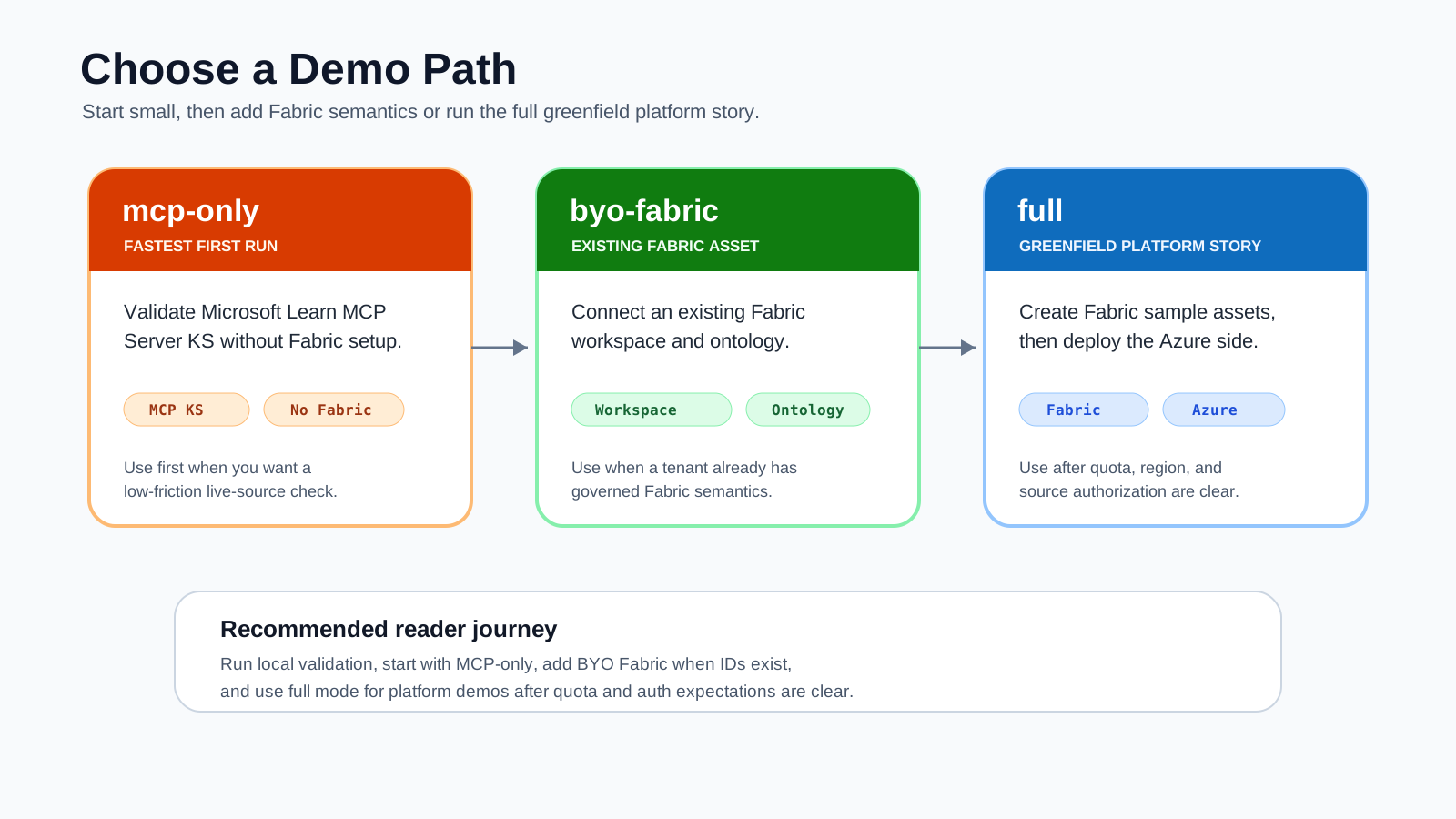
Start with offline replay, then choose the smallest live profile that proves the behavior you need.
| Profile | Use when | Main risk or prerequisite | Success signal |
|---|---|---|---|
offline |
You need to inspect the response contract immediately. | It proves shape, not live retrieval. | Answer plus MCP and Fabric trace evidence. |
search-index |
An agentic-ready Search index already exists and you want the lowest-risk live path. | Search data-plane permissions and a semantic configuration. | Stable retrieve returns extracted text and searchIndex evidence; cleanup preserves the index. |
mcp-search-index |
You want preview MCP routing over an existing Search service and index. | Existing Azure OpenAI deployment plus Search managed identity model access. | Independent Search and MCP checks pass before combined evidence; cleanup preserves all reused assets. |
three-source |
Existing Search, OpenAI, and Fabric ontology assets should compose without provisioning. | Same-tenant Fabric IDs, delegated user authorization, and model access. | Search, MCP, and Fabric pass independently before combined evidence; all underlying assets survive cleanup. |
mcp-only |
You want the first preview live path without Fabric. | Azure AI Search preview and model availability. | microsoft_docs_search appears in activity or references. |
byo-fabric |
Existing governed Fabric semantics should ground retrieval. | Workspace/ontology IDs and delegated user authorization. | Separate checks prove both KS paths; the combined KB shows planner-selected routing. |
full |
A greenfield platform demo must create everything. | Billable Fabric F2 quota, longer duration, tenant settings, cleanup. | Fabric GraphModel, both KS paths, app, and teardown pass. |
Decision
Use search-index when an agentic-ready index already exists and stable extractive retrieval is enough. Upgrade that same service to mcp-search-index when an existing Azure OpenAI deployment and its Search managed identity grant are ready. Use three-source only when an existing native Fabric ontology and delegated authorization are also ready. Otherwise use mcp-only unless the answer to one of these is yes:
- Existing Fabric workspace and ontology IDs are ready: use
byo-fabric. - The audience must see Fabric sample creation from zero and quota is confirmed: use
full. - No cloud mutation should occur: remain on
offline.
Command Shapes
./liveks init --profile search-index --env liveks-index
# Add the existing endpoint, index, semantic configuration, and optional field lists.
./liveks plan --env liveks-index
./liveks up --env liveks-index
./liveks init --profile mcp-search-index --env liveks-combined
# Add the existing Search and Azure OpenAI deployment values.
./liveks plan --env liveks-combined
./liveks up --env liveks-combined --query "<index question>" --expect-term "<known term>"
./liveks init --profile three-source --env liveks-three
# Add existing Search, Azure OpenAI, Fabric workspace, and ontology values.
./liveks plan --env liveks-three
./liveks up --env liveks-three --query "<index question>" --expect-term "<known term>" --fabric-query "<ontology question>"
./liveks init --profile mcp-only --env liveks-mcp
./liveks plan --env liveks-mcp
./liveks up --env liveks-mcp
./liveks init --profile byo-fabric --env liveks-byo
# Add fabric.workspace_id and fabric.ontology_id to .liveks/liveks-byo.yaml.
./liveks plan --env liveks-byo
./liveks up --env liveks-byo
./liveks init --profile full --env liveks-full
./liveks plan --env liveks-full
./liveks up --env liveks-full --accept-fabric-capacity
Source Pattern
| Knowledge Source pattern | Sample entry point |
|---|---|
| Search Index KS | Stable Search Index Knowledge Source |
| Search Index KS + MCP Server KS | MCP + Search Index Knowledge Base |
| Search Index KS + MCP Server KS + Fabric Ontology KS | Preview Three-Source Knowledge Base |
| MCP Server KS | samples/rest/01-create-mcp-server-ks.http |
| Fabric Ontology KS | samples/rest/04-create-fabric-ontology-ks.http |
| Combined Knowledge Base | samples/rest/05-create-combined-kb.http |
The direct combined verifiers use one Knowledge Base but supply one source parameter at a time before the combined query. In any combined Knowledge Base, the returned activity, references, and sourceData are the evidence of what actually ran.