Aggregate completed manifests
Released in v0.41.0. Standalone aggregation reads an explicit set of completed public manifests from an existing local immutable store. It does not start agents, credential helpers or the original worker. Mutable result files and Azure credential-backed aggregation are not inputs to this profile.
Worked example: retained public sources
Section titled “Worked example: retained public sources”Start with a completed manifest from the
immutable publication workflow. Set
MANIFEST_SHA256 to its actual finalized digest. If available, set
EVIDENCE_SHA256 to the actual published public evidence-sidecar digest.
These are references, not verification claims.
# Without a sidecar, admission can be complete but execution and usage are unknown.waza aggregate --store .waza-artifacts "$MANIFEST_SHA256" -o metadata-aggregate.jsonCreate a qualified input set without guessing digest strings or overwriting a file:
node --input-type=module <<'JS'import { writeFileSync } from 'node:fs';const manifest = process.env.MANIFEST_SHA256;const evidence = process.env.EVIDENCE_SHA256;if (!/^[0-9a-f]{64}$/.test(manifest ?? '') ||    !/^[0-9a-f]{64}$/.test(evidence ?? '')) {  throw new Error('Set actual MANIFEST_SHA256 and EVIDENCE_SHA256 public digests.');}writeFileSync('aggregate-inputs.json', JSON.stringify([  { manifest_sha256: manifest, evidence_sha256: evidence }]), { flag: 'wx', mode: 0o600 });JS
waza aggregate --store .waza-artifacts --inputs aggregate-inputs.json -o aggregate.json
The evaluated report is emitted to stdout and saved to the new output file. Incomplete/conflicting reports are still emitted and saved, but exit nonzero. Do not treat a nonzero exit as permission to discard diagnostics or retry unchanged inputs until they appear complete. Existing output files are not replaced.
Understand the three populations
Section titled “Understand the three populations”input_members counts exact unique reference pairs; per-member state/outcome
counts use this denominator. unique_verified_manifests counts current verified
publications. unique_verified_execution_records counts original admitted source
records, not legacy attempt ordinals. Compatible multiple views remain visible
but count a record once. A saved report cannot map one execution ID to different
manifests, while same-manifest views remain valid. Distinct repeated executions
are valid, not conflicts.
Different identity/selection/mode/grader profiles remain separate display groups;
there is no latest winner or pooled quality score.
Complete admission is not a passing task or execution attestation. Failed and cancelled source outcomes remain unchanged. Supported legacy metadata-only sources, optional omitted sidecars and privacy-redacted categories can be complete inputs. Supplied invalid sidecars, missing sources and conflicting claims remain explicit.
usage.recorded_historical_usage is either a complete historical total over unique
admitted, non-cached execution records or null. No partial total, token-price
estimate or new SDK billing is invented. Explicit recorded zero remains zero;
missing credits/model attribution remain unavailable. Per-view source labels
distinguish mock/authored/cached/unknown records from observed live evidence.
Readers reject a complete usage claim if any supplied view lacks execution
identity or a verified, present single usage observation, or declares cached
categories/lineage exclusion. An eligible view cannot override another’s
exclusion. Complete metadata-only admission still retains unavailable/null
usage. This consistency check is not source reverification or live-only
attestation. Optional aggregate credits/model attribution may remain absent;
missing values are unavailable, never recorded zero.
If the full serialized report would exceed 32 MiB because of recorded usage,
recorded_usage_report_size_unavailable withholds the entire historical total.
Membership, diagnostics and the unique execution count remain available; the
smaller records do not become an unlabeled subset total. Nothing is truncated.
Lab and JSON downloads
Section titled “Lab and JSON downloads”Open waza serve --lab --results-dir RESULTS_DIR with the configured results directory containing its
existing .waza-artifacts store, then select Runner. In Aggregate completed public manifests, enter one manifest
digest and optionally its evidence digest per line. The server reads only this
configured local store; browser input cannot select filesystem paths or providers.
Uploads are limited to 1 MiB and five seconds before opening storage. Stalled
uploads return HTTP 408 (aggregate_request_timeout); cancellation stops
admission (408 when delivery is still possible). Deadline
setup/reset failures return 500 (aggregate_transport_unavailable), and
unsupported bounded delivery aborts the connection instead of returning success.
After admission, evaluation has its separate 30-second budget. Response delivery
is bounded to five seconds without changing canonical report bytes.
The aggregate-only client deadline is 50 seconds, covering those phases plus ten
seconds of headroom while preserving caller cancellation. Source open/close and
synchronous filesystem I/O are separate constraints, not a universal lifetime
guarantee. Blocked diagnostic sinks use the existing bounded reporter rather
than blocking report delivery or accumulating a logger per request.
The panel displays composition, profile counts, member state/outcome counts, conflicts, omissions, category states, historical usage availability and source manifest inspection links. Evaluated incomplete/conflicting HTTP 409 reports stay visible and downloadable. The JSON download preserves the actual canonical API response; transport/malformed responses clear earlier success data instead of showing it as current.
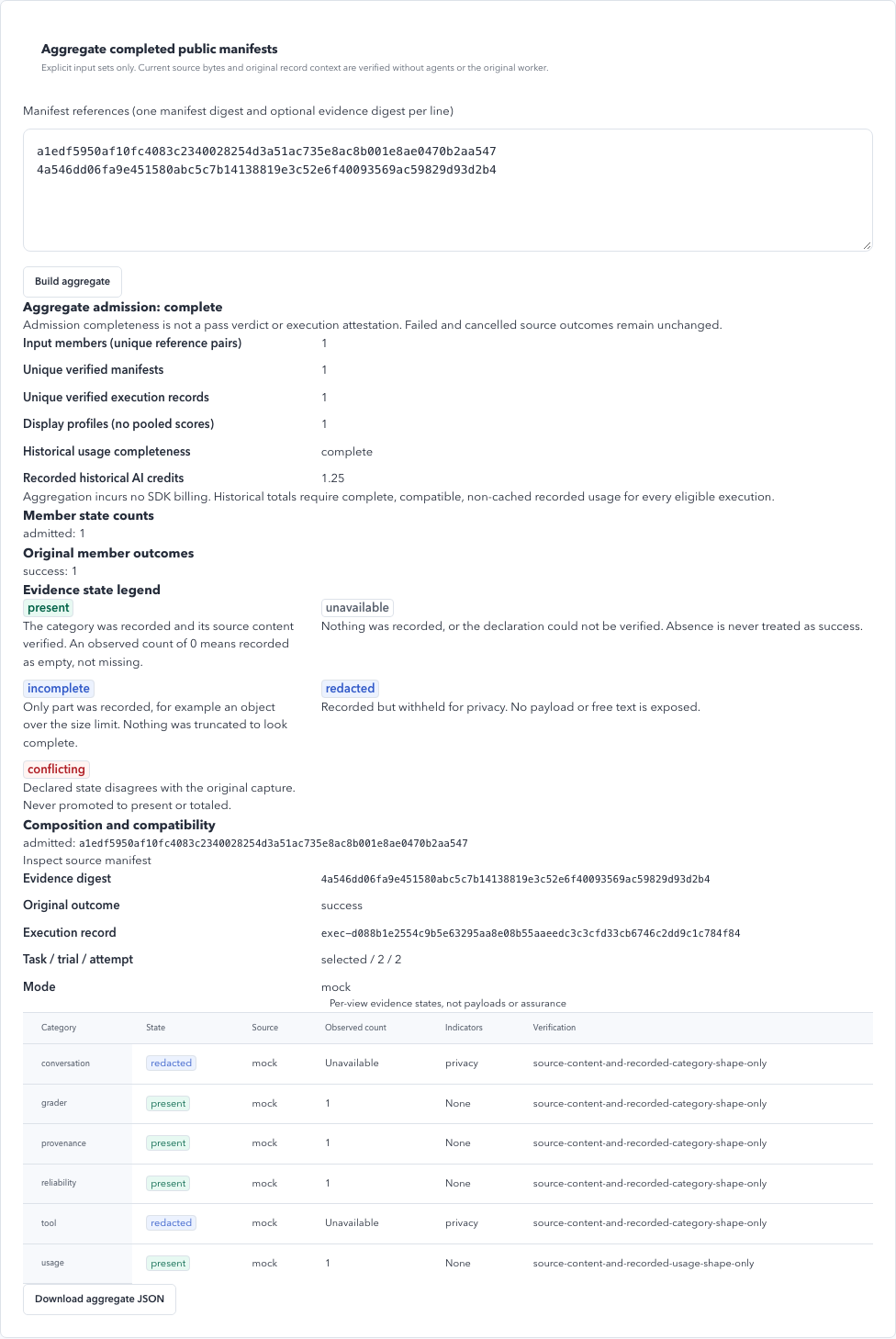
This producer-backed example contains author-recorded mock usage, not observed SDK billing or execution attestation.
The aggregate response limit is 32 MiB of UTF-8 bytes, including escaped identifiers. The client checks member-driven admission state (conflicts take priority), named populations, display groups and historical-usage completeness before showing or downloading a report. A schema-valid but internally inconsistent response is not accepted as complete.
To read each member’s category states, retry parent and evidence lineage,
see Reviewing evidence states.
Compatibility, migration and troubleshooting
Section titled “Compatibility, migration and troubleshooting”Aggregate schema 1.0 is separate from manifest, evidence and result versions. Completed manifest/terminal 1.0 sources are supported with or without a sidecar. Evidence/capture/attempt/completion 1.0 can qualify original record context. Unknown versions are explicit unsupported/invalid inputs; historical mutable results are not automatically converted and ownership/usage is never synthesized. Custom attempt artifact names are supported only when the selected descriptor matches the original reservation bytes; an unchanged execution ID alone is not sufficient. Ordering is deterministic for the same requested population and observed source state, including summation order. Diagnostics contain stable codes, not payloads or private provider errors.
For missing_source, restore the original public source rather than dropping it.
For corruption/conflicts, preserve evidence and inspect the source records.
For read_budget_exhausted, the original population remains incomplete; a subset
must not be relabeled as its complete aggregate. Missing namespace capability or
usage stays unavailable, not zero. Reordering cannot repair a missing source.
This opt-in profile was released in v0.41.0; it is not a full acceptance claim. Existing result readers and ordinary evaluation behavior remain unchanged.