
Credit consumption & cost

What Copilot costs, where it goes, and who to bill.

Templates, browser tools and methodology for tracking Microsoft Copilot credit consumption and cost — from a single view of spend across products, through to departmental chargeback and spend policy.

New · Power BI template

Consumption Central

One template for Copilot credit consumption and cost across four products — Cowork / Work IQ, Copilot Studio, GitHub Copilot and Azure AI Foundry. Today that is four portals and four exports with no single view.

  • Group spend by your own org data — department, cost centre, country, manager
  • Forecast to the end of the billing period, with overage and unused capacity against prepaid packs
  • Three deployment paths — local CSV, Fabric, or straight from Viva
  • Synthetic sample data ships with it — see the whole report before touching a tenant

It reports; it does not enforce. Limits and policies stay in the admin centre — this tells you what they should be.

Two-minute walkthrough — what it covers and how it fits together.
Two templates on this page

They read different exports, so which one fits depends on what you have access to and what you need out the other end.

Cowork Chargeback

Runs on Microsoft 365 admin center credit exports plus an Entra user export. Built for departmental chargeback — billing models, prepaid pool allocation, and per-user allowances.

Consumption Central

Reads the Viva Insights consumption export alongside Power Platform, GitHub and Azure, so Copilot Studio, GitHub Copilot and Foundry spend land in the same model as Cowork.

Power BI template

Cowork Credit Chargeback

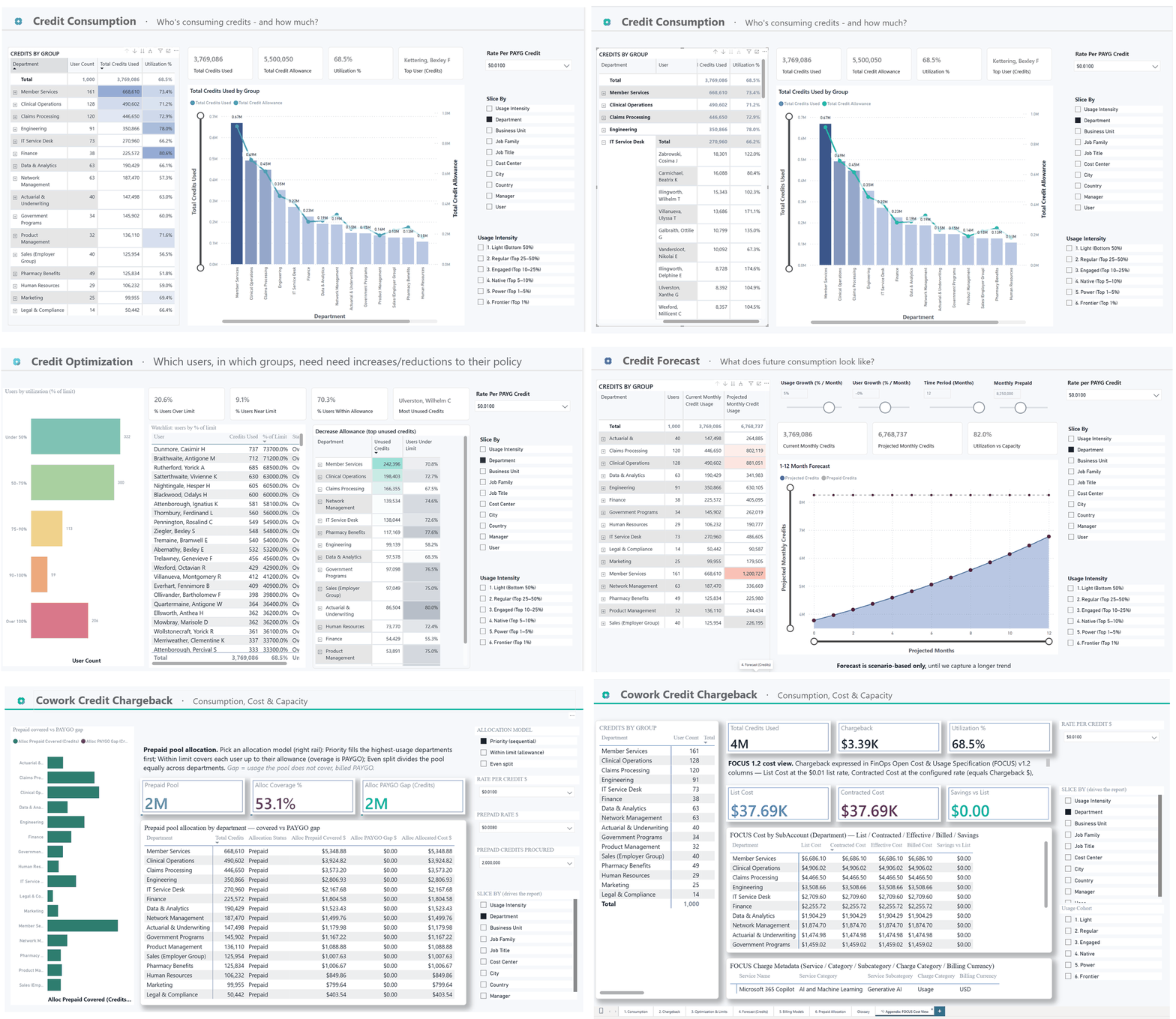
Turns Cowork credit consumption into a departmental bill, from the Microsoft 365 admin center export plus your Entra user list.

  • Three billing models priced side by side — pay-as-you-go, prepaid, hybrid, with the cheapest flagged
  • Prepaid pool allocation — split by usage, by headcount, or by budgeted allowance
  • Per-user limits and an over-limit watchlist — who needs their allowance adjusted
  • Row-level security — department heads see only their own line
  • FOCUS cost view — the chargeback in FinOps Open Cost & Usage Specification columns
Animated walkthrough of the Cowork Credit Chargeback Power BI report

Walkthrough — Consumption, Chargeback, Billing Models, Prepaid Allocation.

Cowork browser tools

No install, no setup. Each runs entirely in your browser on exports you already own. Nothing is uploaded anywhere.

Cowork Chargeback ↗

Who owes what, in dollars. Feed it your Cowork consumption and org exports and get a finance-ready, invoice-reconciled bill per cost center and per person. Full-consumption or overage basis, dynamic cut-by, and CSV exports.

Analytics Hub · cowork-chargeback

Multi-Budget Chargeback Report ↗

Credit entitlements, settled back to whoever funded them. For divisions, subsidiaries, agencies or districts that share one tenant but hold separate budgets. Set each entity’s entitlement — its share of the prepaid pool — and every bill is rebuilt against it, so the organisation that consumed earliest does not keep the discount.

Analytics Hub · multi-budget-chargeback

Cowork ROI Model ↗

Interactive value model with no tenant payload. Enter your own task counts and assumptions; only research-based minutes-per-task defaults are preloaded by category.

Analytics Hub · cowork-roi-model

Cowork Policy Helper ↗

Set the limits before the bill arrives. Assign users to spend-tier billing policies by attribute, review the exception queue, and export a point-in-time record of who is on which policy.

Analytics Hub · cowork-policy-helper

FinOps & FOCUS cost report ↗

Same numbers, FinOps language. Recasts that same Cowork credit consumption into a FinOps Framework and FOCUS-aligned cost view: List / Contracted / Effective / Billed cost, showback and chargeback allocation, and rate optimization.

Analytics Hub · FinOps-Cowork

Cowork Usage Tracker Retired

This app existed because Cowork exports were point-in-time snapshots with no trend. Microsoft now ships that natively. The Consumption Dashboard in Viva Insights tracks Copilot Credit usage over time, broken down by group, organization or job function, with active users, usage intensity across user segments, and which spending policies are nearing their limits — no manual uploads.

Available to Insights Analysts, Managers (scoped to their group) and Global Administrators. Requires usage-based billing enabled. Credit figures there are for reference — the Microsoft 365 admin center remains the billing record of truth.

Superseded by Viva Insights · Read the docs ↗

Not sure which one? Chargeback and the FinOps report run on the same data. Chargeback answers “bill this department.” FinOps answers “show Cowork next to our other cloud spend.” If the customer already has a FinOps practice, start with FinOps. If they just need to bill departments, start with Chargeback. Policy Helper is the follow-up either way: Chargeback tells you what already happened, Policy Helper stops it happening again.

How credit limits actually behave

The two limits in a spending policy enforce very differently. This trips up most conversations, so it is worth being precise — and it explains why a user capped at 20,000 credits can still finish a task at 32,000.

Hard cap

Policy-level budget

The overall monthly credit limit on the spending policy. This one really stops.

“When users hit the limit, they lose access to agents and services for the rest of the month until credits reset on the first of the month.”

This is the number to manage if you need spend to stop at a figure you can commit to.

Soft limit

Per-user spending limit

The per-person allowance inside a policy. It does not hard-stop a running task.

“If a running task exceeds the per-user limit, it can complete without interruption. The excess usage doesn’t count toward the policy limit, isn’t billed (at Microsoft’s sole discretion), and doesn’t appear as consumed credits in the Cost Management dashboards.”

So per-user overage is currently absorbed by Microsoft, not billed to you — and because it never appears as consumed credits, you cannot reconstruct it from the export.

Both quotations are verbatim from Microsoft’s Managing AI experiences enabled by usage-based billing, last updated 13 August 2026. Note the qualifier “at Microsoft’s sole discretion” — this is current behaviour, not a contractual guarantee, and it can change. Treat any overage figure in these tools as a planning estimate; full-consumption figures are unaffected. Your Microsoft invoice remains the record of truth.

Where do I get these files?

Each browser app above runs on two CSV exports you already own — nothing is uploaded, everything is parsed locally in your browser:

  1. Entra user export(s) — in the Microsoft Entra admin center, open Identity → Users → All users and choose Download users. This CSV carries the org attributes (Department, Cost Center, Job title, etc.) used to allocate cost and group people.
  2. Copilot credit / Cost Management export — in the Microsoft 365 admin center, go to Copilot → Cost management → Consumption and choose Export CSV. It just needs one row per user with the credits they consumed.

Column names are auto-detected, so most export layouts work as-is. The Power BI report & template uses the same two sources.

Cowork Methodology Walkthrough
↓ PPTX

Rendered via the Microsoft Office Web Viewer. Some slide animations and embedded video may render differently than in PowerPoint desktop — download the file for the full-fidelity experience.

Downloads & resources

Questions or feedback on the methodology?

Reach the Copilot ROI Advisory team directly at copilot-roi-advisory-team-gh@microsoft.com.