Demo: Aurora 1.5 on Foundry#
This example submits an Aurora 1.5 forecast to an Azure AI Foundry endpoint. The fine-tuned Aurora 1.5 models extend the base Aurora model with:
26 surface-level variables (including insolation)
36 static variables (land-surface and vegetation fields)
Variable lead-time embeddings, enabling hourly (sub-6-hour) output
7 output-only surface variables (e.g. precipitation, wind gusts)
Model perturbations for ensemble prediction in the
aurora-0.25-v1.5-ensembleversion
We download ERA5 data for 1 Jan 2023 at 0.25° resolution, build a Batch, and submit
it to the Foundry endpoint with hourly sub-steps, producing 24 hourly predictions.
Please note thate ERA5 data are used here for illustrative example purposes only. The model is fine-tuned on IFS data and is therefore not guaranteed to have the same accuracy when using ERA5.
Setup#
Install the required packages:
%pip install -q cdsapi matplotlib
import logging
import warnings

warnings.filterwarnings("ignore")

logging.basicConfig(level=logging.WARNING, format="%(asctime)s [%(levelname)s] %(message)s")
logging.getLogger("aurora").setLevel(logging.INFO)
Downloading the Data#
Register an account with the Climate Data Store
and create $HOME/.cdsapirc:
url: https://cds.climate.copernicus.eu/api
key: <API key>
Accept the terms of use on the ERA5 single-levels and ERA5 pressure-levels dataset pages.
from pathlib import Path

import cdsapi

download_path = Path("~/downloads/era5_v1p5").expanduser()
download_path.mkdir(parents=True, exist_ok=True)

# ----- Surface-level variables (extended set for V1.5) -----
if not (download_path / "2023-01-01-surface-level.nc").exists():
    c = cdsapi.Client()
    c.retrieve(
        "reanalysis-era5-single-levels",
        {
            "product_type": "reanalysis",
            "variable": [
                "2m_temperature",
                "10m_u_component_of_wind",
                "10m_v_component_of_wind",
                "mean_sea_level_pressure",
                "2m_dewpoint_temperature",
                "total_column_water_vapour",
                "total_cloud_cover",
                "100m_u_component_of_wind",
                "100m_v_component_of_wind",
                "surface_pressure",
                "low_cloud_cover",
                "medium_cloud_cover",
                "high_cloud_cover",
                "skin_temperature",
                "soil_temperature_level_1",
                "volumetric_soil_water_layer_1",
                "sea_ice_cover",
                "snow_depth",
            ],
            "year": "2023",
            "month": "01",
            "day": "01",
            "time": ["00:00", "06:00", "12:00", "18:00"],
            "data_format": "netcdf",
        },
        str(download_path / "2023-01-01-surface-level.nc"),
    )
print("Surface-level variables downloaded!")

# ----- Atmospheric variables -----
if not (download_path / "2023-01-01-atmospheric.nc").exists():
    c = cdsapi.Client()
    c.retrieve(
        "reanalysis-era5-pressure-levels",
        {
            "product_type": "reanalysis",
            "variable": [
                "temperature",
                "u_component_of_wind",
                "v_component_of_wind",
                "specific_humidity",
                "geopotential",
            ],
            "pressure_level": [
                "50",
                "100",
                "150",
                "200",
                "250",
                "300",
                "400",
                "500",
                "600",
                "700",
                "850",
                "925",
                "1000",
            ],
            "year": "2023",
            "month": "01",
            "day": "01",
            "time": ["00:00", "06:00", "12:00", "18:00"],
            "data_format": "netcdf",
        },
        str(download_path / "2023-01-01-atmospheric.nc"),
    )
print("Atmospheric variables downloaded!")
Downloading the Static Variables#
Aurora 1.5 uses an extended set of 36 static variables (land-sea mask, orography, vegetation fields, soil types, etc.). These are provided in a pickle file alongside the checkpoints on HuggingFace.
from huggingface_hub import hf_hub_download

# Download the static variables from HuggingFace.
static_path = hf_hub_download(
    repo_id="microsoft/aurora",
    filename="aurora-0.25-v1.5-static.pickle",
)
print("Static variables downloaded!")
Preparing the Batch#
We convert the downloaded data to an aurora.Batch. Aurora V1.5 requires:
18 input surface variables (+ insolation, computed automatically)
36 static variables (from the pickle file)
5 atmospheric variables at 13 pressure levels
The 7 output-only surface variables are handled automatically by the model.
import pickle
from datetime import datetime

import numpy as np
import torch
import xarray as xr

from aurora import Batch, Metadata
from aurora.insolation import insolation

surf_vars_ds = xr.open_dataset(download_path / "2023-01-01-surface-level.nc", engine="netcdf4")
atmos_vars_ds = xr.open_dataset(download_path / "2023-01-01-atmospheric.nc", engine="netcdf4")

# CDS NetCDF variable name -> Aurora canonical short name.
surf_name_map = {
    "t2m": "2t",
    "u10": "10u",
    "v10": "10v",
    "msl": "msl",
    "d2m": "2d",
    "tcwv": "tcwv",
    "tcc": "tcc",
    "u100": "100u",
    "v100": "100v",
    "sp": "sp",
    "lcc": "lcc",
    "mcc": "mcc",
    "hcc": "hcc",
    "skt": "skt",
    "stl1": "stl1",
    "swvl1": "swvl1",
    "siconc": "ci",
    "sd": "scaled_sd",
}

# Build surface variable tensors: select hours 00:00 and 06:00, insert batch dim.
surf_vars = {}
for nc_name, aurora_name in surf_name_map.items():
    data = surf_vars_ds[nc_name].values[:2][None]  # (1, 2, H, W)
    surf_vars[aurora_name] = torch.from_numpy(np.nan_to_num(data, nan=0.0).astype(np.float32))

# Compute and add insolation for the two input time steps.
lat = surf_vars_ds.latitude.values.astype(np.float32)
lon = surf_vars_ds.longitude.values.astype(np.float32)

input_times = [datetime(2023, 1, 1, 0), datetime(2023, 1, 1, 6)]
sol = np.stack(
    [insolation([t], lat, lon, enforce_2d=True)[0] for t in input_times],
    axis=0,
)
surf_vars["insolation"] = torch.from_numpy(sol[None].astype(np.float32))

# Build atmospheric variable tensors: (1, 2, 13, H, W).
levels = (50, 100, 150, 200, 250, 300, 400, 500, 600, 700, 850, 925, 1000)
atmos_vars = {}
for nc_name, aurora_name in [("t", "t"), ("u", "u"), ("v", "v"), ("q", "q"), ("z", "z")]:
    data = atmos_vars_ds[nc_name].sel(pressure_level=list(levels)).values[:2][None]
    atmos_vars[aurora_name] = torch.from_numpy(np.nan_to_num(data, nan=0.0).astype(np.float32))

# Load static variables from the pickle file.
with open(static_path, "rb") as f:
    static_raw = pickle.load(f)
static_vars = {k: torch.from_numpy(v) for k, v in static_raw.items()}

# Longitude: ensure values are in [0, 360).
if surf_vars_ds.longitude.values.min() < 0:
    raise ValueError("Aurora expects longitude values to be in the range [0, 360).")

batch = Batch(
    surf_vars=surf_vars,
    static_vars=static_vars,
    atmos_vars=atmos_vars,
    metadata=Metadata(
        lat=torch.from_numpy(surf_vars_ds.latitude.values),
        lon=torch.from_numpy(surf_vars_ds.longitude.values),
        time=(input_times[1],),
        atmos_levels=levels,
    ),
)

print(
    f"Batch ready: {len(batch.surf_vars)} surf vars, "
    f"{len(batch.static_vars)} static vars, "
    f"{len(batch.atmos_vars)} atmos vars, "
    f"shape {batch.spatial_shape}"
)
Submit to Azure AI Foundry#
We connect to the Foundry endpoint and run Aurora V1.5 for 4 main steps with
hourly sub-steps (fine_lead_times=[1, 2, 3, 4, 5, 6]), producing 24 hourly
predictions.
The environment variables FOUNDRY_ENDPOINT, FOUNDRY_TOKEN, and BLOB_URL_WITH_SAS
must be set. See the Foundry intro for details.
import os

from aurora.foundry import BlobStorageChannel, FoundryClient, submit

foundry_client = FoundryClient(
    endpoint=os.environ["FOUNDRY_ENDPOINT"],
    token=os.environ["FOUNDRY_TOKEN"],
)
channel = BlobStorageChannel(os.environ["BLOB_URL_WITH_SAS"])

predictions = list(
    submit(
        batch,
        model_name="aurora-0.25-v1.5",
        num_steps=4,
        foundry_client=foundry_client,
        channel=channel,
        fine_lead_times=[1.0, 2.0, 3.0, 4.0, 5.0, 6.0],
    )
)

print(f"Received {len(predictions)} hourly predictions.")
Visualising the Results#
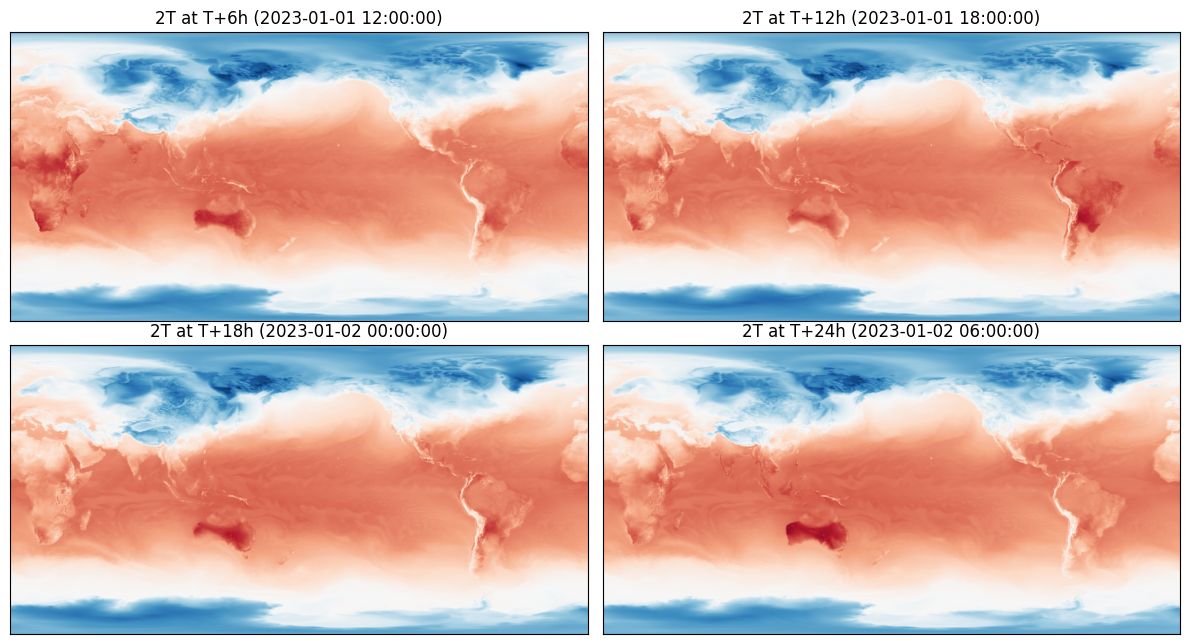
We plot 2-metre temperature predictions at T+6h, T+12h, T+18h, and T+24h.
import matplotlib.pyplot as plt

show_indices = [5, 11, 17, 23]  # T+6h, T+12h, T+18h, T+24h

fig, axes = plt.subplots(2, 2, figsize=(12, 6.5))

for ax, idx in zip(axes.flat, show_indices):
    pred = predictions[idx]
    lead_hours = idx + 1
    im = ax.imshow(pred.surf_vars["2t"][0, 0].numpy() - 273.15, vmin=-50, vmax=50, cmap="RdBu_r")
    ax.set_title(f"2T at T+{lead_hours}h ({pred.metadata.time[0]})")
    ax.set_xticks([])
    ax.set_yticks([])

plt.tight_layout()
plt.show()
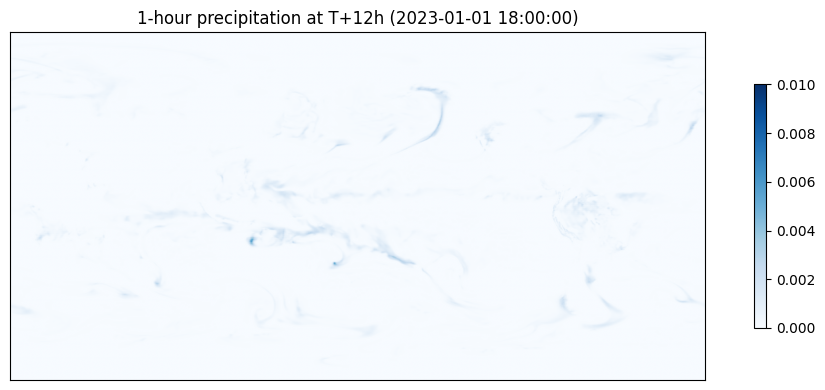
Aurora V1.5 also predicts output-only variables such as precipitation and wind gusts.
Here we plot the total precipitation (scaled_tp_1h) at T+12h:
pred_12h = predictions[11]

fig, ax = plt.subplots(figsize=(10, 4))
im = ax.imshow(
    pred_12h.surf_vars["scaled_tp_1h"][0, 0].numpy(),
    vmin=0,
    vmax=0.01,
    cmap="Blues",
)
ax.set_title(f"1-hour precipitation at T+12h ({pred_12h.metadata.time[0]})")
ax.set_xticks([])
ax.set_yticks([])
plt.colorbar(im, ax=ax, shrink=0.7)
plt.tight_layout()
plt.show()