
Core
The Core module provides foundational entities and reference data structures used across all industry solution modules. It establishes common organizational constructs, people and workforce taxonomy, governance and decision frameworks, legal and compliance structures, risk and impact tracking, content management, and privacy consent capabilities. Rather than providing standalone business functionality, Core serves as the shared foundation that other modules extend and reference for consistent data structures, standardized classifications, and enterprise-wide reference data.
All industry solution modules depend on Core and leverage its entities to maintain organizational consistency, enable cross-module reporting, and support enterprise data governance.
Using the Module
The module establishes foundational data structures organized into several functional areas that can be referenced and extended by specialized business modules.
Organizational Structure is established through Organization Units representing departments, divisions, programs, or teams with hierarchical relationships via organization unit type assignments and parent organization unit references. Accounts provide external organization references for partners, vendors, or member organizations. Locations capture physical places (sites, buildings, rooms) with address details, country and state/province references, and location hierarchies. Organization Initiatives document strategic efforts, programs, or campaigns with parent initiative relationships enabling initiative portfolio management. Judicial Districts support government and legal scenarios with district codes, jurisdiction levels, presiding judge assignments, and state/province context.
People and Workforce foundations include Person records (from Dataverse Contact entity) representing individuals across the enterprise. Personal Information extends person records with sensitive data elements categorized by Personal Information Type with privacy controls and consent tracking. Personnel Types categorize workforce segments (civilian, military, contractor, volunteer) for differentiated policies and benefits. Job Series groups occupational families for classification and career progression. Grade-Rank combines grade and rank structures for hierarchical workforce systems. Pay Grades establish salary ranges and compensation structures. Clearance Levels define security clearance requirements with clearance codes and security level hierarchies. Competencies document skills, knowledge areas, or capabilities with competency codes and parent competency hierarchies for competency frameworks. Credential Types categorize certification, license, or qualification categories with parent credential type relationships and competency linkages. Credential Assignments link persons to credential types with issue/expiration/renewal dates, certification status, credential numbers, and supporting documents.
Governance and Decisions capabilities include Agreements documenting formal commitments, contracts, MOUs, or partnership arrangements with agreement type and status, counterparty organizations, effective and expiration dates, key terms, primary contacts, total value with currency support, and parent agreement hierarchies for master agreements and amendments. Formal Decisions capture official decisions with decision type, decision date, effective date, decision maker references, decision rationale, approval status, related organization initiatives, and supporting documents for governance audit trails. Discussion Items maintain meeting agenda items or policy discussion topics with parent discussion item threading, formal decision linkages when discussions result in decisions, and discussion context. After Action Reports document event retrospectives with event and report dates, report numbers, executive summaries, what went well narratives, areas for improvement, recommendations, overall assessments, report authors, organization unit attribution, related initiatives, and supporting documents for continuous improvement.
Legal and Compliance structures provide Legal Authorities capturing statutes, regulations, executive orders, policies, or legal instruments with authority type and status, citations, document numbers, jurisdiction levels, effective/enactment/expiration dates, issuing authority and body references, full text URLs, summaries, disposition notes, and parent legal authority hierarchies. Legal Amendments track changes to legal authorities with amendment numbers and dates, effective dates, changes summaries, legal authority impact indicators, and original authority references. Legal Cross-References document relationships between legal authorities with relationship type, impact indicators, and bidirectional authority references. Compliance Frameworks define regulatory, policy, or standard frameworks (FISMA, NIST, ISO, etc.) with framework codes, categories, versions, issuing organizations, publication status, effective dates, scope descriptions, parent framework hierarchies, and supporting documents. Compliance Framework Categories organize frameworks into taxonomic groupings with category codes and parent category relationships. Compliance Requirements detail specific compliance obligations with requirement numbers, compliance frameworks and categories, legal authority references, control objectives, compliance status, priority, responsible organization units, and parent requirement hierarchies.
Risk and Impact tracking enables Risk Items documenting threats, vulnerabilities, or uncertainties with risk descriptions, likelihood and impact ratings, risk status, mitigation strategies, owners, parent risk hierarchies for risk breakdown structures, and analysis linkages. Impacts capture consequences or effects with impact descriptions, impact types, severity assessments, status tracking, affected parties, risk item associations, and analysis references. Analysis records provide analytical studies with analysis numbers and dates, conducted by attributions, findings and recommendations, action status, general category classification, owning organization units, and supporting documents, with bidirectional links to associated risks and impacts.
Content and Documentation management provides Documents as a central document repository with document numbers, titles, versions, file attachments, publication status, effective dates, security classification, visibility controls, and document type categorization. Content Templates maintain reusable content patterns with template content, versions, effective dates, general category classification, and descriptions for standardized document generation.
Privacy capabilities include Privacy Consents documenting individual consent for data processing with consent type, consent status, consent date, expiration date, purpose, scope, withdrawal date, person references, and supporting consent documents for GDPR, CCPA, or similar privacy regulation compliance.
Products are supported through Product records (from Dataverse Product entity) representing goods, services, or standard items that can be referenced by procurement, asset management, inventory, or service delivery modules with parent product hierarchies for product families and variants.
Geographic references include Countries with country names and abbreviations, and States or Provinces with names, abbreviations, and country associations for address standardization and location management.
Fiscal structures provide Fiscal Periods representing budgetary timeframes (quarters, years) with start/end dates and parent fiscal period hierarchies for multi-level fiscal calendars.
graph TD
  appbase_AfterActionReport(After Action Report)
  appbase_Agreement(Agreement)
  appbase_Analysis(Analysis)
  appbase_Competency(Competency)
  appbase_ComplianceFramework(Compliance Framework)
  appbase_ComplianceFrameworkCategory(Compliance Framework Category)
  appbase_ComplianceRequirement(Compliance Requirement)
  appbase_Country(Country)
  appbase_CredentialAssignment(Credential Assignment)
  appbase_CredentialType(Credential Type)
  appbase_DiscussionItem(Discussion Item)
  appbase_Document(Document)
  appbase_FiscalPeriod(Fiscal Period)
  appbase_FormalDecision(Formal Decision)
  appbase_GradeRank(Grade-Rank)
  appbase_Impact(Impact)
  appbase_JudicialDistrict(Judicial District)
  appbase_LegalAmendment(Legal Amendment)
  appbase_LegalAuthority(Legal Authority)
  appbase_LegalCrossReference(Legal Cross-Reference)
  appbase_Location(Location)
  appbase_OrganizationInitiative(Organization Initiative)
  appbase_OrganizationUnit(Organization Unit)
  appbase_OrganizationUnitType(Organization Unit Type)
  appbase_PayGrade(Pay Grade)
  appbase_PersonalInformation(Personal Information)
  appbase_PersonalInformationType(Personal Information Type)
  appbase_PrivacyConsent(Privacy Consent)
  appbase_Product(Product)
  appbase_RiskItem(Risk Item)
  appbase_StateorProvince(State or Province)
  appbase_Agreement --> appbase_Agreement
  appbase_Impact --> appbase_Analysis
  appbase_RiskItem --> appbase_Analysis
  appbase_Competency --> appbase_Competency
  appbase_CredentialType --> appbase_Competency
  appbase_ComplianceFramework --> appbase_ComplianceFramework
  appbase_ComplianceRequirement --> appbase_ComplianceFramework
  appbase_ComplianceFramework --> appbase_ComplianceFrameworkCategory
  appbase_ComplianceFrameworkCategory --> appbase_ComplianceFrameworkCategory
  appbase_ComplianceRequirement --> appbase_ComplianceFrameworkCategory
  appbase_ComplianceRequirement --> appbase_ComplianceRequirement
  appbase_Location --> appbase_Country
  appbase_StateorProvince --> appbase_Country
  appbase_CredentialAssignment --> appbase_CredentialType
  appbase_CredentialType --> appbase_CredentialType
  appbase_DiscussionItem --> appbase_DiscussionItem
  appbase_AfterActionReport --> appbase_Document
  appbase_Agreement --> appbase_Document
  appbase_Analysis --> appbase_Document
  appbase_ComplianceFramework --> appbase_Document
  appbase_ComplianceRequirement --> appbase_Document
  appbase_CredentialAssignment --> appbase_Document
  appbase_FormalDecision --> appbase_Document
  appbase_LegalAmendment --> appbase_Document
  appbase_LegalAuthority --> appbase_Document
  appbase_PrivacyConsent --> appbase_Document
  appbase_FiscalPeriod --> appbase_FiscalPeriod
  appbase_DiscussionItem --> appbase_FormalDecision
  appbase_Impact --> appbase_Impact
  appbase_JudicialDistrict --> appbase_JudicialDistrict
  appbase_ComplianceRequirement --> appbase_LegalAuthority
  appbase_LegalAmendment --> appbase_LegalAuthority
  appbase_LegalAuthority --> appbase_LegalAuthority
  appbase_LegalCrossReference --> appbase_LegalAuthority
  appbase_LegalCrossReference --> appbase_LegalAuthority
  appbase_AfterActionReport --> appbase_OrganizationInitiative
  appbase_FormalDecision --> appbase_OrganizationInitiative
  appbase_OrganizationInitiative --> appbase_OrganizationInitiative
  appbase_OrganizationUnit --> appbase_OrganizationUnitType
  appbase_GradeRank --> appbase_PayGrade
  appbase_PersonalInformation --> appbase_PersonalInformationType
  appbase_Product --> appbase_Product
  appbase_Impact --> appbase_RiskItem
  appbase_RiskItem --> appbase_RiskItem
  appbase_JudicialDistrict --> appbase_StateorProvince
  appbase_Location --> appbase_StateorProvince
Tables
Organization Unit
The Organization Unit table represents organizational structure entities such as departments, divisions, programs, teams, offices, or external partner organizations. Each record includes a name, organization unit type assignment for categorization (e.g., Division, Office, Program), parent organization unit references for hierarchy modeling, and contact information including primary contact person, phone, email, and website. Additional fields support descriptions, notes, organizational codes, and status tracking to manage the complete organizational structure from headquarters through field offices and partner entities.
Organization Unit Type
The Organization Unit Type table categorizes organization units into standard types (e.g., Headquarters, Regional Office, Division, Bureau, Program Office, External Partner) with type names, descriptions, and type codes for consistent organizational taxonomy and reporting segmentation.
Account
The Account table (from Dataverse Account entity) represents external organizations including partners, vendors, contractors, member organizations, or counterparty entities. Standard Dataverse account fields support organization names, addresses, contact information, account numbers, and relationship management, enabling modules to reference external entities in agreements, procurement, partnerships, and external engagement scenarios.
Person
The Person table (from Dataverse Contact entity) represents individuals throughout the enterprise including employees, contractors, partners, constituents, or external participants. Standard Dataverse contact fields provide name, contact information, demographic data, and relationship context. The only custom field is Custom Page State for UI state persistence, with other person-related data captured through related tables like Personal Information, Credential Assignments, and module-specific references.
Personal Information
The Personal Information table extends person records with structured sensitive data elements categorized by information type (e.g., SSN, Passport Number, Emergency Contact, Medical Information, Dietary Restrictions). Each record links to a person and personal information type, captures the information value, includes effective and expiration dates for time-bound information, security classification, verification tracking (is verified, verified by, verified date), and name/description fields. This maintains privacy-protected personal data with controlled access and verification audit trails.
Personal Information Type
The Personal Information Type table defines categories of personal information with type names, descriptions, type codes, general category classification, sensitivity indicators (is sensitive flag), and verification requirement indicators to establish personal information taxonomy and handling requirements.
Organization Initiative
The Organization Initiative table documents strategic initiatives, programs, campaigns, or organizational priorities with initiative names, descriptions, start and end dates, initiative status tracking, responsible organization units, executive sponsors, parent initiative hierarchies for nested initiative structures, and outcome descriptions. This enables initiative portfolio management, strategic alignment tracking, and cross-module initiative references.
Location
The Location table captures physical places including sites, buildings, floors, rooms, storage areas, or geographic coordinates with location names, descriptions, full addresses (street, city, state/province, postal code, country references), location types, parent location hierarchies for site-building-room nesting, GPS coordinates (latitude/longitude), and status indicators. This supports asset placement, position assignments, meeting locations, telework sites, and facility management across all modules.
Country
The Country table provides country reference data with country names and standard abbreviations for address standardization and geographic categorization.
State or Province
The State or Province table maintains state and province reference data with full names, abbreviations, and country associations for address validation and geographic reporting.
Judicial District
The Judicial District table supports government and legal scenarios with judicial district names, district codes, jurisdiction levels (federal, state, county, municipal), presiding judge assignments, state/province context, parent judicial district hierarchies, and descriptions for geographic legal jurisdiction management.
Personnel Type
The Personnel Type table categorizes workforce segments with type names, descriptions, type codes, and associated employment types (full-time, part-time, temporary, contract, volunteer) to support differentiated policies, benefits, compensation structures, and reporting requirements across employment categories.
Job Series
The Job Series table groups related occupations into occupational families (e.g., Information Technology, Legal, Administrative, Medical) with series names, descriptions, and series codes for classification systems, career progression planning, and workforce analytics.
Pay Grade
The Pay Grade table establishes salary grade structures with grade names, minimum/midpoint/maximum salary values (with currency support), and exchange rates to define compensation ranges for positions, job classifications, and employment actions.
Grade-Rank
The Grade-Rank table combines grade and rank identifiers for organizations using hierarchical workforce structures (military, uniformed services, grade-based career ladders) with grade-rank names, associated pay grades, descriptions, and identifiers, enabling grade and rank-based compensation and advancement frameworks.
Clearance Level
The Clearance Level table defines security clearance requirements with clearance names, clearance codes, security level numeric indicators for comparison ordering, and descriptions to support position clearance requirements and personnel security eligibility tracking in sensitive environments.
Competency
The Competency table documents skills, knowledge areas, abilities, or behavioral competencies with competency names, codes, descriptions, general category classification, and parent competency hierarchies to build competency frameworks for workforce development, position requirements, training planning, and performance management.
Credential Type
The Credential Type table categorizes certifications, licenses, qualifications, or accreditations with type names, descriptions, credential type codes, issuing organizations, validity periods (days), renewal requirement indicators, general category classification, competency linkages for skill mapping, and parent credential type hierarchies. This standardizes credential tracking and supports certification management, professional licensing, and qualification validation.
Credential Assignment
The Credential Assignment table links persons to credential types documenting individual certification or licensure status. Records capture credential numbers, issue/expiration/renewal dates, certification status (active, expired, suspended, revoked), person and credential type references, supporting documents for verification, and names/descriptions. This maintains workforce credential inventories, tracks expiration for renewal planning, and supports qualification verification.
Agreement
The Agreement table documents formal commitments, contracts, MOUs, inter-agency agreements, partnership arrangements, or service level agreements. Records include agreement numbers, names, agreement types and status, effective and expiration dates, primary and counterparty organizations, primary contacts, organization unit ownership, descriptions and key terms, total value with currency support, parent agreement references for master agreements with amendments or task orders, and supporting document linkages. This provides enterprise agreement inventory, commitment tracking, and partnership coordination.
Formal Decision
The Formal Decision table captures official decisions made through governance processes with decision names, decision types (policy, strategic, operational, budgetary, personnel), decision dates, effective dates, decision makers, decision authority organizations, decision rationales, decision status, approval status, related organization initiatives for strategic alignment, and supporting documents. This maintains governance decision records for transparency, accountability, and audit compliance.
Discussion Item
The Discussion Item table manages meeting agenda items, policy discussion topics, or deliberation points with item names, descriptions, discussion types, discussion dates, discussion status, parent discussion item threading for sub-topics, formal decision linkages when discussions result in decisions, submitter and assigned to references, priority indicators, and notes. This supports structured meeting management and discussion-to-decision workflows.
After Action Report
The After Action Report table documents event retrospectives or lessons learned with report numbers, names, event and report dates, report authors, reporting organization units, executive summaries, “what went well” and “areas for improvement” narratives, recommendations, overall assessments (successful, mixed, needs improvement), general category classification, related initiative linkages, and supporting documents. This enables organizational learning, continuous improvement, and best practice sharing.
Legal Authority
The Legal Authority table captures statutes, regulations, executive orders, policies, directives, legal opinions, or governing legal instruments with authority names, citations, document numbers, authority types and status, jurisdiction levels (federal, state, local, international), issuing authority and body references, enactment/effective/expiration dates, full text URLs, summaries, disposition notes for amendments or repeal tracking, parent legal authority hierarchies, and supporting document linkages. This provides legal authority inventory, citation management, and regulatory compliance foundation.
Legal Amendment
The Legal Amendment table tracks changes to legal authorities with amendment names, numbers, and dates, effective dates, changes summaries, legal authority impact indicators (major, minor, clarification, repeal), original authority references, descriptions, and supporting documents to maintain amendment history and legal authority version control.
Legal Cross-Reference
The Legal Cross-Reference table documents relationships between legal authorities (implements, modifies, supersedes, references, contradicts) with cross-reference names, primary and related authority references, relationship types via general category classification, impact indicators, and descriptions to map legal authority networks and dependency analysis.
Compliance Framework
The Compliance Framework table defines regulatory, policy, or standard frameworks (FISMA, NIST Cybersecurity Framework, ISO 27001, HIPAA, SOX, Privacy Shield) with framework names, codes, categories, versions, issuing organizations, publication status, effective dates, scope descriptions, parent framework hierarchies for framework families or versions, and supporting documents. This establishes compliance program structure and regulatory mapping foundation.
Compliance Framework Category
The Compliance Framework Category table organizes compliance frameworks into taxonomic groupings (cybersecurity, privacy, financial, safety, quality) with category names, codes, descriptions, and parent category hierarchies to support framework classification and reporting segmentation.
Compliance Requirement
The Compliance Requirement table details specific compliance obligations or controls with requirement names, numbers, compliance frameworks and categories, legal authority references establishing the requirement basis, control objectives, descriptions, compliance status, priority, responsible organization units, general category classification, parent requirement hierarchies for multi-level control frameworks, and supporting documents. This maps regulatory requirements to organizational accountability for compliance management and audit preparation.
Risk Item
The Risk Item table documents threats, vulnerabilities, uncertainties, or risk events with risk names, numbers, descriptions, general category classification, likelihood and severity assessments, overall risk level calculations, identified by and identified date attribution, impact descriptions, mitigation strategies, action status tracking, analysis linkages for risk assessments, owning organization units, and parent risk hierarchies for risk breakdown structures. This enables enterprise risk management, risk registers, and risk-informed decision making.
Impact
The Impact table captures consequences, effects, or outcomes with impact names, descriptions, impact types, severity levels, status tracking, affected parties, risk item associations, analysis references, and general category classification to document impacts from risks, decisions, projects, or events for impact assessment and evaluation.
Analysis
The Analysis table documents analytical studies, research, assessments, or evaluations with analysis names, numbers, dates, conducted by attributions, findings and recommendations narratives, action status, general category classification, owning organization units, and supporting documents. Analysis records maintain bidirectional linkages to associated risk items and impacts, enabling evidence-based findings to inform risk and impact management, and supporting analytical rigor in decision support.
Document
The Document table provides centralized document repository functionality with document names, numbers, titles, versions, document types via general category, publication status, effective dates, security classifications, visibility controls, descriptions, file attachments, and notes. Documents can be referenced from legal authorities, agreements, compliance frameworks, analyses, credentials, decisions, and other entities requiring document evidence or supporting materials for comprehensive document management.
Content Template
The Content Template table maintains reusable content patterns or boilerplate text with template names, template content (HTML or markdown), versions, effective dates, general category categorization, and descriptions for standardized document generation, automated communications, or content consistency.
Privacy Consent
The Privacy Consent table documents individual consent for data processing with consent names, types via general category, consent status, consent and expiration dates, purpose and scope narratives, person references, revoked by and revoked date tracking for consent withdrawal, supporting consent documents, and user references for consent collector attribution. This supports GDPR Article 6 lawful basis, CCPA consent requirements, and privacy regulation compliance.
Product
The Product table represents goods, services, or standard items with product names, numbers, codes, descriptions, specifications, general category classification, manufacturers, URLs, unit prices with currency support, unit of issue indicators (each, box, case, hour, etc.), and parent product hierarchies for product families, variants, or assemblies. Products can be referenced by procurement, asset management, inventory, catalog, or service delivery modules for standardized product data.
Fiscal Period
The Fiscal Period table represents budgetary timeframes including fiscal years, quarters, or months with period names, start and end dates, and parent fiscal period hierarchies for multi-level fiscal calendars (year containing quarters containing months), supporting financial planning, budget cycles, and fiscal reporting.
Action Item
The Action Item table provides general-purpose task tracking capability for items requiring follow-up action. While the ERD doesn’t show this entity (not enough relationships to appear in filtered diagram), it’s a foundational task management entity available for modules to reference or extend for action tracking, tasking, and to-do management functionality.
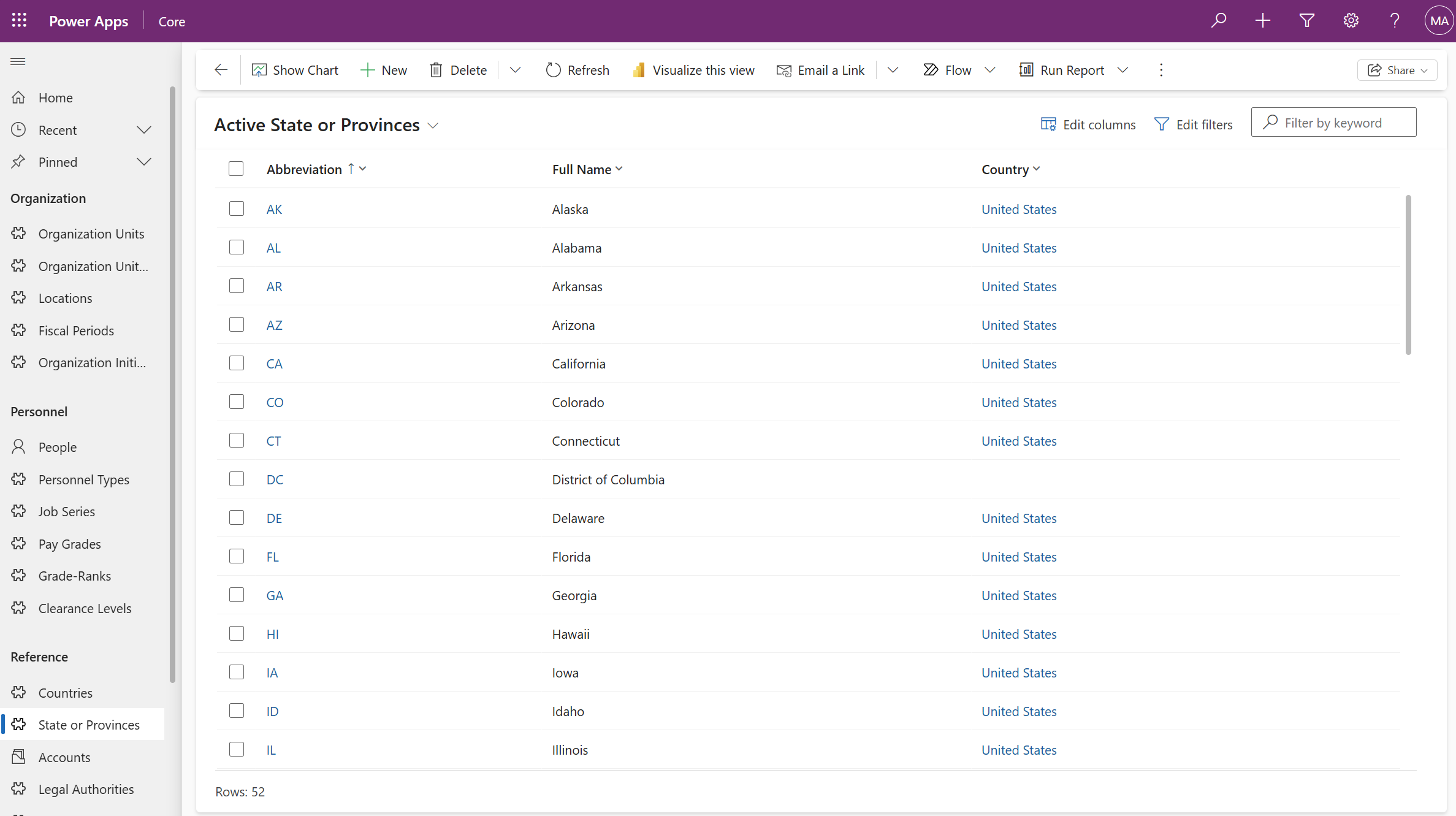
Note: All data shown in screenshots is fictitious and for demonstration purposes only.
Use the pac data CLI command or the Configuration Migration tool to import sample data into your environment.
📦 Sample Data
Sample foundational data including organization units, locations, legal authorities, compliance frameworks, and governance structures typical for enterprise organizations.
No guides are available for this solution yet.
ERD — Core
Screenshot
Note: All data shown is fictitious and for demonstration purposes only.

An open-source MIT License project maintained by Microsoft. Open Source at Microsoft