
Event Management
The Event Management module enables organizations to plan, organize, and execute events of all types and scales. The module supports defining events with classification and scheduling, managing participant registration and tracking across multiple roles, organizing sessions into thematic tracks with time blocks and locations, capturing presentation and exhibition submissions with review workflows, coordinating event sponsors and partnership arrangements, processing event requests and approvals, and tracking participant check-ins and attendance with certificate issuance. The module accommodates conferences and symposiums, training events and workshops, public hearings and town halls, festivals and community events, board meetings and governance sessions, webinars and virtual events, and hybrid event formats combining in-person and virtual participation.
Typical use cases include conference and symposium management, training program coordination, public engagement and community outreach events, stakeholder meetings and town halls, professional development workshops, virtual and hybrid event execution, sponsor and exhibitor coordination, and continuing education credit tracking.
Using the Module
The module supports event lifecycle management from planning through execution and follow-up. Users can create Event Request records to capture proposed or requested events prior to formal approval with request details, requestor information, proposed dates and locations, event purpose, expected attendance, budget estimates, and approval workflow for intake and evaluation before official event creation.
Event records serve as the primary entity defining planned occurrences with event titles, Event Type classifications (conference, training, public hearing, webinar, festival, meeting, workshop), event codes, event formats (in-person, virtual, hybrid), descriptions, start and end dates/times, primary locations, decision status, expected and actual attendee counts, event status throughout the lifecycle (draft, planning, open for registration, registration closed, in progress, completed, cancelled, postponed), and ownership assignments. Events can be organized into Event Track records representing thematic or organizational groupings—technology, policy, community outreach, breakout topics—with hierarchical track relationships enabling nested track structures for complex events.
Event Participant records represent individuals or organizations involved with participant types (attendee, speaker, presenter, panelist, moderator, staff, volunteer, exhibitor, sponsor representative, VIP, media), participation status (invited, tentative, registered, confirmed, waitlisted, checked-in, attended, no-show, cancelled, declined), registration dates, check-in tracking, payment status, certificate issuance indicators, dietary restrictions or accessibility needs, and contact information. Participants can be linked to specific sessions through Event Session Participant records when attendance, roles, or responsibilities differ by session.
Event Session records represent scheduled time blocks within events—breakout sessions, hearing segments, workshops, keynote slots, panel discussions—with session titles, session descriptions, start and end times, session locations or virtual meeting details, session capacity and current registration counts, session status, Event Track assignments, parent session references for multi-part sessions, and session moderator or facilitator assignments. Sessions provide granular scheduling and capacity management for complex multi-track events.
Event Entry records represent exhibitions, presentations, booths, posters, demonstrations, or other showcased submissions with entry titles, entry descriptions, entry types and formats, submission dates, review and approval status, assigned Event Session or Event Track references, presenter assignments, supporting document attachments, and approval workflow for managing call-for-papers, call-for-posters, or exhibitor application processes.
Event Sponsor records document organizations or entities providing financial or in-kind support with sponsor names, sponsorship levels (platinum, gold, silver, bronze, in-kind), sponsorship types, contribution amounts with currency support, commitment dates, Agreement references for formal sponsorship contracts, sponsorship benefits and deliverables, logo and branding materials, and sponsor contact information for partnership coordination and benefit fulfillment.
graph TD
  appbase_Agreement(Agreement)
  appbase_Document(Document)
  appbase_Event(Event)
  appbase_EventEntry(Event Entry)
  appbase_EventParticipant(Event Participant)
  appbase_EventRequest(Event Request)
  appbase_EventSession(Event Session)
  appbase_EventSessionParticipant(Event Session Participant)
  appbase_EventSponsor(Event Sponsor)
  appbase_EventTrack(Event Track)
  appbase_EventType(Event Type)
  appbase_EventSponsor --> appbase_Agreement
  appbase_EventEntry --> appbase_Document
  appbase_EventEntry --> appbase_Event
  appbase_EventParticipant --> appbase_Event
  appbase_EventRequest --> appbase_Event
  appbase_EventSession --> appbase_Event
  appbase_EventSponsor --> appbase_Event
  appbase_EventTrack --> appbase_Event
  appbase_EventSessionParticipant --> appbase_EventParticipant
  appbase_EventEntry --> appbase_EventSession
  appbase_EventSession --> appbase_EventSession
  appbase_EventSessionParticipant --> appbase_EventSession
  appbase_EventEntry --> appbase_EventTrack
  appbase_EventSession --> appbase_EventTrack
  appbase_EventTrack --> appbase_EventTrack
  appbase_Event --> appbase_EventType
The Event Management module provides a structured system for planning, organizing, and executing events of all types and scales. It manages event definitions, participant registration and tracking, session scheduling, presentation and exhibition submissions, and sponsorship arrangements. The module supports detailed participant management including role assignments, check-in tracking, and certificate issuance. Sessions can be organized into tracks with scheduled time blocks, locations, and capacity management. The module accommodates submission workflows for presentations, posters, and exhibitions with review and approval processes. Typical use cases include conferences and symposiums, training events and workshops, public hearings and town halls, festivals and community events, board meetings and governance sessions, webinars and virtual events, and hybrid event formats combining in-person and virtual participation.
Tables
Event
The primary record representing a planned occurrence (conference, meeting, hearing, training, festival, etc.). Stores core details such as title, description, dates, location, status, and overall ownership.
Event Type
A classification table defining categories of events (e.g., Conference, Training, Public Hearing, Webinar). Often used to drive default behaviors, templates, or required fields.
Event Track
Represents a thematic or organizational grouping within an event (e.g., “Technology,” “Policy,” “Community Outreach”). Sessions and/or entries may be associated with a track.
Event Request
Captures a proposed or requested event prior to formal approval or scheduling. Used for intake, evaluation, and approval workflows before an official Event record is created.
Event Participant
Represents an individual or organization involved in the event. This can include attendees, speakers, staff, volunteers, exhibitors, VIPs, or panelists. Tracks participation status (invited, registered, confirmed, checked-in, etc.).
Event Session Participant
Links participants to specific sessions. Used when attendance, roles, or responsibilities differ by session (e.g., a speaker in one session, attendee in another).
Event Session
Represents a scheduled time block within an event (e.g., breakout session, hearing segment, workshop, keynote slot). Includes start/end time, location/room, capacity, and session-specific details.
Event Entry
Represents an exhibition, presentation, booth, poster, demonstration, or other showcased submission within an event. Typically includes submission details, review/approval status, assigned session or track, and associated presenters.
Event Sponsor
Represents an organization or entity providing financial or in-kind support for the event. May track sponsorship level, benefits, commitments, and related agreements.
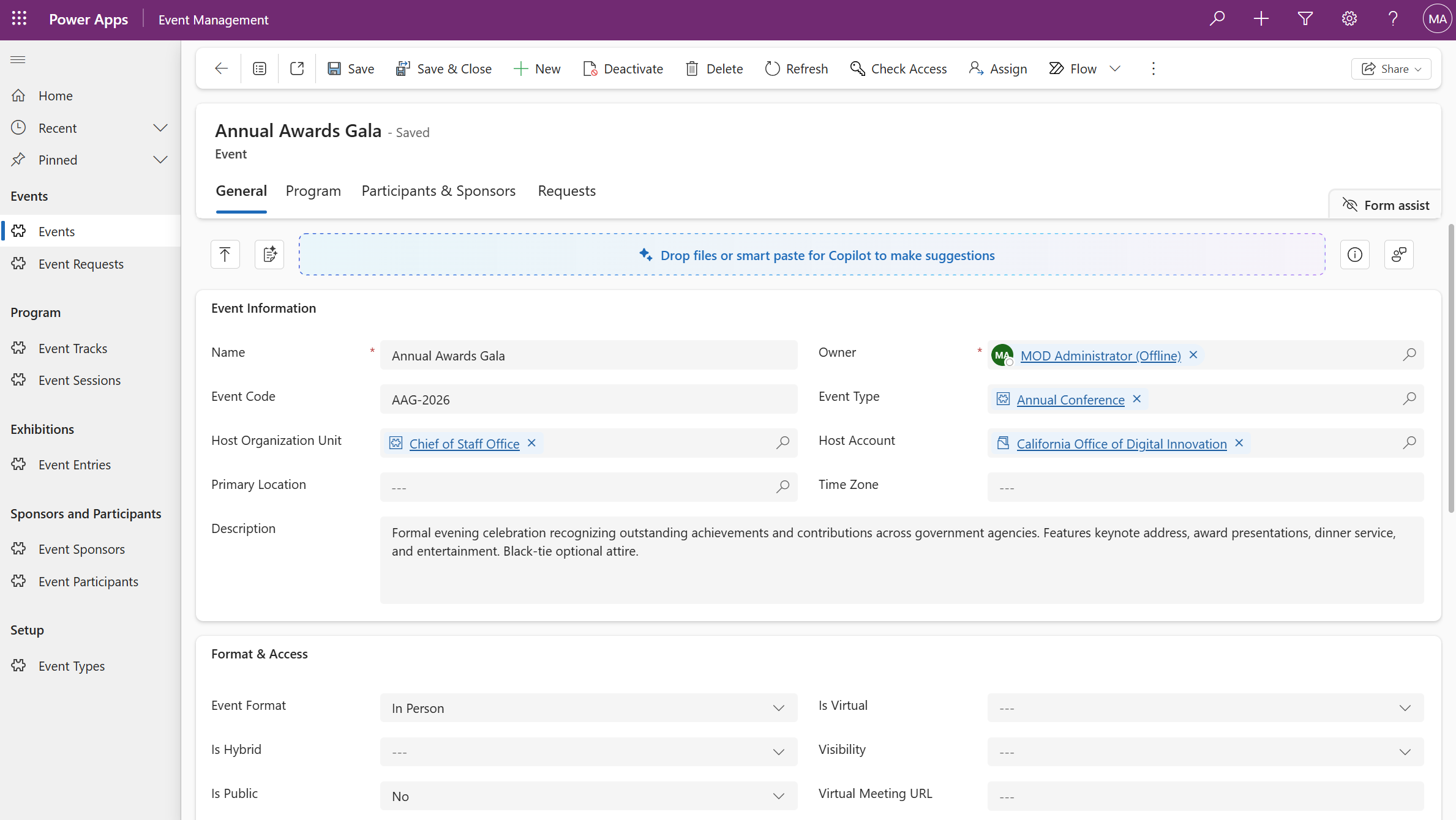
Note: All data shown in screenshots is fictitious and for demonstration purposes only.
Use the pac data CLI command or the Configuration Migration tool to import sample data into your environment.
📦 Sample Data
Sample event management data including events, participant registrations, session schedules, tracks, presentations, sponsorships, and attendance tracking.
No guides are available for this solution yet.
Required Modules
- 🧰 Core
ERD — Event Management
Screenshot
Note: All data shown is fictitious and for demonstration purposes only.

An open-source MIT License project maintained by Microsoft. Open Source at Microsoft