
Dispute Resolution
The Dispute Resolution module enables organizations to manage internal complaints, grievances, and disputes from initial intake through investigation, mediation, determination, and appeals. The module supports documenting dispute allegations and parties, conducting investigations with evidence and interview tracking, facilitating mediation and alternative dispute resolution, analyzing issues and making formal determinations with findings, tracking corrective actions and remediation, processing appeals of determinations, and managing referrals to internal or external authorities. The module supports employee grievances and workplace disputes, vendor and contractor disputes, customer complaints requiring investigation, internal policy violations, ethics concerns, discrimination or harassment complaints, labor relations matters, and alternative dispute resolution programs with full audit trails and confidentiality controls.
Typical use cases include employee grievance processing, workplace conflict resolution, discrimination and harassment complaint handling, labor relations dispute management, vendor dispute resolution, ethics violation reviews, alternative dispute resolution programs, and internal complaint system administration.
Using the Module
The module supports dispute case management throughout the complete lifecycle from intake through resolution and appeals. Users can create Dispute Intake records to capture initial inquiries, concerns, or reports prior to formal case creation with intake source, intake date, reporter information when available, concern summary, anonymous reporting indicators, triage assessment, and early resolution efforts. Once accepted, Dispute records serve as the primary case entity with case numbers, case titles, dispute types (grievance, discrimination, harassment, ethics violation, policy dispute, vendor dispute, labor relations, retaliation), decision status, filed dates, assigned staff, organization unit ownership, Legal Authority and Compliance Framework citations establishing policy or regulatory basis, confidentiality indicators, and case priority. Dispute Party records link persons or organizations to cases in defined roles—complainants, respondents, witnesses, representatives, investigators, mediators, or decision makers.
When disputes require structured analysis, Dispute Issue records define specific allegations, claims, or concerns within the case, as a single dispute may address multiple issues (discrimination, retaliation, harassment, policy violations). Issues can reference Legal Authority for policy or regulation citations and support hierarchical relationships for complex, multi-faceted disputes. Dispute Investigation records document formal investigative processes with investigator assignments, investigation scope and objectives, timelines, methodology, investigation status, and completion details. Dispute Interview records track interviews conducted during investigation with interviewee information, interview dates, interview roles, interview locations, summaries, and supporting document references. Dispute Evidence records store or reference collected materials—documents, communications, records, media files, reports—with evidence descriptions, collection dates, evidence types, and document attachments.
Investigation analysis produces Dispute Finding records capturing conclusions for specific dispute issues with finding types (substantiated, unsubstantiated, inconclusive, policy violation confirmed, not a violation), finding dates, finding text and rationale, and evidence linkages. Findings inform Dispute Determination records representing formal outcomes or decisions with determination types (sustained, not sustained, dismissed, settled, resolved informally, no action required), determination dates, deciding officials, determination text and rationale, remedies or actions ordered, and supporting document references for formal decision documentation.
Alternative dispute resolution is supported through Dispute Mediation records documenting structured mediation or facilitation efforts with mediator assignments, mediation session dates, mediation type and approach, mediation status, mediation outcomes, Agreement references for resulting settlements or resolutions, and supporting documentation. Mediation provides parties opportunity for facilitated resolution before or in lieu of formal determination processes.
Determinations can generate Dispute Corrective Action records tracking required actions such as training requirements, disciplinary measures, policy updates, workplace modifications, monitoring plans, or operational changes with action owners, due dates, action status, completion verification, and effectiveness indicators. Dispute Appeal records document formal challenges to determinations with appeal filing dates, appeal basis and grounds, appeal authority assignments, appellate review status, appeal outcomes (affirmed, reversed, modified, remanded), and appellate decision rationale.
Dispute Referral records track referrals of intakes or cases to other offices, authorities, or support functions—HR departments, legal counsel, security offices, compliance teams, employee assistance programs, ombudsman offices, or external agencies—with referral dates, referral reasons, referral types, referral status, and referred party information for coordination and case routing.
graph TD
  appbase_Agreement(Agreement)
  appbase_ComplianceFramework(Compliance Framework)
  appbase_Dispute(Dispute)
  appbase_DisputeAppeal(Dispute Appeal)
  appbase_DisputeCorrectiveAction(Dispute Corrective Action)
  appbase_DisputeDetermination(Dispute Determination)
  appbase_DisputeEvidence(Dispute Evidence)
  appbase_DisputeFinding(Dispute Finding)
  appbase_DisputeIntake(Dispute Intake)
  appbase_DisputeInterview(Dispute Interview)
  appbase_DisputeInvestigation(Dispute Investigation)
  appbase_DisputeIssue(Dispute Issue)
  appbase_DisputeMediation(Dispute Mediation)
  appbase_DisputeParty(Dispute Party)
  appbase_DisputeReferral(Dispute Referral)
  appbase_Document(Document)
  appbase_LegalAuthority(Legal Authority)
  appbase_DisputeMediation --> appbase_Agreement
  appbase_Dispute --> appbase_ComplianceFramework
  appbase_DisputeAppeal --> appbase_Dispute
  appbase_DisputeCorrectiveAction --> appbase_Dispute
  appbase_DisputeDetermination --> appbase_Dispute
  appbase_DisputeEvidence --> appbase_Dispute
  appbase_DisputeFinding --> appbase_Dispute
  appbase_DisputeIntake --> appbase_Dispute
  appbase_DisputeInterview --> appbase_Dispute
  appbase_DisputeInvestigation --> appbase_Dispute
  appbase_DisputeIssue --> appbase_Dispute
  appbase_DisputeMediation --> appbase_Dispute
  appbase_DisputeParty --> appbase_Dispute
  appbase_DisputeReferral --> appbase_Dispute
  appbase_DisputeAppeal --> appbase_DisputeDetermination
  appbase_DisputeCorrectiveAction --> appbase_DisputeDetermination
  appbase_DisputeReferral --> appbase_DisputeIntake
  appbase_DisputeEvidence --> appbase_DisputeInvestigation
  appbase_DisputeFinding --> appbase_DisputeInvestigation
  appbase_DisputeInterview --> appbase_DisputeInvestigation
  appbase_DisputeDetermination --> appbase_DisputeIssue
  appbase_DisputeFinding --> appbase_DisputeIssue
  appbase_DisputeIssue --> appbase_DisputeIssue
  appbase_DisputeDetermination --> appbase_Document
  appbase_DisputeEvidence --> appbase_Document
  appbase_DisputeInterview --> appbase_Document
  appbase_DisputeMediation --> appbase_Document
  appbase_Dispute --> appbase_LegalAuthority
  appbase_DisputeIssue --> appbase_LegalAuthority
The Dispute Resolution module supports structured intake, investigation, and resolution of internal complaints, grievances, and disputes within an organization. It enables organizations to document disputes, conduct investigations with evidence and interview tracking, analyze issues, make determinations with findings, and implement corrective actions. The module also supports appeals, mediations, and referrals to external authorities. Typical use cases include employee grievances, workplace disputes, vendor disputes, customer complaints requiring investigation, internal policy violations, ethics concerns, discrimination or harassment complaints, and alternative dispute resolution programs. It provides both operational case management and governance oversight to ensure disputes are handled fairly, consistently, and in compliance with organizational policies and legal requirements.
Tables
Dispute
Represents the primary case record for a formal internal dispute or complaint. Tracks lifecycle status, case type, regulatory framework, assigned staff, key dates, and overall outcome.
Dispute Appeal
Represents a formal challenge to a determination or decision. Tracks appeal authority, filing date, appeal basis, review process, and final appellate outcome.
Dispute Corrective Action
Tracks actions required as a result of a determination or settlement. Examples include training requirements, disciplinary measures, policy updates, or monitoring plans.
Dispute Determination
Represents the formal outcome or decision for a dispute or specific issue. May include findings, remedies, dismissals, settlements, or final agency decisions.
Dispute Evidence
Stores or references materials collected during investigation. Examples include documents, communications, records, media files, and external reports.
Dispute Finding
Captures the conclusion reached for a specific dispute issue after investigation. Examples: Substantiated, Unsubstantiated, Inconclusive, Policy Violation Confirmed.
Dispute Intake
Represents an initial inquiry, concern, or report prior to formal case creation. Supports anonymous reporting, early resolution efforts, and triage decisions.
Dispute Interview
Tracks interviews conducted as part of an investigation. Includes interviewee, role, date, summary, and related evidence.
Dispute Investigation
Represents the formal investigative process associated with a dispute. Tracks investigator assignment, scope, timeline, methodology, and completion status.
Dispute Issue
Defines the specific allegation, claim, or concern within a dispute case. A single dispute may include multiple issues (e.g., discrimination, retaliation, harassment).
Dispute Mediation
Represents a structured mediation or alternative dispute resolution effort. Tracks mediator, session dates, agreements reached, and mediation outcomes.
Dispute Party
Associates individuals or entities to a dispute with defined roles. Roles may include complainant, respondent, witness, representative, investigator, or mediator.
Dispute Referral
Tracks referral of an intake or case to another office, authority, or support function. Examples include HR, Legal, Security, Compliance, or external agencies.
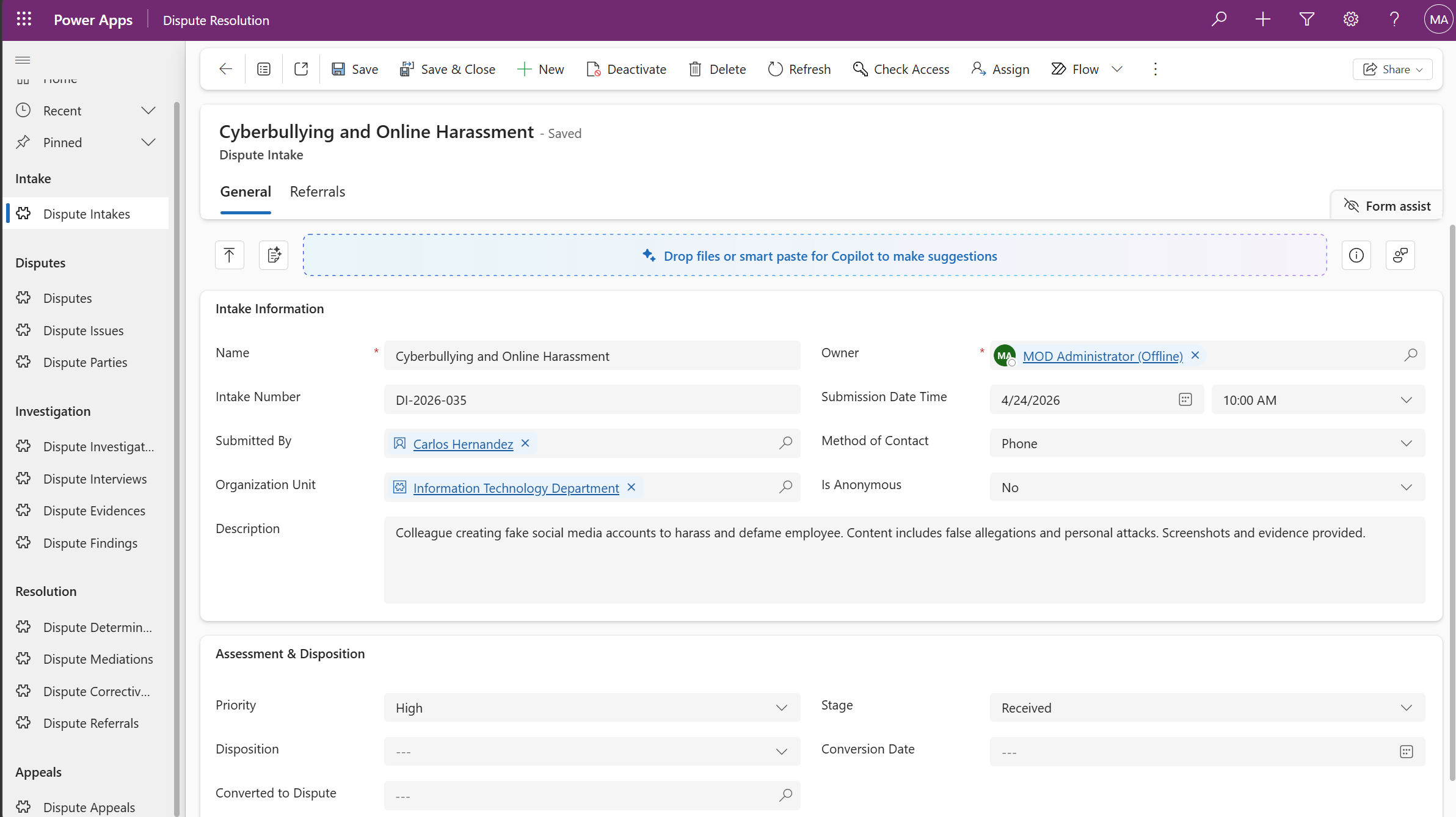
Note: All data shown in screenshots is fictitious and for demonstration purposes only.
Use the pac data CLI command or the Configuration Migration tool to import sample data into your environment.
📦 Sample Data
Sample dispute resolution data including complaints, grievances, investigations, mediation sessions, determinations, appeals, and corrective actions.
No guides are available for this solution yet.
Required Modules
- 🧰 Core
ERD — Dispute Resolution
Screenshot
Note: All data shown is fictitious and for demonstration purposes only.

An open-source MIT License project maintained by Microsoft. Open Source at Microsoft