
IT Service Management
The IT Service Management module provides a structured framework for managing IT service offerings, access control, system inventory, technology standards, and compliance oversight. It balances day-to-day service delivery with architectural visibility and security governance, suitable for public sector and commercial organizations requiring lightweight ITSM capabilities combined with structured system and technology management.
Using the Module
IT service delivery typically begins when users submit IT Service Requests for support, provisioning, hardware, software, or other IT needs. Each request can contain multiple IT Service Request Items that reference specific IT Catalog Items representing orderable IT offerings. Catalog items can define published services, product packages, provisioning actions, or access offerings that users can request. Organizations can associate catalog items with specific IT Technologies through IT Catalog Item Technology records to identify which technologies are required, delivered, approved, or restricted for each offering.
When users require access to systems or applications, IT Access Requests can be submitted to obtain, modify, or remove access to secured resources. Each access request can contain multiple IT Access Request Items specifying individual entitlements, systems, or roles being requested. Access rights are defined through IT Entitlements, which represent specific permissions, license assignments, or roles that can be granted. When an entitlement is provisioned, an IT Entitlement Assignment record can be created to track who has what access and its lifecycle status. Access requests can require manager approval and security review workflows before fulfillment.
The module supports comprehensive system inventory management through IT Systems, which represent logical or operational information systems and serve as the primary records for tracking ownership, purpose, lifecycle status, and governance attributes. Each system can be associated with an IT Hosting Location that identifies the physical or logical hosting environment such as a data center, cloud region, or managed hosting facility. Systems can be decomposed into IT System Components representing structural parts such as application modules, services, databases, infrastructure elements, or interfaces, which can be categorized using IT System Component Types.
Organizations can maintain technology standards by documenting technologies through IT Technology records that represent platforms, frameworks, protocols, runtimes, standards, or tools used within IT systems. Technologies can be classified using IT Technology Types such as Operating System, Database Engine, Framework, Protocol, or Security Standard. The relationship between systems and technologies can be tracked through IT System Technology records, which link systems or specific components to the technologies they use and can capture version information.
From a compliance perspective, systems can undergo formal evaluation through IT Compliance Assessments that assess systems, components, or technologies against defined standards, policies, or regulatory requirements. Assessment outcomes can generate findings that feed into IT POAM Items (Plan of Action and Milestones) used to track remediation of identified compliance gaps, vulnerabilities, or control deficiencies. When remediation is complete and systems meet security requirements, IT System Accreditations can be issued to document formal authorization for systems to operate within defined security and compliance parameters. This integrated approach enables organizations to manage operational IT service delivery while maintaining visibility into system architecture, technology usage, and compliance posture.
graph TD
  appbase_Agreement(Agreement)
  appbase_ComplianceFramework(Compliance Framework)
  appbase_ComplianceRequirement(Compliance Requirement)
  appbase_Document(Document)
  appbase_ITAccessRequest(IT Access Request)
  appbase_ITAccessRequestItem(IT Access Request Item)
  appbase_ITCatalogItem(IT Catalog Item)
  appbase_ITCatalogItemTechnology(IT Catalog Item Technology)
  appbase_ITComplianceAssessment(IT Compliance Assessment)
  appbase_ITEntitlement(IT Entitlement)
  appbase_ITEntitlementAssignment(IT Entitlement Assignment)
  appbase_ITHostingLocation(IT Hosting Location)
  appbase_ITPOAMItem(IT POAM Item)
  appbase_ITServiceRequest(IT Service Request)
  appbase_ITServiceRequestItem(IT Service Request Item)
  appbase_ITSystem(IT System)
  appbase_ITSystemAccreditation(IT System Accreditation)
  appbase_ITSystemComponent(IT System Component)
  appbase_ITSystemComponentType(IT System Component Type)
  appbase_ITSystemTechnology(IT System Technology)
  appbase_ITTechnology(IT Technology)
  appbase_ITTechnologyType(IT Technology Type)
  appbase_LegalAuthority(Legal Authority)
  appbase_RiskItem(Risk Item)
  appbase_ITHostingLocation --> appbase_Agreement
  appbase_ITSystem --> appbase_Agreement
  appbase_ITComplianceAssessment --> appbase_ComplianceFramework
  appbase_ITPOAMItem --> appbase_ComplianceFramework
  appbase_ITSystem --> appbase_ComplianceFramework
  appbase_ITSystemAccreditation --> appbase_ComplianceFramework
  appbase_ITEntitlement --> appbase_ComplianceRequirement
  appbase_ITComplianceAssessment --> appbase_Document
  appbase_ITPOAMItem --> appbase_Document
  appbase_ITSystemAccreditation --> appbase_Document
  appbase_ITAccessRequestItem --> appbase_ITAccessRequest
  appbase_ITEntitlementAssignment --> appbase_ITAccessRequest
  appbase_ITCatalogItem --> appbase_ITCatalogItem
  appbase_ITCatalogItemTechnology --> appbase_ITCatalogItem
  appbase_ITServiceRequestItem --> appbase_ITCatalogItem
  appbase_ITPOAMItem --> appbase_ITComplianceAssessment
  appbase_ITAccessRequestItem --> appbase_ITEntitlement
  appbase_ITEntitlementAssignment --> appbase_ITEntitlement
  appbase_ITAccessRequestItem --> appbase_ITEntitlementAssignment
  appbase_ITSystem --> appbase_ITHostingLocation
  appbase_ITSystemComponent --> appbase_ITHostingLocation
  appbase_ITServiceRequestItem --> appbase_ITServiceRequest
  appbase_ITAccessRequestItem --> appbase_ITSystem
  appbase_ITCatalogItem --> appbase_ITSystem
  appbase_ITComplianceAssessment --> appbase_ITSystem
  appbase_ITEntitlement --> appbase_ITSystem
  appbase_ITEntitlementAssignment --> appbase_ITSystem
  appbase_ITPOAMItem --> appbase_ITSystem
  appbase_ITSystemAccreditation --> appbase_ITSystem
  appbase_ITSystemComponent --> appbase_ITSystem
  appbase_ITSystemTechnology --> appbase_ITSystem
  appbase_ITComplianceAssessment --> appbase_ITSystemComponent
  appbase_ITPOAMItem --> appbase_ITSystemComponent
  appbase_ITSystemComponent --> appbase_ITSystemComponent
  appbase_ITSystemTechnology --> appbase_ITSystemComponent
  appbase_ITSystemComponent --> appbase_ITSystemComponentType
  appbase_ITCatalogItemTechnology --> appbase_ITTechnology
  appbase_ITComplianceAssessment --> appbase_ITTechnology
  appbase_ITSystemTechnology --> appbase_ITTechnology
  appbase_ITTechnology --> appbase_ITTechnologyType
  appbase_ITTechnologyType --> appbase_ITTechnologyType
  appbase_ITSystem --> appbase_LegalAuthority
  appbase_ITPOAMItem --> appbase_RiskItem
The IT Service Management (Lite) / IT System Catalog module provides a structured framework for managing IT service offerings, access control, system inventory, technology standards, and compliance oversight in a unified model. It supports core operational use cases such as submitting and fulfilling service requests, processing access requests and entitlement assignments, publishing orderable IT catalog items, and tracking hosting environments. At the same time, it enables governance scenarios including documenting system components and technology stacks, managing compliance assessments and system accreditations, and tracking remediation activities through POAM items. The module is designed to balance day-to-day service delivery with architectural visibility and security oversight, making it suitable for both public sector and commercial organizations that need lightweight ITSM capabilities combined with structured system and technology governance.
Tables
IT Service Request
Represents a general service transaction submitted by a user for IT support, provisioning, hardware, software, or other service needs. Parent record for request items.
IT Service Request Item
A line-level record under an IT Service Request that references a specific IT Catalog Item or fulfillment action.
IT Access Request
Represents a request submitted to obtain, modify, or remove access to systems, applications, data, or other secured resources. Serves as the parent transaction record for access-related actions.
IT Access Request Item
A line-level record under an IT Access Request specifying the individual entitlement, system, or role being requested. Allows a single request to contain multiple access changes.
IT Entitlement
Defines a specific access right, permission set, license assignment, or role that can be granted to a user or system account.
IT Entitlement Assignment
Represents the assignment of an IT Entitlement to a person, account, or system. Tracks who has what access and its lifecycle status.
IT Catalog Item
Defines an orderable IT offering. Represents a published service, product package, provisioning action, or access offering that users can request.
IT Catalog Item Technology
A junction table linking an IT Catalog Item to one or more IT Technologies. Identifies technologies that are required, delivered, approved, or restricted for that offering.
IT System
Represents a logical or operational information system. Serves as the primary record for tracking ownership, purpose, lifecycle status, and governance attributes.
IT System Component
Represents a structural part of an IT System, such as an application module, service, database, infrastructure element, or interface.
IT System Component Type
Defines categories or classifications of system components (e.g., Application, Database, API, Infrastructure, Interface).
IT System Technology
A junction table linking an IT System (or optionally a specific System Component) to the IT Technologies it uses. Tracks technology usage and version information.
IT Technology
Represents a technology concept, platform, framework, protocol, runtime, standard, or tool used within IT systems.
IT Technology Type
Defines classification categories for IT Technologies (e.g., Operating System, Database Engine, Framework, Protocol, Security Standard).
IT Hosting Location
Represents the physical or logical hosting environment for a system or component, such as a data center, cloud region, or managed hosting facility.
IT System Accreditation
Represents the formal authorization or approval status of an IT System to operate within defined security and compliance parameters.
IT Compliance Assessment
Represents a formal evaluation of a system, component, or technology against defined standards, policies, or regulatory requirements. May generate findings or POAM items.
IT POAM Item
Plan of Action and Milestones (POAM) record used to track remediation of identified compliance findings, vulnerabilities, or control gaps.
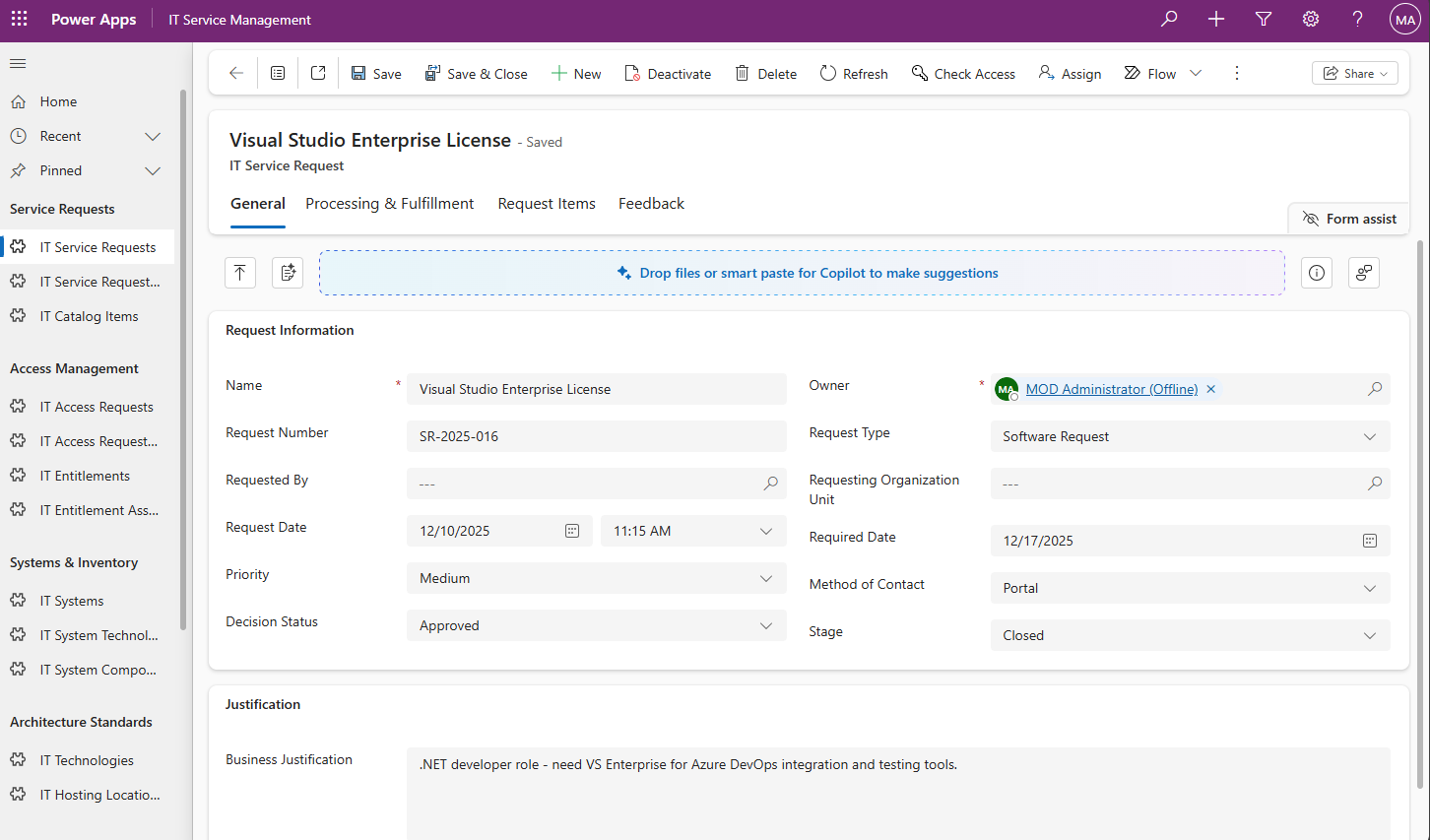
Note: All data shown in screenshots is fictitious and for demonstration purposes only.
Use the pac data CLI command or the Configuration Migration tool to import sample data into your environment.
📦 Sample Data
Sample IT service management data including service offerings, access requests, system inventory, technology standards, compliance requirements, and service delivery tracking.
No guides are available for this solution yet.
ERD — IT Service Management
Screenshot
Note: All data shown is fictitious and for demonstration purposes only.

An open-source MIT License project maintained by Microsoft. Open Source at Microsoft