
Programs and Services
The Programs and Services module provides a structured framework for defining what an organization offers, configuring eligibility, tracking participation, and documenting service delivery outcomes. It separates strategic structure from eligibility configuration and operational execution, enabling consistent service design and delivery across contexts.
Using the Module
Organizations can structure their offerings hierarchically starting with Programs, which represent high-level initiatives or policy areas under which services are offered. Programs can group related services and provide strategic, organizational, or funding context. Programs can reference organization initiatives, legal authorities, administering organization units, program managers, annual budgets, funding sources, effective dates, and policy documentation. Programs can establish hierarchical relationships to reflect parent-child program structures.
Within programs, Services can be defined to represent specific types of service provided. Services can describe what is offered in general terms, reference the parent program, link to legal authorities governing the service, be classified using Service Categories for reporting and organization, track service ownership and lifecycle status, and document service descriptions and supporting materials. Service categories can be organized hierarchically to support multi-level service classification taxonomies.
To make services available for enrollment, Service Offerings can be created to represent specific versions or configurations of a service, typically bounded by time, geography, or policy parameters. Service offerings can define concrete instances of a service that participants may enroll in, specify offering names, codes, and descriptions, track offering dates and availability windows, reference legal authorities and policy documents, manage offering status and lifecycle, and support versioning for service evolution over time.
Eligibility for service offerings can be configured through Service Eligibility Rules, which represent reusable eligibility conditions that may be applied to one or more offerings. Eligibility rules can define qualification criteria such as age ranges, income thresholds, residency requirements, employment status, clearance level requirements, competency or credential requirements, and other conditions. Rules can be linked to specific offerings through Service Offering Eligibility Rules, which define which eligibility rules apply to each offering and can specify whether rules are required or optional, set rule effective dates, and control evaluation sequences.
Geographic availability can be managed through Service Offering Geography records that define where an offering is available or valid by linking offerings to locations, judicial districts, or geographic service areas. This enables organizations to scope services to specific jurisdictions, regions, or delivery zones.
When individuals or organizations enroll in services, Service Participation records can be created to represent enrollment or engagement in a specific service offering. Participation records can anchor the lifecycle of engagement including participation status (active, pending, suspended, completed, withdrawn), enrollment dates and completion dates, eligibility determination results, assigned case managers or service coordinators, privacy consent references, and participation agreements.
During service delivery, Service Activities can be documented to track operational events or actions performed for a specific participation. Activities can record service delivery dates, activity types and descriptions, assigned staff, supporting documentation, and completion status. Activities can represent appointments, assessments, training sessions, consultations, interventions, or other operational milestones.
As services are delivered and decisions are made, Service Results can be created to capture official, factual outcomes that occurred for a specific participation. Results can document approvals, denials, issuances, adjustments, completions, or other auditable outcomes. Each result can reference a Service Result Type from a predefined set of allowable result classifications, record result dates and decision makers, link to formal decisions when required, reference legal authorities supporting the result, attach supporting documentation, and establish a historical record of what officially occurred. This integrated approach enables organizations to manage strategic program structure, operational service delivery, and verifiable outcomes within a unified framework suitable for benefits administration, grants management, community assistance programs, workforce initiatives, customer onboarding, subscription services, vendor programs, and training offerings.
graph TD
  appbase_Agreement(Agreement)
  appbase_ClearanceLevel(Clearance Level)
  appbase_Competency(Competency)
  appbase_Document(Document)
  appbase_FormalDecision(Formal Decision)
  appbase_JudicialDistrict(Judicial District)
  appbase_LegalAuthority(Legal Authority)
  appbase_OrganizationInitiative(Organization Initiative)
  appbase_PrivacyConsent(Privacy Consent)
  appbase_Program(Program)
  appbase_Service(Service)
  appbase_ServiceActivity(Service Activity)
  appbase_ServiceCategory(Service Category)
  appbase_ServiceEligibilityRule(Service Eligibility Rule)
  appbase_ServiceOffering(Service Offering)
  appbase_ServiceOfferingEligibilityRule(Service Offering Eligibility Rule)
  appbase_ServiceOfferingGeography(Service Offering Geography)
  appbase_ServiceParticipation(Service Participation)
  appbase_ServiceResult(Service Result)
  appbase_ServiceResultType(Service Result Type)
  credential(Credential)
  appbase_ServiceParticipation --> appbase_Agreement
  appbase_ServiceEligibilityRule --> appbase_ClearanceLevel
  appbase_ServiceEligibilityRule --> appbase_Competency
  appbase_Program --> appbase_Document
  appbase_Service --> appbase_Document
  appbase_ServiceActivity --> appbase_Document
  appbase_ServiceOffering --> appbase_Document
  appbase_ServiceParticipation --> appbase_Document
  appbase_ServiceResult --> appbase_Document
  appbase_ServiceResult --> appbase_FormalDecision
  appbase_ServiceOfferingGeography --> appbase_JudicialDistrict
  appbase_Program --> appbase_LegalAuthority
  appbase_Service --> appbase_LegalAuthority
  appbase_ServiceOffering --> appbase_LegalAuthority
  appbase_ServiceResult --> appbase_LegalAuthority
  appbase_Program --> appbase_OrganizationInitiative
  appbase_ServiceParticipation --> appbase_PrivacyConsent
  appbase_Program --> appbase_Program
  appbase_Service --> appbase_Program
  appbase_ServiceOffering --> appbase_Service
  appbase_Service --> appbase_ServiceCategory
  appbase_ServiceCategory --> appbase_ServiceCategory
  appbase_ServiceOfferingEligibilityRule --> appbase_ServiceEligibilityRule
  appbase_ServiceOfferingEligibilityRule --> appbase_ServiceOffering
  appbase_ServiceOfferingGeography --> appbase_ServiceOffering
  appbase_ServiceParticipation --> appbase_ServiceOffering
  appbase_ServiceActivity --> appbase_ServiceParticipation
  appbase_ServiceResult --> appbase_ServiceParticipation
  appbase_ServiceResult --> appbase_ServiceResultType
  appbase_ServiceEligibilityRule --> credential
The Programs and Services module provides a structured framework for defining what an organization offers, who is eligible, who is participating, and what officially occurred as a result of service delivery. It separates strategic structure (Program, Service, Service Offering), eligibility configuration (Service Eligibility Rule and related scoping), and operational execution (Service Participation, Service Activity, Service Result), allowing services to be consistently defined and delivered across contexts. This module supports public sector use cases such as benefits administration, grants management, community assistance programs, and workforce initiatives, as well as commercial scenarios such as customer onboarding, subscription services, vendor programs, and training offerings. By cleanly distinguishing between enrollment, operational activities, and auditable outcomes, the module enables reusable service design, lifecycle tracking, and integration with related domains like Claims Processing, Permits and Licensing, Case Management, and Financial Management.
Tables
Program
Represents a high-level initiative or policy area under which services are offered. A Program groups related Services and provides strategic, organizational, or funding context.
Service
Represents a defined type of service provided under a Program. A Service describes what is offered in general terms and may have one or more Service Offerings over time.
Service Category
Represents a classification used to group Services for reporting, organization, or navigation purposes. Categories help structure the service catalog without affecting delivery logic.
Service Offering
Represents a specific version or configuration of a Service, typically bounded by time, geography, or policy parameters. A Service Offering defines the concrete instance of a Service that participants may enroll in.
Service Eligibility Rule
Represents a reusable eligibility condition that may be applied to one or more Service Offerings. Eligibility Rules define qualification logic but are not scoped to a specific offering until linked.
Service Offering Eligibility Rule
Represents the association between a Service Offering and a Service Eligibility Rule. This table defines which eligibility rules apply to a specific offering and may control rule behavior (e.g., required, optional, effective dates).
Service Offering Geography
Represents geographic constraints or applicability for a Service Offering. This table defines where an offering is available or valid.
Service Participation
Represents a person’s or organization’s enrollment or engagement in a specific Service Offering. This table anchors the lifecycle of participation, including status, dates, and eligibility determination.
Service Activity
Represents an operational event or action performed during delivery of a Service to a specific Participation. Service Activities track the timeline of work or milestones related to service execution.
Service Result
Represents an official, factual outcome that occurred for a specific Service Participation. Examples include approval, denial, issuance, adjustment, or completion. Service Results are auditable and historical.
Service Result Type
Represents the predefined set of allowable result classifications that may be applied to Service Results. This table defines the controlled vocabulary of possible outcomes.
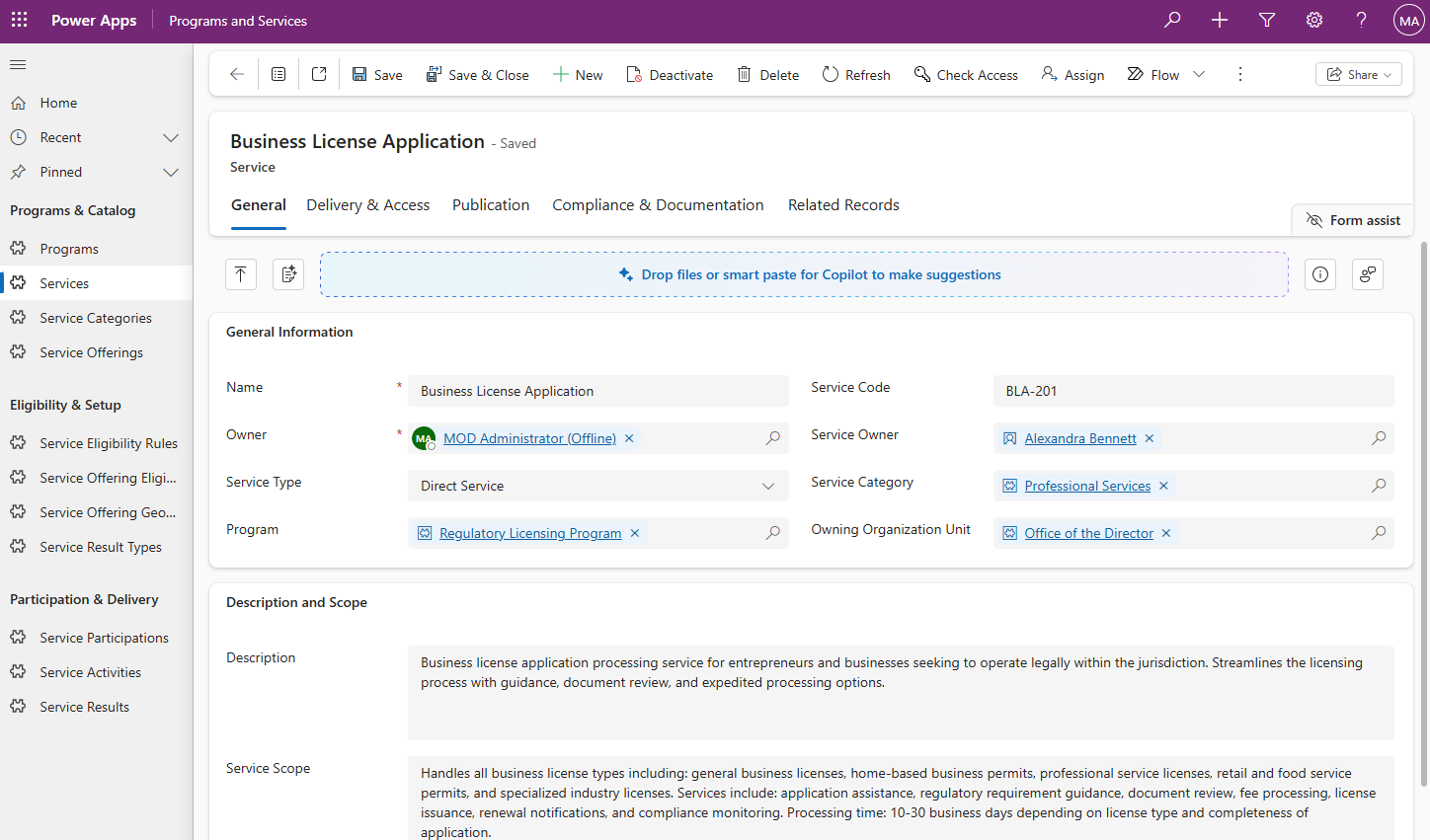
Note: All data shown in screenshots is fictitious and for demonstration purposes only.
Use the pac data CLI command or the Configuration Migration tool to import sample data into your environment.
📦 Sample Data
Sample programs and services data including programs, services, eligibility criteria, participant enrollments, service delivery records, and outcome tracking.
No guides are available for this solution yet.
ERD — Programs and Services
Screenshot
Note: All data shown is fictitious and for demonstration purposes only.

An open-source MIT License project maintained by Microsoft. Open Source at Microsoft