
Executive Coordination
The Executive Coordination module provides a structured way to issue, assign, track, and evaluate executive actions, directives, and high-level taskers that require coordinated response across organizational units. It provides data entry forms and views for documenting action requirements, assigning accountability, managing dependencies, capturing decisions, and reporting progress through completion. Links to legal authorities, agreements, strategic initiatives, risk assessments, and impact analyses provide supporting context, while executive status updates maintain visibility into action health and completion.
Typical use cases include managing executive office directives, policy implementation taskers, compliance-driven actions, strategic initiative coordination, crisis response actions, and cross-organizational accountability tracking.
Using the Module
The module provides forms and views to document and coordinate executive actions throughout their lifecycle from issuance through closure. Foundational reference data is established using Executive Action Types to categorize actions (e.g., Executive Order, Policy Directive, Compliance Tasker, Strategic Initiative, Crisis Response) and define default handling requirements such as priority, required assessments, and legal authority expectations.
When a directive or tasker is issued, Executive Action records can capture the action number, description, issuing details (issued by, issue date, issuing authority), strategic alignment, success criteria, and classification. Actions can be linked to supporting context including Organization Initiatives for strategic alignment, Legal Authorities to document statutory or regulatory basis, and Agreements when actions implement partnership commitments. Accountability is established through executive sponsor, accountable lead, and lead organization unit assignments, with target and actual completion dates tracked for timeline management. Budget estimates, effort hours, priority, lifecycle stage, and overall health indicators provide operational visibility.
The module supports coordination across dependent actions through Executive Action Dependency records, which document predecessor-successor relationships, dependency types (finish-to-start, start-to-start, etc.), critical path indicators, and impact assessments if dependencies are not met. This maintains visibility into sequencing requirements and coordination constraints across complex action portfolios.
Throughout execution, Executive Status Updates provide periodic progress reporting with status date, reporting period, percent complete, action status, overall health assessment, and structured narratives for key accomplishments, next steps, challenges and risks, decisions needed, and resource concerns. Timeline impact, budget impact, scope change requests, and escalation flags alert leadership to emerging issues requiring attention.
The module maintains a decision record through Executive Decision Log entries, which document significant decisions made during action execution including decision date, decided by, decision authority, decision category, rationale, and impact assessments on timeline, budget, scope, and accountability. Decisions can be linked to Formal Decision records when governance processes require structured decision documentation, with communicated date and implementation date tracked for transparency.
Supporting context can be maintained through lookups to Analysis, Impact, and Risk Item records, ensuring that actions are grounded in analytical findings, impact assessments, and risk management considerations. Action status, percent complete, completed and total action items, and actual completion dates provide a comprehensive record of execution outcomes for accountability, audit, and organizational learning.
graph TD
  appbase_Agreement(Agreement)
  appbase_Analysis(Analysis)
  appbase_ExecutiveAction(Executive Action)
  appbase_ExecutiveActionDependency(Executive Action Dependency)
  appbase_ExecutiveActionType(Executive Action Type)
  appbase_ExecutiveDecisionLog(Executive Decision Log)
  appbase_ExecutiveStatusUpdate(Executive Status Update)
  appbase_FormalDecision(Formal Decision)
  appbase_Impact(Impact)
  appbase_LegalAuthority(Legal Authority)
  appbase_OrganizationInitiative(Organization Initiative)
  appbase_RiskItem(Risk Item)
  appbase_ExecutiveAction --> appbase_Agreement
  appbase_Analysis --> appbase_ExecutiveAction
  appbase_ExecutiveActionDependency --> appbase_ExecutiveAction
  appbase_ExecutiveActionDependency --> appbase_ExecutiveAction
  appbase_ExecutiveDecisionLog --> appbase_ExecutiveAction
  appbase_ExecutiveStatusUpdate --> appbase_ExecutiveAction
  appbase_Impact --> appbase_ExecutiveAction
  appbase_RiskItem --> appbase_ExecutiveAction
  appbase_ExecutiveAction --> appbase_ExecutiveActionType
  appbase_ExecutiveDecisionLog --> appbase_FormalDecision
  appbase_ExecutiveAction --> appbase_LegalAuthority
  appbase_ExecutiveAction --> appbase_OrganizationInitiative
Tables
Executive Action
The central entity for documenting high-level directives, taskers, and executive actions requiring coordinated organizational response. Captures action number, name, type, issuance details (issued by, issue date, issuing authority), accountability assignments (executive sponsor, accountable lead, lead organization unit), timeline (start date, target completion date, actual completion date), resource estimates (budget, effort hours), progress indicators (percent complete, action items counters, overall health), and strategic context (organization initiative, legal authority, agreement references). Includes lifecycle stage, priority, security classification, visibility controls, and compliance flags.
Executive Action Type
Standardized classification system for categorizing executive actions (e.g., Executive Order, Policy Directive, Compliance Tasker, Strategic Initiative, Crisis Response). Each type includes name, description, default priority, and configuration flags indicating whether actions of this type typically require impact assessment, risk assessment, or legal authority documentation.
Executive Action Dependency
Documents sequencing and coordination relationships between executive actions for portfolio-level planning and dependency management. Links predecessor action and successor action with dependency type (finish-to-start, start-to-start, finish-to-finish, start-to-finish), dependency status (pending, active, satisfied, blocked), critical path indicators, description, impact if not met narratives, and notes.
Executive Status Update
Periodic progress reporting on executive actions capturing snapshots of execution health, accomplishments, challenges, and forward plans. Includes status date, reporting period, action status, overall health, percent complete, and structured narratives for key accomplishments, next steps, challenges and risks, decisions needed, and resource concerns. Timeline impact, budget impact, scope change requests, and escalation flags alert leadership to emerging issues.
Executive Decision Log
Auditable record of significant decisions made during executive action execution. Documents decision date, decided by, decision authority, decision category, decision description, rationale, and impact assessments on timeline, budget, scope, and accountability. Can link to Formal Decision records when governance processes require structured decision documentation, with communicated date and implementation date tracked.
Analysis
Linkage point to analytical studies, research, or assessments that inform or support executive actions. Enables traceability between executive decisions and underlying evidence, options analysis, or recommendations.
Impact
Linkage point to impact assessment records documenting expected or observed consequences of executive actions. Supports comprehensive impact visibility by connecting actions to detailed impact analyses.
Risk Item
Linkage point to risk management records associated with executive actions. Ensures actions are connected to systematic risk assessment and mitigation planning, supporting informed decision-making and proactive risk management.
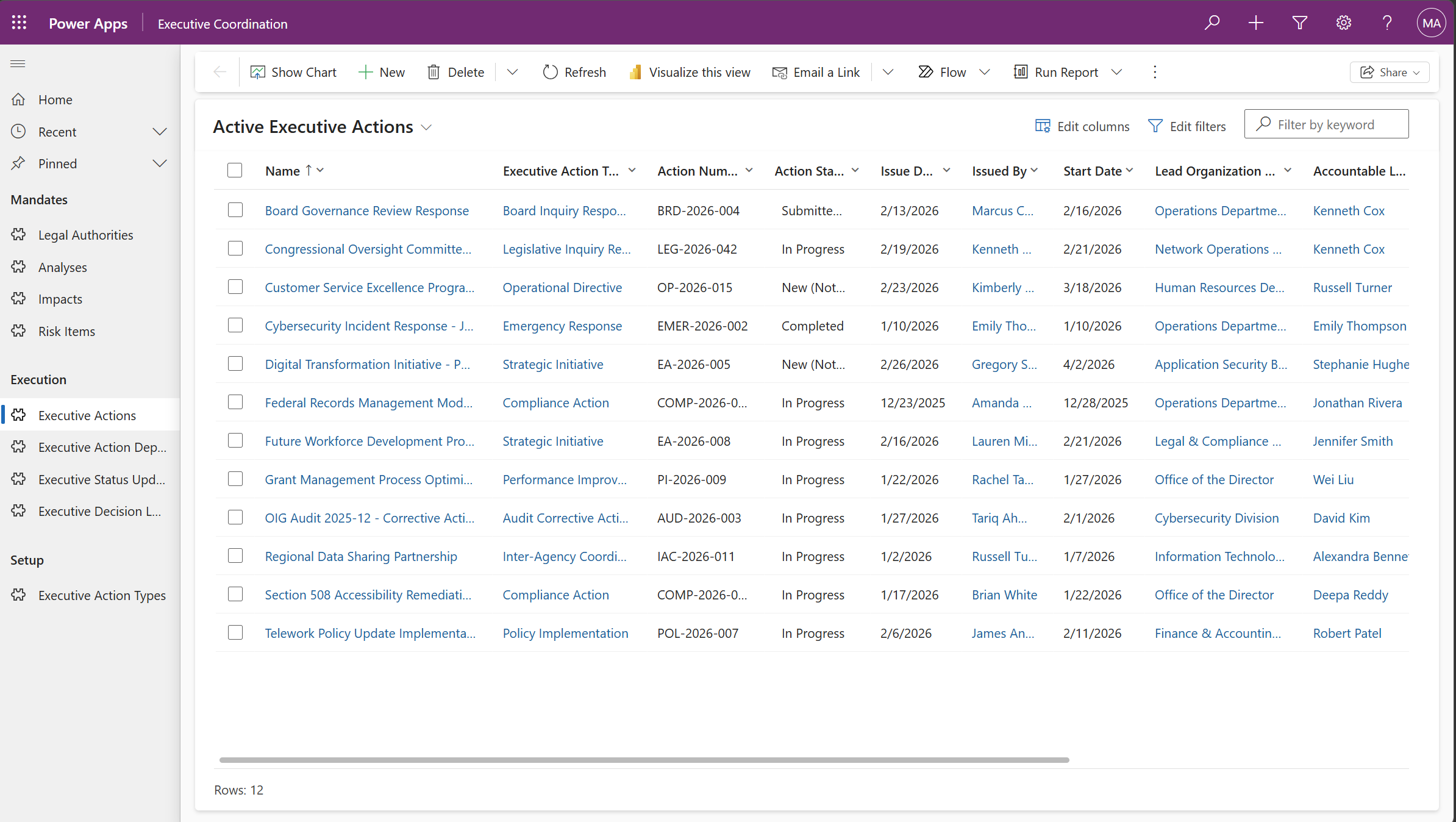
Note: All data shown in screenshots is fictitious and for demonstration purposes only.
Use the pac data CLI command or the Configuration Migration tool to import sample data into your environment.
📦 Government Sample Data
Sample executive actions, directives, and taskers representing typical government coordination scenarios including policy implementation and compliance actions.
No guides are available for this solution yet.
ERD — Executive Coordination
Screenshot
Note: All data shown is fictitious and for demonstration purposes only.

An open-source MIT License project maintained by Microsoft. Open Source at Microsoft