
Gamification
The Gamification module enables organizations to encourage, track, and recognize desired behaviors across programs, teams, and initiatives. The module supports defining games as time-bound or ongoing engagement initiatives, configuring activities that represent measurable actions, establishing achievements that participants can earn based on participation or performance, enrolling participants with individual or team participation models, logging activity instances as participants perform actions, and granting achievement recognition when criteria are met. The module can reinforce training completion, safety compliance, case resolution timeliness, volunteer engagement, productivity milestones, wellness initiatives, community participation, or internal innovation efforts, providing a flexible behavioral reinforcement layer that can operate alongside workforce, compliance, training, service delivery, or operational modules.
Typical use cases include training challenge campaigns, performance improvement drives, compliance tracking initiatives, employee wellness programs, safety recognition systems, volunteer engagement tracking, innovation and idea submission campaigns, service excellence recognition, onboarding milestone tracking, and community engagement programs.
Using the Module
The module supports gamification initiatives from design through participant recognition. Users can create and manage Game records defining structured gamification initiatives or campaigns with game names, game codes, Game Type classifications (training challenge, performance drive, compliance campaign, wellness initiative, safety program, volunteer campaign, innovation challenge, service excellence, onboarding program, community engagement), game descriptions and objectives, start and end dates, ongoing indicator for continuous programs, game status (planning, open for enrollment, active, paused, completed, archived, cancelled), participation models (individual, team, department, organization-wide, invitation-only, tiered), open enrollment indicators, leaderboard enabling for competitive visibility, active participant counts, Organization Initiative linkages for strategic alignment, and banner or logo URL references for branding.
Game Activity records define types of actions tracked within games representing measurable behaviors—training completion, task completion, event attendance, case resolution, time logged, certification earned, feedback submitted, survey completion, mentor session, safety report, innovation submission, volunteer hours—with activity names, activity descriptions, activity types, point values or weights, parent activity relationships for hierarchical activity structures, and activity status for enabling or disabling specific actions.
Game Achievement records establish achievements that can be earned with achievement names, achievement descriptions, achievement types (badge, level, tier, milestone, certificate, title, rank, recognition), achievement criteria and requirements, point thresholds or completion counts, achievement tier or level indicators, Content Template references for certificate generation, parent achievement relationships for progressive achievement paths, and achievement status for availability management.
Game Participant records represent individuals or teams enrolled in specific games with participation status (invited, enrolled, active, inactive, completed, withdrawn), enrollment dates, participation roles (participant, team lead, administrator), team assignments for team-based games, total activity counts, total achievements earned counts, current point or score totals, current rank or tier indicators, and participation context maintaining individual progress and standing within games.
As participants perform actions, Game Participant Activity records log instances of defined activities with activity dates and times, Game Activity references, Game Participant linkages, point values earned, activity completion indicators, verification or approval status, notes or descriptions, and supporting document attachments creating behavioral history used to evaluate achievement criteria and calculate performance metrics.
When achievement criteria are met, Game Participant Achievement records grant recognition with achievement dates, Game Achievement references, Game Participant linkages, achievement status (pending, awarded, verified, revoked), verification workflow, notes, and supporting document references for certificates or recognition materials providing transactional recognition tracking and participant accomplishment history.
graph TD
  appbase_ContentTemplate(Content Template)
  appbase_Document(Document)
  appbase_Game(Game)
  appbase_GameAchievement(Game Achievement)
  appbase_GameActivity(Game Activity)
  appbase_GameParticipant(Game Participant)
  appbase_GameParticipantAchievement(Game Participant Achievement)
  appbase_GameParticipantActivity(Game Participant Activity)
  appbase_OrganizationInitiative(Organization Initiative)
  appbase_GameAchievement --> appbase_ContentTemplate
  appbase_GameParticipantAchievement --> appbase_Document
  appbase_GameParticipantActivity --> appbase_Document
  appbase_GameAchievement --> appbase_Game
  appbase_GameActivity --> appbase_Game
  appbase_GameParticipant --> appbase_Game
  appbase_GameParticipantAchievement --> appbase_Game
  appbase_GameParticipantActivity --> appbase_Game
  appbase_GameAchievement --> appbase_GameAchievement
  appbase_GameParticipantAchievement --> appbase_GameAchievement
  appbase_GameActivity --> appbase_GameActivity
  appbase_GameParticipantActivity --> appbase_GameActivity
  appbase_GameParticipantAchievement --> appbase_GameParticipant
  appbase_GameParticipantActivity --> appbase_GameParticipant
  appbase_Game --> appbase_OrganizationInitiative
The Gamification module provides a structured way to encourage, track, and recognize desired behaviors across programs, teams, and initiatives. It allows organizations to define Games (time-bound or ongoing initiatives), configure Activities that represent measurable actions, and establish Achievements that participants can earn based on participation or performance. Participants (individuals or teams) generate Activity records through their actions, and when criteria are met, Achievement records are granted and tracked. This module can be used to reinforce training completion, safety compliance, case resolution timeliness, volunteer engagement, productivity milestones, wellness initiatives, community participation, or internal innovation efforts—making it a flexible behavioral reinforcement layer that can operate alongside workforce, compliance, training, service delivery, or operational modules across public or commercial environments.
Tables
Game
Represents a structured gamification initiative or campaign. A Game defines the scope, timeframe, participation model, and overall purpose of the engagement effort (e.g., training challenge, performance drive, volunteer campaign).
Game Activity
Defines the types of actions that are tracked within a Game. Activities represent measurable behaviors such as completing training, closing a case, attending an event, or submitting a task. These are definitional and not transactional.
Game Achievement
Defines the achievements that can be earned within a Game. These may represent badges, levels, milestones, point thresholds, or titles. This table stores the criteria and configuration for what participants can earn.
Game Participant
Represents an individual or team enrolled in a specific Game. This table tracks participation status, enrollment, and contextual role within the Game (participant, admin, etc.), separate from the core person or team record.
Game Participant Activity
Logs instances of Participants performing defined Game Activities. This table captures the behavioral history used to evaluate achievement criteria and calculate performance metrics.
Game Participant Achievement
Records when a Participant earns a specific Game Achievement. This is the transactional recognition record, including when it was granted, its status, and any related activity or approval.
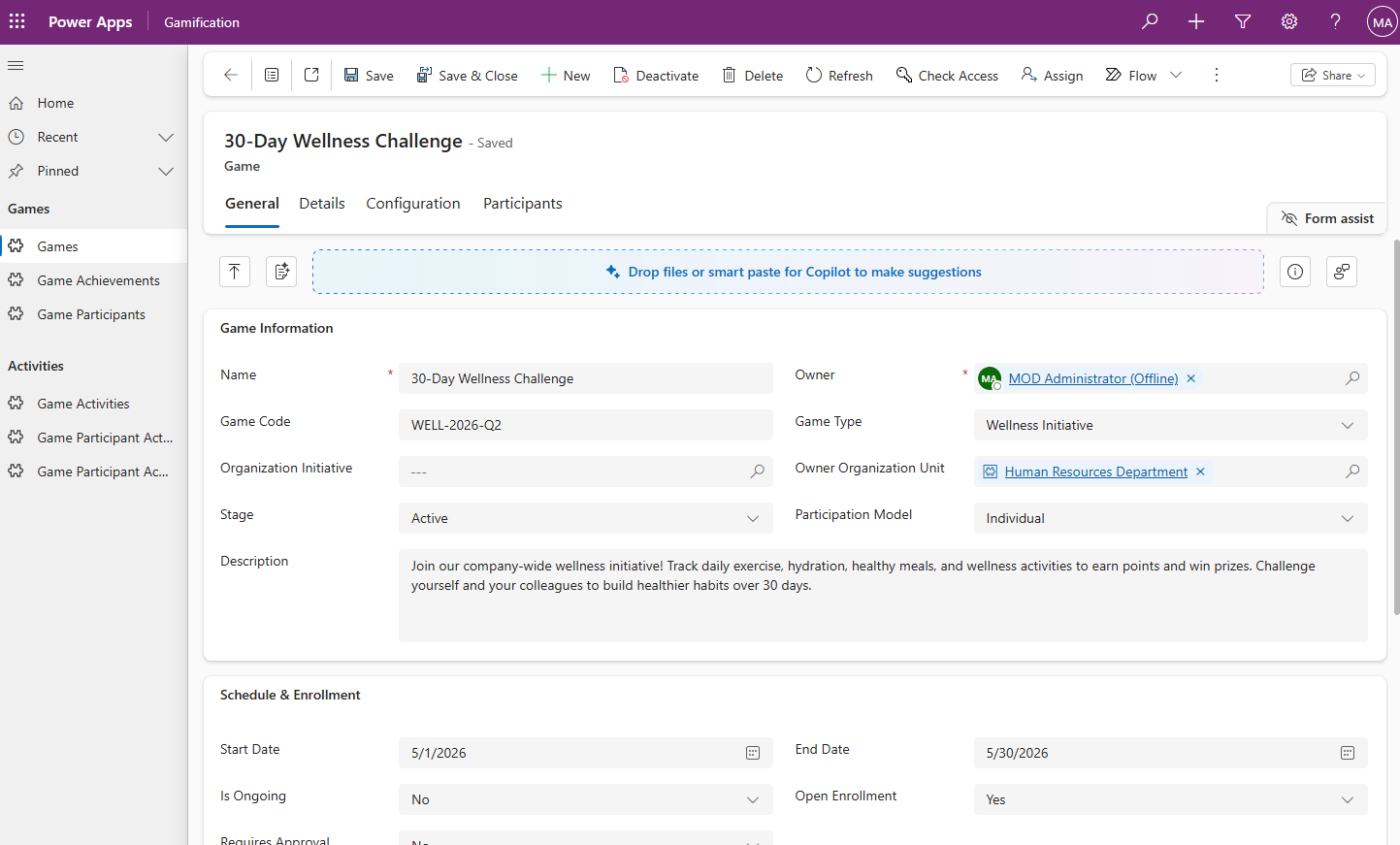
Note: All data shown in screenshots is fictitious and for demonstration purposes only.
Use the pac data CLI command or the Configuration Migration tool to import sample data into your environment.
📦 Sample Data
Sample gamification data including games, activities, achievements, participants, activity instances, and achievement grants for engagement tracking.
No guides are available for this solution yet.
Required Modules
- 🧰 Core
ERD — Gamification
Screenshot
Note: All data shown is fictitious and for demonstration purposes only.

An open-source MIT License project maintained by Microsoft. Open Source at Microsoft