
HR Administration
The HR Administration module provides a comprehensive system for managing workforce positions, employment actions, time and attendance, employee requests, and compliance documentation. It provides data entry forms and views for establishing position structures, processing personnel actions, managing time off and telework requests, documenting workplace accommodations, tracking disciplinary matters, and maintaining employee declarations. Integration with job classifications, pay grades, clearance requirements, and organizational structure ensures consistent workforce management aligned with classification standards and governance requirements.
Typical use cases include managing position authorizations and assignments, processing promotions and transfers, handling leave requests and donations, coordinating telework arrangements, documenting workplace accommodations, maintaining employment milestones, tracking disciplinary actions, capturing compliance declarations, and managing overtime authorization.
Using the Module
The module provides forms and views to support workforce administration throughout the employee lifecycle from position planning through separations. Foundational reference data is established using HR Job Classifications to define standard position categories with classification codes, FLSA status, supervisory indicators, default pay grades, and Job Series linkages for occupational grouping. Personnel Types categorize workforce segments (e.g., civilian, contractor, military), while HR Action Types standardize employment action categories (hire, promotion, transfer, separation) with approval requirements. HR Pay Grades, Grade Ranks, and HR Ranks provide pay scale structures, and Clearance Levels define security clearance requirements for sensitive positions.
Position management begins with HR Position records documenting authorized positions with position numbers, job classification assignments, organizational placement, location, employment type, full-time equivalent (FTE), pay grade, clearance requirements, supervisory relationships, and budget codes. Positions can reference personnel type, bargaining unit, and effective date ranges to manage position lifecycles. HR Position Descriptions capture detailed position documentation including purpose, primary duties, key responsibilities, required and preferred qualifications, supervisory responsibilities, physical requirements, and working conditions, with version control, approval workflow, and supporting document attachments.
When employees are assigned to positions, HR Position Assignment records link persons to positions with assignment type (permanent, temporary, acting, detailed), start and end dates, FTE allocation for partial assignments, primary assignment indicators, reporting relationships (reports to person and position), and assignment status tracking. This supports multiple concurrent assignments, acting appointments, and detailed assignments while maintaining historical assignment records.
Personnel changes are processed through HR Employment Action records, which document employment transactions referenced by action type (hire, promotion, transfer, reassignment, salary adjustment, separation, retirement). Each action captures action number, effective date, approval workflow (requested by, approved by, approval status, approval date), and before/after context for position, location, organization unit, employment type, FTE, pay grade, grade/rank, and salary fields. Justification, description, impact narratives, and legal authority references provide supporting documentation, while action status and processing details maintain transaction audit trails.
Throughout employment, HR Employment Milestones document significant events such as probationary completion, awards, service anniversaries, eligibility dates, and certification achievements. Milestone records include milestone type and date, years of service calculations, notification tracking, recognition indicators, and recorded by attribution for lifecycle visibility and employee recognition programs.
Time and attendance management is supported through HR Request records providing a common request structure for various HR actions, with request number, type, status, priority, requested dates, approval workflow, and denial reason capturing. HR Time Off Requests extend this base with leave type specification, total hours requested/approved/taken, start/end/return dates, reason narratives, emergency contact information, and supporting documentation for leave management. Individual HR Time Off Entries break down approved leave into daily or partial-day increments for payroll integration and balance tracking.
For employees requiring leave support, HR Leave Donation records facilitate leave sharing programs by documenting donor and recipient persons, leave types donated and received, hours donated and received with conversion rates, approval workflow, balance before/after snapshots, and processing status for accountability and payroll adjustments.
HR Overtime Entry records capture overtime work with work date, hours worked, overtime type and rate, pay calculations, approval workflow, pay period reference, project codes for cost allocation, and justification narratives for overtime authorization and compensation tracking.
Modern workplace flexibility is managed through HR Telework Request records documenting telework arrangements with telework type and frequency, start/end dates, business justification, primary telework location and address, equipment needs, internet availability, schedule descriptions, agreement signature status, safety checklist completion, and supervisor approval for remote work coordination. HR Workplace Accommodation requests manage reasonable accommodation processes with accommodation type, need description, requested and approved accommodation details, medical documentation indicators, privacy consent references, implementation details (date, cost), effectiveness evaluation, temporary or permanent status, and approval workflow supporting ADA compliance.
Workforce compliance and conduct are maintained through HR Employee Declaration records capturing required employee attestations such as financial disclosures, conflict of interest statements, ethics acknowledgments, or policy certifications. Each declaration includes declaration type and content, compliance framework and legal authority references, attestation status and date, submission/review dates, reviewer, review comments, effective and expiration dates, and supporting documents for regulatory compliance and audit readiness.
HR Disciplinary Action records document conduct and performance matters with disciplinary action type, incident date and description, violation type, action taken, effective and expiration dates, issue date, issuing authority, appeal filed status, appeal date and outcome, employee response, legal authority references, supporting documents, and security classification for sensitive personnel matters. Action status tracking maintains case progression through investigation, action, and appeal phases.
graph TD
  appbase_ClearanceLevel(Clearance Level)
  appbase_ComplianceFramework(Compliance Framework)
  appbase_Document(Document)
  appbase_GradeRank(Grade Rank)
  appbase_HRActionType(HR Action Type)
  appbase_HRDisciplinaryAction(HR Disciplinary Action)
  appbase_HREmployeeDeclaration(HR Employee Declaration)
  appbase_HREmploymentAction(HR Employment Action)
  appbase_HRJobClassification(HR Job Classification)
  appbase_HRPayGrade(HR Pay Grade)
  appbase_HRPosition(HR Position)
  appbase_HRPositionAssignment(HR Position Assignment)
  appbase_HRPositionDescription(HR Position Description)
  appbase_HRRank(HR Rank)
  appbase_HRRequest(HR Request)
  appbase_HRTeleworkRequest(HR Telework Request)
  appbase_HRTimeOffEntry(HR Time Off Entry)
  appbase_HRTimeOffRequest(HR Time Off Request)
  appbase_HRWorkplaceAccommodation(HR Workplace Accommodation)
  appbase_JobSeries(Job Series)
  appbase_LegalAuthority(Legal Authority)
  appbase_PayGrade(Pay Grade)
  appbase_PersonnelType(Personnel Type)
  appbase_PrivacyConsent(Privacy Consent)
  appbase_HRPosition --> appbase_ClearanceLevel
  appbase_HREmployeeDeclaration --> appbase_ComplianceFramework
  appbase_HRDisciplinaryAction --> appbase_Document
  appbase_HREmployeeDeclaration --> appbase_Document
  appbase_HRPositionDescription --> appbase_Document
  appbase_HRTimeOffRequest --> appbase_Document
  appbase_HRWorkplaceAccommodation --> appbase_Document
  appbase_HRPosition --> appbase_GradeRank
  appbase_HREmploymentAction --> appbase_HRActionType
  appbase_HRPosition --> appbase_HRJobClassification
  appbase_HREmploymentAction --> appbase_HRPayGrade
  appbase_HREmploymentAction --> appbase_HRPayGrade
  appbase_HREmploymentAction --> appbase_HRPosition
  appbase_HREmploymentAction --> appbase_HRPosition
  appbase_HRPosition --> appbase_HRPosition
  appbase_HRPositionAssignment --> appbase_HRPosition
  appbase_HRPositionAssignment --> appbase_HRPosition
  appbase_HRPositionDescription --> appbase_HRPosition
  appbase_HREmploymentAction --> appbase_HRRank
  appbase_HREmploymentAction --> appbase_HRRank
  appbase_HRTeleworkRequest --> appbase_HRRequest
  appbase_HRTimeOffRequest --> appbase_HRRequest
  appbase_HRWorkplaceAccommodation --> appbase_HRRequest
  appbase_HRTimeOffEntry --> appbase_HRTimeOffRequest
  appbase_HRJobClassification --> appbase_JobSeries
  appbase_HRPosition --> appbase_JobSeries
  appbase_HRDisciplinaryAction --> appbase_LegalAuthority
  appbase_HREmployeeDeclaration --> appbase_LegalAuthority
  appbase_HREmploymentAction --> appbase_LegalAuthority
  appbase_HRJobClassification --> appbase_PayGrade
  appbase_HRPosition --> appbase_PayGrade
  appbase_HRPosition --> appbase_PersonnelType
  appbase_HRWorkplaceAccommodation --> appbase_PrivacyConsent
Tables
HR Position
The HR Position table represents authorized positions within the organizational structure, distinct from the persons who occupy them. Each position record includes position number, name, job classification assignment, organizational placement (organization unit, location), employment type, full-time equivalent (FTE), position status (authorized, filled, frozen, abolished), and effective date ranges for position lifecycle management. Supervisory relationships are maintained through reports-to position references, while grade/rank, pay grade, job series, and personnel type assignments establish compensation and classification context. Positions can specify clearance requirements (requires clearance flag and required clearance level), management and supervisory indicators, position designation, bargaining unit, and budget codes for financial planning and workforce structure management.
HR Job Classification
The HR Job Classification table defines standardized job categories used to classify positions with classification codes, names, descriptions, classification levels, and occupational references (job series, standard occupational codes). Each classification includes FLSA status (exempt, non-exempt), bargaining unit eligibility, default bargaining unit, default pay grade, and indicators for supervision (is supervisory), management (is management), and certification requirements. Active status tracking enables classification lifecycle management, supporting consistent position classification, pay administration, and regulatory compliance with fair labor standards and occupational coding frameworks.
Job Series
The Job Series table provides broader occupational family groupings for job classifications and positions, enabling roll-up reporting and career progression planning within related occupational areas.
Personnel Type
The Personnel Type table categorizes workforce segments (e.g., civilian, military, contractor, intern, volunteer) used by positions to support differentiated policies, benefits, and reporting requirements across employment categories.
HR Action Type
The HR Action Type table standardizes employment action categories (hire, promotion, transfer, reassignment, salary adjustment, separation, retirement, conversion, detail, extension) with action category classification, descriptions, and approval requirement indicators. This ensures consistent categorization of personnel transactions and enables workflow routing based on action type requirements.
HR Pay Grade
The HR Pay Grade table defines compensation grade structures used by positions, job classifications, and employment actions to establish pay ranges and salary administration frameworks.
Grade Rank
The Grade Rank table provides combined grade and rank identifiers for organizations using hierarchical or uniformed workforce structures, enabling grade and rank-based pay and advancement systems.
HR Rank
The HR Rank table categorizes rank designations within hierarchical workforce structures, supporting rank-based progression in uniformed services or structured career ladders.
Pay Grade
The Pay Grade table from the core module establishes base pay grade structures referenced by HR job classifications and positions for salary range assignments.
Clearance Level
The Clearance Level table from the core module defines security clearance requirements (e.g., Confidential, Secret, Top Secret) that can be assigned to positions requiring personnel security clearances.
HR Position Description
The HR Position Description table maintains formal position documentation including position purpose, primary duties, key responsibilities, required and preferred qualifications, supervisory responsibilities, physical requirements, and working conditions. Each description references its associated HR position and includes version numbers, effective dates, approval workflow (approval status, approved by, approval date), description status, and supporting document attachments for official position documentation management and compliance with classification standards.
HR Position Assignment
The HR Position Assignment table links persons to HR positions for defined periods, documenting assignment type (permanent, temporary, acting, detailed, concurrent), start and end dates, assignment status (active, pending, completed, cancelled), and FTE allocation for partial assignments. Records maintain primary assignment indicators, reporting relationships (reports to person and position), location and organization unit context, and descriptions to support multiple concurrent assignments, acting appointments, detailed assignments, and historical assignment tracking.
HR Employment Action
The HR Employment Action table documents personnel transactions affecting employment status, position, compensation, or assignment. Each action is categorized by HR action type and includes action number, effective date, action status, and approval workflow (requested by, requested date, approved by, approval status, approval date, processed by, processed date). Before/after context is captured through from/to field pairs for position, location, organization unit, employment type, FTE, pay grade, grade/rank, and salary (with currency support), enabling proper tracking of changes. Justification, description, impact on employee narratives, and legal authority references provide supporting documentation for personnel action audit trails and compliance.
HR Employment Milestone
The HR Employment Milestone table tracks significant lifecycle events for employees including probationary completion, service anniversaries, eligibility dates, awards, certification achievements, or tenure milestones. Each milestone includes milestone type and date, milestone status, years of service calculations, recognition provided indicators, notification tracking (notification date, notification sent), recorded by and recorded date attribution, and descriptions for workforce milestone visibility and employee recognition program administration.
HR Request
The HR Request table provides a common request structure for various HR transactions including time off, telework, and workplace accommodations. Records capture request number, request type and status, priority, request date, requested start and end dates, requesting organization unit and person, approval workflow (approved by, approval status, approval date), denial reason, and descriptions. Specialized request types (time off, telework, accommodations) extend this base structure with type-specific details.
HR Time Off Request
The HR Time Off Request table documents employee leave requests with leave type specification (annual, sick, administrative, compensatory, unpaid, other), start, end, and return dates, total hours requested/approved/taken for balance tracking, reason narratives, approval workflow, contact during leave and emergency contact information, supporting document references, and denial reason. Each request links to the base HR request for common request attributes and generates HR time off entry records for individual leave dates.
HR Time Off Entry
The HR Time Off Entry table stores individual leave date entries for approved time off requests, documenting entry date, hours taken, leave type, approval status, and person for daily or partial-day leave tracking. Entries link to their parent HR time off request and provide granular leave detail for payroll integration and balance calculation.
HR Leave Donation
The HR Leave Donation table facilitates leave sharing programs by documenting voluntary leave transfers between employees. Records capture donor and recipient persons, leave types donated and received (which may differ based on conversion rules), hours donated and hours received with conversion rates, donation date, donor and recipient balance before/after snapshots, approval workflow (approval status, approved by, approval date), processing status and processed date, justification, and notes. This supports leave bank programs, emergency leave sharing, and charitable leave donation with full accountability and balance adjustment tracking.
HR Overtime Entry
The HR Overtime Entry table captures overtime work instances with work date, hours worked, overtime type (overtime, compensatory time, holiday pay), overtime rate multipliers, total pay calculation with currency support, pay period reference, person and organization unit assignment, project codes for cost allocation, approval workflow (approval status, approved by, approval date), justification, and notes. This enables overtime authorization, cost tracking, and compensation administration.
HR Telework Request
The HR Telework Request table manages remote work arrangement requests with telework type (regular, situational, emergency) and frequency specifications, start and end dates, business justification, primary telework location and full address details, schedule descriptions, equipment needs, internet speed availability, safety checklist completion indicators, agreement signed status and date, approval workflow (approval status, approved by, approval date), supervisor reference, request status, and notes. Requests link to the base HR request structure for common request handling and workflow coordination.
HR Workplace Accommodation
The HR Workplace Accommodation table supports reasonable accommodation processes documenting accommodation requests and implementation. Records capture accommodation type, need description, requested and approved accommodation details, medical documentation provided indicator, privacy consent references, temporary or permanent status, start and end dates for temporary accommodations, approval workflow (approval status, approved by, approval date), request status, implementation date and cost (with currency), effectiveness evaluation narratives, supporting document attachments, security classification for sensitive information, and denial reason when applicable. This supports ADA compliance, accommodation coordination, and privacy-protected documentation.
HR Employee Declaration
The HR Employee Declaration table captures required employee attestations and disclosures such as financial disclosures, conflict of interest statements, ethics acknowledgments, policy certifications, or regulatory compliance affirmations. Each declaration includes declaration type and content, compliance framework and legal authority references establishing the requirement basis, attestation status and date, submission date, declaration status, requires review indicator, review workflow (reviewed by, review date, review comments), effective and expiration dates for renewal tracking, supporting documents, security classification, and notes. This maintains compliance with disclosure requirements, ethics programs, and regulatory mandates.
HR Disciplinary Action
The HR Disciplinary Action table documents personnel conduct and performance matters with disciplinary action type (verbal warning, written reprimand, suspension, demotion, termination), incident date and description, violation type, action taken, issue date and issuing authority, effective and expiration dates, approval workflow, action status, employee response narrative, appeal tracking (appeal filed status, appeal date, appeal outcome), legal authority references, supporting documents, organization unit, person, security classification, and visibility controls. This maintains sensitive personnel matter documentation for due process, appeal procedures, and workforce accountability.
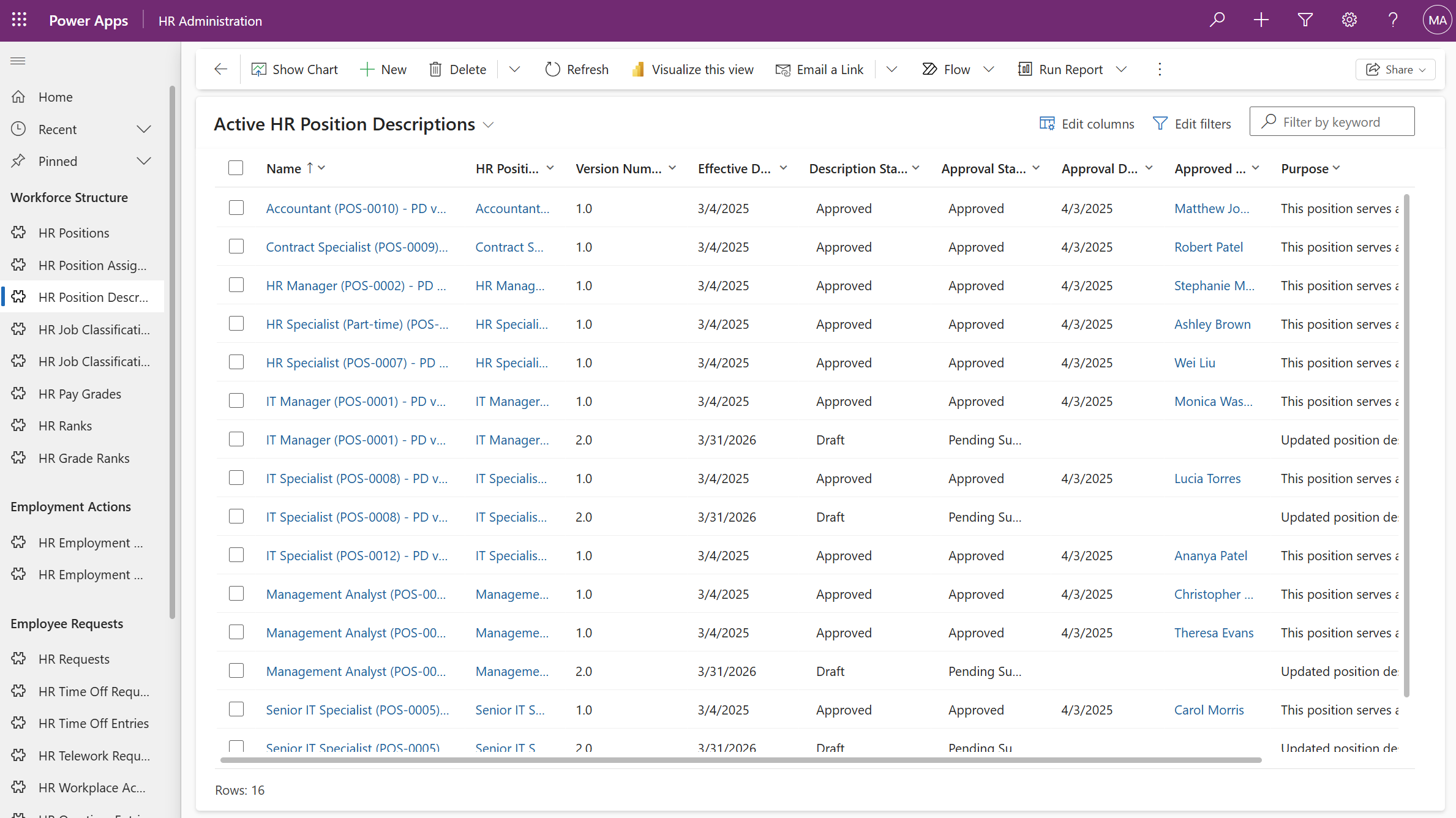
Note: All data shown in screenshots is fictitious and for demonstration purposes only.
Use the pac data CLI command or the Configuration Migration tool to import sample data into your environment.
📦 Government Sample Data
Sample HR data including positions, employment actions, leave requests, and compliance records following government classification and pay grade structures.
No guides are available for this solution yet.
ERD — HR Administration
Screenshot
Note: All data shown is fictitious and for demonstration purposes only.

An open-source MIT License project maintained by Microsoft. Open Source at Microsoft