🔎 Build a RAG Agent with Azure AI Search
Welcome, agent. Your mission is Operation Vector Vault: give a Copilot Studio agent the ability to reason over your organization's own documents using Retrieval-Augmented Generation (RAG) powered by Azure AI Search vector search. You'll stand up a search service, vectorize a stack of candidate resumes, and wire the index into an HR Knowledge Agent so it answers questions by meaning, not just keywords, with document-backed citations. 🎯
This mission uses the GitHub Copilot harness
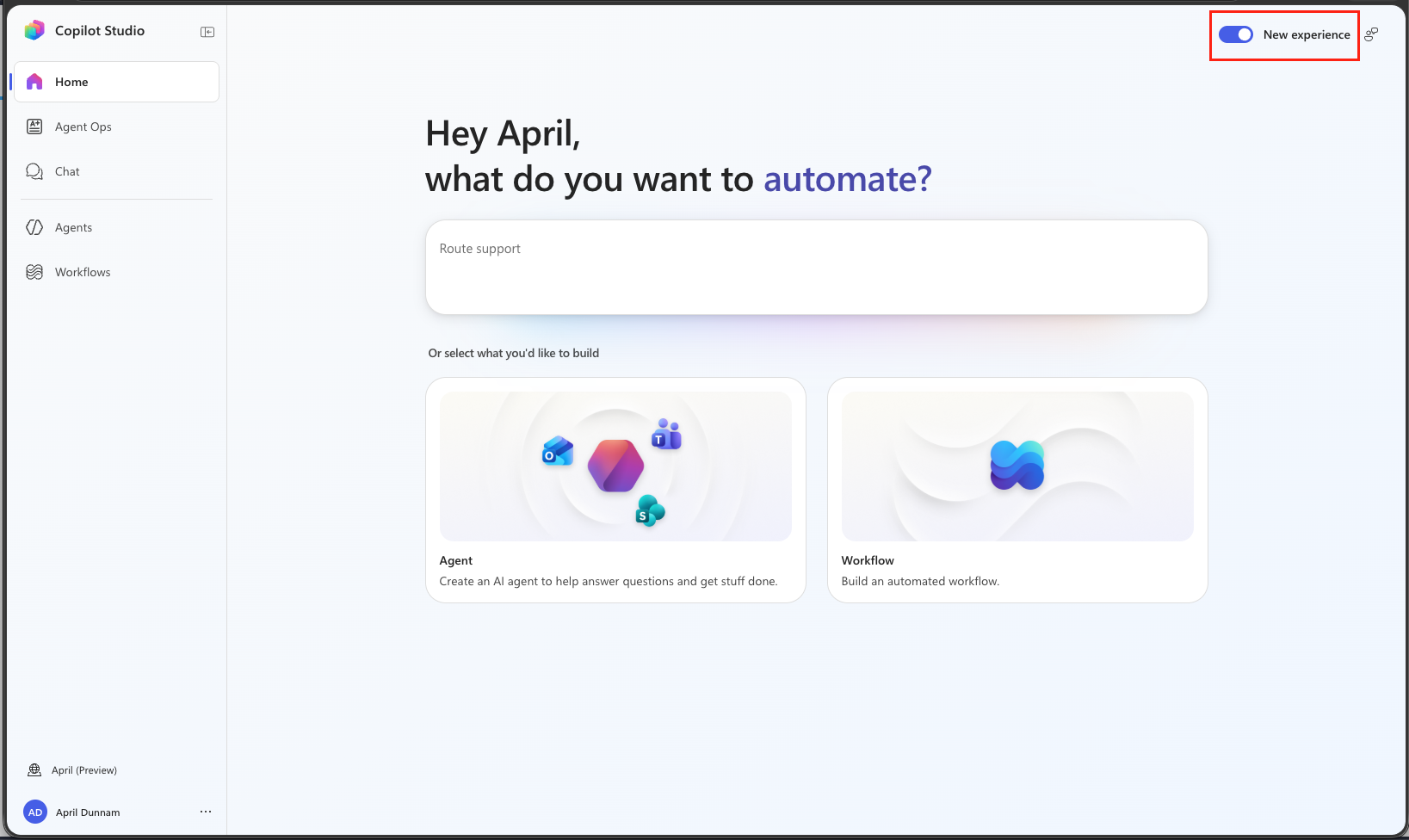
The Copilot Studio steps require an agent powered by the GitHub Copilot harness. Turn on New Experience before you create the agent.
Curriculum credit: This mission adapts material from the Microsoft Copilot Developer Camp. Thanks to Paolo Pialorsi and the Copilot Camp contributors for the original curriculum. This Agent Academy version updates the lab for the GitHub Copilot harness and presents it in the Special Ops format.
🎯 Mission objectives
In this mission, you'll learn how to:
- Create and populate an Azure AI Search vector index
- Connect Azure AI Search to a Copilot Studio agent
- Ground agent responses in your own documents
- Test semantic retrieval and document-backed citations
❓ What is Retrieval-Augmented Generation (RAG)?
Retrieval-Augmented Generation (RAG) is a technique for improving the quality of a language model's answers by letting it look things up before it responds.
Imagine a smart assistant that writes answers to your questions. Sometimes it doesn't know everything it needs to give a great answer. RAG lets the assistant first retrieve relevant information from a large collection of documents, then generate a response grounded in what it found.
So RAG combines two steps:
- Retrieval: finding relevant information from a large pool of data.
- Generation: using that information to compose a detailed, accurate response.
This makes answers more informed and trustworthy, which is ideal for question answering, research assistance, and scenarios where the truth lives in your documents rather than in the model's memory.
🧠 Why vector search?
Vector search finds information based on meaning rather than exact keywords. Instead of matching words literally, it converts content into numeric vectors and finds content that is conceptually similar to your query. That lets it handle:
- Semantic similarity: matching concepts that mean the same thing in different words (for example, "recruitment" and "hiring").
- Multilingual content: finding equivalent content across languages (for example, "resume" and "curriculum vitae").
- Multiple content types: searching across formats such as text documents and PDFs.
Here's how it works:
- Convert text to vectors: documents are turned into vectors that capture their meaning, using an embedding model.
- Store vectors: the vectors are stored in a search index (Azure AI Search) built to handle them efficiently.
- Search with vectors: your query is also converted to a vector, and the index returns the vectors closest in meaning.
For example, a search for "software engineering skills" can surface candidates described as having "programming expertise" or "development capabilities", even without the exact words from your query.
⚙️ Prerequisites
- Microsoft Copilot Studio trial or paid account with access to the GitHub Copilot harness. If you don't have an account, see the course setup instructions for a free trial.
- An Azure subscription with permission to create resources (Azure AI Search, Storage, and Azure OpenAI / Microsoft Foundry).
- Familiarity with basic Copilot Studio agent creation and basic Azure resource management.
GitHub Copilot harness billing
This mission uses the GitHub Copilot harness in Microsoft Copilot Studio, which uses usage-based billing. Building, testing in Preview, evaluating, and using the agent might consume Copilot Credits. Review the Copilot Credits billing overview before you begin.
🎯 The Scenario
Contoso's HR team is drowning in candidate resumes across formats and languages. They want an agent that lets recruiters ask natural-language questions, like "who speaks Spanish and knows Python?", and get accurate, cited answers pulled from the actual resume documents. You're the agent builder wiring up RAG with Azure AI Search.
🧪 Lab 1.1: Set up the Azure AI Search service
In this exercise you create and configure the Azure AI Search service that will store and index your documents.
Create the Azure AI Search service
Navigate to the Azure Portal and create an Azure AI Search service:
Select Create a resource and search for
Azure AI Search.Select Azure AI Search, then Create.
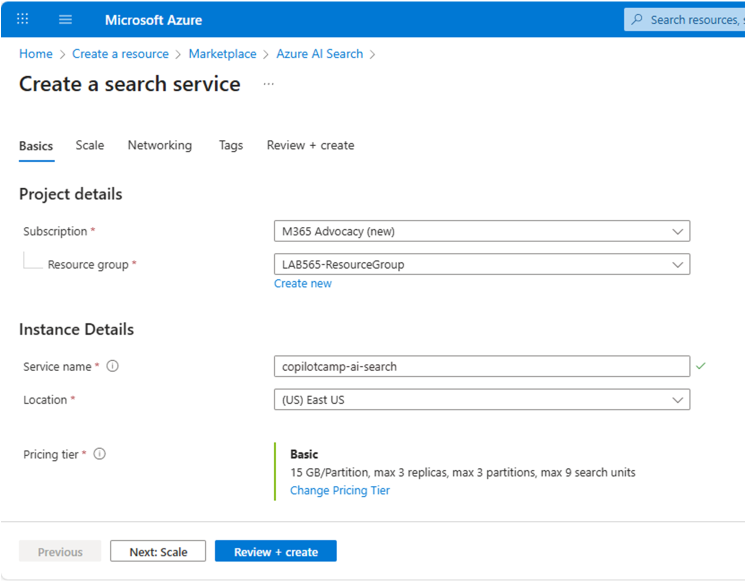
Fill out the following details and select Review + Create:
- Subscription: your Azure subscription
- Resource group: an existing group or a new one, for example
agent-academy-rg - Service name: a globally unique name, for example
agentacademy-ai-search - Location: the same region as your other Azure resources
- Pricing tier: Basic (sufficient for this mission)
Once the service is created, open the resource and capture two values you'll need later:
- On the Overview page, copy the URL (the search endpoint).
- Under Settings → Keys, copy the Primary admin key.
TIP
Keep the endpoint URL and admin key somewhere safe because you'll paste them into the Azure AI Search connection in Copilot Studio in Lab 1.3.
Create an Azure Storage account
You need somewhere to hold the documents before they're indexed.
In the Azure Portal, select Create a resource and search for
Storage Account.Select Storage Account, then Create.
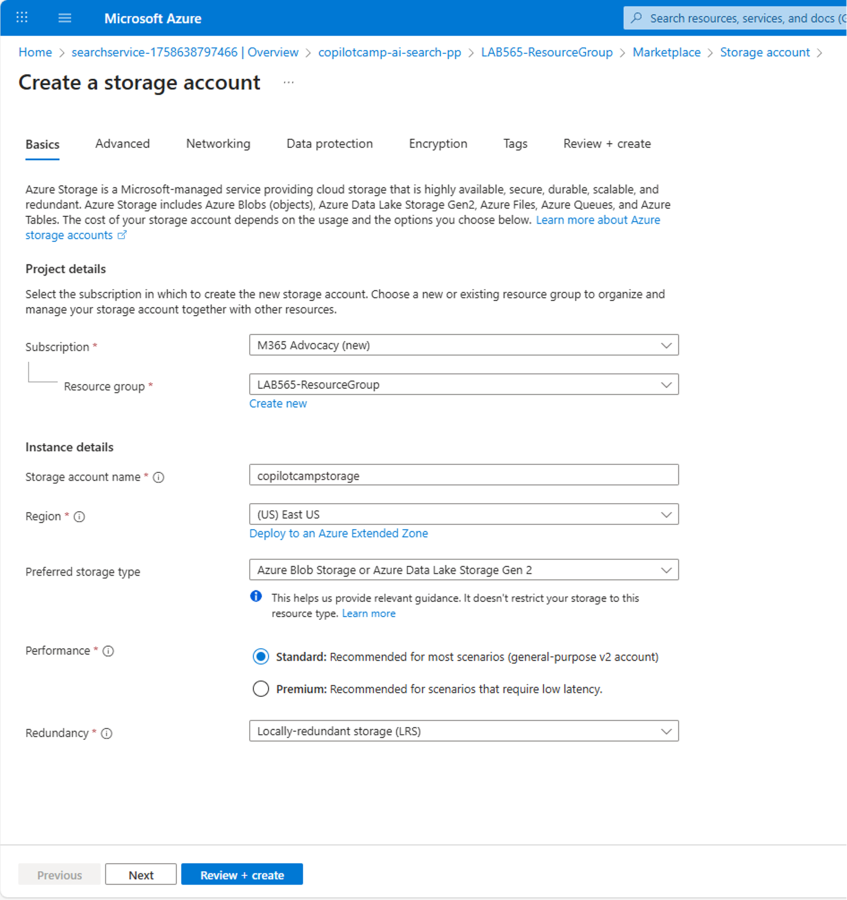
Fill out the following and select Review + Create:
- Subscription: your Azure subscription
- Resource group: the same group as your Azure AI Search service
- Storage account name: a globally unique name, for example
agentacademystorage - Region: the same region as your Azure AI Search service
- Performance: Standard
- Redundancy: Locally redundant storage (LRS)
Deploy a text embedding model
Vector search needs an embedding model to turn documents and queries into vectors.
If you don't already have an Azure OpenAI service, create one first (Create a resource → Azure OpenAI → Create, Standard S0 tier, in a region that supports Azure OpenAI).
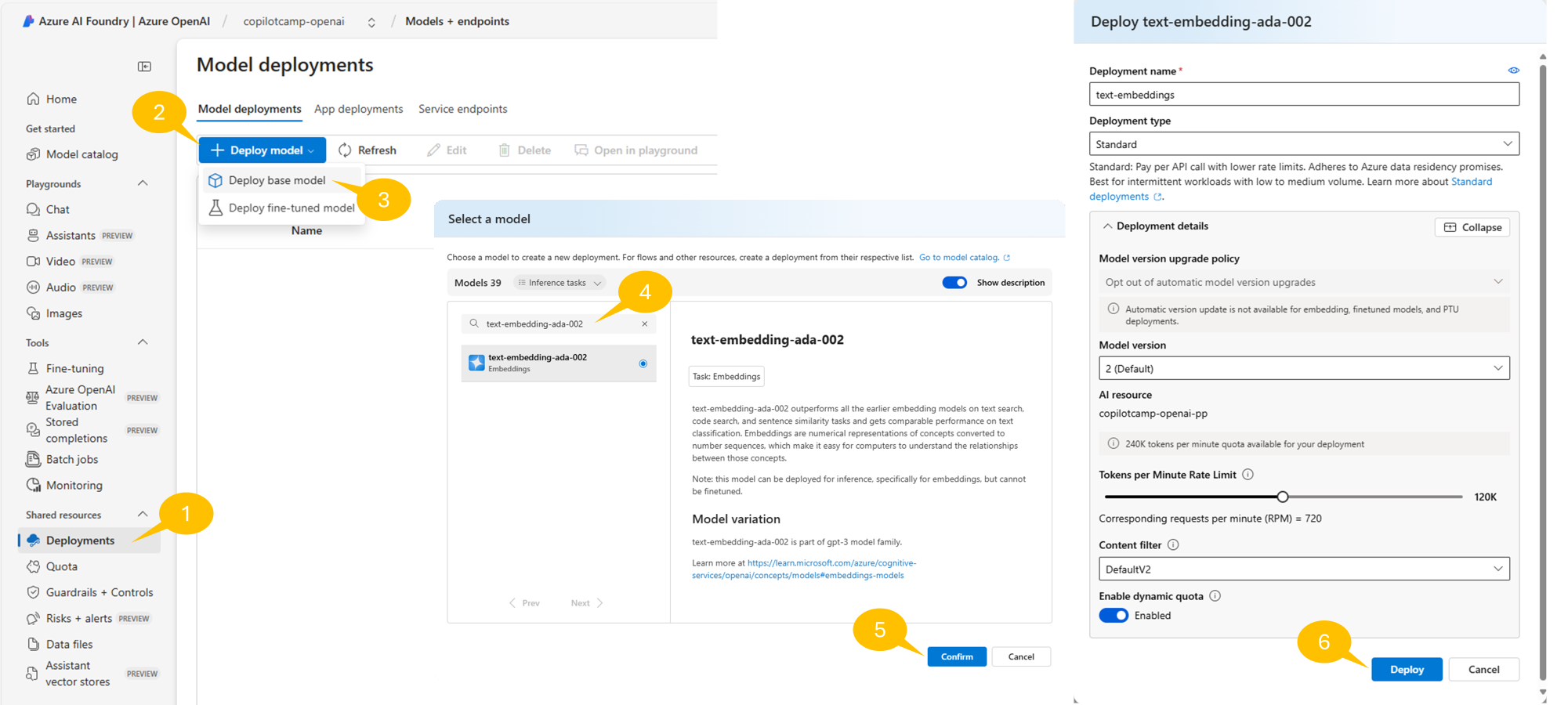
Then open Microsoft Foundry, select your Azure OpenAI instance, and deploy the embedding model:
Select Deployments in the left navigation.
Select + Deploy model → Deploy base model.
Search for
text-embedding-ada-002and select Confirm.Configure the deployment:
- Deployment name:
text-embeddings(remember this name) - Deployment type: Standard
- Model version: 2 (Default)
- Content Filter: DefaultV2
- Deployment name:
Select Deploy and wait for it to complete.
NOTE
What does text-embedding-ada-002 do? It converts text into numeric vectors that represent meaning, enabling vector search that finds semantically similar text across languages and formats. Paired with Azure AI Search, it returns the most relevant, contextually accurate content instead of exact keyword matches.
🧪 Lab 1.2: Create and populate the search index
Now you'll create a search index in Azure AI Search and populate it with candidate resume documents using the integrated vectorization feature.
Preparing sample documents
For this lab, download fictitious_resumes.zip, then extract the PDF files that you'll index for search.
These sample resumes contain diverse candidate profiles with information such as:
- Candidate names and contact information
- Technical skills and expertise areas
- Work experience and role history
- Education backgrounds
- Language proficiencies
- Professional certifications
Review the content of these files to understand the type of information that will be searchable through your RAG-enabled agent. Notice also that the documents are written in various languages. This will not be a problem for the text-embedding-ada-002 model or for the vector index.
Upload sample documents to the storage account
First, upload the resume documents to the storage account that Azure AI Search will use as its data source.
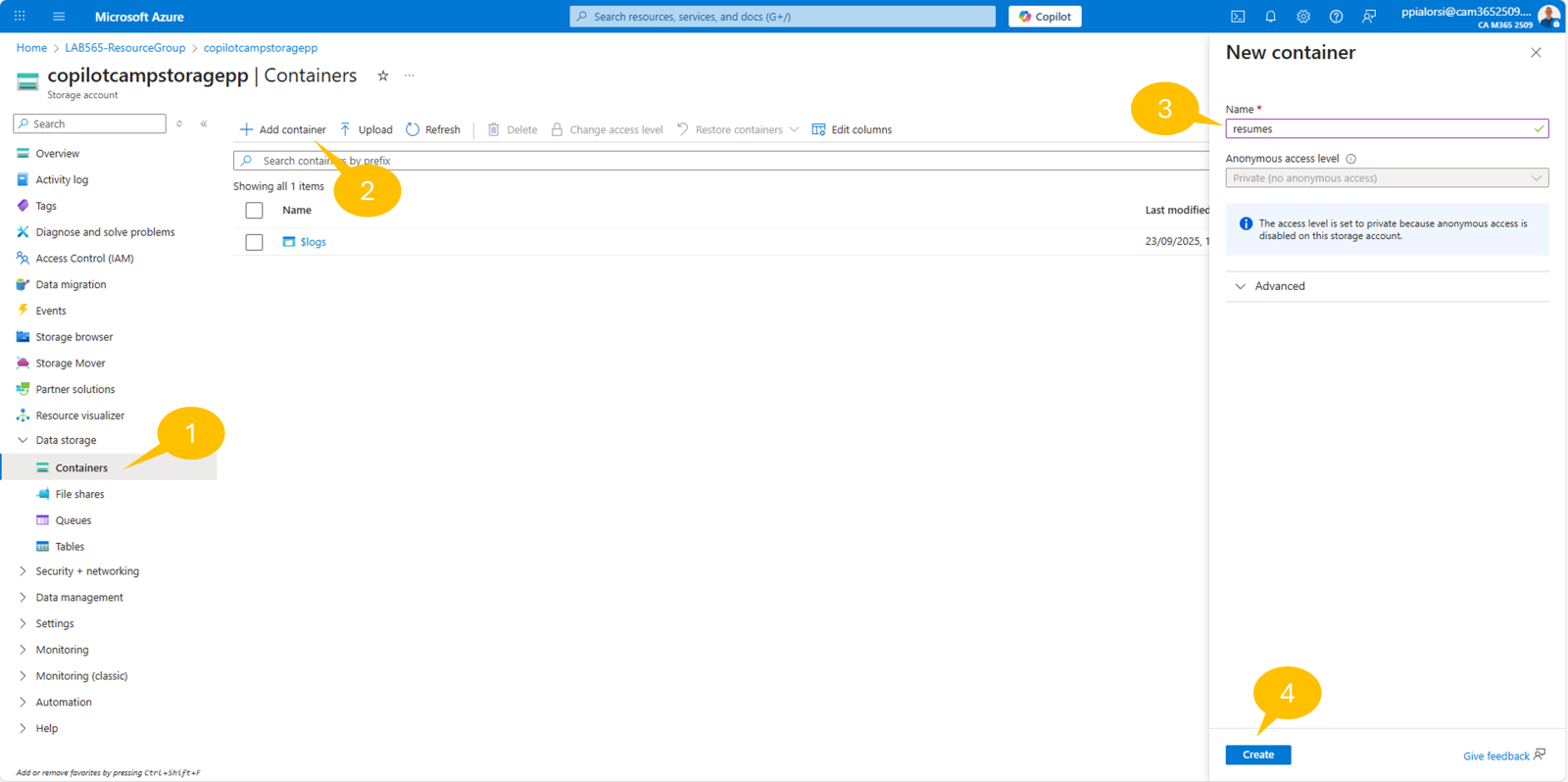
Navigate to the Azure portal and open the storage account you created in Lab 1.1.
Under Data storage in the left navigation, select Containers.
In the command bar, select + Container.
Enter
resumesas the container name.Select Create.
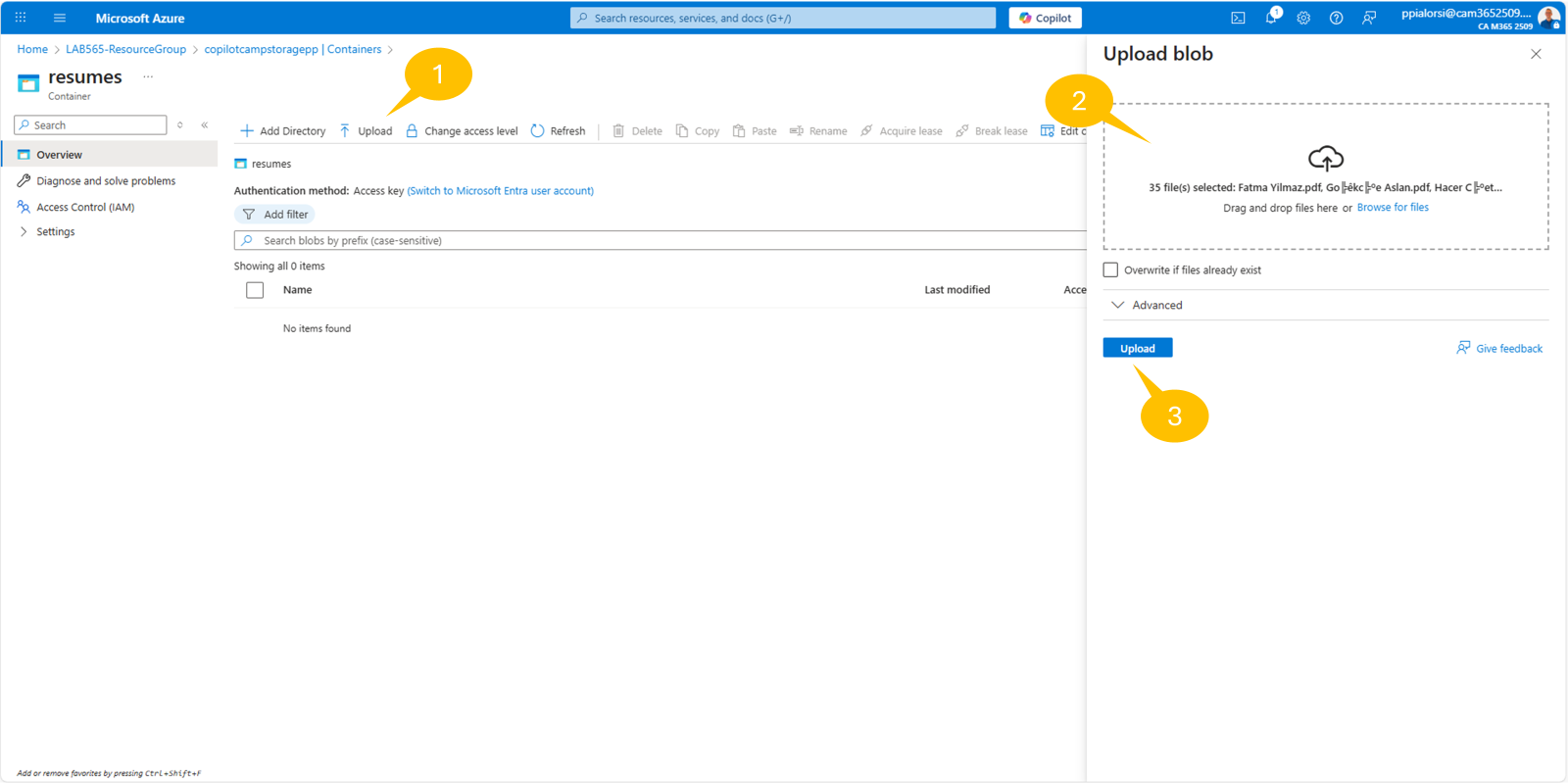
Once the container has been created, you can upload the resume files following these steps:
Select Upload
Drag and drop the resume files or select Browse for files and select the resume files
Select the Upload command and wait for the upload to complete
Populate the vector index with integrated vectorization
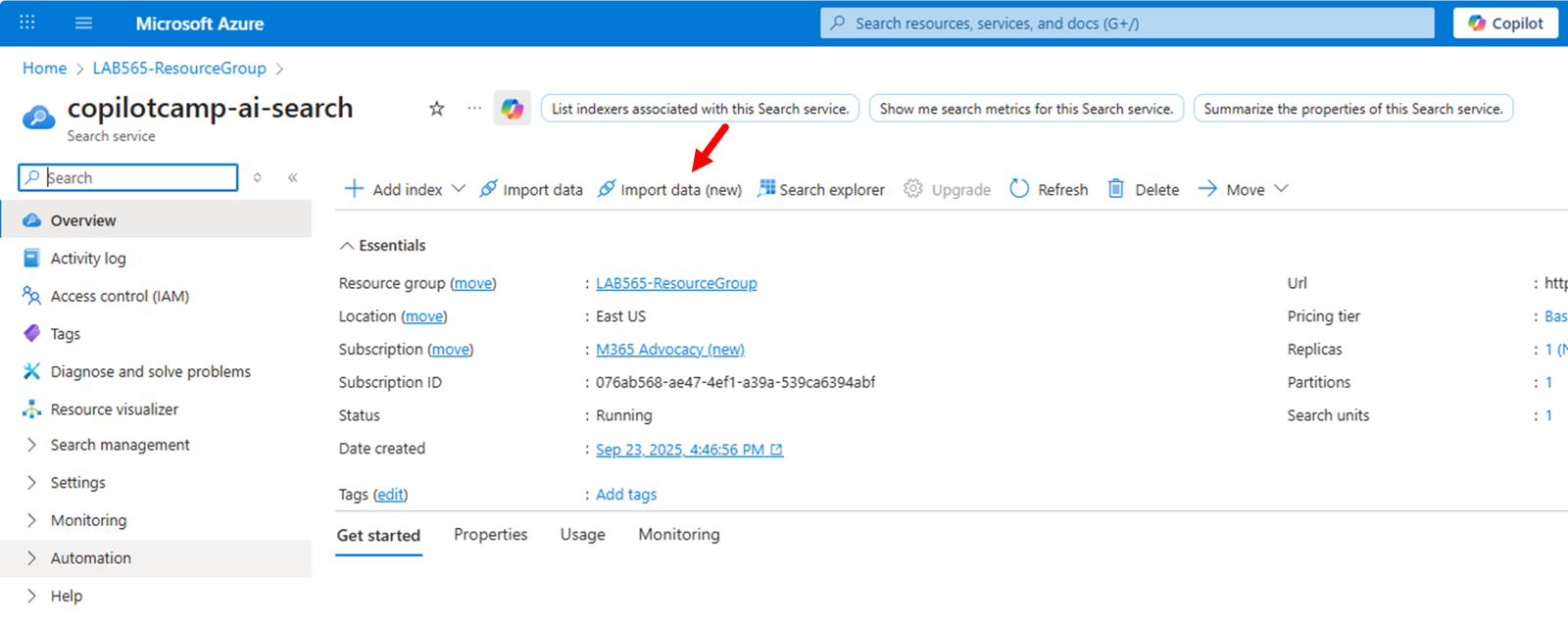
Return to the Azure portal and open your Azure AI Search service.
In the top command bar, select Import data (new).
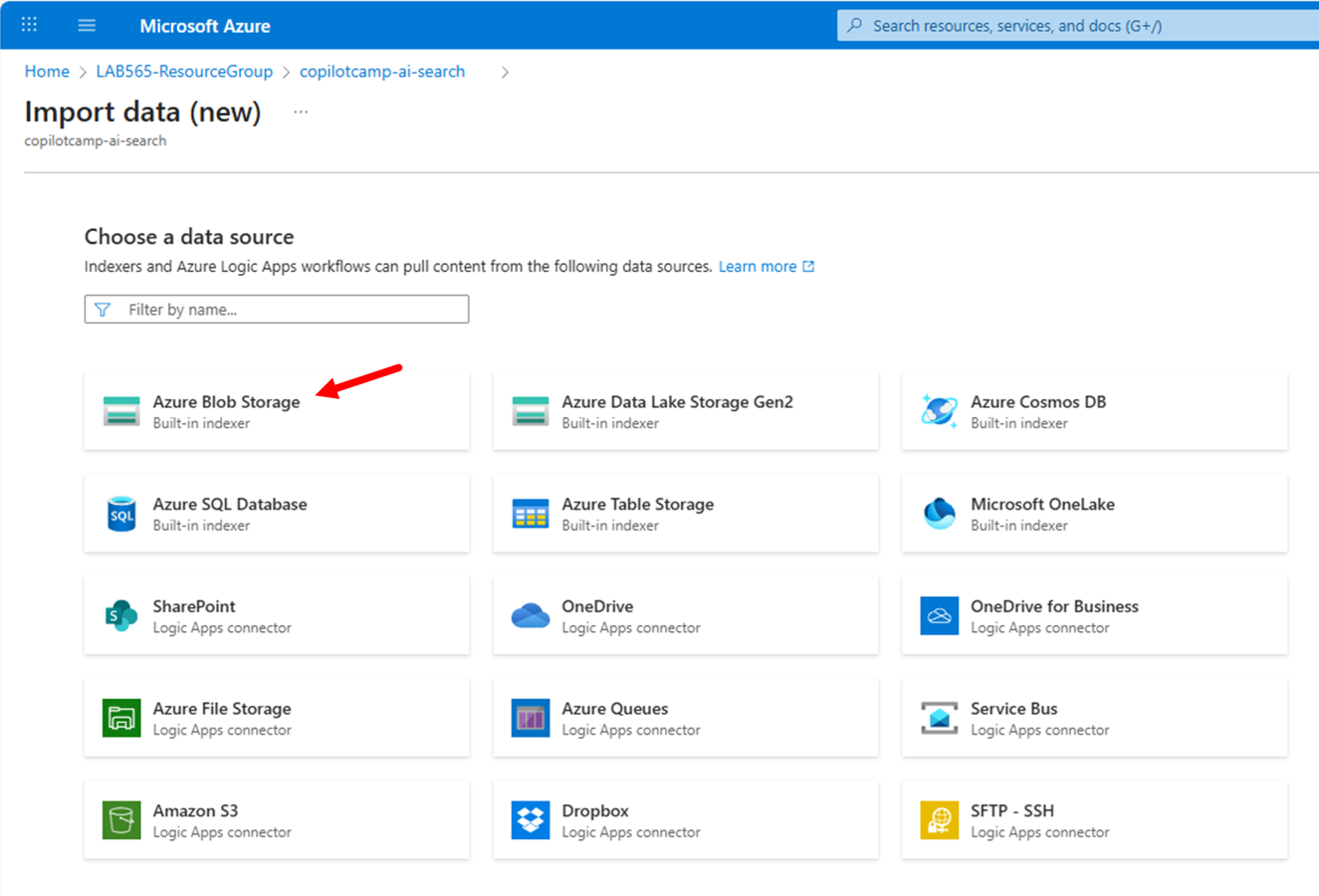
On the data import page, select Azure Blob Storage as the data source.
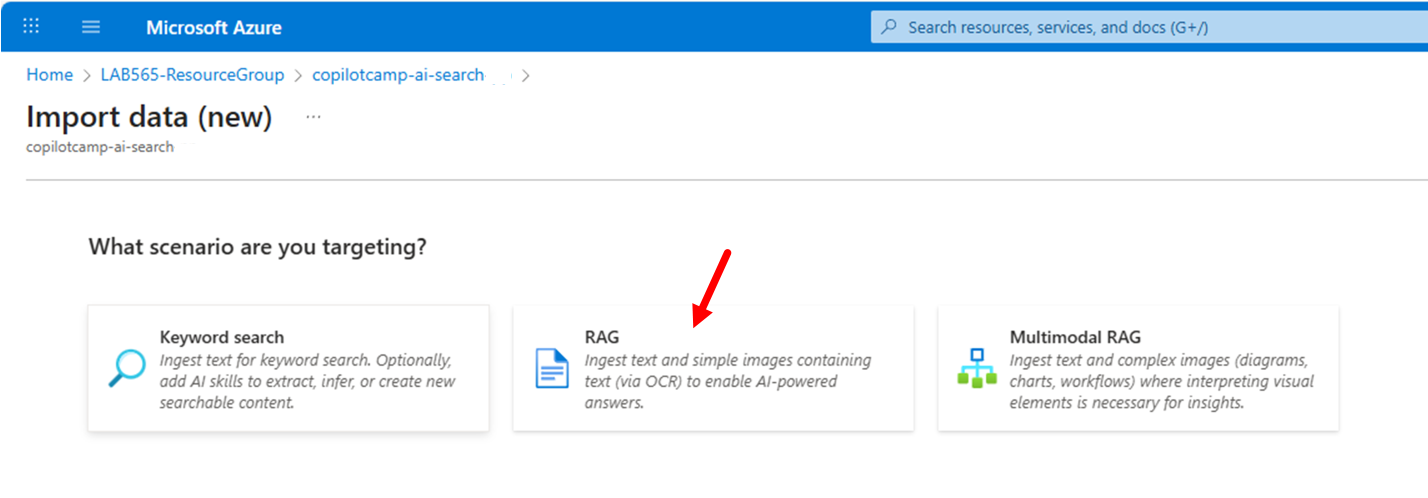
Select RAG as the target scenario.
Configure your Azure Blob Storage section:
- Subscription: Your Azure subscription
- Storage account: the storage account you created before
- Blob container: the new container that you just created and where you uploaded the resume files
- Blob folder: you can leave it blank, unless you created a folder structure in the storage container
- Parsing mode: use the Default value
- Select Next
Vectorize your text section:
- Kind: Azure OpenAI
- Subscription: your subscription
- Azure OpenAI service: your Azure OpenAI instance
- Model deployment: the
text-embeddingsmodel you deployed - Authentication type: API Key (default)
- Check the box acknowledging that connecting to Azure OpenAI incurs additional cost, then select Next.
Vectorize your images section:
- In case you are willing to process images and text in images, you could configure specific settings
- Here you can simply move Next
Advanced ranking and relevancy section:
- If you like you can schedule recurring updates of the index, on a timer based model. You can also choose whether to use the semantic ranker to get results also based on semantic and not only on lexical analysis. Last but not least, you can configure the fields that will be created in the target index
- Here you can simply move Next
Review and create section:
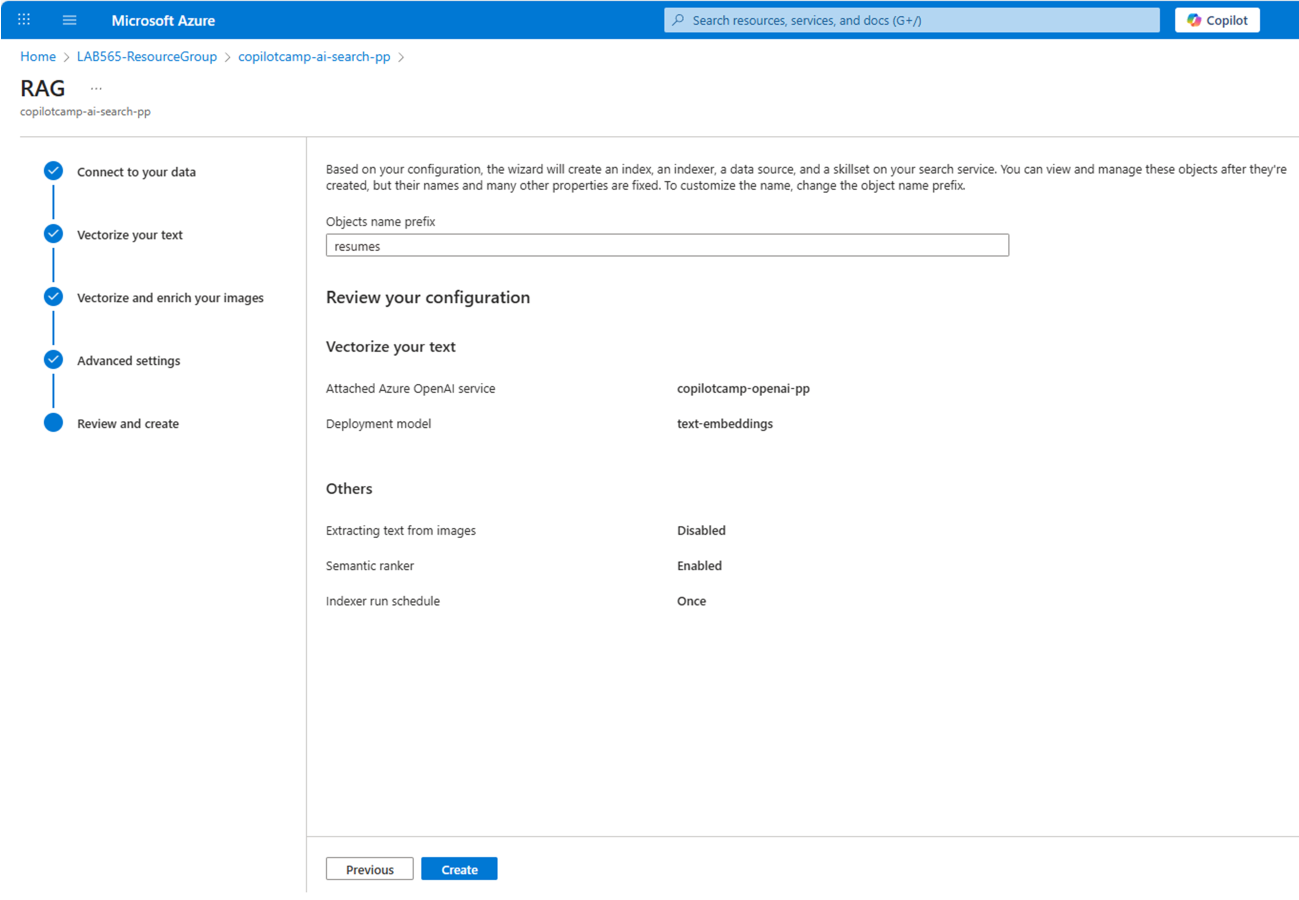
- Here you can provide a prefix for the index, indexer, data source, and skill set that will be created. For example you can use the value resumes
- Review the settings and when you are ready select Create to create and feed the vector index
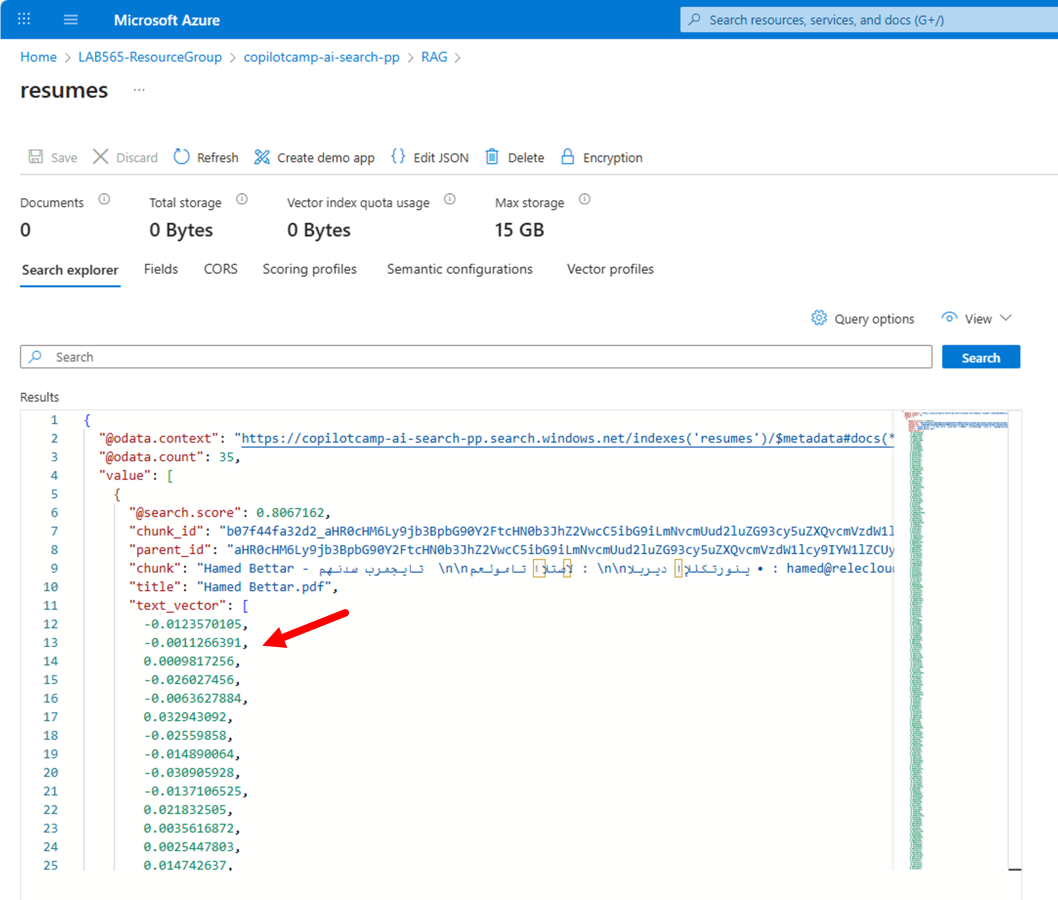
Once the vector index is created, a small dialog confirms the index creation and availability. Select the Start searching command to start playing with the index. In the search index page, you can simply select the Search command and see the output. Notice that, for every value in the index, you also have a text_vector field that contains the text vectorized using the text-embedding-ada-002 model.
🧪 Lab 1.3 — Build the RAG-enabled agent
In this exercise you will create a Microsoft Copilot Studio agent that leverages your Azure AI Search index to provide intelligent, document-backed responses about HR candidates.
Create the HR Knowledge Agent
Navigate to Microsoft Copilot Studio and sign in. Make sure New experience is turned on.
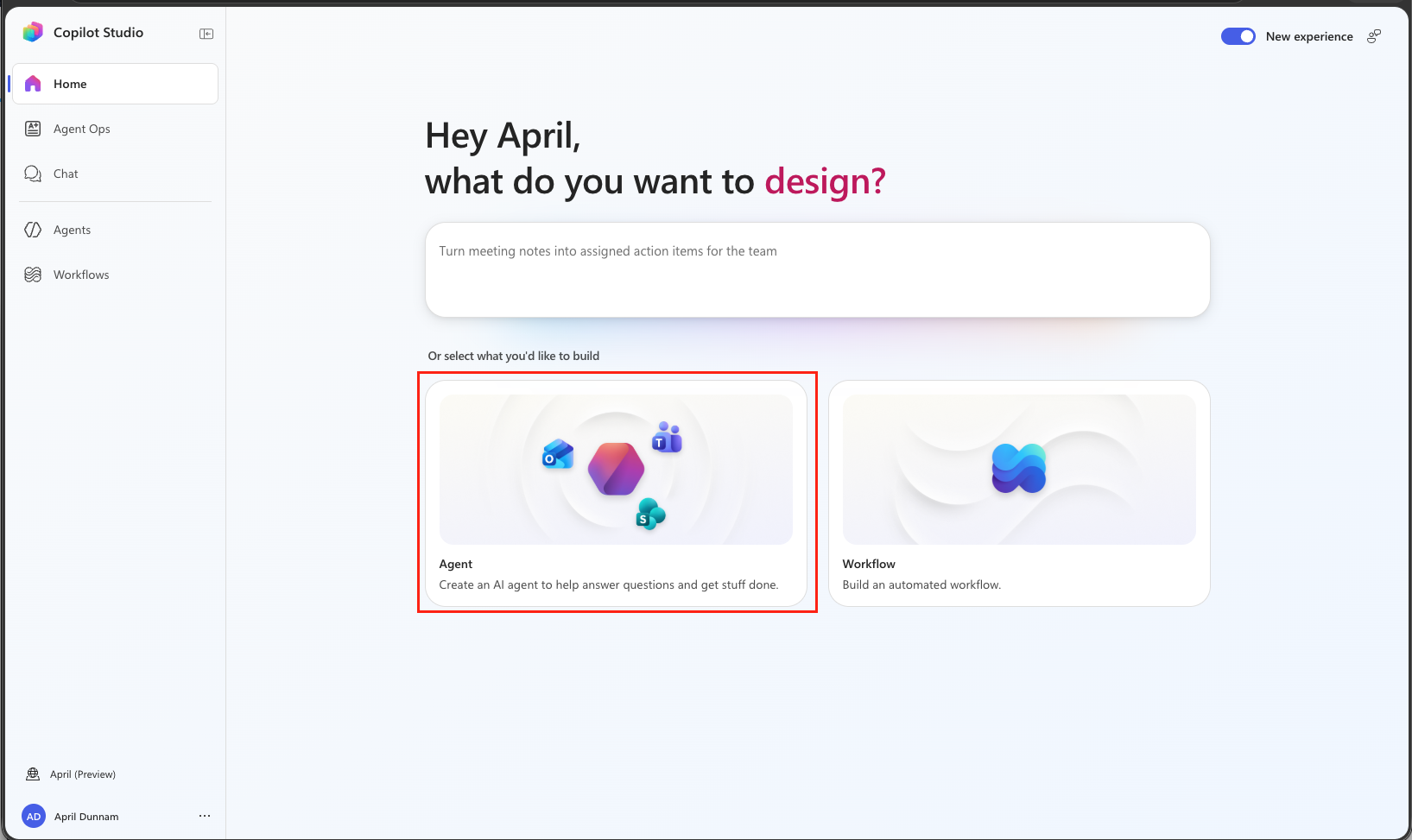
Select New Agent
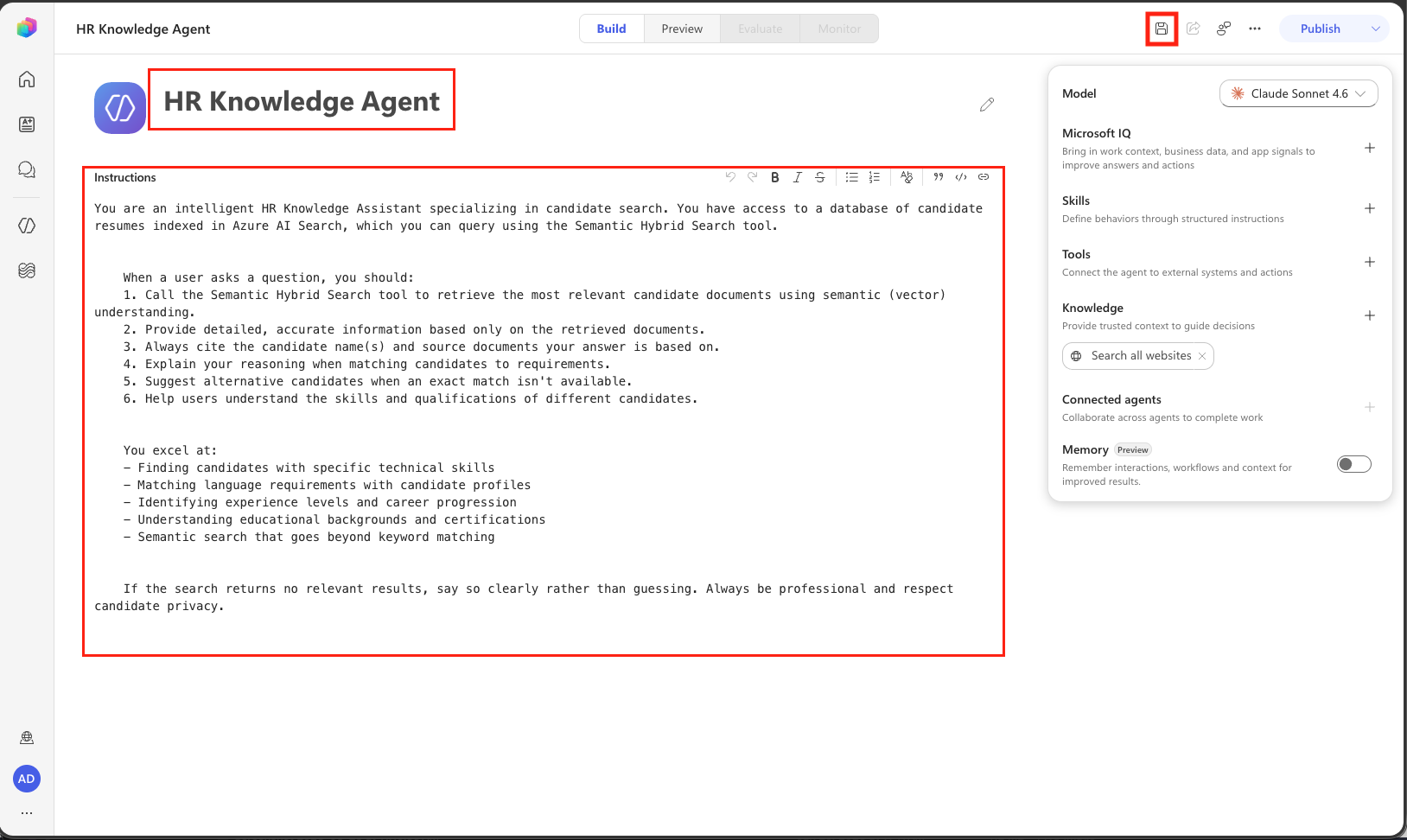
Enter the following as the agent Name (in the title box at the top):
textHR Knowledge AgentCopy and paste the following into the Instructions field. The first paragraph is the agent's description; the rest tells it how to behave and, importantly, to call the Azure AI Search tool for retrieval:
textYou are an intelligent HR Knowledge Assistant specializing in candidate search. You have access to a database of candidate resumes indexed in Azure AI Search, which you can query using the Semantic Hybrid Search tool. When a user asks a question, you should: 1. Call the Semantic Hybrid Search tool to retrieve the most relevant candidate documents using semantic (vector) understanding. 2. Provide detailed, accurate information based only on the retrieved documents. 3. Always cite the candidate name(s) and source documents your answer is based on. 4. Explain your reasoning when matching candidates to requirements. 5. Suggest alternative candidates when an exact match isn't available. 6. Help users understand the skills and qualifications of different candidates. You excel at: - Finding candidates with specific technical skills - Matching language requirements with candidate profiles - Identifying experience levels and career progression - Understanding educational backgrounds and certifications - Semantic search that goes beyond keyword matching If the search returns no relevant results, say so clearly rather than guessing. Always be professional and respect candidate privacy.Select Save in the upper right hand corner to save your changes.
Connect Azure AI Search as a tool
IMPORTANT
For agents powered by the GitHub Copilot harness, Azure AI Search is not a Knowledge source. The Add knowledge dialog only offers Public websites, SharePoint, and OneDrive. Instead, you connect Azure AI Search as a connector tool and let the agent call it for retrieval.
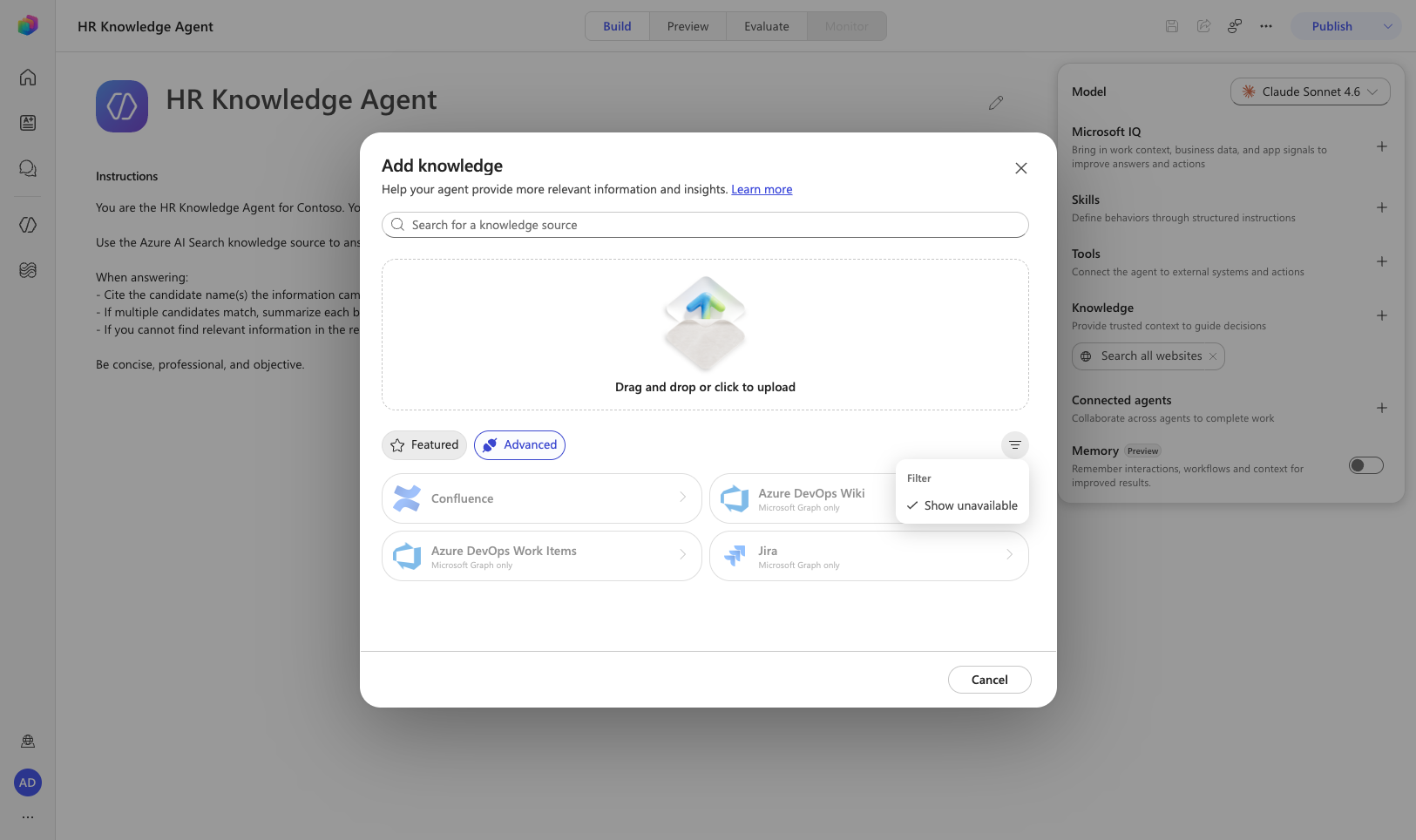
In the right-hand Agent configuration panel, find the Tools card and select Add tool.
In the Add a tool dialog, search for
Azure AI Search. The Azure AI Search connector appears with its actions, including Semantic Hybrid Search, Search vectors with natural language, Get search indexes, and Get index statistics.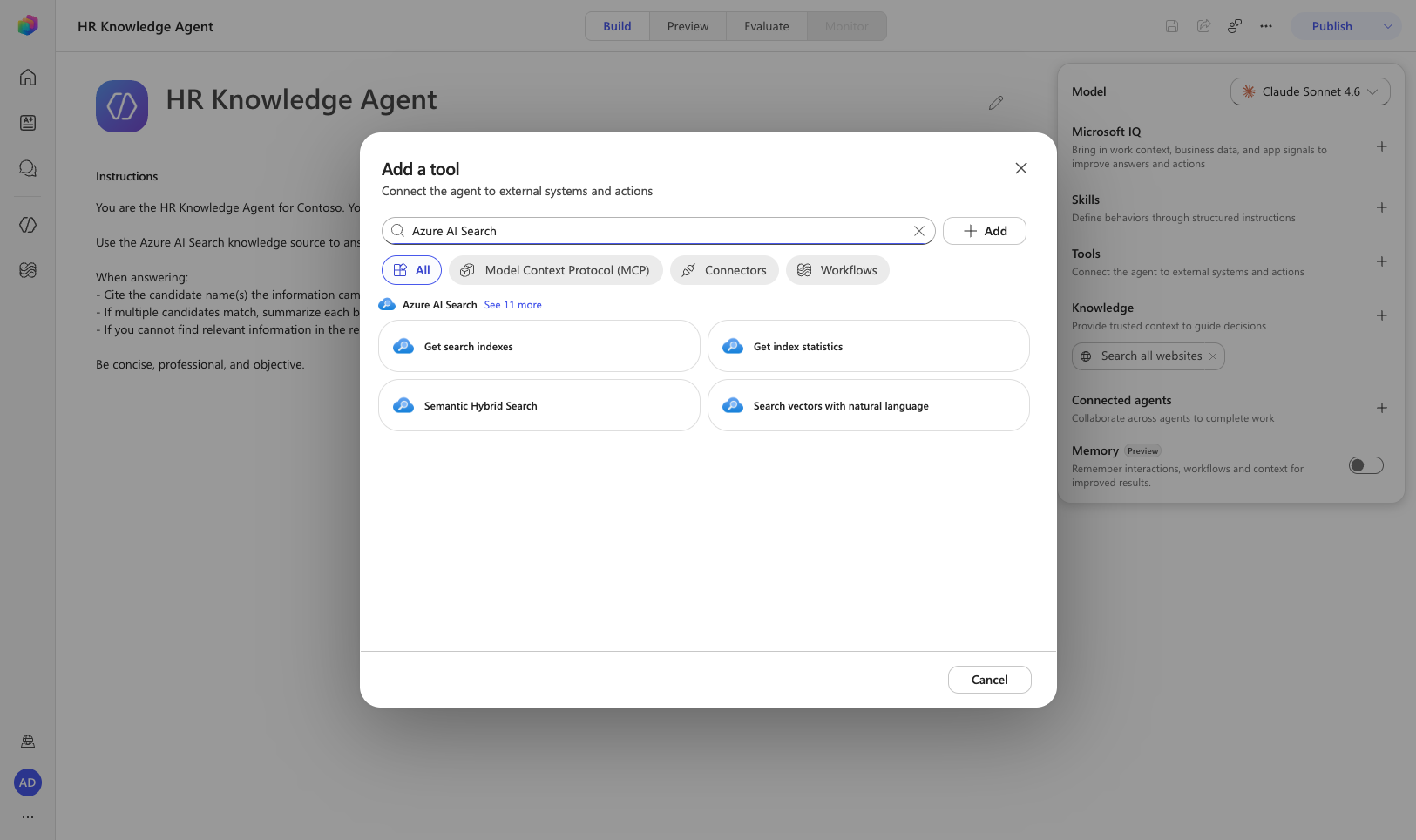
Select the Semantic Hybrid Search action, then select Add. (This action performs semantic hybrid search — combining vector and keyword search — against your index. Search vectors with natural language is a good alternative for pure vector queries.)
The tool is added under Tools. Select it to open Tool details. Here you set the tool Name, Description, and Authentication mode (User or Maker). Configure the connector connection with your Azure AI Search endpoint URL and admin key (the values you saved in Exercise 1), and point it at the
resumesindex.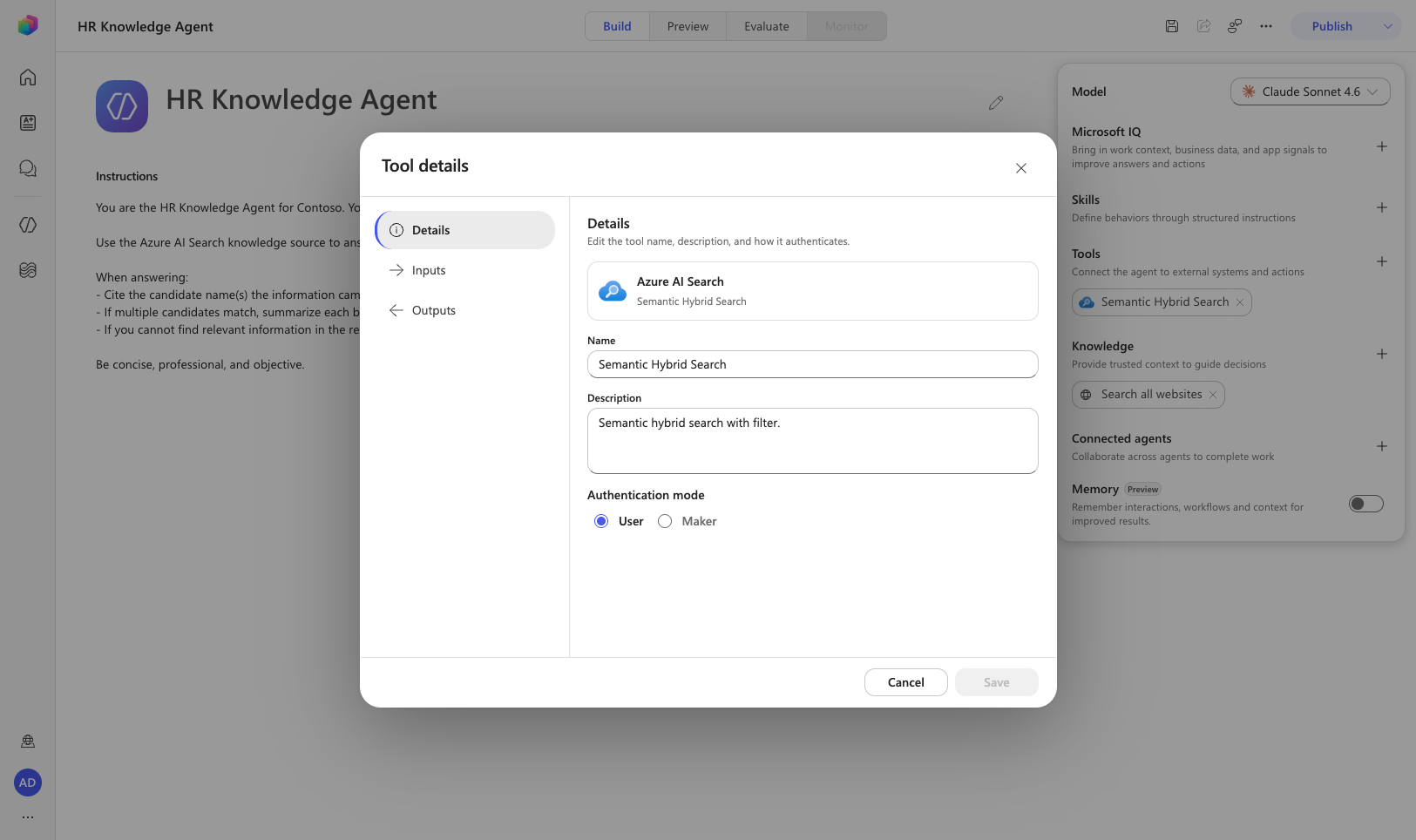
TIP
Choose User authentication if each user should connect with their own credentials, or Maker if the agent should always use the connection you (the maker) configured. For a shared HR knowledge base, Maker is usually the right choice.
Select Save and confirm the Save button becomes disabled — that means the tool is committed to the agent.
WARNING
If you navigate away with unsaved changes, they are silently discarded. Always confirm Save goes disabled before leaving the Build canvas.
🧪 Lab 1.4 — Test the agent
Now validate retrieval in the Preview tab.
Select the Preview tab. If you just added the tool, select New chat so the agent picks up the new tool context.
Try these basic queries to confirm the agent retrieves and cites indexed documents:
textHello! Can you help me find candidates with software engineering experience?textI'm looking for candidates who speak multiple languages. Can you help?textShow me candidates with machine learning or AI experience.Watch how the agent calls the Semantic Hybrid Search tool, returns relevant candidate information, cites the source documents, and uses semantic understanding rather than exact keyword matching.
NOTE
The first time the tool runs you may be prompted to confirm or create the Azure AI Search connection. Complete the connection prompt, then retry the message.
Now try more sophisticated, multi-criteria queries that show off vector search:
textFind candidates suitable for a senior role that requires 5+ years of Python experience and fluency in SpanishtextI need someone with both frontend and backend development skills. Who would be good for a full-stack position?textCan you recommend candidates for a data science position that requires experience with machine learning frameworks?textWho has project management experience combined with technical skills?Notice how the agent combines multiple criteria, explains its reasoning, suggests alternatives when there's no exact match, and grounds every recommendation in the retrieved resumes.
✅ Mission Accomplished
Congrats, agent — Operation Vector Vault is complete! Your Copilot Studio agent now answers questions by retrieving from your own documents through Azure AI Search vector search.
In this mission, you accomplished:
✅ Azure AI Search: created and configured a search service for enterprise knowledge ✅ Integrated Vectorization: built a vector index from PDFs using an embedding model ✅ Connector-based RAG: Connected Azure AI Search as a tool for an agent powered by the GitHub Copilot harness, replacing the retired Azure AI Search knowledge source ✅ Instruction Engineering: directed the agent to call the search tool and cite its sources ✅ Semantic Testing: validated meaning-based retrieval with basic and complex queries
The RAG pattern you built applies far beyond HR — customer support knowledge bases, technical documentation, policy guides, and any domain where users need to search large document collections through natural conversation.
🏅 Claim your completion badge
Congrats, agent — mission accomplished! Now it's time to claim your badge.
Simply submit the badge request form and answer all required questions:
https://aka.ms/agent-academy-special-ops/vector-vanguard/form
Once your submission is reviewed, you will receive an email from Global AI Community with instructions to claim your badge.
TIP
If you do not see the email, check your spam or junk folder.
📚 Tactical Resources
📖 Integrated vectorization in Azure AI Search
📖 Azure AI Search connector reference
📖 Add tools to a Copilot Studio agent
📖 Retrieval-Augmented Generation (RAG) overview