Task 03: Migrate the RHEL VM
Introduction
This is the “go time” moment Terra Firm worries about most - moving the workload without surprises. A planned migration uses the latest replicated data for a controlled cutover, helping Dennis demonstrate a predictable process and making it easier to justify scaling the approach across the rest of the environment.
Description
In this task, you’ll initiate a planned migration for the replicated Airsonic-Frontend VM and monitor the migration job until it completes.
Success criteria
- A planned migration completes successfully for Airsonic-Frontend.
- The migrated VM is created in Azure and starts successfully.
Key tasks
- Confirm replication is protected and initiate Migrate (planned failover) from the replication item.
- Approve shutdown of the on-premises VM for a no-data-loss cutover.
- Monitor the migration job until it completes successfully.
-
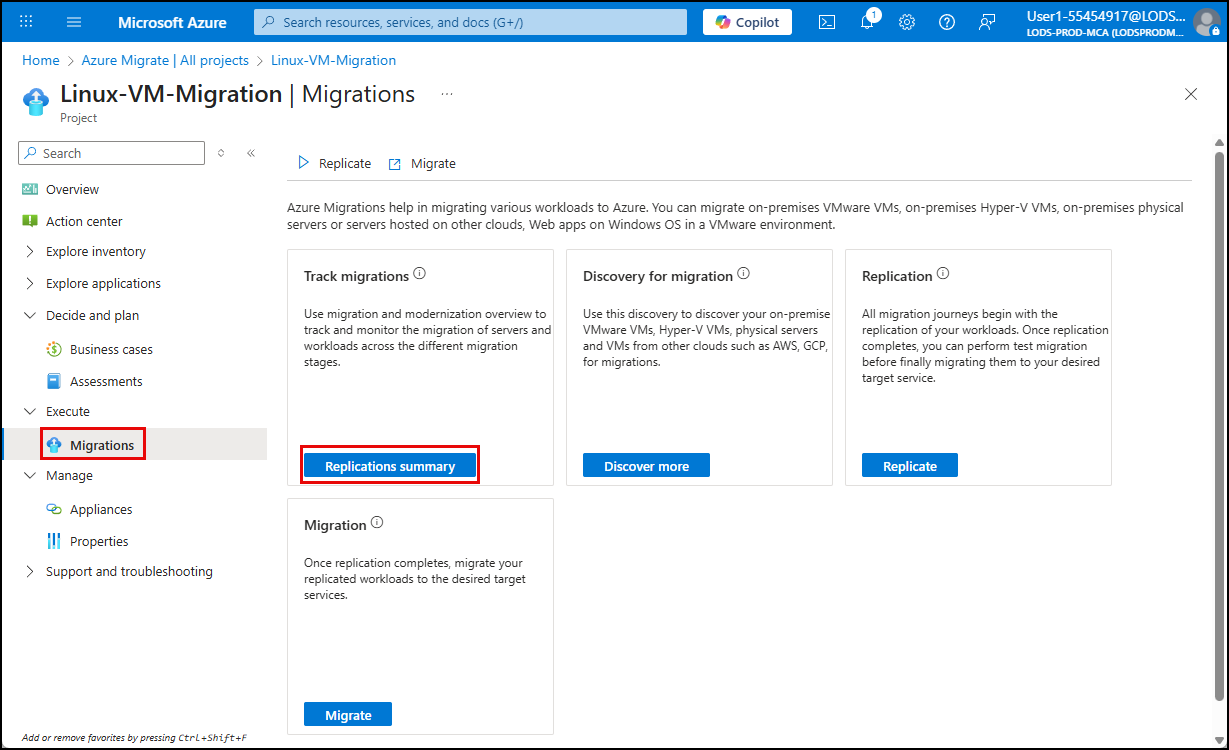
In the Azure portal, return to the Migration-Project-@lab.LabInstance.Id Project page, expand Execute in the left menu, select Migrations, and on the Migration blade, select Replications summary.
-
On the Replications Summary page, expand Migration in the left menu, select Replications, and observe the replication you started previously.
The replication is complete when you see the replication status for the Airsonic-Frontend set to Protected.
-
Start the migration by selecting the ellipsis to the right of the Airsonic-Frontend item, and then select Migrate from the context menu.
-
Select Yes to shutting down the VM and performing a planned migration with no data loss.
-
Select Migrate to begin the migration process.
The migration process will take approximately 15 minutes.
Congratulations!
You performed a planned migration cutover to create and start the Azure VM using the latest replicated data with minimal risk of data loss.