Task 05: Hunt for lateral movement with graph-semantic KQL
Introduction
Graph-semantic KQL queries allow you to define entities and their relationships directly in query logic—ideal for visualizing lateral movement.
Description
You’ll simulate a small graph dataset and visualize how user and device relationships can indicate attacker movement.
Success criteria
- A graph query runs successfully.
- Results show clear Source–Target entity relationships.
Key steps:
-
Run a graph-semantic query.
Expand here for detailed steps
 let Now = now();
 datatable(EdgeId:string, SourceId:string, TargetId:string, EdgeType:string, OffsetHours:int)
 [
   "E1","U1","D1","LoggedOn",5,
   "E2","D1","D2","RemoteSession",4,
   "E3","U2","D2","LoggedOn",3
 ]
 | extend TimeGenerated = datetime_add('hour', -OffsetHours, Now)
 | project EdgeId, SourceId, TargetId, EdgeType, TimeGenerated
 | join kind=inner (
     datatable(NodeId:string, NodeType:string, NodeName:string)
     [
       "U1","User","alice@contoso.com",
       "D1","Device","PC-Alice",
       "D2","Device","Server-Finance",
       "U2","User","bob@contoso.com"
     ]
     | project NodeId, SourceName = NodeName
 ) on $left.SourceId == $right.NodeId
 | join kind=inner (
     datatable(NodeId:string, NodeType:string, NodeName:string)
     [
       "U1","User","alice@contoso.com",
       "D1","Device","PC-Alice",
       "D2","Device","Server-Finance",
       "U2","User","bob@contoso.com"
     ]
     | project NodeId, TargetName = NodeName
 ) on $left.TargetId == $right.NodeId
 | project SourceName, EdgeType, TimeGenerated, TargetName
 | order by TimeGenerated desc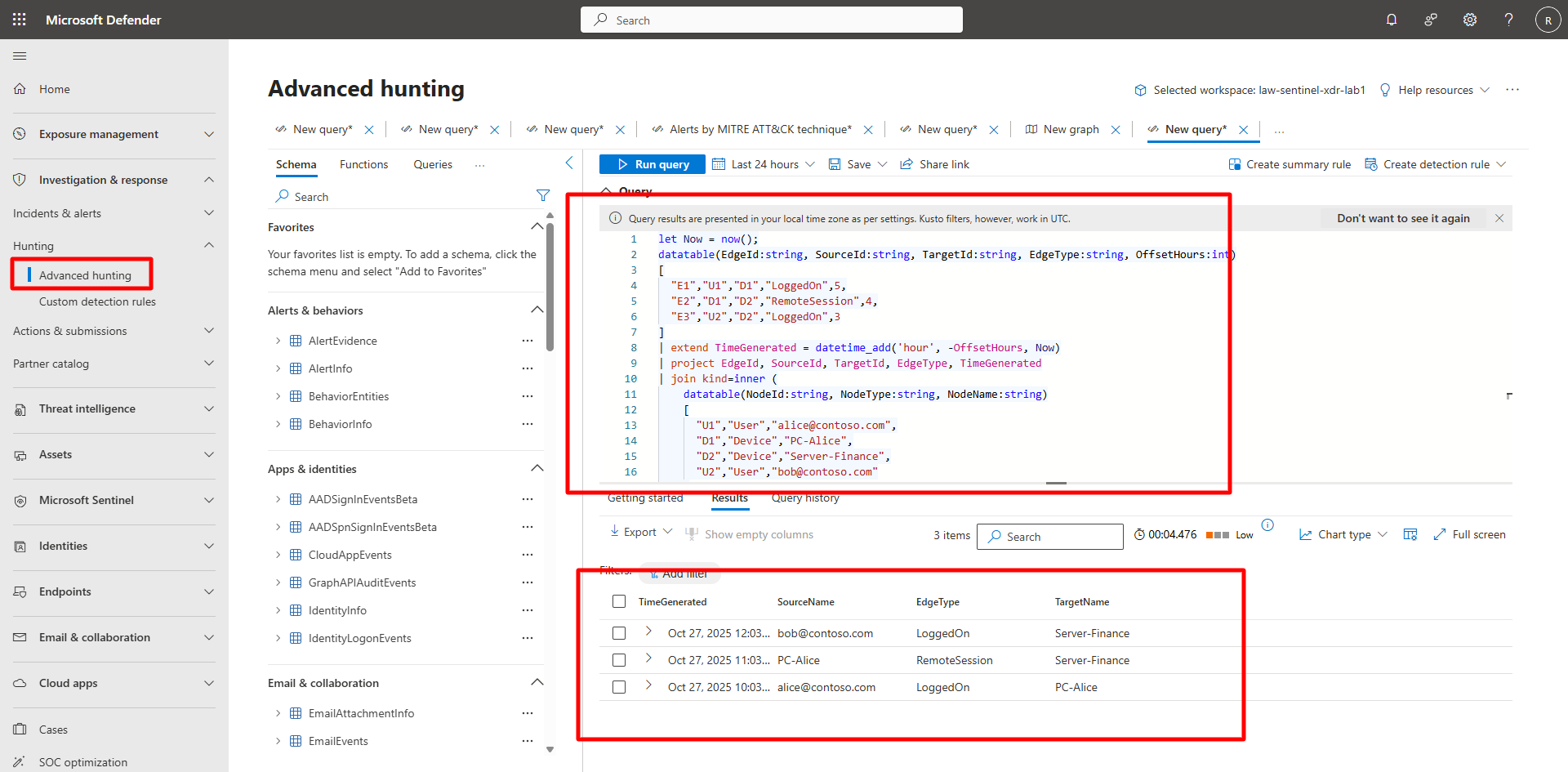
This query builds mock Edges and Nodes tables, joining them twice to display meaningful relationships between users and devices.