Microsoft.UI.Reactor (Reactor) is a declarative shell over WinUI. You write a Component whose
Render() method returns an immutable tree of element records — value
types that describe what you want on screen, not the WinUI controls that
implement it. A single reconciler diffs the new tree against the previous
one and edits a long-lived WinUI control tree in place, renting and
returning controls through an element pool so the heavy classes
(Button, TabView,
ItemsRepeater) survive across renders. Hooks like
UseState hold the state that drives the loop, and effects
fire after the reconciler has committed property writes, so the UI you
observe in an effect is the UI on screen. The most common mistake is
reading this page as "Reactor wraps XAML" — the element tree is not a
shadow XAML graph, it is a new authoring surface that happens to
materialize WinUI.
Architecture Overview¶
This page maps Reactor's runtime end-to-end so the rest of the Under-the-hood track has a shared diagram to point at. Read it once, then jump to the section you care about: Reactivity Model, Reconciliation, Hooks Internals, or Effects Scheduling.
The render loop¶
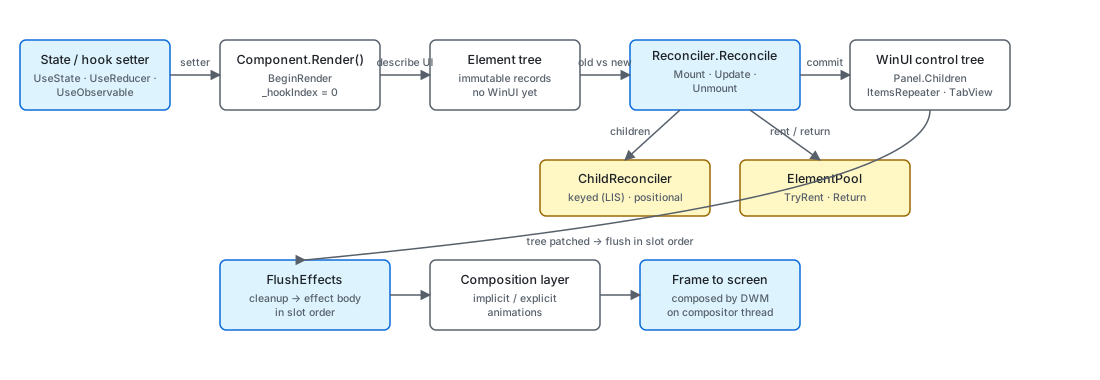
The flow is one-way. A hook setter writes a new value into a
RenderContext slot, the context calls back into
the host with a re-render request, the component's Render() produces a
new element tree, the reconciler walks both trees in lockstep and writes
the differences to existing WinUI controls. Nothing pulls. There is no
binding expression listening to a property; the element tree is the
single source of truth for the frame after a re-render, and the
reconciler is the single mutator.
| Subsystem | Files | What it owns |
|---|---|---|
| Component shell | src/Reactor/Core/Component.cs |
Render() contract, ShouldUpdate, hook convenience methods |
| Hook table | src/Reactor/Core/RenderContext.cs |
Slot table, hook implementations, UI-thread invariant |
| Elements | src/Reactor/Core/Element.cs, ElementFactory.cs |
Immutable records, factory plumbing for ItemsRepeater |
| Reconciler | src/Reactor/Core/Reconciler*.cs, ChildReconciler.cs |
Mount / Update / Unmount, keyed LIS diff |
| Pool | src/Reactor/Core/ElementPool.cs |
TryRent / Return for poolable leaf controls |
| Modifiers | src/Reactor/Elements/ElementExtensions*.cs |
Fluent modifier fold |
| Hosting | src/Reactor/Hosting/ |
Window/app bootstrap, UI dispatcher capture |
| Diagnostics | src/Reactor/Core/Diagnostics/ |
ETW provider, overlay hooks |
| Advanced sibling package | src/Reactor.Advanced/ |
Optional heavy dependencies; first inhabitant is Win2D canvas |
Every section below zooms into one row of that table.
public abstract class Component
{
    // Settable so the reconciler can transfer a live RenderContext (hooks +
    // cleanups) onto a freshly-constructed instance when a Hot Reload edit
    // mints a new component Type token (spec 049 §7 subtree migration). Outside
    // that path the value is the per-instance context created here.
    internal RenderContext Context { get; set; } = new();

    /// <summary>
    /// Override to describe the UI. Use UseState, UseEffect, etc. from the context.
    /// Must call hooks in the same order every render.
    /// </summary>
    public abstract Element Render();

    /// <summary>
    /// Controls whether this propless component should re-render when its parent re-renders.
    /// Default: false — propless components only re-render from their own state changes or context changes.
    /// Override and return true to always re-render when the parent re-renders.
    /// </summary>
    protected internal virtual bool ShouldUpdate() => false;
Component is the surface — a single abstract Element Render() plus
the ShouldUpdate() hook that lets a propless component opt out of
parent-driven renders. Everything else is convenience wiring around the
RenderContext that holds the hook slot table.
Function components (Memo(ctx => ...)) skip the class declaration but
go through the same RenderContext machinery.
Caveat: The reconciler never recreates the WinUI control tree on a re-render. If you cache a control reference outside Reactor (e.g. stash a
Buttonfrom a captured ref in a long-lived field) and the element it materialized later gets replaced because its type changed, your stash points at an unmounted control — one that may already have been returned to the element pool, stripped of its element tag, and re-rented by an unrelated part of the tree. UseUseElementRefand read.Currentinside an effect — the ref is the only thing the reconciler keeps current.
Element records — the immutable description¶
public abstract record Element
{
    /// <summary>
    /// Optional key for stable identity across re-renders (like React's key prop).
    /// When set, the reconciler uses it to match elements across list reorderings.
    /// </summary>
    public string? Key { get; init; }

    /// <summary>
    /// Layout modifiers (margin, padding, size, alignment, etc.) applied to this element.
    /// Set via fluent extension methods: TextBlock("hi").Margin(10).Width(200)
    /// Modifiers are stored inline so the concrete element type is preserved through chaining.
    /// </summary>
    public ElementModifiers? Modifiers { get; init; }
Every node in the tree is a record deriving from Element. The shape
matters: records are value-like, structurally immutable, and cheap to
allocate. A render produces a fresh tree on the heap; the previous
tree's records become garbage as soon as the reconciler finishes the
pass. The Key slot is the identity primitive — set it via .WithKey()
on collection items so the child reconciler can
match elements across reorderings.
Modifiers ride inside ElementModifiers. A chain like
TextBlock("hi").FontSize(24).Margin(8) produces one TextBlockElement with a
merged Modifiers record, not three nested wrappers — the
modifier system folds them so the reconciler only
sees one shape per concept.
public UIElement GetElement(ElementFactoryGetArgs args)
{
    // Resolve the realized data → (key, dataIndex). Three paths:
    //   1. Spec 042: args.Data is ReactorRow — read both off the row.
    //   2. Legacy: args.Data is int — index directly, synthetic key.
    //   3. Fallback: unknown shape, treat as index 0.
    string key;
    int index;
    bool keyed;
    switch (args.Data)
    {
        case ReactorRow row:
            key = row.Key;
            index = row.Index;
            keyed = true;
            break;
        case int i:
            index = i;
            key = i.ToString(global::System.Globalization.CultureInfo.InvariantCulture);
            keyed = false;
            break;
        default:
            index = 0;
            key = "0";
            keyed = false;
            break;
    }

    if (index < 0 || index >= _items.Count)
        return new TextBlock { Text = "" };

    var item = _items[index];
    var element = BuildOrCache(key, item, index, keyed);

    UIElement? control;
    if (TryTakeCompatibleFromPool(element, out var reused, out var oldElement, out var parkedVisibility))
    {
        // Reuse a previously-recycled container. The framework still has
        // it parented to the ItemsRepeater, so the ViewManager.cpp:866
        // Append-skip kicks in and the visual tree stays stable.
        //
        // Undo the parking collapse from RecycleElement BEFORE reconciling.
        // Restore the exact pre-park value source rather than forcing
        // Visible: an in-place diff whose Visibility modifier is unchanged
        // writes nothing, so forcing Visible would silently un-collapse a
        // row the author asked to hide.
        RestoreParkedVisibility(reused, parkedVisibility);
        var replacement = _reconciler.Reconcile(oldElement, element, reused, _requestRerender);
        if (replacement is not null && !ReferenceEquals(replacement, reused))
        {
            // Pass-2 reuse: the row's key changed, so Reconcile unmounted the old
            // component (effect cleanups ran) and built a fresh wrapper. Move that
            // subtree back into the container we already have — returning the
            // replacement instead would strand `reused`, which cannot be un-parented
            // from an ItemsRepeater (see DetachFromParent). (Issues #326, #919.)
            //
            // A pass-1 selection can land here too: CanUpdate was true, but a
            // decorator-style handler substituted a different instance. Re-check
            // CanSafelyAdopt so only wrappers whose entire state lives in the
            // component subtree are adopted; everything else takes the fresh
            // replacement and parks the container.
            if (CanSafelyAdopt(reused, oldElement, element)
                && _reconciler.TryAdoptRealizedReplacement(reused, replacement))
            {
                control = reused;
                // Same as the adopt path above: refresh the back-pointer the
                // adoption itself does not move, so the reported source
                // location follows the row that is actually live (spec 010).
                if (reused is FrameworkElement adoptedFe)
                    Reconciler.SetElementTagIfNeeded(adoptedFe, element);
            }
            else
            {
                // Nothing can install `replacement` into `reused`. Retire `reused`
                // — park it collapsed with its Reactor state detached — rather than
                // leaving a live ghost row painted over the list. Do NOT return it to
                // the pool: it was unmounted inside Reconcile, so its tracked Element
                // no longer describes it.
                RetireAlreadyUnmounted(reused);
                control = replacement;
            }
        }
        else
        {
            control = reused;
        }
    }
    else
    {
        control = _reconciler.Mount(element, _requestRerender);
    }

    _mountedElements[key] = element;
    if (control is not null)
    {
        _keyByControl[control] = key;
        _lastElementByControl[control] = element;
        if (_keyByControl.Count > _maxRealized) _maxRealized = _keyByControl.Count;

        // Issue #383: arm the multi-select checkmark flicker guard on the
        // realized container. Idempotent per container instance.
        // Intentionally scoped to ItemContainer (the ItemsView item-root
        // wrapper): LazyVStack/LazyHStack realize into plain panels via
        // ItemsRepeater, not ItemContainer, and the MultiSelectStates.Multiple
        // storyboard the guard collapses only ever runs for multi-select
        // ItemContainers — so widening this to all controls would be inert
        // work everywhere else. Do not "generalize" it.
        if (control is ItemContainer itemContainer)
            ItemContainerSelectionFlickerGuard.Ensure(itemContainer);
    }

    return control ?? new TextBlock { Text = "" };
}
Element factories show the shape from the other side: the
collections layer hands an ItemsRepeater an
ElementFactory which, on demand, builds a new element for an item
index, mounts a control through the same reconciler, and hands the
control back. The _viewBuilder is the closure you passed to
ForEach(items, viewBuilder); the reconciler ensures that re-rendering
re-uses the same control whenever the keyed identity matches.
Reconciler — the only mutator¶
public UIElement? Reconcile(
    Element? oldElement,
    Element? newElement,
    UIElement? existingControl,
    Action requestRerender)
{
    ReferenceDirtySet.BeginCommit();
    try
    {
    // Trace only top-level reconcile passes (depth == 0) to avoid flooding
    // the provider with per-subtree entries; nested Reconcile() calls during
    // the same pass don't emit their own start/stop. Gate the depth counter
    // and Start emit on IsEnabled so the disabled path pays nothing extra.
    // `traceEnabled` and `emitTrace` are tracked separately: every enabled
    // call must decrement the depth it incremented, but only the outermost
    // one emits. Decrementing on `emitTrace` alone would leak the counter
    // once a pass contained a nested reconcile, permanently suppressing
    // every later top-level trace.
    bool traceEnabled = Diagnostics.ReactorEventSource.Log.IsEnabled(
        global::System.Diagnostics.Tracing.EventLevel.Informational,
        Diagnostics.ReactorEventSource.Keywords.Reconcile);
    bool emitTrace = traceEnabled && _reconcileTraceDepth++ == 0;
    if (emitTrace)
    {
        Diagnostics.ReactorEventSource.Log.ReconcileStart(
            newElement?.GetType().Name ?? "null");
    }
    if (_debugReconcileDepth++ == 0)
    {
        DebugElementsDiffed = 0;
        DebugElementsSkipped = 0;
        DebugUIElementsCreated = 0;
        DebugUIElementsModified = 0;
        // Drop destination references a previous pass queued but never flushed. Every
        // shipped host flushes at the end of each render, but a pass that threw
        // mid-reconcile — or a Reconcile() caller that never flushes (tests,
        // embedders) — must not accumulate strong UIElement refs. A list clear, so
        // nothing here can throw and strand the depth counter incremented just above.
        _pendingConnectedAnimationStarts.Clear();
        _preparedConnectedAnimationKeys.Clear();
        if (ReactorFeatureFlags.HighlightReconcileChanges)
        {
            (_highlightMounted ??= new()).Clear();
            (_highlightModified ??= new()).Clear();
        }
        // Consume the hot-reload signal exactly once per top-level pass so
        // every component re-runs Render() even when props/deps are unchanged.
        _forceFullRenderActive = ForceFullRenderPending;
        ForceFullRenderPending = false;

        // Build the dirty-ancestor path. For every component node
        // whose SelfTriggered is true, walk up the realized visual
        // tree and add each ancestor control. Consumed by Update's
        // shallow-equality short-circuit so the walk can reach the
        // self-triggered descendant even when its ancestor element
        // records are structurally unchanged.
        PopulateDirtyAncestorPath();
    }
    try {
    try
    {
        if (newElement is null or EmptyElement)
        {
            if (existingControl is not null)
                Unmount(existingControl);
            return null;
        }

        if (oldElement is null or EmptyElement || existingControl is null)
            return Mount(newElement, requestRerender);

        return ReconcileImperative(oldElement, newElement, existingControl, requestRerender);
Reconcile is a tri-state dispatch: (oldElement, newElement) resolves
into Unmount, Mount, or Update. A newElement that
is null or EmptyElement unmounts; a missing oldElement (or a
missing existingControl) mounts; anything else falls through to
ReconcileImperative, the update walk. The Mount path allocates WinUI
controls (or rents them from the element pool); the
update path uses CanUpdate(old, new) to decide whether to patch the
existing control in place or unmount-and-remount. The Unmount path
returns to the pool and walks effect cleanups in slot order.
The reconciler is split across partial files: Reconciler.Mount.cs
and Reconciler.Update.cs hold the dispatch logic plus the
composition-primitive handlers, registered descriptors/handlers hold
per-control mount/update logic, and ChildReconciler.cs
holds the keyed-vs-positional child diff. There is one reconciler instance per host; component
recursion shares the dispatch.
Hooks — slot table per RenderContext¶
public (T Value, Action<T> Set) UseState<T>(T initialValue, bool threadSafe = false)
{
    if (_hookIndex >= _hooks.Count)
    {
        _hooks.Add(new ValueHookState<T>(initialValue, threadSafe));
    }

    var currentIndex = _hookIndex;
    _hookIndex++;

    if (_hooks[currentIndex] is not ValueHookState<T> hook)
        throw new HookOrderException(
            $"Hook at index {currentIndex} is {_hooks[currentIndex].GetType().Name}, expected ValueHookState<{typeof(T).Name}> (UseState). " +
            "Hooks must be called in the same order every render.");
Each component instance owns a RenderContext
with a List<HookState> indexed by call order. BeginRender resets
_hookIndex to zero; each hook call reads or creates the slot at the
current index and advances. Slot type mismatches throw
HookOrderException immediately — this is why
hook rules (no conditional hooks, no hooks in
loops with varying counts) exist. Without the positional invariant, a
setter on render N would write the wrong slot on render N+1.
Hook setters are the entry point into the render loop. They do not
mutate the UI directly; they store a value, equality-check against the
previous, and call _requestRerender on the host if anything changed.
The host coalesces requests through DispatcherQueue.TryEnqueue, so a
synchronous handler that calls three setters produces one re-render.
Patterns¶
Tracing a render end-to-end¶
When you need to know what happened on a single frame, enable the
reconcile overlay from the dev menu and watch the ETW
ReactorEventSource provider. The keywords are split so you can subscribe
to State, Render, Reconcile, and Effect independently — each
roughly corresponds to one box on the diagram above. The
perf-instrumentation page covers the
attribution side; the devtools-internals page
covers the overlay rendering.
public abstract class Component
{
    // Settable so the reconciler can transfer a live RenderContext (hooks +
    // cleanups) onto a freshly-constructed instance when a Hot Reload edit
    // mints a new component Type token (spec 049 §7 subtree migration). Outside
    // that path the value is the per-instance context created here.
    internal RenderContext Context { get; set; } = new();

    /// <summary>
    /// Override to describe the UI. Use UseState, UseEffect, etc. from the context.
    /// Must call hooks in the same order every render.
    /// </summary>
    public abstract Element Render();

    /// <summary>
    /// Controls whether this propless component should re-render when its parent re-renders.
    /// Default: false — propless components only re-render from their own state changes or context changes.
    /// Override and return true to always re-render when the parent re-renders.
    /// </summary>
    protected internal virtual bool ShouldUpdate() => false;
Setting a state cell turns into a StateChange event, the request
fires RenderStart, the reconciler emits ReconcileStart and
ReconcileStop with elements-diffed / elements-skipped counters, and
each effect emits its own EffectStart/EffectStop. Following the
sequence in PerfView for a single frame is the fastest way to confirm
the runtime is doing what you expect.
Common Mistakes¶
Treating the element tree as a retained graph¶
// Don't:
private TextBlockElement _label = TextBlock("hello");
public override Element Render() => _label;  // same record every render
public abstract record Element
{
    /// <summary>
    /// Optional key for stable identity across re-renders (like React's key prop).
    /// When set, the reconciler uses it to match elements across list reorderings.
    /// </summary>
    public string? Key { get; init; }

    /// <summary>
    /// Layout modifiers (margin, padding, size, alignment, etc.) applied to this element.
    /// Set via fluent extension methods: TextBlock("hi").Margin(10).Width(200)
    /// Modifiers are stored inline so the concrete element type is preserved through chaining.
    /// </summary>
    public ElementModifiers? Modifiers { get; init; }
The reconciler compares the new tree against the old to decide what to
patch. Returning the same instance defeats with expressions on the
modifier chain and prevents any state-driven property update from
reaching the WinUI control; the comparison short-circuits as
"unchanged" and nothing flows. Always describe the UI freshly inside
Render() and let element identity follow position (or Key) — the
records are cheap.
Tips¶
The diagram is the API contract. When you read a new corner of
src/Reactor/, locate it on the render-loop diagram first. The four
boxes (Render, Reconcile, Effects, Composition) are mutually exclusive
in time; anything that doesn't fit one of them is either hosting glue
or diagnostics.
Reconciler.cs is partial on purpose. Don't grep for a Mount
implementation in Reconciler.cs itself — the dispatch lives there,
the handlers live in Reconciler.Mount.cs. Same for Update / gestures
/ drag-drop.
The element pool is opt-in by type. If a custom control needs
pooling, the type must be in ElementPool.PoolableTypes and survive a
CleanElement reset pass. Interactive controls (Button, TextBox,
ToggleSwitch) are pooled today — safe because their event
trampolines resolve the live element through the attached DP rather
than capturing it; the element-pool page documents
the current set.
Next Steps¶
- Reactor vs XAML — Same diagram, but mapped onto the XAML concepts you already know.
- Reactivity Model — Zooms into the state-setter → re-render arrow.
- Reconciliation — Zooms into the diff box.
- Hooks Internals — Zooms into the slot table.
- Effects Scheduling — Zooms into the effect-flush box and the async layer above it.