Task 02: Correlate email click to post-phish endpoint activity
-
Copy the following KQL into the query window, then select Run query.
Expand here to copy KQL-2.txt
 // Recipients who clicked through (with demo devices only)
 // Dynamic time + demo rows; no reference to DeviceInfo (safe on tenants w/o MDE)

 // ---- Settings ----
 let UseDemoData = 1;   // 1 = include demo rows; 0 = real data only
 let lookback    = 7d;

 // ---- Demo clicks (store OFFSETS; turn into timestamps with ago()) ----
 let UrlClickEvents_demo_base =
 datatable(Offset:timespan, ActionType:string, IsClickedThrough:bool,
           AccountUpn:string, Url:string, Workload:string,
           NetworkMessageId:string, ReportId:string)
 [
   90m, "ClickAllowed", true, "alex.johnson@contoso.com", "https://phish.bad/sso?m=1", "Email", "MSG-1001", "CL-9001",
   80m, "ClickAllowed", true, "jess.yeo@contoso.com",     "https://phish.bad/login",   "Email", "MSG-1002", "CL-9002"
 ];
 let UrlClickEvents_demo =
     UrlClickEvents_demo_base
     | extend Timestamp = ago(Offset)
     | project Timestamp, ActionType, IsClickedThrough, AccountUpn, Url, Workload, NetworkMessageId, ReportId;

 // ---- Real clicks (MDO) ----
 let UrlClickEvents_real =
     UrlClickEvents
     | where Timestamp >= ago(lookback)
     | project Timestamp, ActionType, IsClickedThrough, AccountUpn, Url, Workload, NetworkMessageId, ReportId;

 // ---- Proper union gating (no iff around union) ----
 let UrlClickEvents_all =
     union isfuzzy=true
         (UrlClickEvents_real | extend __demo = 0),
         (UrlClickEvents_demo | extend __demo = 1)
     | where __demo == 0 or UseDemoData == 1;

 // ---- Clicks normalized ----
 let clicks =
     UrlClickEvents_all
     | extend UrlDomain = tostring(parse_url(Url).Host)
     | where ActionType == "ClickAllowed" or tobool(IsClickedThrough) == true
     | project ClickTime=Timestamp, AccountUpn=tolower(AccountUpn), Url, UrlDomain, Workload, NetworkMessageId, ReportId;

 // ---- Demo user→device map (only used when UseDemoData=1) ----
 let UserDevices_demo =
 datatable(AccountUpn:string, DeviceName:string)
 [
   "alex.johnson@contoso.com", "PC-ALPHA.contoso.com",
   "alex.johnson@contoso.com", "PC-BETA.contoso.com",
   "jess.yeo@contoso.com",     "PC-BETA.contoso.com"
 ]
 | summarize Devices = make_set(DeviceName) by AccountUpn;

 // ---- Final ----
 clicks
 | summarize FirstClick=min(ClickTime),
             ClickCount=dcount(ReportId),
             AnyMessageIds=make_set(NetworkMessageId, 3),
             DomainsClicked=make_set(UrlDomain, 5)
           by AccountUpn
 | join kind=leftouter (UserDevices_demo | project AccountUpn=tolower(AccountUpn), Devices) on AccountUpn
 | order by FirstClick desc
The KQL uses demo tables_demo to simulate telemetry, not your production logs. We populate the UrlClickEvents_demo, UserDevices_demo with realistic fields and timestamps generated relative to now() so the scenarios always produce results. To run against real data, replace the Demo* references (currently pointing at the lab tables) with your actual tables.
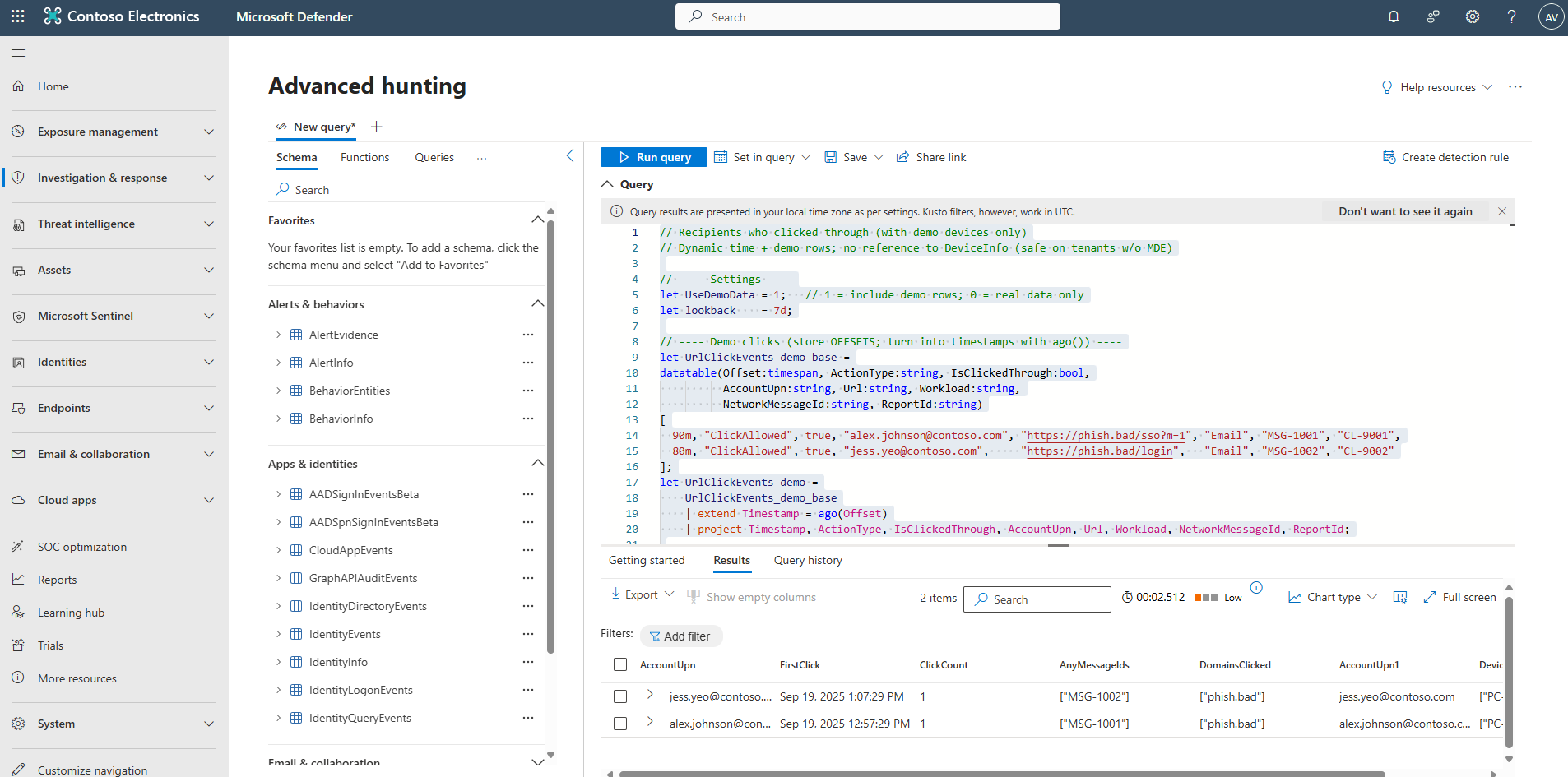
This KQL joins URL click, email, and device process signals to build a timeline of user activity within ±2h of the phish click.
Identify:
- Who clicked (AccountUpn)
- Where (DeviceName, IP)
- What executed (powershell, cmd, etc.)